
Carbohydrates Saccharides Structure of Saccharides Composed of monomers
Carbohydrates (Saccharides)

Structure of Saccharides • Composed of monomers with the Empirical Formula CH 2 O • Monomers are distinguished by the #Cs and type of carbonyl group • Monomers exist in a linear or ring-like state • May be isomers like fructose and glucose, same chemical formula but different structures.

Monosaccharides (simple sugars) • all have the formula C 6 H 12 O 6 • Glucose has a ring structure – (glucose is an example)
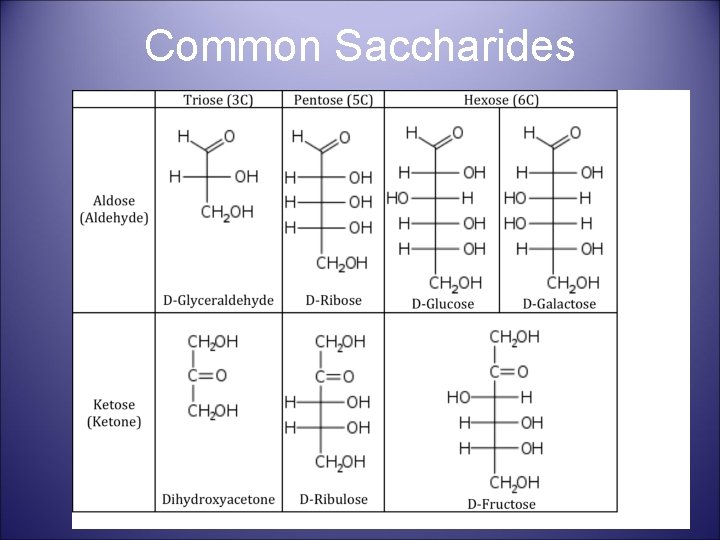
Common Saccharides

Ring State of Carbohydrates • In water monosaccharide's perform a reversible rxn to form ring • One of the OH groups “attack” the carbonyl group to form ring • Ring structure has isomers (same molecular structure, different atomic arrangement) D-glucose Source: http: //en. wikipedia. org/wiki/I mage: Dglucose_color_coded. png α-Glucose Source: http: //en. wikipedia. org/wiki/Image: Alpha-Dglucopyranose-2 D-skeletal. png β-Glucose Source: http: //en. wikipedia. org/wiki/Image: Beta-Dglucopyranose-2 D-skeletal. png
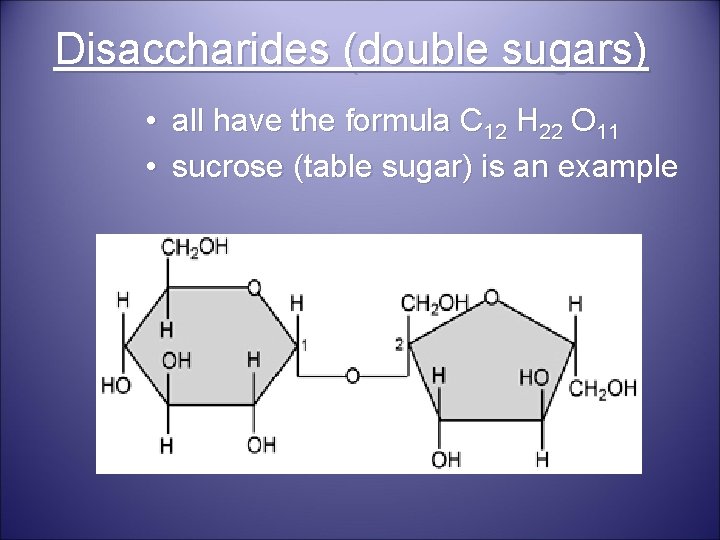
Disaccharides (double sugars) • all have the formula C 12 H 22 O 11 • sucrose (table sugar) is an example

Simple carbohydrates: • Monosaccharides examples fructose (fruits and honey) glucose (photosynthetic product) • Disaccharides examples sucrose (table sugar) lactose (milk) Glucose Fructose Source: http: //en. wikipedia. org/wiki/Image: Glucose_wpmp. png Source: http: //en. wikipedia. org/wiki/Image: Beta-DFructofuranose. svg Lactose Source: http: //en. wikipedia. org/wiki/File: Lactose. svg Sucrose Source: http: //en. wikipedia. org/wiki/Image: Saccharose. svg
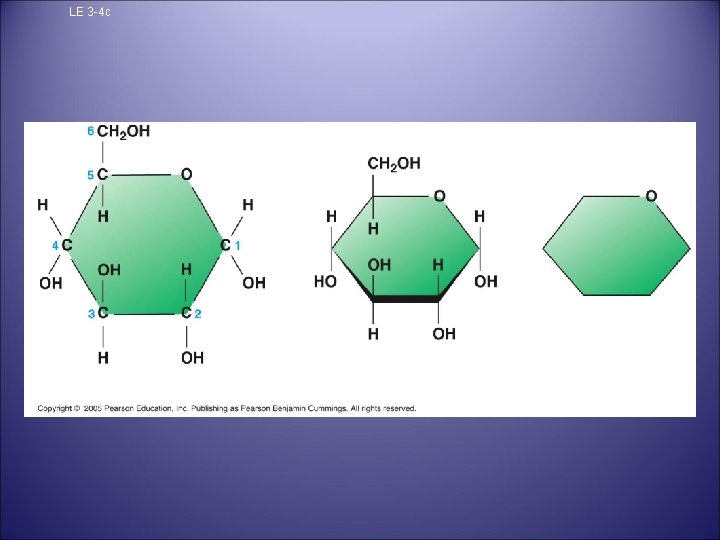
LE 3 -4 c Structural formula Abbreviated structure Simplified structure

Types of Complex carbohydrates: • Polysaccharides (formed by dehydration synthesis of monosaccharides) • Oligosaccharide is a short saccharide chain • Glycosidic bond = bond between saccharide subunits (1, 4 or 1, 6 Glycosidic linkage)
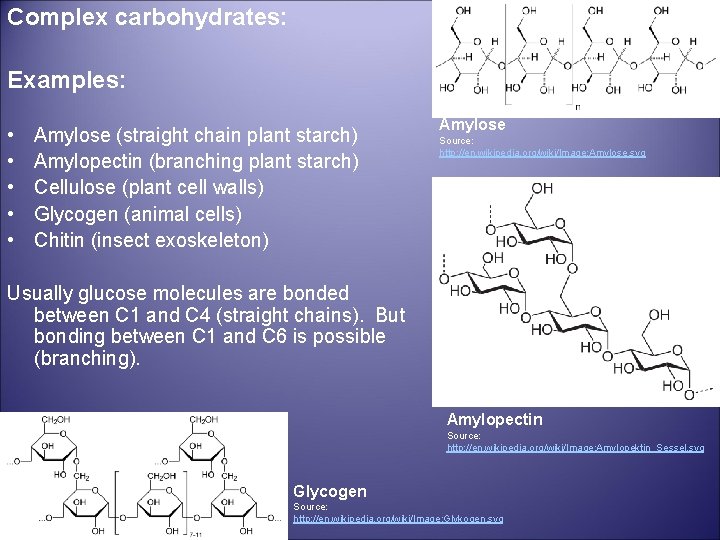
Complex carbohydrates: Examples: • • • Amylose (straight chain plant starch) Amylopectin (branching plant starch) Cellulose (plant cell walls) Glycogen (animal cells) Chitin (insect exoskeleton) Amylose Source: http: //en. wikipedia. org/wiki/Image: Amylose. svg Usually glucose molecules are bonded between C 1 and C 4 (straight chains). But bonding between C 1 and C 6 is possible (branching). Amylopectin Source: http: //en. wikipedia. org/wiki/Image: Amylopektin_Sessel. svg Glycogen Source: http: //en. wikipedia. org/wiki/Image: Glykogen. svg
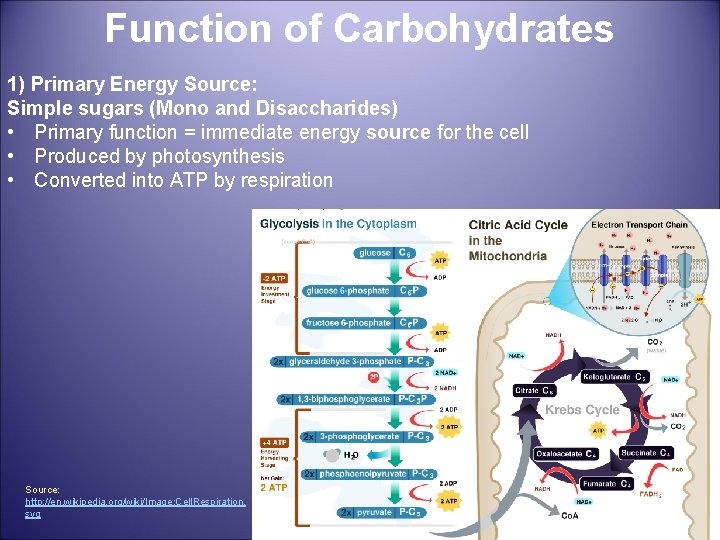
Function of Carbohydrates 1) Primary Energy Source: Simple sugars (Mono and Disaccharides) • Primary function = immediate energy source for the cell • Produced by photosynthesis • Converted into ATP by respiration Source: http: //en. wikipedia. org/wiki/Image: Cell. Respiration. svg
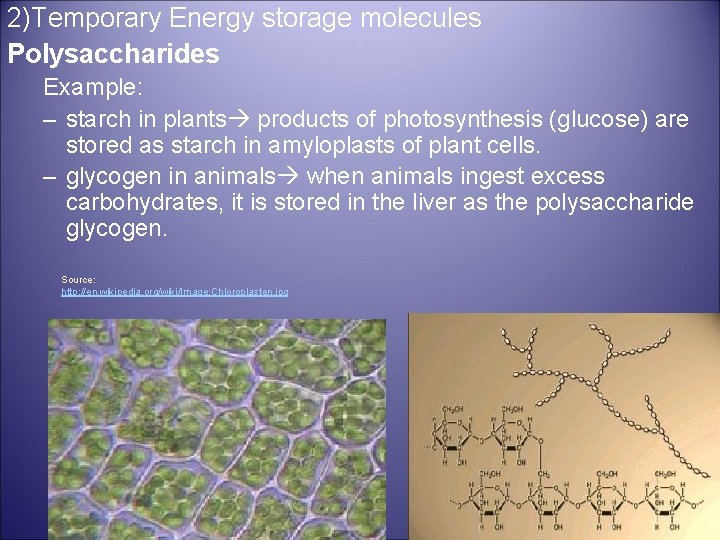
2)Temporary Energy storage molecules Polysaccharides Example: – starch in plants products of photosynthesis (glucose) are stored as starch in amyloplasts of plant cells. – glycogen in animals when animals ingest excess carbohydrates, it is stored in the liver as the polysaccharide glycogen. Source: http: //en. wikipedia. org/wiki/Image: Chloroplasten. jpg
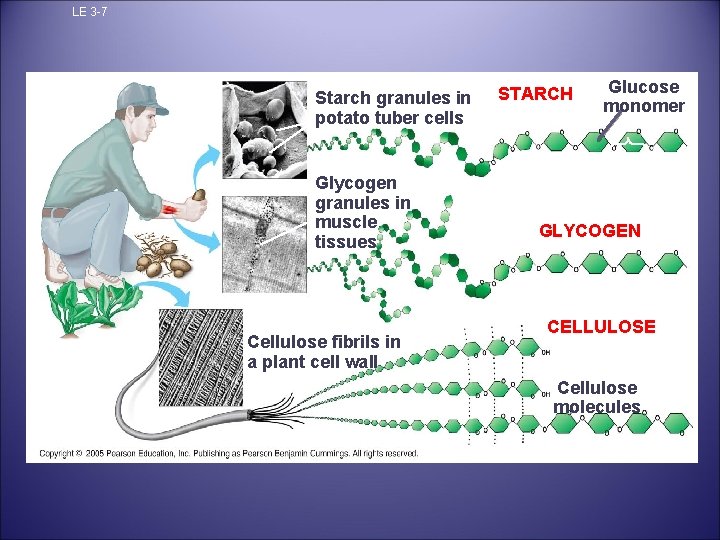
LE 3 -7 Starch granules in potato tuber cells Glycogen granules in muscle tissues Cellulose fibrils in a plant cell wall STARCH Glucose monomer GLYCOGEN CELLULOSE Cellulose molecules
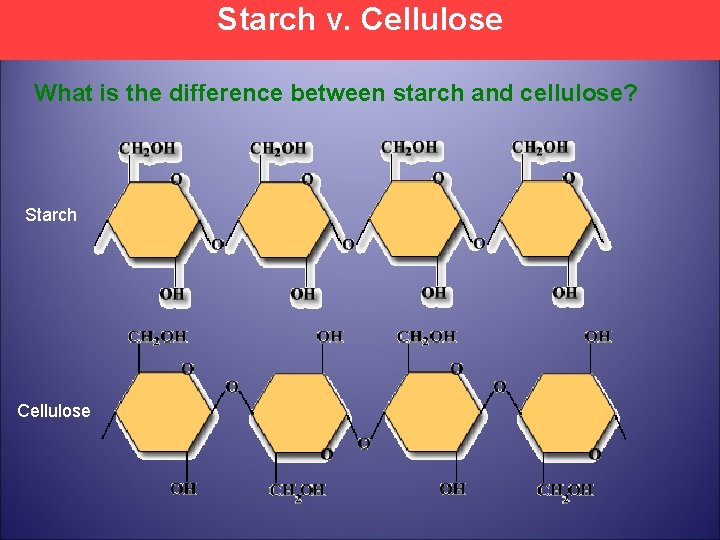
Starch v. Cellulose What is the difference between starch and cellulose? Starch Cellulose
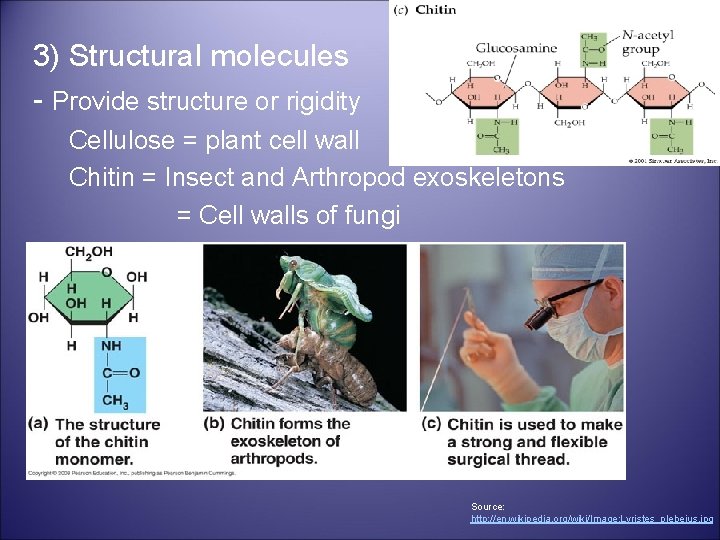
3) Structural molecules - Provide structure or rigidity Cellulose = plant cell wall Chitin = Insect and Arthropod exoskeletons = Cell walls of fungi Source: http: //en. wikipedia. org/wiki/Image: Lyristes_plebejus. jpg
Carb Functions Continued 4) Carbohydrates in Membranes • Carbohydrates in membrane act as cell surface markers, cell-to-cell signaling, cell anchoring • Carbohydrates can be attached to other molecules embedded in cell membranes • “Glyco-” is term for such molecules (e. g. glycoprotein = carbohydrate attached to protein)
Did you Know? Cellulose is the most common organic compound on earth? • 33% of all plant matter • 90% of cotton • 50% of wood
How are complex carbohydrates formed and broken down?
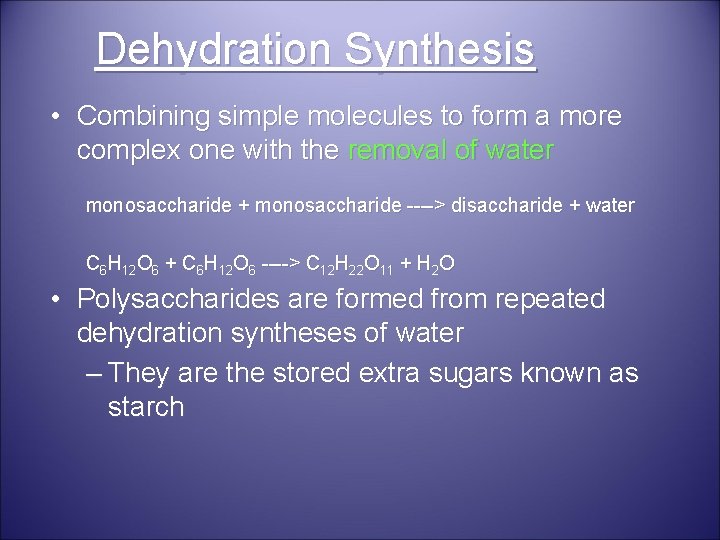
Dehydration Synthesis • Combining simple molecules to form a more complex one with the removal of water monosaccharide + monosaccharide ----> disaccharide + water C 6 H 12 O 6 + C 6 H 12 O 6 ----> C 12 H 22 O 11 + H 2 O • Polysaccharides are formed from repeated dehydration syntheses of water – They are the stored extra sugars known as starch
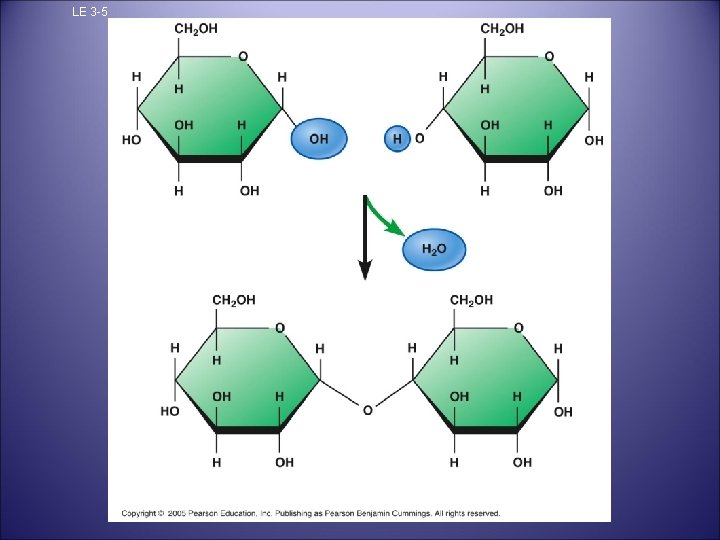
LE 3 -5 Glucose Maltose
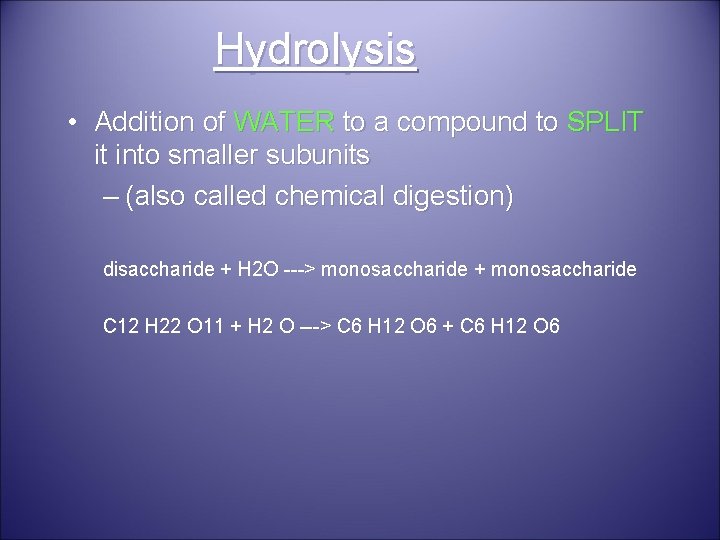
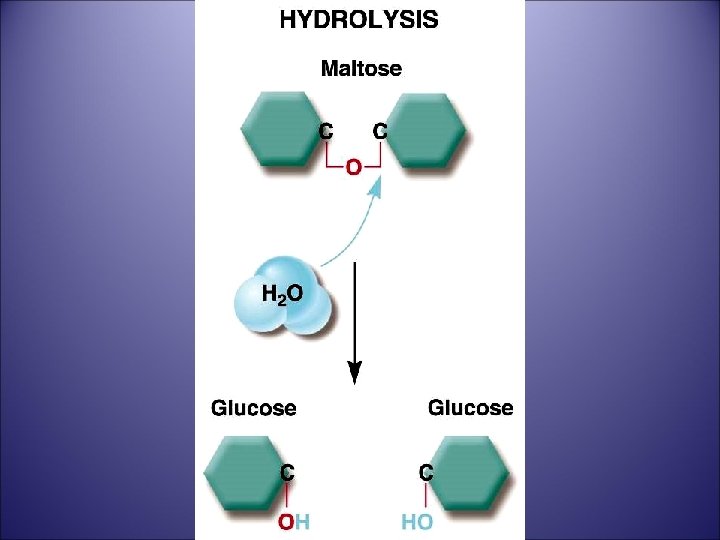
Hydrolysis • Addition of WATER to a compound to SPLIT it into smaller subunits – (also called chemical digestion) disaccharide + H 2 O ---> monosaccharide + monosaccharide C 12 H 22 O 11 + H 2 O ---> C 6 H 12 O 6 + C 6 H 12 O 6
- Slides: 22