
CARBOHYDRATES CnH 2 Om Monosaccharides have ONE sugar
CARBOHYDRATES Cn(H 2 O)m Monosaccharides have ONE sugar: eg. glucose, fructose, ribose Disaccharides have TWO sugars: eg. sucrose, maltose, lactose Oligosaccharides have a FEW sugars: eg. raffinose Polysaccharides have MANY sugars: eg. starch, cellulose Carbohydrates store water as well as being an energy source C. Bohne/D. Berg Copyright 2011 -19 – For use in the Uvic Chem 400 course only – Spring 2019 1
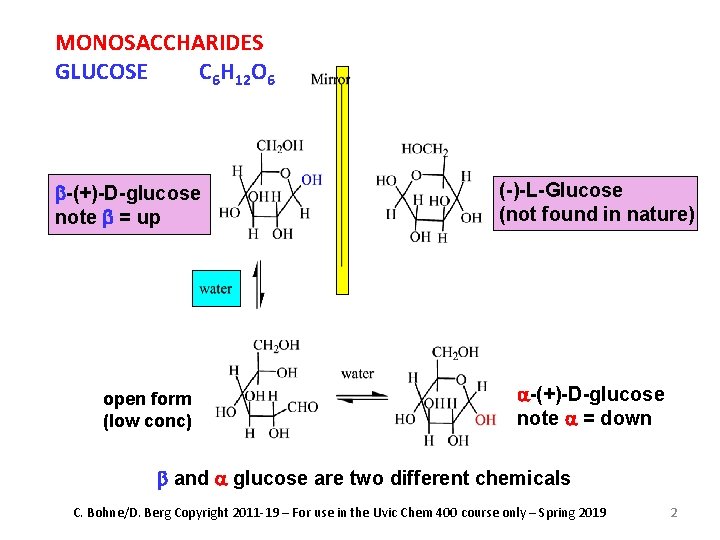
MONOSACCHARIDES GLUCOSE C 6 H 12 O 6 b-(+)-D-glucose note b = up open form (low conc) (-)-L-Glucose (not found in nature) a-(+)-D-glucose note a = down b and a glucose are two different chemicals C. Bohne/D. Berg Copyright 2011 -19 – For use in the Uvic Chem 400 course only – Spring 2019 2
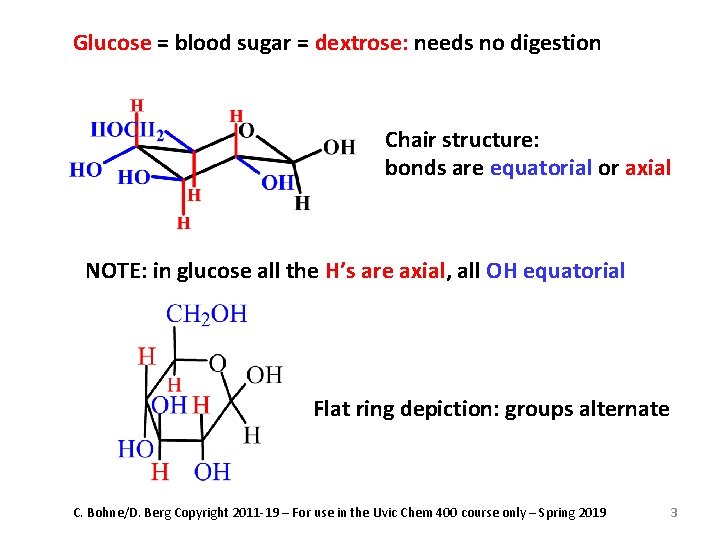
Glucose = blood sugar = dextrose: needs no digestion Chair structure: bonds are equatorial or axial NOTE: in glucose all the H’s are axial, all OH equatorial Flat ring depiction: groups alternate C. Bohne/D. Berg Copyright 2011 -19 – For use in the Uvic Chem 400 course only – Spring 2019 3
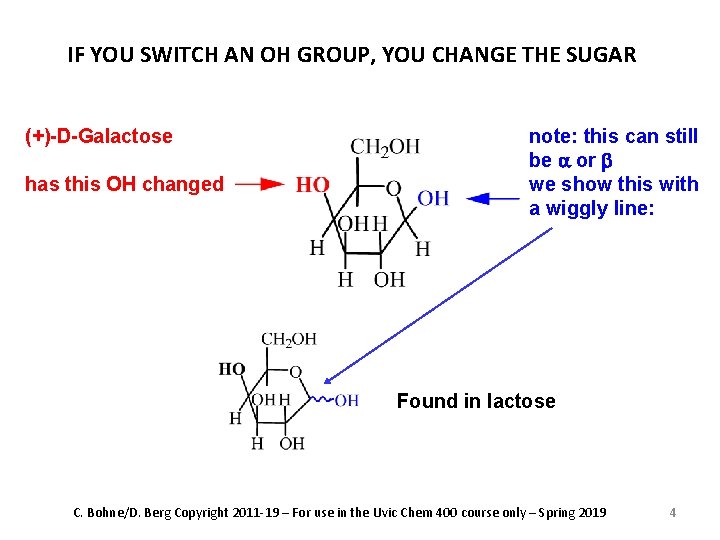
IF YOU SWITCH AN OH GROUP, YOU CHANGE THE SUGAR (+)-D-Galactose has this OH changed note: this can still be a or b we show this with a wiggly line: Found in lactose C. Bohne/D. Berg Copyright 2011 -19 – For use in the Uvic Chem 400 course only – Spring 2019 4
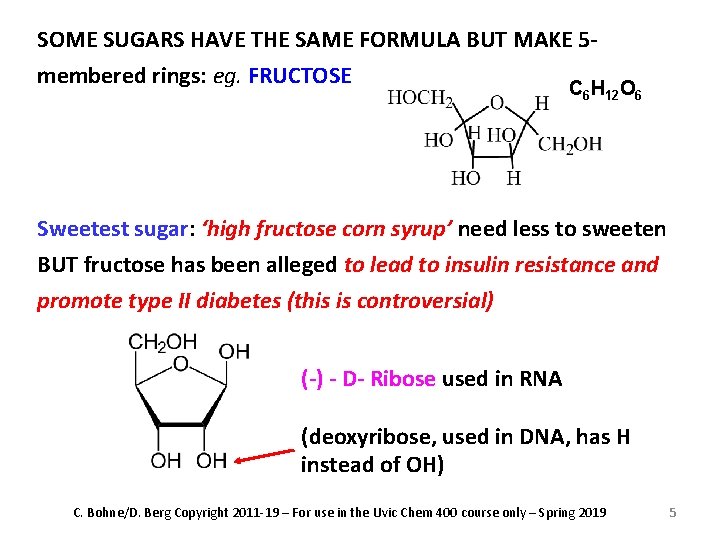
SOME SUGARS HAVE THE SAME FORMULA BUT MAKE 5 membered rings: eg. FRUCTOSE C 6 H 12 O 6 Sweetest sugar: ‘high fructose corn syrup’ need less to sweeten BUT fructose has been alleged to lead to insulin resistance and promote type II diabetes (this is controversial) (-) - D- Ribose used in RNA (deoxyribose, used in DNA, has H instead of OH) C. Bohne/D. Berg Copyright 2011 -19 – For use in the Uvic Chem 400 course only – Spring 2019 5
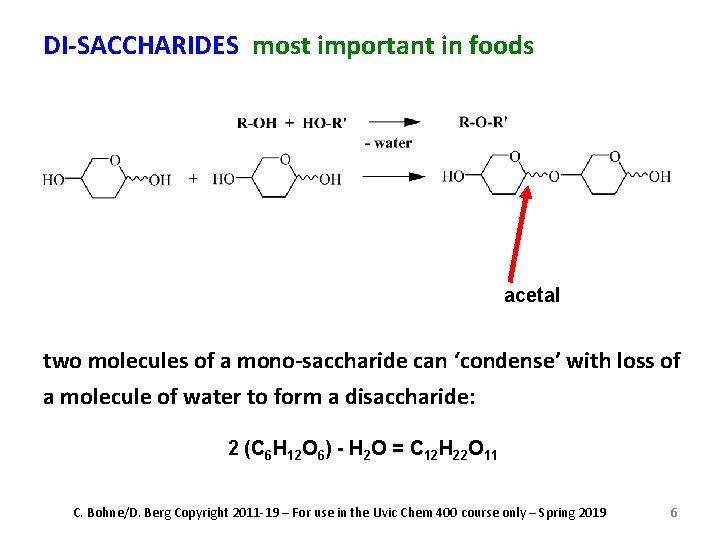
DI-SACCHARIDES most important in foods acetal two molecules of a mono-saccharide can ‘condense’ with loss of a molecule of water to form a disaccharide: 2 (C 6 H 12 O 6) - H 2 O = C 12 H 22 O 11 C. Bohne/D. Berg Copyright 2011 -19 – For use in the Uvic Chem 400 course only – Spring 2019 6
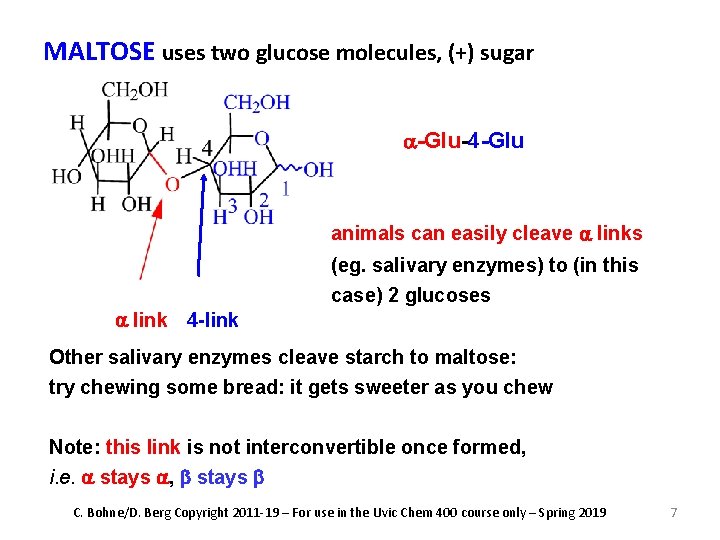
MALTOSE uses two glucose molecules, (+) sugar a-Glu-4 -Glu animals can easily cleave a links (eg. salivary enzymes) to (in this case) 2 glucoses a link 4 -link Other salivary enzymes cleave starch to maltose: try chewing some bread: it gets sweeter as you chew Note: this link is not interconvertible once formed, i. e. a stays a, b stays b C. Bohne/D. Berg Copyright 2011 -19 – For use in the Uvic Chem 400 course only – Spring 2019 7
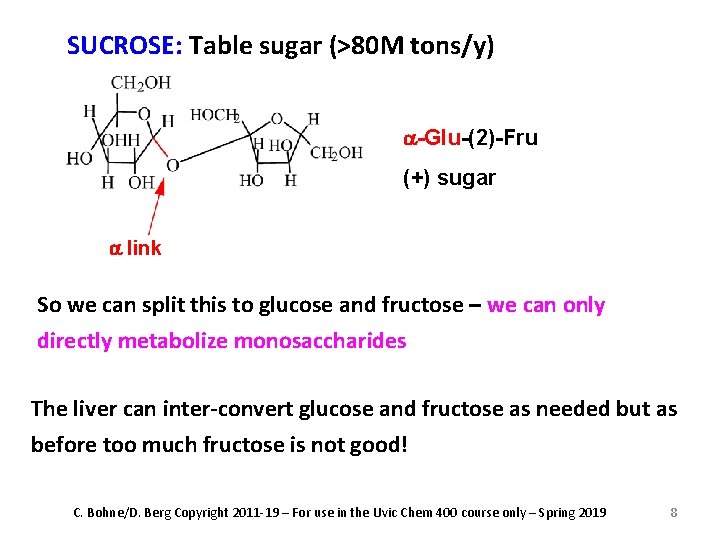
SUCROSE: Table sugar (>80 M tons/y) a-Glu-(2)-Fru (+) sugar a link So we can split this to glucose and fructose – we can only directly metabolize monosaccharides The liver can inter-convert glucose and fructose as needed but as before too much fructose is not good! C. Bohne/D. Berg Copyright 2011 -19 – For use in the Uvic Chem 400 course only – Spring 2019 8
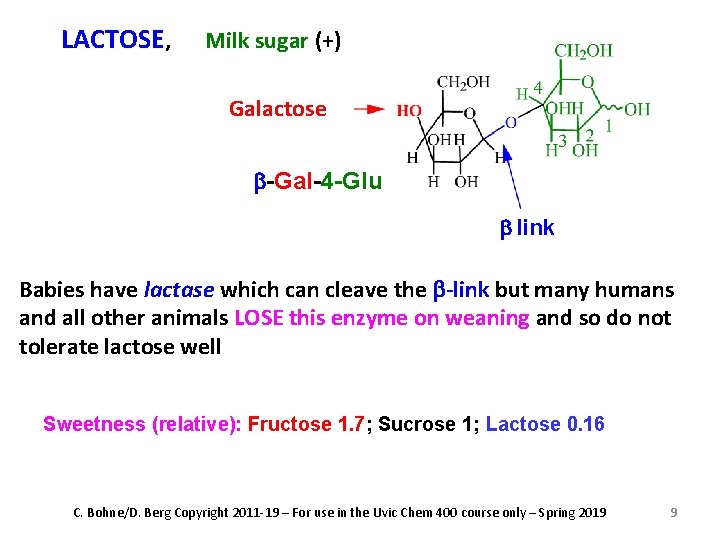
LACTOSE, Milk sugar (+) Galactose b-Gal-4 -Glu b link Babies have lactase which can cleave the b-link but many humans and all other animals LOSE this enzyme on weaning and so do not tolerate lactose well Sweetness (relative): Fructose 1. 7; Sucrose 1; Lactose 0. 16 C. Bohne/D. Berg Copyright 2011 -19 – For use in the Uvic Chem 400 course only – Spring 2019 9
![POLYSACCHARIDES STARCH, Amylose = water soluble portion of starch (20 -25%) AMYLOSE -[a-Glu-4 -Glu-]n.](http://slidetodoc.com/presentation_image_h2/451ff5322667555ef133045d41fe2440/image-10.jpg "POLYSACCHARIDES STARCH, Amylose = water soluble portion of starch (20 -25%) AMYLOSE -[a-Glu-4 -Glu-]n.")
POLYSACCHARIDES STARCH, Amylose = water soluble portion of starch (20 -25%) AMYLOSE -[a-Glu-4 -Glu-]n. ALL a-links n = 15 -250 rest is AMYLOPECTIN 1000 -5000 Glu units (3 D) cross-linked using the CH 2 OH C. Bohne/D. Berg Copyright 2011 -19 – For use in the Uvic Chem 400 course only – Spring 2019 10
Plants store STARCH for energy usage (plus a lot of water - they do not have to move!) Animals use GLYCOGEN: stored in liver and muscles: branched/cross-linked but a-links for fast breakdown to glucose Starch cannot pass thru intestine, so to be absorbed, it is broken down by maltase into MALTOSE Amylose when heated & cooled sets to gel: PUDDINGS, CANDIES Amylopectin goes more pasty: GRAVIES, SAUCES C. Bohne/D. Berg Copyright 2011 -19 – For use in the Uvic Chem 400 course only – Spring 2019 11
![CELLULOSE -[-b-Glu-4 -Glu-]n- all b-links Most animals lack cellobiase which can cleave the b-links](http://slidetodoc.com/presentation_image_h2/451ff5322667555ef133045d41fe2440/image-12.jpg "CELLULOSE -[-b-Glu-4 -Glu-]n- all b-links Most animals lack cellobiase which can cleave the b-links")
CELLULOSE -[-b-Glu-4 -Glu-]n- all b-links Most animals lack cellobiase which can cleave the b-links Cows, goats, horses, termites, etc. have bacteria in their rumens (2 nd stomach) which have the enzymes to cleave cellulose C. Bohne/D. Berg Copyright 2011 -19 – For use in the Uvic Chem 400 course only – Spring 2019 12

SWEETENERS Lead acetate is sweet but toxic!! Pb(OCOCH 3)2 - sugar of lead Not much logic as to why things taste sweet SACCHARIN discovered 1879! 300 x sweeter than sucrose C. Bohne/D. Berg Copyright 2011 -19 – For use in the Uvic Chem 400 course only – Spring 2019 13
‘Sweet & Low’ (US): granulated sugar substitute dextrose (3. 6%), saccharin (36 mg per 1 g packet), cream of tartar and calcium silicate (an anti-caking agent) Banned in Canada since 1977 for causing cancer in rats BUT Study used saccharin as 5% of diet (equiv to 800 cans/pop per day!) Use was >200, 000 kg/year in Canada in soft drinks at time of ban Not banned in US (already had banned cyclamates) Some get a very bitter after-taste ! C. Bohne/D. Berg Copyright 2011 -19 – For use in the Uvic Chem 400 course only – Spring 2019 14
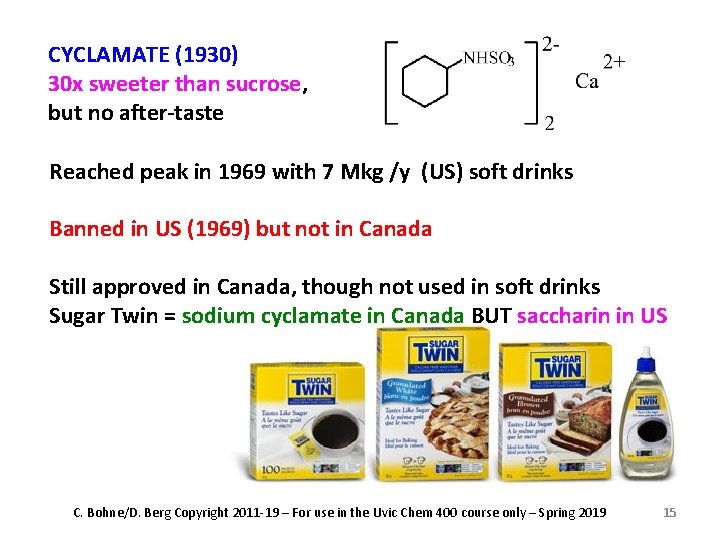
CYCLAMATE (1930) 30 x sweeter than sucrose, but no after-taste Reached peak in 1969 with 7 Mkg /y (US) soft drinks Banned in US (1969) but not in Canada Still approved in Canada, though not used in soft drinks Sugar Twin = sodium cyclamate in Canada BUT saccharin in US C. Bohne/D. Berg Copyright 2011 -19 – For use in the Uvic Chem 400 course only – Spring 2019 15
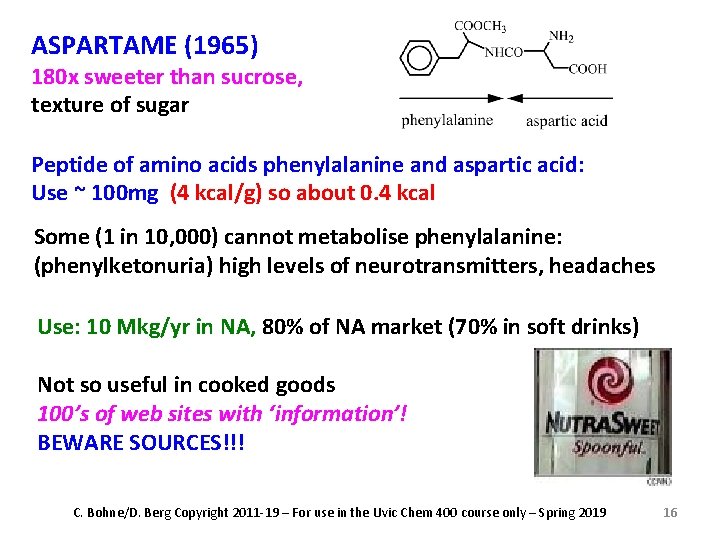
ASPARTAME (1965) 180 x sweeter than sucrose, texture of sugar Peptide of amino acids phenylalanine and aspartic acid: Use ~ 100 mg (4 kcal/g) so about 0. 4 kcal Some (1 in 10, 000) cannot metabolise phenylalanine: (phenylketonuria) high levels of neurotransmitters, headaches Use: 10 Mkg/yr in NA, 80% of NA market (70% in soft drinks) Not so useful in cooked goods 100’s of web sites with ‘information’! BEWARE SOURCES!!! C. Bohne/D. Berg Copyright 2011 -19 – For use in the Uvic Chem 400 course only – Spring 2019 16
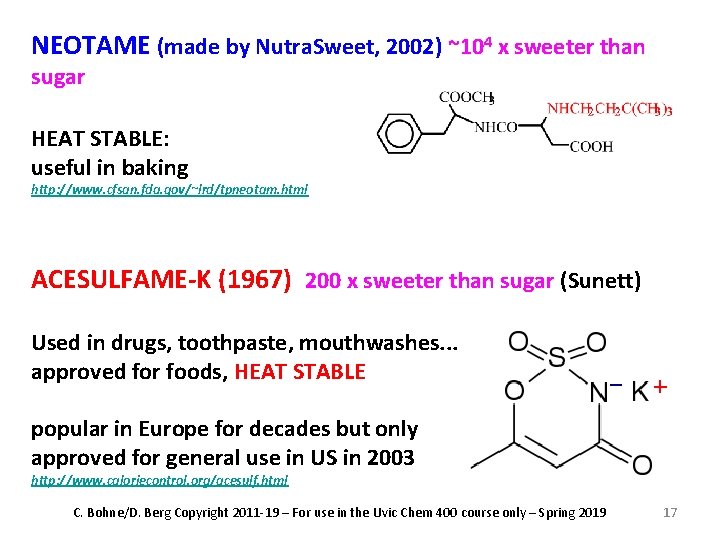
NEOTAME (made by Nutra. Sweet, 2002) ~104 x sweeter than sugar HEAT STABLE: useful in baking http: //www. cfsan. fda. gov/~lrd/tpneotam. html ACESULFAME-K (1967) 200 x sweeter than sugar (Sunett) Used in drugs, toothpaste, mouthwashes. . . approved for foods, HEAT STABLE popular in Europe for decades but only approved for general use in US in 2003 http: //www. caloriecontrol. org/acesulf. html C. Bohne/D. Berg Copyright 2011 -19 – For use in the Uvic Chem 400 course only – Spring 2019 17
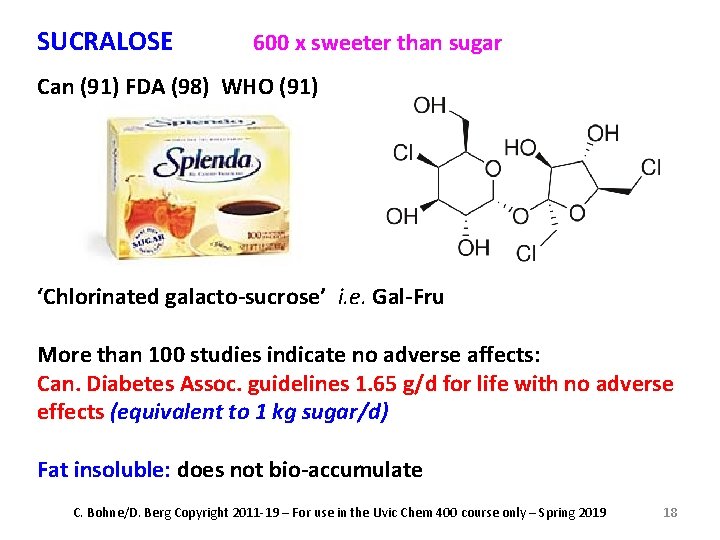
SUCRALOSE 600 x sweeter than sugar Can (91) FDA (98) WHO (91) ‘Chlorinated galacto-sucrose’ i. e. Gal-Fru More than 100 studies indicate no adverse affects: Can. Diabetes Assoc. guidelines 1. 65 g/d for life with no adverse effects (equivalent to 1 kg sugar/d) Fat insoluble: does not bio-accumulate C. Bohne/D. Berg Copyright 2011 -19 – For use in the Uvic Chem 400 course only – Spring 2019 18
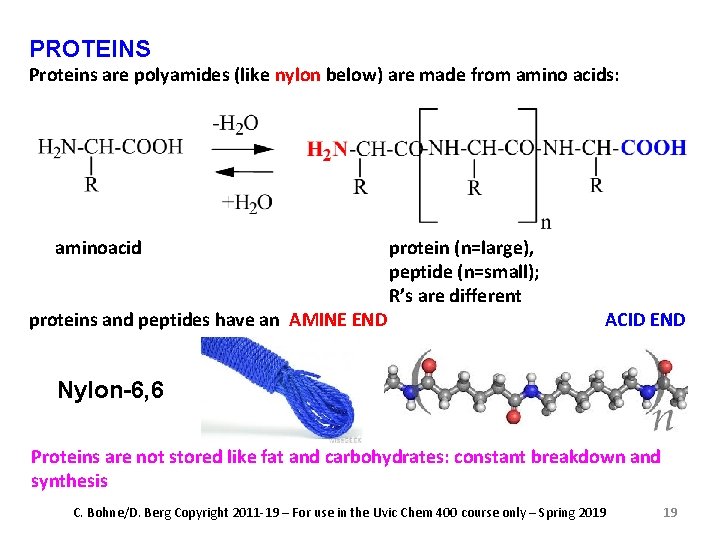
PROTEINS Proteins are polyamides (like nylon below) are made from amino acids: aminoacid proteins and peptides have an AMINE END protein (n=large), peptide (n=small); R’s are different ACID END Nylon-6, 6 Proteins are not stored like fat and carbohydrates: constant breakdown and synthesis C. Bohne/D. Berg Copyright 2011 -19 – For use in the Uvic Chem 400 course only – Spring 2019 19
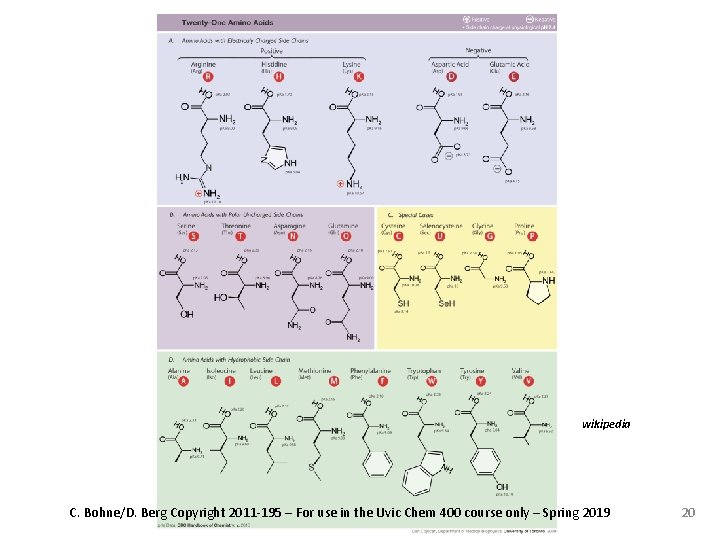
wikipedia C. Bohne/D. Berg Copyright 2011 -195 – For use in the Uvic Chem 400 course only – Spring 2019 20
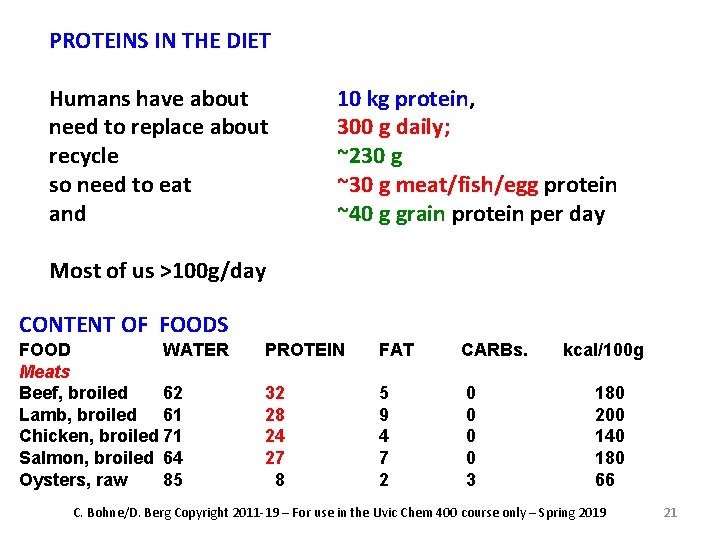
PROTEINS IN THE DIET Humans have about need to replace about recycle so need to eat and 10 kg protein, 300 g daily; ~230 g ~30 g meat/fish/egg protein ~40 g grain protein per day Most of us >100 g/day CONTENT OF FOODS FOOD WATER Meats Beef, broiled 62 Lamb, broiled 61 Chicken, broiled 71 Salmon, broiled 64 Oysters, raw 85 PROTEIN FAT CARBs. 32 28 24 27 8 5 9 4 7 2 0 0 3 kcal/100 g 180 200 140 180 66 C. Bohne/D. Berg Copyright 2011 -19 – For use in the Uvic Chem 400 course only – Spring 2019 21
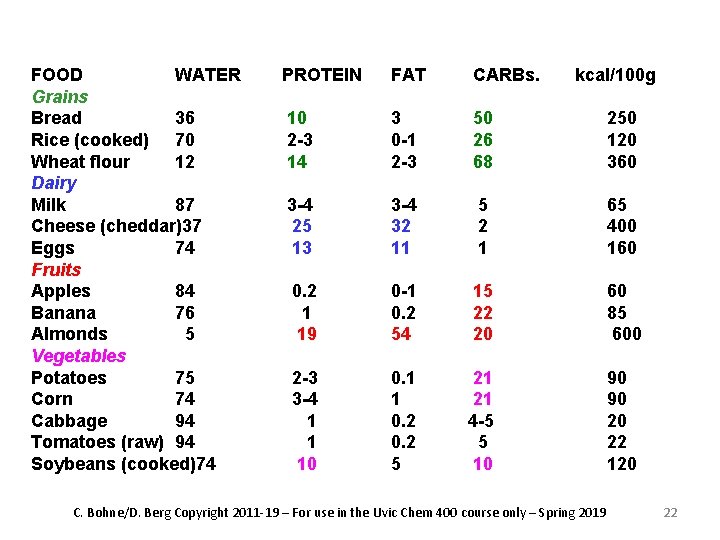
FOOD WATER Grains Bread 36 Rice (cooked) 70 Wheat flour 12 Dairy Milk 87 Cheese (cheddar)37 Eggs 74 Fruits Apples 84 Banana 76 Almonds 5 Vegetables Potatoes 75 Corn 74 Cabbage 94 Tomatoes (raw) 94 Soybeans (cooked)74 PROTEIN FAT CARBs. kcal/100 g 10 2 -3 14 3 0 -1 2 -3 50 26 68 250 120 360 3 -4 25 13 3 -4 32 11 5 2 1 65 400 160 0. 2 1 19 0 -1 0. 2 54 15 22 20 60 85 600 2 -3 3 -4 1 1 10 0. 1 1 0. 2 5 21 21 4 -5 5 10 90 90 20 22 120 C. Bohne/D. Berg Copyright 2011 -19 – For use in the Uvic Chem 400 course only – Spring 2019 22
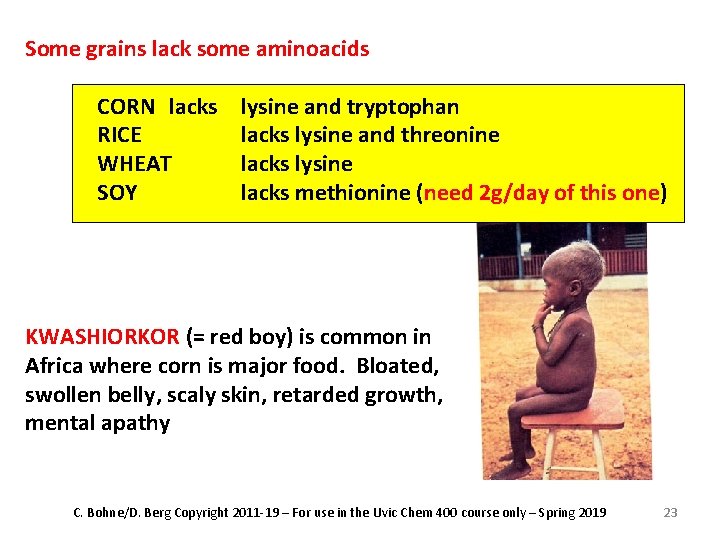
Some grains lack some aminoacids CORN lacks RICE WHEAT SOY lysine and tryptophan lacks lysine and threonine lacks lysine lacks methionine (need 2 g/day of this one) KWASHIORKOR (= red boy) is common in Africa where corn is major food. Bloated, swollen belly, scaly skin, retarded growth, mental apathy C. Bohne/D. Berg Copyright 2011 -19 – For use in the Uvic Chem 400 course only – Spring 2019 23
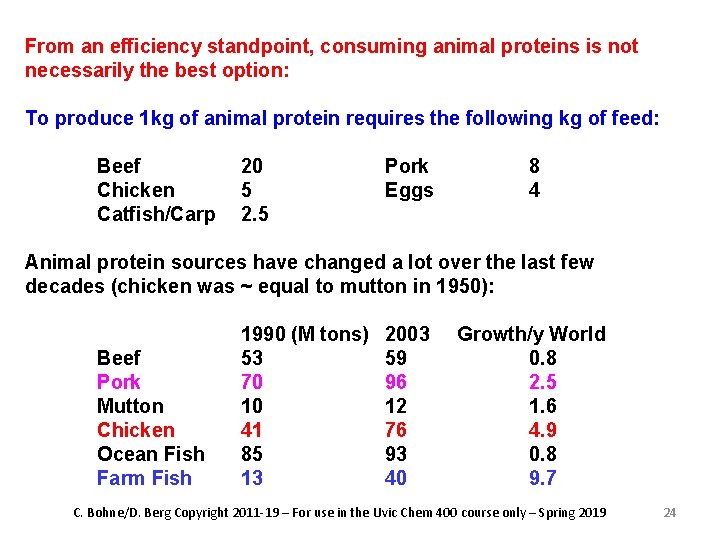
From an efficiency standpoint, consuming animal proteins is not necessarily the best option: To produce 1 kg of animal protein requires the following kg of feed: Beef Chicken Catfish/Carp 20 5 2. 5 Pork Eggs 8 4 Animal protein sources have changed a lot over the last few decades (chicken was ~ equal to mutton in 1950): Beef Pork Mutton Chicken Ocean Fish Farm Fish 1990 (M tons) 53 70 10 41 85 13 2003 59 96 12 76 93 40 Growth/y World 0. 8 2. 5 1. 6 4. 9 0. 8 9. 7 C. Bohne/D. Berg Copyright 2011 -19 – For use in the Uvic Chem 400 course only – Spring 2019 24
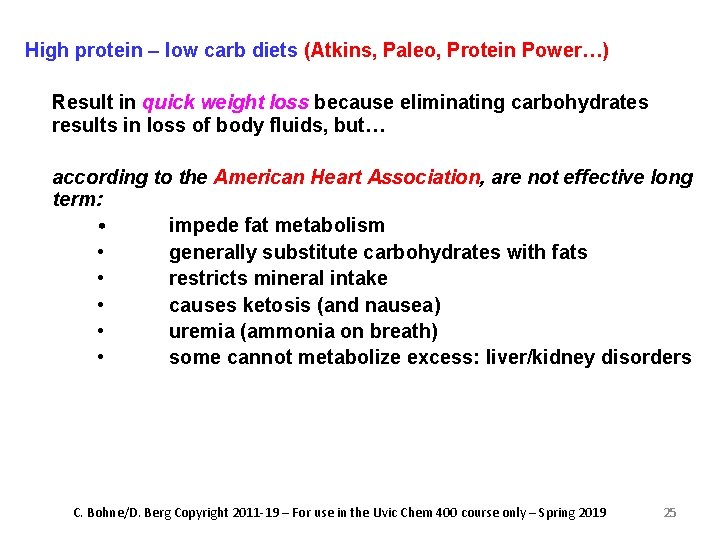
High protein – low carb diets (Atkins, Paleo, Protein Power…) Result in quick weight loss because eliminating carbohydrates results in loss of body fluids, but… according to the American Heart Association, are not effective long term: • impede fat metabolism • generally substitute carbohydrates with fats • restricts mineral intake • causes ketosis (and nausea) • uremia (ammonia on breath) • some cannot metabolize excess: liver/kidney disorders C. Bohne/D. Berg Copyright 2011 -19 – For use in the Uvic Chem 400 course only – Spring 2019 25
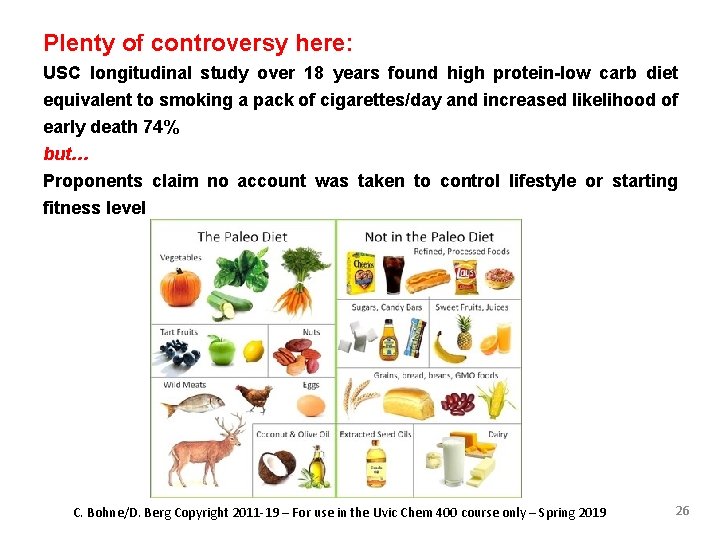
Plenty of controversy here: USC longitudinal study over 18 years found high protein-low carb diet equivalent to smoking a pack of cigarettes/day and increased likelihood of early death 74% but… Proponents claim no account was taken to control lifestyle or starting fitness level C. Bohne/D. Berg Copyright 2011 -19 – For use in the Uvic Chem 400 course only – Spring 2019 26
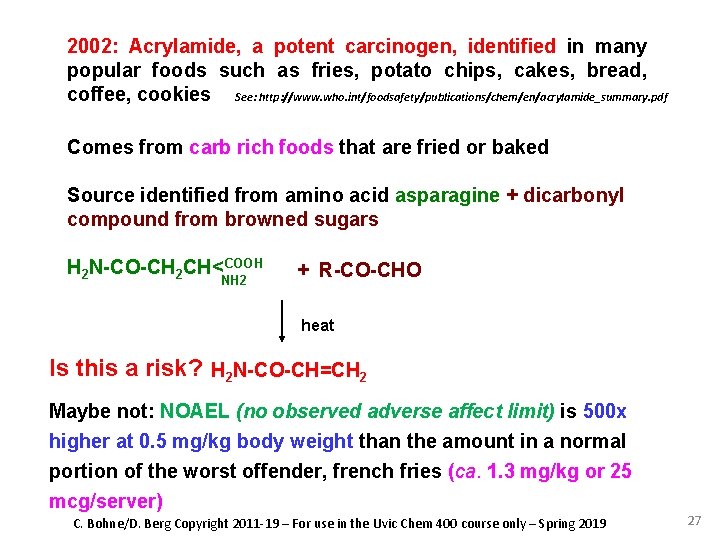
2002: Acrylamide, a potent carcinogen, identified in many popular foods such as fries, potato chips, cakes, bread, coffee, cookies See: http: //www. who. int/foodsafety/publications/chem/en/acrylamide_summary. pdf Comes from carb rich foods that are fried or baked Source identified from amino acid asparagine + dicarbonyl compound from browned sugars H 2 N-CO-CH 2 CH<COOH NH 2 + R-CO-CHO heat Is this a risk? H 2 N-CO-CH=CH 2 Maybe not: NOAEL (no observed adverse affect limit) is 500 x higher at 0. 5 mg/kg body weight than the amount in a normal portion of the worst offender, french fries (ca. 1. 3 mg/kg or 25 mcg/server) C. Bohne/D. Berg Copyright 2011 -19 – For use in the Uvic Chem 400 course only – Spring 2019 27
- Slides: 27