
CARBOHYDRATE RECOMMENDATIONS FOR ATHLETES Lecture content provided by

CARBOHYDRATE RECOMMENDATIONS FOR ATHLETES Lecture content provided by GSSI, a division of Pepsi. Co, Inc. Any opinions or scientific interpretations expressed in this presentation are those of the author and do not necessarily reflect the position or policy of Pepsi. Co, Inc.
Carbohydrate Review § Carbohydrate (CHO) is the primary fuel source for moderate and highintensity exercise § The stored form of CHO in the muscle and liver is called glycogen, supplies most of this fuel and can be manipulated through diet and training § CHO intake throughout the day, and before and after training and competition will help to ensure adequate glycogen stores
What is Glycogen? A starch – long chain of glucose molecules and the storage form of glucose in cells Muscle glycogen is a major energy source for muscle contraction, and is only used by the muscle Liver glycogen helps maintain blood glucose, which can be used by the brain and muscle during exercise Glycogen stores are often a limiting factor for endurance performance. Once stores are low, the athlete will fatigue quickly, "hitting the wall"
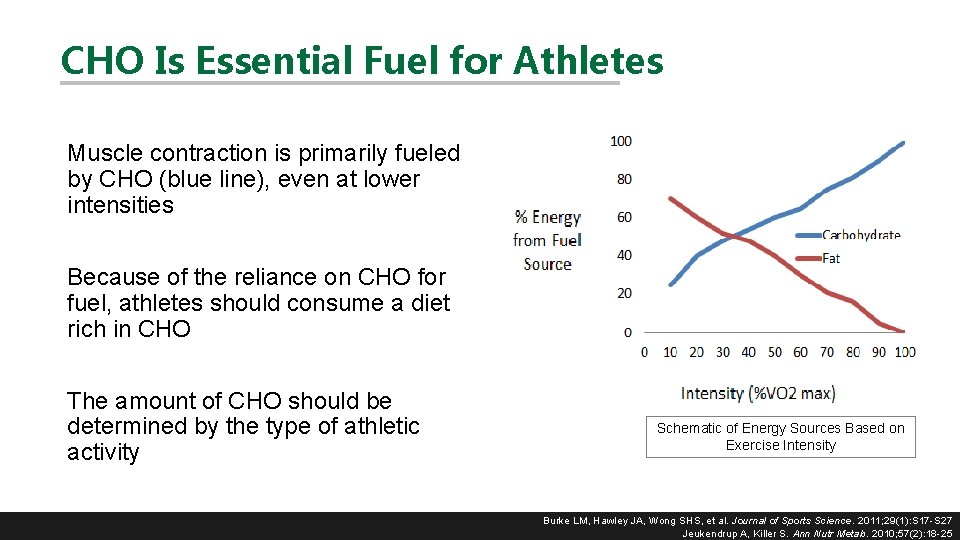
CHO Is Essential Fuel for Athletes Muscle contraction is primarily fueled by CHO (blue line), even at lower intensities Because of the reliance on CHO for fuel, athletes should consume a diet rich in CHO The amount of CHO should be determined by the type of athletic activity Schematic of Energy Sources Based on Exercise Intensity Burke LM, Hawley JA, Wong SHS, et al. Journal of Sports Science. 2011; 29(1): S 17 -S 27 Jeukendrup A, Killer S. Ann Nutr Metab. 2010; 57(2): 18 -25
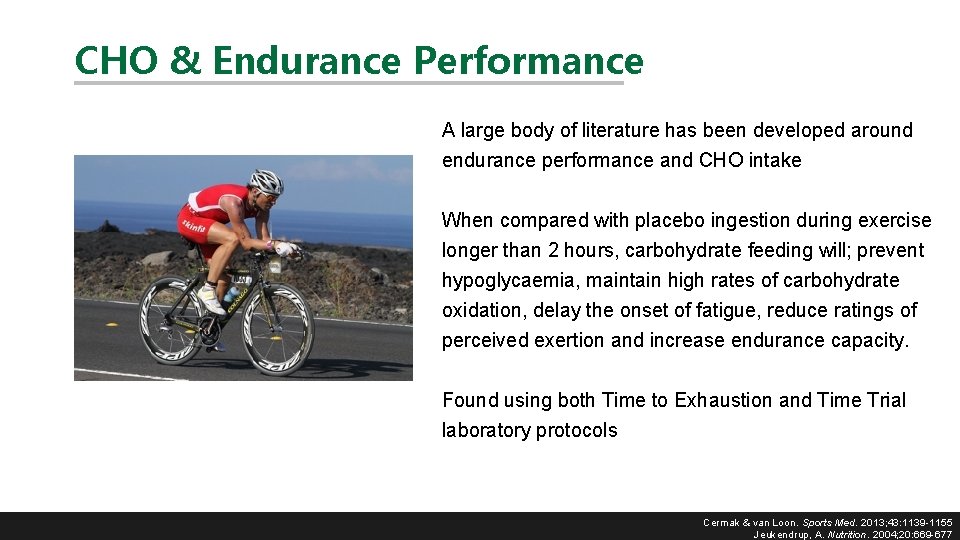
CHO & Endurance Performance A large body of literature has been developed around endurance performance and CHO intake When compared with placebo ingestion during exercise longer than 2 hours, carbohydrate feeding will; prevent hypoglycaemia, maintain high rates of carbohydrate oxidation, delay the onset of fatigue, reduce ratings of perceived exertion and increase endurance capacity. Found using both Time to Exhaustion and Time Trial laboratory protocols Cermak & van Loon. Sports Med. 2013; 43: 1139 -1155 Jeukendrup, A. Nutrition. 2004; 20: 669 -677
CHO & Team Sport Performance in team or intermittent type sports is harder to measure, therefore the impact of CHO harder to quantify While the outcome on skill performance is variable, across studies CHO appears to improve Intermittent High Intensity Exercise Capacity § Sports such as soccer, rugby, field hockey and basketball consistently show greater intermittent high intensity exercise capacity with CHO intake § 10 out of 12 studies found improved intermittent high intensity exercise capacity with CHO vs. placebo Phillips et al. Sports Med. 2011; 41: 559 -585 Baker et al. Nutrients. 2015; 7: 5733 -5763

Carbohydrate and Team Sports Field Sports STRENGTH + POWER ENDURANCE Short distances covered, many short bursts Large distances covered, high speeds Batting Sports Court Sports Lower overall energy demands, long duration Smaller area, shorter duration, tournaments, substitutions CARBOHYDRATES ARE ESSENTIAL Maintain short energy bursts To maintain glycogen stores To maintain blood glucose for attention & decision making To maintain glycogen over time Holway & Spriet. J Sport Sci. 2011; 29(1): S 115 -125

DAILY CARBOHYDRATE RECOMMENDATIO NS FOR ATHLETES
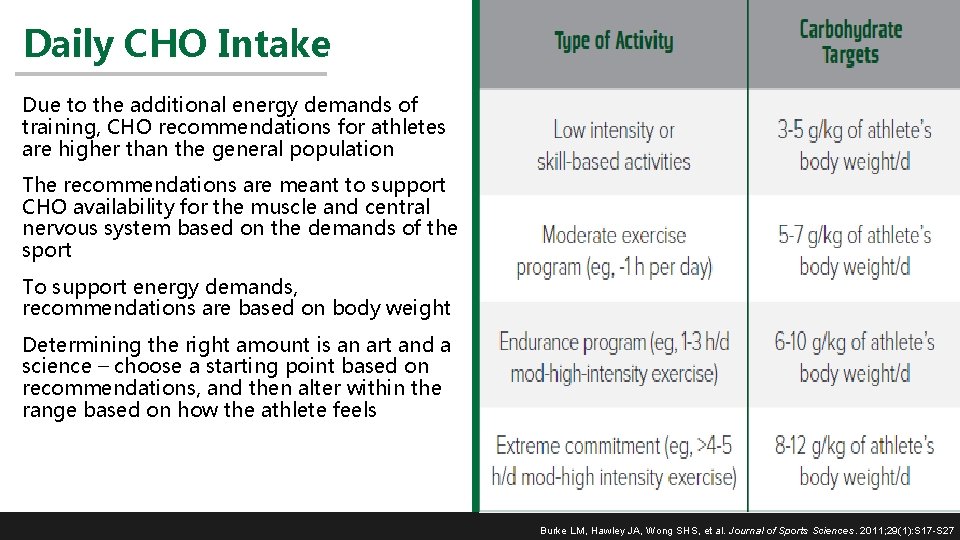
Daily CHO Intake Due to the additional energy demands of training, CHO recommendations for athletes are higher than the general population The recommendations are meant to support CHO availability for the muscle and central nervous system based on the demands of the sport To support energy demands, recommendations are based on body weight Determining the right amount is an art and a science – choose a starting point based on recommendations, and then alter within the range based on how the athlete feels Burke LM, Hawley JA, Wong SHS, et al. Journal of Sports Sciences. 2011; 29(1): S 17 -S 27
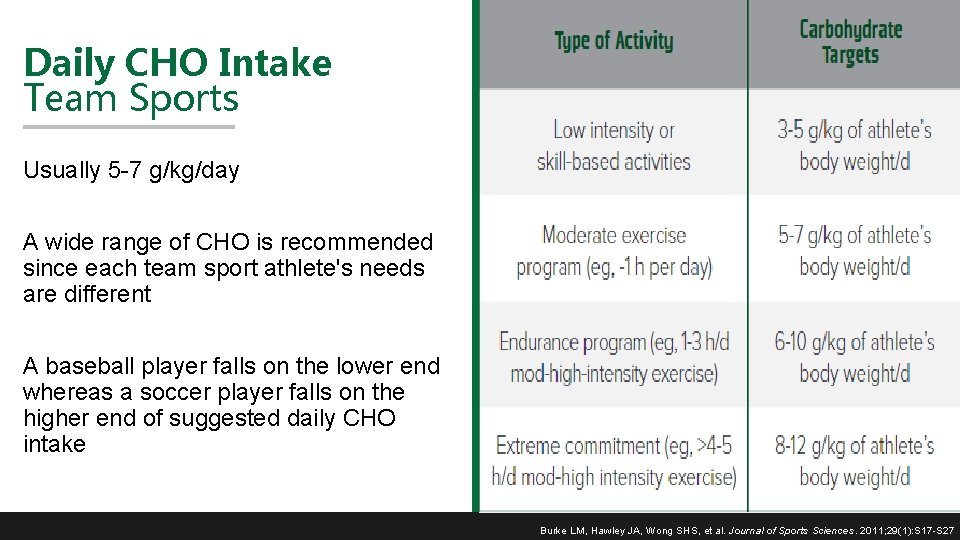
Daily CHO Intake Team Sports Usually 5 -7 g/kg/day A wide range of CHO is recommended since each team sport athlete's needs are different A baseball player falls on the lower end whereas a soccer player falls on the higher end of suggested daily CHO intake Burke LM, Hawley JA, Wong SHS, et al. Journal of Sports Sciences. 2011; 29(1): S 17 -S 27
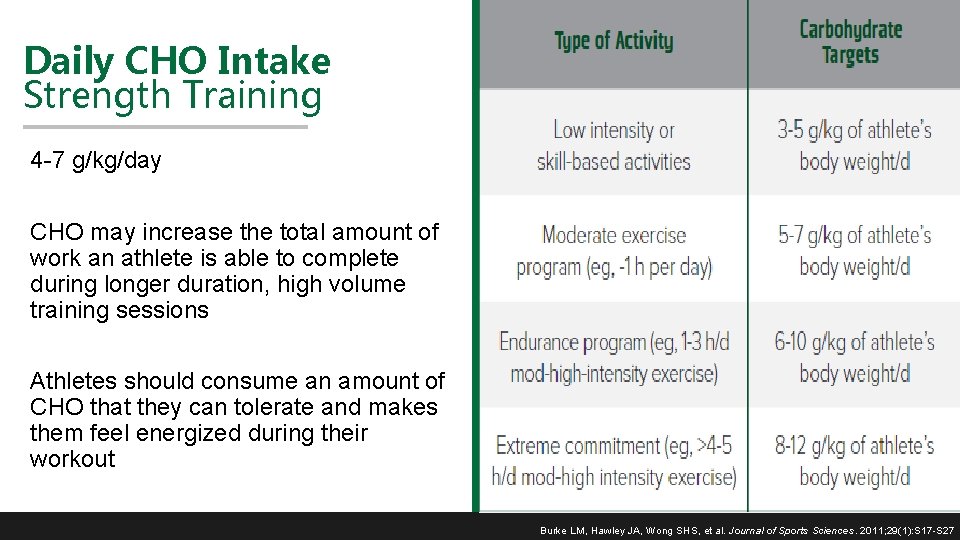
Daily CHO Intake Strength Training 4 -7 g/kg/day CHO may increase the total amount of work an athlete is able to complete during longer duration, high volume training sessions Athletes should consume an amount of CHO that they can tolerate and makes them feel energized during their workout Burke LM, Hawley JA, Wong SHS, et al. Journal of Sports Sciences. 2011; 29(1): S 17 -S 27
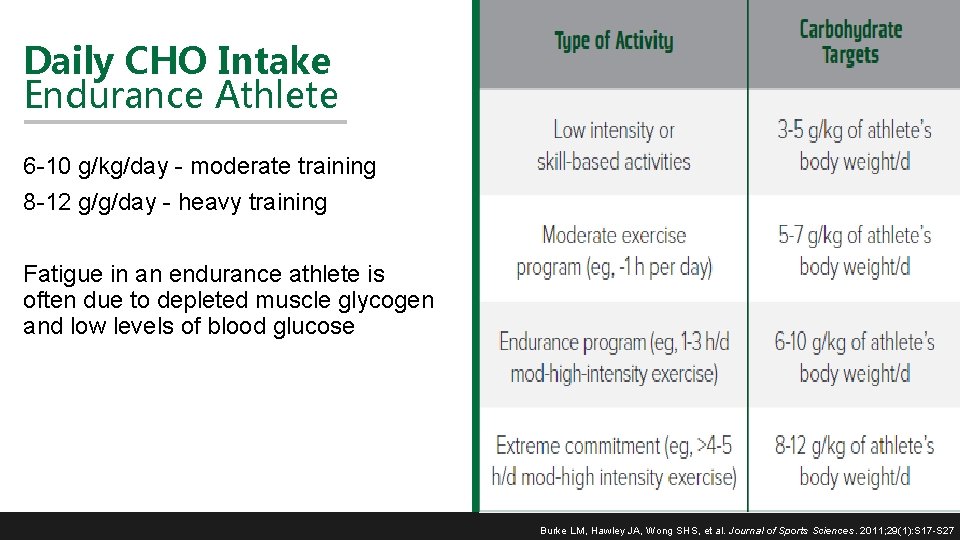
Daily CHO Intake Endurance Athlete 6 -10 g/kg/day - moderate training 8 -12 g/g/day - heavy training Fatigue in an endurance athlete is often due to depleted muscle glycogen and low levels of blood glucose Burke LM, Hawley JA, Wong SHS, et al. Journal of Sports Sciences. 2011; 29(1): S 17 -S 27
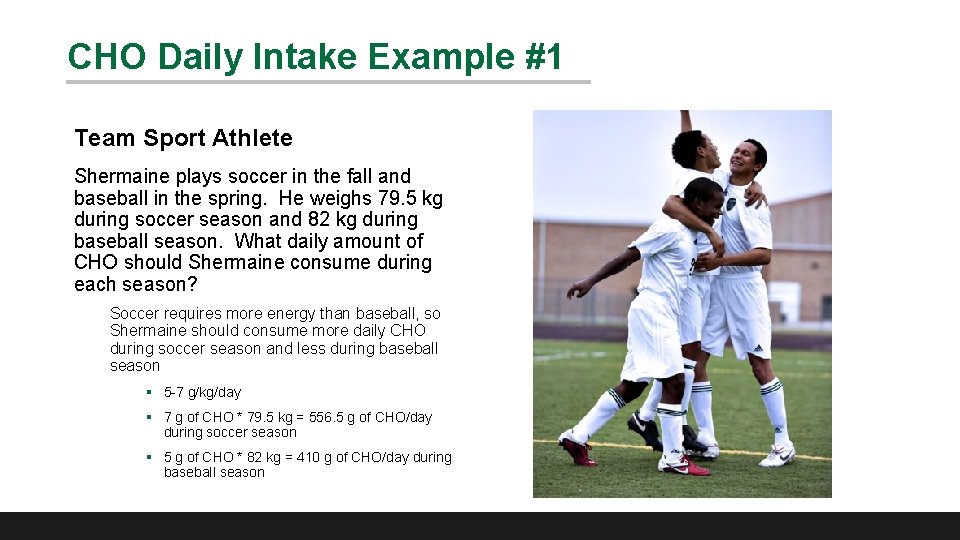
CHO Daily Intake Example #1 Team Sport Athlete Shermaine plays soccer in the fall and baseball in the spring. He weighs 79. 5 kg during soccer season and 82 kg during baseball season. What daily amount of CHO should Shermaine consume during each season? Soccer requires more energy than baseball, so Shermaine should consume more daily CHO during soccer season and less during baseball season § 5 -7 g/kg/day § 7 g of CHO * 79. 5 kg = 556. 5 g of CHO/day during soccer season § 5 g of CHO * 82 kg = 410 g of CHO/day during baseball season
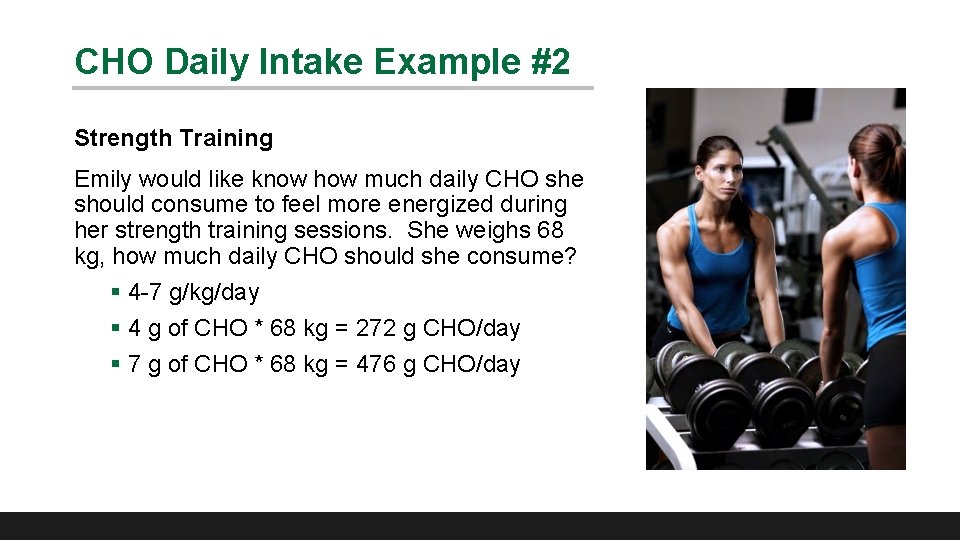
CHO Daily Intake Example #2 Strength Training Emily would like know how much daily CHO she should consume to feel more energized during her strength training sessions. She weighs 68 kg, how much daily CHO should she consume? § 4 -7 g/kg/day § 4 g of CHO * 68 kg = 272 g CHO/day § 7 g of CHO * 68 kg = 476 g CHO/day
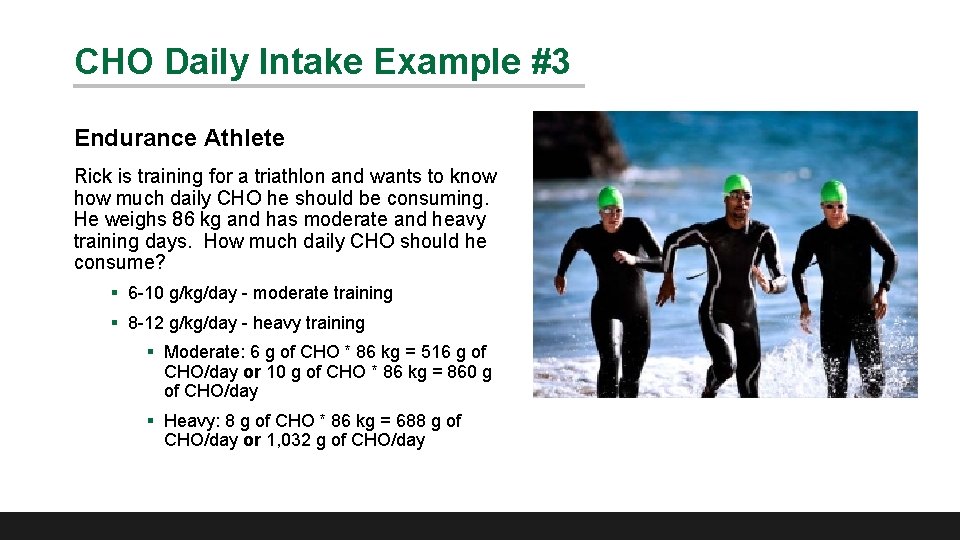
CHO Daily Intake Example #3 Endurance Athlete Rick is training for a triathlon and wants to know how much daily CHO he should be consuming. He weighs 86 kg and has moderate and heavy training days. How much daily CHO should he consume? § 6 -10 g/kg/day - moderate training § 8 -12 g/kg/day - heavy training § Moderate: 6 g of CHO * 86 kg = 516 g of CHO/day or 10 g of CHO * 86 kg = 860 g of CHO/day § Heavy: 8 g of CHO * 86 kg = 688 g of CHO/day or 1, 032 g of CHO/day

CHO BEFORE TRAINING AND COMPETITION
CHO Before Training & Competition 1 -4 Hour Prior to Exercise § 1 -4 hours prior to exercise, the athlete should consume 1 -4 g of CHO/kg of body weight § The choice of where within this range an athlete falls depends on a number of factors including the type of sport/event, goal of the athlete, stomach issues, practice time, and when coach plans pregame meals Burke LM, Hawley JA, Wong SHS, et. al. Journal of Sports Science. 2011; 29(1): S 17 -S 27 Jeukendrup A, Killer S. Ann Nutr Metab. 2010; 57(2): 18 -25
CHO Before Training & Competition <1 Hour Prior to Exercise § Within about an hour of exercise, the amount and type of CHO consumed is based on the athlete’s preference and tolerance § Intake in this window begins to meet the “during” exercise needs of the athlete § Consuming CHO during this time period is particularly important if the athlete cannot or will not consume fuel during their training or competition § Many athletes do well with 25 -30 g of CHO during this time period which is an appropriate amount when considering during exercise recommendations § Research shows even if “rebound hypoglycemia” occurs, it does not impact performance Burke LM, Hawley JA, Wong SHS, et. al. Journal of Sports Science. 2011; 29(1): S 17 -S 27 Jeukendrup A, Killer S. Ann Nutr Metab. 2010; 57(2): 18 -25
CHO Before Training & Competition: Type Athletes should choose carbohydrate-rich foods with minimal fiber, fat, and protein § Fiber, fat, and protein can slow the digestion and absorption process § If consumed too close to the start of exercise, these nutrients can potentially cause gastrointestinal distress during exercise All athletes should practice pre-exercise nutrition strategies to find the best timing and amount that will work for them during competition Burke LM, Hawley JA, Wong SHS, et. al. Journal of Sports Science. 2011; 29(1): S 17 -S 27 Jeukendrup A, Killer S. Ann Nutr Metab. 2010; 57(2): 18 -25
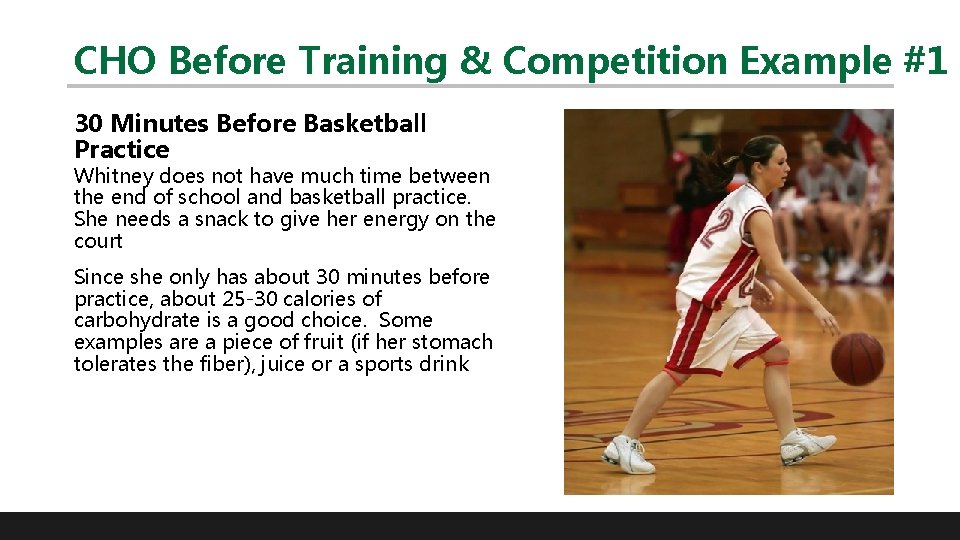
CHO Before Training & Competition Example #1 30 Minutes Before Basketball Practice Whitney does not have much time between the end of school and basketball practice. She needs a snack to give her energy on the court Since she only has about 30 minutes before practice, about 25 -30 calories of carbohydrate is a good choice. Some examples are a piece of fruit (if her stomach tolerates the fiber), juice or a sports drink
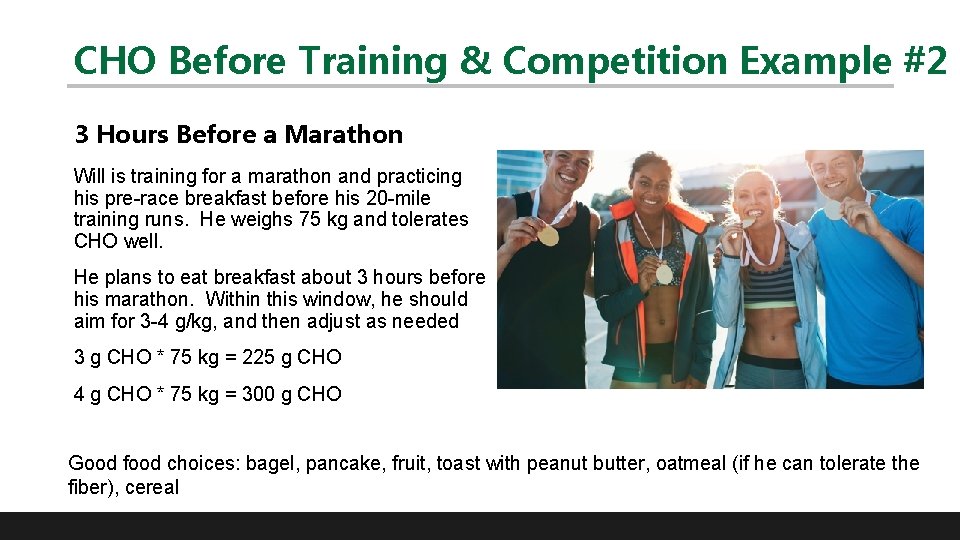
CHO Before Training & Competition Example #2 3 Hours Before a Marathon Will is training for a marathon and practicing his pre-race breakfast before his 20 -mile training runs. He weighs 75 kg and tolerates CHO well. He plans to eat breakfast about 3 hours before his marathon. Within this window, he should aim for 3 -4 g/kg, and then adjust as needed 3 g CHO * 75 kg = 225 g CHO 4 g CHO * 75 kg = 300 g CHO Good food choices: bagel, pancake, fruit, toast with peanut butter, oatmeal (if he can tolerate the fiber), cereal

CHO DURING TRAINING AND COMPETITION
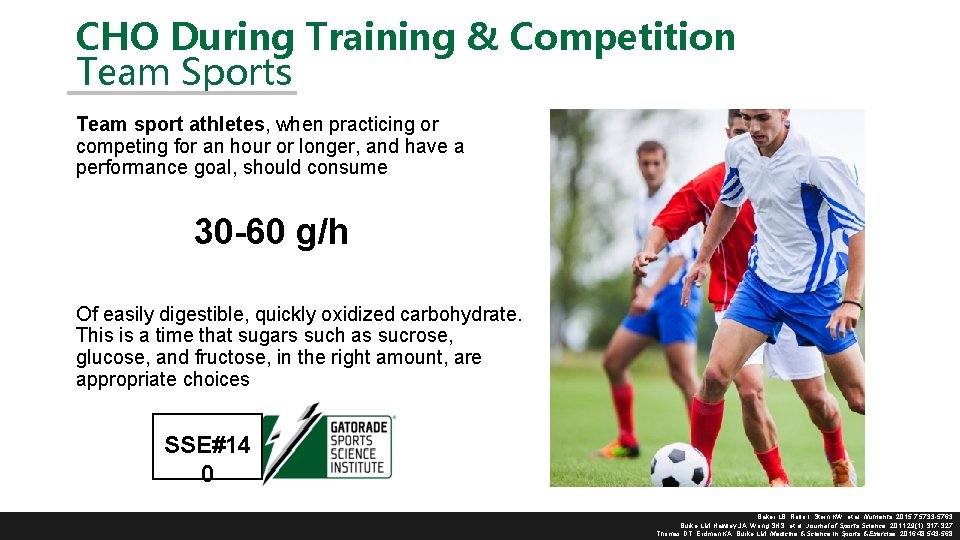
CHO During Training & Competition Team Sports Team sport athletes, when practicing or competing for an hour or longer, and have a performance goal, should consume 30 -60 g/h Of easily digestible, quickly oxidized carbohydrate. This is a time that sugars such as sucrose, glucose, and fructose, in the right amount, are appropriate choices SSE#14 0 Baker LB, Rollo I, Stein KW, et al. Nutrients. 2015; 7: 5733 -5763 Burke LM, Hawley JA, Wong SHS, et al. Journal of Sports Science. 2011; 29(1): S 17 -S 27 Thomas DT, Erdman KA, Burke LM. Medicine & Science in Sports & Exercise. 2016; 48: 543 -568
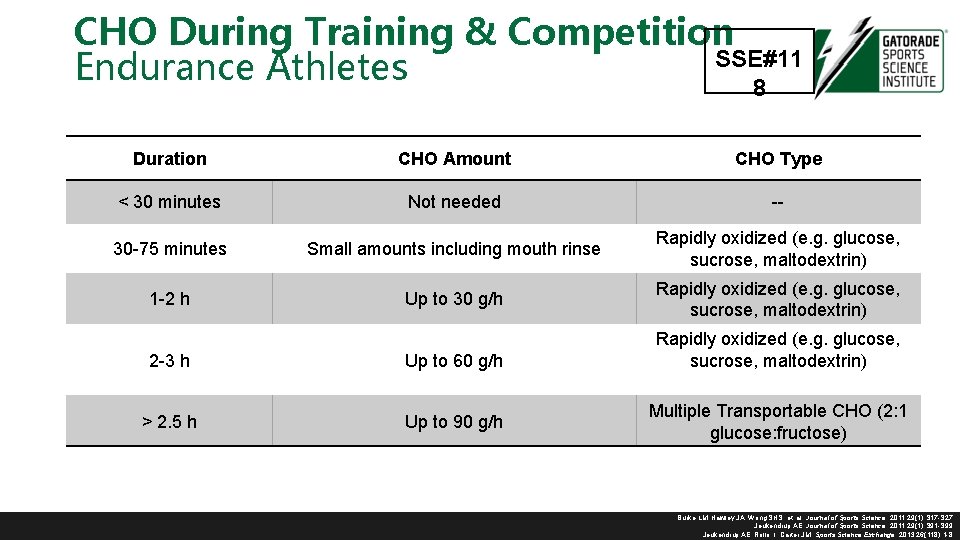
CHO During Training & Competition SSE#11 Endurance Athletes 8 Duration CHO Amount CHO Type < 30 minutes Not needed -- 30 -75 minutes Small amounts including mouth rinse Rapidly oxidized (e. g. glucose, sucrose, maltodextrin) 1 -2 h Up to 30 g/h Rapidly oxidized (e. g. glucose, sucrose, maltodextrin) 2 -3 h Up to 60 g/h > 2. 5 h Up to 90 g/h Rapidly oxidized (e. g. glucose, sucrose, maltodextrin) Multiple Transportable CHO (2: 1 glucose: fructose) Burke LM, Hawley JA, Wong SHS, et. al. Journal of Sports Science. 2011; 29(1): S 17 -S 27 Jeukendrup AE. Journal of Sports Science. 2011; 29(1): S 91 -S 99 Jeukendrup AE, Rollo, I, Carter JM. Sports Science Exchange. 2013; 26(118): 1 -8
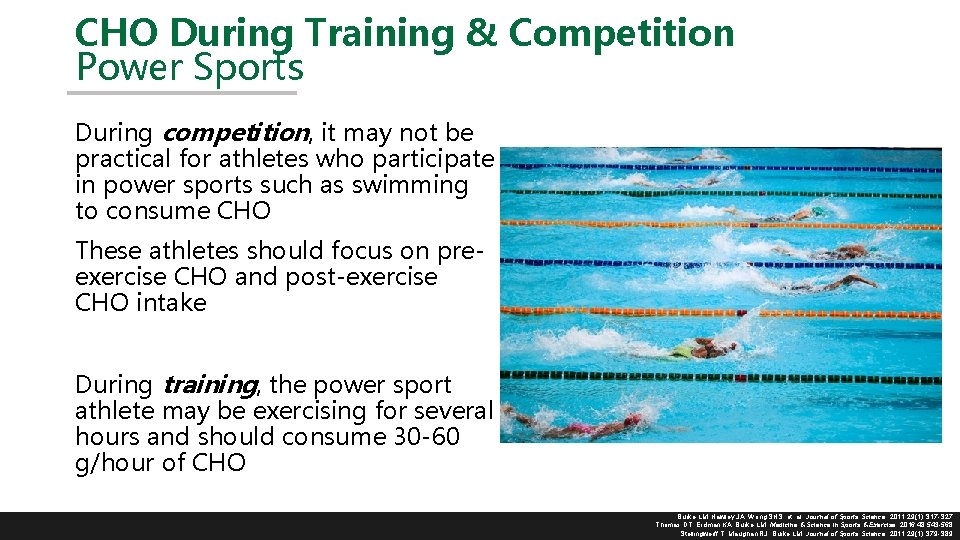
CHO During Training & Competition Power Sports During competition, it may not be practical for athletes who participate in power sports such as swimming to consume CHO These athletes should focus on preexercise CHO and post-exercise CHO intake During training, the power sport athlete may be exercising for several hours and should consume 30 -60 g/hour of CHO Burke LM, Hawley JA, Wong SHS, et. al. Journal of Sports Science. 2011; 29(1): S 17 -S 27 Thomas DT, Erdman KA, Burke LM. Medicine & Science in Sports & Exercise. 2016; 48: 543 -568 Stellingwerff T, Maughan RJ, Burke LM. Journal of Sports Science. 2011; 29(1): S 79 -S 89
CHO During Training & Competition Strength Training Carbohydrate intake is not necessary during strength sessions Burke LM, Hawley JA, Wong SHS, et. al. Journal of Sports Science. 2011; 29(1): S 17 -S 27 Thomas DT, Erdman KA, Burke LM. Medicine & Science in Sports & Exercise. 2016; 48: 543 -568 Stellingwerff T, Maughan RJ, Burke LM. Journal of Sports Science. 2011; 29(1): S 79 -S 89
CHO During Training & Competition The type of carbohydrate consumed is important during exercise! Choose a carbohydrate that is easily digested, rapidly absorbed and oxidized Glucose (dextrose), sucrose and maltodextrin are appropriate choices Fructose, while oxidized more slowly, is appropriate in small amounts when combined with the sources listed above The form in which CHO is consumed (gel, drink solid) does not influence oxidation rates and athletes should choose the form that works best for them Baker LB, Rollo I, Stein KW, et al. Nutrients. 2015; 7: 5733 -5763 Pfieffer B, Stellingwerff T, Zaltas E, et. al. Medicine & Science in Sports & Exercise. 2010; 42: 2030 -2037 Thomas DT, Erdman KA, Burke LM. Medicine & Science in Sports & Exercise. 2016; 48: 543 -568
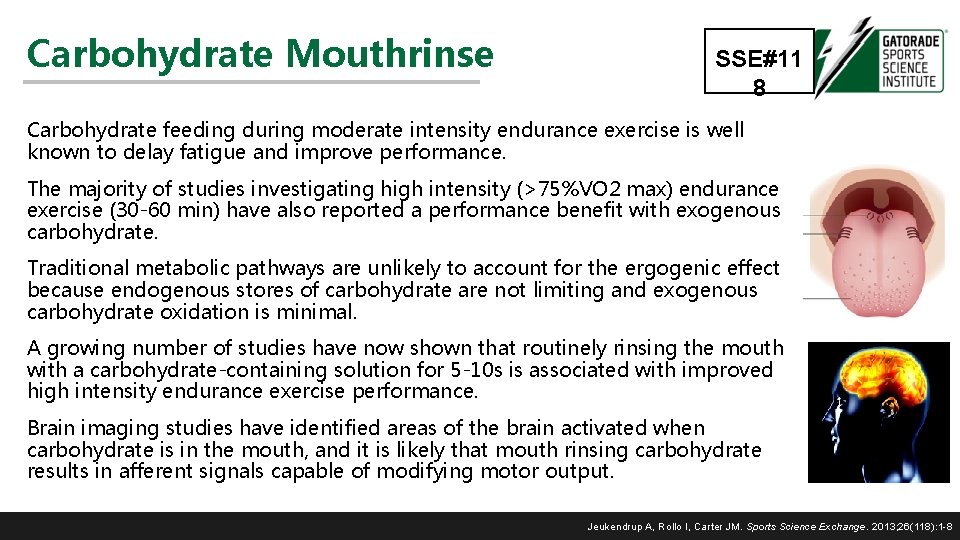
Carbohydrate Mouthrinse SSE#11 8 Carbohydrate feeding during moderate intensity endurance exercise is well known to delay fatigue and improve performance. The majority of studies investigating high intensity (>75%VO 2 max) endurance exercise (30 -60 min) have also reported a performance benefit with exogenous carbohydrate. Traditional metabolic pathways are unlikely to account for the ergogenic effect because endogenous stores of carbohydrate are not limiting and exogenous carbohydrate oxidation is minimal. A growing number of studies have now shown that routinely rinsing the mouth with a carbohydrate-containing solution for 5 -10 s is associated with improved high intensity endurance exercise performance. Brain imaging studies have identified areas of the brain activated when carbohydrate is in the mouth, and it is likely that mouth rinsing carbohydrate results in afferent signals capable of modifying motor output. Jeukendrup A, Rollo I, Carter JM. Sports Science Exchange. 2013; 26(118): 1 -8
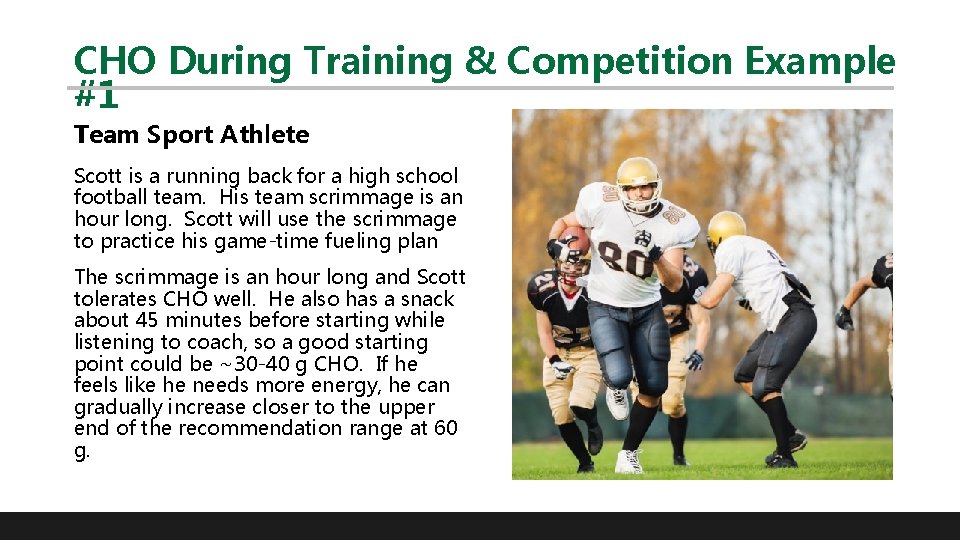
CHO During Training & Competition Example #1 Team Sport Athlete Scott is a running back for a high school football team. His team scrimmage is an hour long. Scott will use the scrimmage to practice his game-time fueling plan The scrimmage is an hour long and Scott tolerates CHO well. He also has a snack about 45 minutes before starting while listening to coach, so a good starting point could be ~30 -40 g CHO. If he feels like he needs more energy, he can gradually increase closer to the upper end of the recommendation range at 60 g.
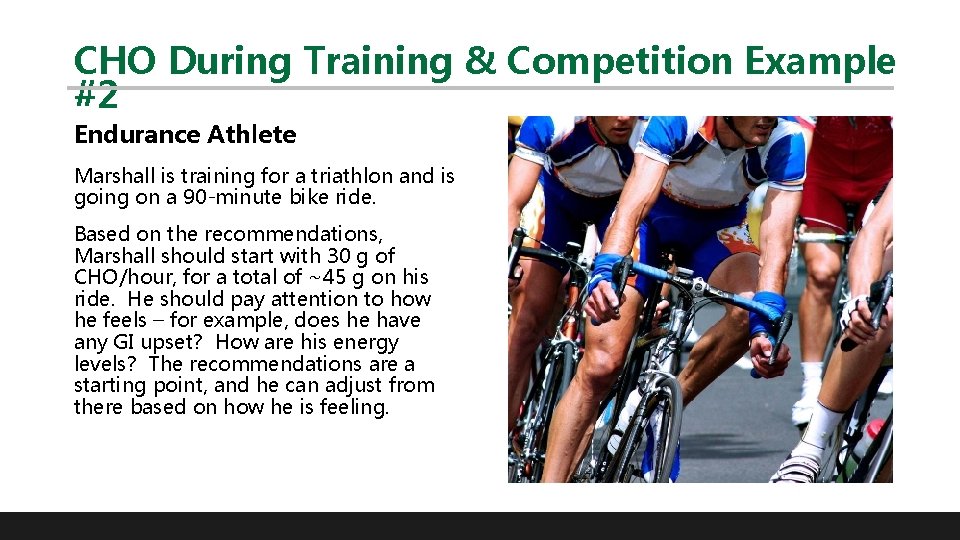
CHO During Training & Competition Example #2 Endurance Athlete Marshall is training for a triathlon and is going on a 90 -minute bike ride. Based on the recommendations, Marshall should start with 30 g of CHO/hour, for a total of ~45 g on his ride. He should pay attention to how he feels – for example, does he have any GI upset? How are his energy levels? The recommendations are a starting point, and he can adjust from there based on how he is feeling.

CHO AFTER TRAINING AND COMPETITION
CHO After Training & Competition § Short Recovery Time § An athlete should consume 1 -1. 2 g of CHO/kg/hour (0. 45 -0. 55 g/lb/hour) every hour for the first 4 -6 hours post-exercise § Then resume regular dietary habits in order to quickly replenish glycogen stores § Greater Amount of Recovery Time § Consuming CHO post-exercise is a good habit for athletes who have a greater amount of recovery time § Meeting daily CHO needs should be adequate to restore muscle glycogen § Muscle glycogen stores can generally be normalized within 24 hours § More time may be needed if an athlete follows a low-carbohydrate diet Burke LM, Hawley JA, Wong SHS, et. al. Journal of Sports Sciences. 2011; 29(1): S 17 -S 27 Burke LM, Kiens B, Ivy JL. Journal of Sports Sciences. 2004; 22: 15 -30 Thomas DT, Erdman KA, Burke LM. Medicine & Science in Sports & Exercise. 2016; 48: 543 -568

PUTTING IT ALL TOGETHER
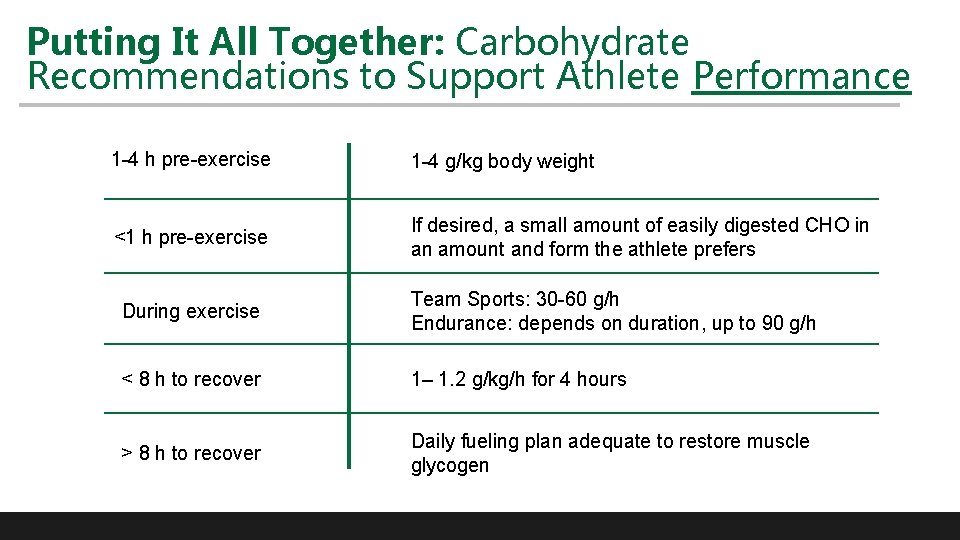
Putting It All Together: Carbohydrate Recommendations to Support Athlete Performance 1 -4 h pre-exercise 1 -4 g/kg body weight <1 h pre-exercise If desired, a small amount of easily digested CHO in an amount and form the athlete prefers During exercise Team Sports: 30 -60 g/h Endurance: depends on duration, up to 90 g/h < 8 h to recover 1– 1. 2 g/kg/h for 4 hours > 8 h to recover Daily fueling plan adequate to restore muscle glycogen

Putting It All Together: Carbohydrate Recommendations to Support Athlete Performance Remember, recommendations are a starting point. Every athlete is individual, and to dial in their carbohydrate needs you need to consider the recommendations, their goals and beliefs, and how they respond to food.
Putting It All Together Example #1 Team Sport Athlete Knox is a student and plays for his school’s lacrosse team. He weighs 82 kg and knows his pre-exercise nutrition strategy. He has class during the first half of the day and practice in the afternoon for 2 hours. He then has a team lifting session the following morning. How should Knox properly fuel to prepare for practice and his lifting session?
Putting It All Together Example #2 Endurance Athlete It is Amy is preparing her fueling strategy for a half marathon race. She weighs 50 kg and plans on finishing her race in 2: 15. Can you suggest a pre/during/post strategy for Amy, that she will practice during her training?

Link to Summary Video
- Slides: 38