
Carbohydrate Metabolism During Exercise Importance of Carbohydrate Metabolism
Carbohydrate Metabolism During Exercise
Importance of Carbohydrate Metabolism • Involved in resynthesis of ATP during highintensity exercsise • Also provide substrate for Krebs/TCA cycle
Carbohydrate Depletion and Fatigue • Glycogen depletion or hypglycemia often associated with exercise fatigue • Glycolysis provides pyruvate which feeds into Krebs/TCA • If glucose is insufficient to fuel glycolysis, Krebs may be slowed as a result
Carbohydrate Supplementation Attenuates Fatigue • Ingestion of carbohydrates during prolonged exercise maintains intracellular concentration of Krebs intermediates • Also attenuates increased levels of IMP accumulation
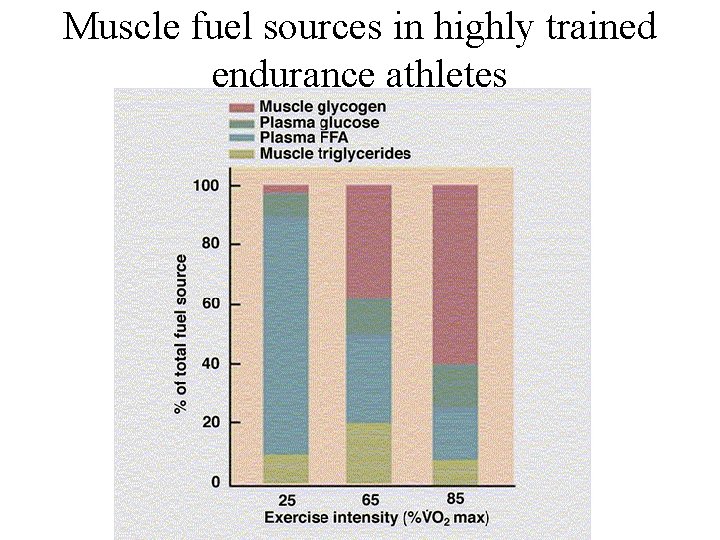
Exercise Intensity Limited in the Absence of CHO • If lipid is the sole energy source, exercise above 50 -60 % VO 2 max cannot be sustained
Mc. Cardles Disease as a Model • Mc. Cardles patients do not have PHOS – Cannot utilize glycogen as a fuel source • Exercise capacity only 50 % of predicted • Also greater ATP degradation – Elevated IMP levels compared to normals
Glycogenolysis • Glycogen breakdown is both exercise intensity and duration dependent • Glycogenolysis is most rapid during short duration exercise – Rate is exponentially related to intensity – (ie. Doubling intensity 60 % - 120 %VO 2 max results in squaring the rate [100 fold increase in this case])
• As exercise proceeds, glycogneolytic rate decreases – Could be reduction in glycogen stores • remember previous exercise – Could be change in the levels of allosteric regulators of PHOS as a result of lower intensity • If duration is longer, intensity must be lower
Insert fig 2. 1
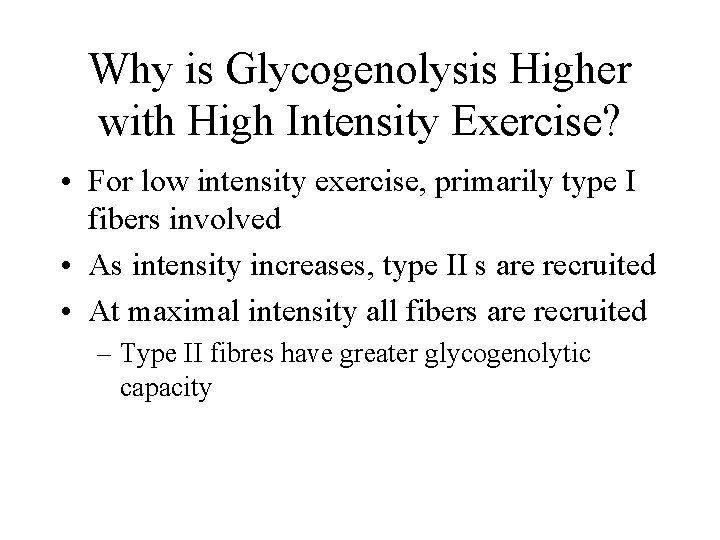
Why is Glycogenolysis Higher with High Intensity Exercise? • For low intensity exercise, primarily type I fibers involved • As intensity increases, type II s are recruited • At maximal intensity all fibers are recruited – Type II fibres have greater glycogenolytic capacity
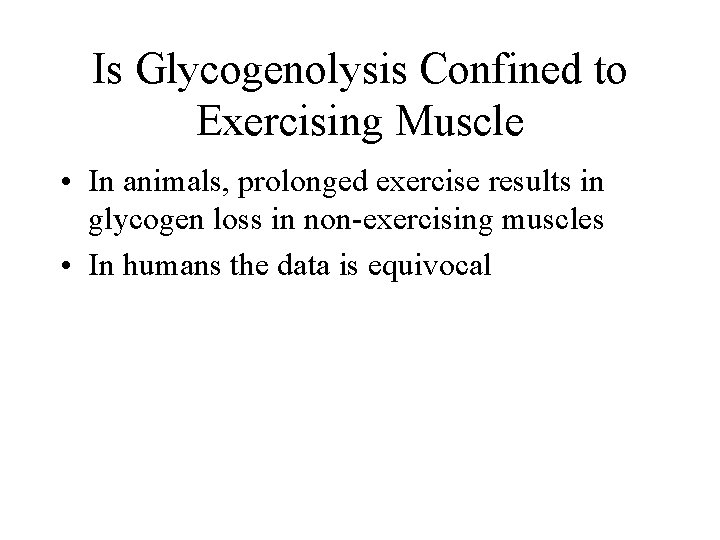
Is Glycogenolysis Confined to Exercising Muscle • In animals, prolonged exercise results in glycogen loss in non-exercising muscles • In humans the data is equivocal
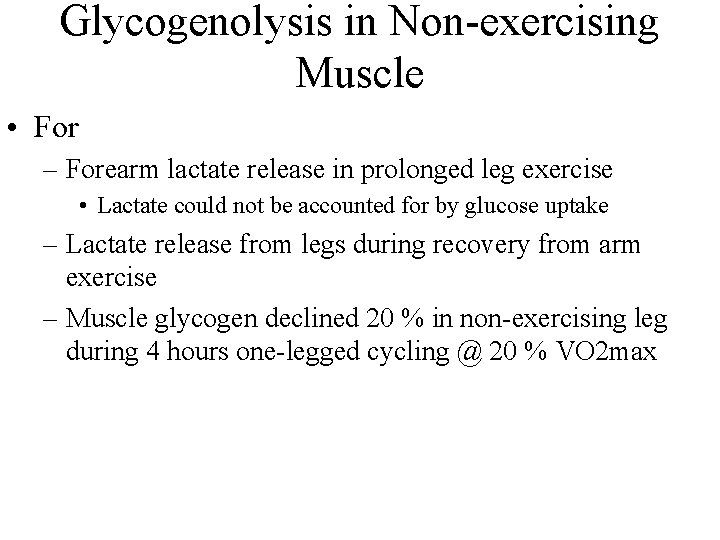
Glycogenolysis in Non-exercising Muscle • For – Forearm lactate release in prolonged leg exercise • Lactate could not be accounted for by glucose uptake – Lactate release from legs during recovery from arm exercise – Muscle glycogen declined 20 % in non-exercising leg during 4 hours one-legged cycling @ 20 % VO 2 max
• Against – No change in non-exercising muscle glycogen content after glycogen depleting exercise – No change in 2 hours of one-legged cycling – No change in deltoid content with 2 hours leg exercise @ 55% VO 2 max • 65% decline in VL glycogen content
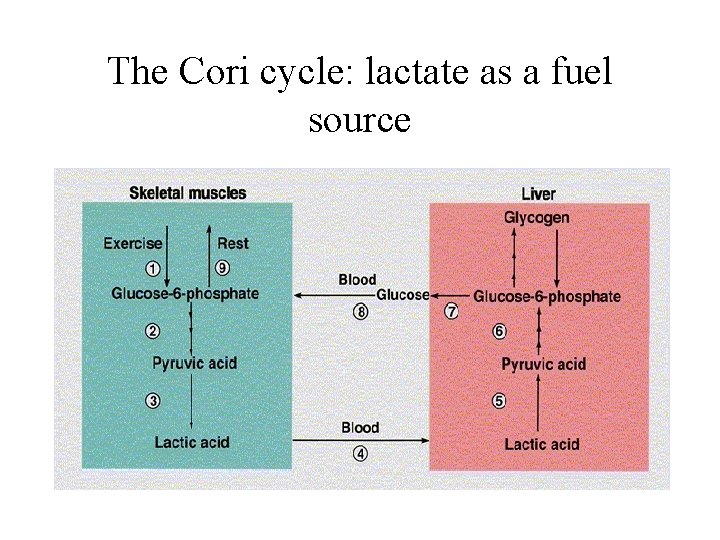
Why would you want glycogenolysis in non-exercising muscles? • If glycogenolysis occurs, glucose can be broken down via glycolysis • Pyruvate may be converted to lactate which can then be released from non-exercising muscle • Lactate can be converted to glucose via gluconeogenesis – Maintains blood glucose
PHOS • Oh no, not again!!!
How does CHO intake affect PHOS activity? • In animals, elevated blood glucose decreases glycogen breakdown
Low Intensity Exercise • During low intensity exercise (50% VO 2 max) w/ 30 s sprints, elevated blood glucose attenuates glycogen breakdown – Hypoth-between sprints, high glucose promoted glycogen resynthesis – This led to reduced NET breakdown
High Intensity Exercise • At high intensity 70 -75%, elevated blood glucose has no effect on glycogen levels • Still ergogenic, maintains blood glucose


Phosphofructokinase (PFK) regulation • Most important regulator of PFK activity is ATP • ATP can bind to PFK at two sites and alter its activity • Binds to catalytic site with high affinity • Can also bind to allosteric site
PFK cont’d • Binding to the allosteric site inhibits activity • So, … when [ATP] in the cell is high, PFK will be inhibited – no need for glycolysis, plenty of ATP • H+ can enhance ATP affinity for allosteric site – Provides feedback inhibition
Some other proposed modulators • Inhibitors – Citrate – Phosphoglycerate – Phophoenolpyruvate – Mg 2+
• Promoters – AMP and ADP – Pi – NH 4+ – Fructose – 2, 6 diphosphate
Citrate • Probably not a major factor during short, intense exercise • Aerobic metabolism does not contribute greatly until later (>30 s) • Citrate probably does not accumulate within the 30 -60 s time frame • May be a factor as Krebs and fat metabolism become more predominant
Promoters • ADP and AMP will accumulate rapidly at the onset of anaerobic exercise – Breakdown of PCr • H+ may be reduced at the onset of exercise – Removing the ATP induced inhibition
Hormonal Regulation of Glucose Metabolism • Under non-exercising conditions, insulin needed to stimulate glucose entry into cell • Is insulin needed during exercise? – Permissive amount?
Insulin Not Necessary During Exercise • During exercise insulin levels decline • Glucose transport is stimulated by exercise in the absence of insulin • Effects of exercise and insulin are additive – Different mechanisms?
GLUT 4 • Both exercise and insulin translocate GLUT 4 to the cell membrane • Different pools of GLUT 4? – Effects are synergistic
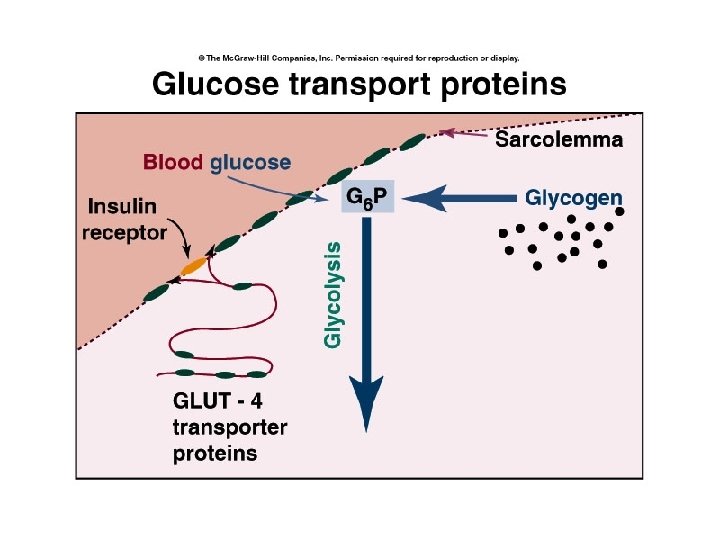
GLUT proteins
• So, insulin is not necessary for glucose transport during exercise • But, exercise increases cellular sensitivity to insulin • Hyperinsulinemia at the onset of exercise results in rapid drop in blood glucose – Implications for competition meals?
Epinephrine • Effects on glucose uptake are equivocal at best, confusing at worst • Can’t say one way or the other • Epi will activate PHOS though – This will stimulate glycogenolysis and possibly elevate G-6 -P, in effect reducing glucose uptake
Glycogen Availability • Inverse relationship between glycogen levels and glucose uptake • Leg glucose uptake directly related to percentage glycogen-empty muscle fibers • Also, inversely related to muscle G-6 -P levels – Inhibition through G-6 -P levels? ?
Blood Glucose Availability • Glucose uptake is elevated during exercise when blood glucose levels are high • During the latter stages of exercise, as blood glucose drops, glucose uptake also decreases • High rates of glucose uptake can be achieved late in exercise if blood glucose levels are maintained – Carbs not ergogenic if glycogen stores elevated
Glucose-Fatty Acid Cycle • Randall proposed that increased FFA oxidation resul in citrate , mediated inhibition of PFK • Resulting elevations in G-6 -P inhibited hexokinase, glucose phosphorylation and uptake • Experimental results equivocal to this point • This may work in a test tube, but it’s hard to show physio.
Lactate Metabolism • Lactate originally believed to be a “waste” product of anaerobic glycolytic metabolism • More recently believed to participate in carbohydrate metabolism, serve as an energy source as well as metabolic regulator
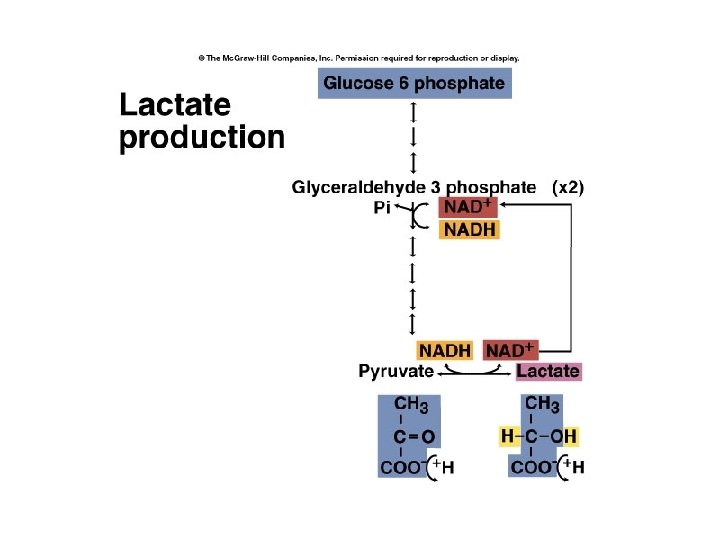
Lactate Production
Factors Affecting Lactate Production • O 2 availability – Classic pathological factor affecting lactate production (ischemia) • Rate of glycogenolysis and glycolysis • Diet – High CHO diet results in more lactate formation • Catecholamines
The Cori cycle: lactate as a fuel source


Muscle fuel sources in highly trained endurance athletes
Contributions of four energy sources over prolonged time in endurance athletes
- Slides: 43