
Capturing Topology in Graph Pattern Matching Shuai Ma
- Slides: 23
Capturing Topology in Graph Pattern Matching Shuai Ma, Yang Cao, Wenfei Fan, Jinpeng Huai, Tianyu Wo University of Edinburgh
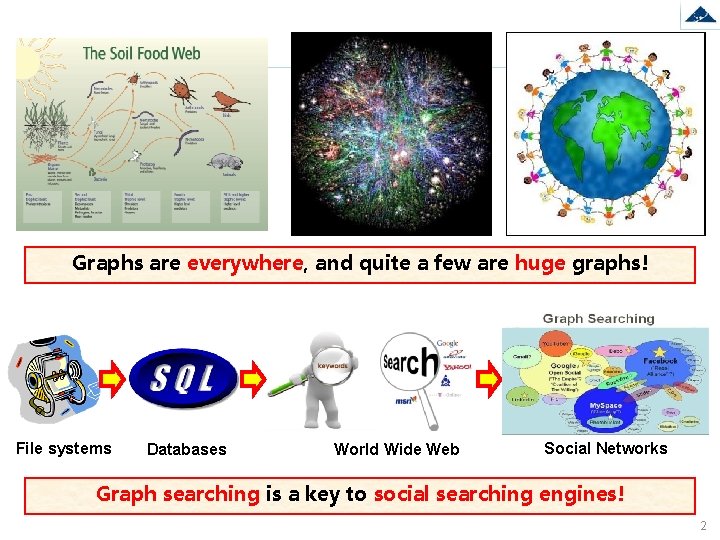
Graphs are everywhere, and quite a few are huge graphs! File systems Databases World Wide Web Social Networks Graph searching is a key to social searching engines! 2
Graph Pattern Matching • Given two directed graphs G 1 (pattern graph) and G 2 (data graph), – decide whether G 1 “matches” G 2 (Boolean queries); – identify “subgraphs” of G 2 that match G 1 • Applications – – – Web mirror detection/ Web site classification Complex object identification Software plagiarism detection Social network/biology analyses … • Matching Models – Traditional: Subgraph Isomorphism – Emerging applications: Graph Simulation and its extensions, etc. . A variety of emerging real-life applications! 3
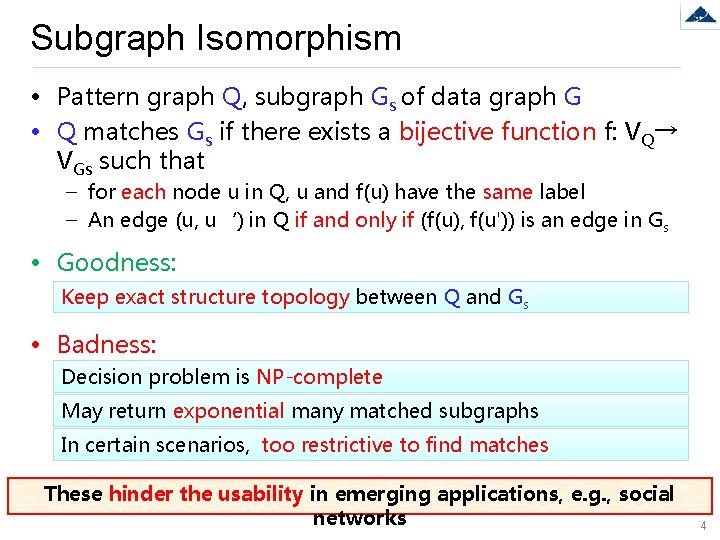
Subgraph Isomorphism • Pattern graph Q, subgraph Gs of data graph G • Q matches Gs if there exists a bijective function f: VQ→ VGs such that – for each node u in Q, u and f(u) have the same label – An edge (u, u‘) in Q if and only if (f(u), f(u')) is an edge in Gs • Goodness: Keep exact structure topology between Q and Gs • Badness: Decision problem is NP-complete May return exponential many matched subgraphs In certain scenarios, too restrictive to find matches These hinder the usability in emerging applications, e. g. , social networks 4
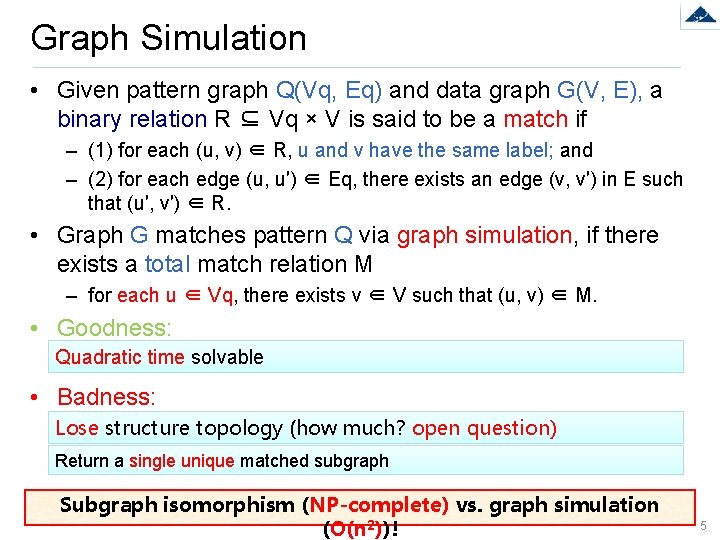
Graph Simulation • Given pattern graph Q(Vq, Eq) and data graph G(V, E), a binary relation R ⊆ Vq × V is said to be a match if – (1) for each (u, v) ∈ R, u and v have the same label; and – (2) for each edge (u, u′) ∈ Eq, there exists an edge (v, v′) in E such that (u′, v′) ∈ R. • Graph G matches pattern Q via graph simulation, if there exists a total match relation M – for each u ∈ Vq, there exists v ∈ V such that (u, v) ∈ M. • Goodness: Quadratic time solvable • Badness: Lose structure topology (how much? open question) Return a single unique matched subgraph Subgraph isomorphism (NP-complete) vs. graph simulation (O(n 2))! 5
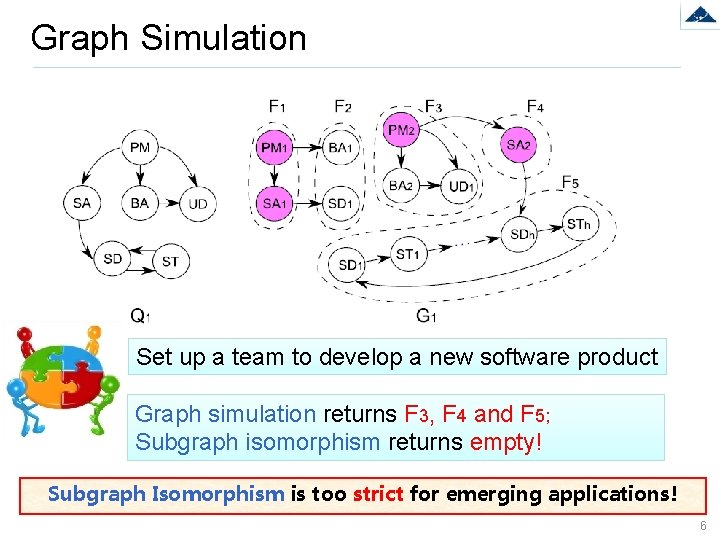
Graph Simulation Set up a team to develop a new software product Graph simulation returns F 3, F 4 and F 5; Subgraph isomorphism returns empty! Subgraph Isomorphism is too strict for emerging applications! 6
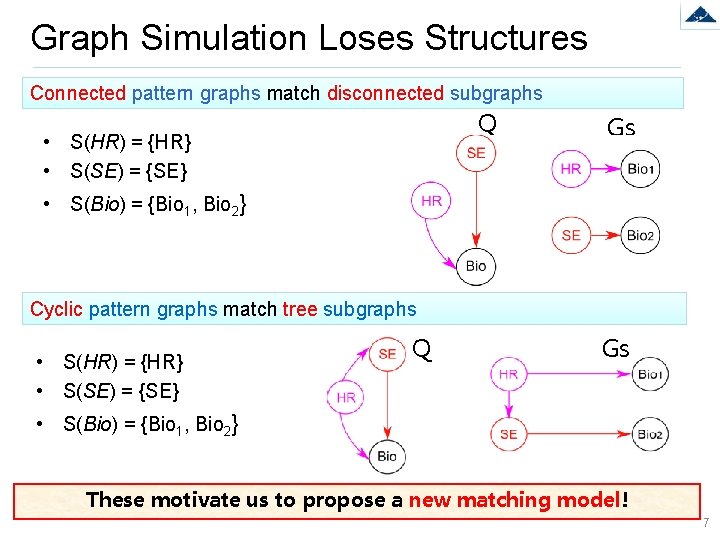
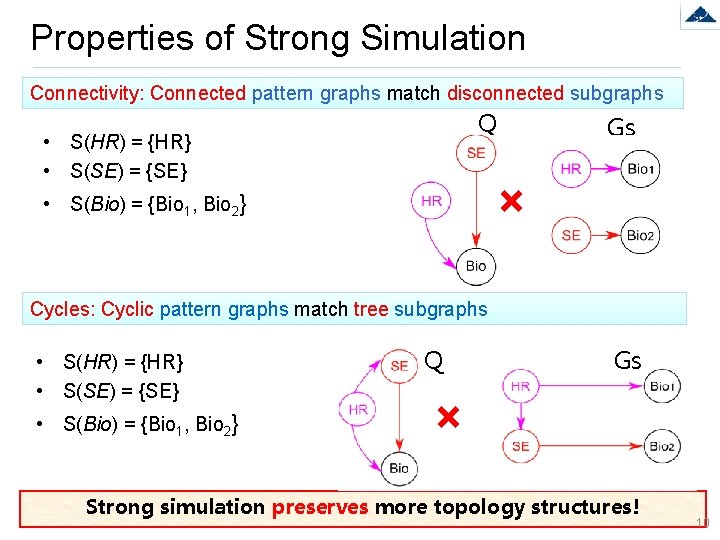
Graph Simulation Loses Structures Connected pattern graphs match disconnected subgraphs Q • S(HR) = {HR} • S(SE) = {SE} Gs • S(Bio) = {Bio 1, Bio 2} Cyclic pattern graphs match tree subgraphs • S(HR) = {HR} • S(SE) = {SE} Q Gs • S(Bio) = {Bio 1, Bio 2} These motivate us to propose a new matching model! 7
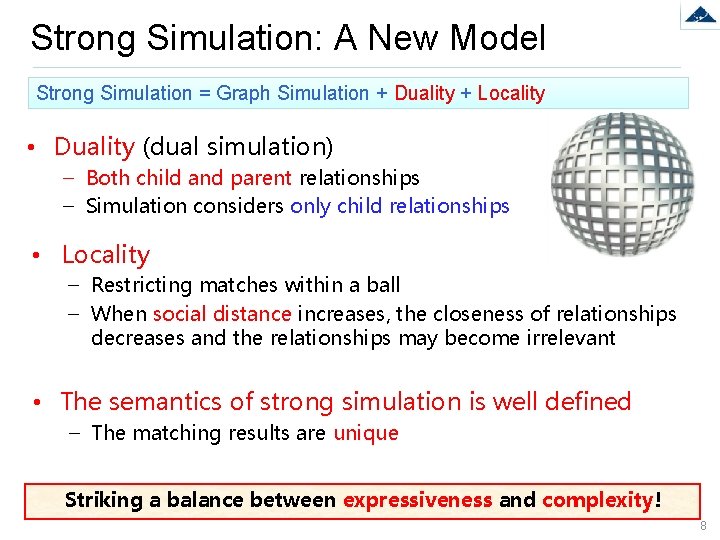
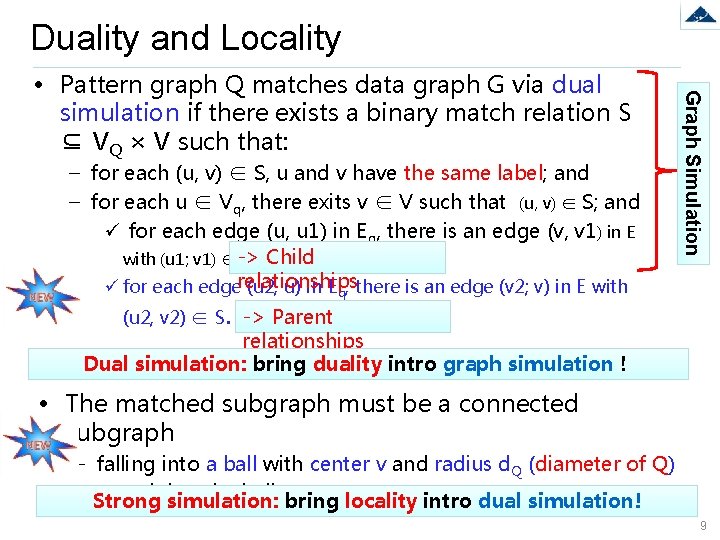
Strong Simulation: A New Model Strong Simulation = Graph Simulation + Duality + Locality • Duality (dual simulation) – Both child and parent relationships – Simulation considers only child relationships • Locality – Restricting matches within a ball – When social distance increases, the closeness of relationships decreases and the relationships may become irrelevant • The semantics of strong simulation is well defined – The matching results are unique Striking a balance between expressiveness and complexity! 8
Duality and Locality – for each (u, v) ∈ S, u and v have the same label; and – for each u ∈ Vq, there exits v ∈ V such that (u, v) ∈ S; and ü for each edge (u, u 1) in Eq, there is an edge (v, v 1) in E with (u 1; v 1) ∈-> S; Child ü for each edgerelationships (u 2, u) in Eq, there is an edge (v 2; v) in E with Graph Simulation • Pattern graph Q matches data graph G via dual simulation if there exists a binary match relation S ⊆ VQ × V such that: (u 2, v 2) ∈ S. -> Parent relationships Dual simulation: bring duality intro graph simulation! • The matched subgraph must be a connected subgraph – falling into a ball with center v and radius d. Q (diameter of Q) – Strong containing the ball center v simulation: bring locality intro dual simulation! 9
Properties of Strong Simulation Connectivity: Connected pattern graphs match disconnected subgraphs Q • S(HR) = {HR} • S(SE) = {SE} Gs × • S(Bio) = {Bio 1, Bio 2} Cycles: Cyclic pattern graphs match tree subgraphs • S(HR) = {HR} • S(SE) = {SE} • S(Bio) = {Bio 1, Bio 2} QQ Gs Gs × Strong simulation preserves more topology structures! 10
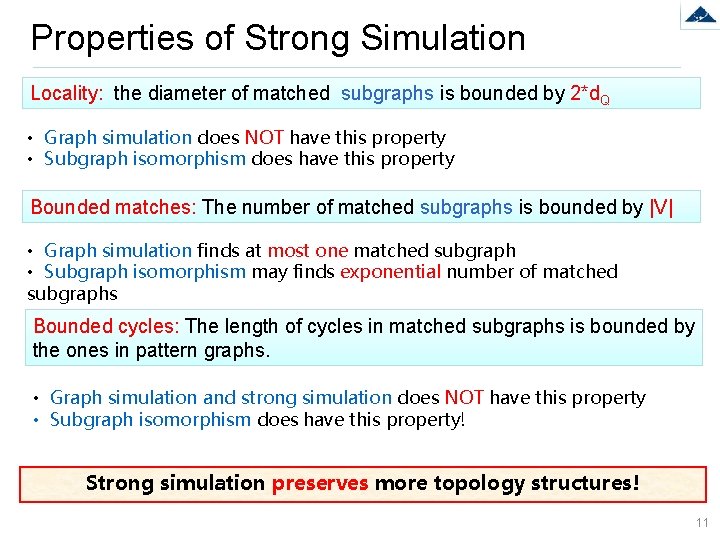
Properties of Strong Simulation Locality: the diameter of matched subgraphs is bounded by 2*d. Q • Graph simulation does NOT have this property • Subgraph isomorphism does have this property Bounded matches: The number of matched subgraphs is bounded by |V| • Graph simulation finds at most one matched subgraph • Subgraph isomorphism may finds exponential number of matched subgraphs Bounded cycles: The length of cycles in matched subgraphs is bounded by the ones in pattern graphs. • Graph simulation and strong simulation does NOT have this property • Subgraph isomorphism does have this property! Strong simulation preserves more topology structures! 11
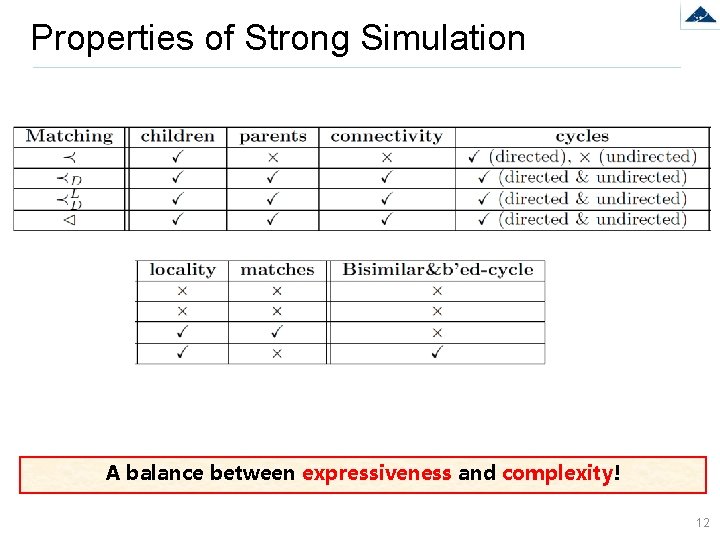
Properties of Strong Simulation A balance between expressiveness and complexity! 12
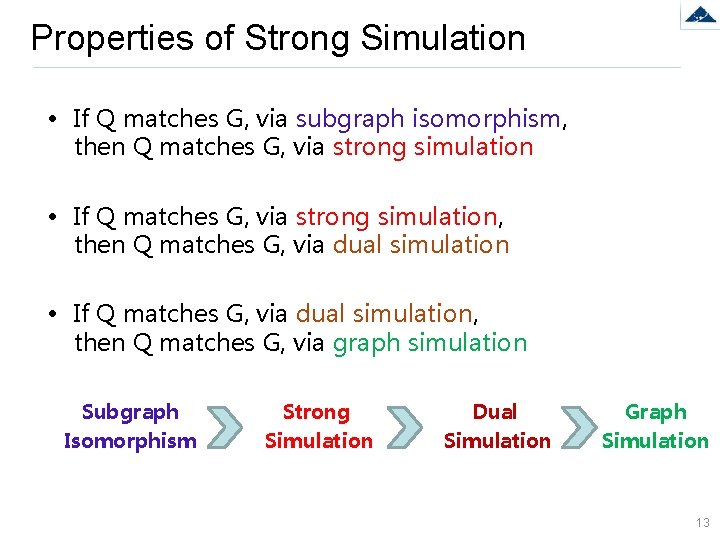
Properties of Strong Simulation • If Q matches G, via subgraph isomorphism, then Q matches G, via strong simulation • If Q matches G, via strong simulation, then Q matches G, via dual simulation • If Q matches G, via dual simulation, then Q matches G, via graph simulation Subgraph Isomorphism Strong Simulation Dual Simulation Graph Simulation 13
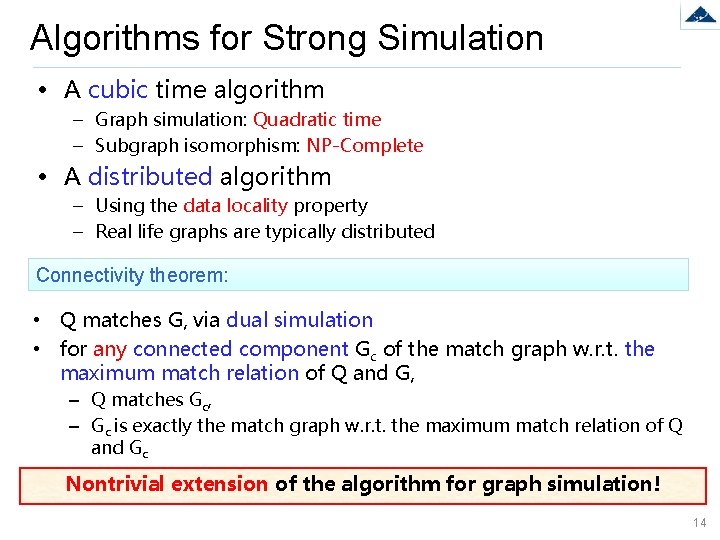
Algorithms for Strong Simulation • A cubic time algorithm – Graph simulation: Quadratic time – Subgraph isomorphism: NP-Complete • A distributed algorithm – Using the data locality property – Real life graphs are typically distributed Connectivity theorem: • Q matches G, via dual simulation • for any connected component Gc of the match graph w. r. t. the maximum match relation of Q and G, – Q matches Gc, – Gc is exactly the match graph w. r. t. the maximum match relation of Q and Gc Nontrivial extension of the algorithm for graph simulation! 14
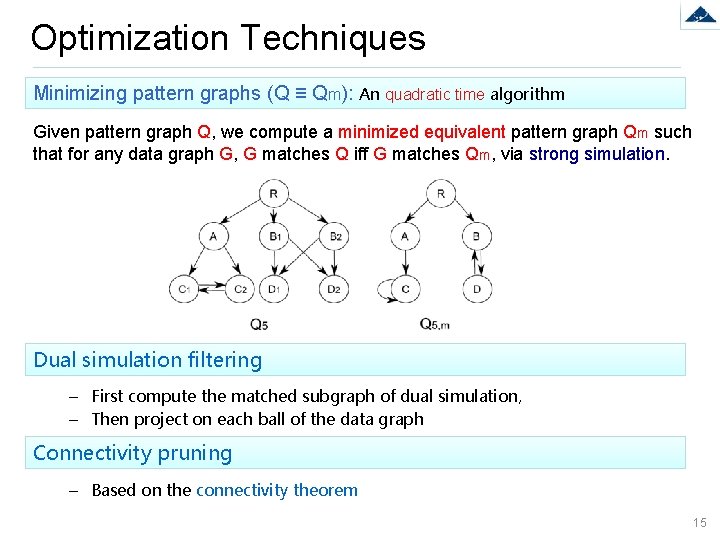
Optimization Techniques Minimizing pattern graphs (Q ≡ Qm): An quadratic time algorithm Given pattern graph Q, we compute a minimized equivalent pattern graph Qm such that for any data graph G, G matches Q iff G matches Qm, via strong simulation. Dual simulation filtering – First compute the matched subgraph of dual simulation, – Then project on each ball of the data graph Connectivity pruning – Based on the connectivity theorem 15
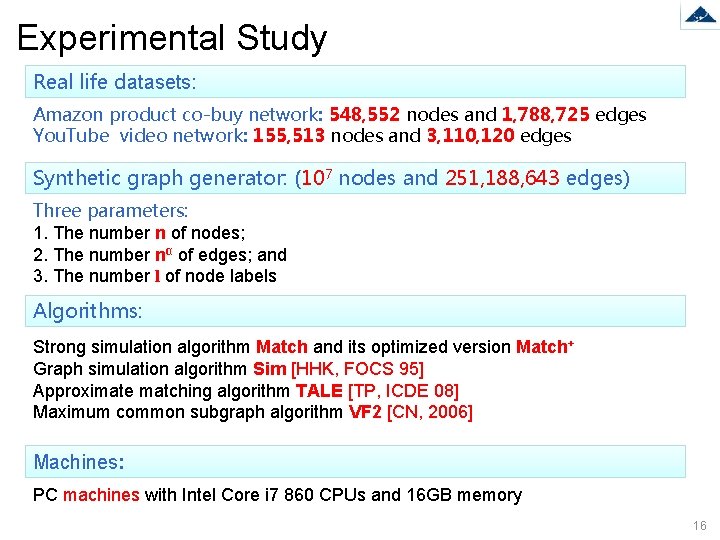
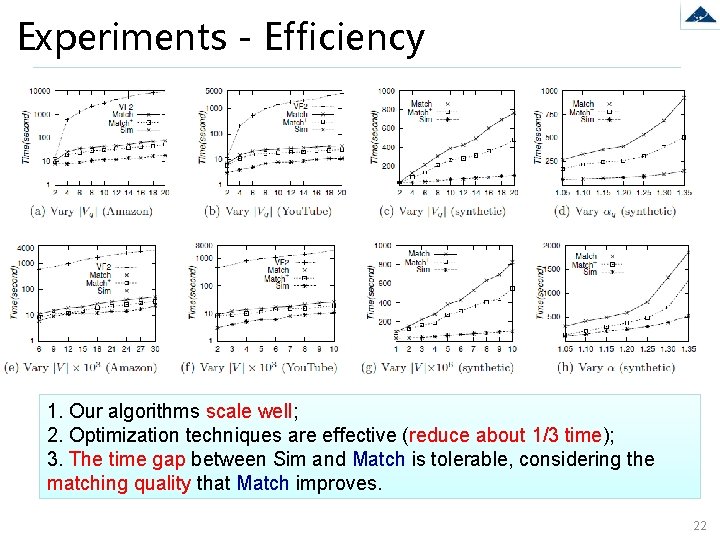
Experimental Study Real life datasets: Amazon product co-buy network: 548, 552 nodes and 1, 788, 725 edges You. Tube video network: 155, 513 nodes and 3, 110, 120 edges Synthetic graph generator: (107 nodes and 251, 188, 643 edges) Three parameters: 1. The number n of nodes; 2. The number nα of edges; and 3. The number l of node labels Algorithms: Strong simulation algorithm Match and its optimized version Match+ Graph simulation algorithm Sim [HHK, FOCS 95] Approximate matching algorithm TALE [TP, ICDE 08] Maximum common subgraph algorithm VF 2 [CN, 2006] Machines: PC machines with Intel Core i 7 860 CPUs and 16 GB memory 16
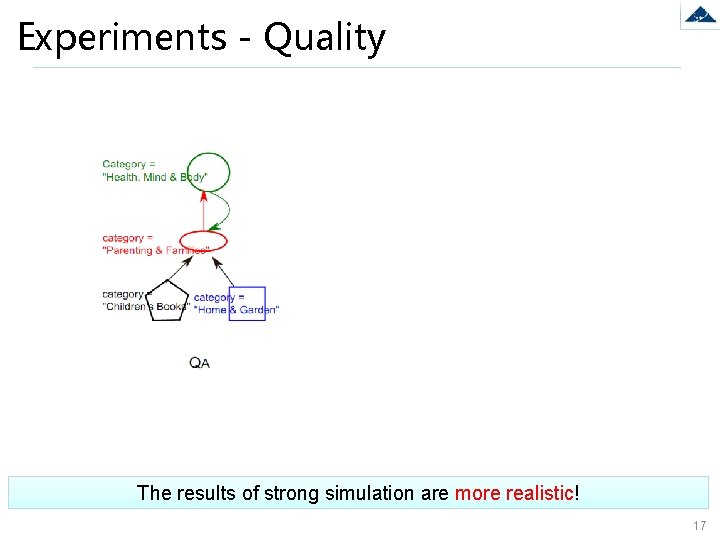
Experiments - Quality The results of strong simulation are more realistic! 17
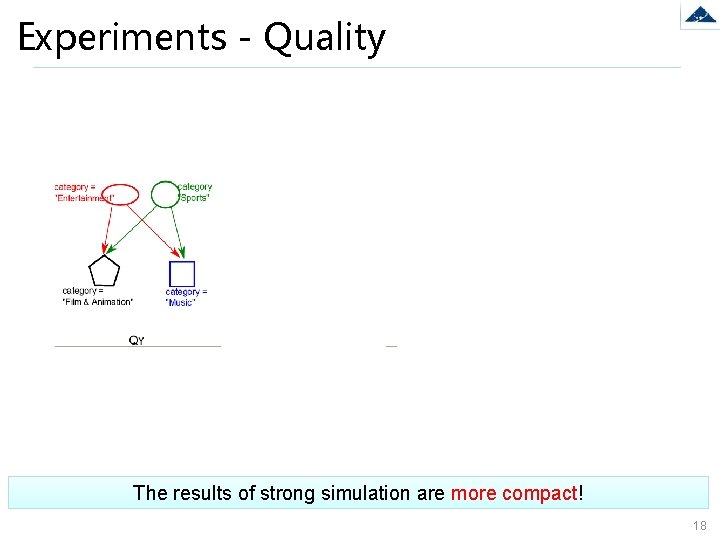
Experiments - Quality The results of strong simulation are more compact! 18
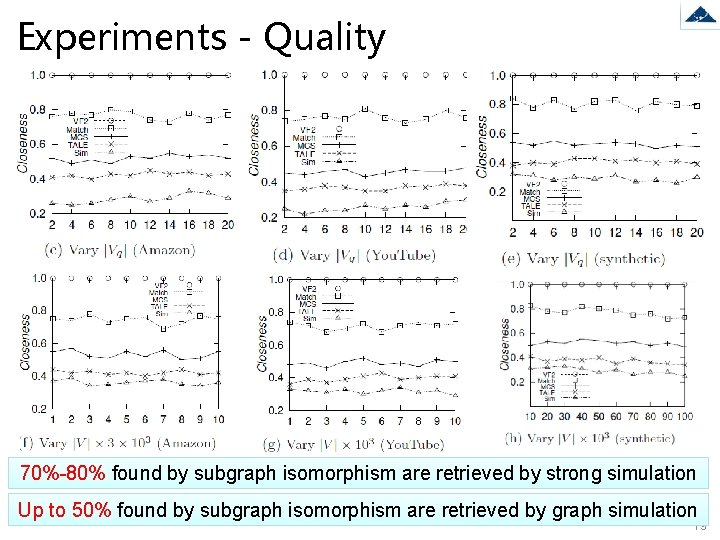
Experiments - Quality 70%-80% found by subgraph isomorphism are retrieved by strong simulation Up to 50% found by subgraph isomorphism are retrieved by graph simulation 19
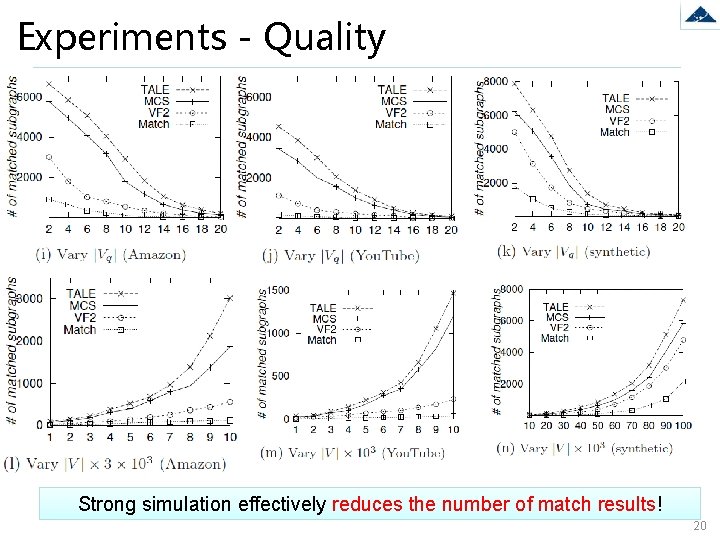
Experiments - Quality Strong simulation effectively reduces the number of match results! 20
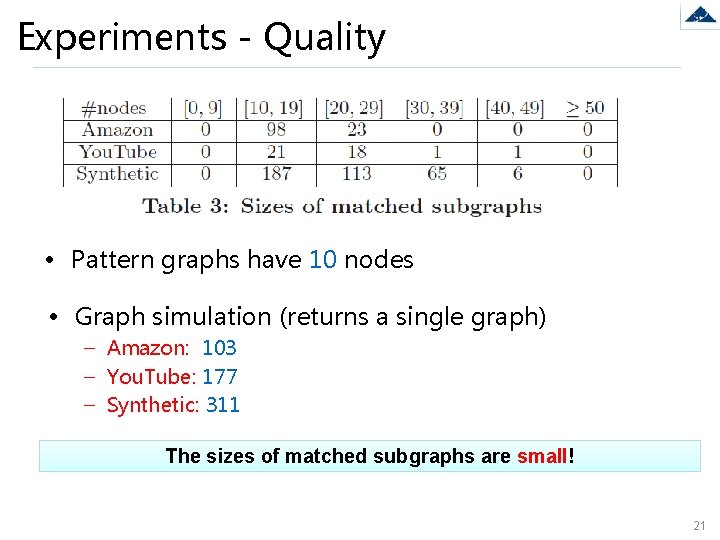
Experiments - Quality • Pattern graphs have 10 nodes • Graph simulation (returns a single graph) – Amazon: 103 – You. Tube: 177 – Synthetic: 311 The sizes of matched subgraphs are small! 21
Experiments - Efficiency 1. Our algorithms scale well; 2. Optimization techniques are effective (reduce about 1/3 time); 3. The time gap between Sim and Match is tolerable, considering the matching quality that Match improves. 22
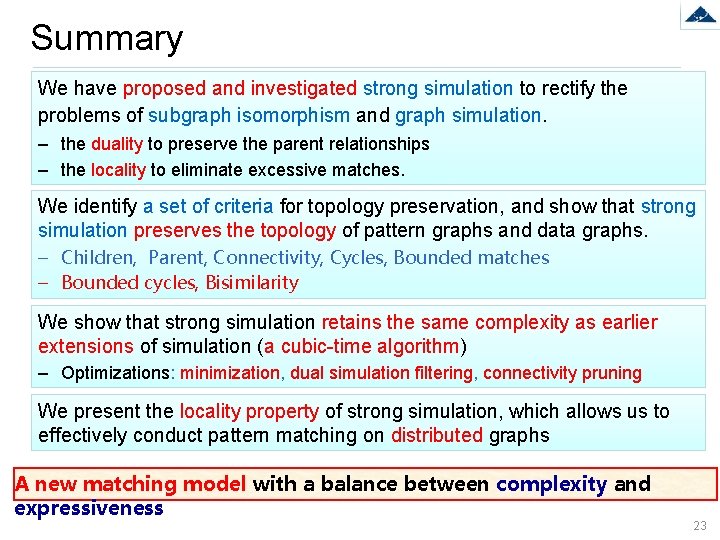
Summary We have proposed and investigated strong simulation to rectify the problems of subgraph isomorphism and graph simulation. – the duality to preserve the parent relationships – the locality to eliminate excessive matches. We identify a set of criteria for topology preservation, and show that strong simulation preserves the topology of pattern graphs and data graphs. – Children, Parent, Connectivity, Cycles, Bounded matches – Bounded cycles, Bisimilarity We show that strong simulation retains the same complexity as earlier extensions of simulation (a cubic-time algorithm) – Optimizations: minimization, dual simulation filtering, connectivity pruning We present the locality property of strong simulation, which allows us to effectively conduct pattern matching on distributed graphs A new matching model with a balance between complexity and expressiveness 23