
Capturing the Secret Dances in the Brain Detecting
Capturing the Secret Dances in the Brain “Detecting current density vector coherent movement”

A problem proposed by: Cerebral Diagnosis
The Brain • The most complex organ • 85 % Water • 100 billion nerve cells • Signal speed may reach upto 429 km/hr
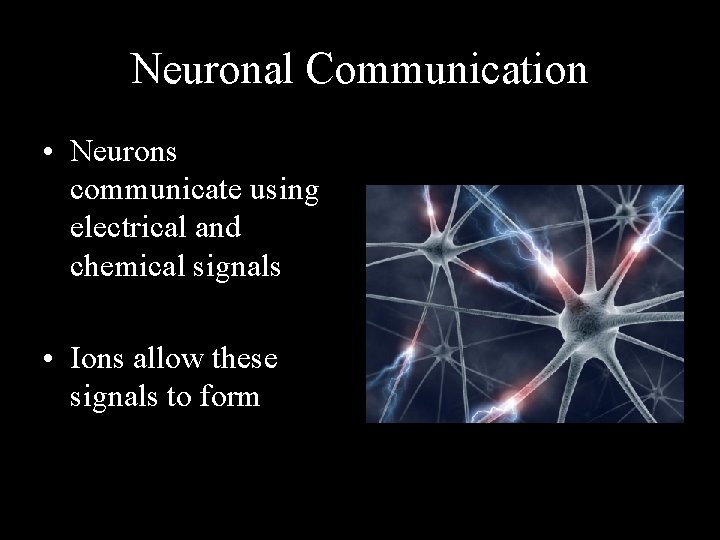
Neuronal Communication • Neurons communicate using electrical and chemical signals • Ions allow these signals to form
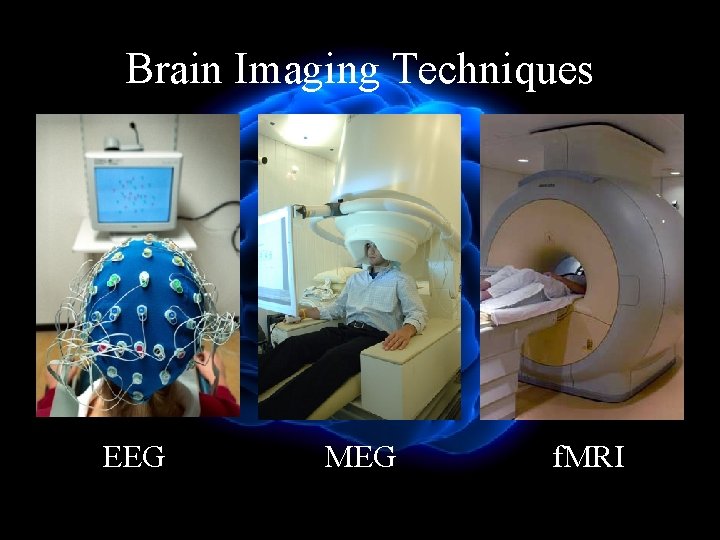
Brain Imaging Techniques EEG MEG f. MRI

Electroencephalogram • Electrodes on scalp measure these voltages • An EEG outputs the voltage and the locations
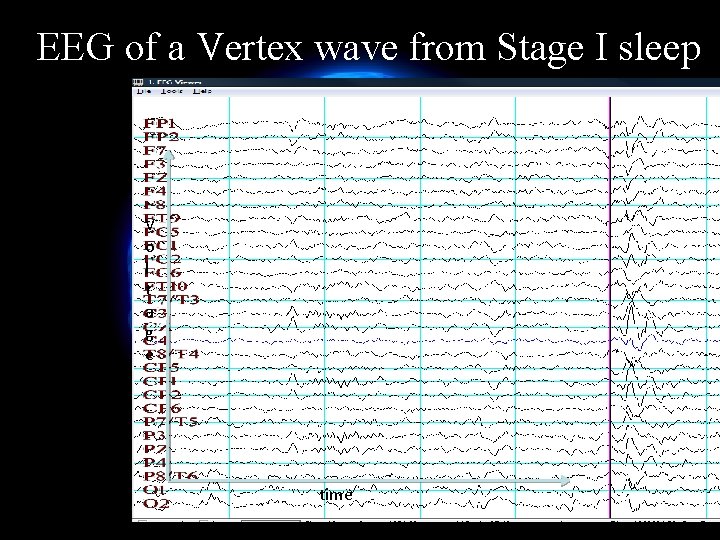
EEG of a Vertex wave from Stage I sleep V o l t a g e time
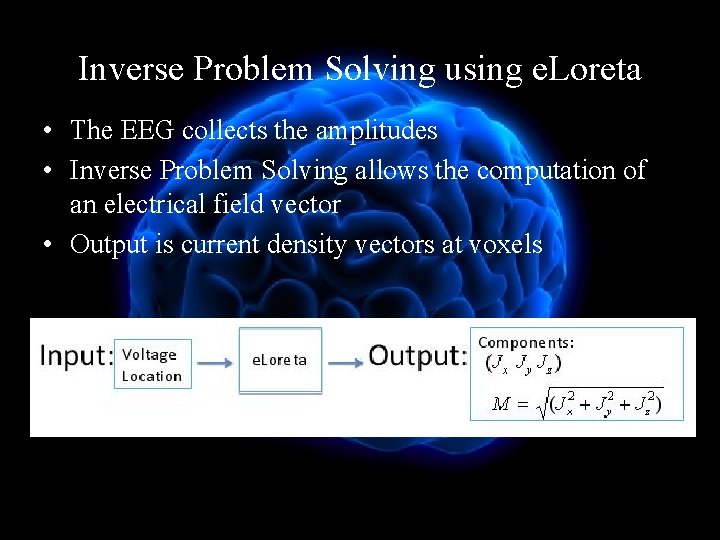
Inverse Problem Solving using e. Loreta • The EEG collects the amplitudes • Inverse Problem Solving allows the computation of an electrical field vector • Output is current density vectors at voxels
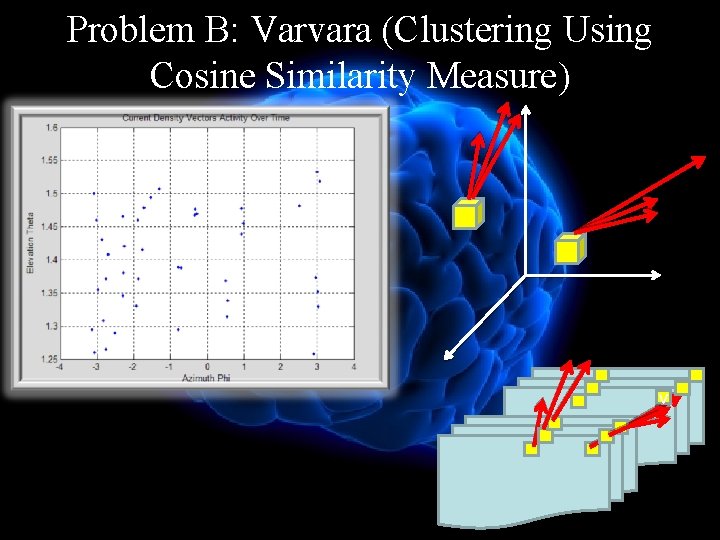
Problems Goal: to capture certain behaviour common to groups of vectors • Problem A: – Classify the vectors according to orientations and spatial positions • Problem B: – Classify the vectors that dance in unison
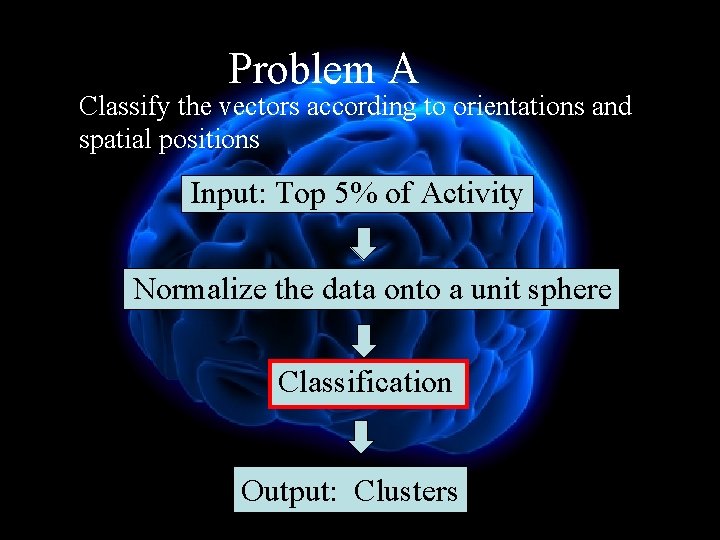
Problem A Classify the vectors according to orientations and spatial positions Input: Top 5% of Activity Normalize the data onto a unit sphere Classification Output: Clusters
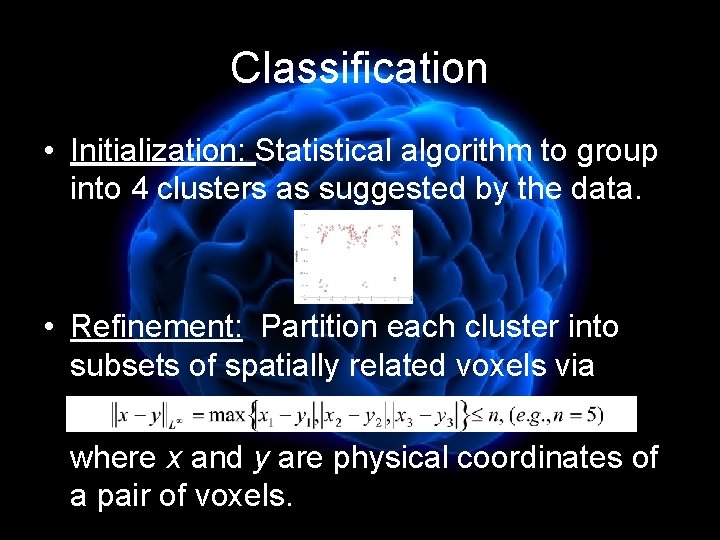
Classification • Initialization: Statistical algorithm to group into 4 clusters as suggested by the data. • Refinement: Partition each cluster into subsets of spatially related voxels via where x and y are physical coordinates of a pair of voxels.
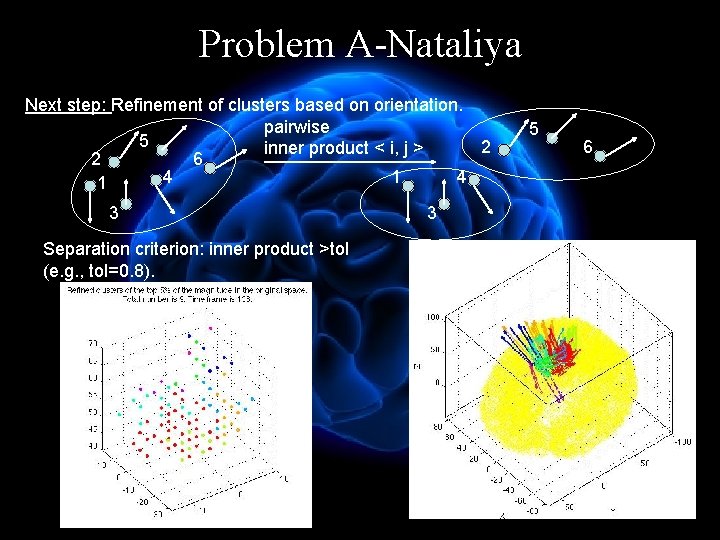
Problem A-Nataliya Next step: Refinement of clusters based on orientation. pairwise 5 2 inner product < i, j > 2 6 4 1 3 Separation criterion: inner product >tol (e. g. , tol=0. 8). 3 5 6
Problem A-Two Layer Classification • First, classify the voxels in connected spatial neighborhoods • Second, refine each neighborhood according to orientations
Problem A-Two Layer Classification
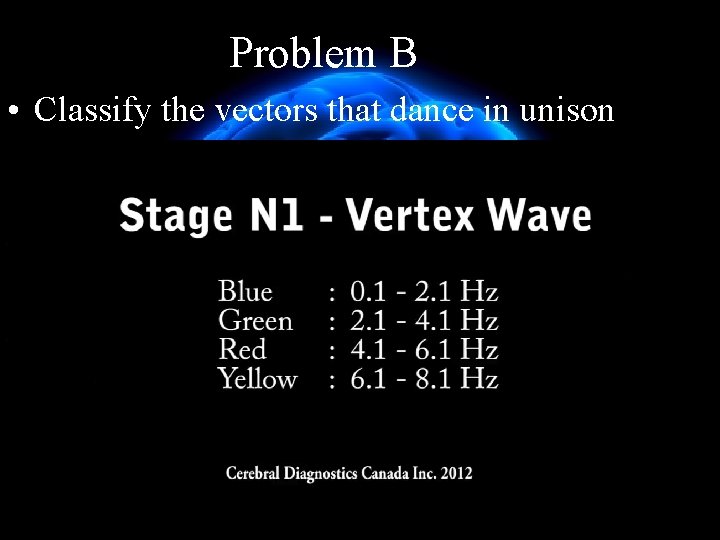
Problem B • Classify the vectors that dance in unison
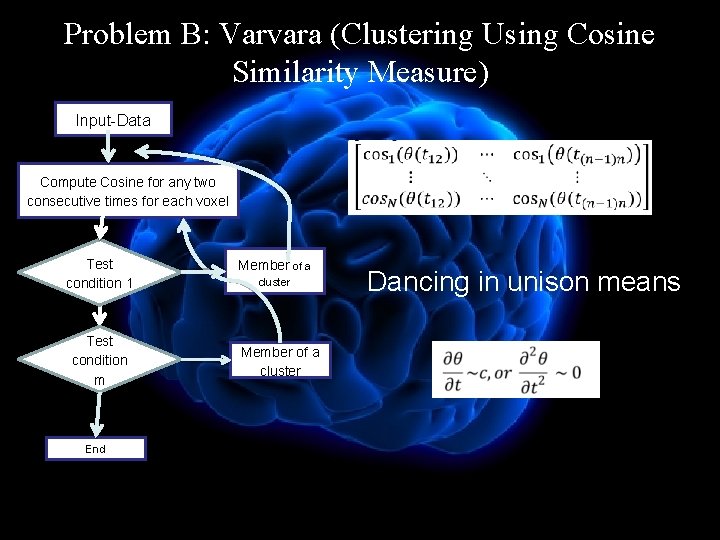
Problem B Dance in Unison? ? ? Doing the same thing at the same time? Doing different things at the same dance?
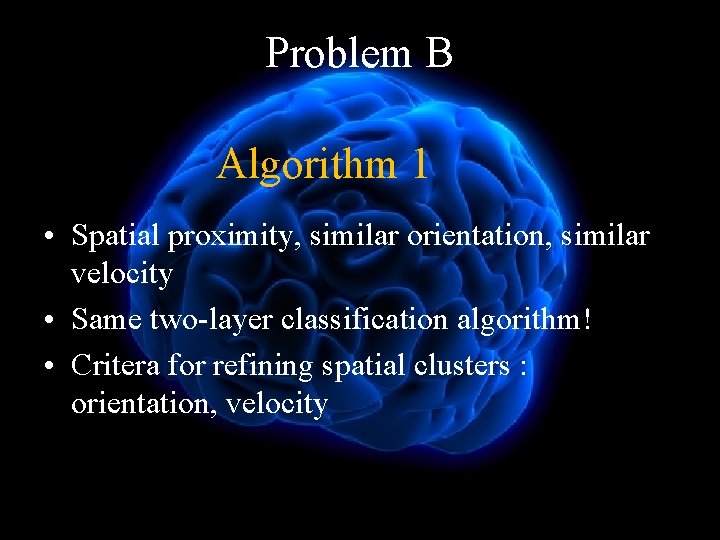
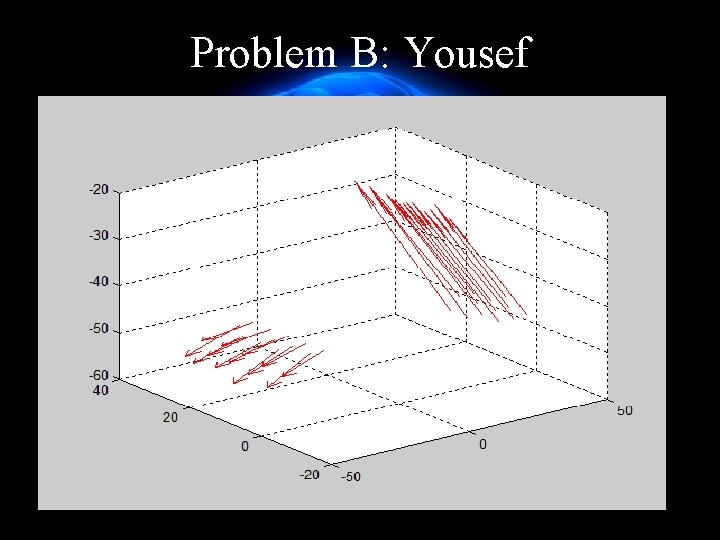
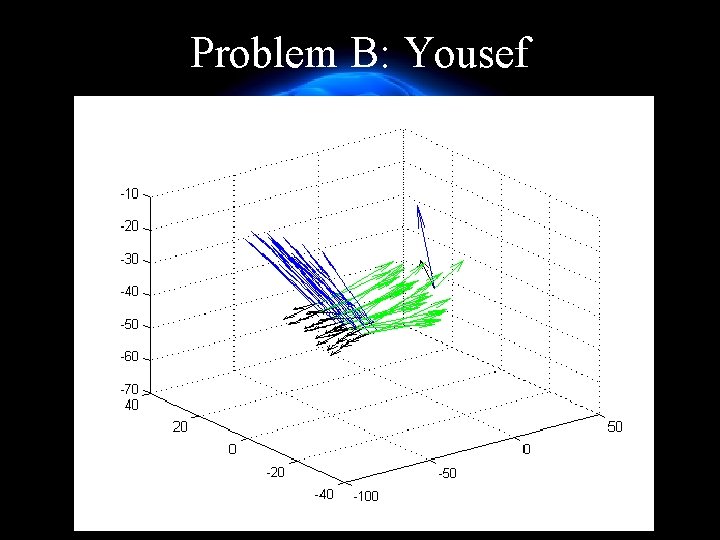
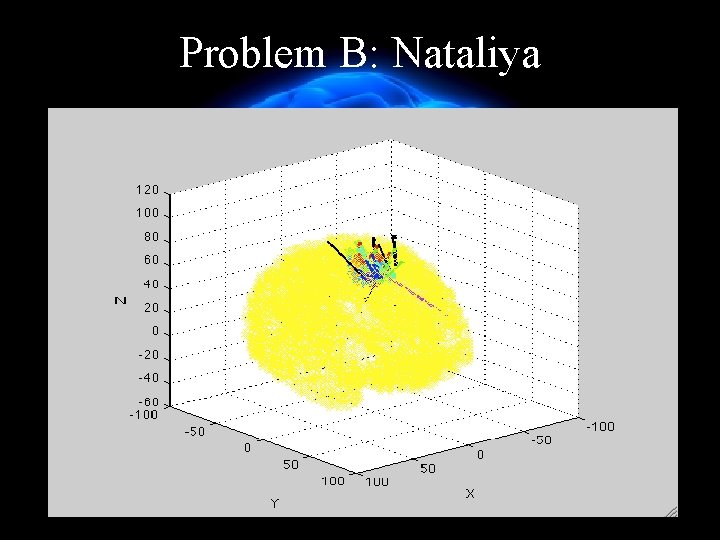
Problem B Algorithm 1 • Spatial proximity, similar orientation, similar velocity • Same two-layer classification algorithm! • Critera for refining spatial clusters : orientation, velocity
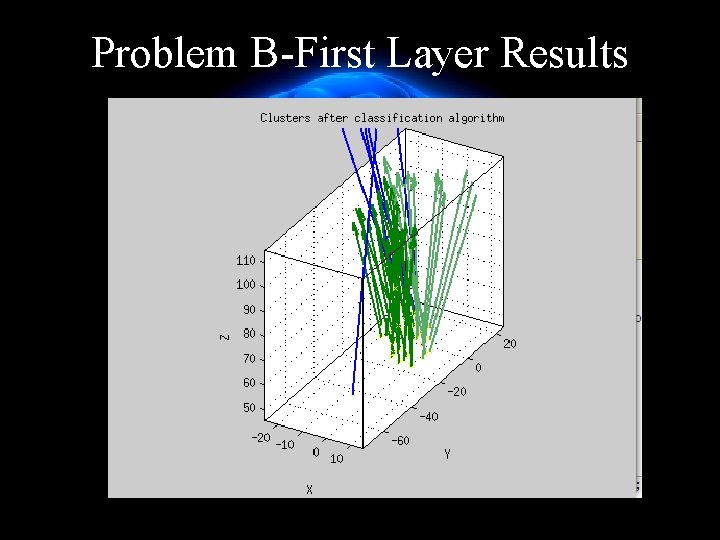
Problem B-First Layer Results
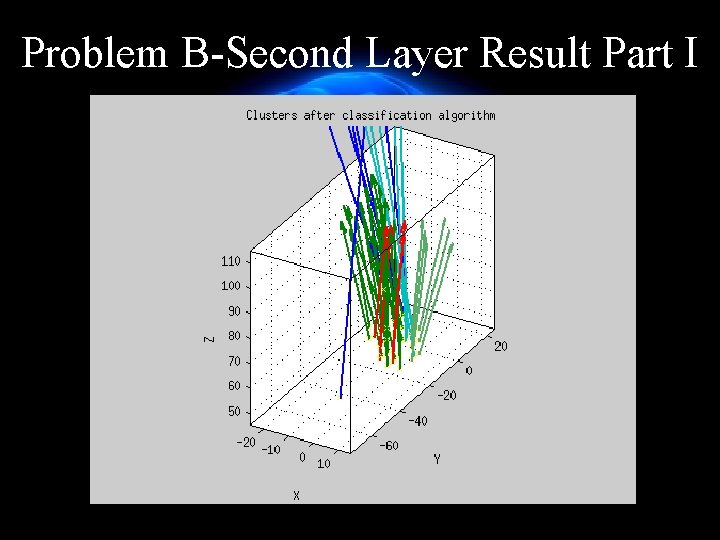
Problem B-Second Layer Result Part I
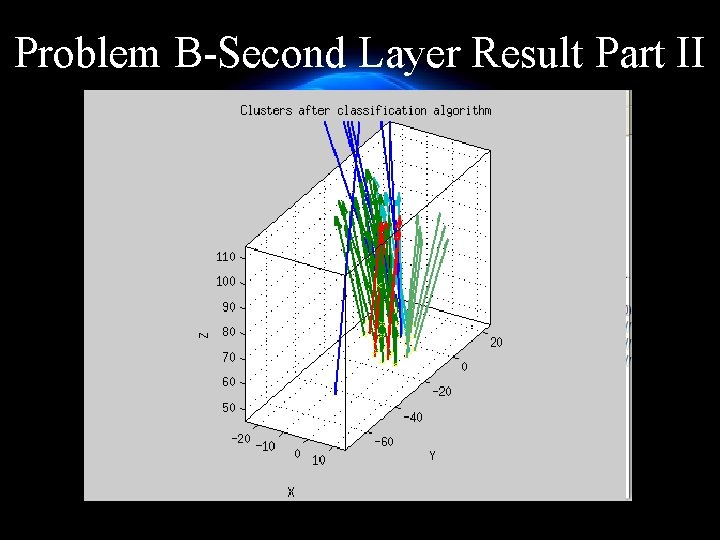
Problem B-Second Layer Result Part II
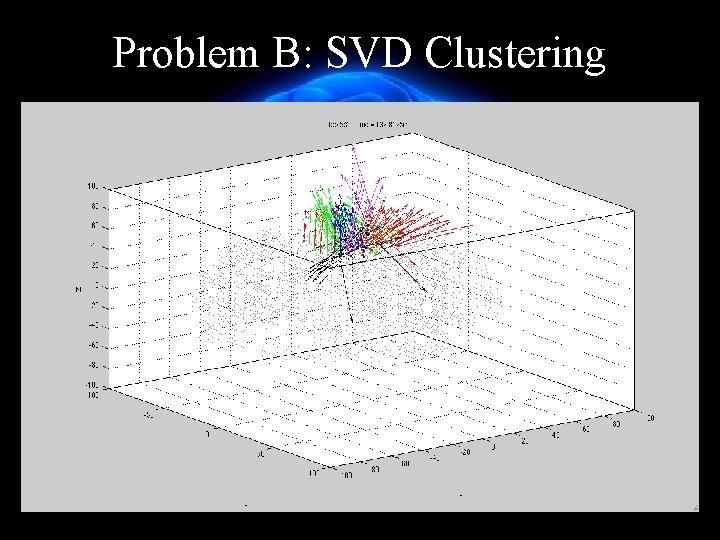
Problem B: SVD Clustering
Problem B: Dominique
Problem B: Yousef
Problem B: Yousef
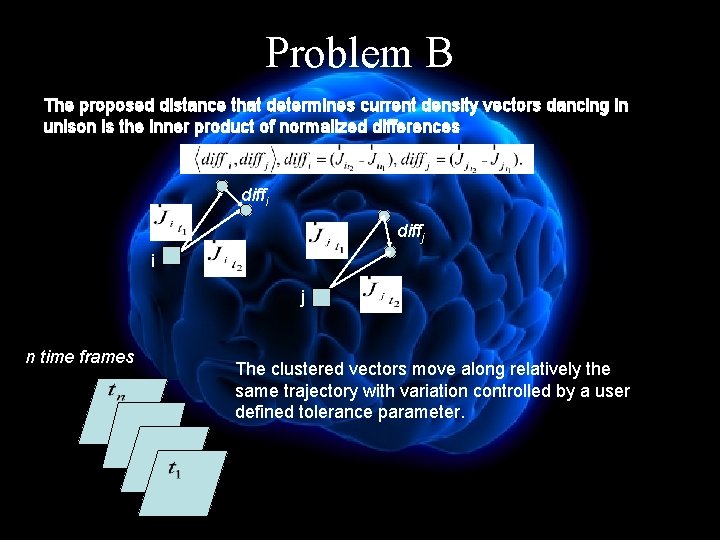
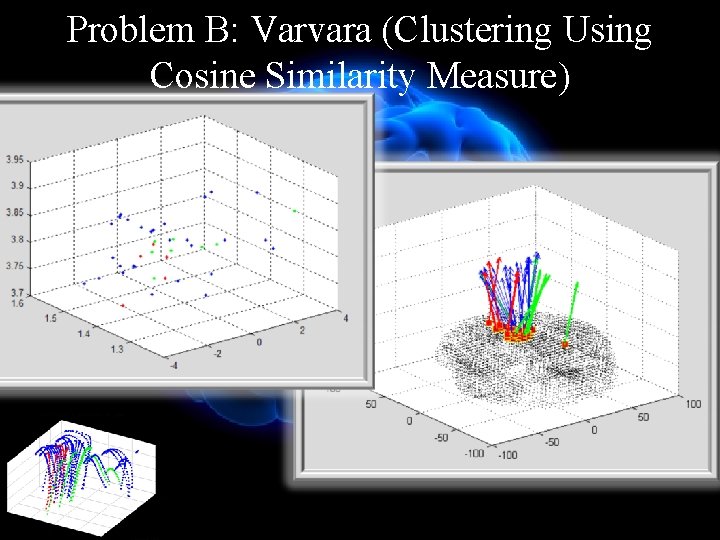
Problem B The proposed distance that determines current density vectors dancing in unison is the inner product of normalized differences diffi diffj i j n time frames The clustered vectors move along relatively the same trajectory with variation controlled by a user defined tolerance parameter.
Problem B: Nataliya
Problem B: Varvara (Clustering Using Cosine Similarity Measure) v
Problem B: Varvara (Clustering Using Cosine Similarity Measure) Input-Data Compute Cosine for any two consecutive times for each voxel Test condition 1 Test condition m End Member of a cluster Dancing in unison means
Problem B: Varvara (Clustering Using Cosine Similarity Measure)
Conclusions: • In this project we tried to observe whether or not any pattern exists in the CDVs data at a fixed time, and over a time interval. • During this very short period of time we were able to solve the two problems in more than one way. • Data whose magnitudes are more that 95% of the maximum magnitudes in the given range were observed. • Next step: validation with other random data, refine models that already work
- Slides: 31