
CAPTURING TACIT KNOWLEDGE CHAPTER 5 Chapter 5 Capturing
- Slides: 24
CAPTURING TACIT KNOWLEDGE CHAPTER 5
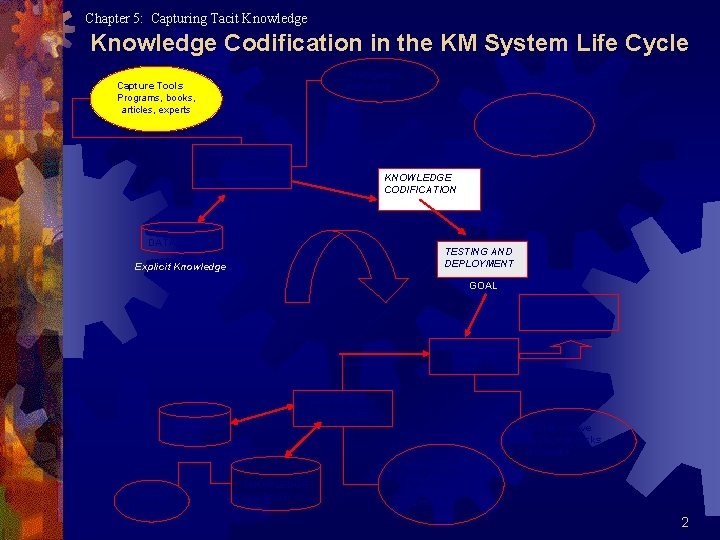
Chapter 5: Capturing Tacit Knowledge Codification in the KM System Life Cycle Intelligence gathering Capture Tools Programs, books, articles, experts Shells, tables, tools, frames maps, rules KNOWLEDGE CAPTURE (Creation) KNOWLEDGE CODIFICATION DATABASES TESTING AND DEPLOYMENT Explicit Knowledge GOAL KNOWLEDGE INNOVATION KNOWLEDGE SHARING KNOWLEDGE TRANSFER DATABASE Insigh t Collaborative tools, networks, Intranets KNOWLEDGE BASE Web browser, Web pages Distributed systems 2
Chapter 5: Capturing Tacit Knowledge What Is Knowledge Capture ? ® Transfer of problem-solving expertise from some knowledge source to a repository or a program ® A process by which the expert’s thoughts and experiences are captured ® Includes capturing knowledge from other sources such as books, technical manuscripts, etc. ® A knowledge developer collaborates with an expert to convert expertise into a coded program ® Knowing how experts know what they know 3
Chapter 5: Capturing Tacit Knowledge Improving the Knowledge Capture Process ® Knowledge developers should focus on how experts approach a problem ® Look beyond the facts or the heuristics ® Re-evaluate how well knowledge developers understand the problem domain and how accurately they are modeling it 4
Chapter 5: Capturing Tacit Knowledge Indicators of Expertise ® Peers regard expert’s decisions good decisions ® Every time there is a problem, the expert is consulted ® Expert sticks to the facts and works with a focus ® Expert has a knack for explaining things ® Expert exhibits an exceptional quality in explanations 5
Chapter 5: Capturing Tacit Knowledge Expert’s Qualifications ® ® ® Knows when to follow hunches Sees big picture Possesses good communication skills Tolerates stress Thinks creatively Exhibits self-confidence Maintains credibility Operates within a schema-driven orientation Uses chunked knowledge Generates motivation and enthusiasm Shares expertise willingly Emulates a good teacher’s habits 6
Chapter 5: Capturing Tacit Knowledge Pros and Cons of Using a Single Expert Advantages: ® Ideal when building a simple KM system ® A problem in a restricted domain ® Facilitates the logistics aspect of coordinating arrangements for knowledge capture ® Problem-related or personal conflicts are easier to resolve ® Shares more confidentiality with projectrelated information than does multiple expert 7
Chapter 5: Capturing Tacit Knowledge Pros and Cons of Using a Single Expert (cont’d) Drawbacks: ® The expert’s knowledge is not easy to capture ® Single experts provide a single line of reasoning, which makes it difficult to evoke indepth discussion of the domain ® Single experts more likely to change scheduled meetings than experts who are part of a team ® Expert knowledge is sometimes dispersed 8
Chapter 5: Capturing Tacit Knowledge Pros and Cons of Using Multiple Experts Advantages ® Complex problem domains benefit from the expertise of more than one expert ® Working with multiple experts stimulates interaction ® Listening to a variety of views allows knowledge developer to consider alternative ways of representing knowledge ® Formal meetings frequently a better environment for generating thoughtful contributions 9
Chapter 5: Capturing Tacit Knowledge Pros and Cons of Using Multiple Experts (cont’d) Drawbacks: ® Scheduling difficulties ® Disagreements frequently occur among experts ® Confidentiality issues ® Requires more than one knowledge developer ® Process loss in determining a solution 10
Chapter 5: Capturing Tacit Knowledge Developing a Relationship With Experts ® Create the right impression ® Do not underestimate the expert’s experience ® Prepare well for the session ® Decide where to hold the session 11
Chapter 5: Capturing Tacit Knowledge Styles of expert’s expressions ® Procedure solution type—methodical approach to the ® Storyteller—focuses on the content of the domain at the expense of the solution ® Godfather—compulsion session to take over the ® Salesperson—spends most of the time explaining his or her solution is the best 12
Chapter 5: Capturing Tacit Knowledge Approaching Multiple Experts ® Individual approach—holding a session with one expert at a time ® Primary and secondary experts—start with the senior expert first, on down to others in the hierarchy. Alternatively, start bottom up for verification and authentication of knowledge gathered ® Small groups approach—experts gathered in one place to provide a pool of information. Each expert tested against expertise of others in the group 13
Chapter 5: Capturing Tacit Knowledge Analogies and Uncertainties In Information ® Experts use analogies to explain events ® An expert’s knowledge is the ability to take uncertain information and use a plausible line of reasoning to clarify the fuzzy details ® Understanding experience. Knowledge in cognitive psychology is helpful background ® Language problem. Reliable knowledge capture requires understanding and interpreting expert’s verbal description of information, heuristics, and so on 14
Chapter 5: Capturing Tacit Knowledge The Interview As a Tool ® Commonly used in the early stages of tacit knowledge capture ® The voluntary nature of the interview is important ® Major benefit is behavioral analysis ® Interviewing as a tool requires training and preparation ® Great tool for eliciting information about complex subjects ® Convenient tool for evaluating the validity of information acquired 15
Chapter 5: Capturing Tacit Knowledge Types of Interviews ® Structured: Questions and responses are definitive. Used when specific information is sought ® Semistructured: Predefined questions are asked but allow expert some freedom in expressing the answers ® Unstructured: Neither the questions nor their responses specified in advance. Used when exploring an issue 16
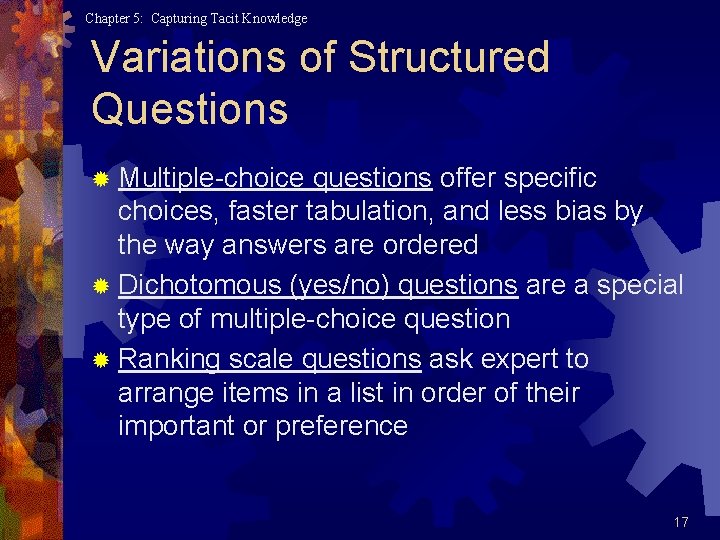
Chapter 5: Capturing Tacit Knowledge Variations of Structured Questions ® Multiple-choice questions offer specific choices, faster tabulation, and less bias by the way answers are ordered ® Dichotomous (yes/no) questions are a special type of multiple-choice question ® Ranking scale questions ask expert to arrange items in a list in order of their important or preference 17
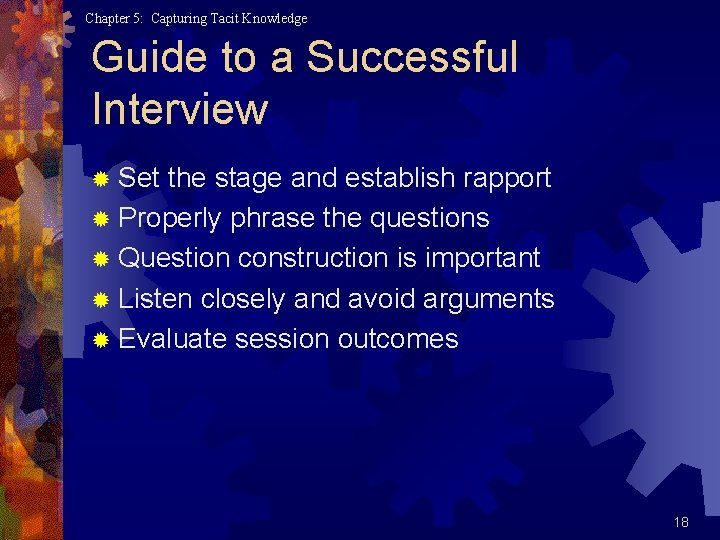
Chapter 5: Capturing Tacit Knowledge Guide to a Successful Interview ® Set the stage and establish rapport ® Properly phrase the questions ® Question construction is important ® Listen closely and avoid arguments ® Evaluate session outcomes 18
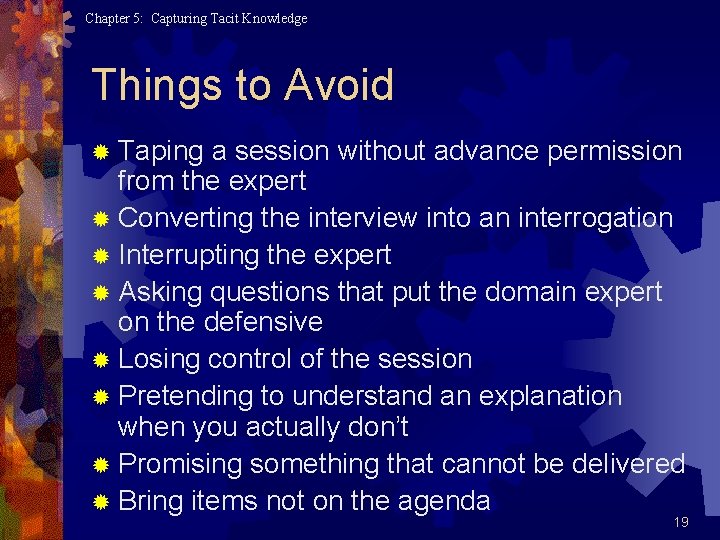
Chapter 5: Capturing Tacit Knowledge Things to Avoid ® Taping a session without advance permission from the expert ® Converting the interview into an interrogation ® Interrupting the expert ® Asking questions that put the domain expert on the defensive ® Losing control of the session ® Pretending to understand an explanation when you actually don’t ® Promising something that cannot be delivered ® Bring items not on the agenda 19
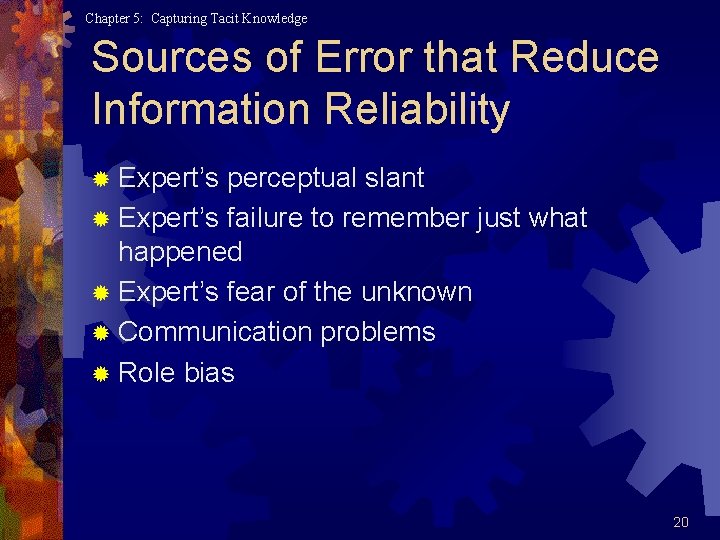
Chapter 5: Capturing Tacit Knowledge Sources of Error that Reduce Information Reliability ® Expert’s perceptual slant ® Expert’s failure to remember just what happened ® Expert’s fear of the unknown ® Communication problems ® Role bias 20
Chapter 5: Capturing Tacit Knowledge Errors Made by the Knowledge Developer ® Age effect ® Race effect ® Gender effect 21
Chapter 5: Capturing Tacit Knowledge Problems Encountered During the Interview ® Response bias ® Inconsistency ® Communication difficulties ® Hostile attitude ® Standardized questions ® Lengthy questions ® Long interview 22
Chapter 5: Capturing Tacit Knowledge Issues to Assess ® ® ® How would one elicit knowledge from experts who cannot say what they mean or mean what they say? What does one say or do when the expert says, “Look, I work with shades of gray reasoning. I simply look at the problem and decide. Don’t ask me why or how. ” How does one set up the problem domain when one has only a general idea of what it should be? What does one do if the relationship with the domain expert turns out to be difficult? What happens if the expert dislikes the knowledge developer? 23
CAPTURING TACIT KNOWLEDGE CHAPTER 5