
CAPTURING SAMPLE COLLECTION DESCRIPTIONS IN THE IR4 FIELD
- Slides: 18
CAPTURING SAMPLE COLLECTION DESCRIPTIONS IN THE IR-4 FIELD DATA BOOK Edith Lurvey & Van Starner Phoenix Conference 3/2/06 (8: 15 a. m. )
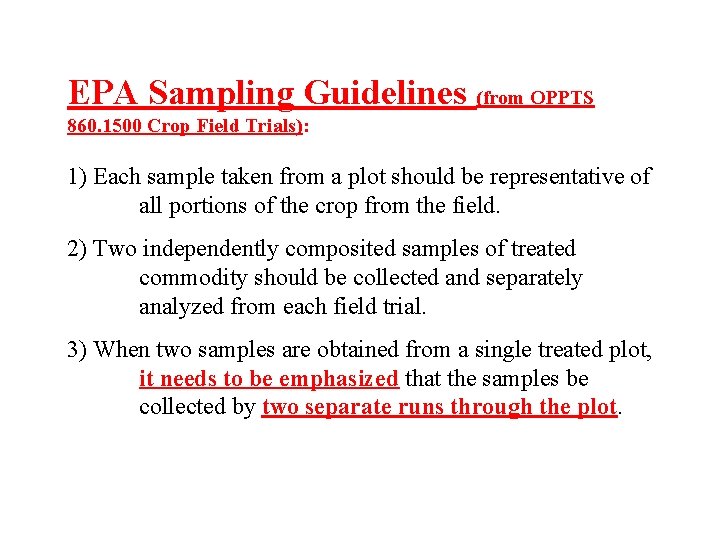
EPA Sampling Guidelines (from OPPTS 860. 1500 Crop Field Trials): 1) Each sample taken from a plot should be representative of all portions of the crop from the field. 2) Two independently composited samples of treated commodity should be collected and separately analyzed from each field trial. 3) When two samples are obtained from a single treated plot, it needs to be emphasized that the samples be collected by two separate runs through the plot.
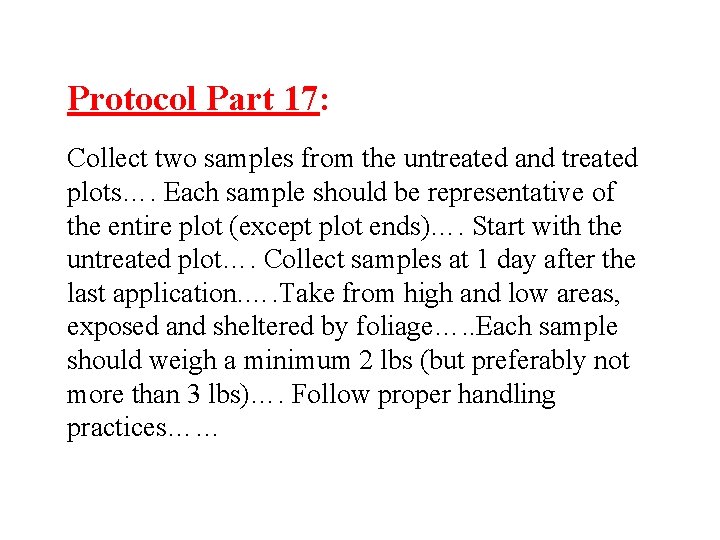
Protocol Part 17: Collect two samples from the untreated and treated plots…. Each sample should be representative of the entire plot (except plot ends)…. Start with the untreated plot…. Collect samples at 1 day after the last application. …. Take from high and low areas, exposed and sheltered by foliage…. . Each sample should weigh a minimum 2 lbs (but preferably not more than 3 lbs)…. Follow proper handling practices……
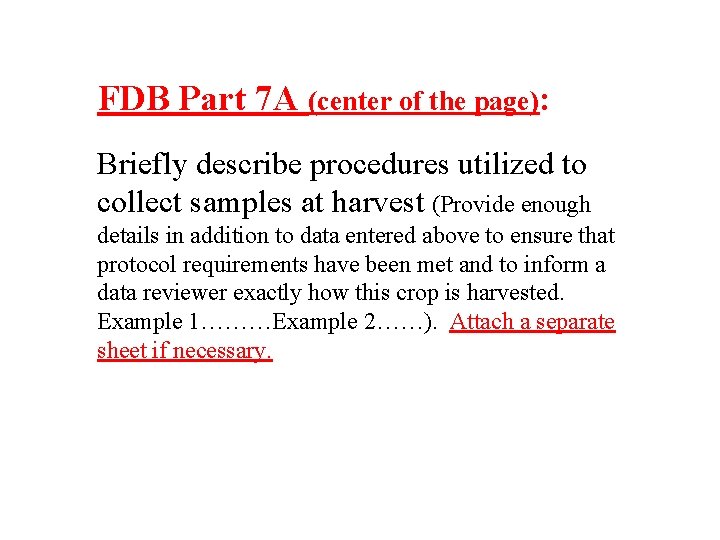
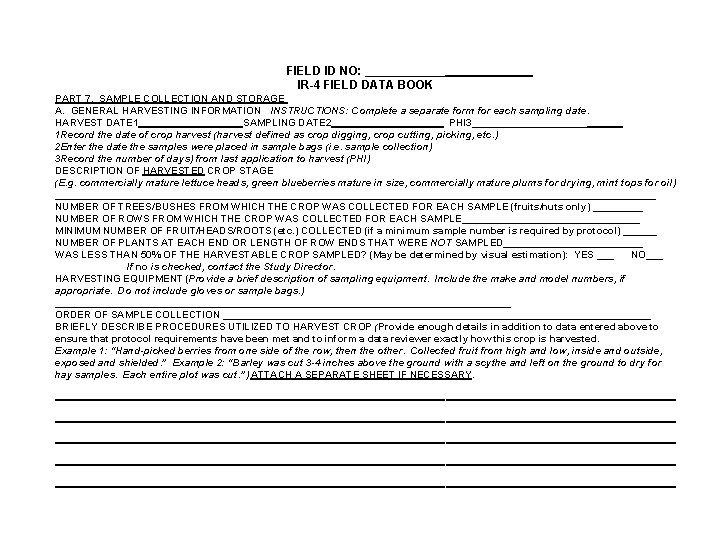
FDB Part 7 A (center of the page): Briefly describe procedures utilized to collect samples at harvest (Provide enough details in addition to data entered above to ensure that protocol requirements have been met and to inform a data reviewer exactly how this crop is harvested. Example 1………Example 2……). Attach a separate sheet if necessary.
FIELD ID NO: ______ IR-4 FIELD DATA BOOK PART 7. SAMPLE COLLECTION AND STORAGE A. GENERAL HARVESTING INFORMATION INSTRUCTIONS: Complete a separate form for each sampling date. HARVEST DATE 1 SAMPLING DATE 2 PHI 3___________ 1 Record the date of crop harvest (harvest defined as crop digging, crop cutting, picking, etc. ) 2 Enter the date the samples were placed in sample bags (i. e. sample collection) 3 Record the number of days) from last application to harvest (PHI) DESCRIPTION OF HARVESTED CROP STAGE (E. g. commercially mature lettuce heads, green blueberries mature in size, commercially mature plums for drying, mint tops for oil) ______________________________________________________ NUMBER OF TREES/BUSHES FROM WHICH THE CROP WAS COLLECTED FOR EACH SAMPLE (fruits/nuts only) _____ NUMBER OF ROWS FROM WHICH THE CROP WAS COLLECTED FOR EACH SAMPLE________________ MINIMUM NUMBER OF FRUIT/HEADS/ROOTS (etc. ) COLLECTED (if a minimum sample number is required by protocol) ______ NUMBER OF PLANTS AT EACH END OR LENGTH OF ROW ENDS THAT WERE NOT SAMPLED_____________ WAS LESS THAN 50% OF THE HARVESTABLE CROP SAMPLED? (May be determined by visual estimation): YES ___ NO___ If no is checked, contact the Study Director. HARVESTING EQUIPMENT (Provide a brief description of sampling equipment. Include the make and model numbers, if appropriate. Do not include gloves or sample bags. ) _________________________________________ ORDER OF SAMPLE COLLECTION _______________________________________ BRIEFLY DESCRIBE PROCEDURES UTILIZED TO HARVEST CROP (Provide enough details in addition to data entered above to ensure that protocol requirements have been met and to inform a data reviewer exactly how this crop is harvested. Example 1: “Hand-picked berries from one side of the row, then the other. Collected fruit from high and low, inside and outside, exposed and shielded. ” Example 2: “Barley was cut 3 -4 inches above the ground with a scythe and left on the ground to dry for hay samples. Each entire plot was cut. ”) ATTACH A SEPARATE SHEET IF NECESSARY. ______________________________________________________________ _______________________________
Example FRD harvest description: Dry plants and bean pods run thru plot harvester.
What do you think? What else is needed? 1. 2. 3. 4. 5. 6. 7.
Example FRD harvest description: Started sampling UTC at 1: 28 pm, into UTC cooler (with 2 blue ice) at 1: 44 pm “Gil” sampled UTC. “Curly” sampled TRT 02 from 1: 28 to TRT cooler at 1: 45. Curly sampled TRT 03 from 1: 45 until 2: 30 pm (into TRT cooler), avoid plot edges 5’ on all sides, picked high/low, exposed & not.
What do you think? What else is needed? 1. 2. 3. 4. 5. 6. 7.
Example FRD harvest description: Collected samples from high and low areas of plants beginning with the untreated plot, then from the low treated rate, and finally the high treated rate, avoiding sampling from ends of plots.
What do you think? What else is needed? 1. 2. 3. 4. 5. 6. 7.
Example FRD harvest description: Representative impartial samples were taken. Beans were harvested by hand placed in two windrows. After 12 days of drying, entire plot was combined and two, 2 lb samples were taken from bean box for each plot
What do you think? What else is needed? 1. 2. 3. 4. 5. 6. 7.
What elements are needed in a good description? 1. 2. 3. 4. 5. 6. 7.
Ideal Part 7 A Sampling Descriptions: Should be sufficiently detailed so that QC reviewers, QA, SD, EPA and anyone else trying to recreate the study understands exactly what you did, how you did it, and can determine whether or not “representative” samples were indeed collected. Ask yourself: “If I hadn’t been here, would my description be sufficient for me to repeat the sampling in the same manner that it was done? ”
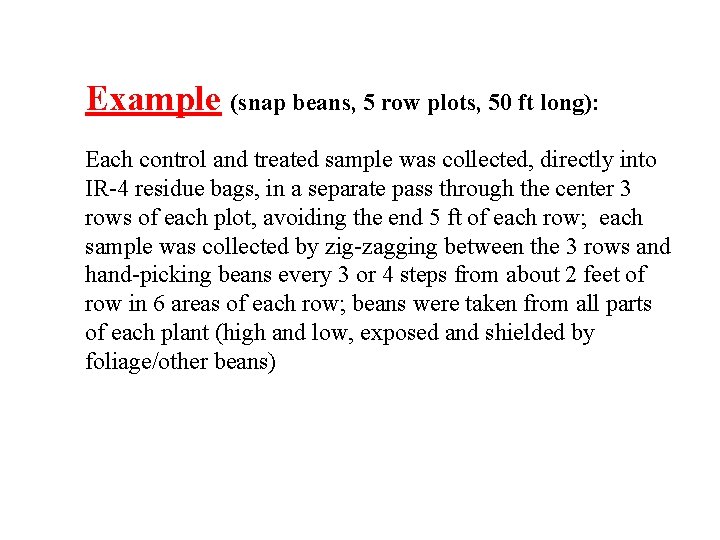
Example (snap beans, 5 row plots, 50 ft long): Each control and treated sample was collected, directly into IR-4 residue bags, in a separate pass through the center 3 rows of each plot, avoiding the end 5 ft of each row; each sample was collected by zig-zagging between the 3 rows and hand-picking beans every 3 or 4 steps from about 2 feet of row in 6 areas of each row; beans were taken from all parts of each plant (high and low, exposed and shielded by foliage/other beans)
Example (beet root & tops, 4 row plots, 60 ft long): Starting with the untreated plot, first beets were pulled, by hand, from the center 2 rows of the 4 -row plot, avoiding the first and last 5 feet. Samples were collected by zig-zagging between the 2 rows and pulling a plant every 3 to 4 steps. When pulled, the tops were cut from the root with clean pruning shears about 0. 5 to 1 inch above the crown, and bagged. The soil was then brushed off the root by hand bagged. Each plant was completed before moving to the next plant, and each sample was completed before starting the next. For the untreated samples, additional tops were needed to meet the required weight, so 6 additional tops were cut, just above the soil line, shaken and added to the residue bag.
FDB Part 7 A questions to ponder and discuss! 1. What does “representative” mean? 2. What does “commercially mature” mean? 3. How do you collect “from high and low” on an indeterminate plant? 4. What do you do if your mature fruit will rot before harvest date? 5. When sampling roots and tops, do you take both from the same plants? 6. 7. 8.