
Capturing indicators of high quality interactions and meaningful
- Slides: 1
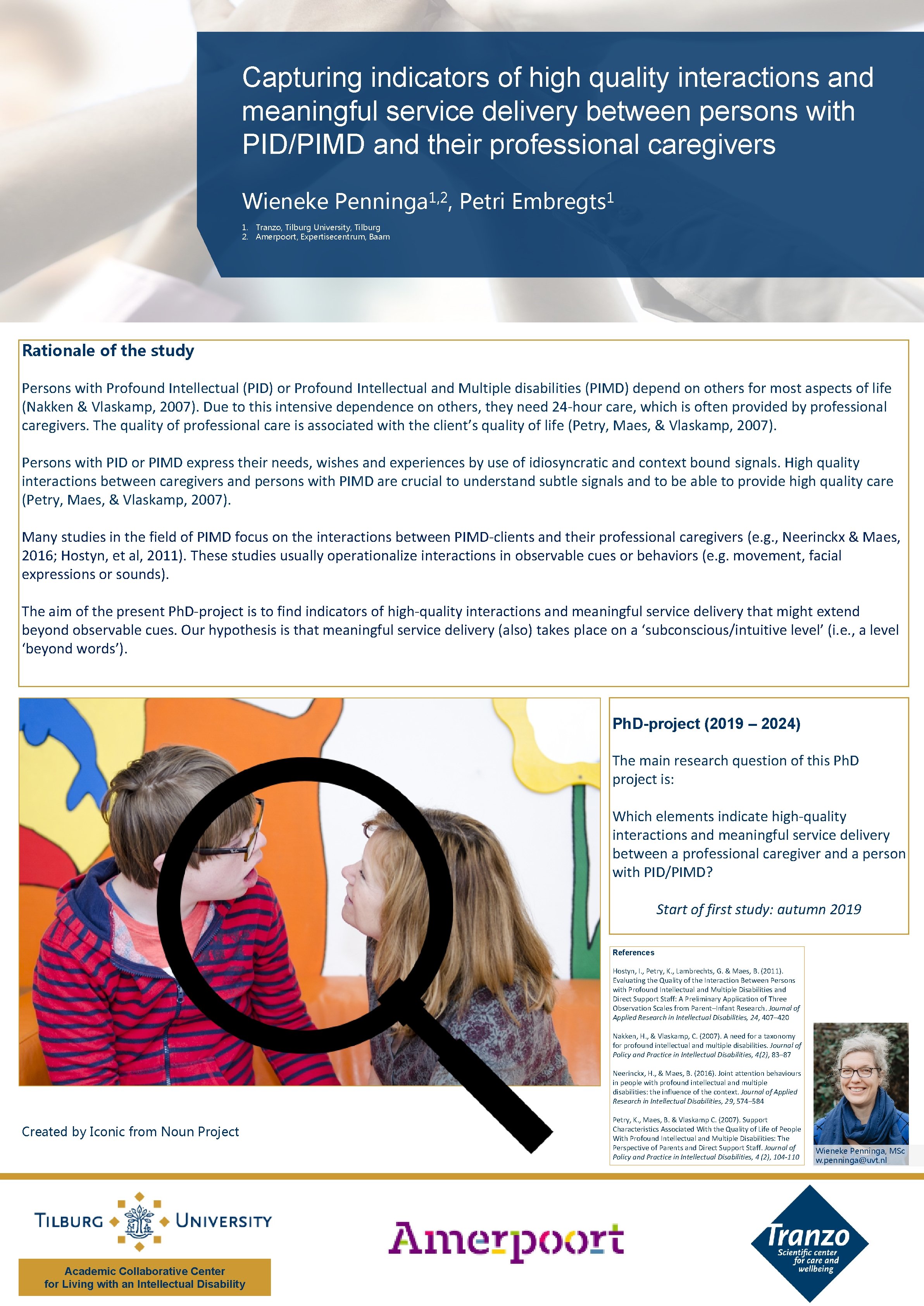
Capturing indicators of high quality interactions and meaningful service delivery between persons with PID/PIMD and their professional caregivers Wieneke 1, 2 Penninga , Petri 1 Embregts 1. Tranzo, Tilburg University, Tilburg 2. Amerpoort, Expertisecentrum, Baarn Rationale of the study Persons with Profound Intellectual (PID) or Profound Intellectual and Multiple disabilities (PIMD) depend on others for most aspects of life (Nakken & Vlaskamp, 2007). Due to this intensive dependence on others, they need 24 -hour care, which is often provided by professional caregivers. The quality of professional care is associated with the client’s quality of life (Petry, Maes, & Vlaskamp, 2007). Persons with PID or PIMD express their needs, wishes and experiences by use of idiosyncratic and context bound signals. High quality interactions between caregivers and persons with PIMD are crucial to understand subtle signals and to be able to provide high quality care (Petry, Maes, & Vlaskamp, 2007). Many studies in the field of PIMD focus on the interactions between PIMD-clients and their professional caregivers (e. g. , Neerinckx & Maes, 2016; Hostyn, et al, 2011). These studies usually operationalize interactions in observable cues or behaviors (e. g. movement, facial expressions or sounds). The aim of the present Ph. D-project is to find indicators of high-quality interactions and meaningful service delivery that might extend beyond observable cues. Our hypothesis is that meaningful service delivery (also) takes place on a ‘subconscious/intuitive level’ (i. e. , a level ‘beyond words’). Ph. D-project (2019 – 2024) The main research question of this Ph. D project is: Which elements indicate high-quality interactions and meaningful service delivery between a professional caregiver and a person with PID/PIMD? Start of first study: autumn 2019 References Hostyn, I. , Petry, K. , Lambrechts, G. & Maes, B. (2011). Evaluating the Quality of the Interaction Between Persons with Profound Intellectual and Multiple Disabilities and Direct Support Staff: A Preliminary Application of Three Observation Scales from Parent–Infant Research. Journal of Applied Research in Intellectual Disabilities, 24, 407– 420 Nakken, H. , & Vlaskamp, C. (2007). A need for a taxonomy for profound intellectual and multiple disabilities. Journal of Policy and Practice in Intellectual Disabilities, 4(2), 83– 87 Neerinckx, H. , & Maes, B. (2016). Joint attention behaviours in people with profound intellectual and multiple disabilities: the influence of the context. Journal of Applied Research in Intellectual Disabilities, 29, 574– 584 Created by Iconic from Noun Project Academic Collaborative Center for Living with an Intellectual Disability Petry, K. , Maes, B. & Vlaskamp C. (2007). Support Characteristics Associated With the Quality of Life of People With Profound Intellectual and Multiple Disabilities: The Perspective of Parents and Direct Support Staff. Journal of Policy and Practice in Intellectual Disabilities, 4 (2), 104 -110 Wieneke Penninga, MSc w. penninga@uvt. nl