
Captives 101 What is Captive Insurance How do

- Slides: 52
Captives 101 What is Captive Insurance? How do I know if its right for my business? � � � CT Captive Symposium, October 25, 2017 Rocco Mancini, Marsh Captive Solutions Alicia Miller, Crowe Horwath Colin Finch Milliman Janet Grace, CT Insurance Dept. , Moderator
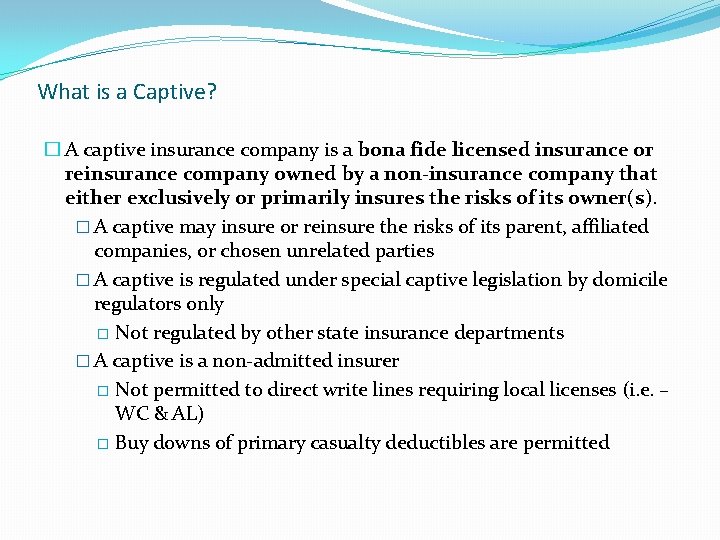
What is a Captive? � A captive insurance company is a bona fide licensed insurance or reinsurance company owned by a non-insurance company that either exclusively or primarily insures the risks of its owner(s). � A captive may insure or reinsure the risks of its parent, affiliated companies, or chosen unrelated parties � A captive is regulated under special captive legislation by domicile regulators only � Not regulated by other state insurance departments � A captive is a non-admitted insurer � Not permitted to direct write lines requiring local licenses (i. e. – WC & AL) � Buy downs of primary casualty deductibles are permitted
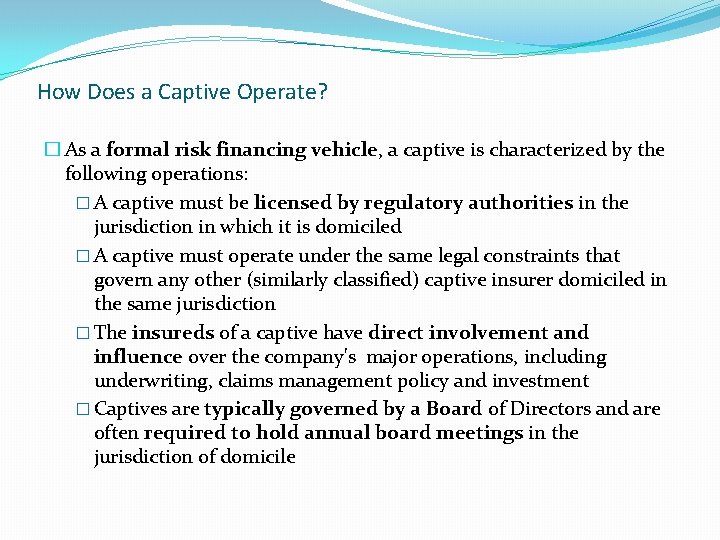
How Does a Captive Operate? � As a formal risk financing vehicle, a captive is characterized by the following operations: � A captive must be licensed by regulatory authorities in the jurisdiction in which it is domiciled � A captive must operate under the same legal constraints that govern any other (similarly classified) captive insurer domiciled in the same jurisdiction � The insureds of a captive have direct involvement and influence over the company's major operations, including underwriting, claims management policy and investment � Captives are typically governed by a Board of Directors and are often required to hold annual board meetings in the jurisdiction of domicile
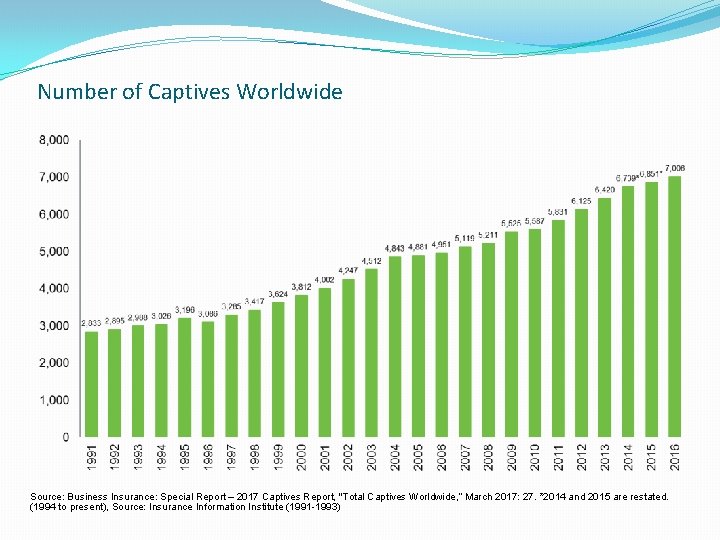
Number of Captives Worldwide Source: Business Insurance: Special Report – 2017 Captives Report, "Total Captives Worldwide, ” March 2017: 27. *2014 and 2015 are restated. (1994 to present), Source: Insurance Information Institute (1991 -1993)
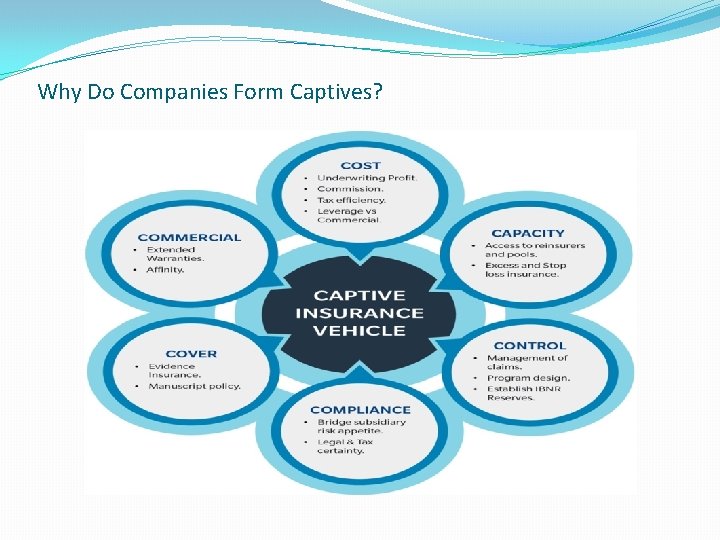
Why Do Companies Form Captives?
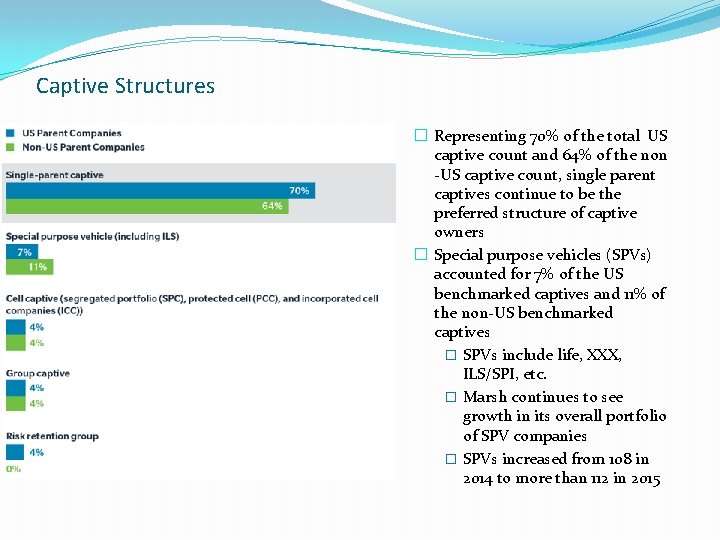
Captive Structures � Representing 70% of the total US captive count and 64% of the non -US captive count, single parent captives continue to be the preferred structure of captive owners � Special purpose vehicles (SPVs) accounted for 7% of the US benchmarked captives and 11% of the non-US benchmarked captives � SPVs include life, XXX, ILS/SPI, etc. � Marsh continues to see growth in its overall portfolio of SPV companies � SPVs increased from 108 in 2014 to more than 112 in 2015
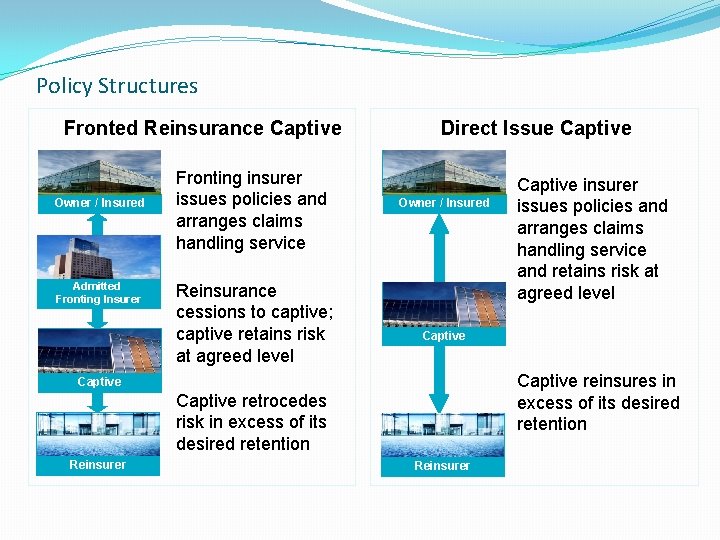
Policy Structures Fronted Reinsurance Captive Owner / Insured Admitted Fronting Insurer Fronting insurer issues policies and arranges claims handling service Reinsurance cessions to captive; captive retains risk at agreed level Direct Issue Captive Owner / Insured Captive reinsures in excess of its desired retention Captive retrocedes risk in excess of its desired retention Reinsurer Captive insurer issues policies and arranges claims handling service and retains risk at agreed level Reinsurer
Policy Structures: Fronted Reinsurance �Reinsure when… �Admitted insurance policies are required �Need to meet proof of financial responsibility requirements (property -landlords, products liability -retailers) �Security issues (A. M. Best rating) �Providing insurance to unrelated parties
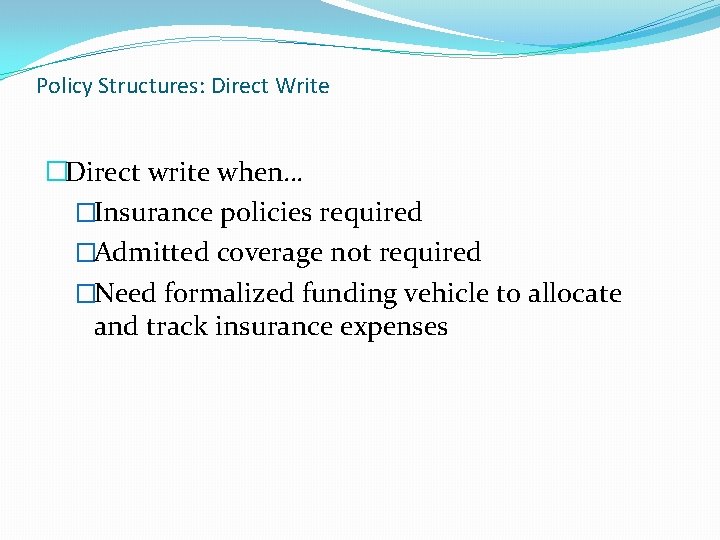
Policy Structures: Direct Write �Direct write when… �Insurance policies required �Admitted coverage not required �Need formalized funding vehicle to allocate and track insurance expenses
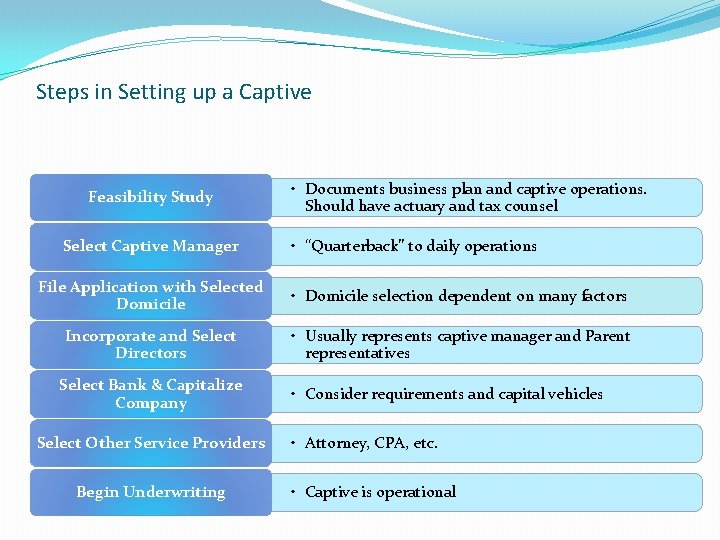
Steps in Setting up a Captive Feasibility Study Select Captive Manager • Documents business plan and captive operations. Should have actuary and tax counsel • “Quarterback” to daily operations File Application with Selected Domicile • Domicile selection dependent on many factors Incorporate and Select Directors • Usually represents captive manager and Parent representatives Select Bank & Capitalize Company Select Other Service Providers Begin Underwriting • Consider requirements and capital vehicles • Attorney, CPA, etc. • Captive is operational
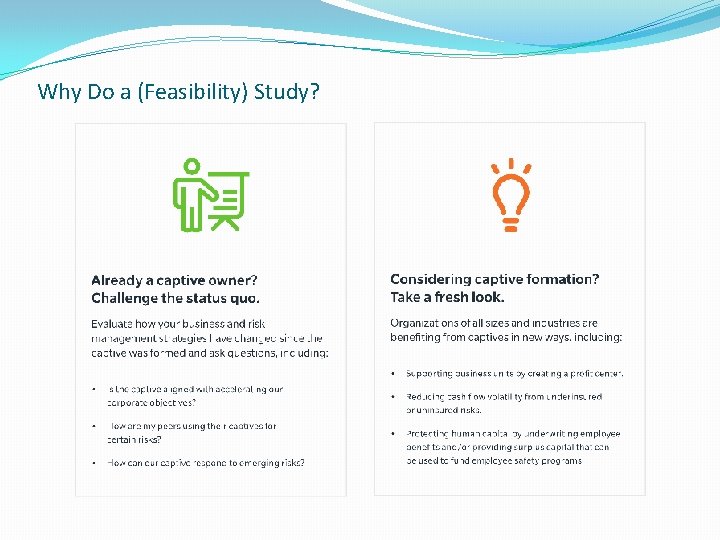
Why Do a (Feasibility) Study?
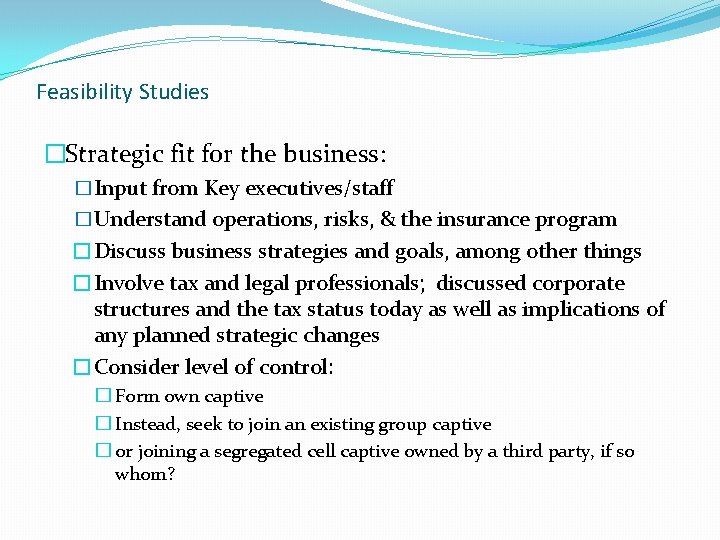
Feasibility Studies �Strategic fit for the business: �Input from Key executives/staff �Understand operations, risks, & the insurance program �Discuss business strategies and goals, among other things �Involve tax and legal professionals; discussed corporate structures and the tax status today as well as implications of any planned strategic changes �Consider level of control: � Form own captive � Instead, seek to join an existing group captive � or joining a segregated cell captive owned by a third party, if so whom?
Captives: Roles of the Actuary �Retention Analysis �Feasibility Analysis �Annual Reserving (incl. Statement of Actuarial Opinion (“SAO”)) �Annual Funding �Other Supporting Services
Roles of the Actuary – Retention Analysis � Analysis in determine an organization’s best use of it’s capital when deciding to retain or transfer risk � Determination of optimal retention by evaluating: � Expected losses � Probability distributions � Risk appetite � Reinsurance/excess insurance industry quotes � Total Cost of Risk and Capital � Typical data required includes: � Basic operational information – historical deductibles/retentions, operational changes, etc. � Historical annual loss summaries (minimum 5 years) – includes accident/report date, paid loss and ALAE, case reserves, by claim � Exposure information (historical and prospective � Reinsurance (excess insurance) quotes at limits to be considered � Company selected loss confidence level
Roles of the Actuary – Feasibility Study � Evaluation of the financial viability of the captive � Includes: � Forecast of loss estimates under certain/various policy limits and/or net retentions � Five-year pro-forma financials to illustrate the financial results of the captive under both expected and adverse scenarios � Additional data required includes premium growth assumptions, premium earnings/collection, expense assumptions, and expected rate of return on investments � Also aides in � Risk identification/quantification � Regulator requirements � Reinsurance negotiations
Roles of the Actuary – Feasibility Study (cont. ) � Loss Analysis � Review of past loss experience � Actuarial adjustments Development, Internal Factors (e. g. loss control), External Factors (e. g. trend) � Selected loss rate � Projected losses = Selected Loss Rate x Projected Exposures � Projections at higher (lower) limits based on company data and/or industry factors � � Pro Forma Financial statements � 5 years of prospective financial statements including income statement, balance sheet, and cash flow � Use actuarially determined payout patterns � Expected incorporation of ongoing expenses � Investment modeling � Surplus and capital contributions
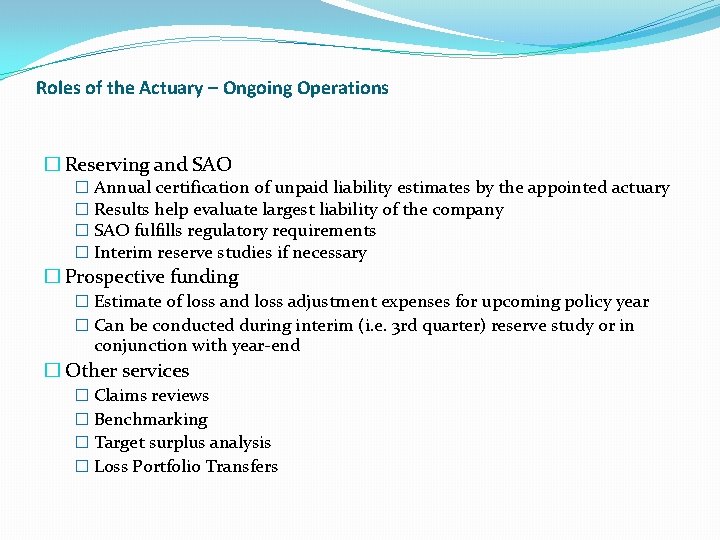
Roles of the Actuary – Ongoing Operations � Reserving and SAO � Annual certification of unpaid liability estimates by the appointed actuary � Results help evaluate largest liability of the company � SAO fulfills regulatory requirements � Interim reserve studies if necessary � Prospective funding � Estimate of loss and loss adjustment expenses for upcoming policy year � Can be conducted during interim (i. e. 3 rd quarter) reserve study or in conjunction with year-end � Other services � Claims reviews � Benchmarking � Target surplus analysis � Loss Portfolio Transfers
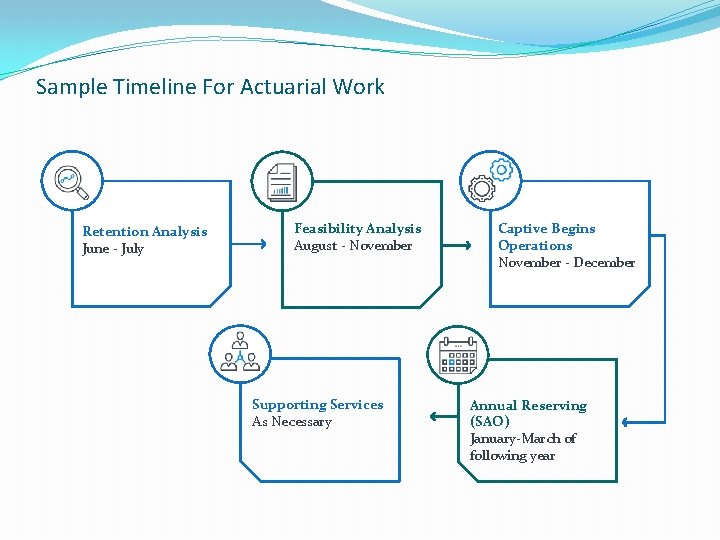
Sample Timeline For Actuarial Work Retention Analysis June - July Feasibility Analysis August - November Supporting Services As Necessary Captive Begins Operations November - December Annual Reserving (SAO) January-March of following year
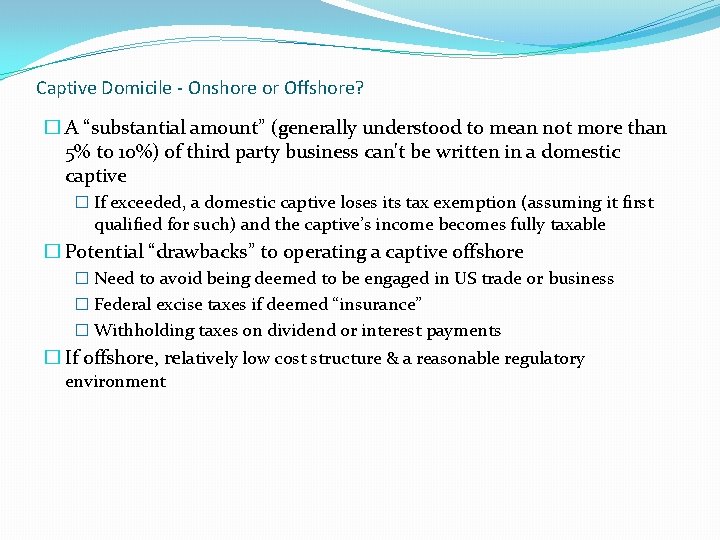
Captive Domicile - Onshore or Offshore? � A “substantial amount” (generally understood to mean not more than 5% to 10%) of third party business can't be written in a domestic captive � If exceeded, a domestic captive loses its tax exemption (assuming it first qualified for such) and the captive’s income becomes fully taxable � Potential “drawbacks” to operating a captive offshore � Need to avoid being deemed to be engaged in US trade or business � Federal excise taxes if deemed “insurance” � Withholding taxes on dividend or interest payments � If offshore, relatively low cost structure & a reasonable regulatory environment
Evaluating Onshore Domiciles � The onshore discussion is less tax centric, although some jurisdictions have different premium and self procurement taxes � Focus is more on: � Regulatory scheme � Permitted coverages � Domicile costs � Capitalization � Administrative burdens � CT fits the bill, as you’ll learn throughout the Collaborative
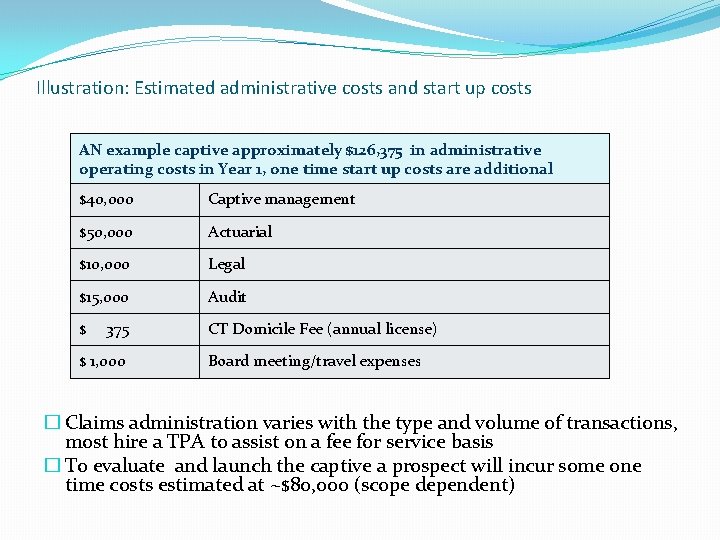
Illustration: Estimated administrative costs and start up costs AN example captive approximately $126, 375 in administrative operating costs in Year 1, one time start up costs are additional $40, 000 Captive management $50, 000 Actuarial $10, 000 Legal $15, 000 Audit $ CT Domicile Fee (annual license) 375 $ 1, 000 Board meeting/travel expenses � Claims administration varies with the type and volume of transactions, most hire a TPA to assist on a fee for service basis � To evaluate and launch the captive a prospect will incur some one time costs estimated at ~$80, 000 (scope dependent)
Capitalization � The captive will need to be capitalized to begin operations, with such capital and accumulated surplus amounts maintained to ensure that the captive has a sufficient financial foundation going forward � In CT, this capital can take the form of cash and/or letters of credit (LOC) � A single parent captive must have a minimum of $250, 000 in capital/surplus per CT captive regulations, amounts for other captive types vary � The amount of capital really needed depends on the risk profile, the amount of which reflects various ratio tests (retention ratio, premium : surplus, reserves : surplus) and the nature of the coverage provided
Captive Taxation Proprietary and Confidential. For Towers Watson and Towers Watson client use only.
Types of Taxes �Federal Income Taxes �Federal Excise Taxes �State Premium Taxes �Self-Procurement Taxes �State Income Taxes
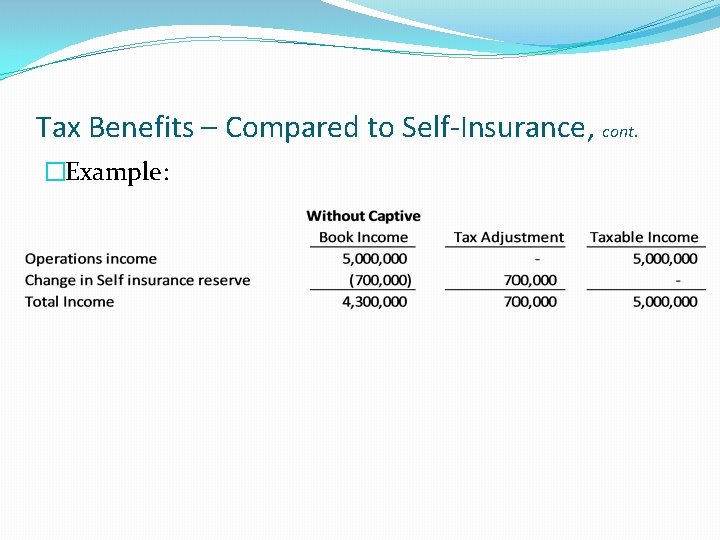
Tax Benefits – Compared to Self-Insurance Under a straight self-insured arrangement, an insured would recognize a tax deduction as losses are paid out over time. For example, General Liability losses, which occurred within one underwriting period are paid out over a period of eight to ten years. The tax deduction is recognized as losses are paid out.
Tax Benefits – Compared to Self-Insurance, cont. �Example:
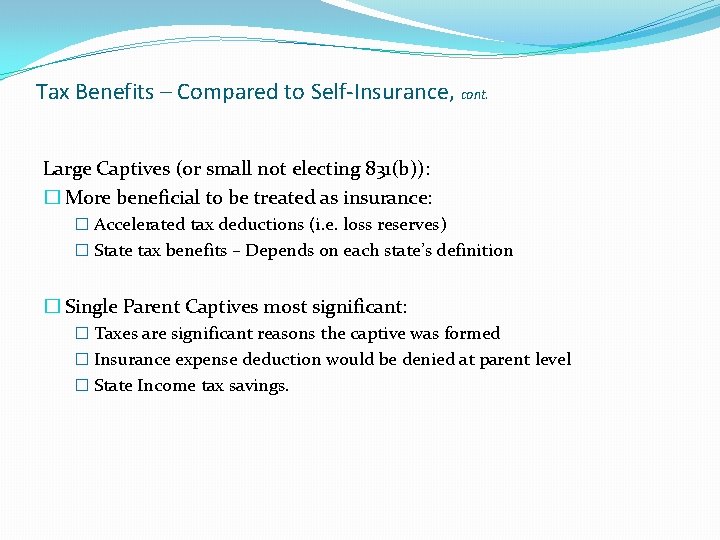
Tax Benefits – Compared to Self-Insurance, cont. Large Captives (or small not electing 831(b)): � More beneficial to be treated as insurance: � Accelerated tax deductions (i. e. loss reserves) � State tax benefits – Depends on each state’s definition � Single Parent Captives most significant: � Taxes are significant reasons the captive was formed � Insurance expense deduction would be denied at parent level � State Income tax savings.
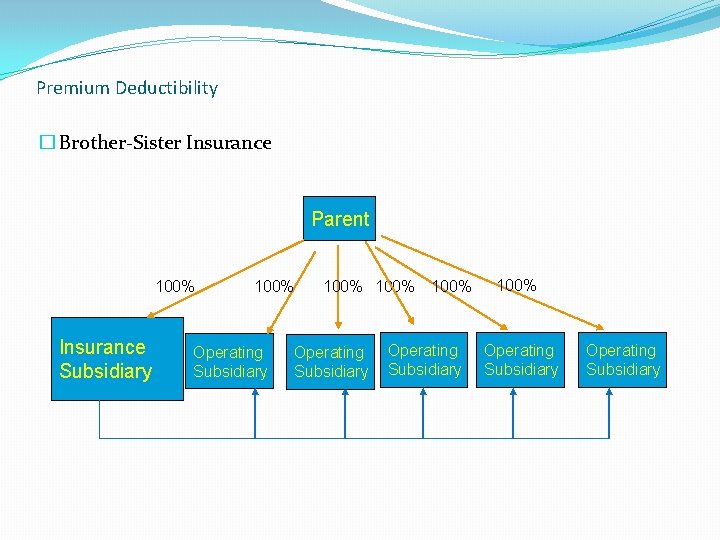
Premium Deductibility � Brother-Sister Insurance Parent 100% Insurance Subsidiary 100% Operating Subsidiary 100% Operating Subsidiary
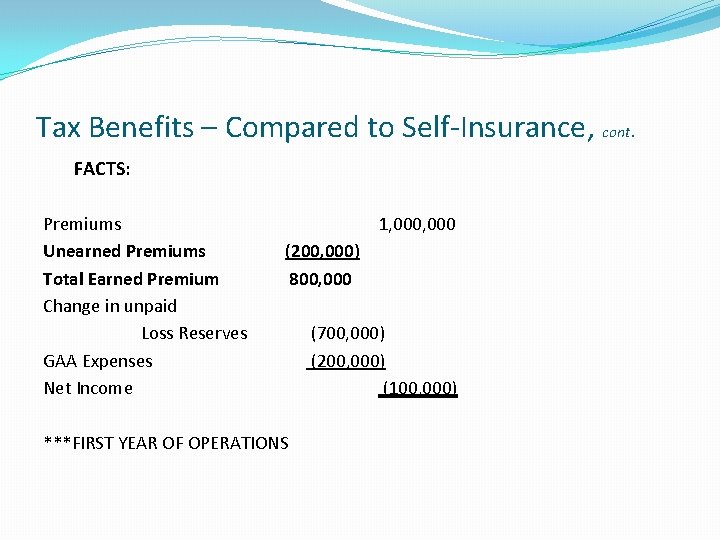
Tax Benefits – Compared to Self-Insurance, cont. FACTS: Premiums Unearned Premiums Total Earned Premium Change in unpaid Loss Reserves GAA Expenses Net Income 1, 000 (200, 000) 800, 000 ***FIRST YEAR OF OPERATIONS (700, 000) (200, 000) (100, 000)
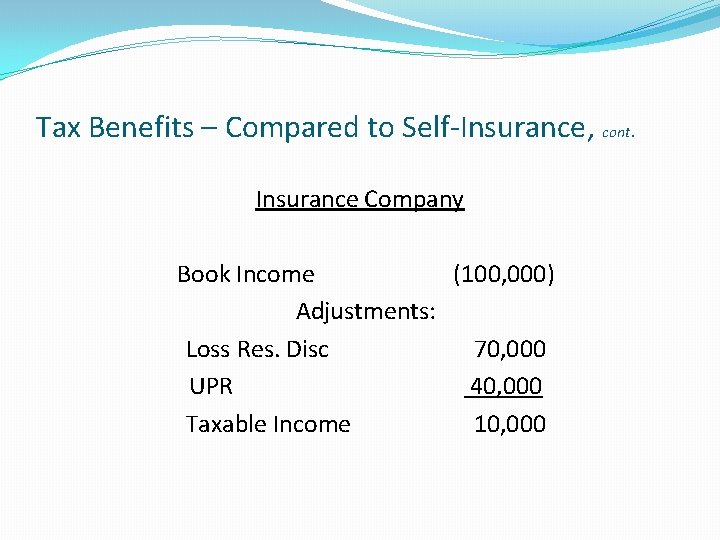
Tax Benefits – Compared to Self-Insurance, cont. Insurance Company Book Income (100, 000) Adjustments: Loss Res. Disc 70, 000 UPR 40, 000 Taxable Income 10, 000
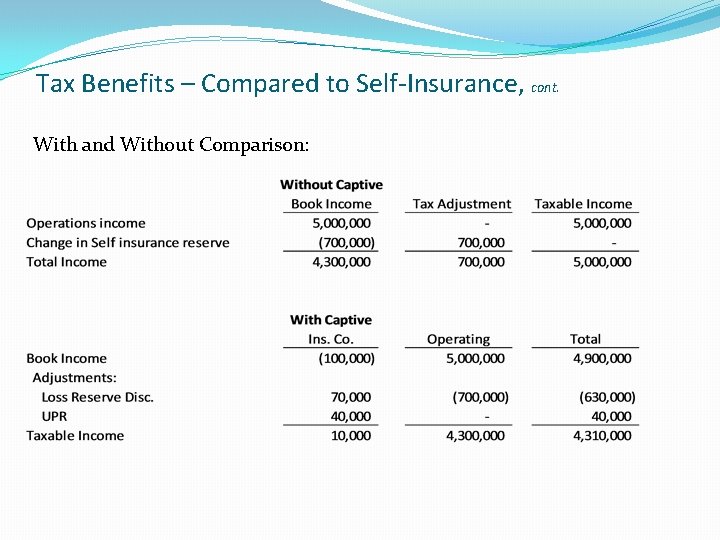
Tax Benefits – Compared to Self-Insurance, cont. With and Without Comparison:
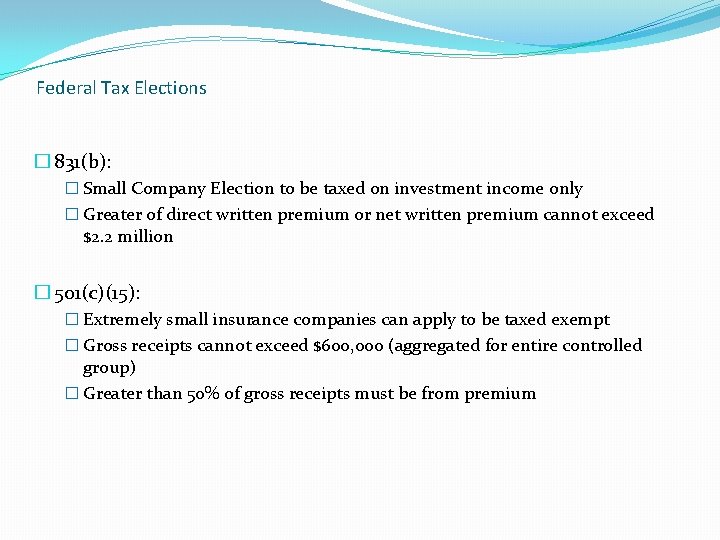
Federal Tax Elections � 831(b): � Small Company Election to be taxed on investment income only � Greater of direct written premium or net written premium cannot exceed $2. 2 million � 501(c)(15): � Extremely small insurance companies can apply to be taxed exempt � Gross receipts cannot exceed $600, 000 (aggregated for entire controlled group) � Greater than 50% of gross receipts must be from premium
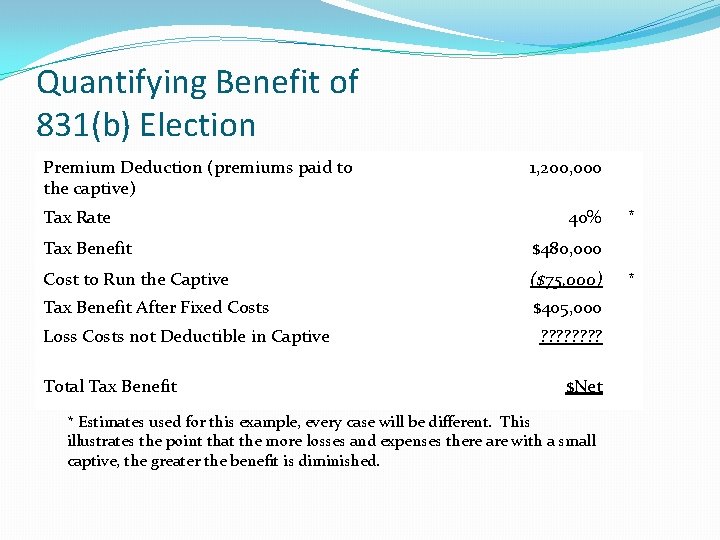
Quantifying Benefit of 831(b) Election Premium Deduction (premiums paid to the captive) Tax Rate 1, 200, 000 40% Tax Benefit $480, 000 Cost to Run the Captive ($75, 000) Tax Benefit After Fixed Costs $405, 000 Loss Costs not Deductible in Captive Total Tax Benefit ? ? ? ? $Net * Estimates used for this example, every case will be different. This illustrates the point that the more losses and expenses there are with a small captive, the greater the benefit is diminished. * *
The History Proprietary and Confidential. For Towers Watson and Towers Watson client use only.
The History of the War with the IRS, cont. Common Law: Helvering v. Le. Gierse– 1941 Supreme Court estate tax case which established ground works to what defines insurance. �Insurable risk �Risk shifted to insurer �Pooled
The History of the War with the IRS, cont. IRS Strikes The Economic Family Theory: Revenue Ruling 77 -316 – An insurance arrangement between related corporations should be recharacterized as a “self-insurance” reserve within an “economic family”.
The History of the War with the IRS, cont. Industry Fights Back The Courts rule favorably: ü Humana Inc. v. Commissioner ü Gulf Oil Corp. v. Commissioner ü AMERICO, Inc. v. Commissioner ü The Harper Group v. Commissioner ü Sears, Roebuck & Co. v. Commissioner ü Hospital Corp. of America v. Commissioner
The History of the War with the IRS, cont. IRS Concedes: • Revenue Ruling 2001 -31 – The IRS will no longer invoke the economic family theory • However, they will continue to challenge certain captive insurance transactions based on facts and circumstances
The History of the War with the IRS, cont. IRS Tries Again The Courts rule favorably: ü Rent A Center v. Commissioner ü Securitas v. Commissioner ü RVI v. Commissioner
What Constitutes Insurance? � The IRS ‘definition’ of an insurance company � For purposes of the preceding sentence, the term "insurance company" means any company more than half of the business of which during the taxable year is the issuing of insurance or annuity contracts or the reinsuring of risks underwritten by insurance companies � The IRS does not define “insurance contract”! Therefore we must look to the courts for case law interpretations: � Insurance contract must have: � Risk Shifting � Risk Distribution
Risk Shifting • In Helvering v. Le. Gierse, the Supreme Court said that for a transaction to be considered insurance, it must transfer the risk of loss from one party to another, among other points. That is Risk Shifting. • How risk shifting is defined by law, courts, and the IRS is the subject of much time and money. Captives have been at the center of this issue. • Have you shifted the risk? How much is needed to qualify (5, 10, 50 percent)? What about reinsurance? Who owns the captive? • Rev. Ruling 2002 -89 states that 50% of unrelated business will suffice for Risk Shifting. • Rev. Ruling 2002 -90 states 12 subs whereby no one sub makes up more than 15% of the premium or less than 5% of the premium will qualify.
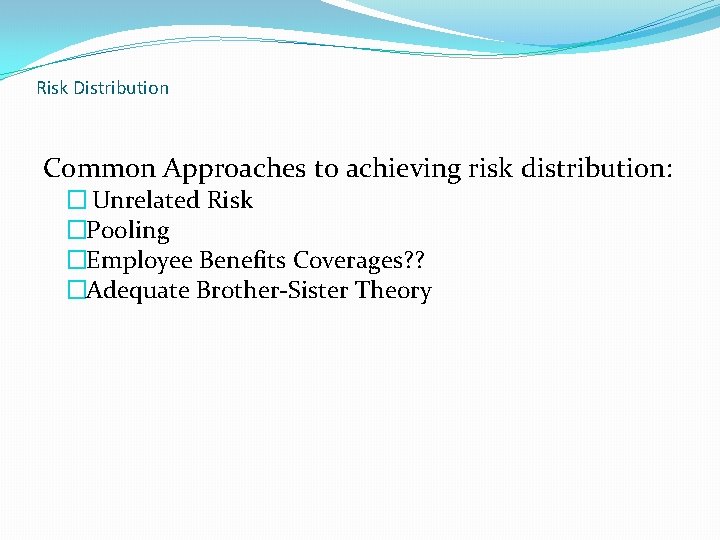
Risk Distribution Common Approaches to achieving risk distribution: � Unrelated Risk �Pooling �Employee Benefits Coverages? ? �Adequate Brother-Sister Theory
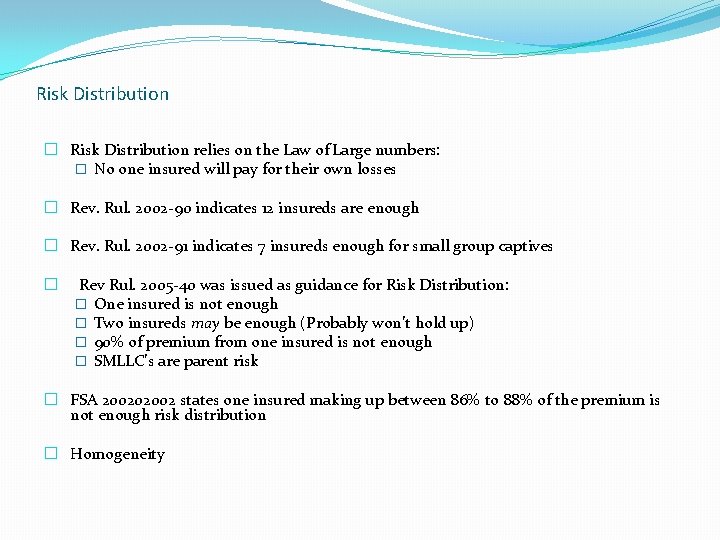
Risk Distribution � Risk Distribution relies on the Law of Large numbers: � No one insured will pay for their own losses � Rev. Rul. 2002 -90 indicates 12 insureds are enough � Rev. Rul. 2002 -91 indicates 7 insureds enough for small group captives � Rev Rul. 2005 -40 was issued as guidance for Risk Distribution: � One insured is not enough � Two insureds may be enough (Probably won’t hold up) � 90% of premium from one insured is not enough � SMLLC’s are parent risk � FSA 200202002 states one insured making up between 86% to 88% of the premium is not enough risk distribution � Homogeneity
Other Considerations �Capitalization �Business Purpose �Indemnifications & Guarantees �Commonly Accepted as Insurance
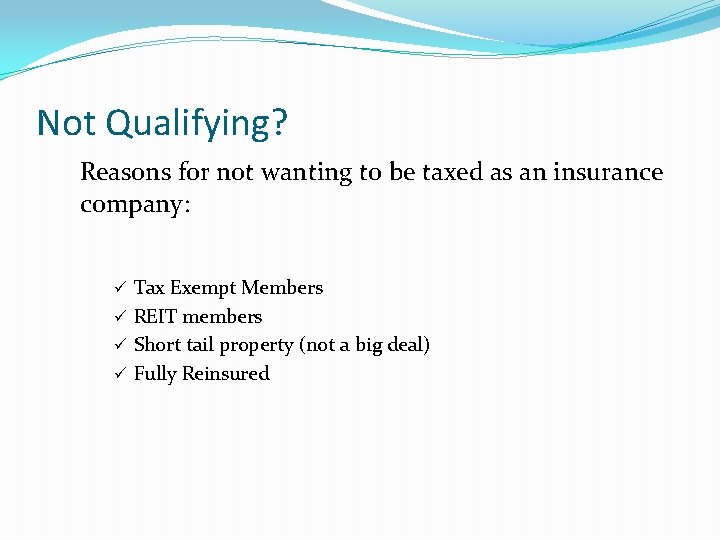
Not Qualifying? Reasons for not wanting to be taxed as an insurance company: ü Tax Exempt Members ü REIT members ü Short tail property (not a big deal) ü Fully Reinsured
State Premium Taxes � Connecticut � Taxes are on a sliding rate scale ( 0. 0038 - 0. 00024); the annual minimum tax is $7, 500. 00 and the annual maximum aggregate tax is $200, 000 � A tax credit of $7, 500 applies the fist year; for captives with <$20 million in premium net first year premium taxes are $0.
Develop pro forma financial statements for the proposed captive program � The pro forma financial statements incorporate the previous noted assumptions pertaining to retained losses, program expenses, and capital requirements (or a margin for risk) to support the written exposure � Separately, as part of a business plan submitted with the captive application you also need to develop an Adverse Case pro forma to test the captive “under stress” � The stress is more likely and likely more severe if the adverse event occurs early in the captives life � Should such losses be experienced early, the captive owners would likely need to contribute additional capital to the captive and/or increase premium funding prospectively
A captive could provide advantages going forward… � Greater entity presence � Greater flexibility to cover unique risk exposures � Direct access to reinsurers � Presumable cost savings Some disadvantages potentially exist, as well… � A captive requires capital � A captive incurs additional expenses for captive management, audit, legal and domicile fees � A captive is a regulated insurance company � A captive typically requires management time (Board meetings, underwriting, risk control, and claims committees)
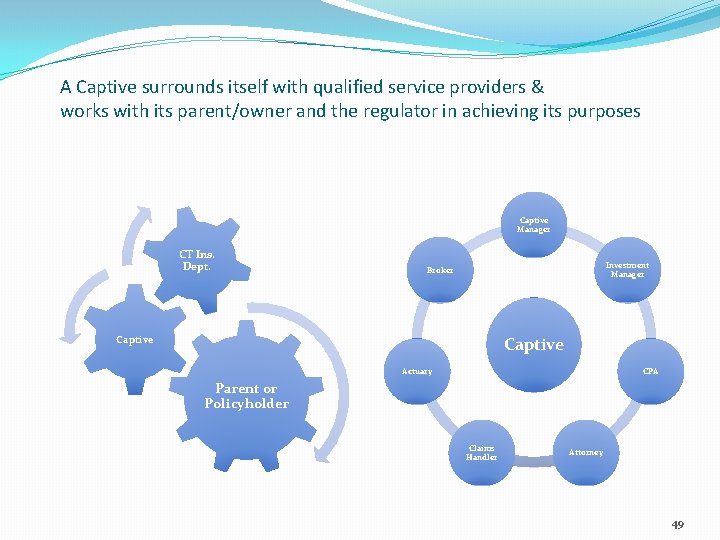
A Captive surrounds itself with qualified service providers & works with its parent/owner and the regulator in achieving its purposes Captive Manager CT Ins. Dept. Investment Manager Broker Captive Actuary CPA Parent or Policyholder Claims Handler Attorney 49
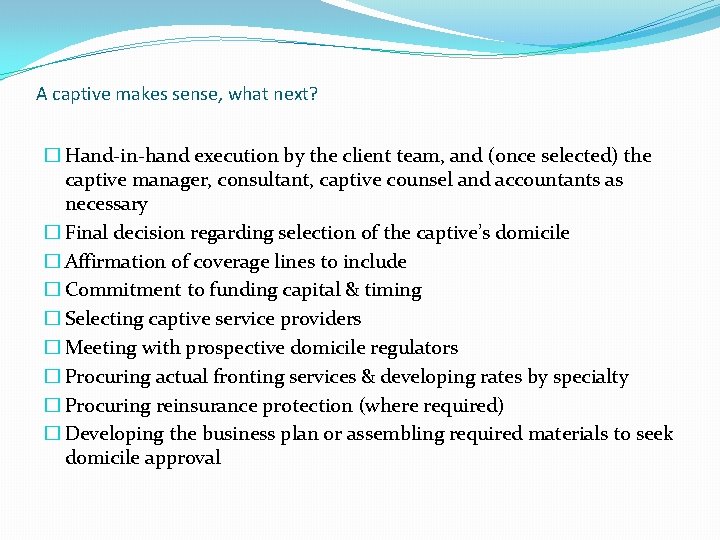
A captive makes sense, what next? � Hand-in-hand execution by the client team, and (once selected) the captive manager, consultant, captive counsel and accountants as necessary � Final decision regarding selection of the captive’s domicile � Affirmation of coverage lines to include � Commitment to funding capital & timing � Selecting captive service providers � Meeting with prospective domicile regulators � Procuring actual fronting services & developing rates by specialty � Procuring reinsurance protection (where required) � Developing the business plan or assembling required materials to seek domicile approval
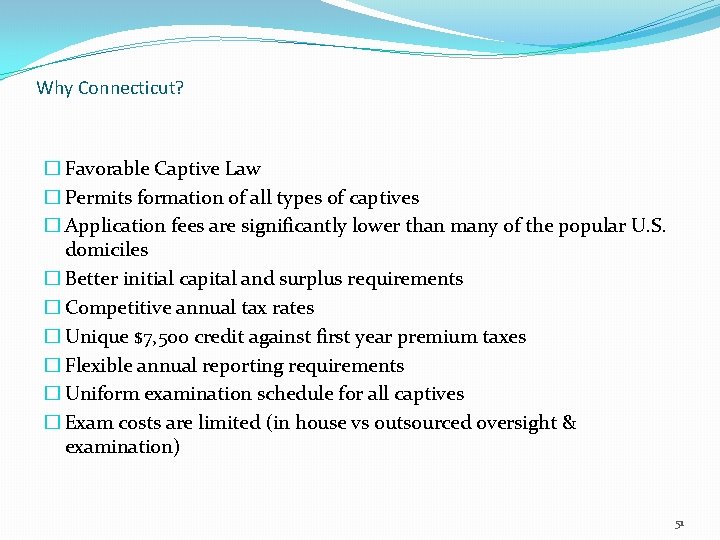
Why Connecticut? � Favorable Captive Law � Permits formation of all types of captives � Application fees are significantly lower than many of the popular U. S. domiciles � Better initial capital and surplus requirements � Competitive annual tax rates � Unique $7, 500 credit against first year premium taxes � Flexible annual reporting requirements � Uniform examination schedule for all captives � Exam costs are limited (in house vs outsourced oversight & examination) 51
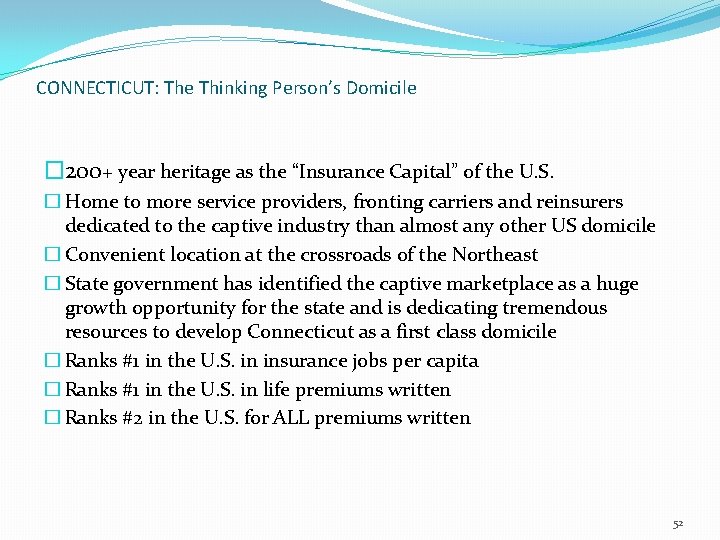
CONNECTICUT: The Thinking Person’s Domicile � 200+ year heritage as the “Insurance Capital” of the U. S. � Home to more service providers, fronting carriers and reinsurers dedicated to the captive industry than almost any other US domicile � Convenient location at the crossroads of the Northeast � State government has identified the captive marketplace as a huge growth opportunity for the state and is dedicating tremendous resources to develop Connecticut as a first class domicile � Ranks #1 in the U. S. in insurance jobs per capita � Ranks #1 in the U. S. in life premiums written � Ranks #2 in the U. S. for ALL premiums written 52