
Captive breeding programs Peter de Sve Saving species
Captive breeding programs Peter de Sève
Saving species Assuming a decline is already well under way: what to do? - remove threats (harvest regulation, development, etc. ) (what if threat is exotic species? ) - enhance natural reproduction; improve habitat (conspecific attraction; food supplementation, etc. ) - translocate individuals to increase variation, N - captive breed for short term to produce stock for translocation - captive breed for long term to have stock ready for periodic use - captive breed indefinitely

Purposes of captive breeding programs: • conservation of threatened species – objective to restore wild popns (no wild individuals left) – objective to supplement wild populations that have declined or are threatened
Purposes of captive breeding programs: • captive maintenance of threatened species – habitat is completely lost – threats to extinction cannot be overcome – duration of captivity has irrevocably altered species
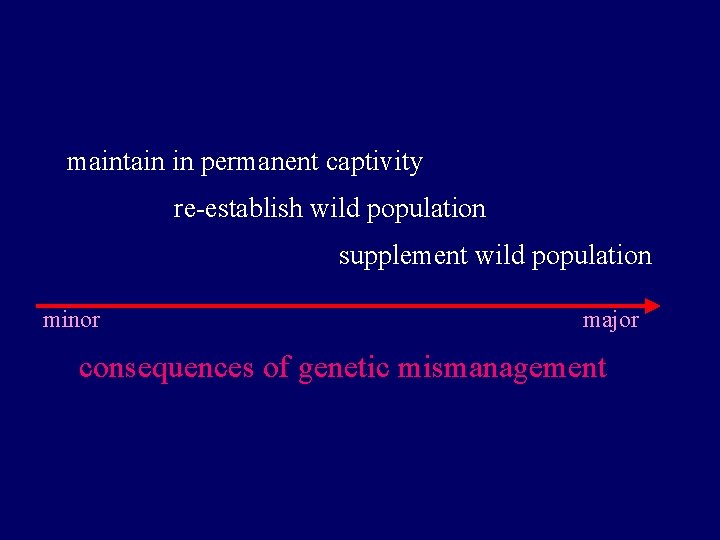
maintain in permanent captivity re-establish wild population supplement wild population minor major consequences of genetic mismanagement

Stages in a captive breeding program • • • decline of wild population, genetic consequences choice of founder population growing captive population in captivity maintaining captive population reintroducing individuals managing reintroduced population
Issues for captive propagation • • • source of founder population(s) space requirements in captivity/space availability in zoos courtship/mating behaviors intrinsic rate of increase isolation of sub-populations availability of wild populations as sources of new variation
Rules for captive propagation Founding the population - minimize genetic and phenotypic change – collect random sample of founders – collect data on locality, habitat of origin – collect genetic data from founders – keep sub-populations isolated
Rules for captive propagation Maintaining the population • maximize N and Ne (maximize sex ratio) • maintain equal family sizes
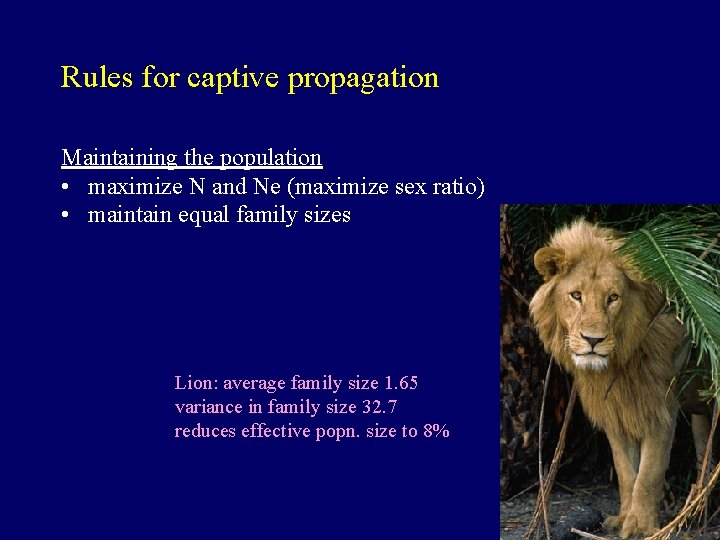
Rules for captive propagation Maintaining the population • maximize N and Ne (maximize sex ratio) • maintain equal family sizes Lion: average family size 1. 65 variance in family size 32. 7 reduces effective popn. size to 8%
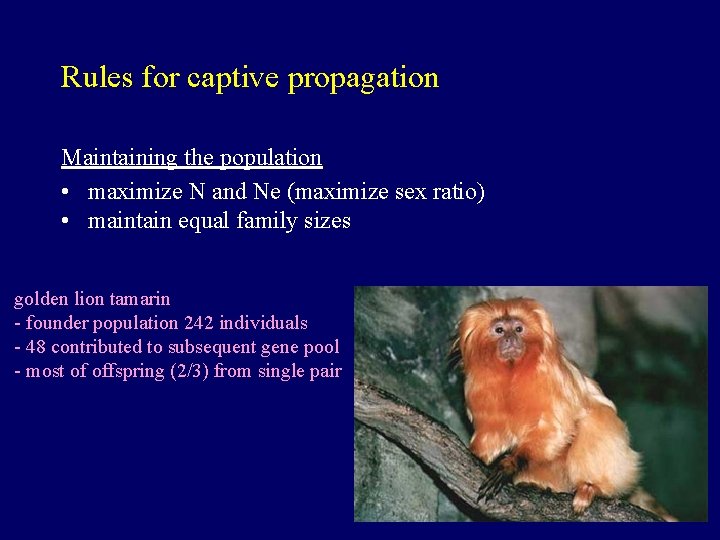
Rules for captive propagation Maintaining the population • maximize N and Ne (maximize sex ratio) • maintain equal family sizes golden lion tamarin - founder population 242 individuals - 48 contributed to subsequent gene pool - most of offspring (2/3) from single pair

Rules for captive propagation • minimize loss of genetic variation – maximize N and Ne (maximize sex ratio) – maintain equal family sizes – periodically check variability, compare with wild populations • minimize behavioral changes – minimize duration of captivity (maximize generation time) • minimize inbreeding – conduct pedigree analysis/management – outcross population with new individuals
Rules for captive propagation • manage demographics – determine reasonable carrying capacity (note effect on other taxa) – achieve carrying capacity rapidly – stabilize population at carrying capacity • maintain representation of age classes • what to do with excess animals?
Rules for captive propagation Species Survival Plans (SSPs) for zoo species goal: preserve genetic variation – 90% of H over 100 years
Rules for captive propagation Species Survival Plans (SSPs) for zoo species goal: preserve genetic variation – 90% of H over 100 years – list each individual in a studbook – sex, sire and dam, likely alternatives if uncertain parentage – acquire data: age-specific fecundity, mortality, lifetime reproductive success, inbreeding – equalize reproductive contributions of each individual – pair individuals of lowest mean kinship – work with other zoos to share genetic material Limits to zoo taxa….
Problems with captive propagation African wildlife in Texas ranches http: //www. cbsnews. com/video/watch/? id=7396832 n&tag=segement. Extra. Scroller; housing
Problems with captive propagation Deliberate (artificial) selection • for increased productivity – fecundity, growth, or both • for ‘better’ type or traits (color, size) • for tractability (handling, breeding season) – problems with linkage of undesirable traits
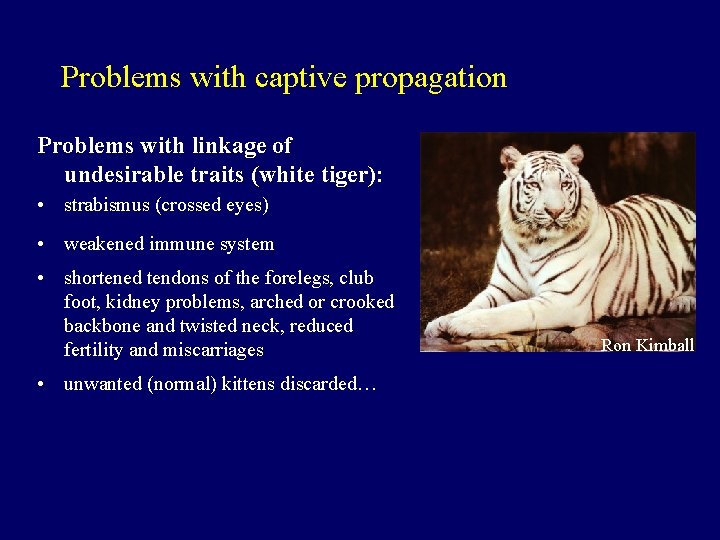
Problems with captive propagation Problems with linkage of undesirable traits (white tiger): • strabismus (crossed eyes) • weakened immune system • shortened tendons of the forelegs, club foot, kidney problems, arched or crooked backbone and twisted neck, reduced fertility and miscarriages • unwanted (normal) kittens discarded… Ron Kimball
Problems with captive propagation Accidental selection • for increased productivity – fecundity, growth, or both • domestication – select for fitness under captive conditions – tends to homogenize differences among sub-populations
Problems with captive propagation Absence of selection…
General post-release problems • lower fitness in wild – domestication – genetic and/or behavioral – loss of variation • increased fitness in wild – loss of wild populations through competition for mates, habitat – captive-bred may be healthier – different development stages
General post-release problems • lower fitness in wild – domestication – genetic and/or behavioral – loss of variation • increased fitness in wild – loss of wild populations through competition for mates, habitat – captive-bred may be healthier – different development stages lake trout (Foster 1984) • rapid early growth in hatchery • young age at sexual maturity • premature reproductive senescence
General post-release problems • captive individuals may hybridize with wild indivs. – pollution of wild genome – loss of variation if lowered variance in captive stock
Additional methods: Cross-fostering “head-start” programs – minimize duration of captivity Artificial insemination Embryo transfer
Association of Zoos and Aquariums Guidelines for Reintroduction of Animals Born or Held in Captivity http: //www. aza. org/reintroduction/
- Slides: 25