
Capstone Senior Design Project Ideas Joseph Zimmerman CU

- Slides: 21
Capstone Senior Design Project Ideas Joseph Zimmerman CU Aerospace LLC 9/5/2017 CUA Capstone Projects 1
Summary • Brief Company Overview • Thermoelectric Waste Heat Recovery (POETS) • Pulse Driver Circuit for Plasma Flow Control (related to NASA contract) CUA Capstone Projects 2
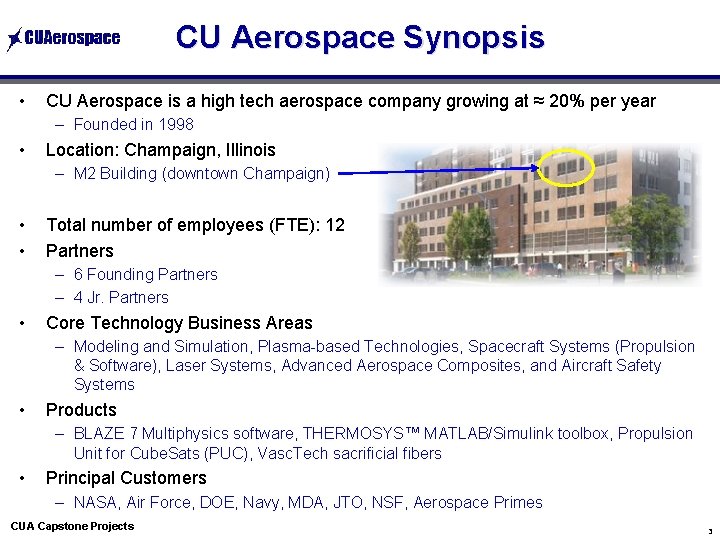
CU Aerospace Synopsis • CU Aerospace is a high tech aerospace company growing at ≈ 20% per year – Founded in 1998 • Location: Champaign, Illinois – M 2 Building (downtown Champaign) • • Total number of employees (FTE): 12 Partners – 6 Founding Partners – 4 Jr. Partners • Core Technology Business Areas – Modeling and Simulation, Plasma-based Technologies, Spacecraft Systems (Propulsion & Software), Laser Systems, Advanced Aerospace Composites, and Aircraft Safety Systems • Products – BLAZE 7 Multiphysics software, THERMOSYS™ MATLAB/Simulink toolbox, Propulsion Unit for Cube. Sats (PUC), Vasc. Tech sacrificial fibers • Principal Customers – NASA, Air Force, DOE, Navy, MDA, JTO, NSF, Aerospace Primes CUA Capstone Projects 3
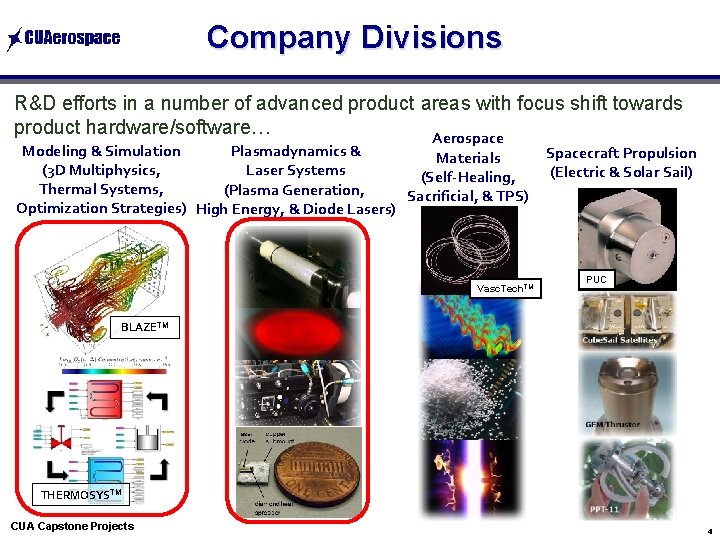
Company Divisions R&D efforts in a number of advanced product areas with focus shift towards product hardware/software… Aerospace Modeling & Simulation Plasmadynamics & Materials (3 D Multiphysics, Laser Systems (Self-Healing, Thermal Systems, (Plasma Generation, Sacrificial, & TPS) Optimization Strategies) High Energy, & Diode Lasers) Spacecraft Propulsion (Electric & Solar Sail) BLAZE-VI Vasc. Tech. TM PUC BLAZETM THERMOSYSTM CUA Capstone Projects 4
Project Idea #1 “Thermoelectric Waste Heat Recovery in Mobile Systems” • POETS-sponsored joint Mech. SE-ECE team • POETS: Power Optimization of Electro-Thermal Systems • Potential applications in various CUA products Proposed project objectives: • Apply thermoelectric effect to convert waste heat from battery-powered supply to stored potential • Demonstrate the ability of thermal energy harvesting to extend the operational life of the mobile power supply • Consider impact on size, weight, and practicality of the mobile system CUA Capstone Projects 5
Turbulent Separation Control Today VGs on B 737 -700 • Passive flow control remains method of choice for commercial aircraft • VGs configured for takeoff, landing (~1 -3% of flight time) • Cruise penalty • Most active actuation approaches suited for either low-speeds or high-complexity CUA Capstone Projects 6
Background Innovative Concept Cyclotronic Plasma Actuator Result: Low-Complexity, On. Demand Vortex Generator Focused E Field • Thermal-based actuation of boundary-layer flow • Lorentz force coupling of arc filament and magnetic field to produce angular velocity • Sweeping arc-filament plasma for vortex formation and enhanced mixing • Turbulent boundary-layer separation control CUA Capstone Projects 7
Arc Breakdown Visualization • High-speed video of arc breakdown (Ansell, UIUC) • Acquired at 100, 000 fps, playback 10 fps (1/10, 000 real-time) • Arc breakdown every 0. 5 seconds in playback • Correlates to 20 k. Hz driving frequency of AC circuit CUA Capstone Projects 8
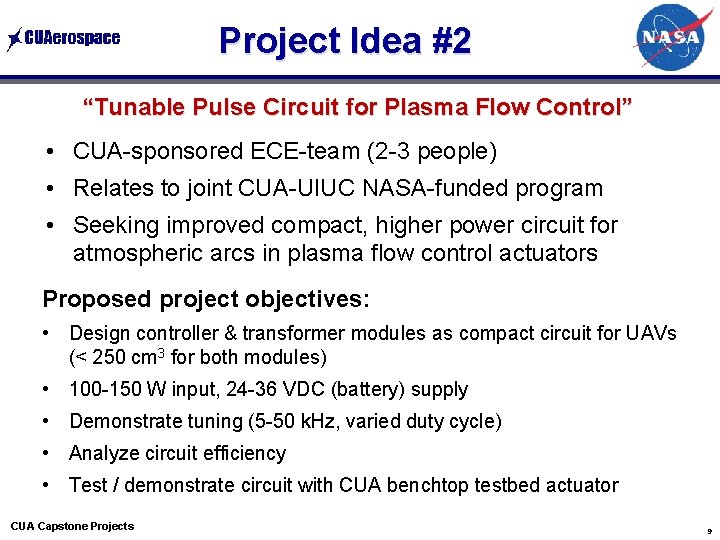
Project Idea #2 “Tunable Pulse Circuit for Plasma Flow Control” • CUA-sponsored ECE-team (2 -3 people) • Relates to joint CUA-UIUC NASA-funded program • Seeking improved compact, higher power circuit for atmospheric arcs in plasma flow control actuators Proposed project objectives: • Design controller & transformer modules as compact circuit for UAVs (< 250 cm 3 for both modules) • 100 -150 W input, 24 -36 VDC (battery) supply • Demonstrate tuning (5 -50 k. Hz, varied duty cycle) • Analyze circuit efficiency • Test / demonstrate circuit with CUA benchtop testbed actuator CUA Capstone Projects 9
Questions? CUA Capstone Projects 10
Back-up Slides for Discussion CUA Capstone Projects 11
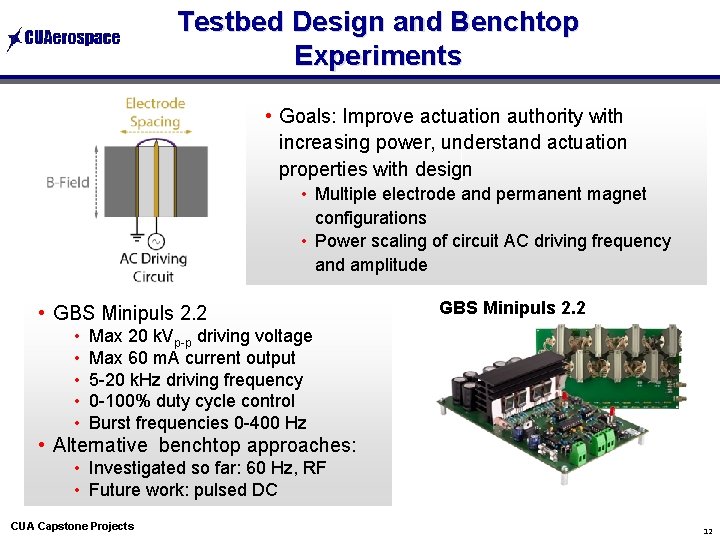
Testbed Design and Benchtop Experiments • Goals: Improve actuation authority with increasing power, understand actuation properties with design • Multiple electrode and permanent magnet configurations • Power scaling of circuit AC driving frequency and amplitude • GBS Minipuls 2. 2 • • • GBS Minipuls 2. 2 Max 20 k. Vp-p driving voltage Max 60 m. A current output 5 -20 k. Hz driving frequency 0 -100% duty cycle control Burst frequencies 0 -400 Hz • Alternative benchtop approaches: • Investigated so far: 60 Hz, RF • Future work: pulsed DC CUA Capstone Projects 12
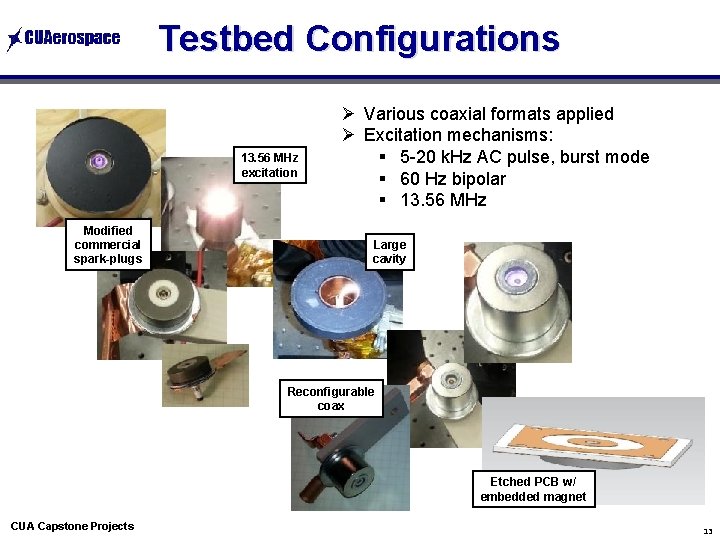
Testbed Configurations 13. 56 MHz excitation Modified commercial spark-plugs Ø Various coaxial formats applied Ø Excitation mechanisms: § 5 -20 k. Hz AC pulse, burst mode § 60 Hz bipolar § 13. 56 MHz Large cavity Reconfigurable coax Etched PCB w/ embedded magnet CUA Capstone Projects 13
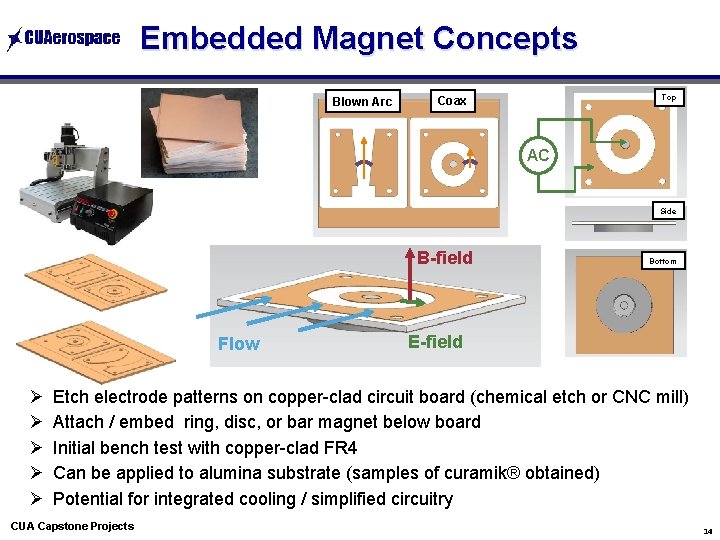
Embedded Magnet Concepts Blown Arc Top Coax AC Side B-field Flow Ø Ø Ø Bottom E-field Etch electrode patterns on copper-clad circuit board (chemical etch or CNC mill) Attach / embed ring, disc, or bar magnet below board Initial bench test with copper-clad FR 4 Can be applied to alumina substrate (samples of curamik® obtained) Potential for integrated cooling / simplified circuitry CUA Capstone Projects 14
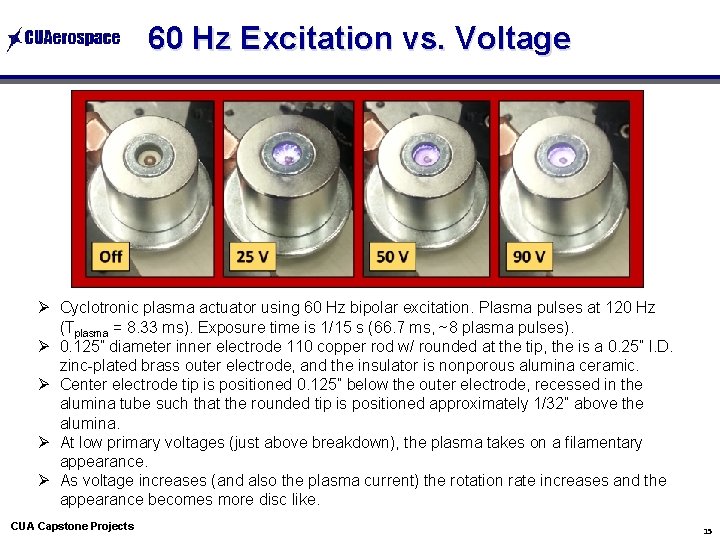
60 Hz Excitation vs. Voltage Ø Cyclotronic plasma actuator using 60 Hz bipolar excitation. Plasma pulses at 120 Hz (Tplasma = 8. 33 ms). Exposure time is 1/15 s (66. 7 ms, ~8 plasma pulses). Ø 0. 125” diameter inner electrode 110 copper rod w/ rounded at the tip, the is a 0. 25” I. D. zinc-plated brass outer electrode, and the insulator is nonporous alumina ceramic. Ø Center electrode tip is positioned 0. 125” below the outer electrode, recessed in the alumina tube such that the rounded tip is positioned approximately 1/32” above the alumina. Ø At low primary voltages (just above breakdown), the plasma takes on a filamentary appearance. Ø As voltage increases (and also the plasma current) the rotation rate increases and the appearance becomes more disc like. CUA Capstone Projects 15
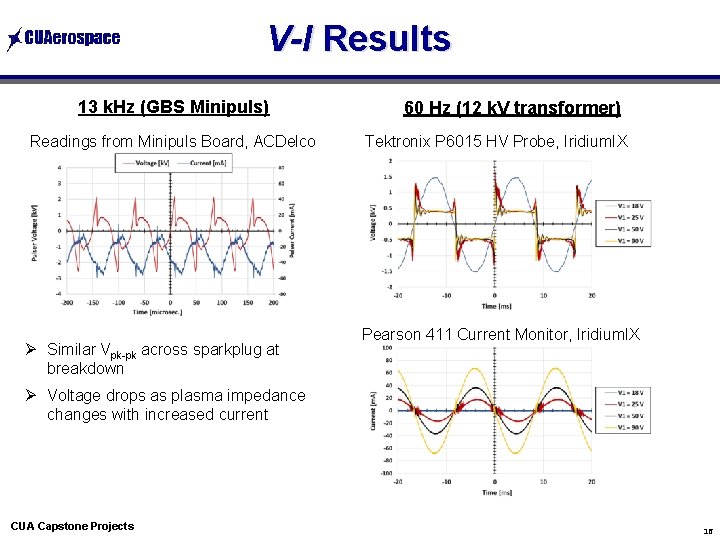
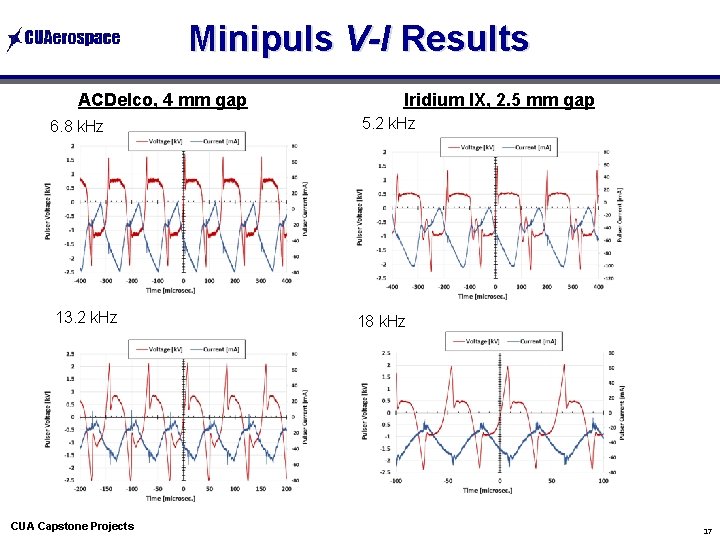
V-I Results 13 k. Hz (GBS Minipuls) Readings from Minipuls Board, ACDelco Ø Similar Vpk-pk across sparkplug at breakdown 60 Hz (12 k. V transformer) Tektronix P 6015 HV Probe, Iridium. IX Pearson 411 Current Monitor, Iridium. IX Ø Voltage drops as plasma impedance changes with increased current CUA Capstone Projects 16
Minipuls V-I Results ACDelco, 4 mm gap 6. 8 k. Hz 13. 2 k. Hz CUA Capstone Projects Iridium IX, 2. 5 mm gap 5. 2 k. Hz 18 k. Hz 17
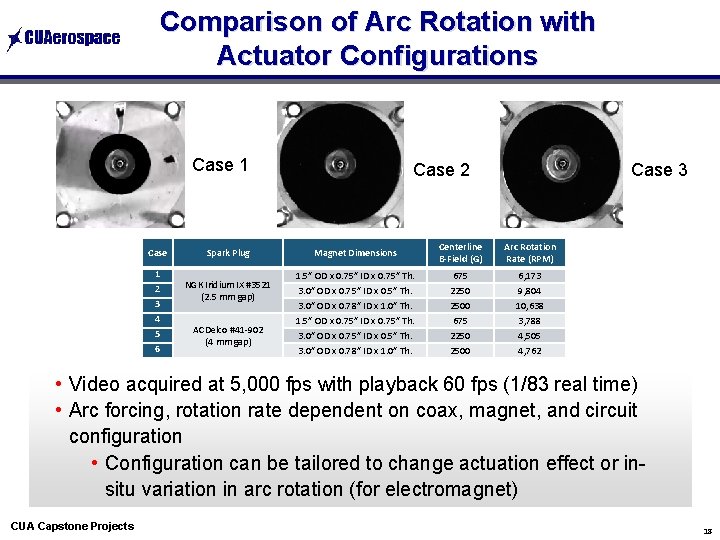
Comparison of Arc Rotation with Actuator Configurations Case 1 2 3 4 5 6 Spark Plug NGK Iridium IX #3521 (2. 5 mm gap) ACDelco #41 -902 (4 mm gap) Case 2 Case 3 Magnet Dimensions Centerline B-Field (G) Arc Rotation Rate (RPM) 1. 5” OD x 0. 75” ID x 0. 75” Th. 3. 0” OD x 0. 75” ID x 0. 5” Th. 3. 0” OD x 0. 78” ID x 1. 0” Th. 675 2250 2500 6, 173 9, 804 10, 638 3, 788 4, 505 4, 762 • Video acquired at 5, 000 fps with playback 60 fps (1/83 real time) • Arc forcing, rotation rate dependent on coax, magnet, and circuit configuration • Configuration can be tailored to change actuation effect or insitu variation in arc rotation (for electromagnet) CUA Capstone Projects 18
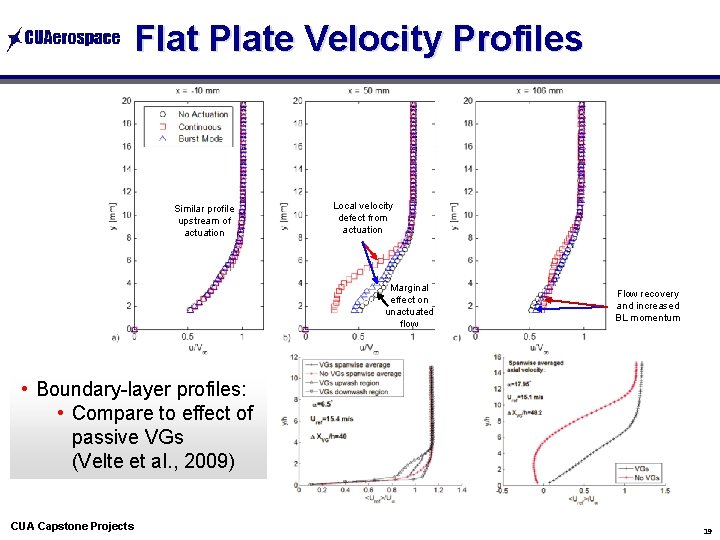
Flat Plate Velocity Profiles Similar profile upstream of actuation Local velocity defect from actuation Marginal effect on unactuated flow Flow recovery and increased BL momentum • Boundary-layer profiles: • Compare to effect of passive VGs (Velte et al. , 2009) CUA Capstone Projects 19
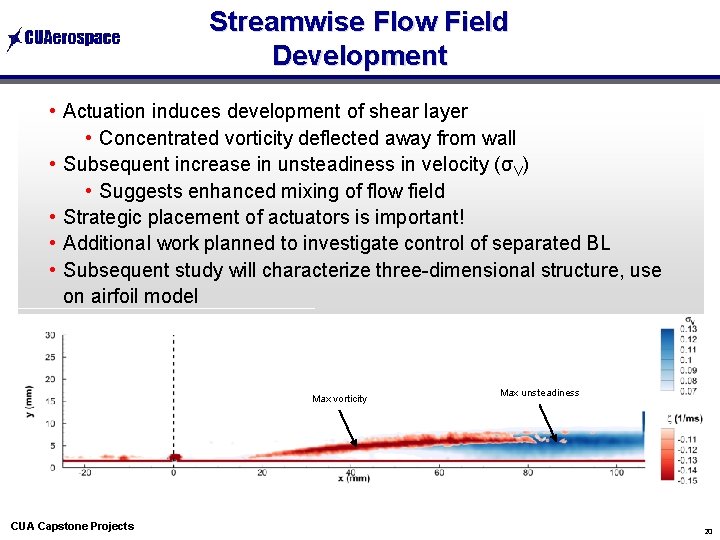
Streamwise Flow Field Development • Actuation induces development of shear layer • Concentrated vorticity deflected away from wall • Subsequent increase in unsteadiness in velocity (σV) • Suggests enhanced mixing of flow field • Strategic placement of actuators is important! • Additional work planned to investigate control of separated BL • Subsequent study will characterize three-dimensional structure, use on airfoil model Max vorticity CUA Capstone Projects Max unsteadiness 20
VG and Plasma Recovery Comparison VG Strip Single VG Single Cyclotron (Underpowered) No Control DBD • Effects of plasma actuator qualitatively similar to conventional VG • Plasma actuator underpowered resulting in lower difference in ΔCp • VG may be oversized for application (h > δ) • Phase I electronics limited power input significantly increase power/current to plasma in Phase II to obtain similar VG ΔCp performance while retaining on-demand actuation CUA Capstone Projects 21