
Capstone Design 1 B RAMAMURTHY CSE 651 C
Capstone Design 1 B. RAMAMURTHY CSE 651 C, B. Ramamurthy July 27, 2015
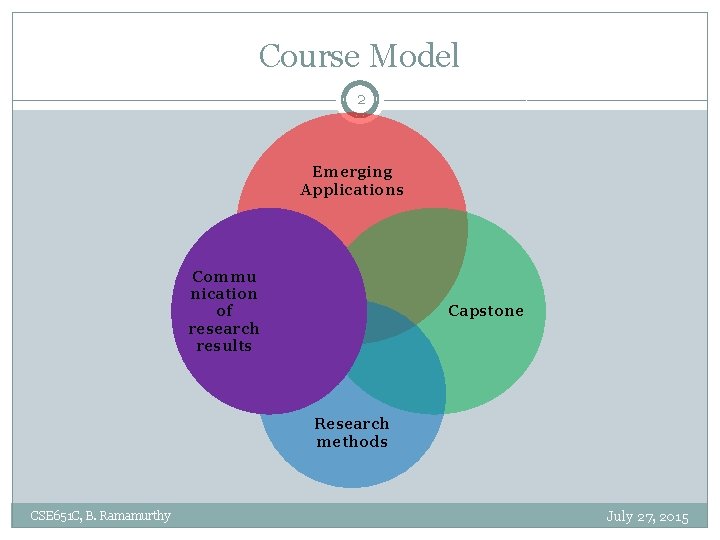
Course Model 2 Emerging Applications Commu nication of research results Capstone Research methods CSE 651 C, B. Ramamurthy July 27, 2015
Course Model 3 CSE 651 C, B. Ramamurthy July 27, 2015
References 4 � J. R. Goldberg. Capstone Design Courses: Producing Industry-Ready Biomedical Engineers, Morgan-Claypool, 2007 CSE 651 C, B. Ramamurthy July 27, 2015
What is Capstone? 5 �It provides them with the opportunity to apply what students have learned in previous courses; �Develop their communication (written, analytical, oral, and graphical (Visualization)), interpersonal (teamwork, conflict management, and negotiation), project management, and design skills; �Reinforce the design and development process of a product; �It also provides students with an understanding of the economic, financial, legal, and regulatory aspects of the design, development, and commercialization of technology. CSE 651 C, B. Ramamurthy July 27, 2015
Why Capstone? 6 � Development of design and technical skills � Development of “soft skills” such as teamwork, communication, and interpersonal skills � Develop the ability to manage the product development process � Oral, written, and graphical/ Visualization communication skills � Experience with solving a real-life, open-ended problem � Development of an understanding of the industry perspective (including financial, regulatory, and legal issues): in this case automotive industry � Exposure to results-oriented evaluations of their projects � It is a culmination of all the knowledge from other courses and application of the same. � Capstone projects are important components in a program accreditation process (esp. in United States) � For your capstone project you can try to use one or more EAPS we will discuss CSE 651 C, B. Ramamurthy July 27, 2015
Goal of Capstone Project 7 �Ability to design a system, component, or process to meet desired needs within realistic constraints such as economic, environmental, social, political, ethical, health and safety, manufacturability, and sustainability. CSE 651 C, B. Ramamurthy July 27, 2015
How do you do it? 8 �Define the requirements based on customer/client needs �Determine / understand the constraints (e. g. the memory constraint in Arduino boards) �Define the problem to be solved �Define the project scope �Study alternative solutions and compare �Make a selection of final design �Build prototype to meet needs �Validates performance of prototype �Document all the steps. CSE 651 C, B. Ramamurthy July 27, 2015
Capstone project deliverables 9 � Project definition document: contains project objective statement (which defines problem and project scope � Requirements document: contains list of needs along with design constraints � Generated concepts document: rough sketch or schematic of what you want to do � Final concept document: defends selection of proposed final design � Experimental validation document: contains test protocols, test results, data analysis, � Conclusions regarding how well prototype meets performance requirements � Final report: contains final design, test results, information regarding how well the requirements were met � Prototype CSE 651 C, B. Ramamurthy July 27, 2015
Deliverables Template 10 � See the project report we discusses earlier �We will prepare a Java. Script-based web page for presenting our project report �Multi-media presentation/screen shots/movie clips �The paper you will write also helps in achieving the goal of the capstone course. CSE 651 C, B. Ramamurthy July 27, 2015
Requirements 11 �A clear and well defined requirements-document is important Correctness of design, implementation and testing �There are different approaches to specifying the requirements �Use case diagram specifies the uses of the system, with user stimulus that invokes a particular use. �It also specifies error conditions, and how it is handled. �See https: //www. andrew. cmu. edu/course/90754/umlucdfaq. html �It can in a pictorial form or in a text form/document CSE 651 C, B. Ramamurthy July 27, 2015
Analysis and Design 12 �Typically OO design �Class diagrams, sequence diagrams, etc. �During the analysis phase you will discover the classes and the relationship (has a, is a, etc) among them. These are represented using class diagrams. �The class diagrams are then used as design for the implementation of the prototype. �There are other model for analysis and design. �You will learn more about these in your OO course. CSE 651 C, B. Ramamurthy July 27, 2015
Prototype Implementation 13 �In the prototype implementation for this course you will have a hardware and a software component. �Clearly document the implementation details and steps taken. �An IDE (integrated development environment) will be used in the design of your project. CSE 651 C, B. Ramamurthy July 27, 2015
Testing and Modification of Design 14 �Your project document should provide the test set used to determine the correctness of your implementation �There may functional as well as non-functional requirements that need to be tested. CSE 651 C, B. Ramamurthy July 27, 2015
Newer Approaches 15 �Probabilistic approaches: many events can be modeled as stochastic or random processes �Big data approaches : enormous amount of data is being collected by various sensors inside an automobile, how to analyze this and learn from it, extract useful knowledge, discover anomalies CSE 651 C, B. Ramamurthy July 27, 2015
- Slides: 15