
Capstone Concept for Joint Operations Version 3 0
- Slides: 6
Capstone Concept for Joint Operations Version 3. 0 Distribution Statement A Approved for public release; distribution is unlimited. Edited by Dr. Paul Losiewicz ONRG, 26 Mar 2009
Security Cooperative security involves the comprehensive set of continuous, long‐term and integrated actions among a broad spectrum of U. S. and international governmental and nongovernmental partners that maintains or enhances stability, prevents or mitigates crises, and facilitates other operations when crises occur. Essentially it is the challenge of fostering a favorable security environment and establishing a solid base for effective crisis response. From CCJO v 3. 0 (Italics added)
Successful Collaboration …. it is essential that military forces begin partnering with other federal agencies and local authorities as rapidly as possible, especially when nongovernmental organizations are involved. … the greater the risk of misunderstanding and disputes. Military commanders must be able to tolerate a certain degree of ambiguity and inefficiency as the price of successful cross‐agency collaboration. They likewise must allocate sufficient resources and effort to overcoming this challenge. Effectiveness therefore will put a premium on close and continuous liaison and communications. From CCJO v 3. 0 (Italics added)
Uncertainty and Learning In short, as both a concession and response to pervasive uncertainty, all joint operations are fundamentally and explicitly an adaption based on learning about the situation through action. Both understanding the situation and arranging combat, security, engagement, and relief and reconstruction become continuous activities informed by feedback. Regardless of the mission, the more quickly and appropriately the joint force can adapt itself to its situation, the more successful it will be. From CCJO v 3. 0 (Italics added)
Some Implications • Build a balanced and versatile joint force • Create general‐purpose forces capable of operating independently at increasingly lower echelons • Improve the ability to operate in urban environments • Markedly increase language and cultural capabilities and capacities • Institute mechanisms to prepare general‐purpose forces quickly for new mission sets • Markedly improve the ability to integrate with other U. S. agencies and other partners • Improve organizational solutions for protracted missions that cut across geographical boundaries • Improve Service and institutional adaptability to deal with rapid change From CCJO v 3. 0 (Italics added)
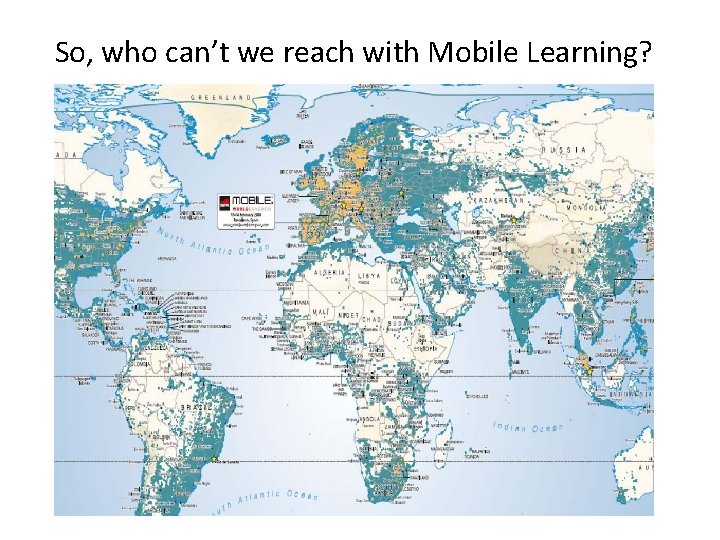
So, who can’t we reach with Mobile Learning?