
Capitalism Socialism Communism The Industrial Revolution opened a
- Slides: 12
Capitalism Socialism Communism
The Industrial Revolution opened a wide gap between the rich and the poor. Business leaders believed that governments should stay out of business and economic affairs. Reformers, however, felt that governments needed to play an active role to improve conditions for the poor workers. What are examples of business and ‘economic affairs’?
The Ideas/Philosophers of Industrialization Laissez Faire (French for ‘let do’…and ‘let people do as they please’) This is an economic policy that believed in letting owners of industry and business set working conditions without interference by the government. People who followed this policy believed the world economy would benefit from no government intervention or regulation. What are some benefits to no government involvement in world commerce (trade)? What are some problems or negatives that could develop from no government involvement?
Adam Smith and the Natural Laws of Economics Adams Smith was a professor at the University of Glasgow and he believed that with no government interference in the economy that people would gain wealth. He stressed 3 natural laws of economics: the law of self-interest: people work for their own good the law of competition: competition forces people to make a better product the law of supply and demand: enough goods would be produced at the lowest possible price to meet demand in a market economy Do you think this is true? Why or why not?
The Economics of Capitalism (Laissez-Faire) Capitalism: an economic system in which the factors of production are privately owned and money is invested in business ventures to make a profit. These ideas helped bring out the Industrial Revolution. What are ’factors of production’? What are some examples?
(Laissez-Faire) Capitalism (continued) A proponent of this thought was David Ricardo. He believed that there would always be a poor ‘underclass’. He stated that if there were plentiful natural resources and plentiful workers then the resources and labor will remain cheap. With the population living longer and increasing throughout the Industrial Revolution Ricardo believed that working wages would decrease. Do you think there will always be a poor class of people? Why or why not?
The Rise of Socialism Socialist theories were in direct contrast to capitalism. Those people who supported socialism desired government involvement in business and economy. They believed the government should aid the poor workers in helping to improve their lives. Socialism is an economic philosophy in which the factors of production are owned and controlled by the government. How would people benefit if the government controlled the various factors of production? How could the government control be negative? Socialists believed the government should plan the economy rather than depend on free-market capitalism to do the job.
Marxism: Radical Socialism Karl Marx believed in a radical form of socialism that was called ‘Marxism’. Marx and Frederich Engels wrote a pamphlet called The Communist Manifesto in which they shared their ideas of society. They wrote about ‘warring classes’ of the Industrial Revolution who were the ‘haves’ (employers, bourgeoisie) and the ‘havenots’(workers, proletariat). The ‘haves’, who controlled the factors of production gained wealth at the expense of the ‘have-nots’ who performed difficult labor under horrible working conditions.
Marxism: Radical Socialism (continued) ‘Freeman and slave, patrician and plebeian, lord and serf, guild-master and journeyman, in a word, oppressor and oppressed, stood in constant opposition to one another, carried on an uninterrupted, now hidden, now open fight, a fight that each time ended, either in a revolutionary reconstitutions of society at large, or in the common ruin of the contending classes. ’ (Karl Marx and Frederich Engels, The Communist Manifesto (1848) Do we have the ‘haves’ and the ‘have not's in our society today? Examples? Do you think it is true that they are ‘at war’ with each other? Explain your answer.
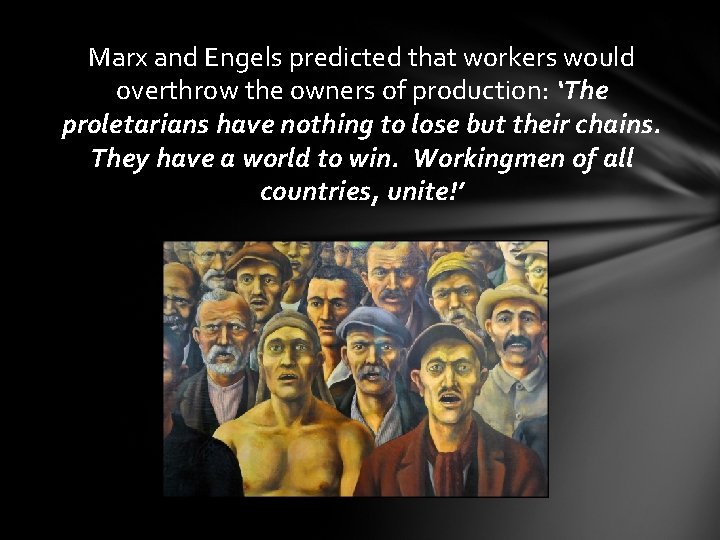
Marx and Engels predicted that workers would overthrow the owners of production: ‘The proletarians have nothing to lose but their chains. They have a world to win. Workingmen of all countries, unite!’
Marxism: Radical Socialism (continued) They believed the capitalist system that produced the Industrial Revolution would end up destroying itself. Marx and Engels predicted the small business owners would be driven out of business leaving just a few wealthy factory owners to control the production and the wealth. In response to their horrible treatment the ‘have-nots’ (proletariat) would revolt and take control of the factories and produce what was needed for society. The workers would then share the profits and bring about monetary equality. (No one is really rich or poor…everyone is equal in wealth. ) Ultimately, the people would control the government and a classless society would develop.
Communism (according to Marx) After the workers rebelled and controlled the government bringing about a classless society people would be living in a communist society. In a (Marxist) communist society the means of production would be controlled by the people. There would be no private property and people shared all goods equally. Do you think this would work? Why or why not?