
Capital Structure Refers to the mix of debt
Capital Structure • Refers to the mix of debt and equity that a company uses to finance its business Capital Restructuring • Capital restructuring involves changing the amount of leverage a firm has without changing the firm’s assets • The firm can increase leverage by issuing debt and repurchasing outstanding shares • The firm can decrease leverage by issuing new shares and retiring outstanding debt 1
Capital Structure Theory • Modigliani and Miller Theory of Capital Structure – Proposition I – firm value – Proposition II – WACC • The value of the firm is determined by the cash flows to the firm and the risk of the assets • To change firm value – Change the risk of the cash flows – Change the cash flows 2
Capital Structure Theory Under Three Special Cases • Case I – Assumptions – No corporate or personal taxes – No bankruptcy costs • Case II – Assumptions – Corporate taxes, but no personal taxes – No bankruptcy costs • Case III – Assumptions – Corporate taxes, but no personal taxes – Bankruptcy costs 3
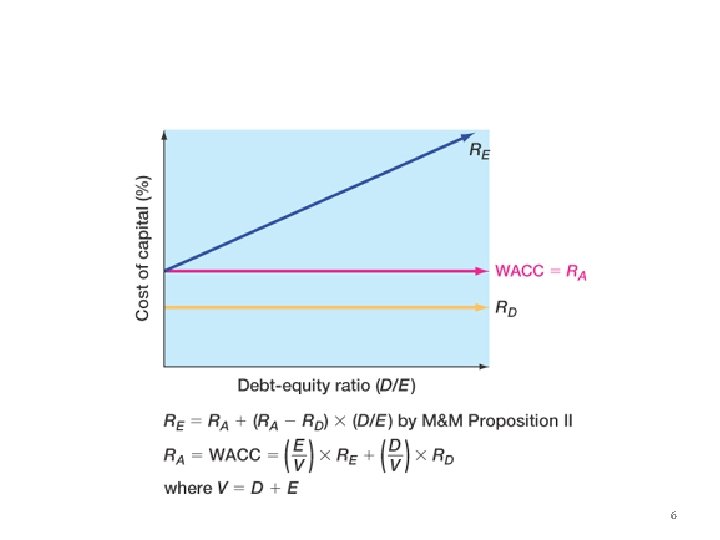
Case I – Propositions I and II • Value of the firm (Proposition I) – The value of the firm is NOT affected by changes in the capital structure – The cash flows of the firm do not change; therefore, value doesn’t change • WACC (Proposition II) – The WACC of the firm is NOT affected by capital structure 4
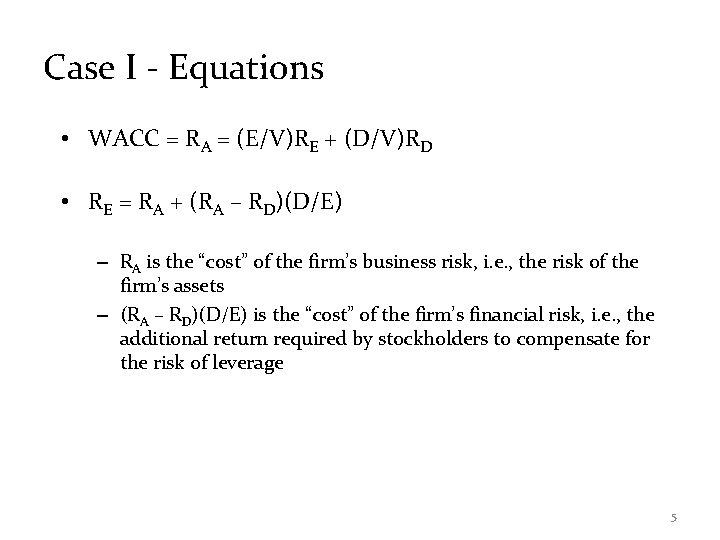
Case I - Equations • WACC = RA = (E/V)RE + (D/V)RD • RE = RA + (RA – RD)(D/E) – RA is the “cost” of the firm’s business risk, i. e. , the risk of the firm’s assets – (RA – RD)(D/E) is the “cost” of the firm’s financial risk, i. e. , the additional return required by stockholders to compensate for the risk of leverage 5
6
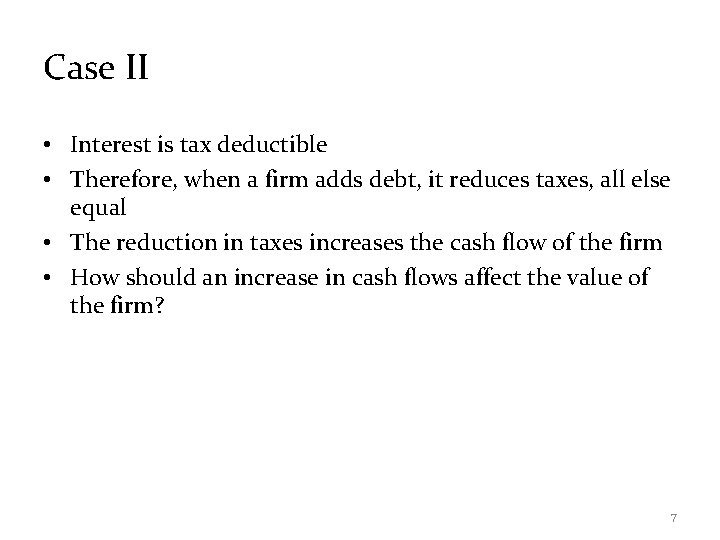
Case II • Interest is tax deductible • Therefore, when a firm adds debt, it reduces taxes, all else equal • The reduction in taxes increases the cash flow of the firm • How should an increase in cash flows affect the value of the firm? 7
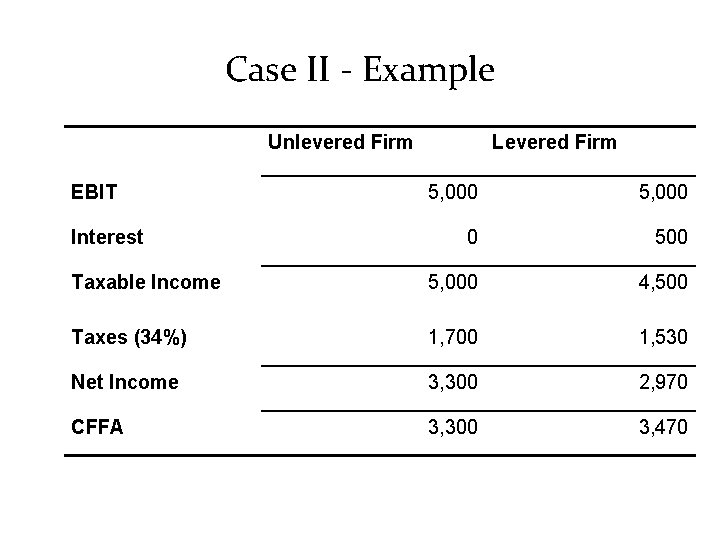
Case II - Example Unlevered Firm EBIT Levered Firm 5, 000 0 500 Taxable Income 5, 000 4, 500 Taxes (34%) 1, 700 1, 530 Net Income 3, 300 2, 970 CFFA 3, 300 3, 470 Interest
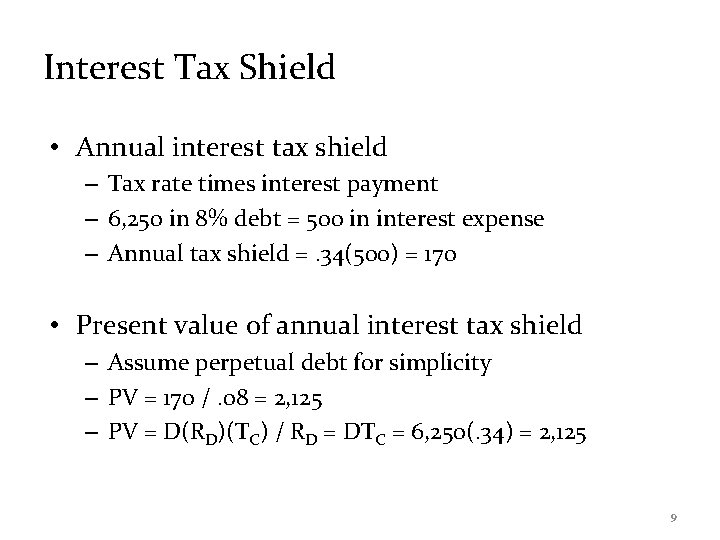
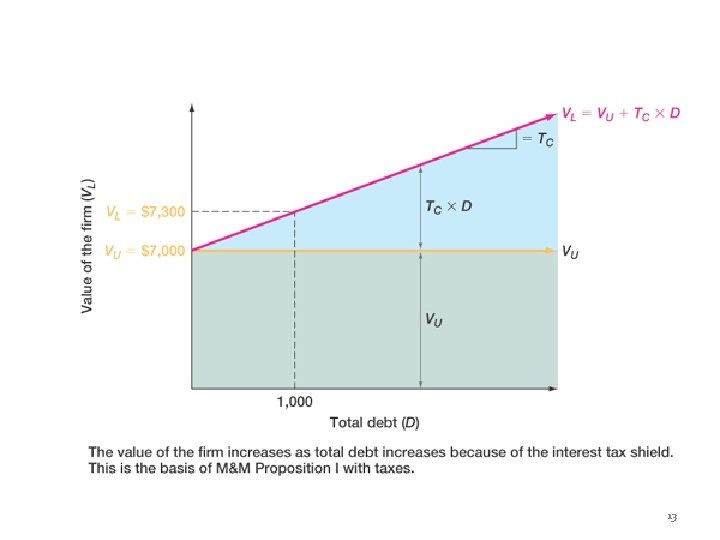
Interest Tax Shield • Annual interest tax shield – Tax rate times interest payment – 6, 250 in 8% debt = 500 in interest expense – Annual tax shield =. 34(500) = 170 • Present value of annual interest tax shield – Assume perpetual debt for simplicity – PV = 170 /. 08 = 2, 125 – PV = D(RD)(TC) / RD = DTC = 6, 250(. 34) = 2, 125 9
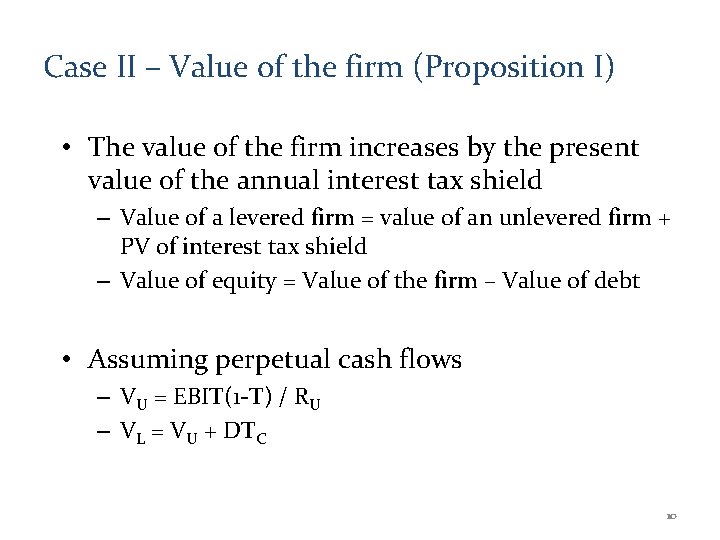
Case II – Value of the firm (Proposition I) • The value of the firm increases by the present value of the annual interest tax shield – Value of a levered firm = value of an unlevered firm + PV of interest tax shield – Value of equity = Value of the firm – Value of debt • Assuming perpetual cash flows – VU = EBIT(1 -T) / RU – VL = VU + DTC 10
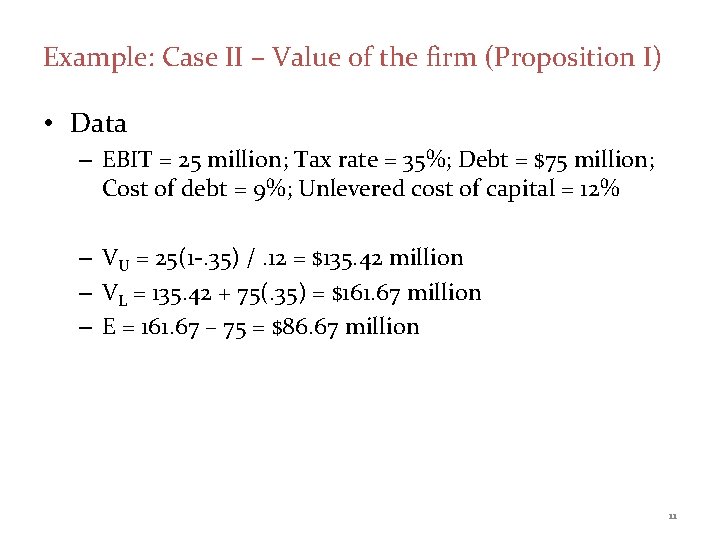
Example: Case II – Value of the firm (Proposition I) • Data – EBIT = 25 million; Tax rate = 35%; Debt = $75 million; Cost of debt = 9%; Unlevered cost of capital = 12% – VU = 25(1 -. 35) /. 12 = $135. 42 million – VL = 135. 42 + 75(. 35) = $161. 67 million – E = 161. 67 – 75 = $86. 67 million 11
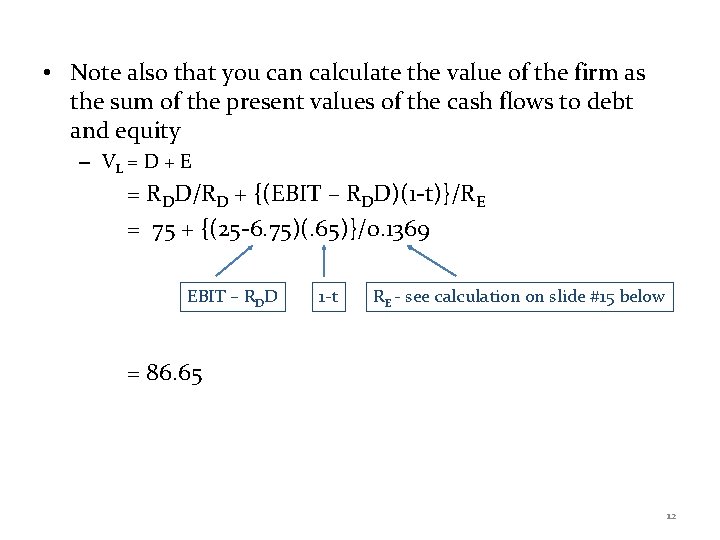
• Note also that you can calculate the value of the firm as the sum of the present values of the cash flows to debt and equity – VL = D + E = RDD/RD + {(EBIT – RDD)(1 -t)}/RE = 75 + {(25 -6. 75)(. 65)}/0. 1369 EBIT – RDD 1 -t RE - see calculation on slide #15 below = 86. 65 12
13
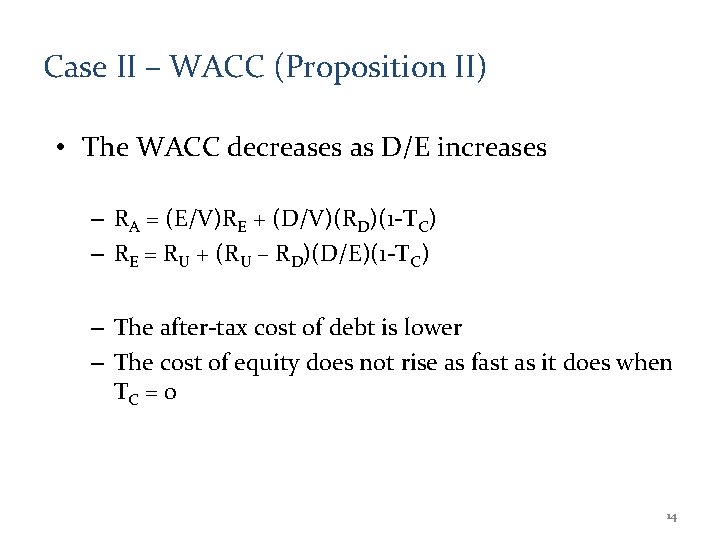
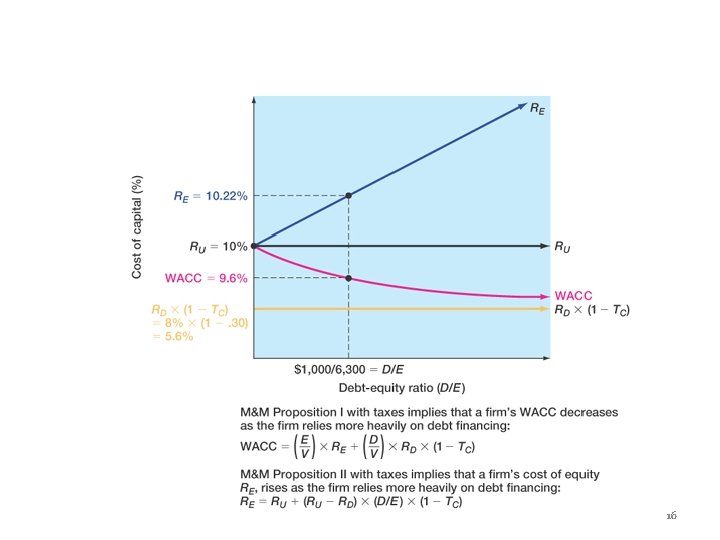
Case II – WACC (Proposition II) • The WACC decreases as D/E increases – RA = (E/V)RE + (D/V)(RD)(1 -TC) – RE = RU + (RU – RD)(D/E)(1 -TC) – The after-tax cost of debt is lower – The cost of equity does not rise as fast as it does when TC = 0 14
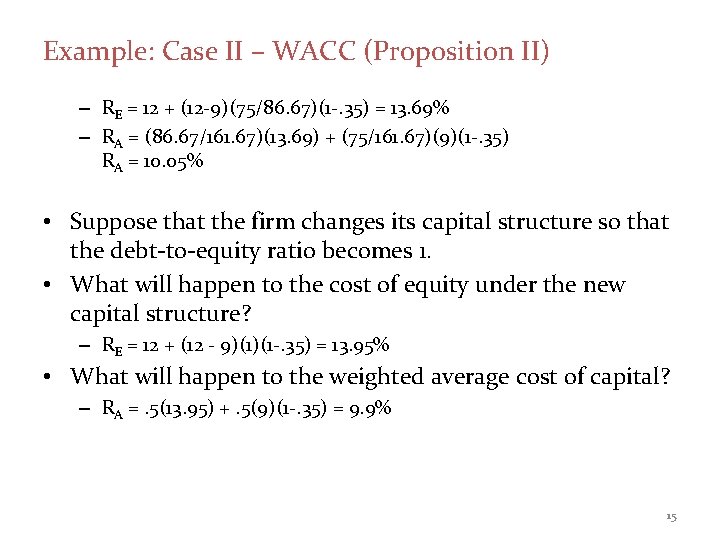
Example: Case II – WACC (Proposition II) – RE = 12 + (12 -9)(75/86. 67)(1 -. 35) = 13. 69% – RA = (86. 67/161. 67)(13. 69) + (75/161. 67)(9)(1 -. 35) RA = 10. 05% • Suppose that the firm changes its capital structure so that the debt-to-equity ratio becomes 1. • What will happen to the cost of equity under the new capital structure? – RE = 12 + (12 - 9)(1)(1 -. 35) = 13. 95% • What will happen to the weighted average cost of capital? – RA =. 5(13. 95) +. 5(9)(1 -. 35) = 9. 9% 15
16
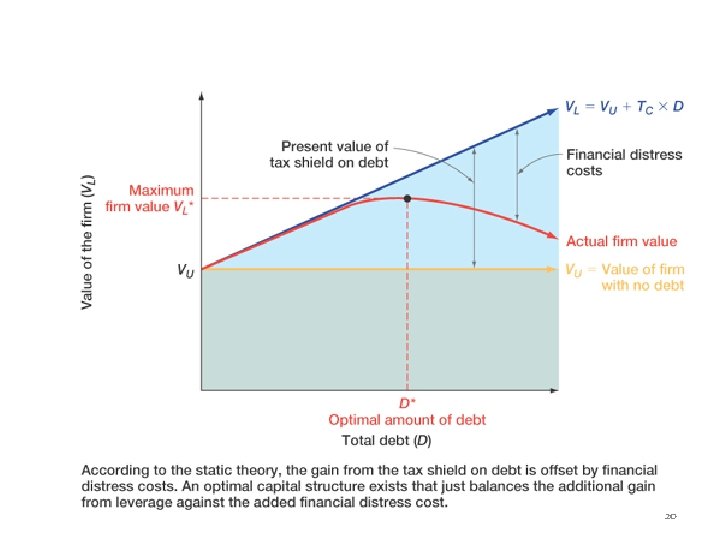
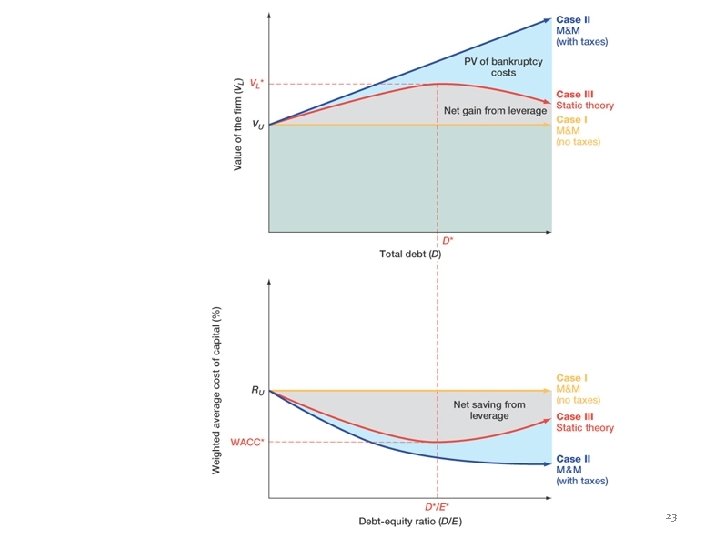
Case III • Now we add bankruptcy costs • As the D/E ratio increases, the probability of bankruptcy increases • This increased probability will increase the expected bankruptcy costs • At some point, the additional value of the interest tax shield will be offset by the increase in expected bankruptcy cost • At this point, the value of the firm will start to decrease and the WACC will start to increase as more debt is added 17
Bankruptcy Costs • Direct costs – Legal and administrative costs – Ultimately cause bondholders to incur additional losses – Disincentive to debt financing • Financial distress – Significant problems in meeting debt obligations – Most firms that experience financial distress do not ultimately file for bankruptcy 18
• Indirect bankruptcy costs – Larger than direct costs, but more difficult to measure and estimate – Stockholders want to avoid a formal bankruptcy filing – Bondholders want to keep existing assets intact so they can at least receive that money – Assets lose value as management spends time worrying about avoiding bankruptcy instead of running the business – The firm may also lose sales, experience interrupted operations and lose valuable employees 19
20
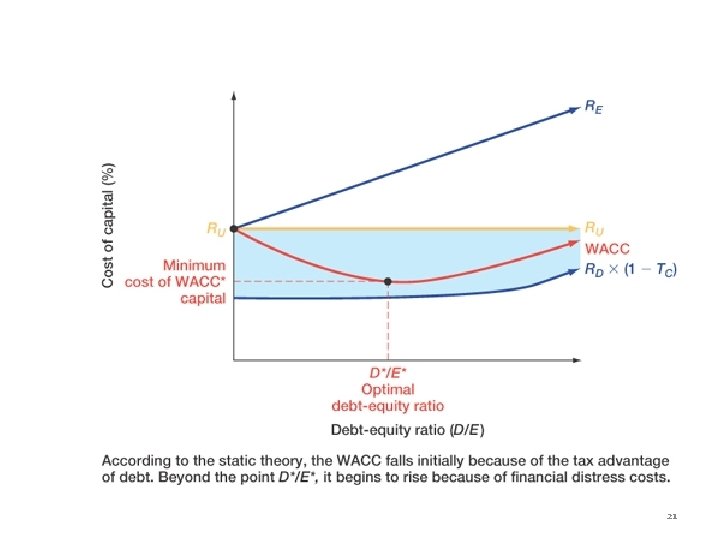
21
Conclusions • Case I – no taxes or bankruptcy costs – No optimal capital structure • Case II – corporate taxes but no bankruptcy costs – Optimal capital structure is almost 100% debt – Each additional dollar of debt increases the cash flow of the firm • Case III – corporate taxes and bankruptcy costs – Optimal capital structure is part debt and part equity – Occurs where the benefit from an additional dollar of debt is just offset by the increase in expected bankruptcy costs 22
23
Managerial Recommendations • The tax benefit is only important if the firm has a large tax liability • Risk of financial distress – The greater the risk of financial distress, the less debt will be optimal for the firm – The cost of financial distress varies across firms and industries and as a manager you need to understand the cost for your industry 24
- Slides: 24