
Capital requirements 1 Motivation The financial and crisis



- Slides: 28
Capital requirements 1
Motivation • The financial and crisis is primarily due to excessive lending, and the lowering or credit standards • The focus was initially on how to solve the crisis. Gradually, the focus is shifting toward better regulation to prevent the occurrence of similar crisis in the future. • At the core of the regulation, is the banks behavior. Lower risk-taking could be achieved by, among other things: – – Better incentives structures. Feasible? Preventing banks from taking excessive risk. Role of capital requirements. 2
Capital regulation banks are required to hold more capital when they lend more, or lend to riskier borrowers Reasons for capital regulation: - Because of deposit insurance, the losses resulting from a bank default are not borne by the shareholders or bondholders. Hence, the costs of failure are not fully internalized, which induces excessive risk-taking. Capital requirements act as a buffer in case of losses. - Incentives alignment: by increasing the economic exposure of shareholders, capital regulation boost their incentives to monitor the management. - Capital requirements will prevent banks from taking too much risks: the riskier the lending, the higher the capital to be raised 3
Lecture plan • How does capital requirements works? • What are the problems with the current system ? • Possible solutions and better regulation 4
Basel I • Since 1978, bank capital has become a focal point of bank regulation • With increasing international competition among banks, regulators have recognized the need to coordinate capital requirements for banks across countries • In 1987, the Bank of International Settlements provided capital standard for all banks in US, Japan and the 10 Western European countries • The accord was fully implemented in 1993 • Relates required capital to the composition of the bank’s assets 5
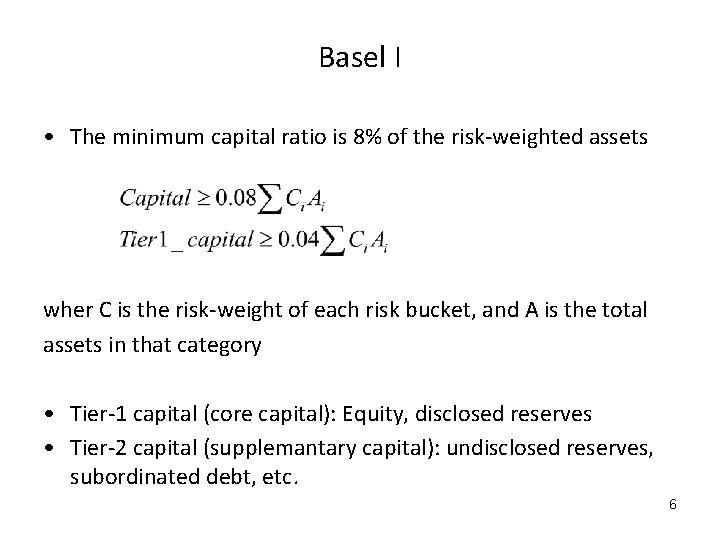
Basel I • The minimum capital ratio is 8% of the risk-weighted assets wher C is the risk-weight of each risk bucket, and A is the total assets in that category • Tier-1 capital (core capital): Equity, disclosed reserves • Tier-2 capital (supplemantary capital): undisclosed reserves, subordinated debt, etc. 6
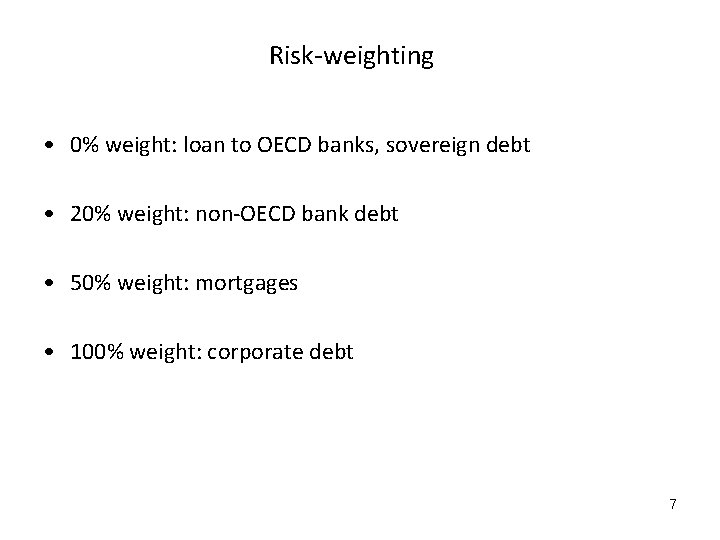
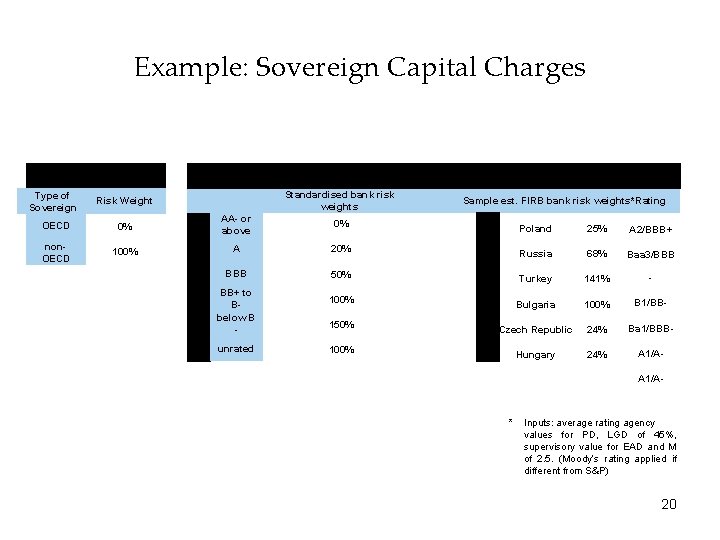
Risk-weighting • 0% weight: loan to OECD banks, sovereign debt • 20% weight: non-OECD bank debt • 50% weight: mortgages • 100% weight: corporate debt 7
Merits of Basel I • Substantial increase in capital ratios • Simple structure • Worldwide adoption • Increased competitive equality among international banks 8
Criticisms • The risk classes are incoherent: Mortgages require half the capital of business loans, although it is not hard to find mortgages that are more risky • Interest-rate risk is not taken into account • Assumption that banking risk is the same in different countries • No recognition of the portfolio aspects of bank balance sheets since requirements are linear in individual asset categories 9
Basel II mian objectives • Adopt more risk-sensitive capital requirements • Make greater use of bank’s own internal risk assessments • Cover a more comprehensive set of risks, including credit risk, interest rate risk and operational risk • Account for the risk mitigation efforts of banks 10
Basel II timeline • 1996: Amendment to Basel I to incorporate market risk • 1999: A new capital adequacy framework – discussion paper • 2001: A new capital adequacy framework – revised draft • 2003: Third draft • 2004 -2007: Additional refinements and final draft • 2006 -2007: start of the implementation • Now: in doubt 11
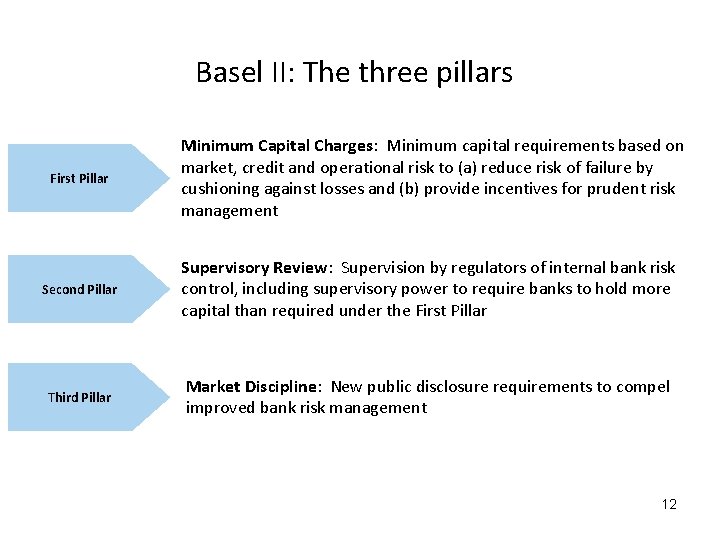
Basel II: The three pillars First Pillar Minimum Capital Charges: Minimum capital requirements based on market, credit and operational risk to (a) reduce risk of failure by cushioning against losses and (b) provide incentives for prudent risk management Second Pillar Supervisory Review: Supervision by regulators of internal bank risk control, including supervisory power to require banks to hold more capital than required under the First Pillar Third Pillar Market Discipline: New public disclosure requirements to compel improved bank risk management 12
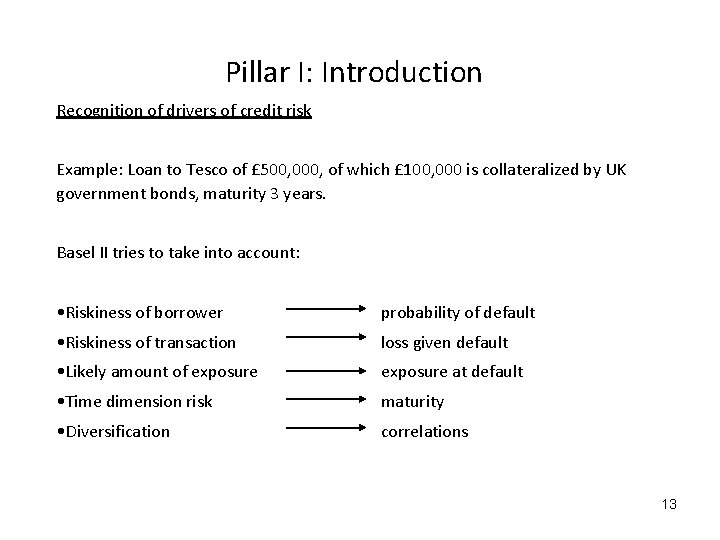
Pillar I: Introduction Recognition of drivers of credit risk Example: Loan to Tesco of £ 500, 000, of which £ 100, 000 is collateralized by UK government bonds, maturity 3 years. Basel II tries to take into account: • Riskiness of borrower probability of default • Riskiness of transaction loss given default • Likely amount of exposure at default • Time dimension risk maturity • Diversification correlations 13
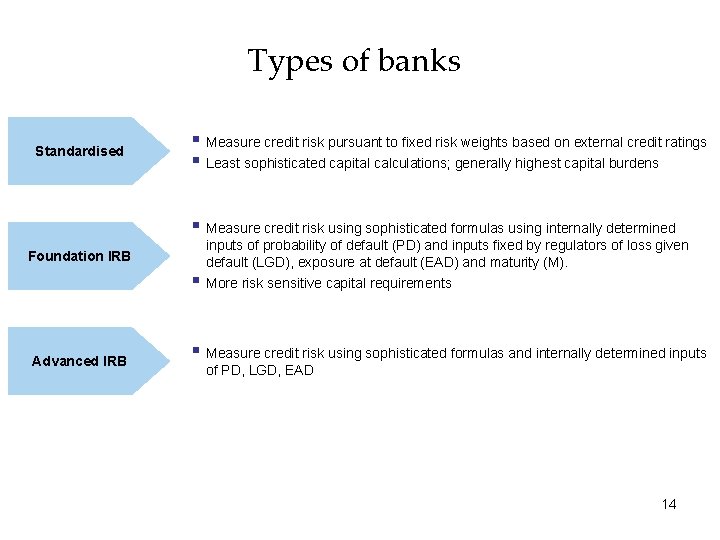
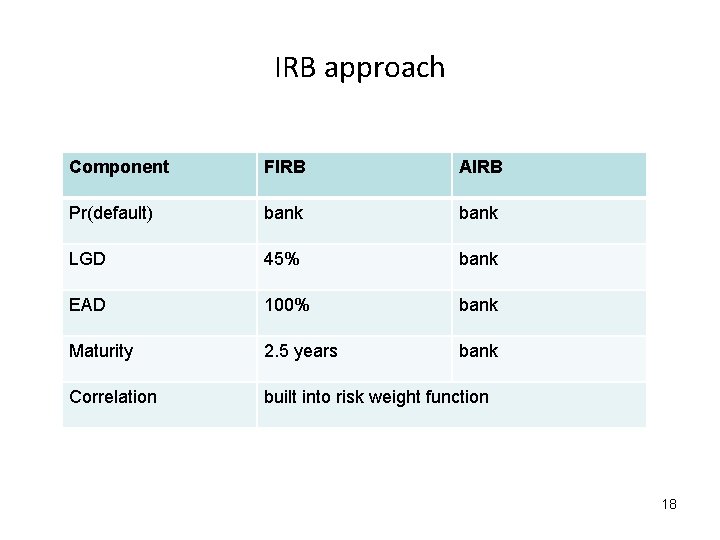
Types of banks Standardised § Measure credit risk pursuant to fixed risk weights based on external credit ratings § Least sophisticated capital calculations; generally highest capital burdens § Measure credit risk using sophisticated formulas using internally determined Foundation IRB § Advanced IRB inputs of probability of default (PD) and inputs fixed by regulators of loss given default (LGD), exposure at default (EAD) and maturity (M). More risk sensitive capital requirements § Measure credit risk using sophisticated formulas and internally determined inputs of PD, LGD, EAD 14
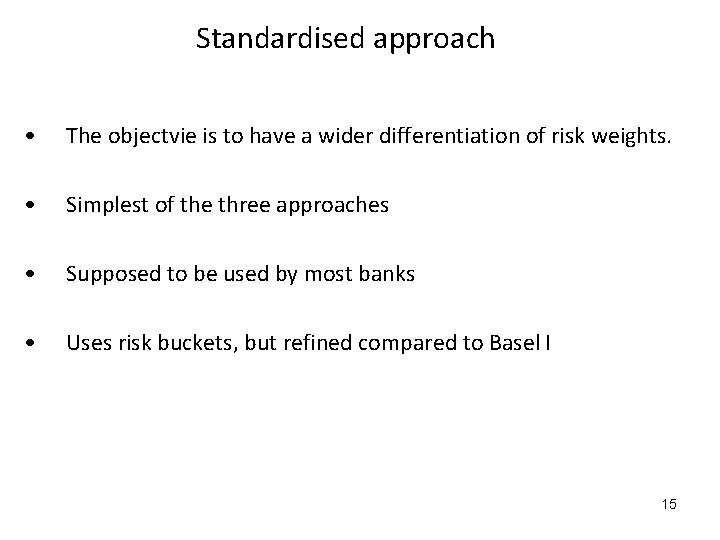
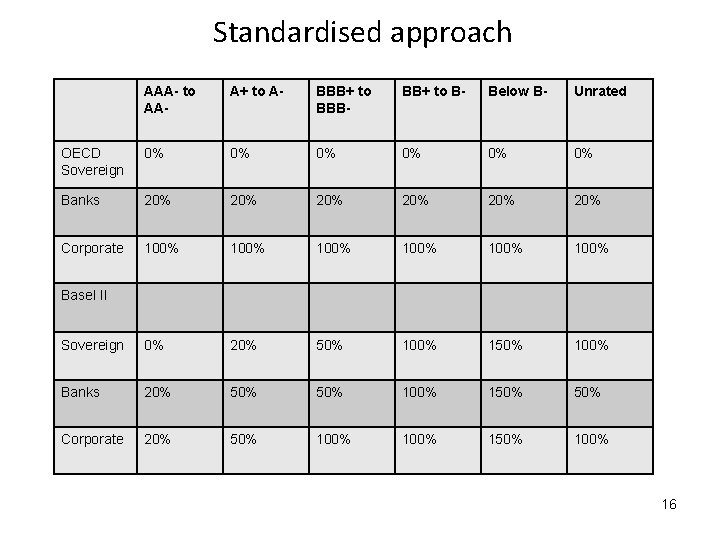
Standardised approach • The objectvie is to have a wider differentiation of risk weights. • Simplest of the three approaches • Supposed to be used by most banks • Uses risk buckets, but refined compared to Basel I 15
Standardised approach AAA- to AA- A+ to A- BBB+ to BBB- BB+ to B- Below B- Unrated OECD Sovereign 0% 0% 0% Banks 20% 20% 20% Corporate 100% 100% Sovereign 0% 20% 50% 100% 150% 100% Banks 20% 50% 100% 150% Corporate 20% 50% 100% 150% 100% Basel II 16
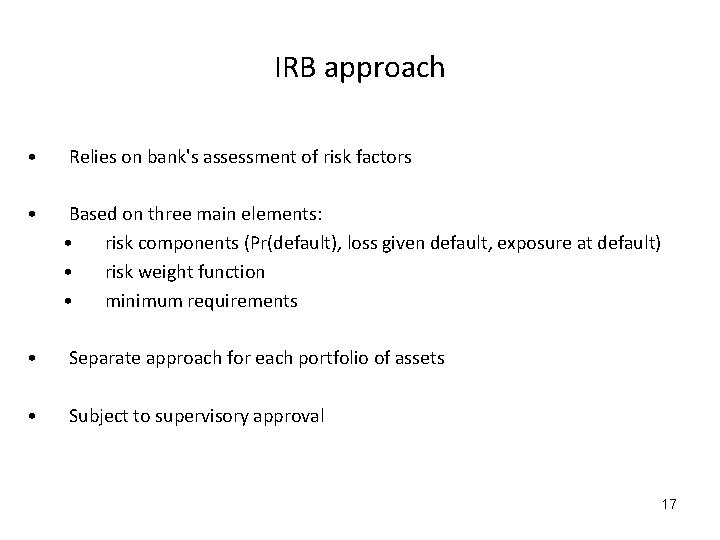
IRB approach • Relies on bank's assessment of risk factors • Based on three main elements: • risk components (Pr(default), loss given default, exposure at default) • risk weight function • minimum requirements • Separate approach for each portfolio of assets • Subject to supervisory approval 17
IRB approach Component FIRB AIRB Pr(default) bank LGD 45% bank EAD 100% bank Maturity 2. 5 years bank Correlation built into risk weight function 18
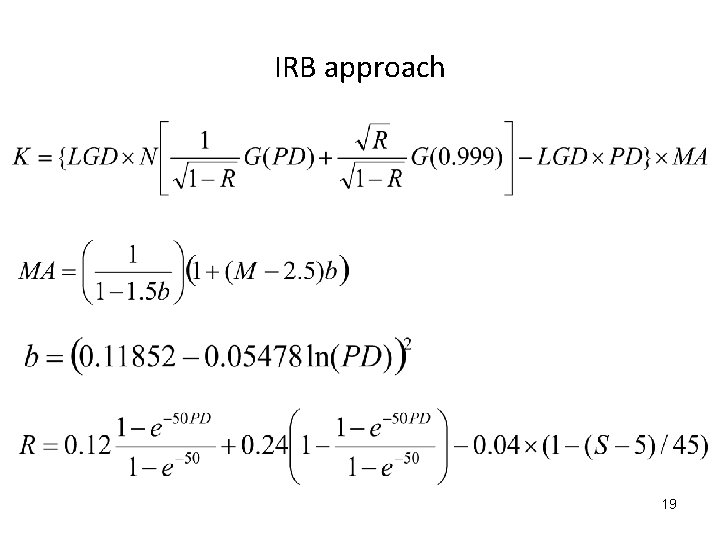
IRB approach 19
Example: Sovereign Capital Charges Basel I Type of Sovereign Basel II Standardised bank risk weights Risk Weight Sample est. FIRB bank risk weights* Rating AA- or above 0% Poland 25% A 2/BBB+ non. OECD 100% A 20% Russia 68% Baa 3/BBB 50% Turkey 141% - Bulgaria 100% B 1/BB- 150% Czech Republic 24% Ba 1/BBB- 100% Hungary 24% A 1/A- BB+ to Bbelow B unrated 100% Country 0% External Rating OECD A 1/A- * Inputs: average rating agency values for PD, LGD of 45%, supervisory value for EAD and M of 2. 5. (Moody’s rating applied if different from S&P) 20
Market risk • Banks are required to have procedures to assess and manage all material market risks. The assessment should be based on Va. R modeling and stress testing. • Example of risk: unexpected change in interest rates. 21
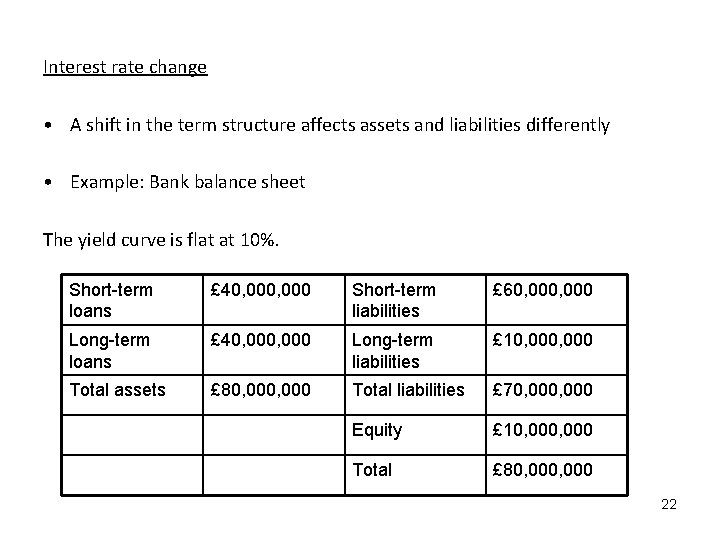
Interest rate change • A shift in the term structure affects assets and liabilities differently • Example: Bank balance sheet The yield curve is flat at 10%. Short-term loans £ 40, 000 Short-term liabilities £ 60, 000 Long-term loans £ 40, 000 Long-term liabilities £ 10, 000 Total assets £ 80, 000 Total liabilities £ 70, 000 Equity £ 10, 000 Total £ 80, 000 22
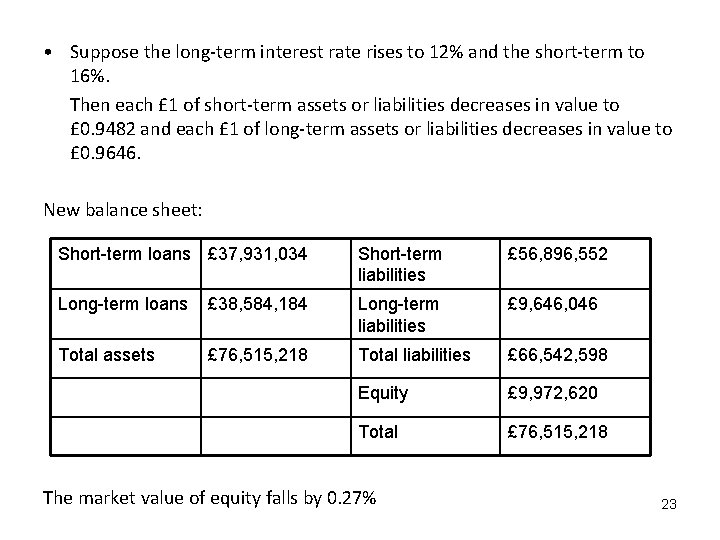
• Suppose the long-term interest rate rises to 12% and the short-term to 16%. Then each £ 1 of short-term assets or liabilities decreases in value to £ 0. 9482 and each £ 1 of long-term assets or liabilities decreases in value to £ 0. 9646. New balance sheet: Short-term loans £ 37, 931, 034 Short-term liabilities £ 56, 896, 552 Long-term loans £ 38, 584, 184 Long-term liabilities £ 9, 646, 046 Total assets £ 76, 515, 218 Total liabilities £ 66, 542, 598 Equity £ 9, 972, 620 Total £ 76, 515, 218 The market value of equity falls by 0. 27% 23
Improvements on Basel I - Basel II increases risk sensitivity considerably - Reduces the possibilities to exploit the capital regulation system - Partially takes into account credit portfolio diversification - Better incentives for appropriate risk mitigation techniques - Lower capital requirements levels 24
Cyclical effects • Banks and cyclicality: § Banks lend less during recession, which exacerbates economic downturns § Banks are more willing to lend during periods of high GDP growth • Basel II and cyclicality: § During recessions, credit ratings deteriorate and banks are required to hold more capital, ans lend less § During expansions, credit ratings improve and banks are required to hold less capital, and lend more Hence, possible conflict between regulation and economic stability 25
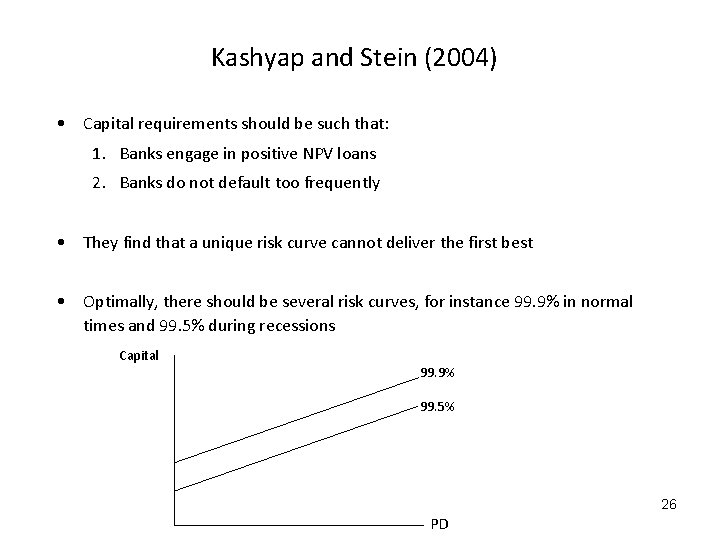
Kashyap and Stein (2004) • Capital requirements should be such that: 1. Banks engage in positive NPV loans 2. Banks do not default too frequently • They find that a unique risk curve cannot deliver the first best • Optimally, there should be several risk curves, for instance 99. 9% in normal times and 99. 5% during recessions Capital 99. 9% 99. 5% 26 PD
• They simulate the impact of Basel II on the 1998 -2002 period • Convert firms’ ratings into a PD, and map the PD into capital charges • Result: Large increases in capital requirements during the 1998 -2002 period • The cyclicality depends on the model considered to compute PD 27
Problems with existing capital regulation • Banks and cyclicality: § Banks lend less during recession, which exacerbates economic downturns § Banks are more willing to lend during periods of high GDP growth • Basel II and cyclicality: § During recessions, credit ratings deteriorate and banks are required to hold more capital, ans lend less § During expansions, credit ratings improve and banks are required to hold less capital, and lend more Hence, possible conflict between regulation and economic stability 28