
Capital Planning and Asset Management Shadi Eskaf Environmental
- Slides: 37
Capital Planning and Asset Management Shadi Eskaf Environmental Finance Center at the University of North Carolina, Chapel Hill Environmental Finance Center Network 919. 962. 2785 eskaf@sog. unc. edu
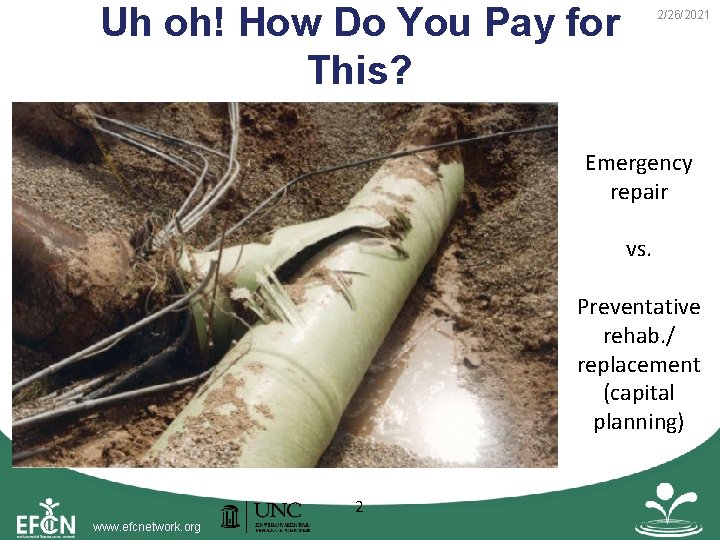
Uh oh! How Do You Pay for This? 2/26/2021 Emergency repair vs. Preventative rehab. / replacement (capital planning) www. efcnetwork. org 2
2/26/2021 Session Objectives • Capital Planning Process • Prioritizing Your Needs • How to Estimate Your Future Costs www. efcnetwork. org
2/26/2021 In the Old Days. . . • Water systems took advantage of the federal government’s ambitious construction grants program of the 1970 s and 1980 s • Everybody loved their “free” money www. efcnetwork. org
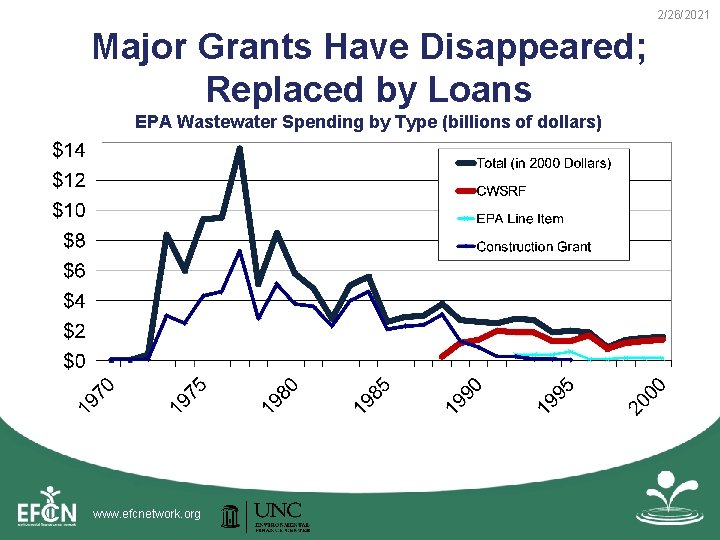
2/26/2021 Capital Finance Today • The money never really was “free”—it came from tax dollars • Today, the financial burden has been shifted away from federal and state tax dollars (grants) to funds raised by the water system itself (customer sales and loans). For example. . . www. efcnetwork. org
2/26/2021 Major Grants Have Disappeared; Replaced by Loans EPA Wastewater Spending by Type (billions of dollars) www. efcnetwork. org
2/26/2021 Capital Finance Today • In other words, you pay (no sense in sugar -coating this) • The harsh reality is that water and wastewater infrastructure is expensive, regardless of the size of your system. Smaller or poorer systems will likely have a hard time paying for capital improvements www. efcnetwork. org
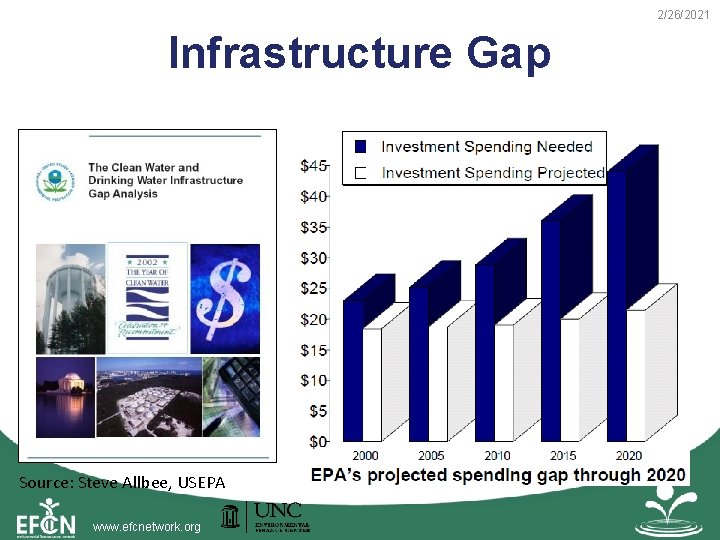
2/26/2021 Infrastructure Gap Source: Steve Allbee, USEPA www. efcnetwork. org
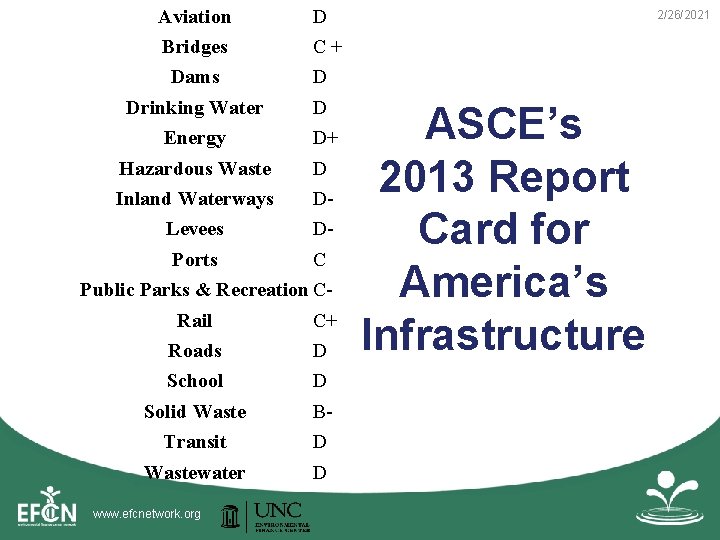
Aviation D Bridges C+ Dams D Drinking Water D Energy D+ Hazardous Waste D Inland Waterways D- Levees D- Ports C Public Parks & Recreation CRail C+ Roads D School D Solid Waste B- Transit D Wastewater D www. efcnetwork. org 2/26/2021 ASCE’s 2013 Report Card for America’s Infrastructure
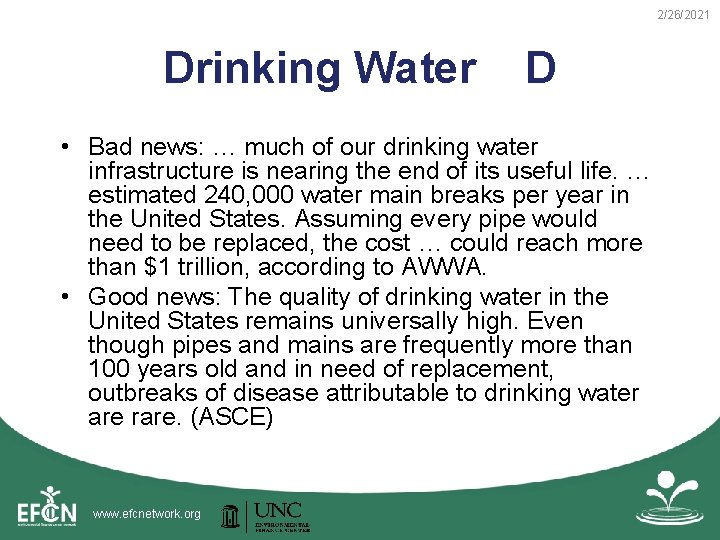
2/26/2021 Drinking Water D • Bad news: … much of our drinking water infrastructure is nearing the end of its useful life. … estimated 240, 000 water main breaks per year in the United States. Assuming every pipe would need to be replaced, the cost … could reach more than $1 trillion, according to AWWA. • Good news: The quality of drinking water in the United States remains universally high. Even though pipes and mains are frequently more than 100 years old and in need of replacement, outbreaks of disease attributable to drinking water are rare. (ASCE) www. efcnetwork. org
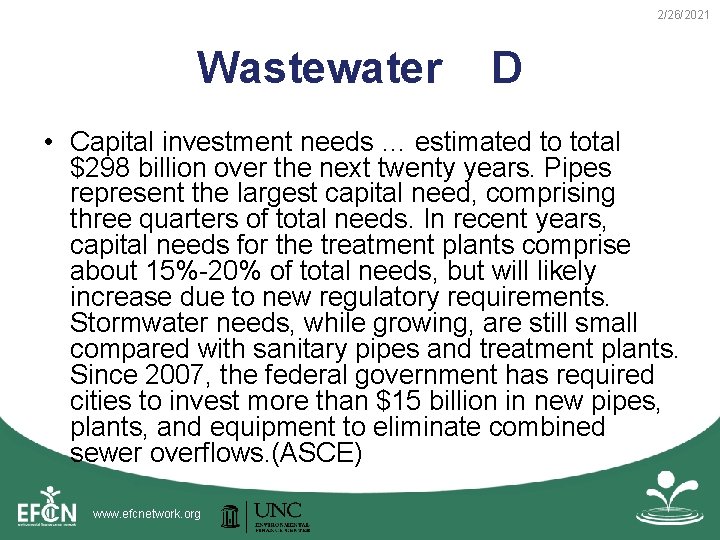
2/26/2021 Wastewater D • Capital investment needs … estimated to total $298 billion over the next twenty years. Pipes represent the largest capital need, comprising three quarters of total needs. In recent years, capital needs for the treatment plants comprise about 15%-20% of total needs, but will likely increase due to new regulatory requirements. Stormwater needs, while growing, are still small compared with sanitary pipes and treatment plants. Since 2007, the federal government has required cities to invest more than $15 billion in new pipes, plants, and equipment to eliminate combined sewer overflows. (ASCE) www. efcnetwork. org
2/26/2021 Two Related Concepts: Asset Management & Capital Planning www. efcnetwork. org
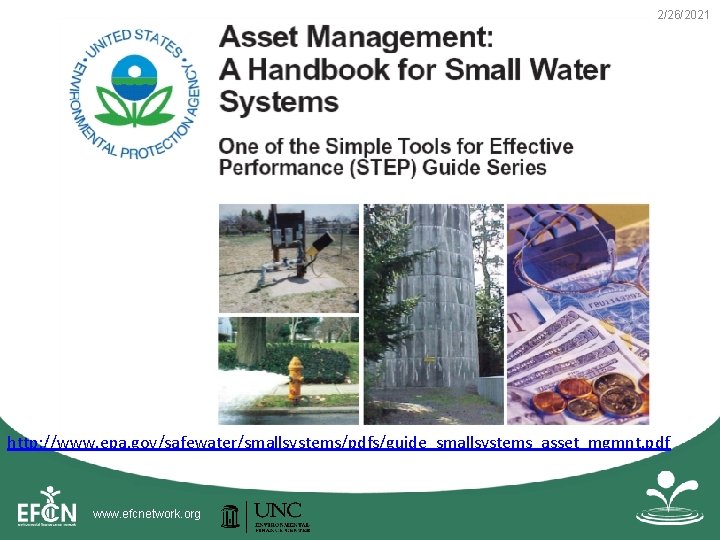
2/26/2021 http: //www. epa. gov/safewater/smallsystems/pdfs/guide_smallsystems_asset_mgmnt. pdf www. efcnetwork. org
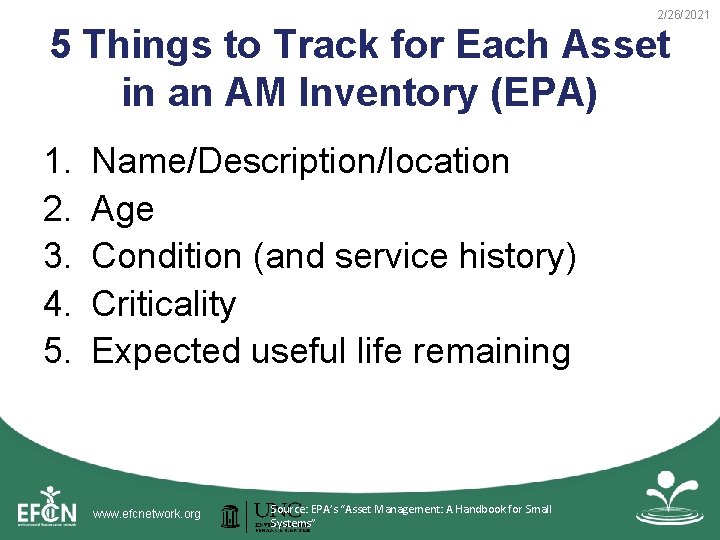
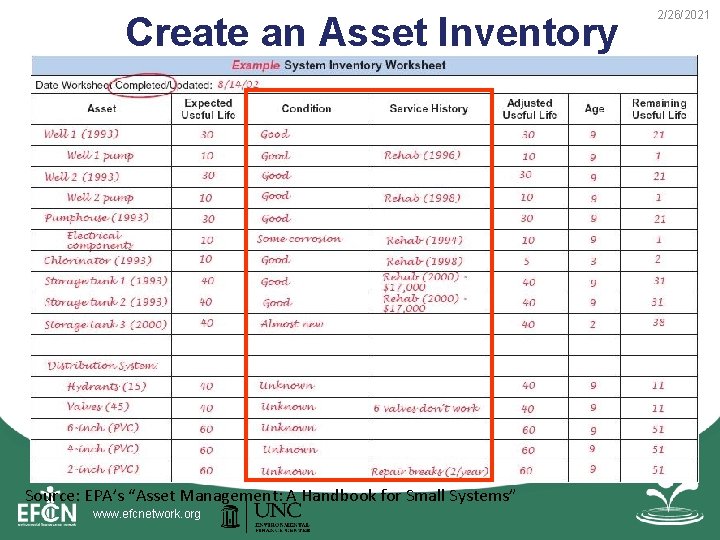
2/26/2021 5 Things to Track for Each Asset in an AM Inventory (EPA) 1. 2. 3. 4. 5. Name/Description/location Age Condition (and service history) Criticality Expected useful life remaining www. efcnetwork. org Source: EPA’s “Asset Management: A Handbook for Small Systems”
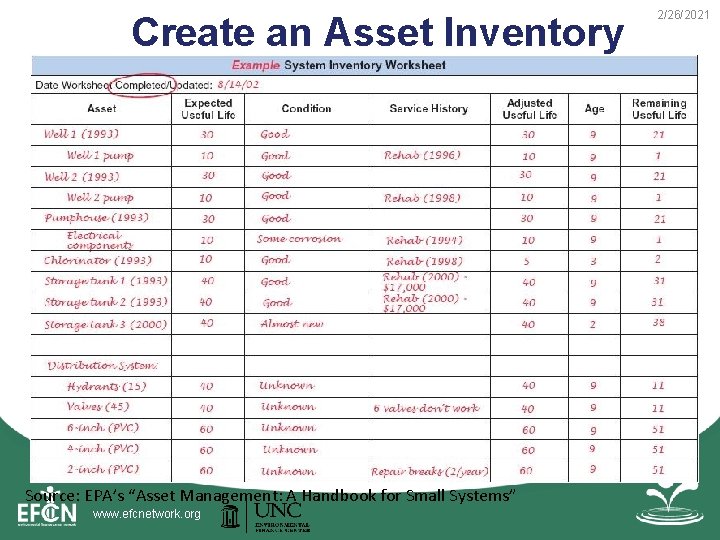
Create an Asset Inventory Source: EPA’s “Asset Management: A Handbook for Small Systems” www. efcnetwork. org 2/26/2021
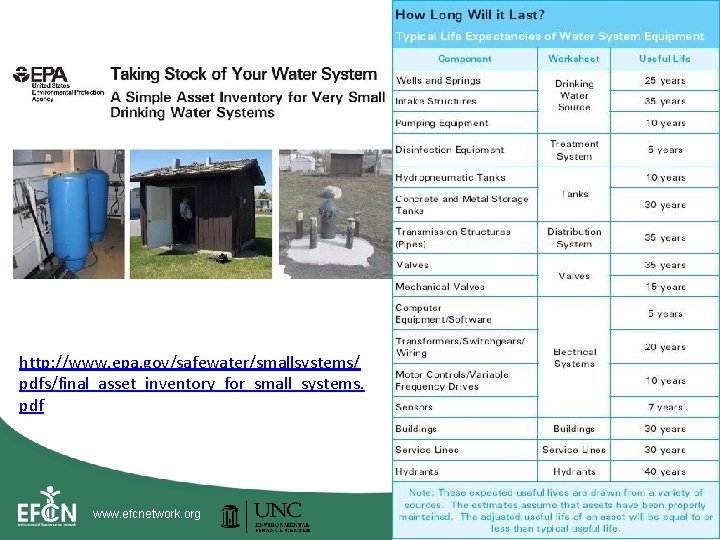
2/26/2021 http: //www. epa. gov/safewater/smallsystems/ pdfs/final_asset_inventory_for_small_systems. pdf www. efcnetwork. org
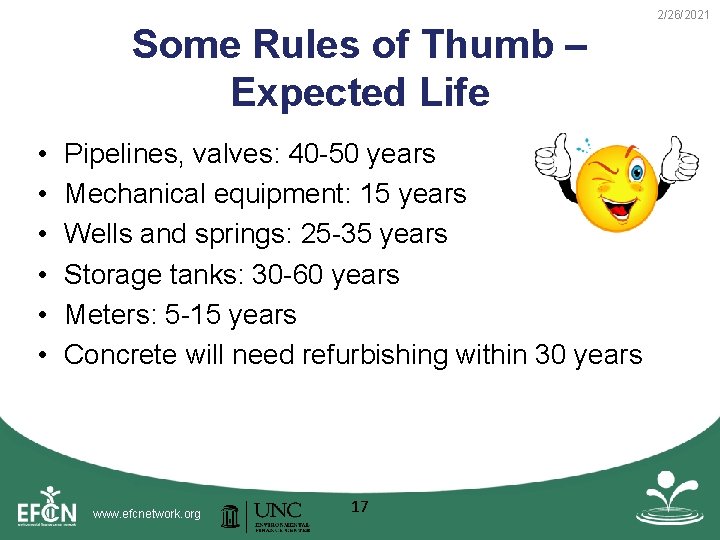
Some Rules of Thumb – Expected Life • • • Pipelines, valves: 40 -50 years Mechanical equipment: 15 years Wells and springs: 25 -35 years Storage tanks: 30 -60 years Meters: 5 -15 years Concrete will need refurbishing within 30 years www. efcnetwork. org 17 2/26/2021
Create an Asset Inventory Source: EPA’s “Asset Management: A Handbook for Small Systems” www. efcnetwork. org 2/26/2021
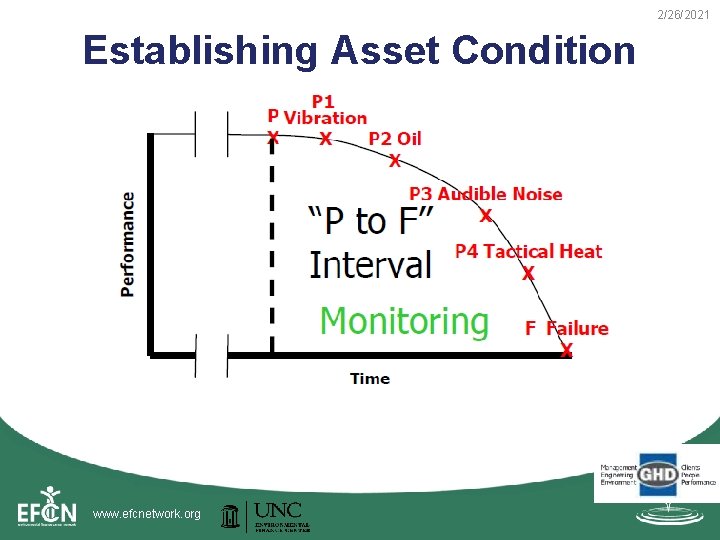
2/26/2021 Establishing Asset Condition www. efcnetwork. org
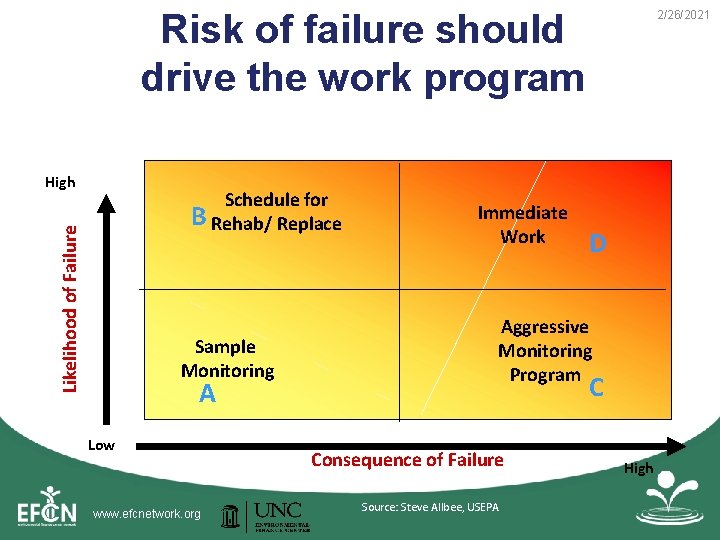
Risk of failure should drive the work program High Likelihood of Failure Schedule for B Rehab/ Replace Sample Monitoring A Low www. efcnetwork. org Immediate Work 2/26/2021 D Aggressive Monitoring Program C Consequence of Failure Source: Steve Allbee, USEPA High
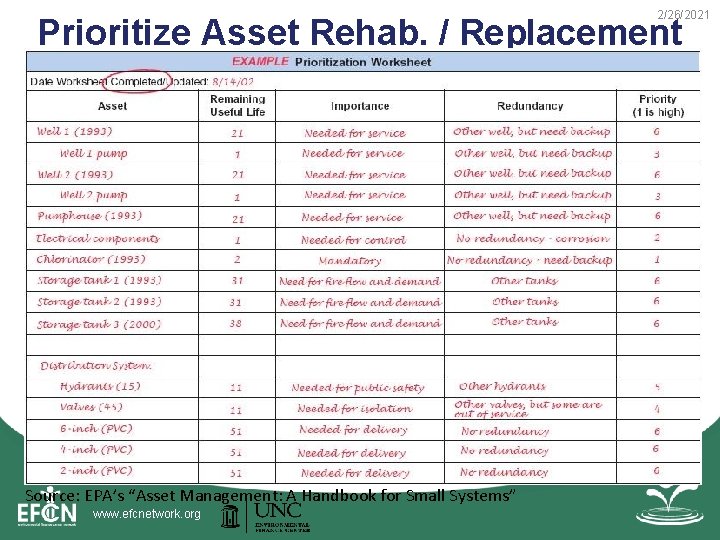
2/26/2021 Prioritize Asset Rehab. / Replacement Source: EPA’s “Asset Management: A Handbook for Small Systems” www. efcnetwork. org
2/26/2021 Long Term Capital Planning • This is strongly related to asset management • An official multi-year document that identifies and prioritizes capital projects, identifies funding sources, and sets timelines www. efcnetwork. org
2/26/2021 Capital Improvement Program • Identify regulatory deficiencies (discuss with regulatory agencies, look at proposed regulations, talk to consultants), in a 10 -20 year window • Identify growth needs, expansion 23 www. efcnetwork. org
2/26/2021 Capital Improvement Program • Identify deferred maintenance problems or where current service is inadequate • Prioritize based on need realizing that “hidden” infrastructure tends to be ignored 24 www. efcnetwork. org
Capital Improvement Program - Timelines 2/26/2021 • Use Asset Management Plan to plan for capital expenses in the long term (~20 years) 25 www. efcnetwork. org
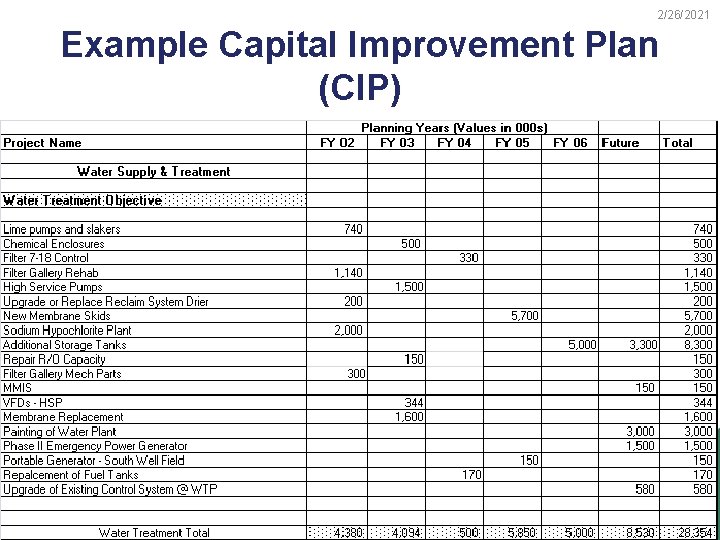
Capital Improvement Program - Timelines 2/26/2021 • Create a Capital Improvement Plan with a narrower timeline (~5 years) in more detail. Specify the projects and accurate estimates of cost. Plan where money will come from. 26 www. efcnetwork. org
Capital Improvement Program - Timelines 2/26/2021 • Create a Capital Improvement Budget with an even narrower timeline (1 – 2 years) committing funds for the planned capital projects. Get it approved/adopted. 27 www. efcnetwork. org
2/26/2021 Example Capital Improvement Plan (CIP) www. efcnetwork. org 28
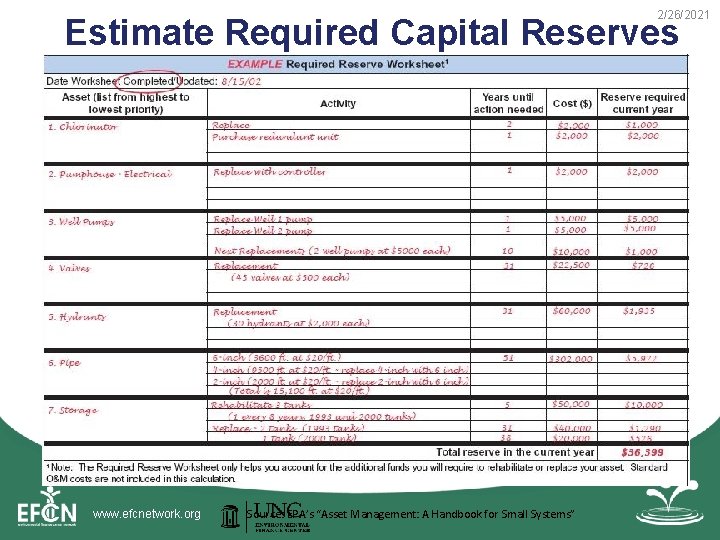
2/26/2021 Estimate Required Capital Reserves www. efcnetwork. org Source: EPA’s “Asset Management: A Handbook for Small Systems”
2/26/2021 Where Can You Find the Prices? • Call a vendor. Actually, call a few. • Ask other systems • Look at past expenses but adjust for increases in costs www. efcnetwork. org
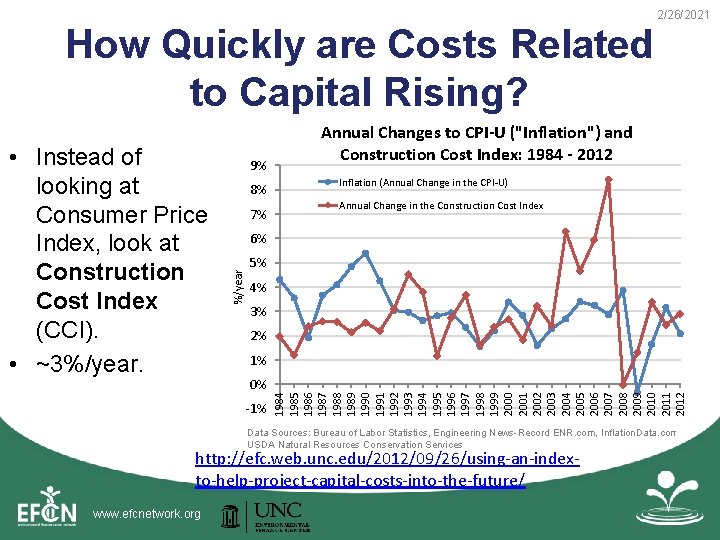
2/26/2021 How Quickly are Costs Related to Capital Rising? 9% 8% 7% Inflation (Annual Change in the CPI-U) Annual Change in the Construction Cost Index 6% 5% 4% 3% 2% 1% 0% -1% 1984 1985 1986 1987 1988 1989 1990 1991 1992 1993 1994 1995 1996 1997 1998 1999 2000 2001 2002 2003 2004 2005 2006 2007 2008 2009 2010 2011 2012 %/year • Instead of looking at Consumer Price Index, look at Construction Cost Index (CCI). • ~3%/year. Annual Changes to CPI-U ("Inflation") and Construction Cost Index: 1984 - 2012 Data Sources: Bureau of Labor Statistics, Engineering News-Record ENR. com, Inflation. Data. com, USDA Natural Resources Conservation Services http: //efc. web. unc. edu/2012/09/26/using-an-indexto-help-project-capital-costs-into-the-future/ www. efcnetwork. org
2/26/2021 Drive Down the CIP Cost • Is it possible to – – – Eliminate projects? Defer projects? Repair or refurbish instead of replace? Find a non-asset solution? Find collaboration/partnerships alternatives with neighboring systems? – Improve balance of cash vs. debt-financed? • Re-evaluate water demands of your customers. Many systems are now noticing that total demand is decreasing over time. www. efcnetwork. org
2/26/2021 Last Concept: Life Cycle Costing • Purchase Price ≠ Total Price www. efcnetwork. org
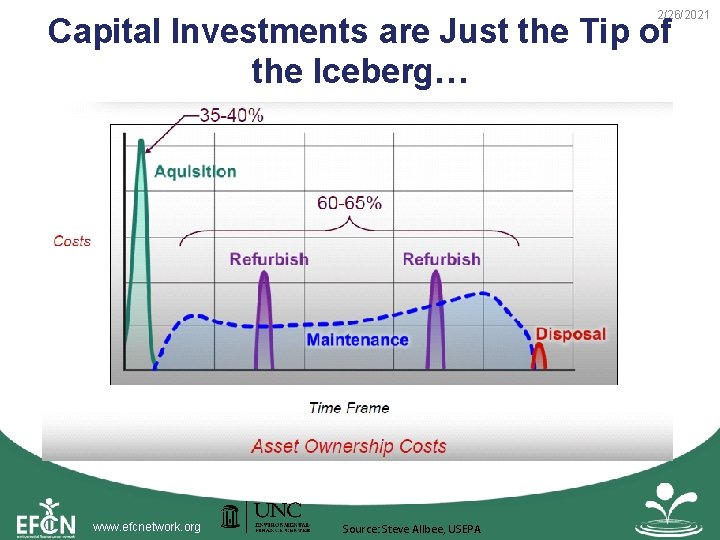
2/26/2021 Capital Investments are Just the Tip of the Iceberg… www. efcnetwork. org Source: Steve Allbee, USEPA
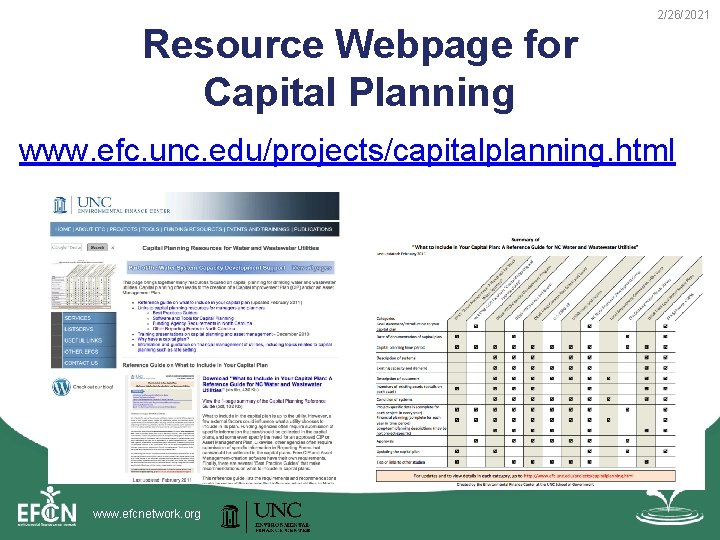
Resource Webpage for Capital Planning 2/26/2021 www. efc. unc. edu/projects/capitalplanning. html www. efcnetwork. org
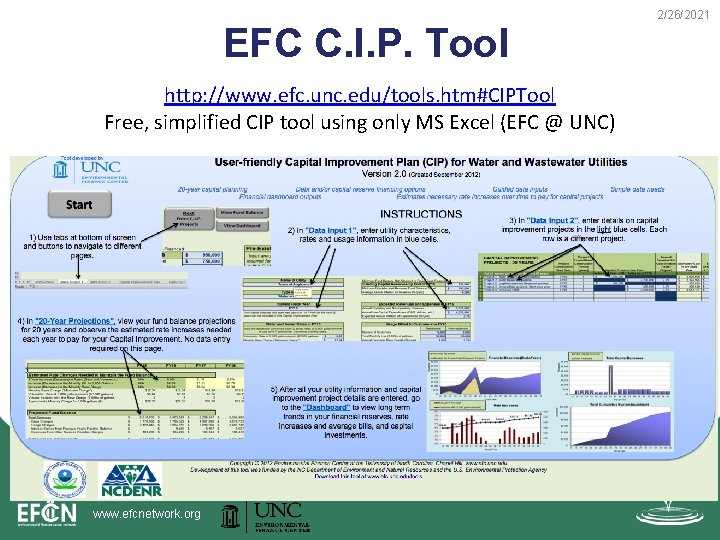
EFC C. I. P. Tool http: //www. efc. unc. edu/tools. htm#CIPTool Free, simplified CIP tool using only MS Excel (EFC @ UNC) www. efcnetwork. org 2/26/2021
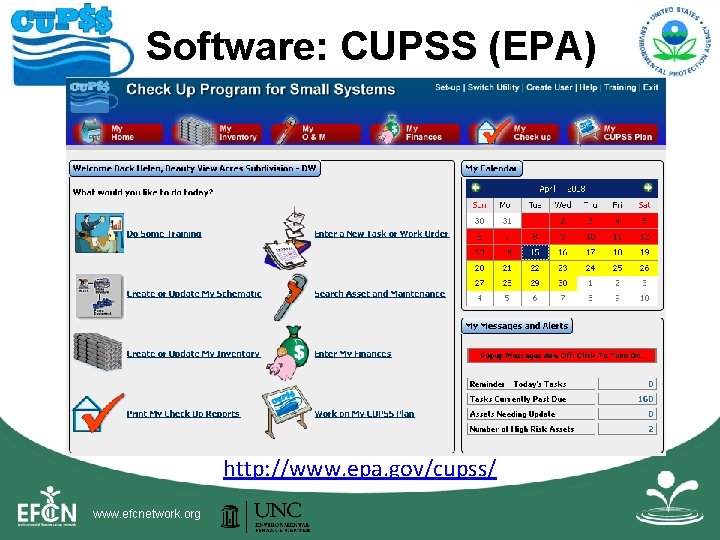
2/26/2021 Software: CUPSS (EPA) http: //www. epa. gov/cupss/ www. efcnetwork. org