
Capital Outlay Review and Funding Processes Associate Director
- Slides: 28
Capital Outlay: Review and Funding Processes Associate Director June 2019 Planning and Budget Michael D. Maul, Department of
2 Training Objectives: - Awareness of Present Capital Environment - Understanding of DPB Procedures on Capital 2
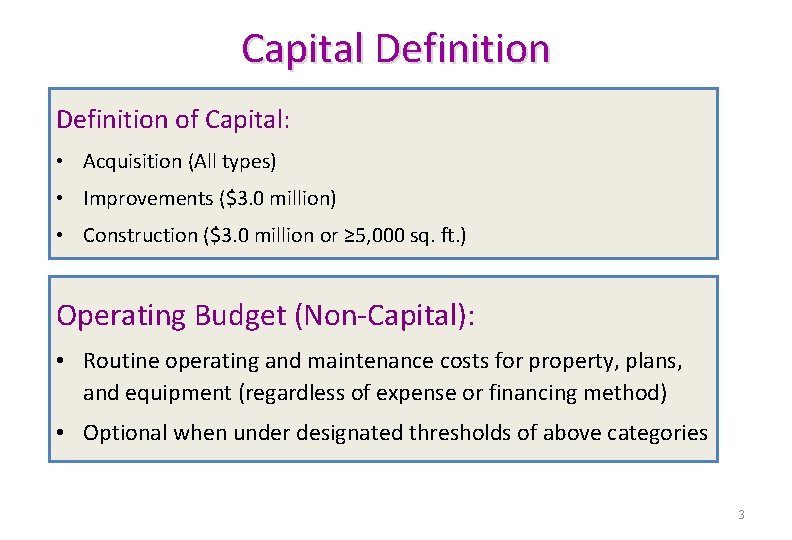
Capital Definition of Capital: • Acquisition (All types) • Improvements ($3. 0 million) • Construction ($3. 0 million or ≥ 5, 000 sq. ft. ) Operating Budget (Non-Capital): • Routine operating and maintenance costs for property, plans, and equipment (regardless of expense or financing method) • Optional when under designated thresholds of above categories 3
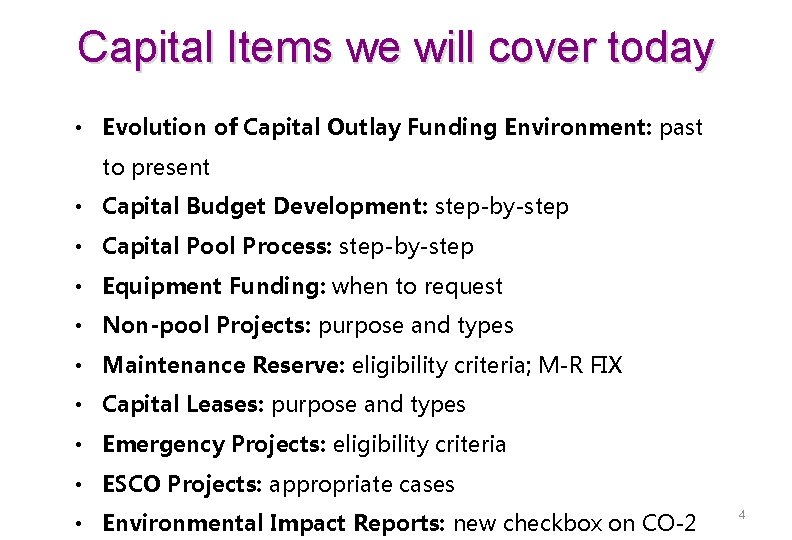
Capital Items we will cover today 4 • Evolution of Capital Outlay Funding Environment: past to present • Capital Budget Development: step-by-step • Capital Pool Process: step-by-step • Equipment Funding: when to request • Non-pool Projects: purpose and types • Maintenance Reserve: eligibility criteria; M-R FIX • Capital Leases: purpose and types • Emergency Projects: eligibility criteria • ESCO Projects: appropriate cases • Environmental Impact Reports: new checkbox on CO-2 4
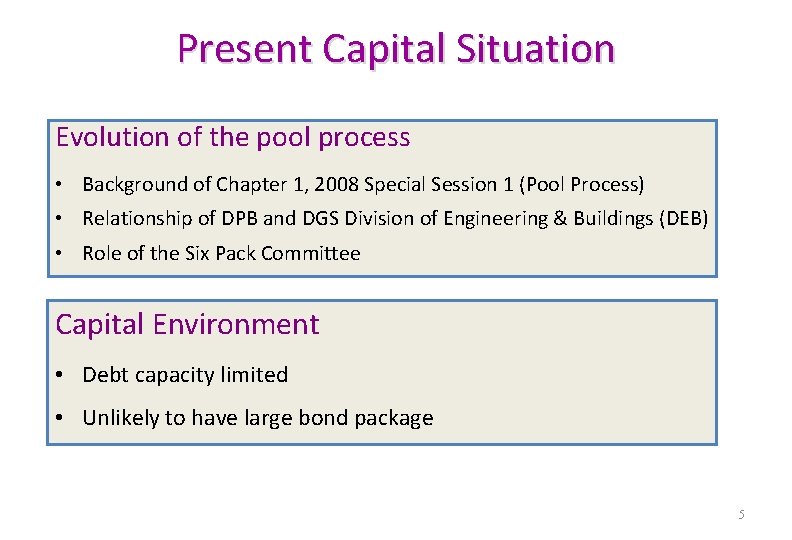
Present Capital Situation Evolution of the pool process • Background of Chapter 1, 2008 Special Session 1 (Pool Process) • Relationship of DPB and DGS Division of Engineering & Buildings (DEB) • Role of the Six Pack Committee Capital Environment • Debt capacity limited • Unlikely to have large bond package 5
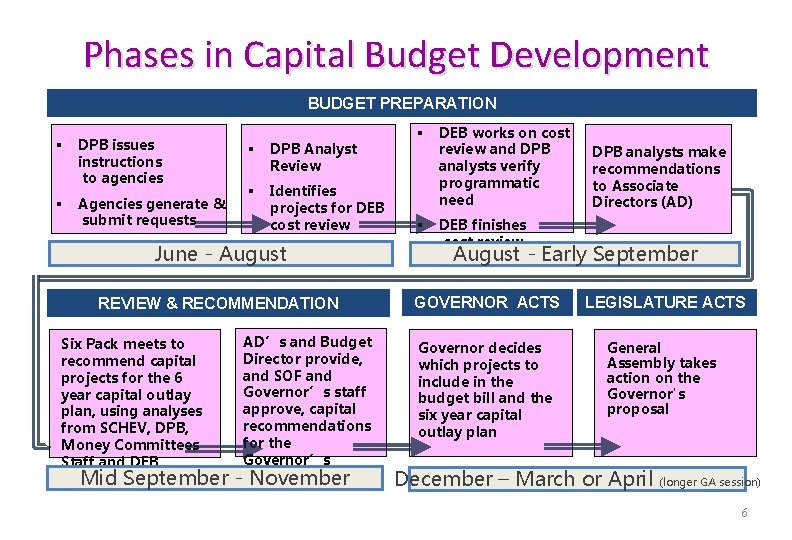
Phases in Capital Budget Development 6 BUDGET PREPARATION § DPB issues instructions to agencies § Agencies generate & submit requests § DPB Analyst Review § Identifies projects for DEB cost review June - August REVIEW & RECOMMENDATION Six Pack meets to recommend capital projects for the 6 year capital outlay plan, using analyses from SCHEV, DPB, Money Committees Staff and DEB Mid September AD’s and Budget Director provide, and SOF and Governor’s staff approve, capital recommendations for the Governor’s -consideration November § § DEB works on cost review and DPB analysts verify programmatic need DPB analysts make recommendations to Associate Directors (AD) DEB finishes cost review August - Early September GOVERNOR ACTS LEGISLATURE ACTS Governor decides which projects to include in the budget bill and the six year capital outlay plan General Assembly takes action on the Governor's proposal December – March or April (longer GA session) 6
Budget Development: step-by-step 7
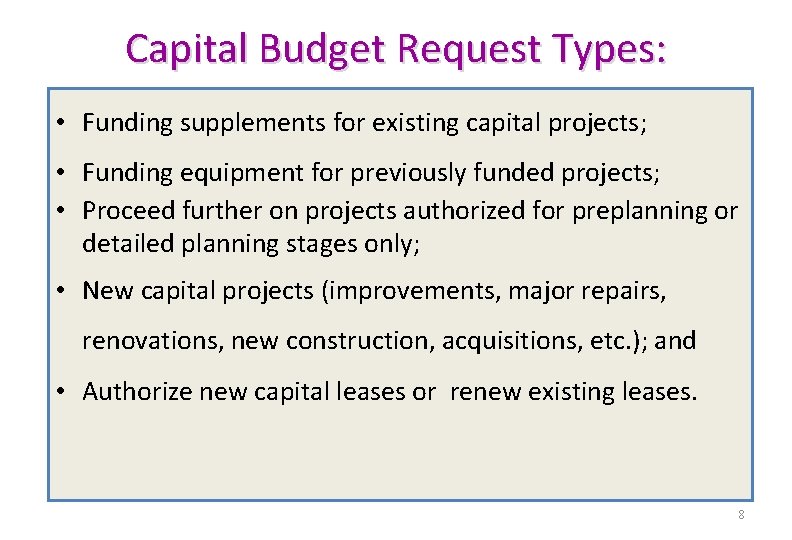
Capital Budget Request Types: • Funding supplements for existing capital projects; • Funding equipment for previously funded projects; • Proceed further on projects authorized for preplanning or detailed planning stages only; • New capital projects (improvements, major repairs, renovations, new construction, acquisitions, etc. ); and • Authorize new capital leases or renew existing leases. 8
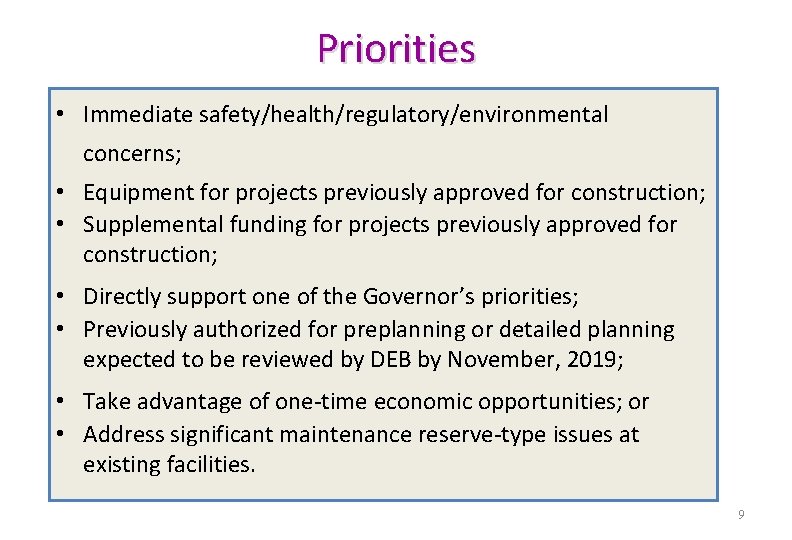
Priorities • Immediate safety/health/regulatory/environmental concerns; • Equipment for projects previously approved for construction; • Supplemental funding for projects previously approved for construction; • Directly support one of the Governor’s priorities; • Previously authorized for preplanning or detailed planning expected to be reviewed by DEB by November, 2019; • Take advantage of one-time economic opportunities; or • Address significant maintenance reserve-type issues at existing facilities. 9
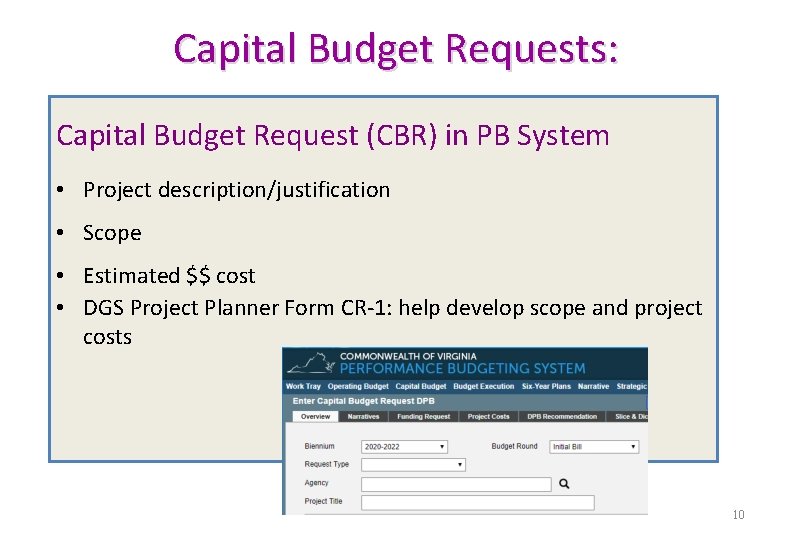
Capital Budget Requests: Capital Budget Request (CBR) in PB System • Project description/justification • Scope • Estimated $$ cost • DGS Project Planner Form CR-1: help develop scope and project costs 10
11 Capital pool process: step-by-step 11
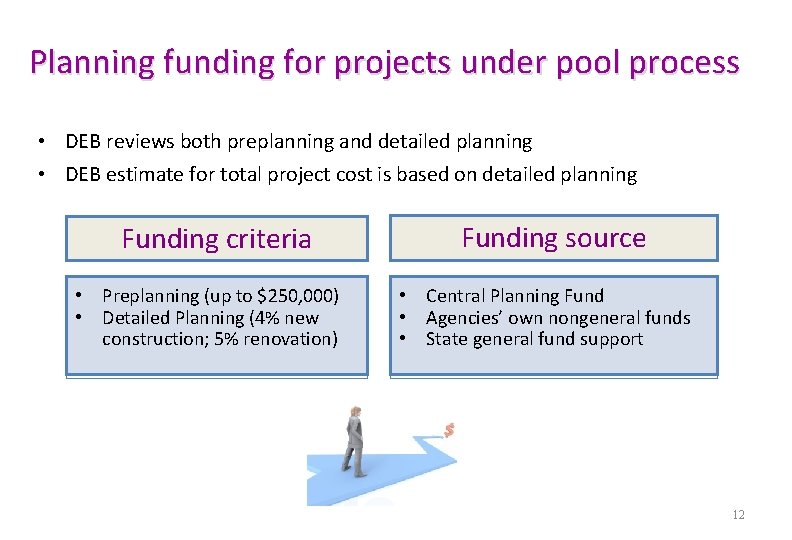
12 Planning funding for projects under pool process • DEB reviews both preplanning and detailed planning • DEB estimate for total project cost is based on detailed planning Funding criteria • Preplanning (up to $250, 000) • Detailed Planning (4% new construction; 5% renovation) Funding source • Central Planning Fund • Agencies’ own nongeneral funds • State general fund support 12
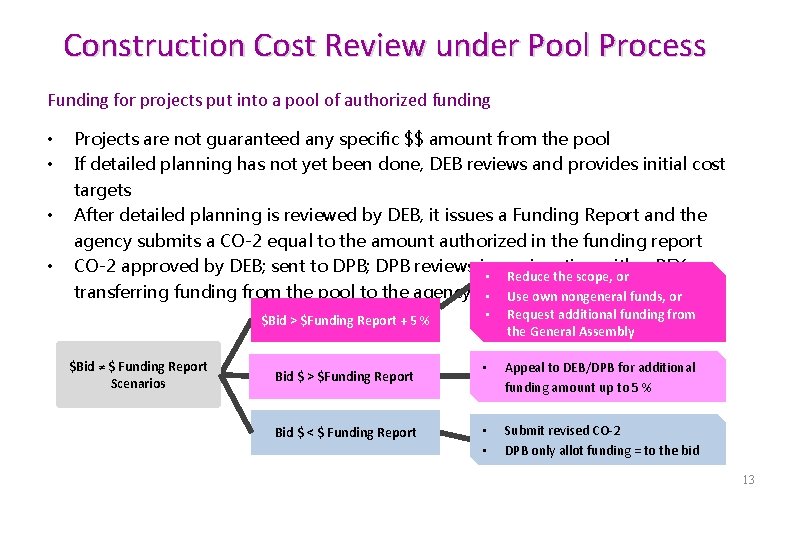
Construction Cost Review under Pool Process Funding for projects put into a pool of authorized funding • • Projects are not guaranteed any specific $$ amount from the pool If detailed planning has not yet been done, DEB reviews and provides initial cost targets After detailed planning is reviewed by DEB, it issues a Funding Report and the agency submits a CO-2 equal to the amount authorized in the funding report CO-2 approved by DEB; sent to DPB; DPB reviews in conjunction with a BEX • Reduce the scope, or transferring funding from the pool to the agency for capital project • the Use own nongeneral funds, or $Bid > $Funding Report + 5 % $Bid ≠ $ Funding Report Scenarios Bid $ > $Funding Report Bid $ < $ Funding Report • Request additional funding from the General Assembly • Appeal to DEB/DPB for additional funding amount up to 5 % • • Submit revised CO-2 DPB only allot funding = to the bid 13
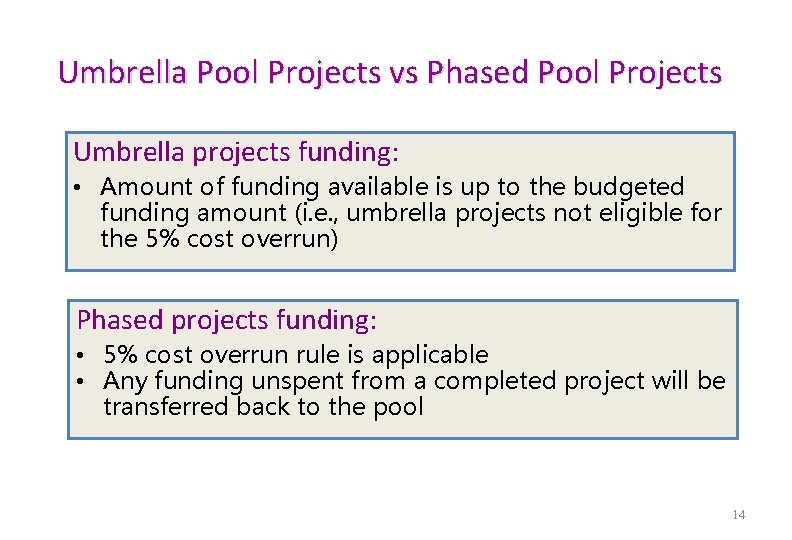
Umbrella Pool Projects vs Phased Pool Projects Umbrella projects funding: • Amount of funding available is up to the budgeted funding amount (i. e. , umbrella projects not eligible for the 5% cost overrun) Phased projects funding: • 5% cost overrun rule is applicable • Any funding unspent from a completed project will be transferred back to the pool 14
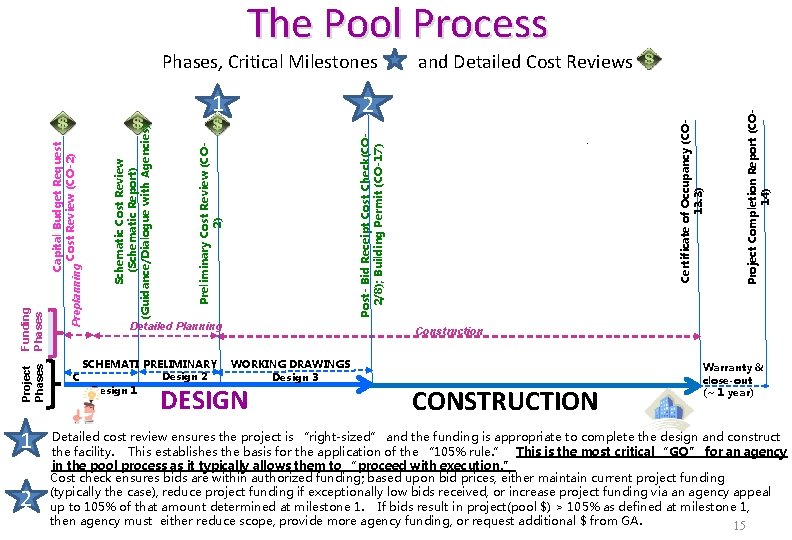
The Pool Process Project Phases 1 2 Detailed Planning SCHEMATI PRELIMINARY Design 2 C Design 1 . Certificate of Occupancy (CO 13. 3) Post- Bid Receipt Cost Check(CO 2/8); Building Permit (CO-17) 2 Preliminary Cost Review (CO 2) Schematic Cost Review (Schematic Report) (Guidance/Dialogue with Agencies) Capital Budget Request Cost Review (CO-2) Preplanning Funding Phases 1 and Detailed Cost Reviews Project Completion Report (CO 14) Phases, Critical Milestones Construction WORKING DRAWINGS Design 3 DESIGN CONSTRUCTION Warranty & close-out (~ 1 year) Detailed cost review ensures the project is “right-sized” and the funding is appropriate to complete the design and construct the facility. This establishes the basis for the application of the “ 105% rule. ” This is the most critical “GO” for an agency in the pool process as it typically allows them to “proceed with execution. ” Cost check ensures bids are within authorized funding; based upon bid prices, either maintain current project funding (typically the case), reduce project funding if exceptionally low bids received, or increase project funding via an agency appeal up to 105% of that amount determined at milestone 1. If bids result in project(pool $) > 105% as defined at milestone 1, then agency must either reduce scope, provide more agency funding, or request additional $ from GA. 15
16 Equipment funding: when to request 16
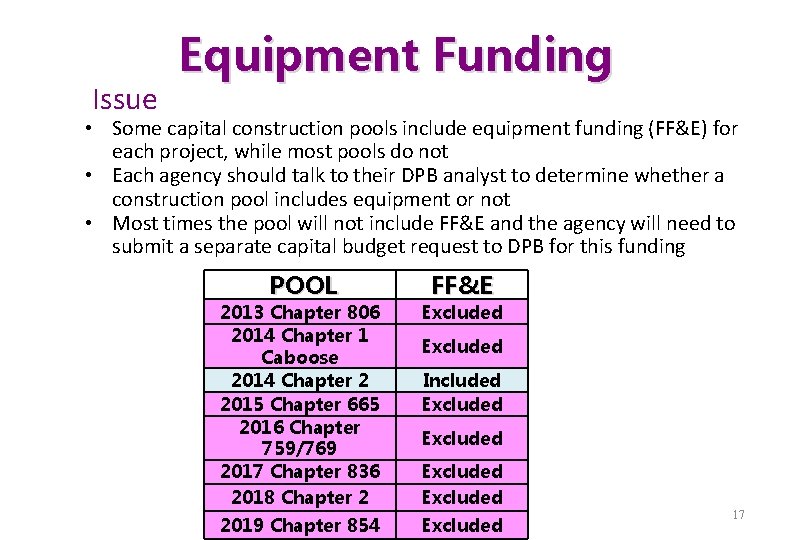
Issue Equipment Funding • Some capital construction pools include equipment funding (FF&E) for each project, while most pools do not • Each agency should talk to their DPB analyst to determine whether a construction pool includes equipment or not • Most times the pool will not include FF&E and the agency will need to submit a separate capital budget request to DPB for this funding POOL FF&E 2013 Chapter 806 2014 Chapter 1 Caboose 2014 Chapter 2 2015 Chapter 665 2016 Chapter 759/769 2017 Chapter 836 2018 Chapter 2 Excluded 2019 Chapter 854 Excluded Included Excluded 17
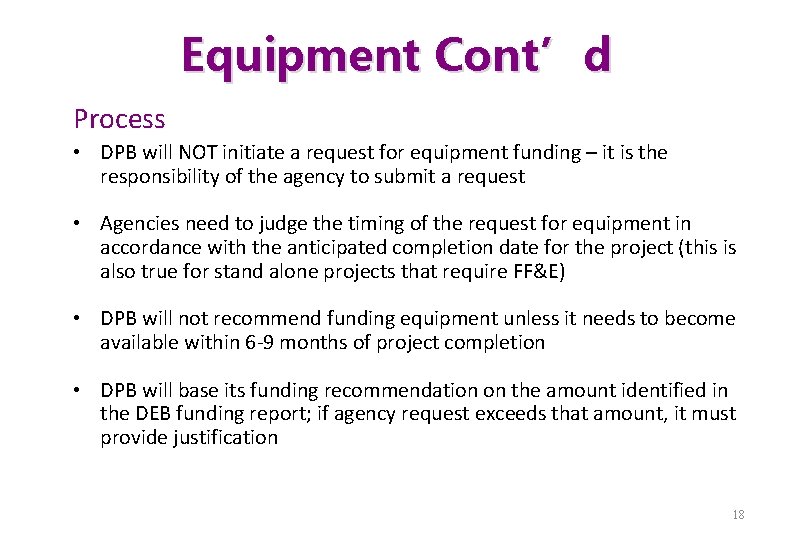
Equipment Cont’d Process • DPB will NOT initiate a request for equipment funding – it is the responsibility of the agency to submit a request • Agencies need to judge the timing of the request for equipment in accordance with the anticipated completion date for the project (this is also true for stand alone projects that require FF&E) • DPB will not recommend funding equipment unless it needs to become available within 6 -9 months of project completion • DPB will base its funding recommendation on the amount identified in the DEB funding report; if agency request exceeds that amount, it must provide justification 18
19 Other Projects: Non-pool Maintenance Reserve Capital leases Emergencies ESCOs 19
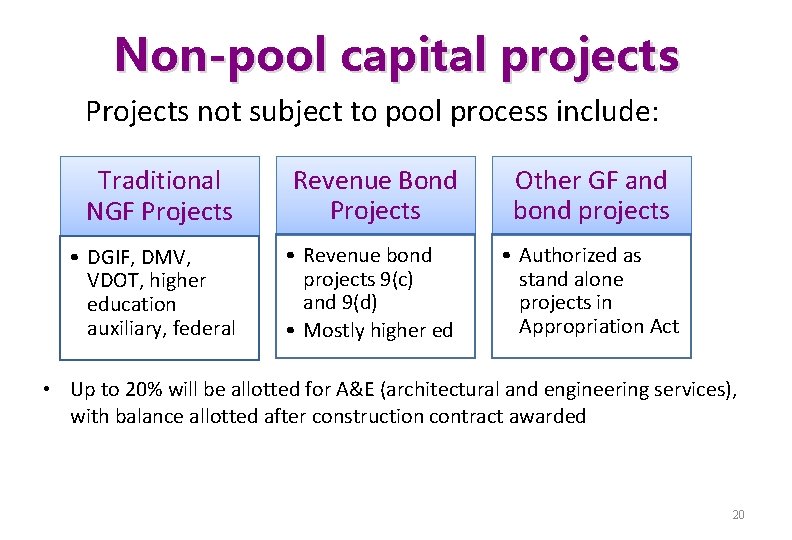
Non-pool capital projects Projects not subject to pool process include: Traditional NGF Projects Revenue Bond Projects Other GF and bond projects • DGIF, DMV, VDOT, higher education auxiliary, federal • Revenue bond projects 9(c) and 9(d) • Mostly higher ed • Authorized as stand alone projects in Appropriation Act • Up to 20% will be allotted for A&E (architectural and engineering services), with balance allotted after construction contract awarded 20
Maintenance Reserve Process • Agencies free to use funds on projects, as needed, consistent with the guidelines for maintenance reserve use • Agencies report annually on previous fiscal year’s expenditures • If agencies fail to follow criteria, subject to having projects reviewed in advance and validated 21
Maintenance Reserve Funding Calculations DGS COVA Trax/M-R FIX Web Portal • Data to be used to allocate maintenance reserve funding, per requirements of § 4 -9. 04 d. of the 2019 Appropriation Act: The Department of Planning and Budget shall revise the formula used to make allocation recommendations for the state’s maintenance reserve funding to account for higher maintenance needs resulting from poor facility condition, aging of facilities, and differences in facility use. • M-R FIX data will be used to help determine the distribution of maintenance reserve funding provided to each agency and institution beginning with the upcoming 2020 – 2022 biennium • Agencies need to incorporate data into M-R FIX by August 30, 2019 • In addition, agencies are being asked to add data associated with EO 24, identifying state facilities vulnerable to extreme weather 22
Capital Leases Subject to capital outlay process since leases can affect debt capacity Criteria of Capital Lease • Building ownership reverts to agency at end of lease at no or nominal cost • Lease for long duration that covers a substantial portion of the useful life of the property Lease vs purchase analysis • What’s most effective and economical: long term lease or a new building • Do analysis at least a year or two before current lease ends • Work with DGS to proceed with capital lease or buying existing building Lease payments paid from operating funds 23
Projects Not Included in the Budget Basic assumption of Appropriation Act that the General Assembly must approve capital projects; however, “emergencies” or “opportunities” do not happen on schedule. When Immediate Need arises between GA sessions for a capital project Governor granted authority to create capital project in certain situations: § § Emergency situations Higher ed project to be funded by revenues or sponsored programs or private gifts and indirect cost recoveries Plant or property received as a gift Project recommended by Tobacco Indemnification and Community Revitalization Commission or Virginia Tobacco Settlement Foundation Criteria • • • Nongeneral funds sources available for both capital and operating elements of project Governor feels the project results in measurable benefit for the state or cost avoidance Detailed justification for project includes cost estimates and fund sources • • Agency notifies DPB of emergency or immediate need DPB prepares decision brief for the Governor either authorizes or declines to authorize the project Authorized project still subject to DEB requirements, including capital outlay form submissions Process 24
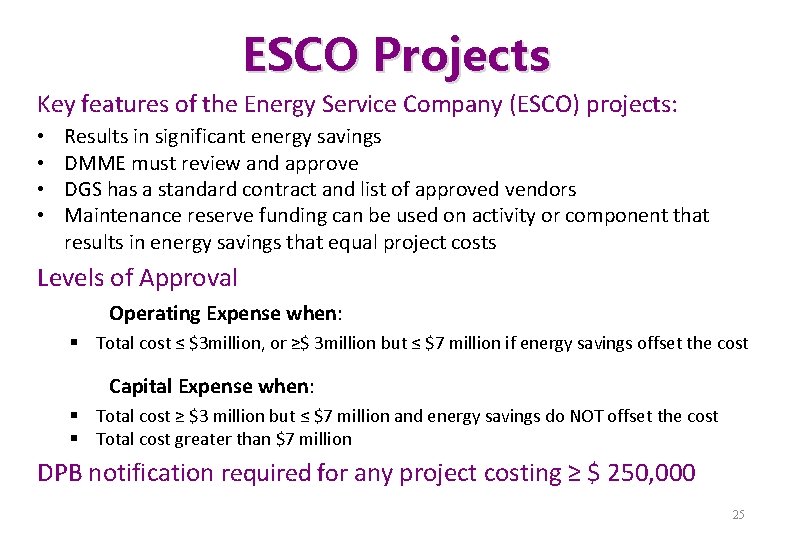
ESCO Projects Key features of the Energy Service Company (ESCO) projects: • • Results in significant energy savings DMME must review and approve DGS has a standard contract and list of approved vendors Maintenance reserve funding can be used on activity or component that results in energy savings that equal project costs Levels of Approval Operating Expense when: § Total cost ≤ $3 million, or ≥$ 3 million but ≤ $7 million if energy savings offset the cost Capital Expense when: § Total cost ≥ $3 million but ≤ $7 million and energy savings do NOT offset the cost § Total cost greater than $7 million DPB notification required for any project costing ≥ $ 250, 000 25
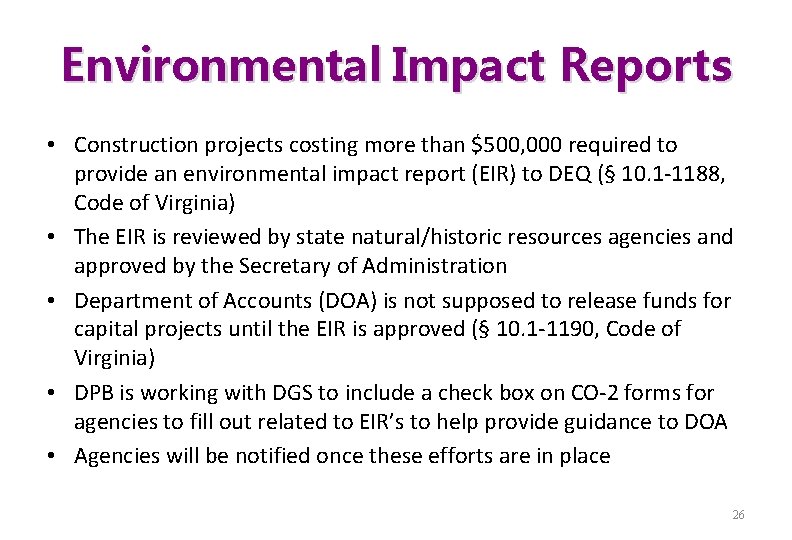
Environmental Impact Reports • Construction projects costing more than $500, 000 required to provide an environmental impact report (EIR) to DEQ (§ 10. 1 -1188, Code of Virginia) • The EIR is reviewed by state natural/historic resources agencies and approved by the Secretary of Administration • Department of Accounts (DOA) is not supposed to release funds for capital projects until the EIR is approved (§ 10. 1 -1190, Code of Virginia) • DPB is working with DGS to include a check box on CO-2 forms for agencies to fill out related to EIR’s to help provide guidance to DOA • Agencies will be notified once these efforts are in place 26
27 Any Questions? 27
28 Department of Planning and Budget Michael D. Maul Associate Director Emily Grimes Capital Coordinator (804) 786 -6657 Michael. Maul@dpb. virginia. gov (804) 786 -1687 Emily. Grimes@dpb. virginia. gov Additional Information can be found at: Virginia Department of Planning and Budget dpb. virginia. gov Call or email your DPB budget analyst with questions for best results 28