
Capital Markets Regulation in the EU Asset Management
- Slides: 27
Capital Markets Regulation in the EU Asset Management Carmine Di Noia October 13 th, 2015 1
Collective and Discretionary Asset Management (AM) in the EU Asset (or investment) management: • Discretionary (or individual) AM: management of a client’s portfolio (retail or professional) on an individual basis and in accordance with the mandate agreed between the asset manager and the client • Collective AM: management of a fund of pooled assets in accordance with specified risk levels and assetallocation parameters (typically associated with investment fund or collective investment scheme (CIS) 2
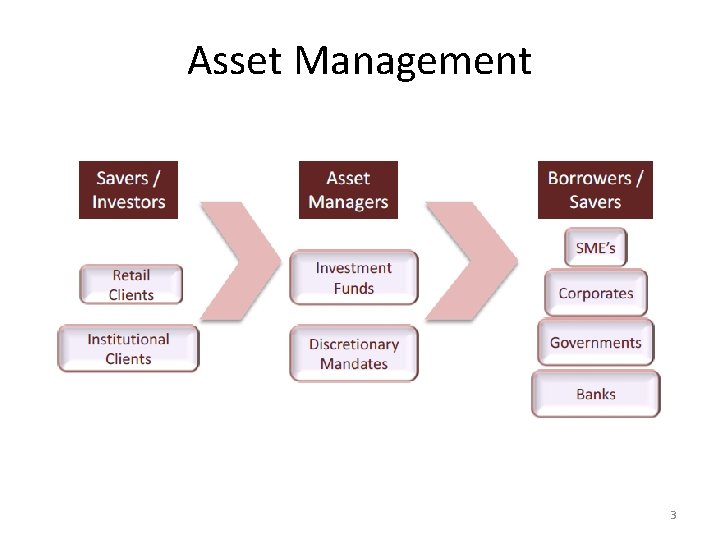
Asset Management 3
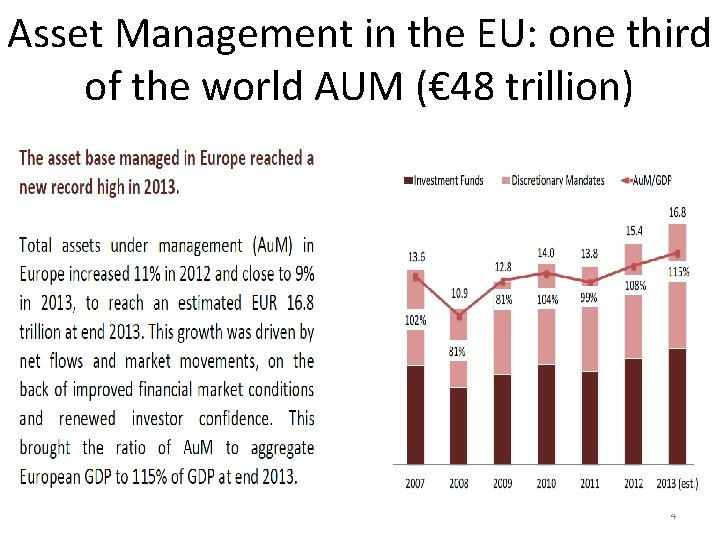
Asset Management in the EU: one third of the world AUM (€ 48 trillion) 4
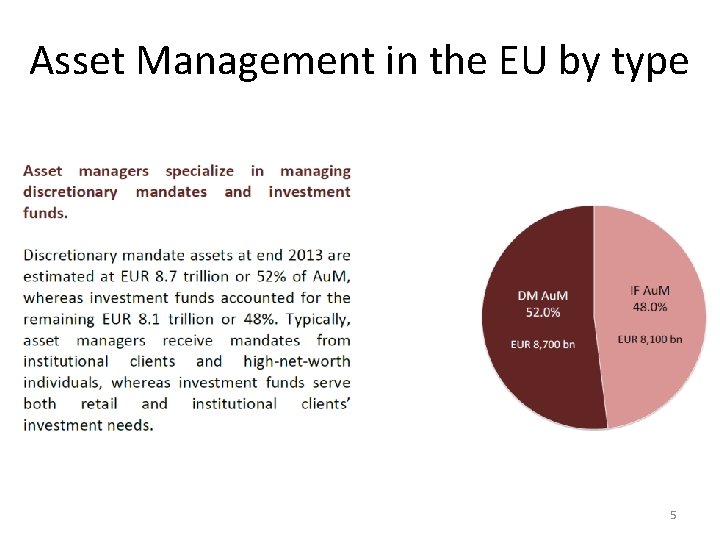
Asset Management in the EU by type 5
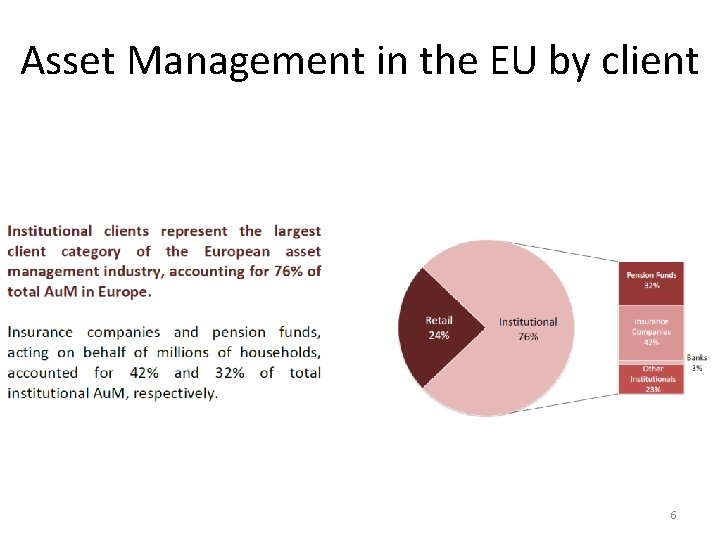
Asset Management in the EU by client 6
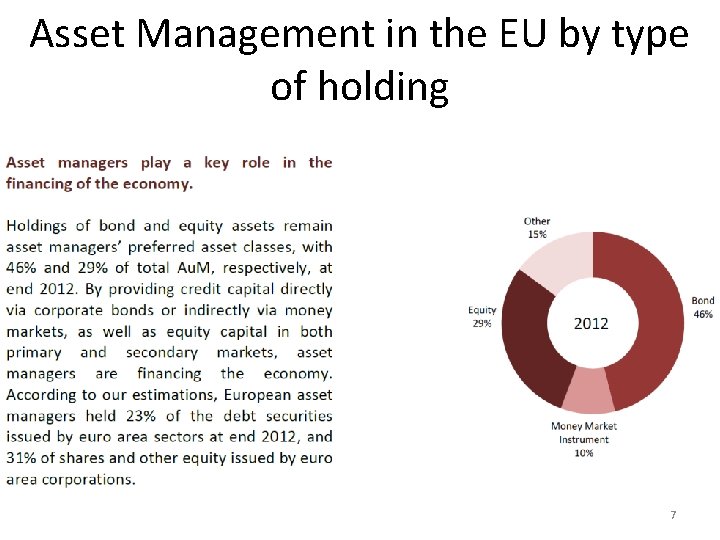
Asset Management in the EU by type of holding 7
The Regulation of Discretionary Asset Management in the EU Within investment services regulation regime Investment Services Directive 1993 Mifid II/Mifir Art. 4. 1(8) Mifid II: ‘portfolio management’ means managing portfolios in accordance with mandates given by clients on a discretionary client-by-client basis where such portfolios include one or more financial instruments; • General rules: authorization and operating requirements (conduct rules and prudential rules governing organization, operation, and capital requirements) 8 • • •
The Regulation of Collective Asset Management in the EU - 1 European law currently covers four types of harmonized investment funds: 1. UCITS (Undertakings for Collective Investment in Transferable Securities), the main European framework covering collective investment schemes that are suitable for retail investors; 2. AIFM (Alternative Investment Fund Managers), covering managers of alternative investment schemes that are addressed to professional investors; 9
The Regulation of Collective Asset Management in the EU - 2 3. Eu. VECA (European Venture Capital Funds), a subcategory of alternative investment schemes that focus on start-up companies; 4. Eu. SEF (European Social Entrepreneurship Funds), an investment scheme that focuses on all kinds of enterprises that achieve proven social impacts. 10
The Regulation of Collective Asset Management in the EU - 3 In addition, the European Commission has, in June and September 2013, proposed two additional cross-border fund ’passports’: • ELTIF (European Long-Term Investment Funds), the proposed framework covering funds that focus on investing in various types of alternative asset classes such as infrastructure, small and medium sized enterprises and real assets; • MMF (Money Market Funds), the proposed European framework that covers collective investment schemes focusing on money market instruments; 11
The Regulation of Collective Asset Management in the EU - 4 • In the area of asset management generally: Key Information Document (KID – a simple document giving key facts to investors in a clear and understandable manner) covering not only collective investment schemes but also other ’packaged’ investment products offered by banks or insurance companies (Regulation on key information for Retail Investment Products, december 2014). 12
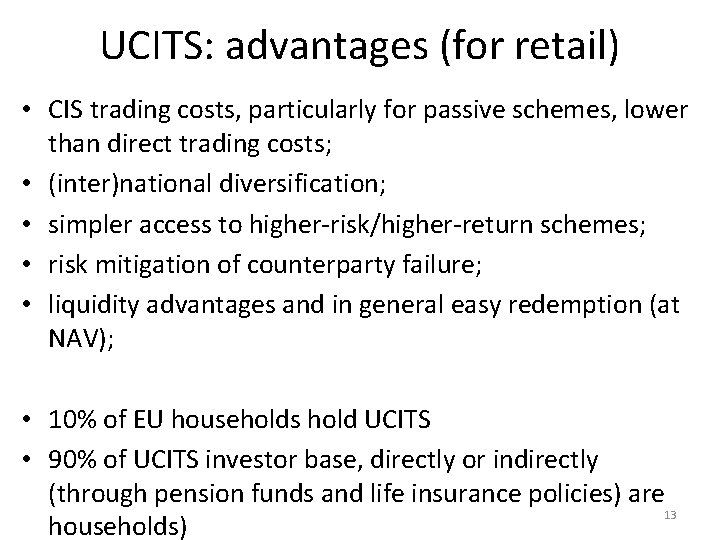
UCITS: advantages (for retail) • CIS trading costs, particularly for passive schemes, lower than direct trading costs; • (inter)national diversification; • simpler access to higher-risk/higher-return schemes; • risk mitigation of counterparty failure; • liquidity advantages and in general easy redemption (at NAV); • 10% of EU households hold UCITS • 90% of UCITS investor base, directly or indirectly (through pension funds and life insurance policies) are 13 households)
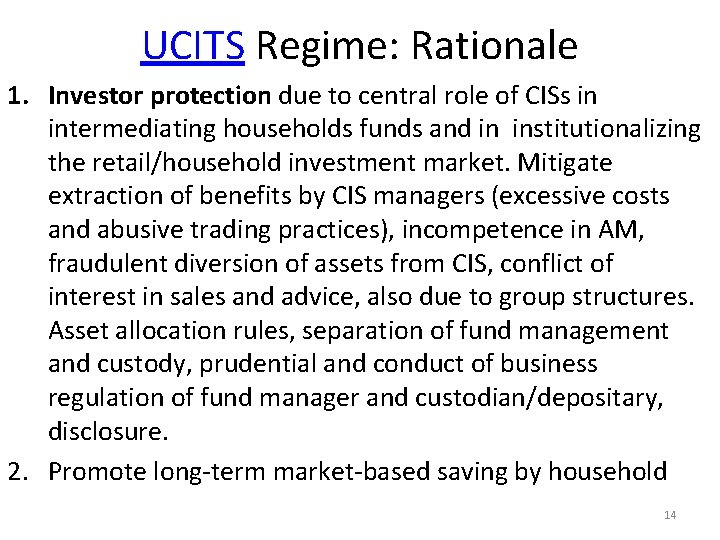
UCITS Regime: Rationale 1. Investor protection due to central role of CISs in intermediating households funds and in institutionalizing the retail/household investment market. Mitigate extraction of benefits by CIS managers (excessive costs and abusive trading practices), incompetence in AM, fraudulent diversion of assets from CIS, conflict of interest in sales and advice, also due to group structures. Asset allocation rules, separation of fund management and custody, prudential and conduct of business regulation of fund manager and custodian/depositary, disclosure. 2. Promote long-term market-based saving by household 14
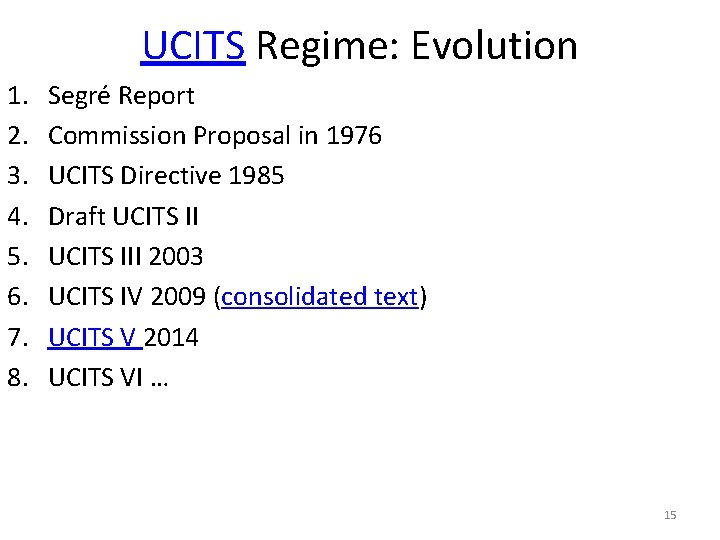
UCITS Regime: Evolution 1. 2. 3. 4. 5. 6. 7. 8. Segré Report Commission Proposal in 1976 UCITS Directive 1985 Draft UCITS III 2003 UCITS IV 2009 (consolidated text) UCITS V 2014 UCITS VI … 15
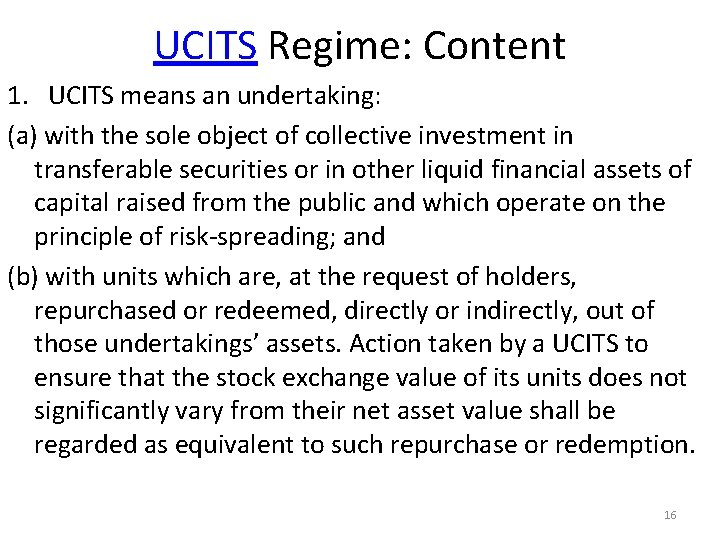
UCITS Regime: Content 1. UCITS means an undertaking: (a) with the sole object of collective investment in transferable securities or in other liquid financial assets of capital raised from the public and which operate on the principle of risk-spreading; and (b) with units which are, at the request of holders, repurchased or redeemed, directly or indirectly, out of those undertakings’ assets. Action taken by a UCITS to ensure that the stock exchange value of its units does not significantly vary from their net asset value shall be regarded as equivalent to such repurchase or redemption. 16
Transferable Securities (n) ‘transferable securities’ means: • (i) shares in companies and other securities equivalent to shares in companies (shares); • (ii) bonds and other forms of securitised debt (debt securities); • (iii) any other negotiable securities which carry the right to acquire any such transferable securities by subscription or exchange; (o) ‘money market instruments’ means instruments normally dealt in on the money market which are liquid and have a value which can be accurately determined at any time; 17
UCITS: organization 3. UCITS may be constituted in accordance with contract law (as common funds managed by management companies), trust law (as unit trusts), or statute (as investment companies). Common fund (with separate management company, investor hold a unit) vs Investment company (investor hold a share) Open-end vs closed end Depositary UCITS V do not apply to closed end and to CIS not ptomoting to the public Only UCITS authorized according to the Directive can pursue 18 their activities and get a “(marketing) passport”
UCITS: organization 2 Authorization by NCA of the management company to get passport: art. 7 (capital, fit and proper people), art. 12 (sound administrative and accounting procedures, control and safeguard arrangements for electronic data processing and adequate internal control mechanisms; is structured and organised in such a way as to minimise the risk of UCITS’ or clients’ interests being prejudiced by conflicts of interest between the company and its clients, between two of its clients, between one of its clients and a UCITS, or between two UCITS), 14 a-b (appropriate remuneration policies), Obligation on depositary (art. 22 -26 b) 19
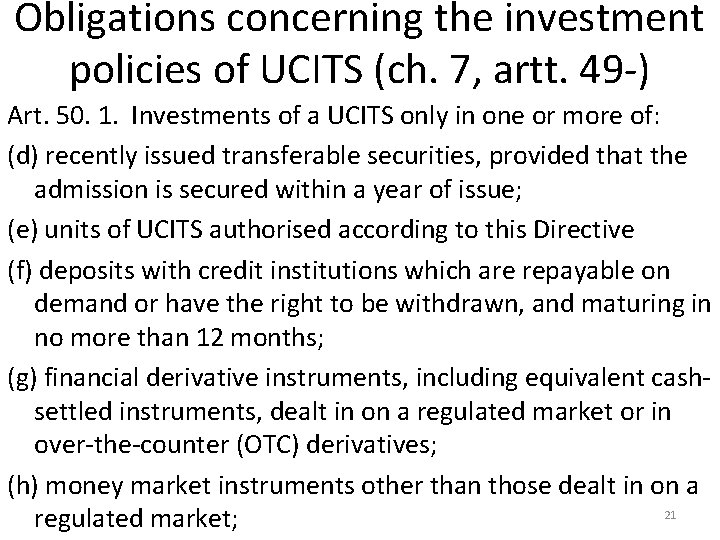
Obligations concerning the investment policies of UCITS (ch. 7, artt. 49 -) Art. 50. 1. Investments of a UCITS only in one or more of: (a) transferable securities and money market instruments admitted to or dealt in on a regulated market as defined in Article 4(1)(14) of Directive 2004/39/EC MIFID); (b) transferable securities and money market instruments dealt in on another regulated market in a MS, which operates regularly, is recognised and open to the public; (c) transferable securities and money market instruments admitted to official listing on a stock exchange or on another regulated market in a third country which operates regularly, is recognised and open to the public, if choice approved by competent authorities or in law or fund rules; 20
Obligations concerning the investment policies of UCITS (ch. 7, artt. 49 -) Art. 50. 1. Investments of a UCITS only in one or more of: (d) recently issued transferable securities, provided that the admission is secured within a year of issue; (e) units of UCITS authorised according to this Directive (f) deposits with credit institutions which are repayable on demand or have the right to be withdrawn, and maturing in no more than 12 months; (g) financial derivative instruments, including equivalent cashsettled instruments, dealt in on a regulated market or in over-the-counter (OTC) derivatives; (h) money market instruments other than those dealt in on a 21 regulated market;
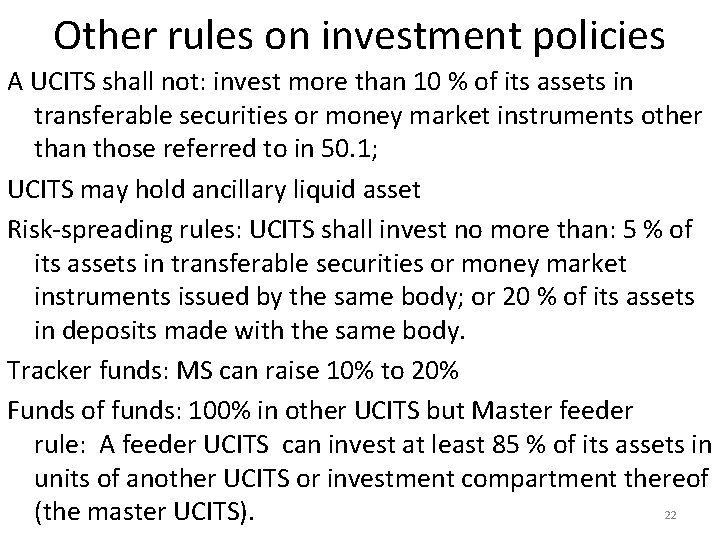
Other rules on investment policies A UCITS shall not: invest more than 10 % of its assets in transferable securities or money market instruments other than those referred to in 50. 1; UCITS may hold ancillary liquid asset Risk-spreading rules: UCITS shall invest no more than: 5 % of its assets in transferable securities or money market instruments issued by the same body; or 20 % of its assets in deposits made with the same body. Tracker funds: MS can raise 10% to 20% Funds of funds: 100% in other UCITS but Master feeder rule: A feeder UCITS can invest at least 85 % of its assets in units of another UCITS or investment compartment thereof 22 (the master UCITS).
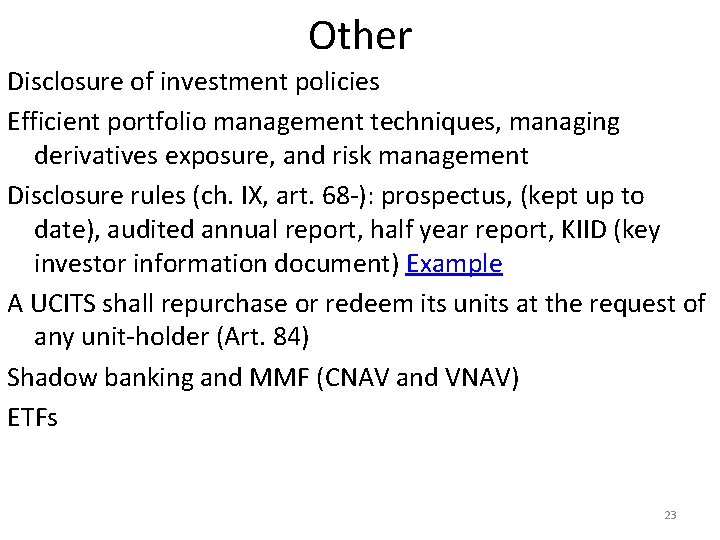
Other Disclosure of investment policies Efficient portfolio management techniques, managing derivatives exposure, and risk management Disclosure rules (ch. IX, art. 68 -): prospectus, (kept up to date), audited annual report, half year report, KIID (key investor information document) Example A UCITS shall repurchase or redeem its units at the request of any unit-holder (Art. 84) Shadow banking and MMF (CNAV and VNAV) ETFs 23
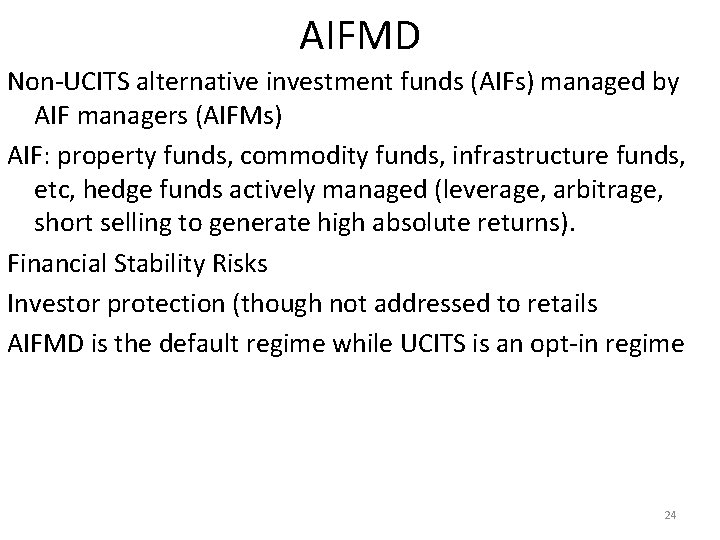
AIFMD Non-UCITS alternative investment funds (AIFs) managed by AIF managers (AIFMs) AIF: property funds, commodity funds, infrastructure funds, etc, hedge funds actively managed (leverage, arbitrage, short selling to generate high absolute returns). Financial Stability Risks Investor protection (though not addressed to retails AIFMD is the default regime while UCITS is an opt-in regime 24
Objectives of the AIFMD • Increase the transparency of AIFM towards investors, supervisors and employees of the investee companies; • Equip NCA, ESMA, ESRB, with info and tools necessary to monitor and respond to risks to the stability of the financial system that could be caused or amplified by AIFM activity; • Introduce a common and robust approach to the protection of investors in these funds; • Strengthen EU single market, creating conditions for increased investor choice and competition in the EU, subject always to high and consistent regulatory standards; • Increase the accountability of AIFM holding controlling stakes in companies (private equity) towards employees 25 and the public at large.
AIFMD scope (a) ‘AIFs’ means collective investment undertakings, including investment compartments thereof, which: (i) raise capital from a number of investors, with a view to investing it in accordance with a defined investment policy for the benefit of those investors; and (ii) do not require authorisation pursuant to Article 5 of Directive 2009/65/EC (UCITS) (b) ‘AIFMs’ means legal persons whose regular business is managing one or more AIFs; De minimis regime for AIF<€ 500 mln or leveraged AIF <€ 100 mln Leveraged AIFs (art. 25) 26 Private equity (art. 26)
Other European Venture Capital Regulation: opt-in regime for AIFM registered under AIFMD Eusef: European Social Entrepreneurship Funds (focus on social investment) Eltif: European Long term Investment fund 27