
Capital Market Line and Beta Corporate Finance Presented

Capital Market Line and Beta Corporate Finance Presented by Dimitar Todorov
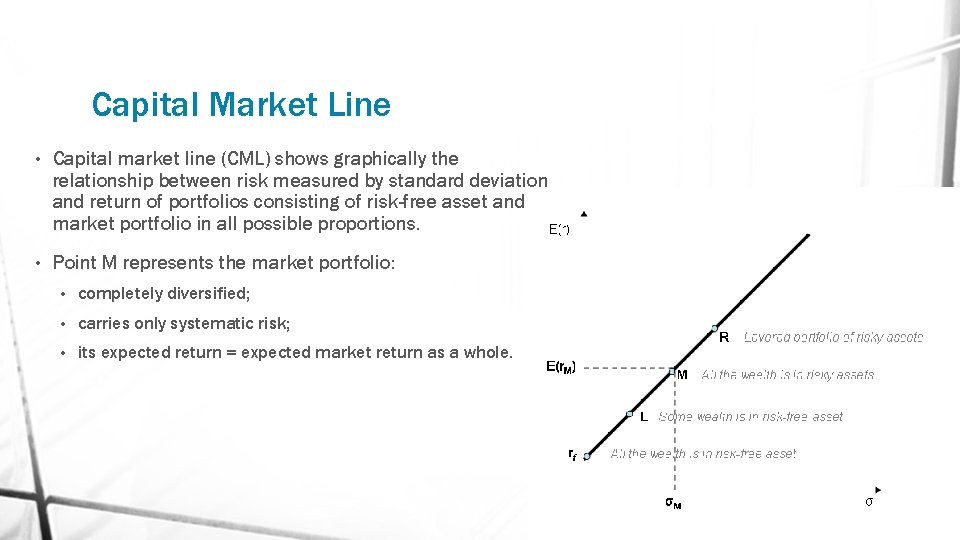
Capital Market Line • Capital market line (CML) shows graphically the relationship between risk measured by standard deviation and return of portfolios consisting of risk-free asset and market portfolio in all possible proportions. • Point M represents the market portfolio: • completely diversified; • carries only systematic risk; • its expected return = expected market return as a whole.
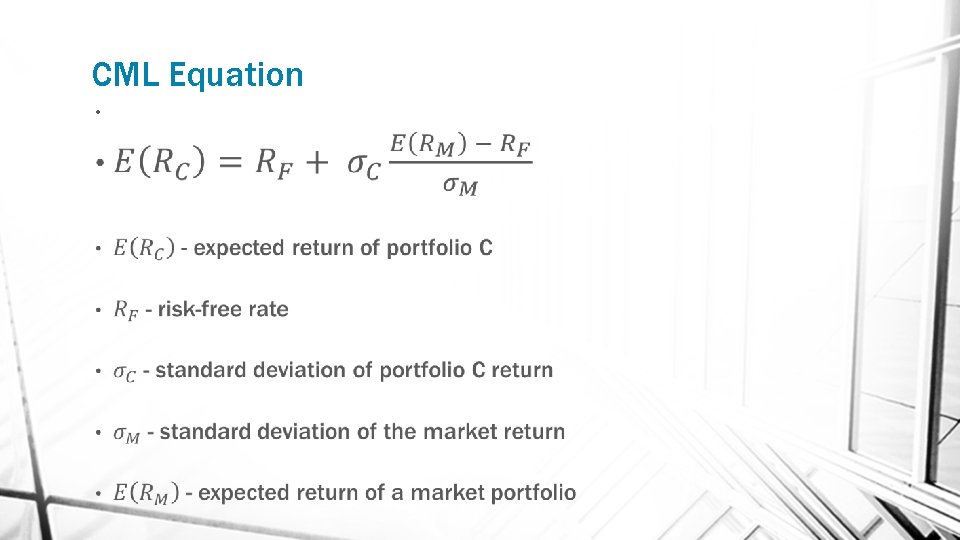
CML Equation •

Example 1 • • Assume that the current risk-free rate is 3%, expected market return is 18% and standard deviation of a market portfolio is 9%. Suppose there are two portfolios: • Portfolio A has standard deviation of 6%; • Portfolio B has standard deviation of 15%. What is the expected return of the two portfolios?
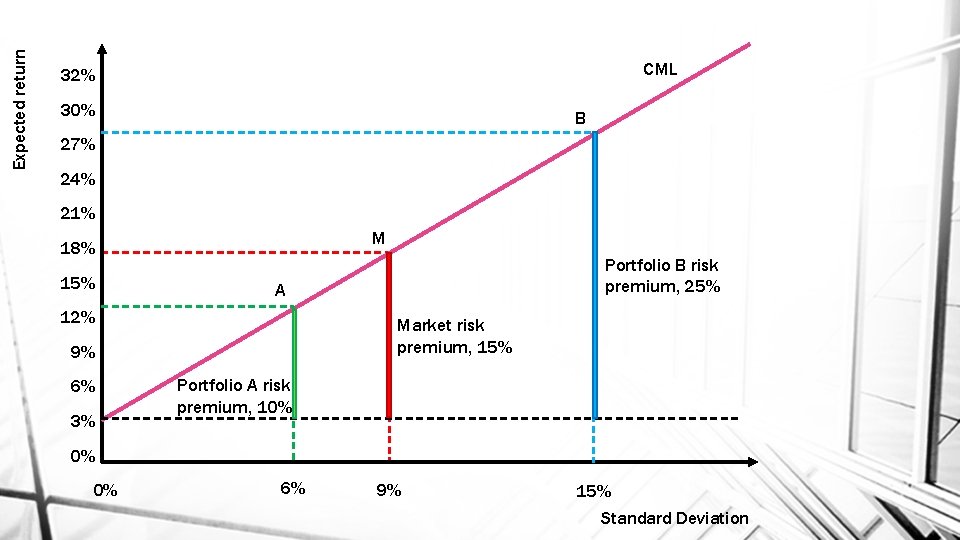
Expected return CML 32% 30% B 27% 24% 21% M 18% 15% A 12% Market risk premium, 15% 9% 6% 3% Portfolio B risk premium, 25% Portfolio A risk premium, 10% 0% 0% 6% 9% 15% Standard Deviation

Limitations of CML • Assumptions of the Capital Market Line and the Capital Asset Pricing Model may not hold true in the real world. • Differing taxes and transaction costs between various investors. • In real market conditions investors can lend at lower rate than borrow. • Real markets are not strongly efficient and investors have unequal information. • Not all investors are rational or risk-averse. • Standard deviation isn’t the only risk measurement. • Risk-free assets do not exist.

Beta • The beta coefficient indicates whether an investment is more or less volatile than the overall market. • β < 1 suggests that the investment is less volatile than the market. • β > 1 suggests that the investment is more volatile than the market. • Beta measures risk that comes from exposure to market movements. • The market portfolio has a β = 1. • β < 0 occurs when investments follow the opposite direction of the market.

Cont. • Beta represents the risk of an investment that can’t be reduced by diversification. • Beta measures the amount of risk an investment adds to an already diversified portfolio. • Beta decay refers to the tendency for companies with high beta (β > 1) to have their beta decline towards the market beta (β = 1).
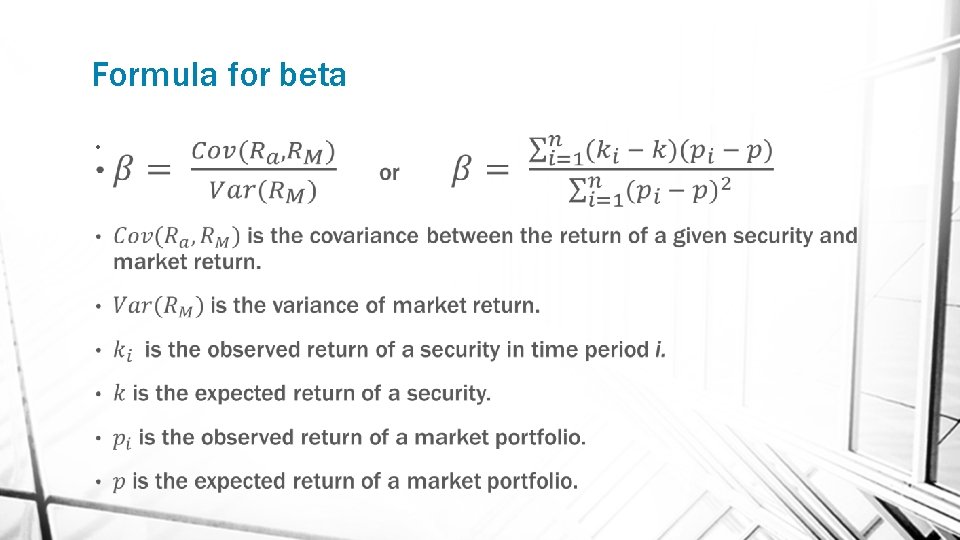
Formula for beta •
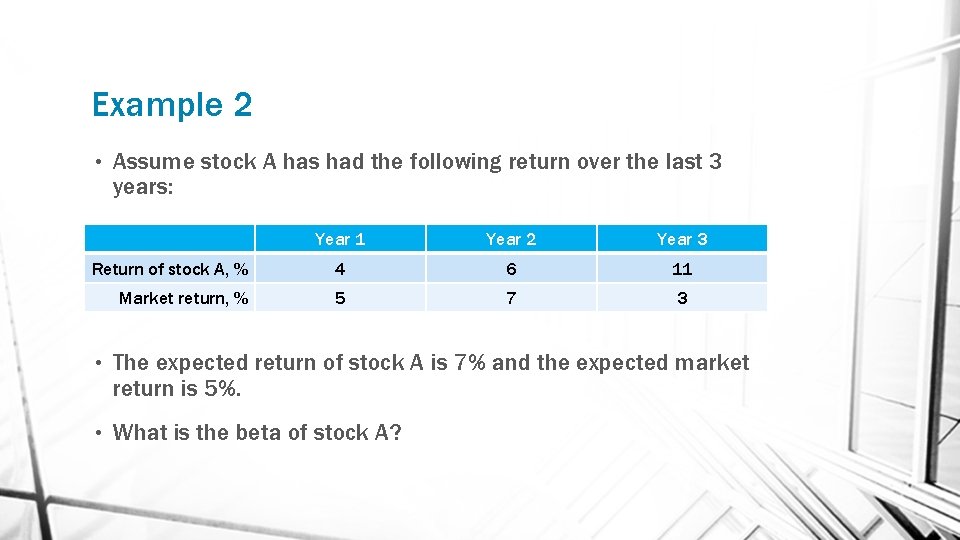
Example 2 • Assume stock A has had the following return over the last 3 years: Year 1 Year 2 Year 3 Return of stock A, % 4 6 11 Market return, % 5 7 3 • The expected return of stock A is 7% and the expected market return is 5%. • What is the beta of stock A?

Beta of a portfolio •

Example 3 • • Assume that portfolio ABC consists of 3 stocks with the following proportions and beta coefficients: • 25% of stock A with βA = 1. 7; • 45% of stock B with βB = 0. 3; • 30% of stock C with βC = 1. 2; What is the beta coefficient of portfolio ABC?

Criticism • Beta views risk solely from the perspective of market prices, failing to take into consideration specific business fundamentals or economic developments. • Price level is ignored. • Beta doesn’t account for the influence investors can have on the riskiness of their holdings. • Beta assumes that upside potential = downside risk for any investment. • In reality past volatility does not reliably predict future performance

Thank you for your attention!
- Slides: 14