
Capital Budgeting Techniques by Binam Ghimire 1 Objectives

Capital Budgeting Techniques by Binam Ghimire 1
Objectives q Understand apply various investment appraisal techniques (PBP, Discounted PBP, ARR, NPV, PI and IRR), Comparing NPV and IRR, IRR pitfalls, MIRR and Capital Rationing 2

Capital Budgeting: Meaning q Answer to the questions: Should an investment be made? Whether or not an investment is worth undertaking? If there alternatives which investment option provides better cash flows and rate of return? q Tool to analyse and appraise investments. Sometimes known as investment appraisal q The process of analysing, comparing and selecting the right investment project 3
Capital Budgeting: Significance q Purpose: Expansion, Improvement, Replacement and Research and Development. These involve large capital investments q Making the right decision q Firms future q Sensitive to shareholders wealth 4
Capital Budgeting: Steps q Estimation of Cash Inflows and Outflows q Collection of relevant information q Selection of appropriate capital budgeting tool(s) q Calculation and analysis of benefit (loss) q Appraisal and Decision Making 5
Types of Project and decision making: Independent Projects q Independent projects: Cash Flows of one project is not affected by the Cash Flows of another. q Example, installation of brick factory and installation of sugar mill are independent projects. q Cash flows of former project do not affect the cash flows of latter one. q If budget permits, both projects can be launched provided they meet the set evaluation criteria. q Decision regarding such projects can be taken independently. 6
Types of Project and decision making: Dependent Projects q Dependent projects: Cash Flows of one project is affected by the Cash Flows of another. q Example: Construction of dam and canal in irrigation project. 7
Types of Project and decision making: Mutually Exclusive Projects q Mutually Exclusive projects: Cash Flows of one project is affected by the Cash Flows of another and selection of one rejects the other q Simple Example: Buying a car for your family (Deciding for a Toyota means not buying Honda or Ford) q Other Examples: Labour intensive production process versus capital intensive production process, frock lift versus conveyor belt, deep well versus canal irrigation 8
Types of Project and decision making: Replacement Projects q Replacement projects: due to the wear and tear, and advent of new technology, existing machine need to be replaced with new one. q Thus, the projects falling in this class are classified into two—maintenance of business and cost reduction. q Should the existing operation be continued? q Replace with new one due to the obsolescence. q Lower the input costs such as labor, materials, and electricity. 9
Types of Project and decision making: Expansion Projects q Expansion projects: Available capacity not sufficient to meet the demand. q Add production capacity. q Expand business: in different geographical regions e. g. opening new retail outlets. 10
Types of Project and decision making: Diversification Projects q Diversification projects. Entering either into the new products or new markets q Acquisition of new equipment and plant and latter one requires substantial amount of money. 11
Techniques: 1. Payback Period q PBP is the number of years required to cover the cost of the project q It is calculated by adding project’s cash inflows to its cost until the cumulative Cash Flows for the project turns positive 12
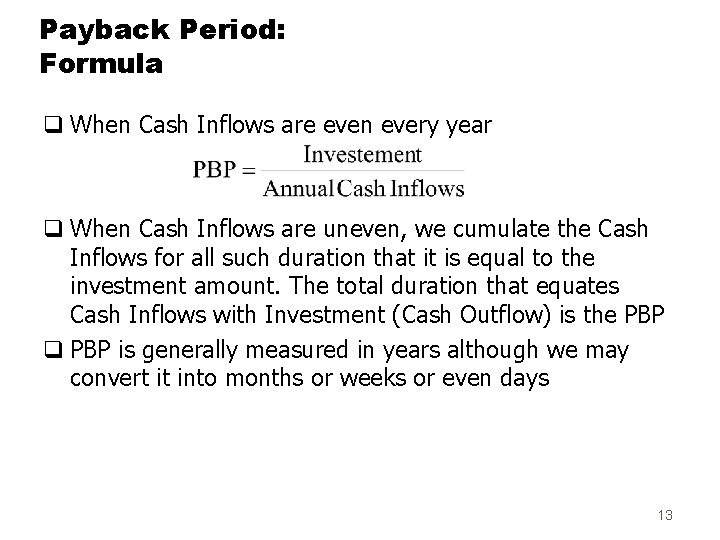
Payback Period: Formula q When Cash Inflows are even every year q When Cash Inflows are uneven, we cumulate the Cash Inflows for all such duration that it is equal to the investment amount. The total duration that equates Cash Inflows with Investment (Cash Outflow) is the PBP q PBP is generally measured in years although we may convert it into months or weeks or even days 13
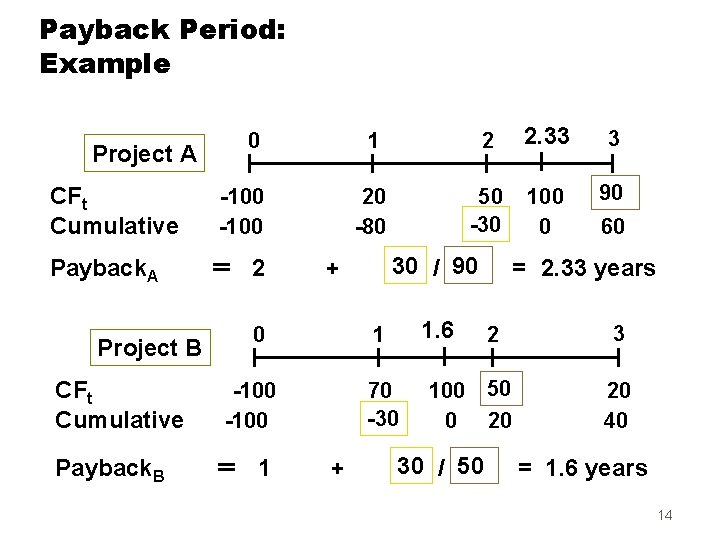
Payback Period: Example Project A CFt Cumulative Payback. A Project B CFt Cumulative Payback. B 0 -100 == 2 2 2. 33 3 20 -80 50 -30 100 0 90 30 / 90 + 0 1. 6 1 -100 == 1 1 70 -30 + = 2. 33 years 2 100 50 0 20 30 / 50 60 3 20 40 = 1. 6 years 14
Payback Period: Decision Making q Independent Project: Compare with the target of the company (maximum acceptable period) or industry average q Mutually Exclusive Projects: Select the one with shortest PBP q Question: In the example for project A and B which project will you accept 1) they are independent 2) they are mutually exclusive 15
Payback Period: Advantages and Disadvantages q Advantages q. Simple: Easy to calculate and understand q. Provides an indication of a project’s risk and liquidity q. Useful for short-term decision making q Disadvantages q. Ignores the time value of money (TVM) q. Ignores CFs occurring after the payback period. This also implies that the method overlooks the risk of CFs after the PBP 16
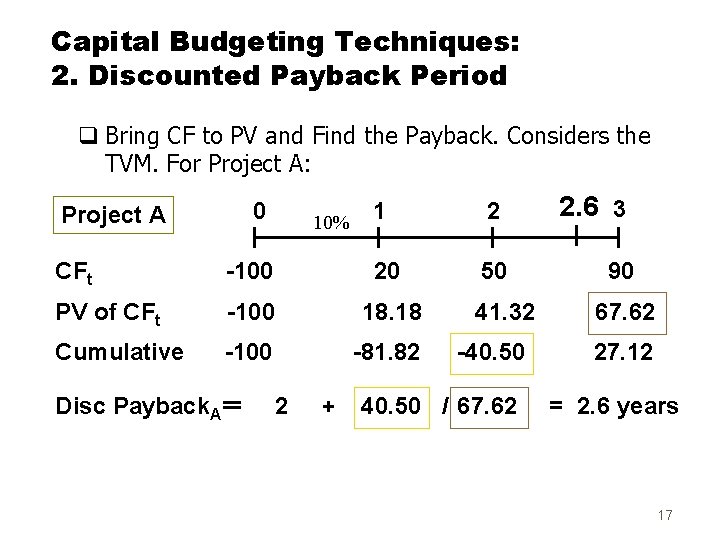
Capital Budgeting Techniques: 2. Discounted Payback Period q Bring CF to PV and Find the Payback. Considers the TVM. For Project A: 0 Project A 1 10% CFt -100 20 PV of CFt -100 18. 18 Cumulative -100 -81. 82 Disc Payback. A == 2 + 2 50 41. 32 -40. 50 / 67. 62 2. 6 3 90 67. 62 27. 12 = 2. 6 years 17
Capital Budgeting Techniques: Payback Period q Choose the correct for PBP: A) Does not account properly for time value of money B) Does not account properly for risk C) Cutoff period is arbitrary D) Does not lead to value-maximizing decisions E) A, B and C F) All of the above 18
Capital Budgeting Techniques: 3. Accounting Rate of Return q ARR is: q the average annual profit/ initial cost of investment q Sometimes instead of initial cost of investment, average cost of investment is also used. To find the average cost, we need to sum the initial cost + the residual value and divide by 2 19
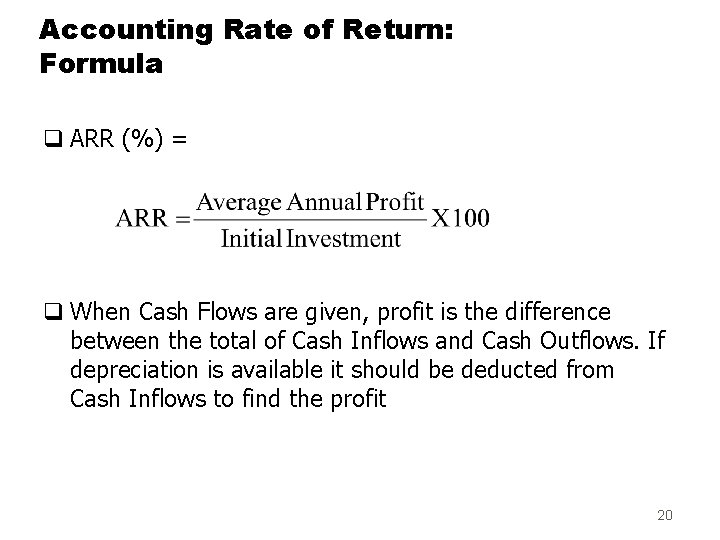
Accounting Rate of Return: Formula q ARR (%) = q When Cash Flows are given, profit is the difference between the total of Cash Inflows and Cash Outflows. If depreciation is available it should be deducted from Cash Inflows to find the profit 20
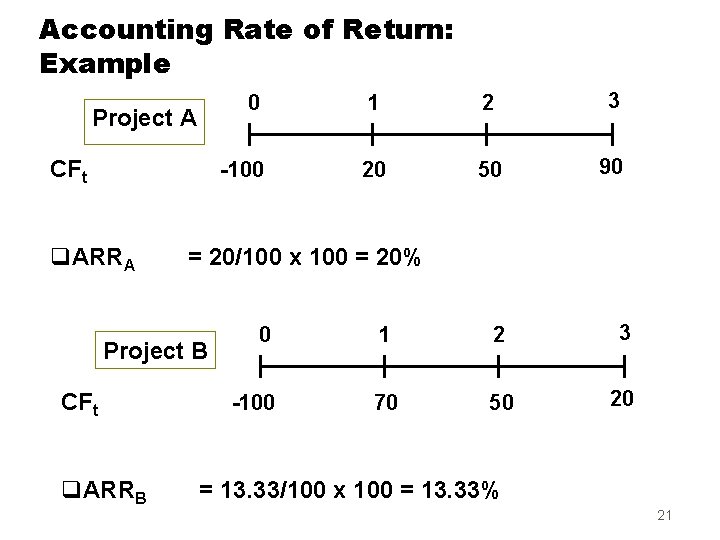
Accounting Rate of Return: Example 0 Project A CFt -100 q. ARRA q. ARRB 2 3 20 50 90 = 20/100 x 100 = 20% Project B CFt 1 0 -100 1 2 3 70 50 20 = 13. 33/100 x 100 = 13. 33% 21
Accounting Rate of Return: Decision Making q Independent Project: Compare with the target/ expected rate of return of the company. Compare with industry average q Mutually Exclusive Projects: Select the one with highest ARR q Question: In the example for project A and B which project will you accept 1) they are independent 2) they are mutually exclusive 22
Accounting Rate of Return: Advantages and Disadvantages q Advantages q. Easy to calculate and understand q. Easy to compare with target and or other investment projects q Disadvantages q. Is based on profit and not Cash Inflows. So affected by noncash items such as depreciation q. Ignores timing of profit 23
Capital Budgeting Techniques: 4. Net Present Value (NPV) q NPV is the sum of PV of Cash Inflows and PV of Cash Outflows of a company. q If the investment is made today NPV is the difference between the PV of all Cash Inflow streams of the future less the investment amount 24
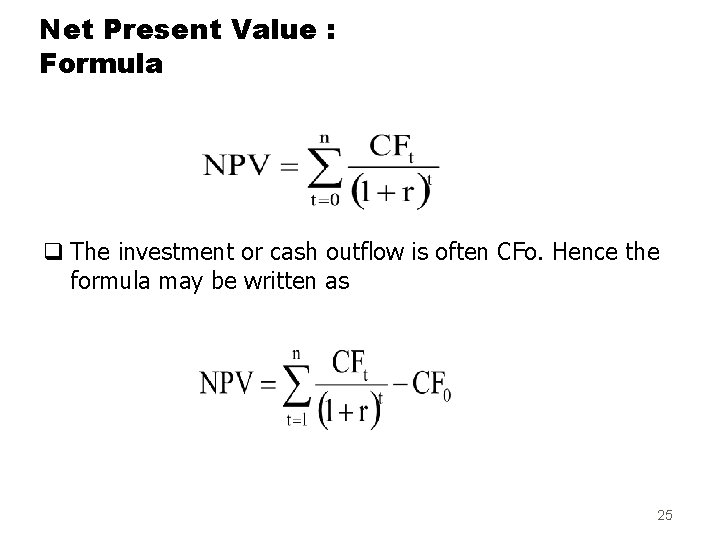
Net Present Value : Formula q The investment or cash outflow is often CFo. Hence the formula may be written as 25
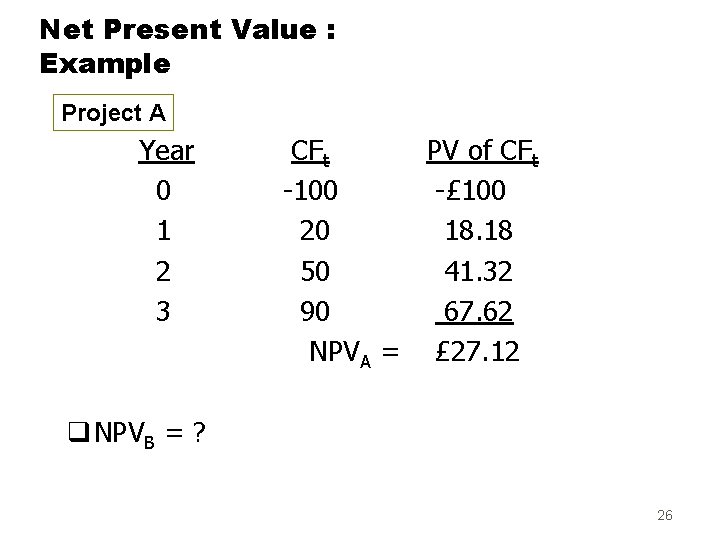
Net Present Value : Example Project A Year 0 1 2 3 CFt PV of CFt -100 -£ 100 20 18. 18 50 41. 32 90 67. 62 NPVA = £ 27. 12 q NPVB = ? 26
Net Present Value : In Microsoft Excel q In Microsoft Excel, NPV function wizard can be used to calculate NPV. q NPV(Rate, Value 1) + Investment Amount. Here the Rate is Discount Rate in %. Value means Cash Flow Stream which can be selected for all rows. Close the bracket and add the investment as: + Investment Amount which is a negative value. In the example above for Project A it is: NPV(10%, 20+50+90)+(-100) 27

Net Present Value : An Example in Microsoft Excel q Consider three alternative projects, A, B and C. q They all cost $1, 000 to set up but project’s A and C returns $800, 000 per year for two years starting one year from set up. Projects B also returns $800, 000 per year for two years, but the cash flows begin two years after set up. q Whilst project C costs $1, 000 to set up it requires $500, 000 initially and $500, 000 at termination (a clean up cost for example). q If the firm uses a discount rate of 20% which is the better project? 28
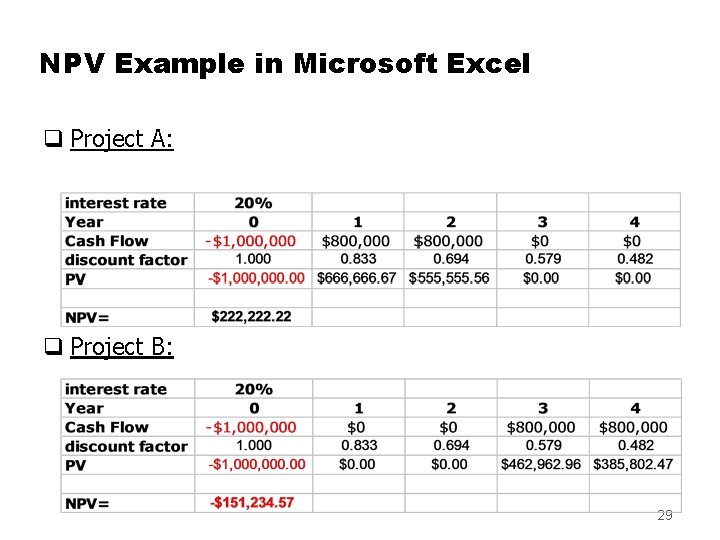
NPV Example in Microsoft Excel q Project A: q Project B: 29
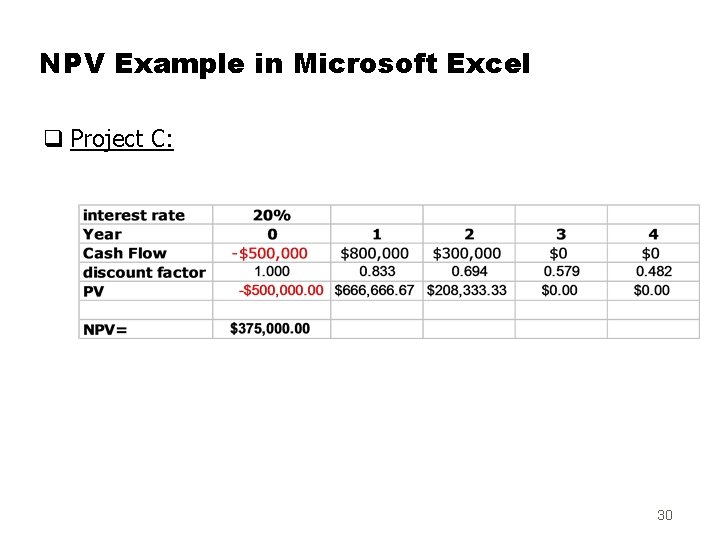
NPV Example in Microsoft Excel q Project C: 30
NPV Example Decision Making q Project C has the highest NPV and therefore if only one project can be undertaken it should be C. q However if more than one project can be undertaken then both A and C should be selected since they both have positive NPV’s. q Project B should be rejected since it has a negative NPV and would therefore destroy wealth. q It makes sense that project C should have the highest NPV, since its cash outflows are deferred relative to the other projects, and its cash flows are early. q In contrast project B has all the costs up front but the cash inflows are deferred. 31
Net Present Value: Decision Making q Independent Project: Accept when NPV > 0 q Mutually Exclusive Projects: Select the one with highest NPV q Suppose a project has a positive NPV, but the NPV is small, say, only a few hundred dollars then the firm should still undertake that project if there are no alternative projects with higher NPV as a firms wealth is increased every time it undertakes a positive NPV project. 32
Net Present Value: Decision Making q A small NPV, as long as it is positive, is net of all input costs and financing costs so even if the NPV is low it still provides additional returns. q A firm that rejects a positive NPV project is rejecting wealth! q Question: In the example for project A and B which project will you accept 1) they are independent 2) they are mutually exclusive 33
Net Present Value: True or False? q Discuss: A) A key input in NPV analysis is the discount rate. B) In the formula - r represents the minimum return that the project must earn to satisfy investors. C) r varies with the risk of the firm and /or the risk of the project. Above – Advantages or Disadvantages? ? 34
Net Present Value: Advantages and Disadvantages q Advantages q. Considers TVM q. Considers all the CFs q. Tells if the investment will increase the firm’s value q. Useful for comparing similar projects with same costs q Disadvantages q. Requires an estimate of the cost of capital q. Expressed in value and not in percentage term 35
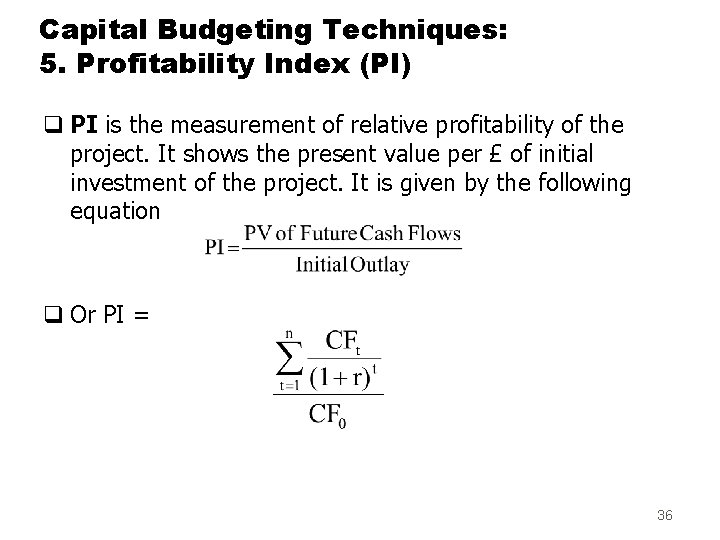
Capital Budgeting Techniques: 5. Profitability Index (PI) q PI is the measurement of relative profitability of the project. It shows the present value per £ of initial investment of the project. It is given by the following equation q Or PI = 36
Profitability Index : Decision Making q The IRR decision rule is then: q. If PI > 1, accept the project q. If PI < 1, reject the project q The PI equal to 1 indicates the zero NPV. Similarly the PI greater than 1 implies positive NPV of the project. Conversely, the PI less than 1, implies negative NPV q Applying the same rationale of NPV, we make a decision under PI method q Find out the PI for project A and B q In the example for project A and B which project will you accept 1) they are independent 2) they are mutually exclusive 37
Capital Budgeting Techniques: 6. Internal Rate of Return (IRR) q IRR is the rate that equates the PV of Cash Inflows with PV of Cash Outflows. q The IRR of a project can be defined as the rate of discount which, when applied to the projects Cash Flows, produces a zero NPV i. e. it is the rate that will force NPV to be zero 38
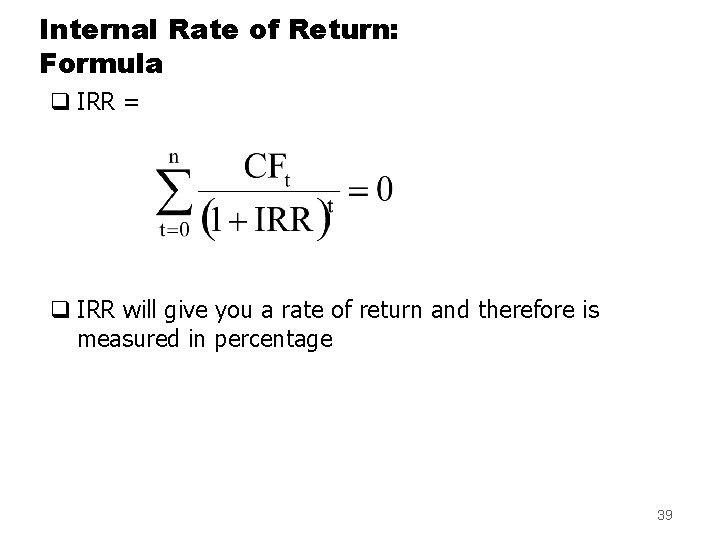
Internal Rate of Return: Formula q IRR = q IRR will give you a rate of return and therefore is measured in percentage 39
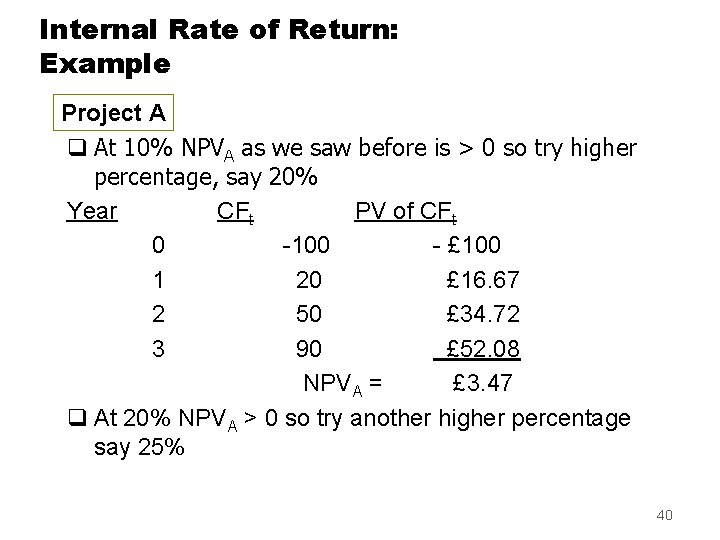
Internal Rate of Return: Example Project A q At 10% NPVA as we saw before is > 0 so try higher percentage, say 20% Year CFt PV of CFt 0 -100 - £ 100 1 20 £ 16. 67 2 50 £ 34. 72 3 90 £ 52. 08 NPVA = £ 3. 47 q At 20% NPVA > 0 so try another higher percentage say 25% 40
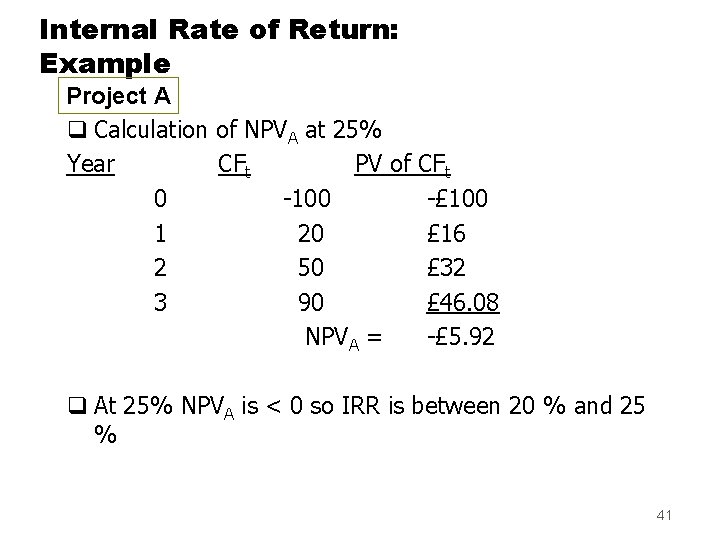
Internal Rate of Return: Example Project A q Calculation of NPVA at 25% Year CFt PV of 0 -100 1 20 2 50 3 90 NPVA = CFt -£ 100 £ 16 £ 32 £ 46. 08 -£ 5. 92 q At 25% NPVA is < 0 so IRR is between 20 % and 25 % 41
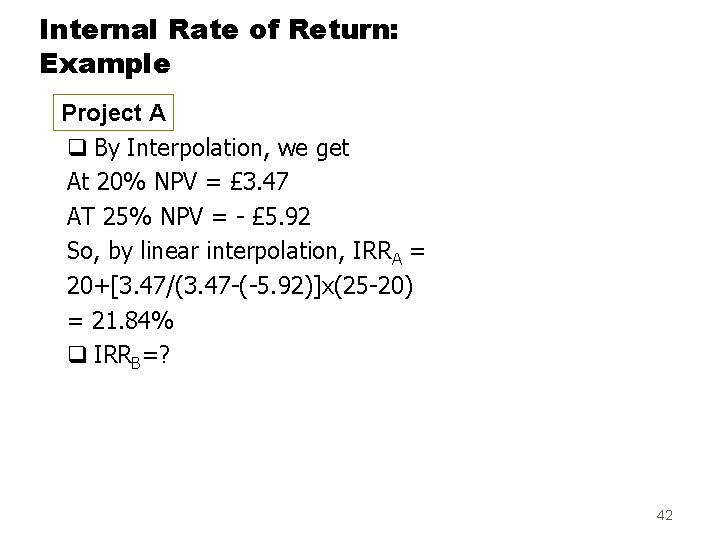
Internal Rate of Return: Example Project A q By Interpolation, we get At 20% NPV = £ 3. 47 AT 25% NPV = - £ 5. 92 So, by linear interpolation, IRRA = 20+[3. 47/(3. 47 -(-5. 92)]x(25 -20) = 21. 84% q IRRB=? 42
Internal Rate of Return: In Microsoft Excel q In Microsoft Excel, IRR function wizard can be used to calculate the IRR q Using the wizard in Microsoft Excel, it is simply selecting all Cash Inflows and Investment Amount (in negative) inside the parenthesis 43
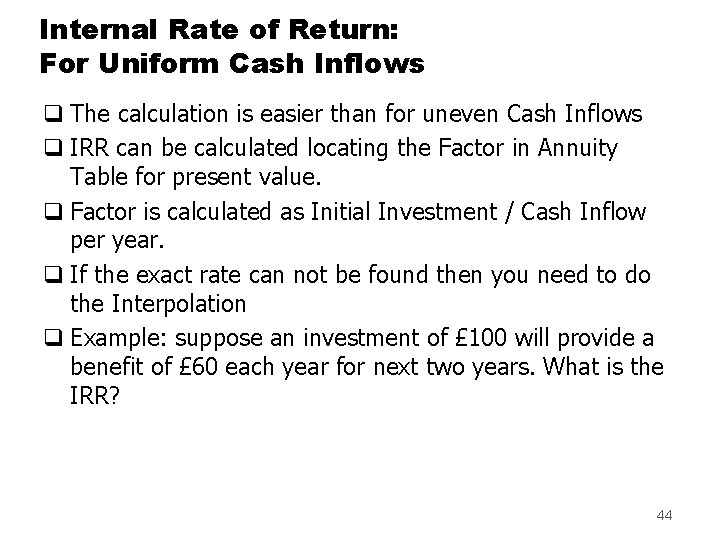
Internal Rate of Return: For Uniform Cash Inflows q The calculation is easier than for uneven Cash Inflows q IRR can be calculated locating the Factor in Annuity Table for present value. q Factor is calculated as Initial Investment / Cash Inflow per year. q If the exact rate can not be found then you need to do the Interpolation q Example: suppose an investment of £ 100 will provide a benefit of £ 60 each year for next two years. What is the IRR? 44
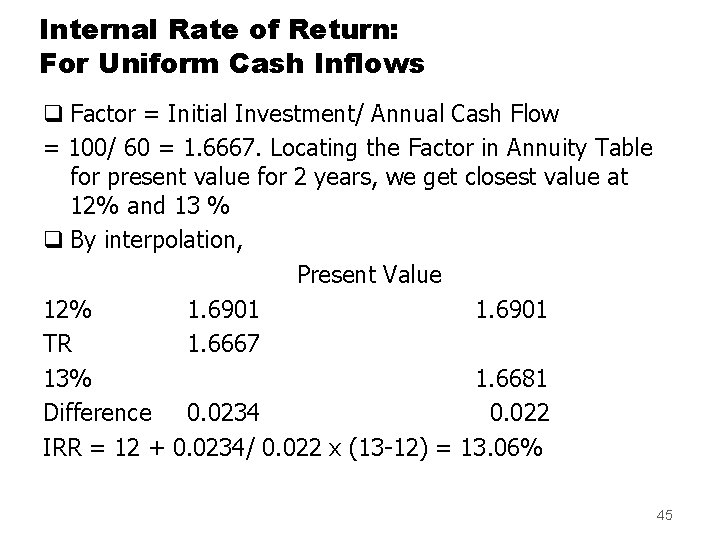
Internal Rate of Return: For Uniform Cash Inflows q Factor = Initial Investment/ Annual Cash Flow = 100/ 60 = 1. 6667. Locating the Factor in Annuity Table for present value for 2 years, we get closest value at 12% and 13 % q By interpolation, Present Value 12% 1. 6901 TR 1. 6667 13% 1. 6681 Difference 0. 0234 0. 022 IRR = 12 + 0. 0234/ 0. 022 x (13 -12) = 13. 06% 45
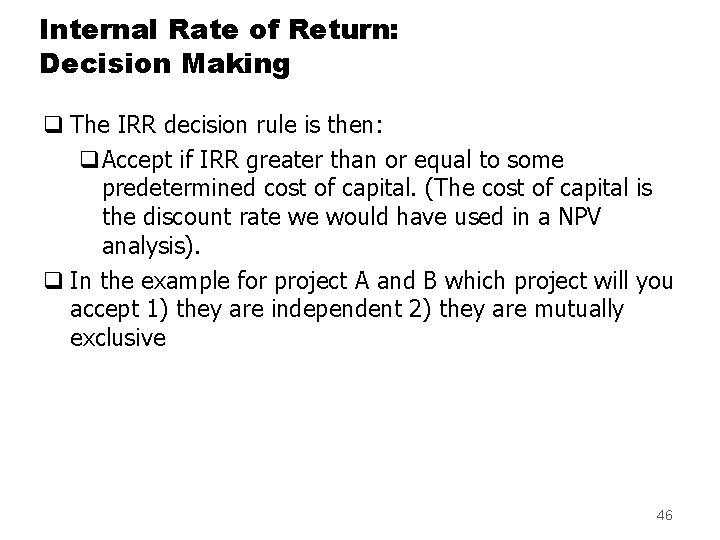
Internal Rate of Return: Decision Making q The IRR decision rule is then: q. Accept if IRR greater than or equal to some predetermined cost of capital. (The cost of capital is the discount rate we would have used in a NPV analysis). q In the example for project A and B which project will you accept 1) they are independent 2) they are mutually exclusive 46
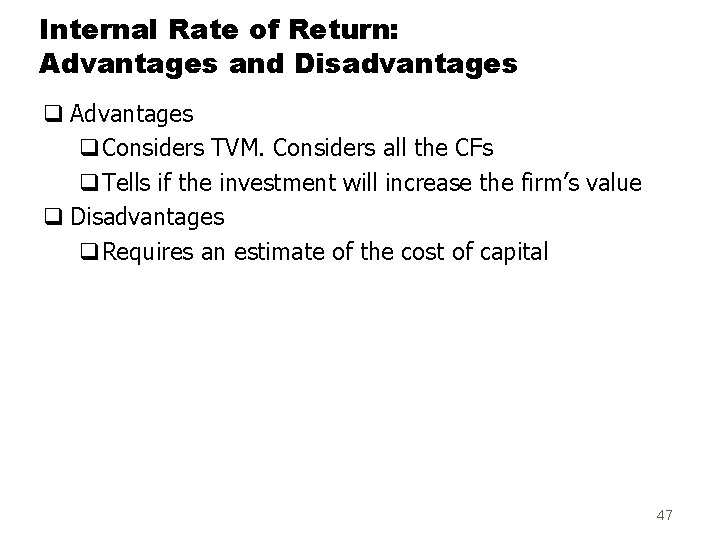
Internal Rate of Return: Advantages and Disadvantages q Advantages q. Considers TVM. Considers all the CFs q. Tells if the investment will increase the firm’s value q Disadvantages q. Requires an estimate of the cost of capital 47
NPV and IRR: the methods q NPV positive: when cost of capital is < IRR q NPV negative: when cost of capital > IRR q Explaining above using NPV profile q. CF for Year 0, 1 and 2 are -1, 500, £ 500 and £ 1, 500 respectively. q. Calculate NPVs at Discount Factor: 0 %, 6%, 12%, 18%, 24%, 30% and 36% respectively and present the NPV profile 48
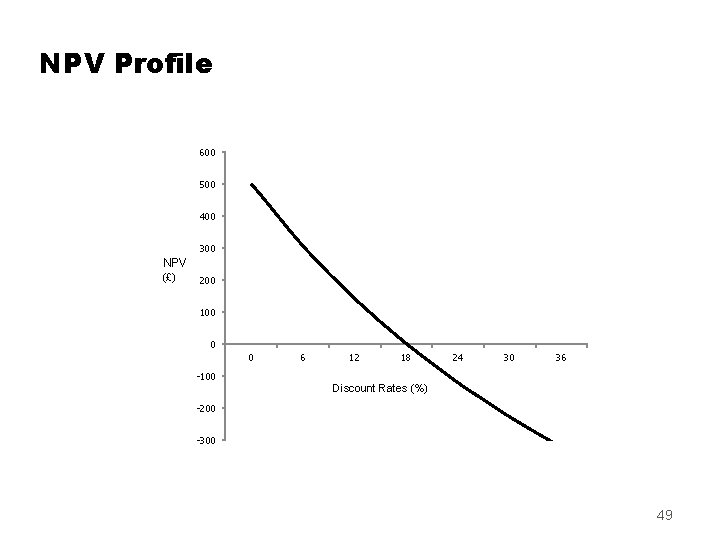
NPV Profile 600 500 400 300 NPV (£) 200 100 0 0 -100 6 12 18 24 30 36 Discount Rates (%) -200 -300 49

NPV and IRR: mutually exclusive projects q NPV and IRR: Check the NPV and IRR calculations for 2 projects given below. Assume Discount Factor of 7% for NPV calculation. Amount in £. q The NPV of Labour project > Machine. But IRR of Machine > Labour. 50
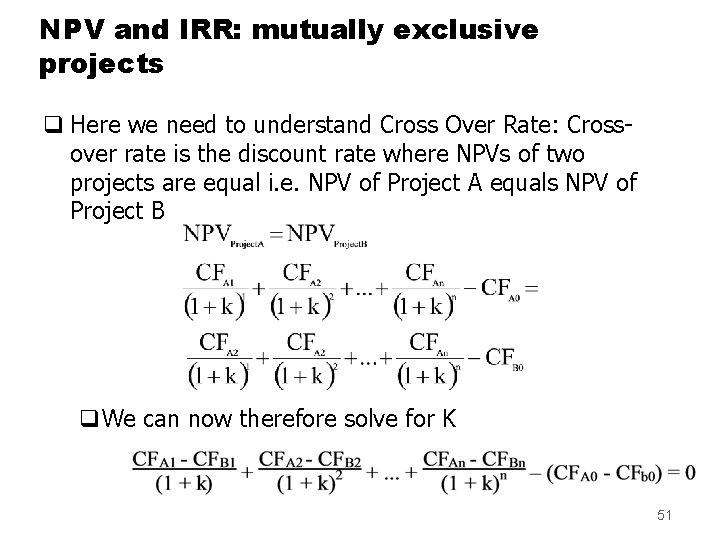
NPV and IRR: mutually exclusive projects q Here we need to understand Cross Over Rate: Crossover rate is the discount rate where NPVs of two projects are equal i. e. NPV of Project A equals NPV of Project B q. We can now therefore solve for K 51
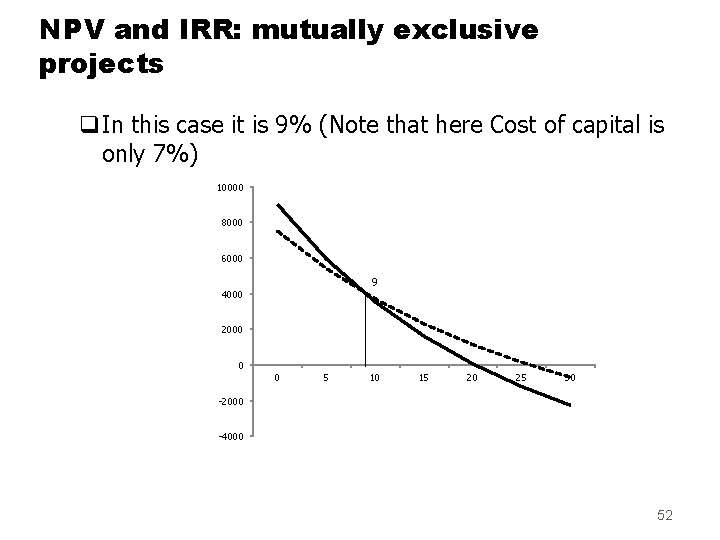
NPV and IRR: mutually exclusive projects q. In this case it is 9% (Note that here Cost of capital is only 7%) 10000 8000 6000 9 4000 2000 0 0 5 10 15 20 25 30 -2000 -4000 52
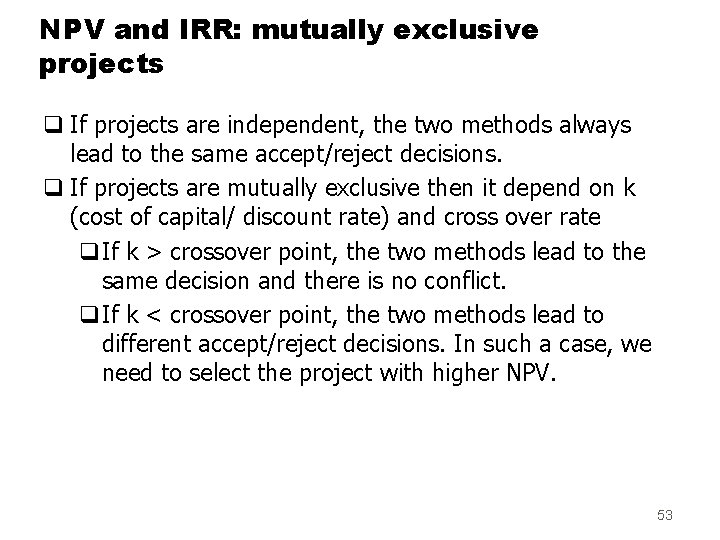
NPV and IRR: mutually exclusive projects q If projects are independent, the two methods always lead to the same accept/reject decisions. q If projects are mutually exclusive then it depend on k (cost of capital/ discount rate) and cross over rate q. If k > crossover point, the two methods lead to the same decision and there is no conflict. q. If k < crossover point, the two methods lead to different accept/reject decisions. In such a case, we need to select the project with higher NPV. 53
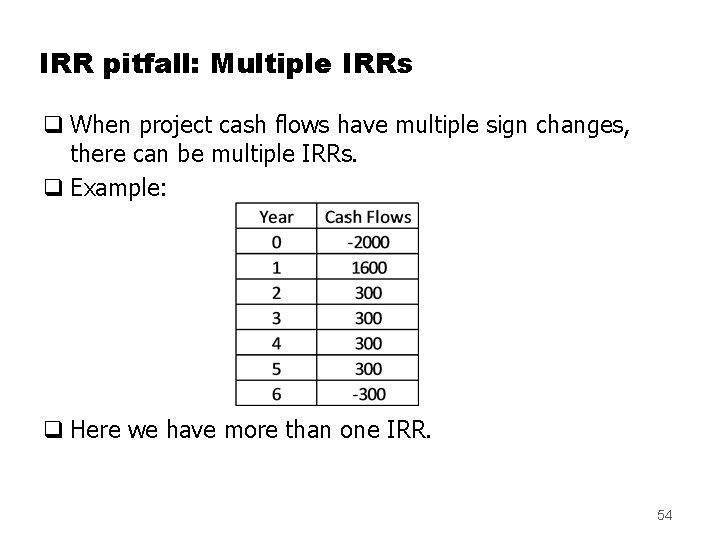
IRR pitfall: Multiple IRRs q When project cash flows have multiple sign changes, there can be multiple IRRs. q Example: q Here we have more than one IRR. 54
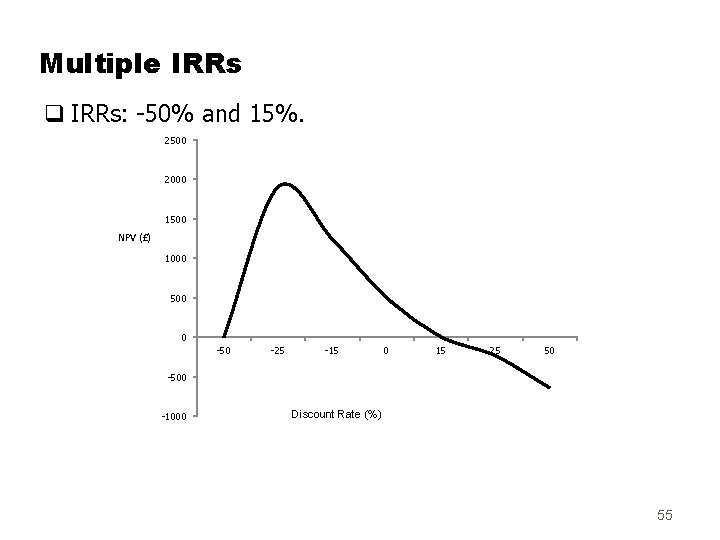
Multiple IRRs q IRRs: -50% and 15%. 2500 2000 1500 NPV (£) 1000 500 0 -50 -25 -15 0 15 25 50 -500 -1000 Discount Rate (%) 55
No IRRs q Find the IRR for the following cash flows: q Year 1, 2 and 3 : £ 1, 000, £-3000 and £ 2, 500 respectively 56
NPV and IRR: compared q Relative and absolute measurement q IRR might not be usable for projects with unconventional cash flows q In the case of mutually exclusive projects, IRR may give the conflicting decision. q IRR does not hold the value additivity principle. (According to the value additivity principle, if we know the value of the separate projects accepted by the management, we can calculate the value of the firm by adding up those projects). We can not add up IRRs of the projects and find out the IRR for the projects in combination. So, for project X and Y, IRR(X) + IRR(Y) is not equal to IRR (X+Y). 57
NPV and IRR: compared q IRR does not consider the scale of investment. In the case of mutually exclusive projects, it considers only the rate of return but does not consider the scale of investment. q Example: Project X and Y are two mutually exclusive projects. Suppose these are one year projects. Project X requires £ 5, 000 investment and Project Y does £ 1, 000. Further let us suppose that the required rate of return on the investment is 10 percent. At the end of the year, Project X and Y generate cash inflows of £ 6, 250 and £ 1, 500. 58
NPV and IRR: compared q IRR of Project X is 25 percent and of Project Y is 50 percent. q Here, Project Y has the higher IRR than that of Project X. q But NPV of Project X Rs 681. 82 and of Project Y is Rs 363. 64. q Thus, IRR does not consider the investment scale and it is not consistent to the shareholder wealth maximization criterion. 59
NPV and IRR: compared q Theoretically, NPV shows how much the market value of the firm will rise if project is accepted and IRR shows what rate of return will the project yield if it is accepted. q NPV and IRR are different with respect to the assumption of reinvestment rate. NPV assumes that cash inflows are reinvested at required rate of return and IRR assumes that they will be reinvested at project rate of return. 60
7. Modified Internal Rate of Return (MIRR) q MIRR overcomes the IRR problems (Conflicting Decisions and Multiple IRRs). q MIRR assumes a single outflow at time 0 and a single inflow at the end of the final year of the project. 61
MIRR q Steps: q. Convert all investment phase outlays as a single equivalent payment at time 0 using cost of capital. q. All net cash inflows of project are converted to a single net equivalent terminal receipt at the end of the project’s life (assuming a reinvestment rate equal to the company’s cost of capital). q. MIRR is the nth root of TV inflows / PV outflows and subtracting 1 (where n is the length of the project in years) 62
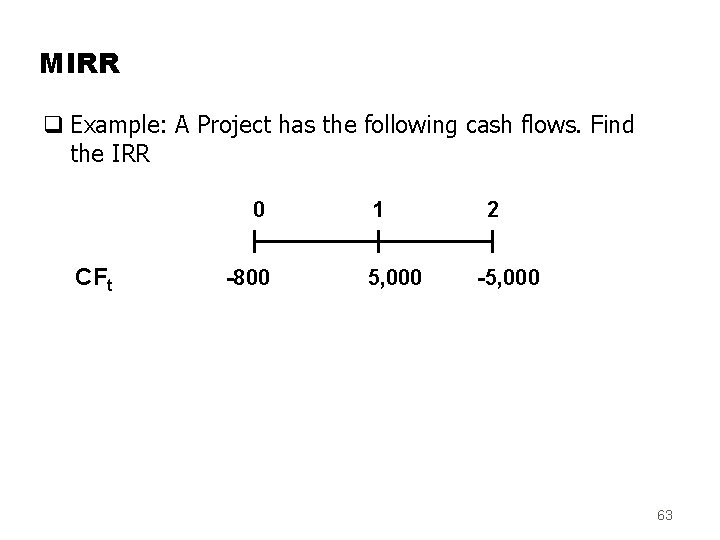
MIRR q Example: A Project has the following cash flows. Find the IRR 0 CFt -800 1 5, 000 2 -5, 000 63
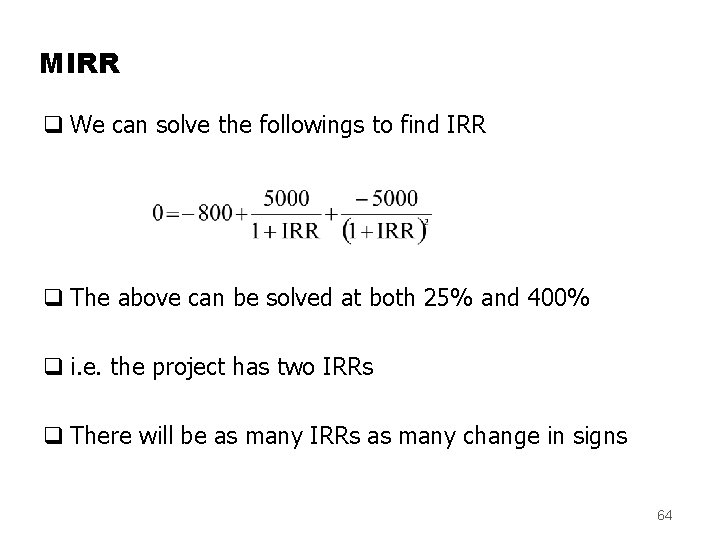
MIRR q We can solve the followings to find IRR q The above can be solved at both 25% and 400% q i. e. the project has two IRRs q There will be as many IRRs as many change in signs 64
MIRR q MIRR to resolve the problem q Steps q. Find out the PV of outflows at cost of capital (say 10%) q. Find out the FV of inflows at cost of capital 65
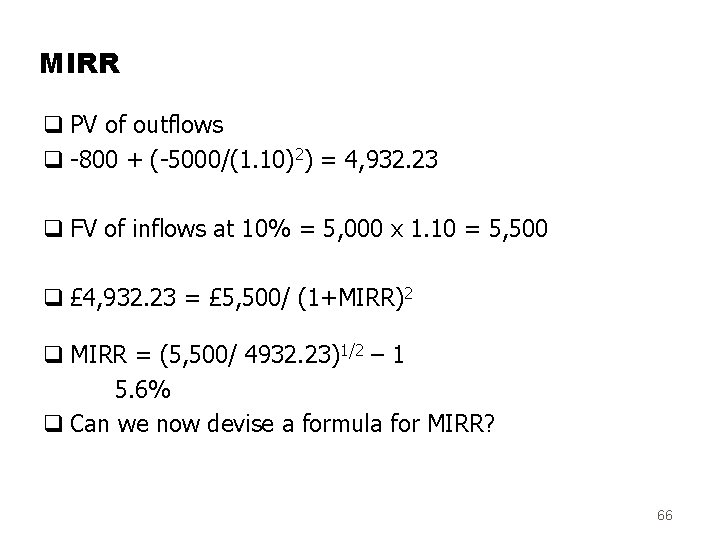
MIRR q PV of outflows q -800 + (-5000/(1. 10)2) = 4, 932. 23 q FV of inflows at 10% = 5, 000 x 1. 10 = 5, 500 q £ 4, 932. 23 = £ 5, 500/ (1+MIRR)2 q MIRR = (5, 500/ 4932. 23)1/2 – 1 5. 6% q Can we now devise a formula for MIRR? 66
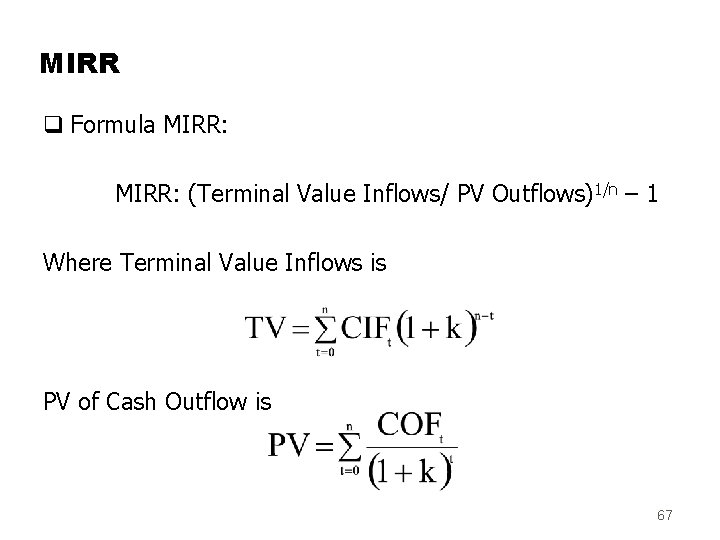
MIRR q Formula MIRR: (Terminal Value Inflows/ PV Outflows)1/n – 1 Where Terminal Value Inflows is PV of Cash Outflow is 67
MIRR q Advantages: q. MIRR solves the problem of multiple returns. MIRR converts the unconventional cash flow into conventional cash flows. q. MIRR is based on the assumption that cash inflows are reinvested at cost of capital. This assumption is more realistic than the assumption of regular IRR. So, MIRR is better indicator of profitability of the project. 68
MIRR q Disadvantages: q. NPV and MIRR of mutually exclusive projects give the same decision provided the size and life of the projects are equal. But NPV and MIRR give the conflicting decision when projects differ in size measured in term of investment. q. First, cash outflows and inflows are converted into the present value and terminal value respectively and then based on the present value of the outflows and terminal value of cash inflows, MIRR is calculated. Hence the calculation process is difficult. q. NPV solves all the problem so not needed in reality 69
Capital Rationing q Choosing the capital Expenditure when resources are limited. 70
Capital Rationing q Shareholders’ wealth will be maximised if a company undertakes all possible positive NPV projects q Capital Rationing implies there are insufficient funds hence it is not possible to select all projects (although with positive NPV) q Thus, capital rationing refers to the situation where the firm is constrained to raise necessary funds to invest in all projects with positive NPV. q Capital rationing: a firm limits capital expenditure to less than the amount required to finance the optimal capital budget. (optimal capital budget – budget for all with +’ve NPVs). 71
Capital Rationing q Why capital rationing? q. Capital ceiling for capital investment. q. Target capital structure therefore reluctant to raise debt capital in excess of optimal debt ratio. q. Reluctant to issue new common share due to the fear of dilution of controlling power in management. q All these factors put constraints to select all projects with positive NPV and the management is bound to make sub -optimal capital budget 72
Capital Rationing q Two Types: Hard and Soft. q Hard rationing is external e. g. imposed by lenders q Soft rationing is internal e. g. by senior managers q The shortage of fund may be for q. Single Period q. Multi Period (This requires linear programming techniques) 73
Capital Rationing q Single Period: The shortage of fund is only for present period and will not arise in the future. There can be three different scenarios: q. The projects are divisible q. The projects are indivisible q. The projects are mutually exclusive 74
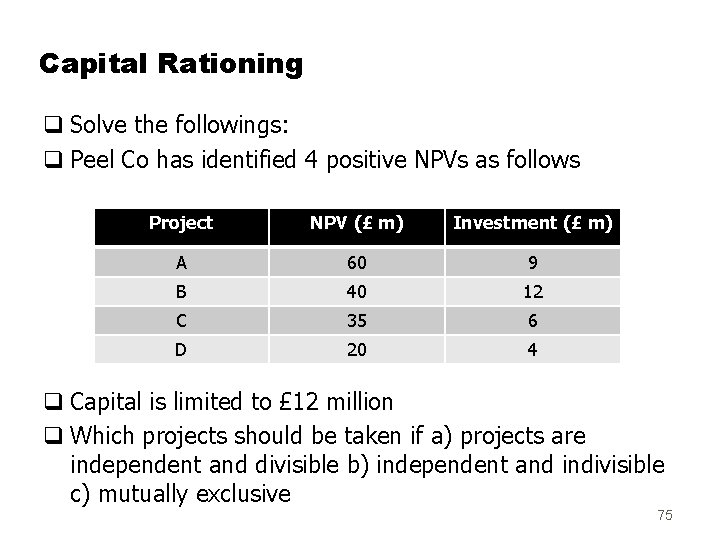
Capital Rationing q Solve the followings: q Peel Co has identified 4 positive NPVs as follows Project NPV (£ m) Investment (£ m) A 60 9 B 40 12 C 35 6 D 20 4 q Capital is limited to £ 12 million q Which projects should be taken if a) projects are independent and divisible b) independent and indivisible c) mutually exclusive 75
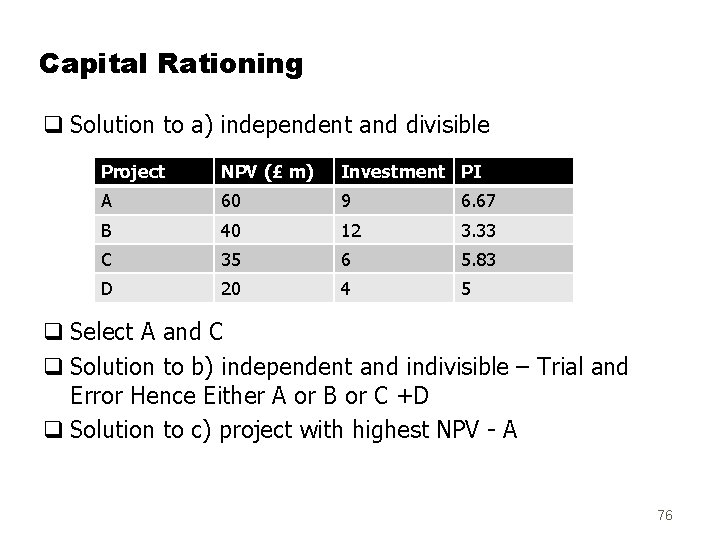
Capital Rationing q Solution to a) independent and divisible Project NPV (£ m) Investment PI A 60 9 6. 67 B 40 12 3. 33 C 35 6 5. 83 D 20 4 5 q Select A and C q Solution to b) independent and indivisible – Trial and Error Hence Either A or B or C +D q Solution to c) project with highest NPV - A 76

Thank you 77
- Slides: 77