
Capital Budgeting Professor Trainor 11 1 Capital Budgeting

Capital Budgeting Professor Trainor 11 -1
Capital Budgeting Decision Techniques Payback period: most commonly used Discounted Payback, not as common Net present value (NPV): best technique theoretically; difficult to calculate realistically Internal rate of return (IRR): widely used with strong intuitive appeal. Modified IRR can be used if several neg. cash flows Profitability index (PI): related to NPV 11 -2
A Capital Budgeting Process Should: Account for the time value of money; Account for risk; Focus on cash flow; Rank competing projects appropriately, and Lead to investment decisions that maximize shareholders’ wealth. 11 -3
Payback Period The payback period is the amount of time required for the firm to recover its initial investment. • If the project’s payback period is less than the maximum acceptable payback period, accept the project. • If the project’s payback period is greater than the maximum acceptable payback period, reject the project. Management determines maximum acceptable payback period. 11 -4
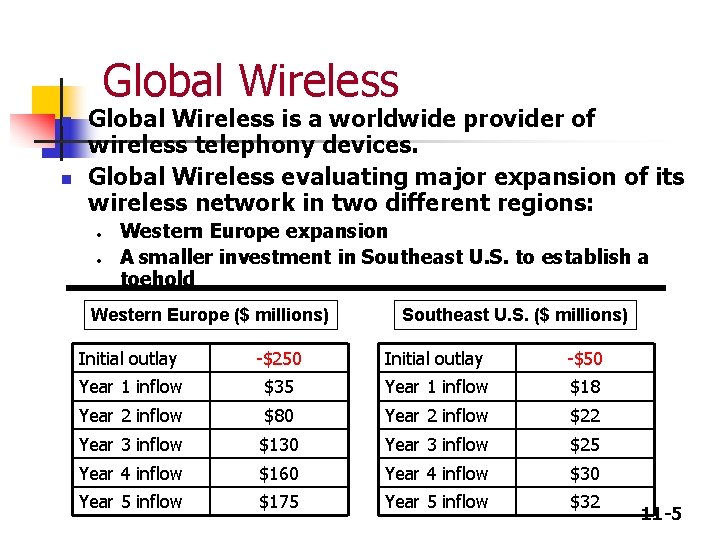
Global Wireless n n Global Wireless is a worldwide provider of wireless telephony devices. Global Wireless evaluating major expansion of its wireless network in two different regions: • • Western Europe expansion A smaller investment in Southeast U. S. to establish a toehold Western Europe ($ millions) Southeast U. S. ($ millions) Initial outlay -$250 Initial outlay -$50 Year 1 inflow $35 Year 1 inflow $18 Year 2 inflow $80 Year 2 inflow $22 Year 3 inflow $130 Year 3 inflow $25 Year 4 inflow $160 Year 4 inflow $30 Year 5 inflow $175 Year 5 inflow $32 11 -5
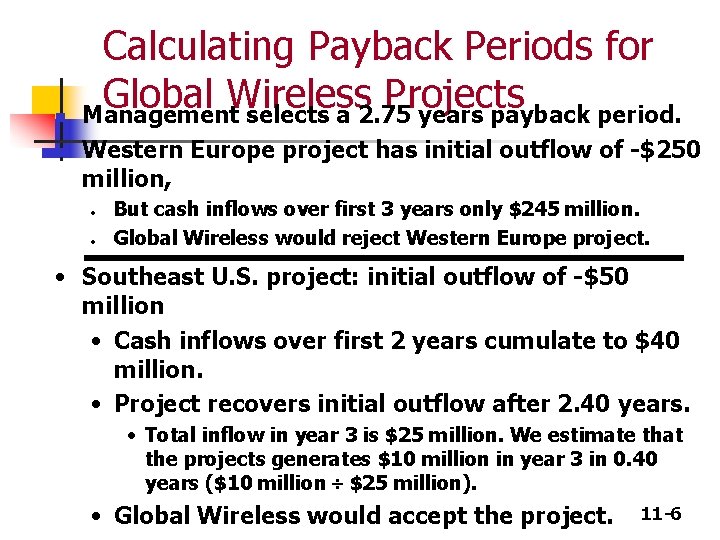
n n Calculating Payback Periods for Global Wireless Projects Management selects a 2. 75 years payback period. Western Europe project has initial outflow of -$250 million, • • But cash inflows over first 3 years only $245 million. Global Wireless would reject Western Europe project. • Southeast U. S. project: initial outflow of -$50 million • Cash inflows over first 2 years cumulate to $40 million. • Project recovers initial outflow after 2. 40 years. • Total inflow in year 3 is $25 million. We estimate that the projects generates $10 million in year 3 in 0. 40 years ($10 million $25 million). • Global Wireless would accept the project. 11 -6
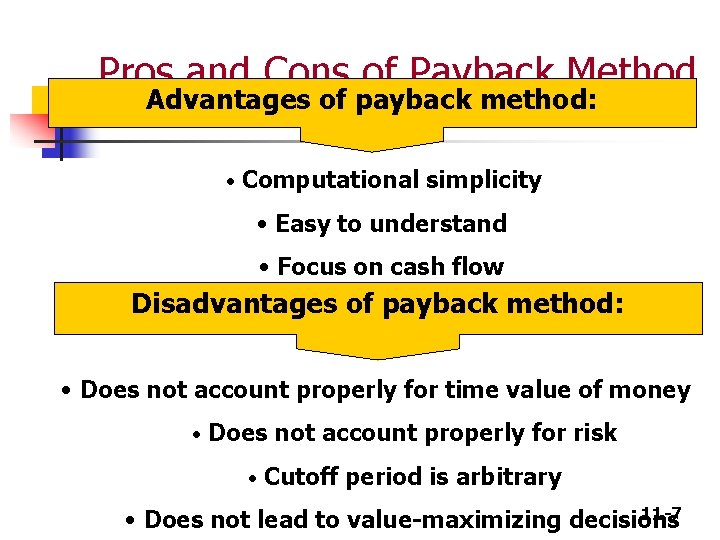
Pros and Cons of Payback Method Advantages of payback method: • Computational simplicity • Easy to understand • Focus on cash flow Disadvantages of payback method: • Does not account properly for time value of money • Does not account properly for risk • Cutoff period is arbitrary 11 -7 • Does not lead to value-maximizing decisions
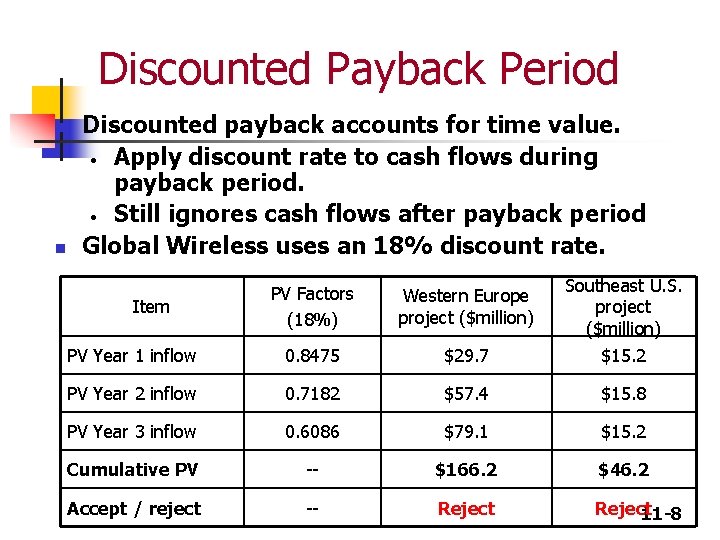
Discounted Payback Period n n Discounted payback accounts for time value. • Apply discount rate to cash flows during payback period. • Still ignores cash flows after payback period Global Wireless uses an 18% discount rate. PV Factors (18%) Western Europe project ($million) Southeast U. S. project ($million) PV Year 1 inflow 0. 8475 $29. 7 $15. 2 PV Year 2 inflow 0. 7182 $57. 4 $15. 8 PV Year 3 inflow 0. 6086 $79. 1 $15. 2 Cumulative PV -- $166. 2 $46. 2 Accept / reject -- Reject 11 -8 Item
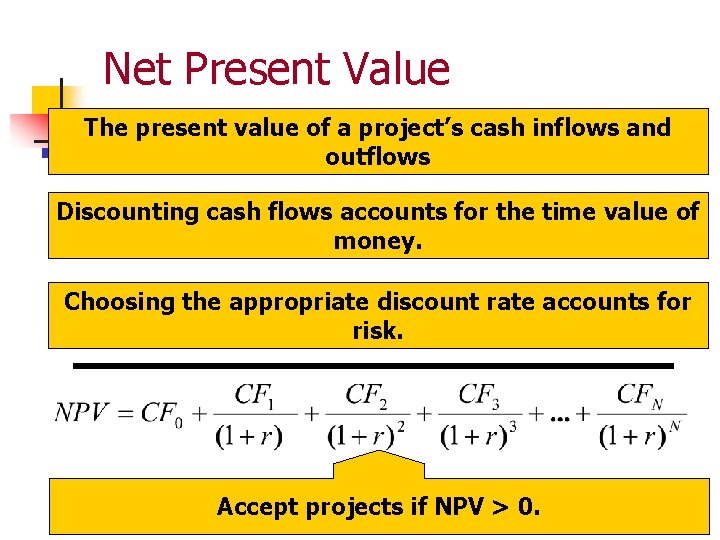
Net Present Value The present value of a project’s cash inflows and outflows Discounting cash flows accounts for the time value of money. Choosing the appropriate discount rate accounts for risk. Accept projects if NPV > 0. 11 -9

Net Present Value A key input in NPV analysis is the discount rate. r represents the minimum return that the project must earn to satisfy investors. r varies with the risk of the firm and/or the risk of the project. 11 -10
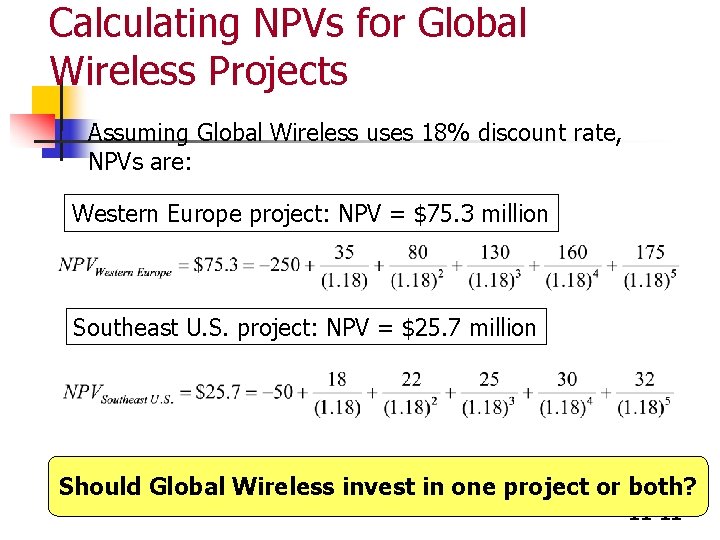
Calculating NPVs for Global Wireless Projects n Assuming Global Wireless uses 18% discount rate, NPVs are: Western Europe project: NPV = $75. 3 million Southeast U. S. project: NPV = $25. 7 million Should Global Wireless invest in one project or both? 11 -11
Pros and Cons of Using NPV as Decision Rule NPV is the “gold standard” of investment decision rules. Key benefits of using NPV as decision rule: • Focuses on cash flows, not accounting earnings • Makes appropriate adjustment for time value of money • Can properly account for risk differences between projects Though best measure, NPV has some drawbacks: • Lacks the intuitive appeal of payback, and • Doesn’t capture managerial flexibility (option value) well. 11 -12
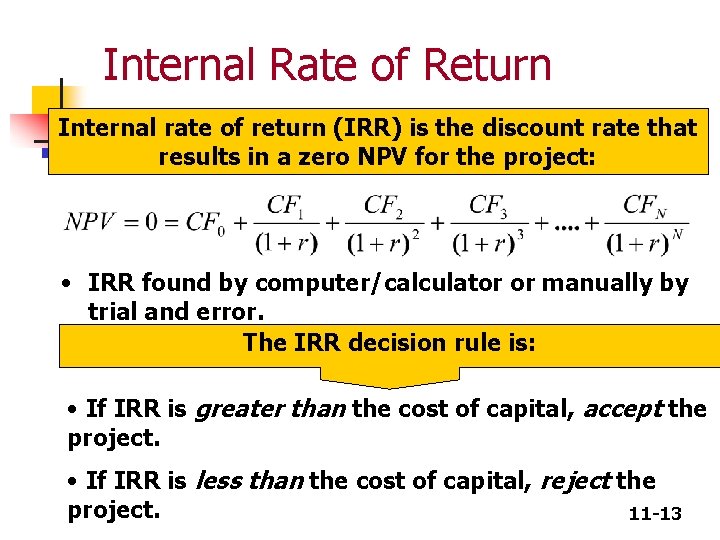
Internal Rate of Return Internal rate of return (IRR) is the discount rate that results in a zero NPV for the project: • IRR found by computer/calculator or manually by trial and error. The IRR decision rule is: • If IRR is greater than the cost of capital, accept the project. • If IRR is less than the cost of capital, reject the project. 11 -13
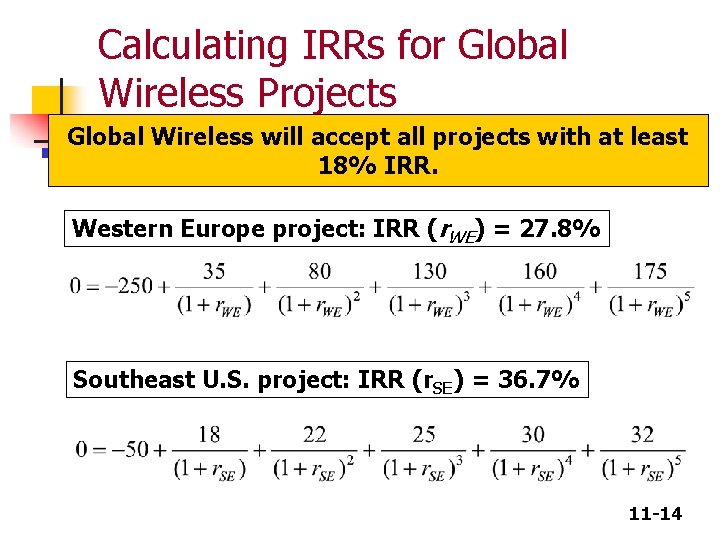
Calculating IRRs for Global Wireless Projects Global Wireless will accept all projects with at least 18% IRR. Western Europe project: IRR (r. WE) = 27. 8% Southeast U. S. project: IRR (r. SE) = 36. 7% 11 -14
Advantages and Disadvantages of IRR Advantages of IRR: • Properly adjusts for time value of money • Uses cash flows rather than earnings • Accounts for all cash flows • Project IRR is a number with intuitive appeal Disadvantages of IRR • “Mathematical problems”: multiple IRRs, no real solutions • Scale problem • Timing problem 11 -15
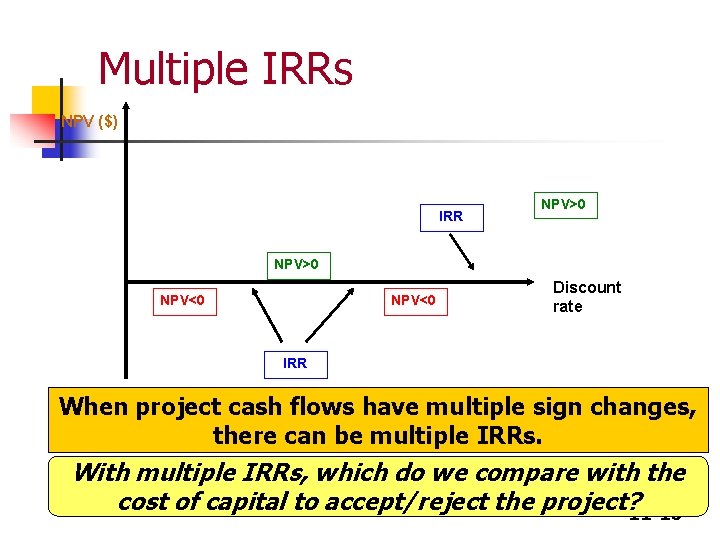
Multiple IRRs NPV ($) IRR NPV>0 NPV<0 Discount rate IRR When project cash flows have multiple sign changes, there can be multiple IRRs. With multiple IRRs, which do we compare with the cost of capital to accept/reject the project? 11 -16
No Real Solution Sometimes projects do not have a real IRR solution. Modify Global Wireless’s Western Europe project to include a large negative outflow (-$355 million) in year 6. • There is no real number that will make NPV=0, so no real IRR. However, can use something called modified IRR. Project is a bad idea based on NPV. At r =18%, project has negative NPV, so reject! 11 -17
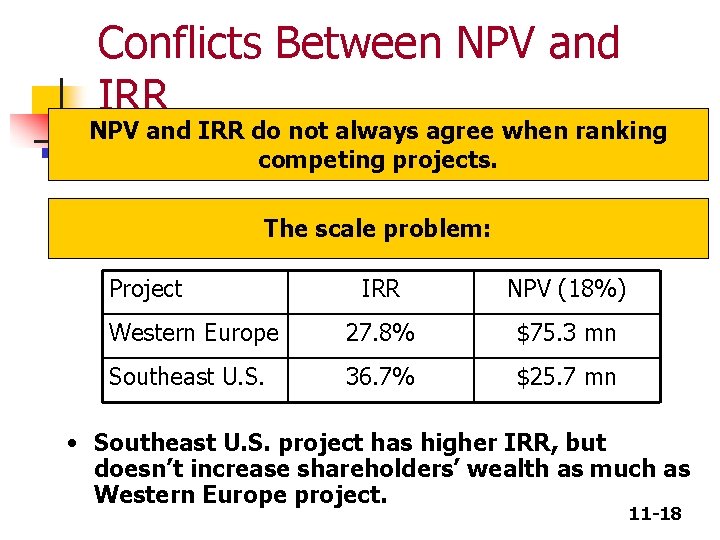
Conflicts Between NPV and IRR do not always agree when ranking competing projects. The scale problem: Project IRR NPV (18%) Western Europe 27. 8% $75. 3 mn Southeast U. S. 36. 7% $25. 7 mn • Southeast U. S. project has higher IRR, but doesn’t increase shareholders’ wealth as much as Western Europe project. 11 -18
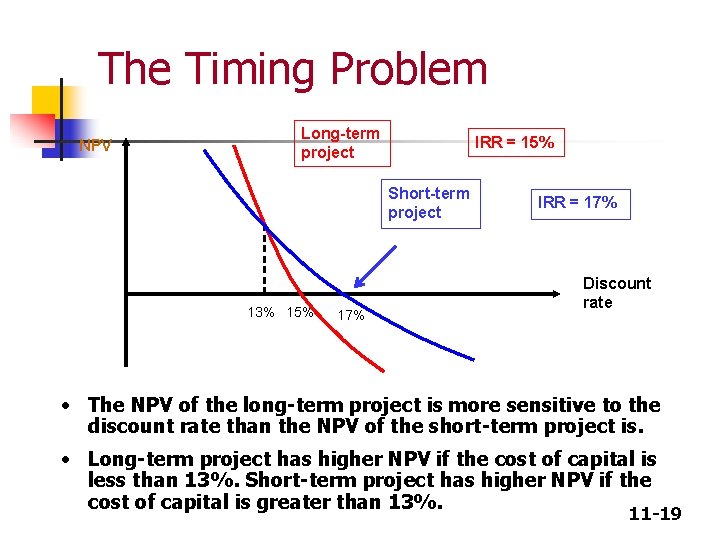
The Timing Problem NPV Long-term project IRR = 15% Short-term project 13% 15% 17% IRR = 17% Discount rate • The NPV of the long-term project is more sensitive to the discount rate than the NPV of the short-term project is. • Long-term project has higher NPV if the cost of capital is less than 13%. Short-term project has higher NPV if the cost of capital is greater than 13%. 11 -19
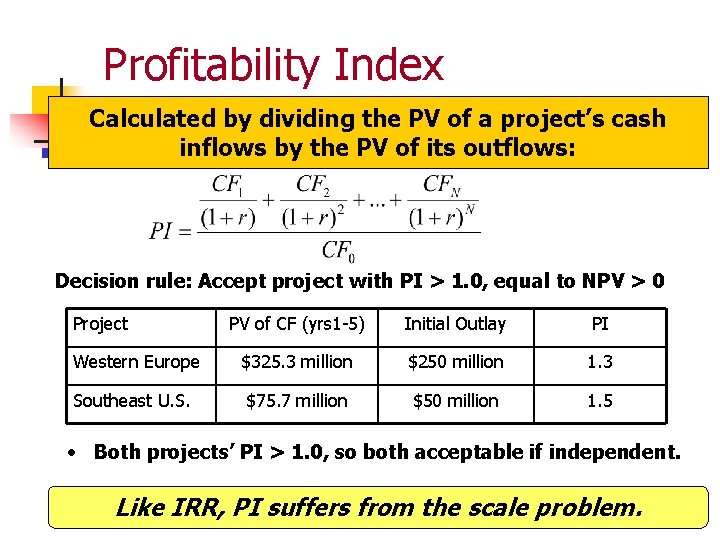
Profitability Index Calculated by dividing the PV of a project’s cash inflows by the PV of its outflows: Decision rule: Accept project with PI > 1. 0, equal to NPV > 0 Project PV of CF (yrs 1 -5) Initial Outlay PI Western Europe $325. 3 million $250 million 1. 3 Southeast U. S. $75. 7 million $50 million 1. 5 • Both projects’ PI > 1. 0, so both acceptable if independent. Like IRR, PI suffers from the scale problem. 11 -20
- Slides: 20