
Capital Budgeting Capital budgeting A process of evaluating
Capital Budgeting • Capital budgeting - A process of evaluating and planning expenditure on assets that will provide future cash flow(s). 9/9/2020 Bus 512 - Capital Budgeting | Dr. Menahem Rosenberg 1
Payback period The number of years required to recover a project’s cost, or how long does it take to recover the investment? Pros: Provides an indication of a project’s risk and liquidity. Easy to calculate and understand. Cons: Ignores the TVM. Ignores CFs occurring after the payback period. 9/9/2020 Bus 512 - Capital Budgeting | Dr. Menahem Rosenberg 2
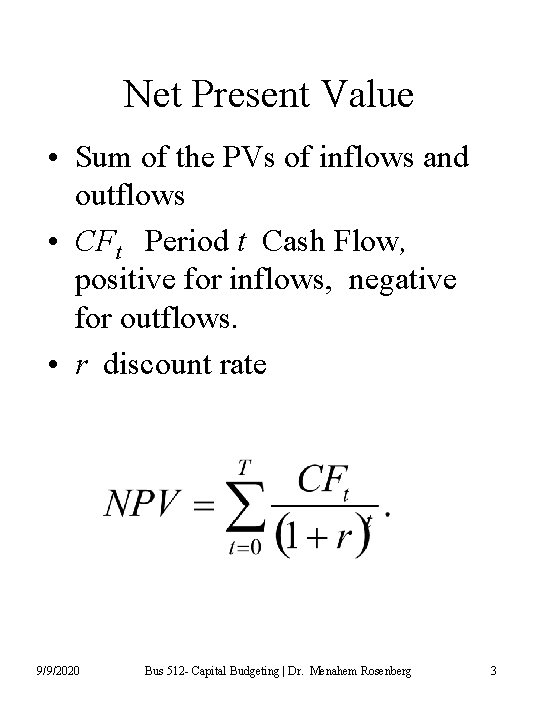
Net Present Value • Sum of the PVs of inflows and outflows • CFt Period t Cash Flow, positive for inflows, negative for outflows. • r discount rate 9/9/2020 Bus 512 - Capital Budgeting | Dr. Menahem Rosenberg 3
NPV Decision rule. NPV = PV Inflows – PV Outflows (Cost) = Net gain in wealth. Accept project if NPV > 0 Reject project if NPV < 0 Choose between mutually exclusive projects on basis of higher NPV. Adds most value. 9/9/2020 Bus 512 - Capital Budgeting | Dr. Menahem Rosenberg 4
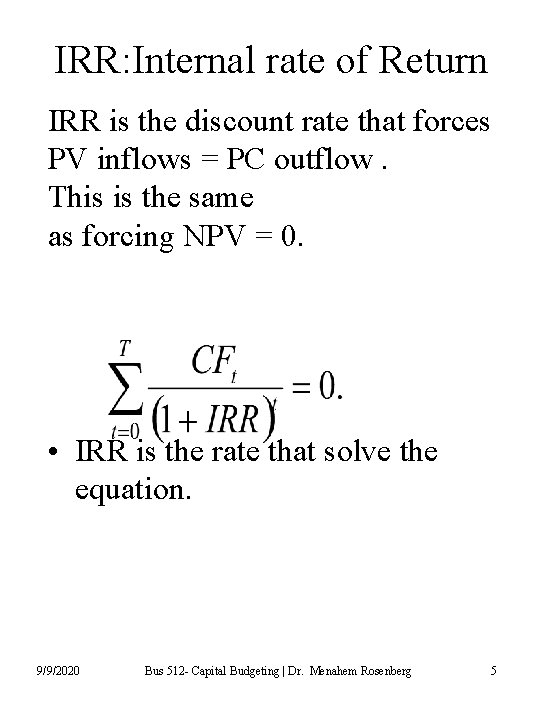
IRR: Internal rate of Return IRR is the discount rate that forces PV inflows = PC outflow. This is the same as forcing NPV = 0. • IRR is the rate that solve the equation. 9/9/2020 Bus 512 - Capital Budgeting | Dr. Menahem Rosenberg 5
IRR Decision Rule • r Discount rate • If IRR > r, accept project. • If IRR < r, reject project. • Consistent with NPV • If IRR > r NPV >0 9/9/2020 Bus 512 - Capital Budgeting | Dr. Menahem Rosenberg 6
NPV vs IRR • NPV assumes reinvest at r (opportunity cost of capital). • IRR assumes reinvest at IRR. • Reinvest at opportunity cost, r, is more realistic, so NPV method is best. NPV should be used to choose between mutually exclusive projects. 9/9/2020 Bus 512 - Capital Budgeting | Dr. Menahem Rosenberg 7
NPV vs IRR • For mutually exclusive projects, IRR does not consider project scale. • Multiple outflow periods lead to multiple IRR. 9/9/2020 Bus 512 - Capital Budgeting | Dr. Menahem Rosenberg 8
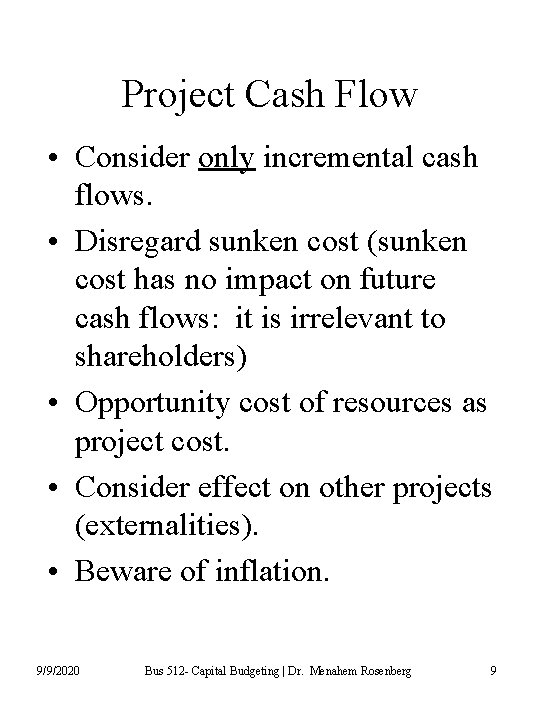
Project Cash Flow • Consider only incremental cash flows. • Disregard sunken cost (sunken cost has no impact on future cash flows: it is irrelevant to shareholders) • Opportunity cost of resources as project cost. • Consider effect on other projects (externalities). • Beware of inflation. 9/9/2020 Bus 512 - Capital Budgeting | Dr. Menahem Rosenberg 9
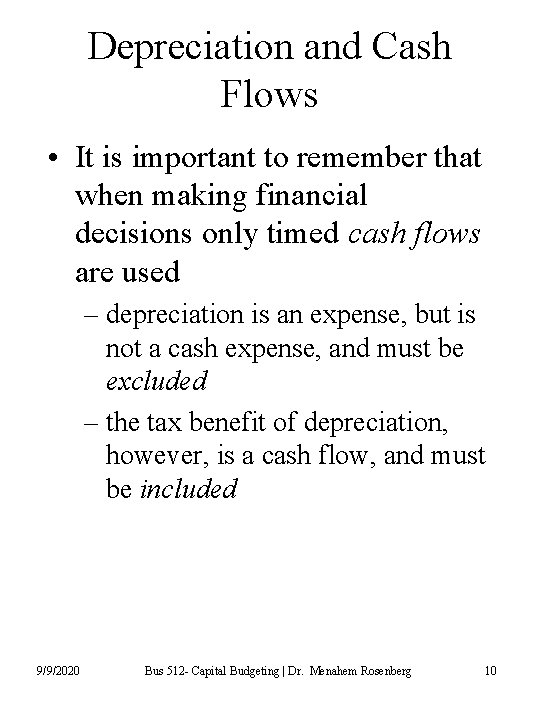
Depreciation and Cash Flows • It is important to remember that when making financial decisions only timed cash flows are used – depreciation is an expense, but is not a cash expense, and must be excluded – the tax benefit of depreciation, however, is a cash flow, and must be included 9/9/2020 Bus 512 - Capital Budgeting | Dr. Menahem Rosenberg 10
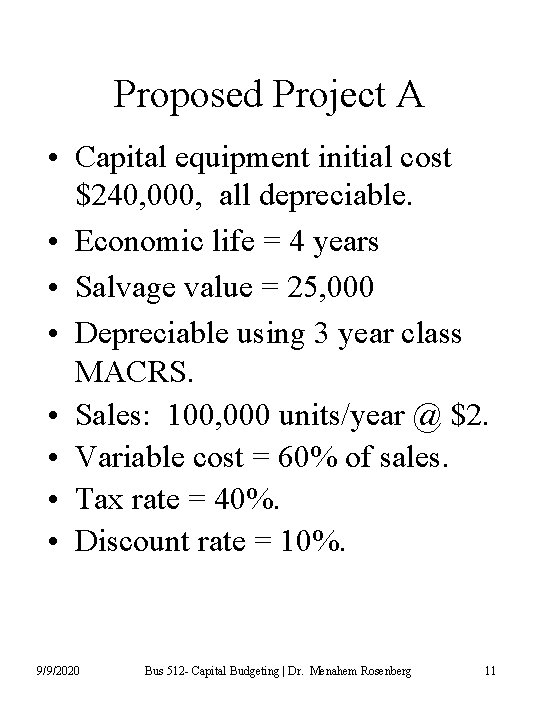
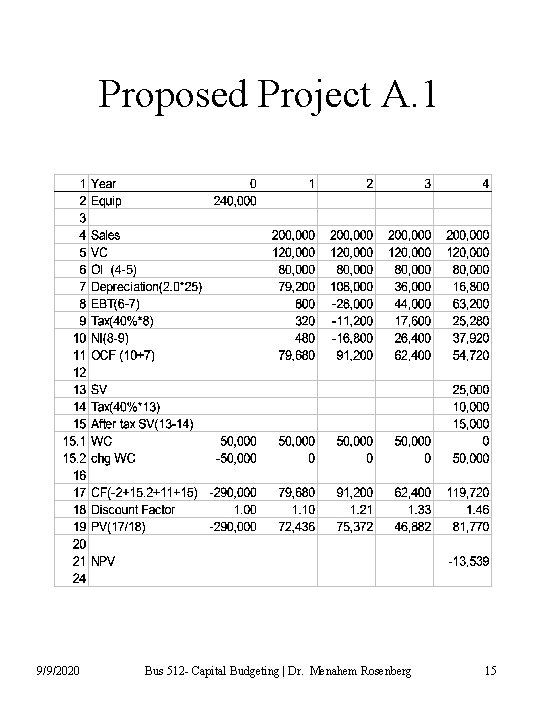
Proposed Project A • Capital equipment initial cost $240, 000, all depreciable. • Economic life = 4 years • Salvage value = 25, 000 • Depreciable using 3 year class MACRS. • Sales: 100, 000 units/year @ $2. • Variable cost = 60% of sales. • Tax rate = 40%. • Discount rate = 10%. 9/9/2020 Bus 512 - Capital Budgeting | Dr. Menahem Rosenberg 11
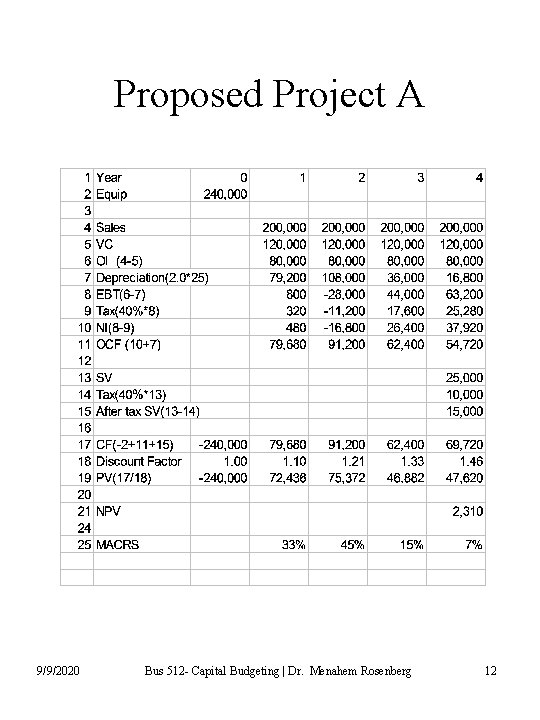
Proposed Project A 9/9/2020 Bus 512 - Capital Budgeting | Dr. Menahem Rosenberg 12
Working Capital & Cash Flows • Some cash flows do not occur on the income statement, but involve timing – working capital additions and reductions are cash flows – at the end of a project, the sum of the nominal changes in working capital is zero 9/9/2020 Bus 512 - Capital Budgeting | Dr. Menahem Rosenberg 13
Proposed Project A. 1 • Working Capital – The difference between current assets and current liabilities. • In capital budgeting Working capital is committed to the project and is fully recovered by the end of the project. • Project requires $50, 000 working capital in the initial year. The working capital is recovered when the project is terminated. 9/9/2020 Bus 512 - Capital Budgeting | Dr. Menahem Rosenberg 14
Proposed Project A. 1 9/9/2020 Bus 512 - Capital Budgeting | Dr. Menahem Rosenberg 15
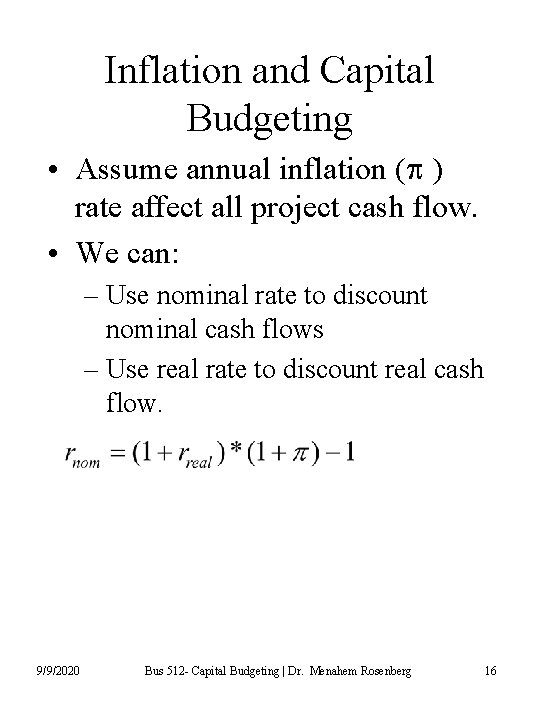
Inflation and Capital Budgeting • Assume annual inflation (p ) rate affect all project cash flow. • We can: – Use nominal rate to discount nominal cash flows – Use real rate to discount real cash flow. 9/9/2020 Bus 512 - Capital Budgeting | Dr. Menahem Rosenberg 16
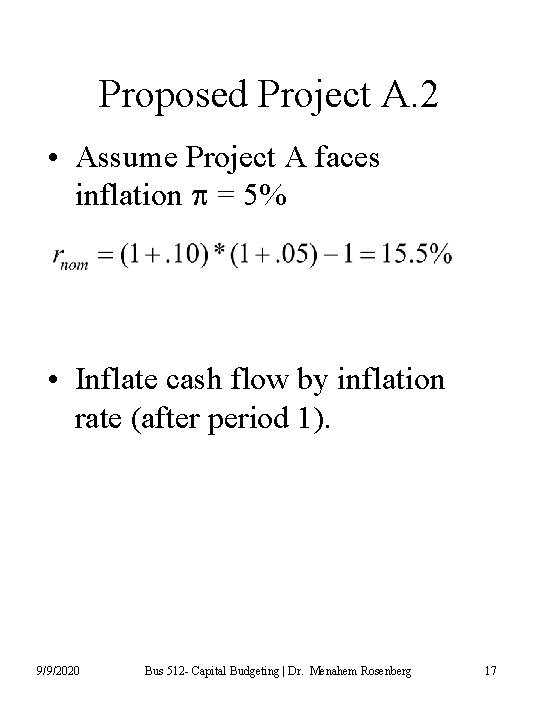
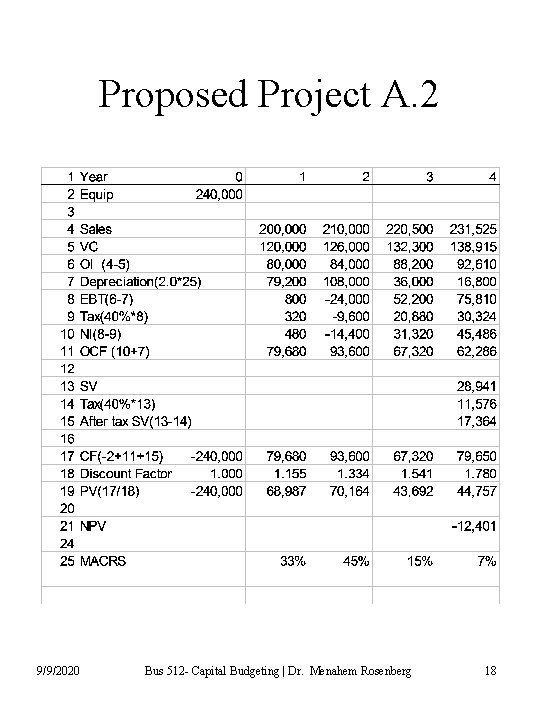
Proposed Project A. 2 • Assume Project A faces inflation p = 5% • Inflate cash flow by inflation rate (after period 1). 9/9/2020 Bus 512 - Capital Budgeting | Dr. Menahem Rosenberg 17
Proposed Project A. 2 9/9/2020 Bus 512 - Capital Budgeting | Dr. Menahem Rosenberg 18
Sensitivity Analysis • Will the project still be economical if some of the underlying variables are incorrect? – We can check the effect on the project of different variable and how sensitive is the project NPV to them – For Example: • Sales Units • Sales Price • Variable Cost • Life of the Project 9/9/2020 Bus 512 - Capital Budgeting | Dr. Menahem Rosenberg 19
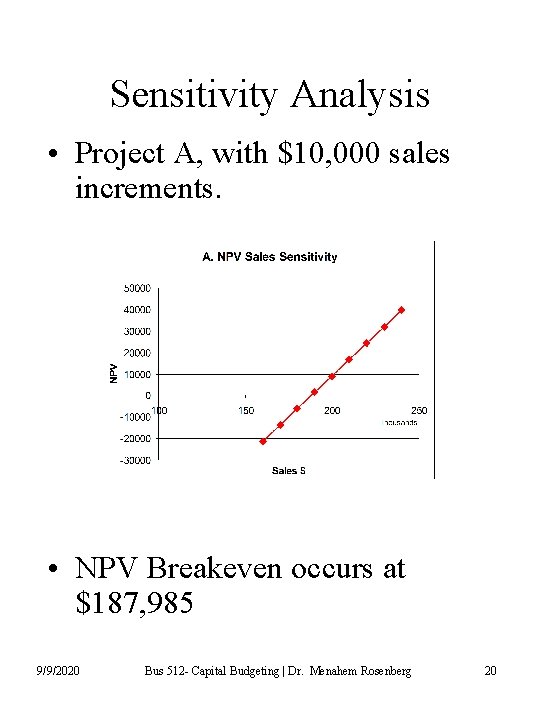
Sensitivity Analysis • Project A, with $10, 000 sales increments. • NPV Breakeven occurs at $187, 985 9/9/2020 Bus 512 - Capital Budgeting | Dr. Menahem Rosenberg 20
- Slides: 20