
Capital budeting decisions with the Net Present Value
Capital budeting decisions with the Net Present Value rule 1. Foundations Professor André Farber Solvay Business School University of Brussels, Belgium Hanoi April 2000 1
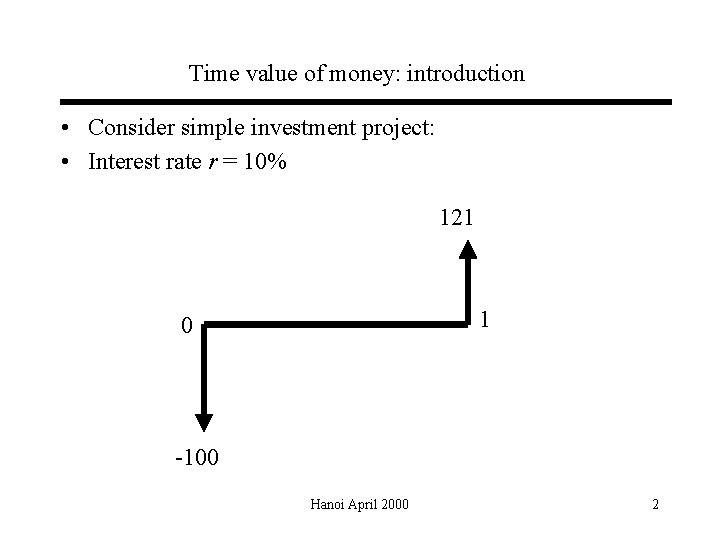
Time value of money: introduction • Consider simple investment project: • Interest rate r = 10% 121 1 0 -100 Hanoi April 2000 2
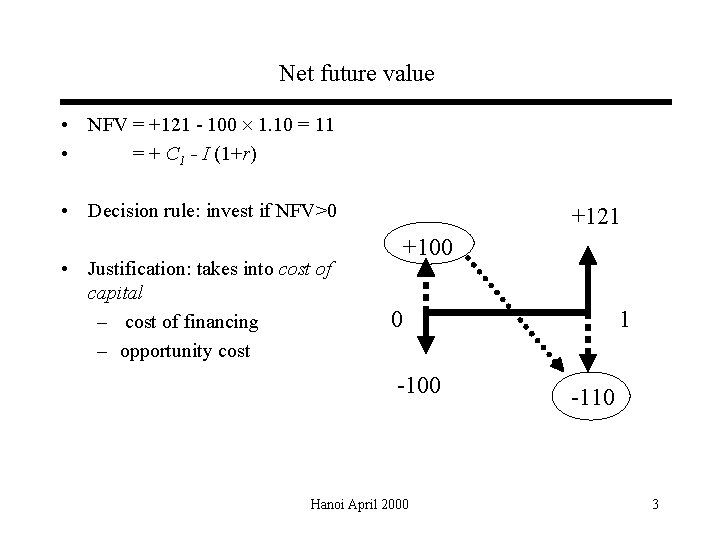
Net future value • NFV = +121 - 100 1. 10 = 11 • = + C 1 - I (1+r) • Decision rule: invest if NFV>0 • Justification: takes into cost of capital – cost of financing – opportunity cost +121 +100 0 -100 Hanoi April 2000 1 -110 3
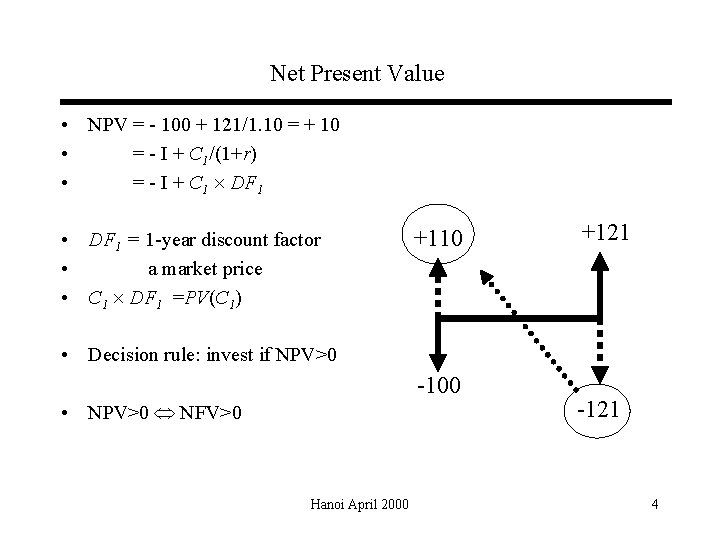
Net Present Value • NPV = - 100 + 121/1. 10 = + 10 • = - I + C 1/(1+r) • = - I + C 1 DF 1 • DF 1 = 1 -year discount factor • a market price • C 1 DF 1 =PV(C 1) +110 +121 • Decision rule: invest if NPV>0 -100 • NPV>0 NFV>0 Hanoi April 2000 -121 4
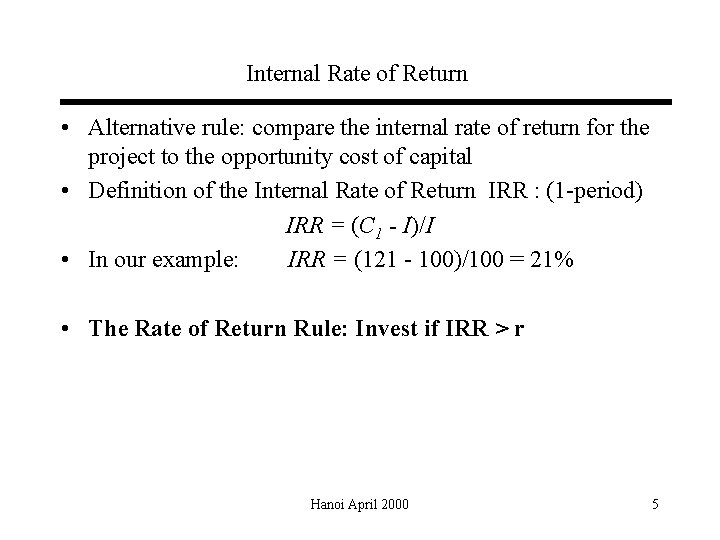
Internal Rate of Return • Alternative rule: compare the internal rate of return for the project to the opportunity cost of capital • Definition of the Internal Rate of Return IRR : (1 -period) IRR = (C 1 - I)/I • In our example: IRR = (121 - 100)/100 = 21% • The Rate of Return Rule: Invest if IRR > r Hanoi April 2000 5
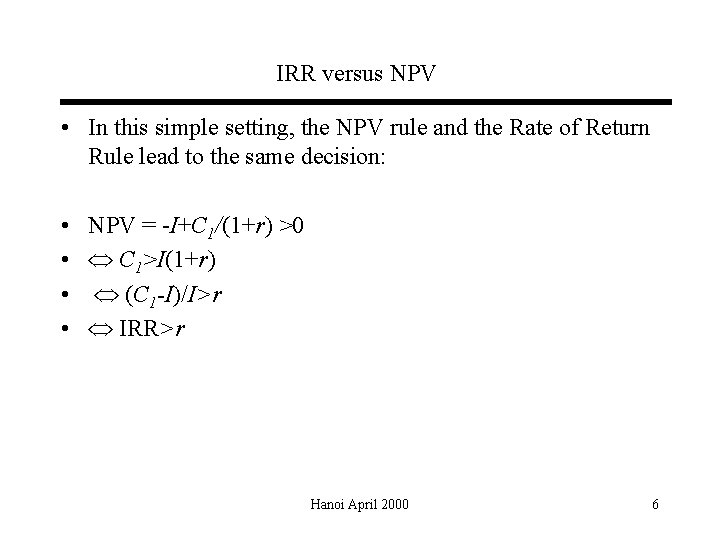
IRR versus NPV • In this simple setting, the NPV rule and the Rate of Return Rule lead to the same decision: • • NPV = -I+C 1/(1+r) >0 C 1>I(1+r) (C 1 -I)/I>r IRR>r Hanoi April 2000 6
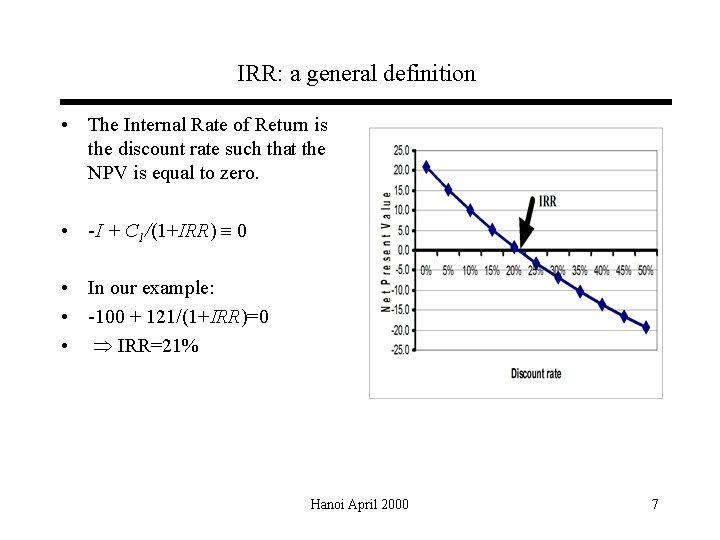
IRR: a general definition • The Internal Rate of Return is the discount rate such that the NPV is equal to zero. • -I + C 1/(1+IRR) 0 • In our example: • -100 + 121/(1+IRR)=0 • IRR=21% Hanoi April 2000 7
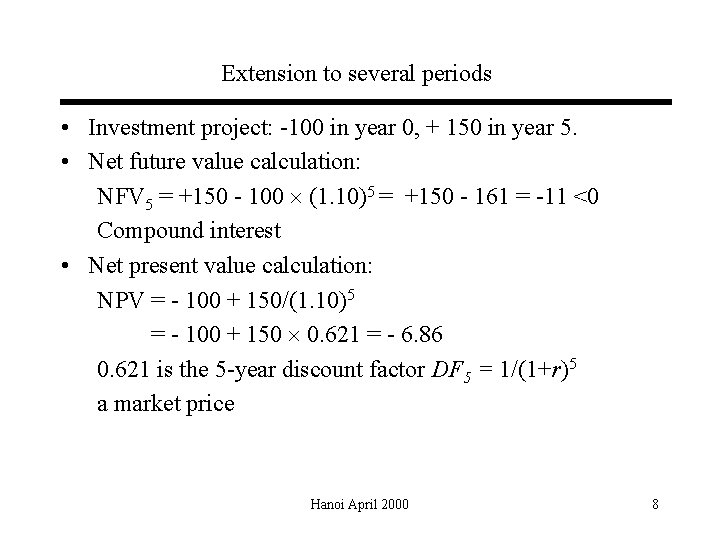
Extension to several periods • Investment project: -100 in year 0, + 150 in year 5. • Net future value calculation: NFV 5 = +150 - 100 (1. 10)5 = +150 - 161 = -11 <0 Compound interest • Net present value calculation: NPV = - 100 + 150/(1. 10)5 = - 100 + 150 0. 621 = - 6. 86 0. 621 is the 5 -year discount factor DF 5 = 1/(1+r)5 a market price Hanoi April 2000 8
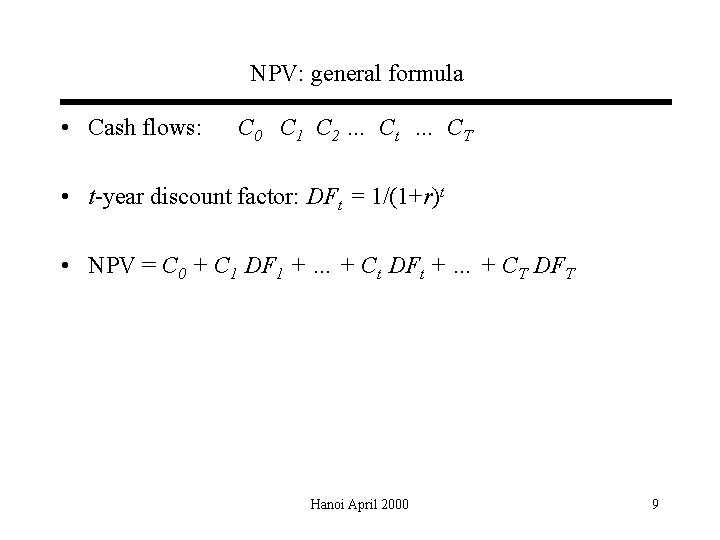
NPV: general formula • Cash flows: C 0 C 1 C 2 … Ct … CT • t-year discount factor: DFt = 1/(1+r)t • NPV = C 0 + C 1 DF 1 + … + Ct DFt + … + CT DFT Hanoi April 2000 9
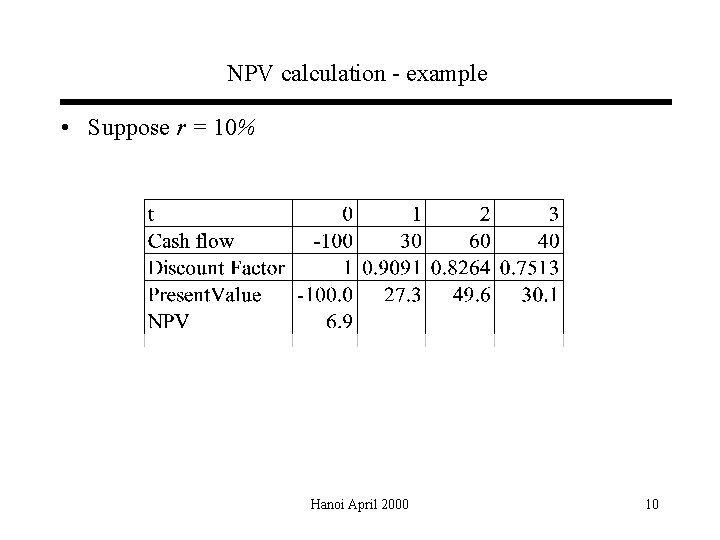
NPV calculation - example • Suppose r = 10% Hanoi April 2000 10
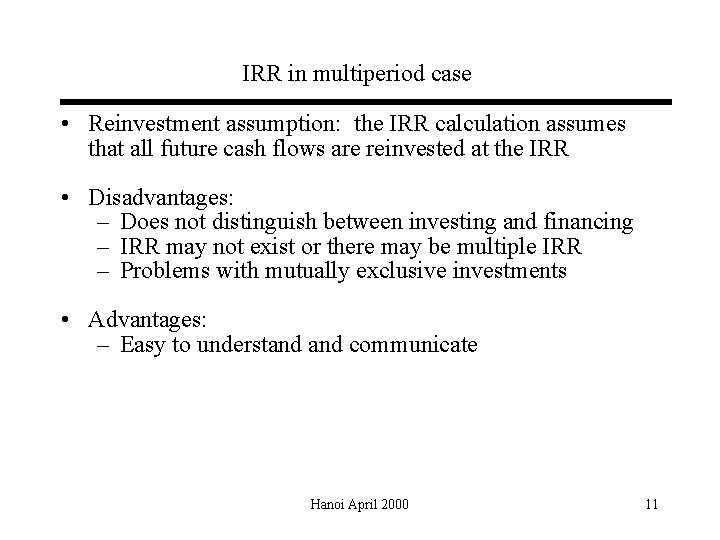
IRR in multiperiod case • Reinvestment assumption: the IRR calculation assumes that all future cash flows are reinvested at the IRR • Disadvantages: – Does not distinguish between investing and financing – IRR may not exist or there may be multiple IRR – Problems with mutually exclusive investments • Advantages: – Easy to understand communicate Hanoi April 2000 11
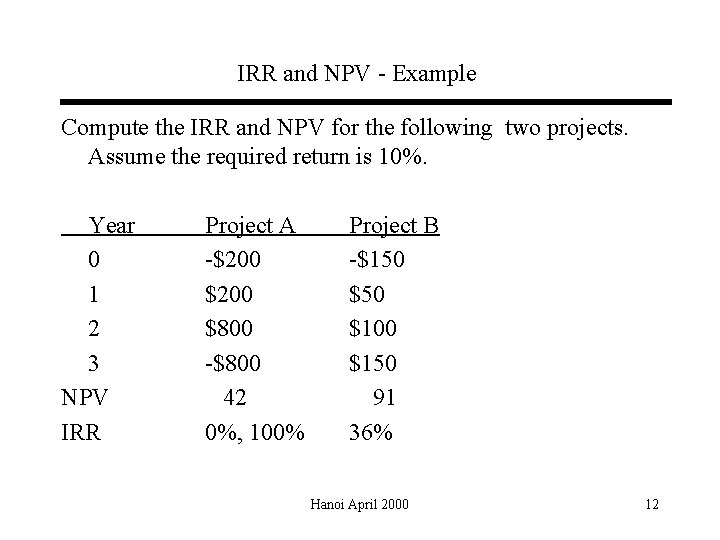
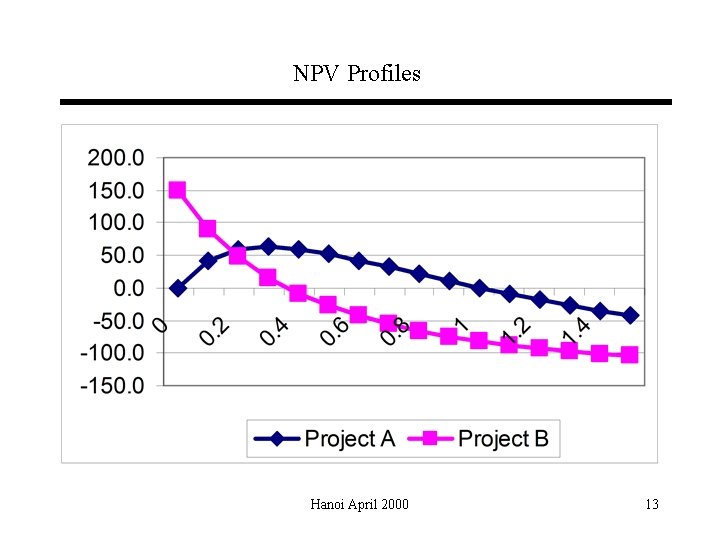
IRR and NPV - Example Compute the IRR and NPV for the following two projects. Assume the required return is 10%. Year 0 1 2 3 NPV IRR Project A -$200 $800 -$800 42 0%, 100% Project B -$150 $100 $150 91 36% Hanoi April 2000 12
NPV Profiles Hanoi April 2000 13
The Payback Period Rule • How long does it take the project to “pay back” its initial investment? • Payback Period = # of years to recover initial costs • Minimum Acceptance Criteria: set by management • Ranking Criteria: set by management Hanoi April 2000 14
The Payback Period Rule (continued) • Disadvantages: – – – Ignores the time value of money Ignores CF after payback period Biased against long-term projects Payback period may not exist or multiple payback periods Requires an arbitrary acceptance criteria A project accepted based on the payback criteria may not have a positive NPV • Advantages: – Easy to understand – Biased toward liquidity Hanoi April 2000 15
The Profitability Index (PI) Rule • • PI = Total Present Value of future CF’s / Initial Investment Minimum Acceptance Criteria: Accept if PI > 1 Ranking Criteria: Select alternative with highest PI Disadvantages: – Problems with mutually exclusive investments • Advantages: – May be useful when available investment funds are limited – Easy to understand communicate – Correct decision when evaluating independent projects Hanoi April 2000 16
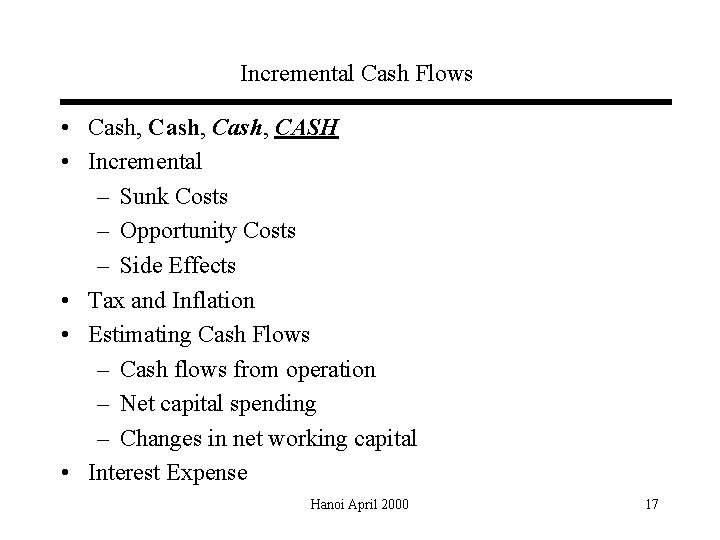
Incremental Cash Flows • Cash, CASH • Incremental – Sunk Costs – Opportunity Costs – Side Effects • Tax and Inflation • Estimating Cash Flows – Cash flows from operation – Net capital spending – Changes in net working capital • Interest Expense Hanoi April 2000 17
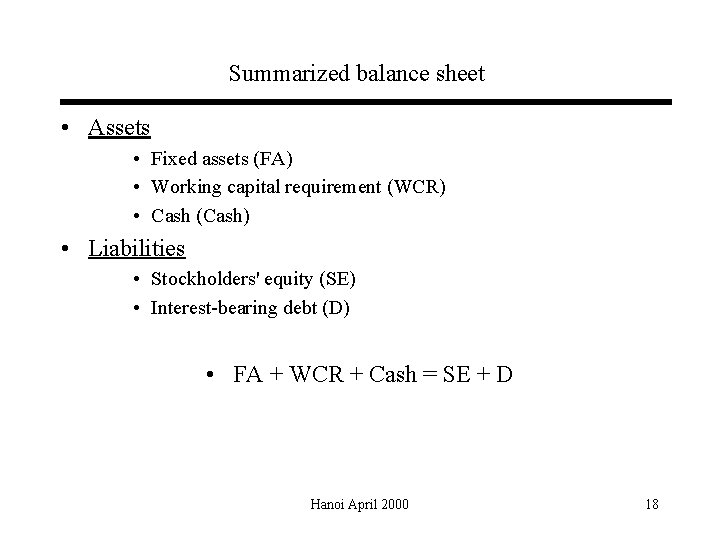
Summarized balance sheet • Assets • Fixed assets (FA) • Working capital requirement (WCR) • Cash (Cash) • Liabilities • Stockholders' equity (SE) • Interest-bearing debt (D) • FA + WCR + Cash = SE + D Hanoi April 2000 18
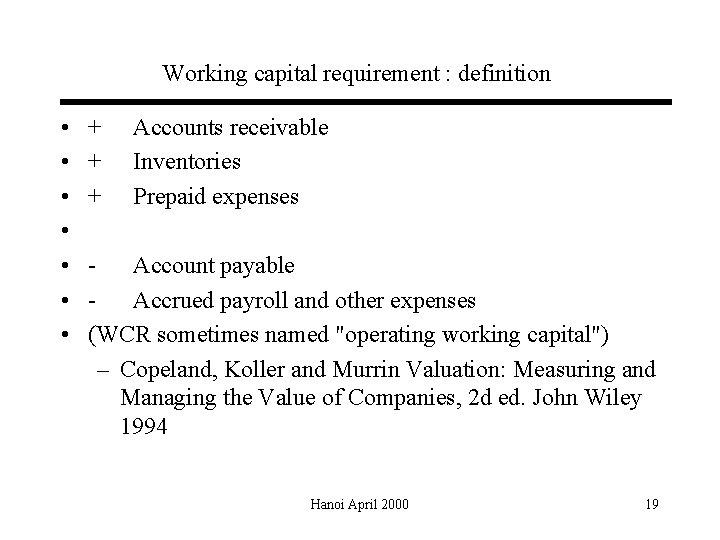
Working capital requirement : definition • • + + + Accounts receivable Inventories Prepaid expenses Account payable Accrued payroll and other expenses (WCR sometimes named "operating working capital") – Copeland, Koller and Murrin Valuation: Measuring and Managing the Value of Companies, 2 d ed. John Wiley 1994 Hanoi April 2000 19
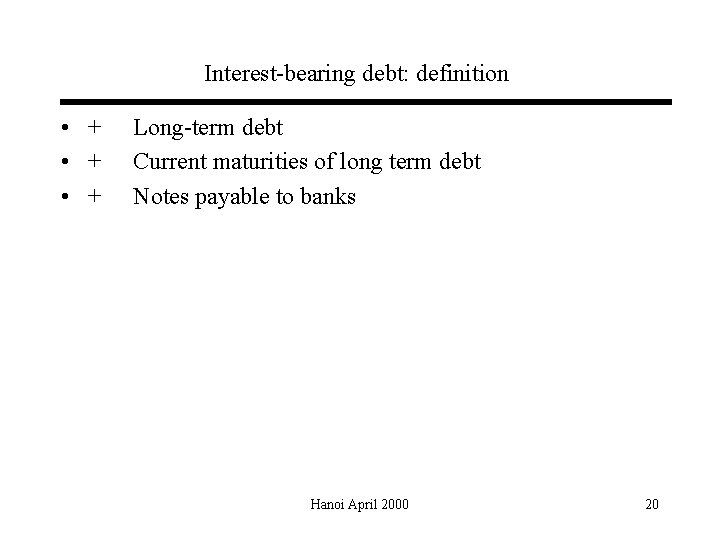
Interest-bearing debt: definition • + • + Long-term debt Current maturities of long term debt Notes payable to banks Hanoi April 2000 20
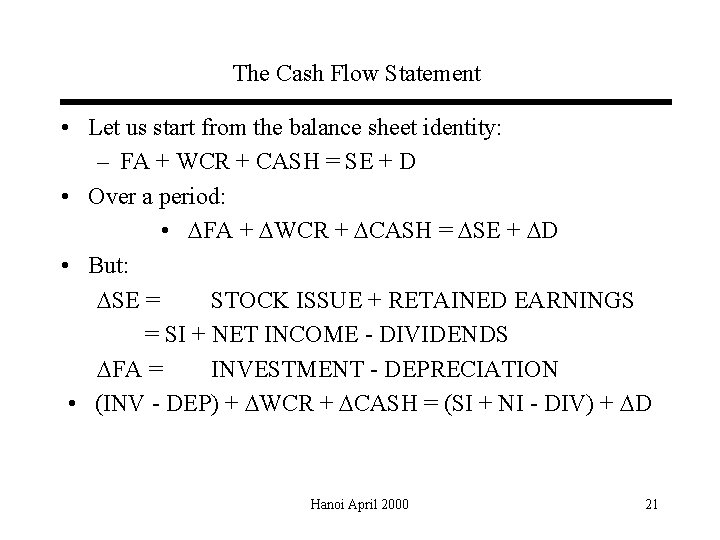
The Cash Flow Statement • Let us start from the balance sheet identity: – FA + WCR + CASH = SE + D • Over a period: • FA + WCR + CASH = SE + D • But: SE = STOCK ISSUE + RETAINED EARNINGS = SI + NET INCOME - DIVIDENDS FA = INVESTMENT - DEPRECIATION • (INV - DEP) + WCR + CASH = (SI + NI - DIV) + D Hanoi April 2000 21
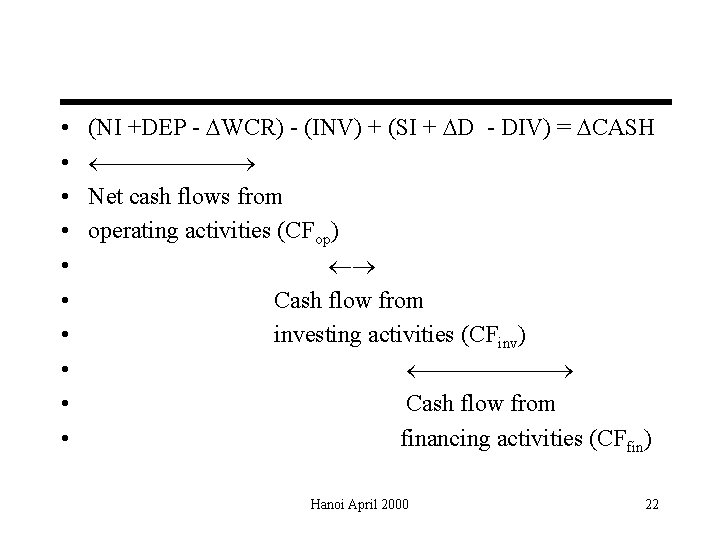
• • • (NI +DEP - WCR) - (INV) + (SI + D - DIV) = CASH Net cash flows from operating activities (CFop) Cash flow from investing activities (CFinv) Cash flow from financing activities (CFfin) Hanoi April 2000 22
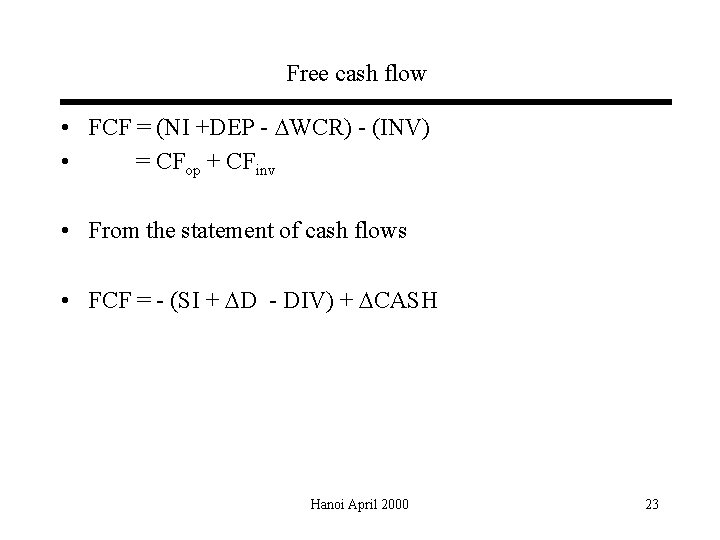
Free cash flow • FCF = (NI +DEP - WCR) - (INV) • = CFop + CFinv • From the statement of cash flows • FCF = - (SI + D - DIV) + CASH Hanoi April 2000 23
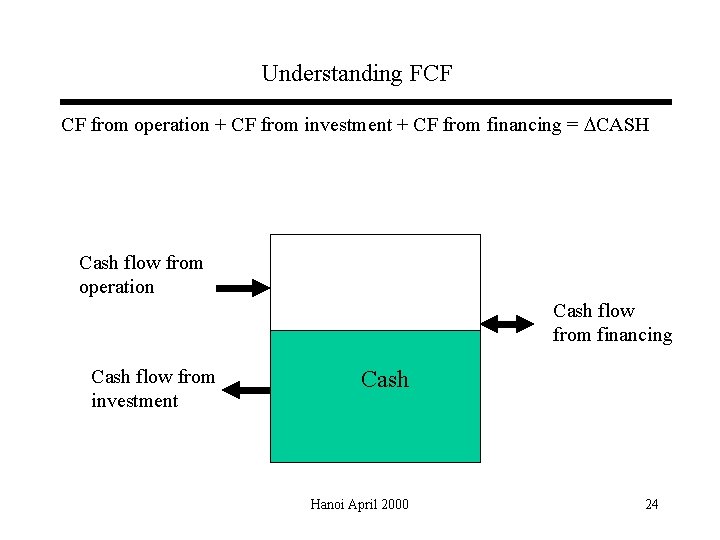
Understanding FCF CF from operation + CF from investment + CF from financing = CASH Cash flow from operation Cash flow from financing Cash flow from investment Cash Hanoi April 2000 24
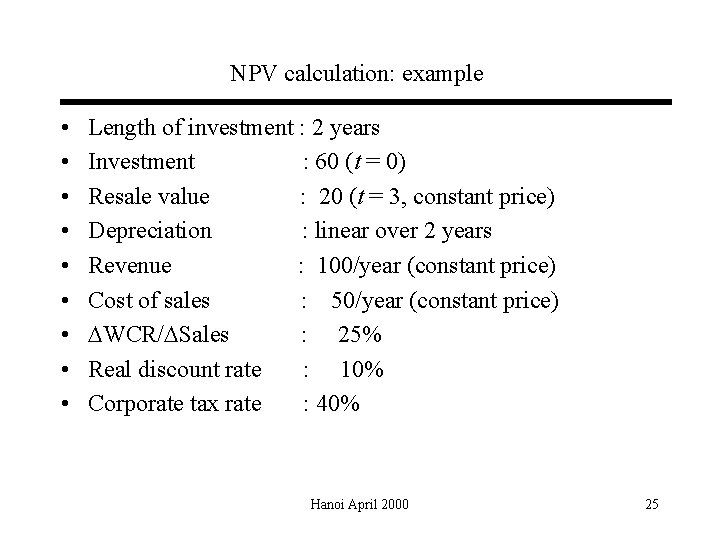
NPV calculation: example • • • Length of investment : 2 years Investment : 60 (t = 0) Resale value : 20 (t = 3, constant price) Depreciation : linear over 2 years Revenue : 100/year (constant price) Cost of sales : 50/year (constant price) WCR/ Sales : 25% Real discount rate : 10% Corporate tax rate : 40% Hanoi April 2000 25
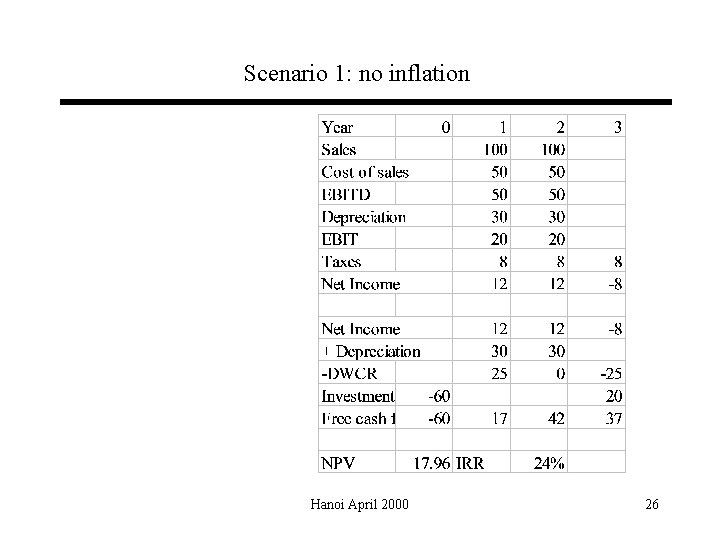
Scenario 1: no inflation Hanoi April 2000 26
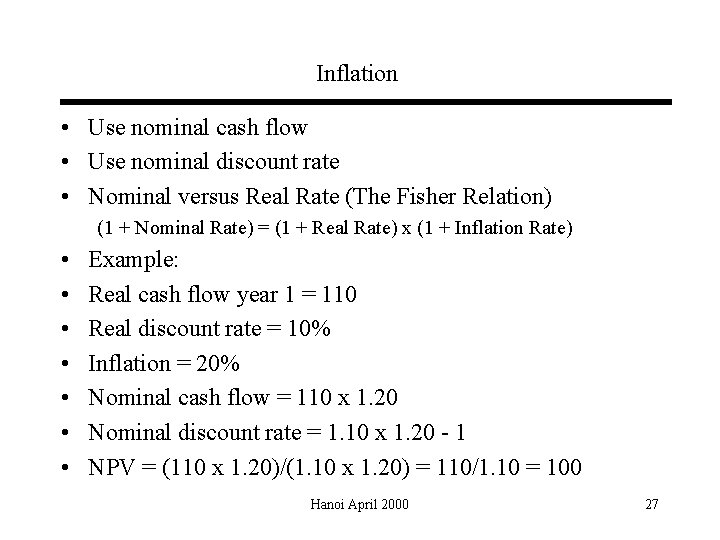
Inflation • Use nominal cash flow • Use nominal discount rate • Nominal versus Real Rate (The Fisher Relation) (1 + Nominal Rate) = (1 + Real Rate) x (1 + Inflation Rate) • • Example: Real cash flow year 1 = 110 Real discount rate = 10% Inflation = 20% Nominal cash flow = 110 x 1. 20 Nominal discount rate = 1. 10 x 1. 20 - 1 NPV = (110 x 1. 20)/(1. 10 x 1. 20) = 110/1. 10 = 100 Hanoi April 2000 27
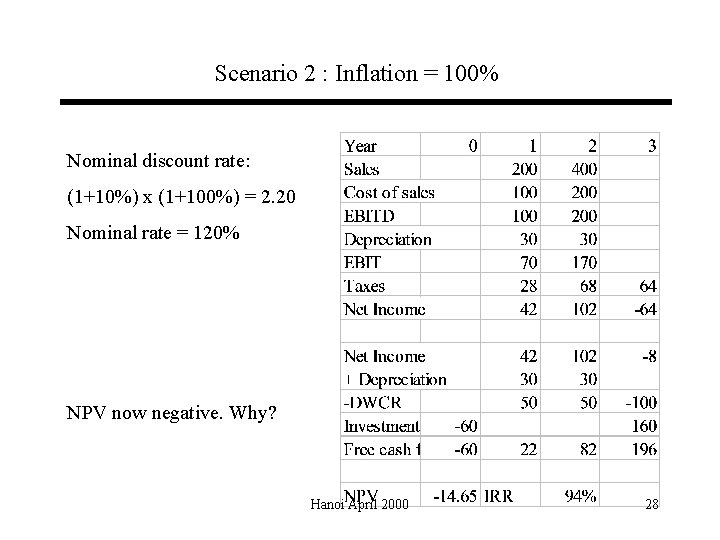
Scenario 2 : Inflation = 100% Nominal discount rate: (1+10%) x (1+100%) = 2. 20 Nominal rate = 120% NPV now negative. Why? Hanoi April 2000 28
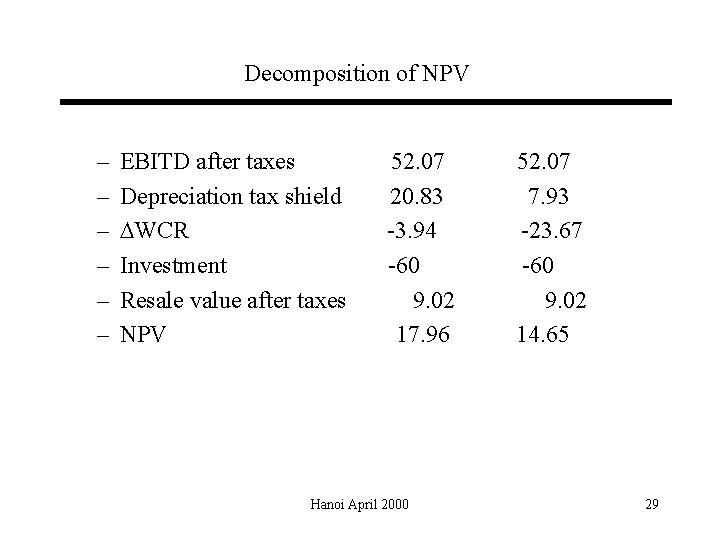
Decomposition of NPV – – – EBITD after taxes Depreciation tax shield WCR Investment Resale value after taxes NPV 52. 07 20. 83 -3. 94 -60 9. 02 17. 96 Hanoi April 2000 52. 07 7. 93 -23. 67 -60 9. 02 14. 65 29
- Slides: 29