
Capital Asset Pricing Model CAPM Using Beta as
Capital Asset Pricing Model (CAPM) Using Beta as a Measure of Risk
MODEL The Capital Asset Pricing Model (CAPM) is used to compute returns on a common stock.
The CAPM model was developed in the 1960’s largely by William Sharpe. MODEL This model uses statistical analysis to relate the risk of an individual stock to its expected return.
MODEL In CAPM, investors must be compensated for the time value of money and the risk of undertaking the investment.
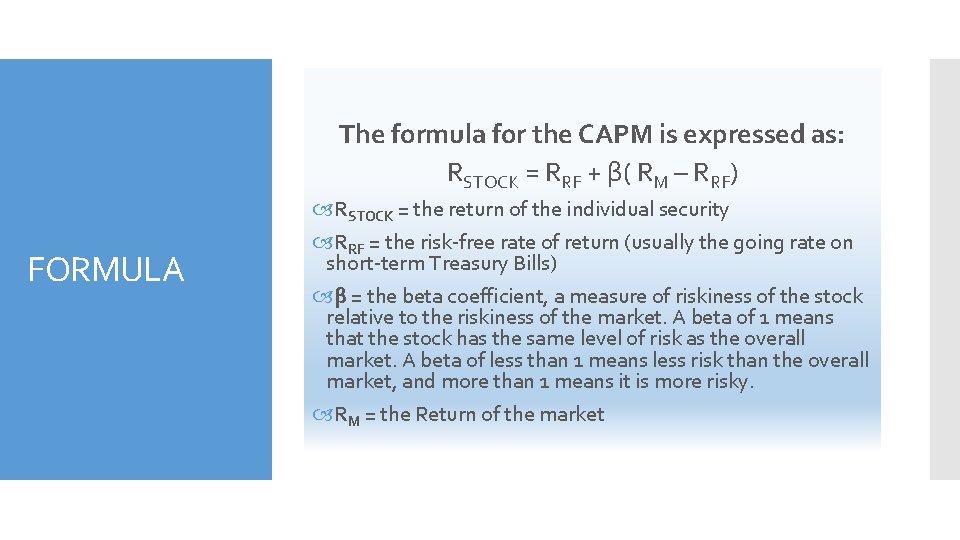
The formula for the CAPM is expressed as: RSTOCK = RRF + β( RM – RRF) FORMULA RSTOCK = the return of the individual security RRF = the risk-free rate of return (usually the going rate on short-term Treasury Bills) β = the beta coefficient, a measure of riskiness of the stock relative to the riskiness of the market. A beta of 1 means that the stock has the same level of risk as the overall market. A beta of less than 1 means less risk than the overall market, and more than 1 means it is more risky. RM = the Return of the market

IBM Corporation EXAMPLE
Using this model we can compute the required return for IBM stock if we know a few things: 1. The going rate on short-term Treasury Bills. This approximates the risk-free rate. IBM Corporation EXAMPLE 2. The rate of return for the S&P 500. This is traditionally used to approximate the return of the market. 3. The beta coefficient of the stock. This can be computed using the historical rates of return for the individual stock and the historical rates of return for the market using a regression analysis. Or, you can look it up on Yahoo. Finance. com.
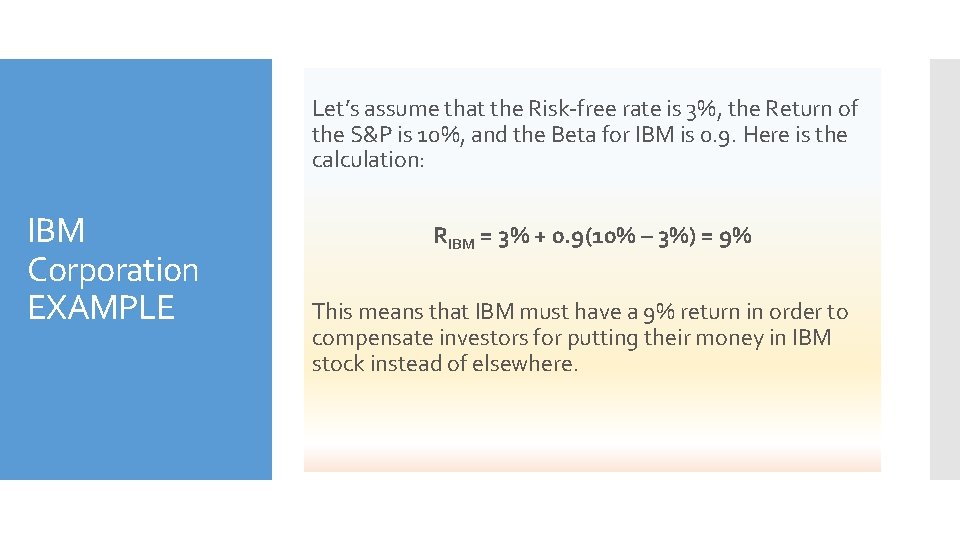
Let’s assume that the Risk-free rate is 3%, the Return of the S&P is 10%, and the Beta for IBM is 0. 9. Here is the calculation: IBM Corporation EXAMPLE RIBM = 3% + 0. 9(10% – 3%) = 9% This means that IBM must have a 9% return in order to compensate investors for putting their money in IBM stock instead of elsewhere.
- Slides: 8