
Capital and Interest An Explanation of Interest Rates
- Slides: 30
Capital and Interest An Explanation of Interest Rates € £ $ Understanding Economics, © Richard Delaney, 2008, Edco ¥
Capital and Interest 2 Essential Features of Capital 1. Capital makes labour more productive 2. Creation of capital causes an opportunity cost - consumer goods v capital goods 3. Savers provide funds for those wishing to invest € £ $ Understanding Economics, © Richard Delaney, 2008, Edco ¥
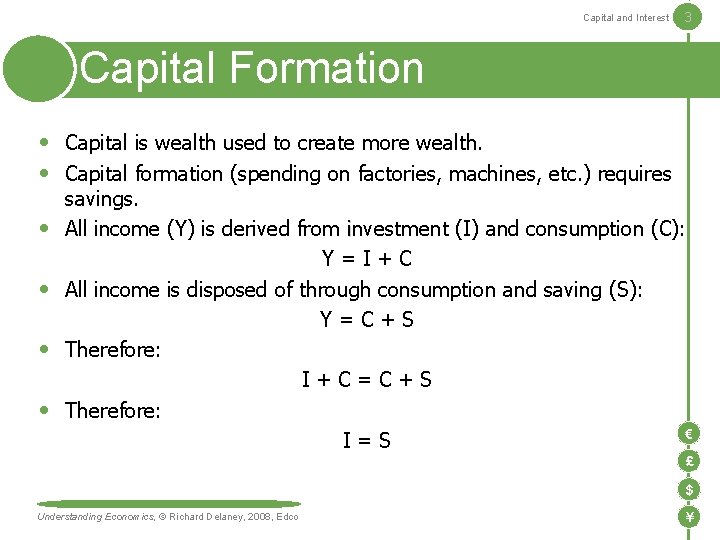
Capital and Interest 3 Capital Formation Capital is wealth used to create more wealth. Capital formation (spending on factories, machines, etc. ) requires savings. All income (Y) is derived from investment (I) and consumption (C): Y=I+C All income is disposed of through consumption and saving (S): Y=C+S Therefore: I+C=C+S Therefore: € I=S £ $ Understanding Economics, © Richard Delaney, 2008, Edco ¥
Capital and Interest 4 Capital and Savings This means that the maximum level of investment is dependent on the level of saving. Therefore, people must refrain from spending some of their income so that money will be available for investment. The reward for saving is interest € £ $ Understanding Economics, © Richard Delaney, 2008, Edco ¥
Capital and Interest 5 The Reasons People Save To purchase some expensive item in the future. For thrift purposes. To earn interest. For precautionary purposes. To provide for retirement. € £ $ Understanding Economics, © Richard Delaney, 2008, Edco ¥
Capital and Interest 6 Factors that Affect the Level of Saving The level of income. The rate of interest. The level of social welfare benefits, particularly old aged pensions. The level of tax on interest on savings. The rate of inflation (may result in negative interest rates). € £ $ Understanding Economics, © Richard Delaney, 2008, Edco ¥
Capital and Interest 7 Theories on Interest Rates There are two theories on interest rates: 1. The Loanable Funds Theory (The Classical Theory) 2. The Liquidity Preference Theory (The Keynesian Theory) € £ $ Understanding Economics, © Richard Delaney, 2008, Edco ¥
Capital and Interest 8 The Loanable Funds Theory This states that the rate of interest is determined by the interaction of the supply of and the demand for money. Here the supply means the amount of money being saved with the financial institutions. The demand means the demand for loans from the financial institutions. € £ $ Understanding Economics, © Richard Delaney, 2008, Edco ¥
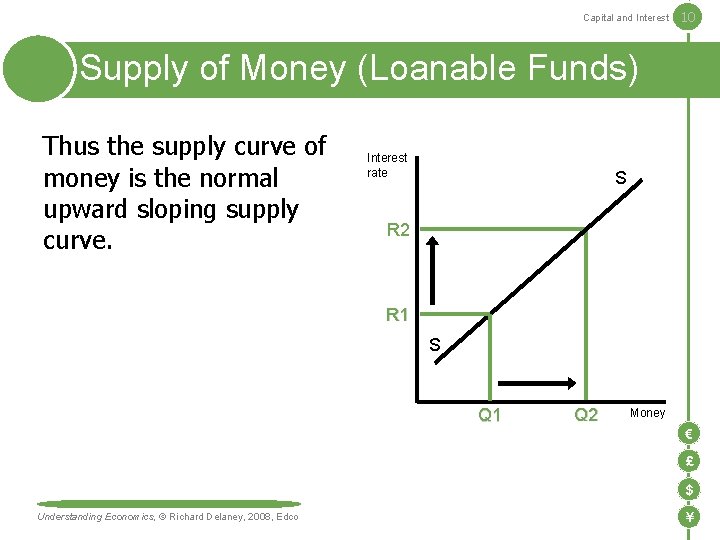
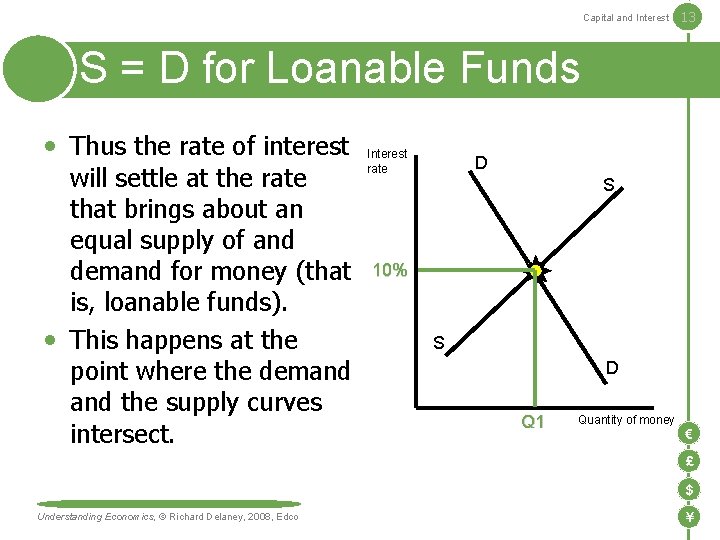
Capital and Interest 9 Supply of Money (Loanable Funds) This theory states that if the supply of savings (money) into the financial institutions is not sufficient to meet the demand for loans, then the banks will increase interest rates to attract more savings and vice versa. € £ $ Understanding Economics, © Richard Delaney, 2008, Edco ¥
Capital and Interest 10 Supply of Money (Loanable Funds) Thus the supply curve of money is the normal upward sloping supply curve. Interest rate S R 2 R 1 S Q 1 Q 2 Money € £ $ Understanding Economics, © Richard Delaney, 2008, Edco ¥
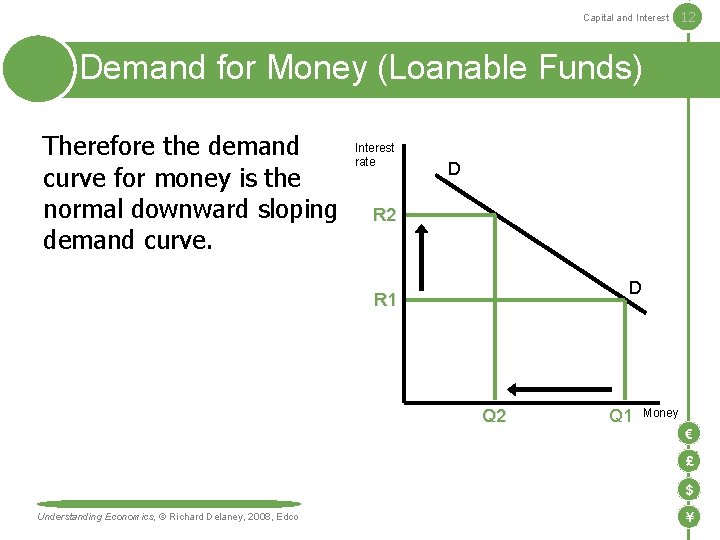
Capital and Interest 11 Demand for Money (Loanable Funds) This theory states that the demand for loans decreases as the rate of interest increases. This happens because when interest rates increase the price – that is, the cost – of borrowing increases. It also assumes that the demand for loans will increase when interest rates decrease as the price – that is, the cost – of borrowing goes down. € £ $ Understanding Economics, © Richard Delaney, 2008, Edco ¥
Capital and Interest 12 Demand for Money (Loanable Funds) Therefore the demand curve for money is the normal downward sloping demand curve. Interest rate D R 2 D R 1 Q 2 Q 1 Money € £ $ Understanding Economics, © Richard Delaney, 2008, Edco ¥
Capital and Interest 13 S = D for Loanable Funds Thus the rate of interest will settle at the rate that brings about an equal supply of and demand for money (that is, loanable funds). This happens at the point where the demand the supply curves intersect. Interest rate D S 10% S D Q 1 Quantity of money € £ $ Understanding Economics, © Richard Delaney, 2008, Edco ¥
Capital and Interest 14 Criticism of the Loanable Funds Theory 1. It assumes that savings will automatically increase as interest rates increase. – This is not always true as people can only save if their income is big enough to allow them to do so. 2. It assumes that savings will automatically decrease as interest rates decrease. – This is not always the case as interest is not the only factor to influence savings. € £ $ Understanding Economics, © Richard Delaney, 2008, Edco ¥
Capital and Interest 15 Liquidity Preference Theory of Interest Rates This states that the rate of interest is determined by the interaction of the supply of and the demand for money. The demand for money means the reasons people want to hold on to money rather than make it available for investment. The supply of money refers to the amount of money in circulation. € £ $ Understanding Economics, © Richard Delaney, 2008, Edco ¥
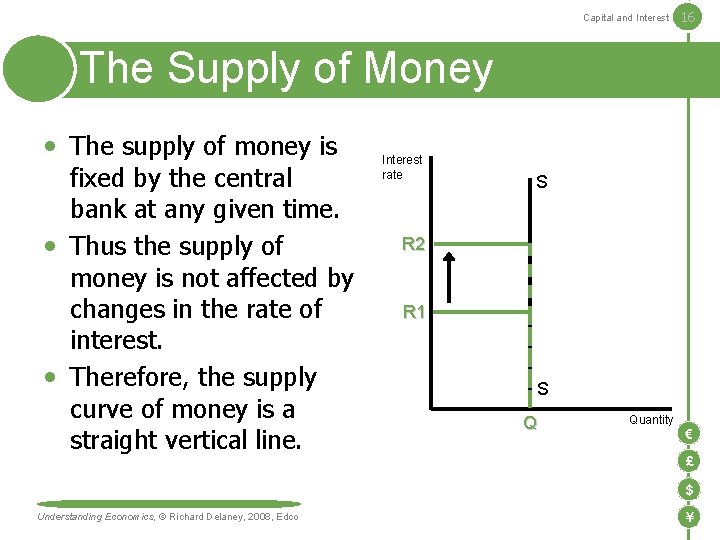
Capital and Interest 16 The Supply of Money The supply of money is fixed by the central bank at any given time. Thus the supply of money is not affected by changes in the rate of interest. Therefore, the supply curve of money is a straight vertical line. Interest rate S R 2 R 1 S Q Quantity € £ $ Understanding Economics, © Richard Delaney, 2008, Edco ¥
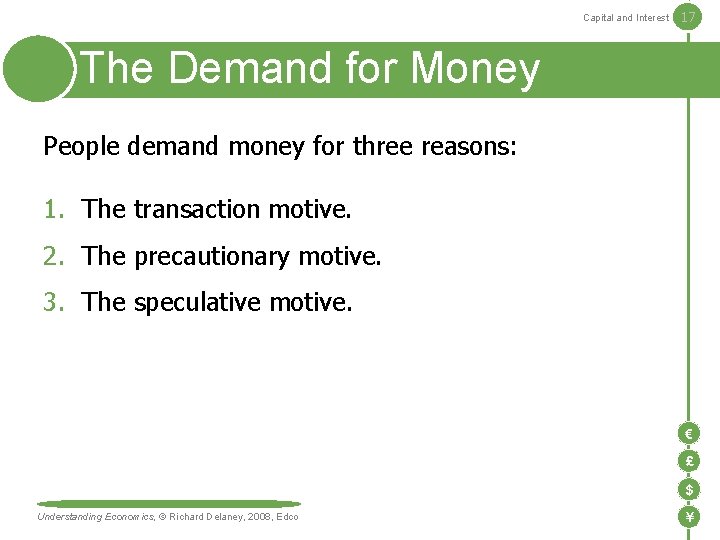
Capital and Interest 17 The Demand for Money People demand money for three reasons: 1. The transaction motive. 2. The precautionary motive. 3. The speculative motive. € £ $ Understanding Economics, © Richard Delaney, 2008, Edco ¥
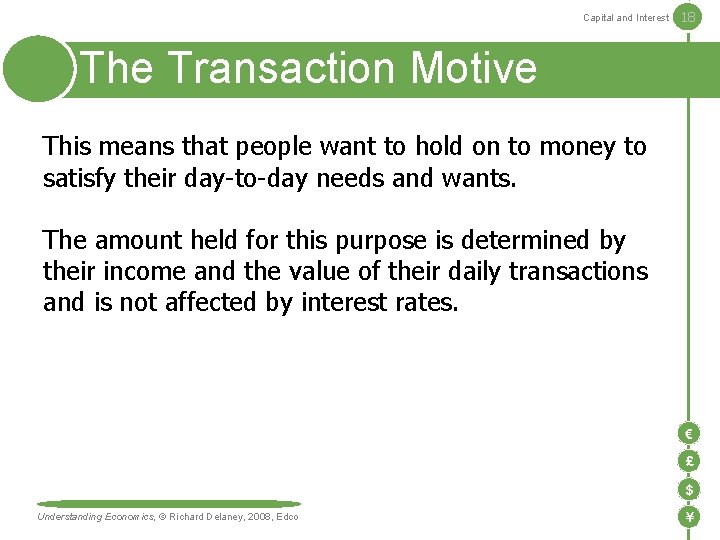
Capital and Interest 18 The Transaction Motive This means that people want to hold on to money to satisfy their day-to-day needs and wants. The amount held for this purpose is determined by their income and the value of their daily transactions and is not affected by interest rates. € £ $ Understanding Economics, © Richard Delaney, 2008, Edco ¥
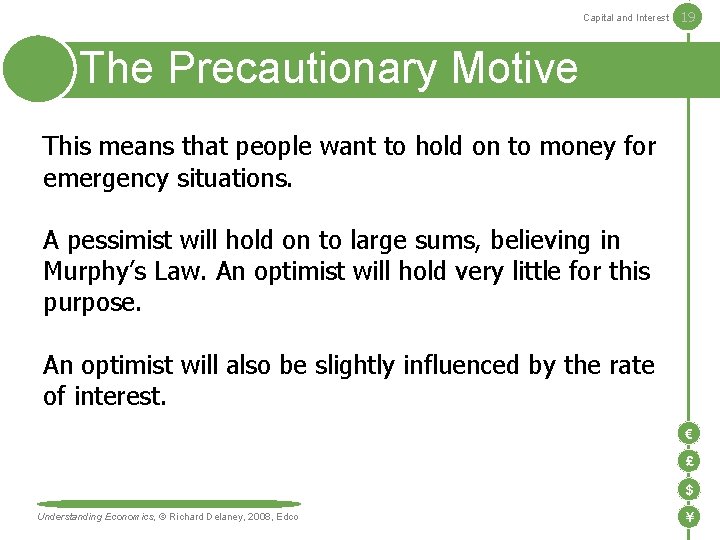
Capital and Interest 19 The Precautionary Motive This means that people want to hold on to money for emergency situations. A pessimist will hold on to large sums, believing in Murphy’s Law. An optimist will hold very little for this purpose. An optimist will also be slightly influenced by the rate of interest. € £ $ Understanding Economics, © Richard Delaney, 2008, Edco ¥
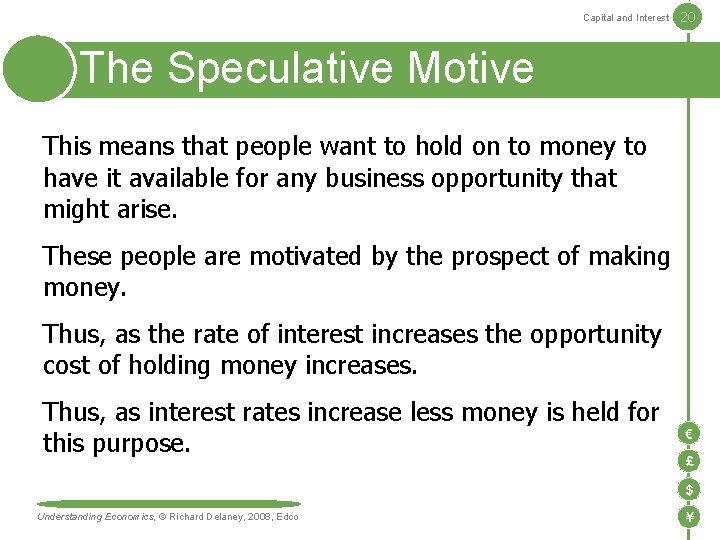
Capital and Interest 20 The Speculative Motive This means that people want to hold on to money to have it available for any business opportunity that might arise. These people are motivated by the prospect of making money. Thus, as the rate of interest increases the opportunity cost of holding money increases. Thus, as interest rates increase less money is held for this purpose. € £ $ Understanding Economics, © Richard Delaney, 2008, Edco ¥
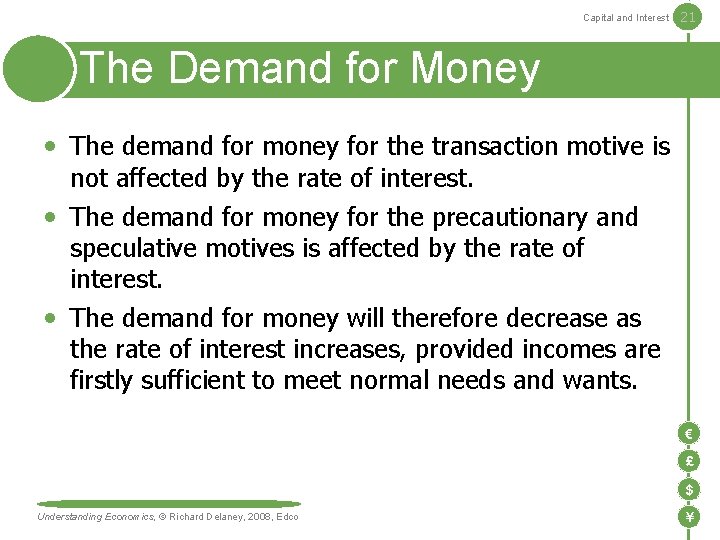
Capital and Interest 21 The Demand for Money The demand for money for the transaction motive is not affected by the rate of interest. The demand for money for the precautionary and speculative motives is affected by the rate of interest. The demand for money will therefore decrease as the rate of interest increases, provided incomes are firstly sufficient to meet normal needs and wants. € £ $ Understanding Economics, © Richard Delaney, 2008, Edco ¥
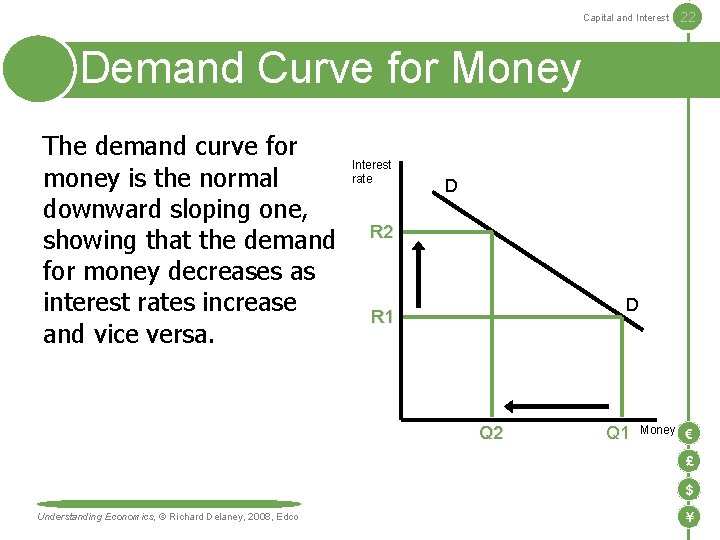
Capital and Interest 22 Demand Curve for Money The demand curve for money is the normal downward sloping one, showing that the demand for money decreases as interest rates increase and vice versa. Interest rate D R 2 D R 1 Q 2 Q 1 Money € £ $ Understanding Economics, © Richard Delaney, 2008, Edco ¥
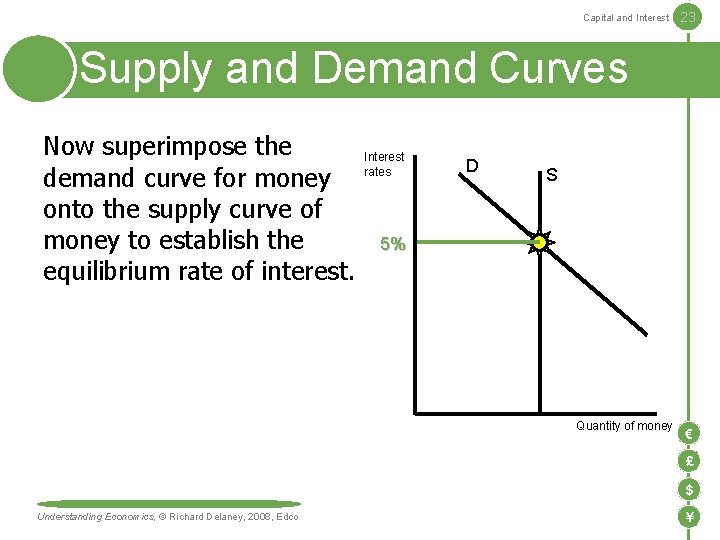
Capital and Interest 23 Supply and Demand Curves Now superimpose the demand curve for money onto the supply curve of money to establish the equilibrium rate of interest. Interest rates D S 5% Quantity of money € £ $ Understanding Economics, © Richard Delaney, 2008, Edco ¥
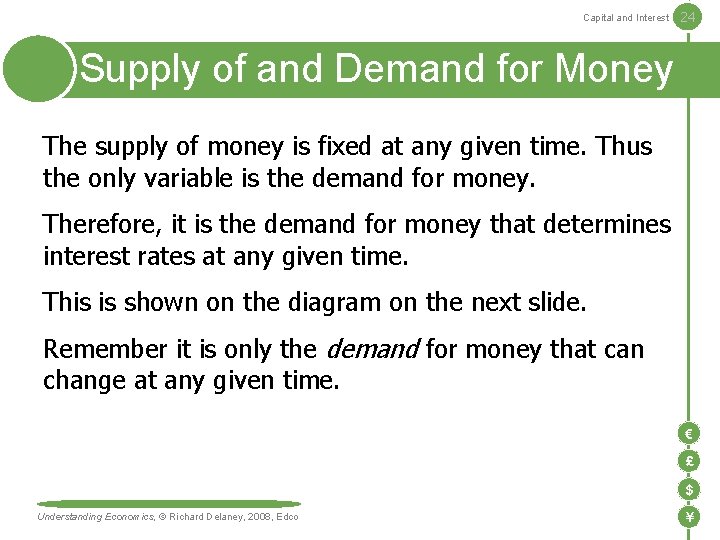
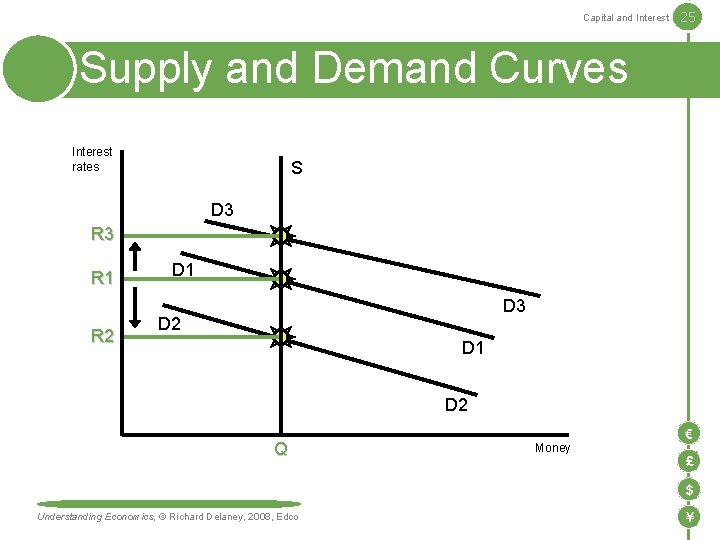
Capital and Interest 24 Supply of and Demand for Money The supply of money is fixed at any given time. Thus the only variable is the demand for money. Therefore, it is the demand for money that determines interest rates at any given time. This is shown on the diagram on the next slide. Remember it is only the demand for money that can change at any given time. € £ $ Understanding Economics, © Richard Delaney, 2008, Edco ¥
Capital and Interest 25 Supply and Demand Curves Interest rates S D 3 R 1 R 2 D 1 D 3 D 2 D 1 D 2 Q Money € £ $ Understanding Economics, © Richard Delaney, 2008, Edco ¥
Capital and Interest 26 Other Factors Affecting Rate of Interest These are in addition to the loanable funds theory and the liquidity preference theory. The European Central Bank The short-term facility rate The degree of risk to the lender The degree of liquidity of the loan The rate of inflation The demand for loans € £ $ Understanding Economics, © Richard Delaney, 2008, Edco ¥
Capital and Interest 27 Factors Influencing Level of Investment Entrepreneurs’ expectations about future profits. The rate of interest. The cost of capital goods. Government policy. The state of technology. The domestic economic climate. The international economic climate. € £ $ Understanding Economics, © Richard Delaney, 2008, Edco ¥
Capital and Interest 28 Capital and Investment Importance of Investment in the Economy Investment has a multiplier effect on incomes. Investment increases the productive capacity of the country. Investment increases the productive capacity of labour. Investment increases employment. Investment creates increased government revenue. € £ $ Understanding Economics, © Richard Delaney, 2008, Edco ¥
Capital and Interest 29 How Government Can Influence Level of Investment Government can influence the level of investment by: giving grants to firms, or taking equity in firms reducing company profit taxes reducing capital gains tax improving the infrastructure allowing depreciation to be written off investments over a shorter period of time. € £ $ Understanding Economics, © Richard Delaney, 2008, Edco ¥
Capital and Interest 30 € £ $ Understanding Economics, © Richard Delaney, 2008, Edco ¥