
Capital Adequacy Standards and The Role of Bank
Capital Adequacy Standards and The Role of Bank Capital Kevin Davis Commonwealth Bank Chair of Finance, University of Melbourne Director, The Melbourne Centre for Financial Studies www. melbournecentre. com. au kevin. davis@melbournecentre. com. au November 2008
Outline • • What is capital, what role does it play? How is capital measured? How much capital is desirable? How does capital influence bank behaviour? 2
Bank Capital: Alternative Perspectives • For the Owner – Wealth tied up (measured as share market value) – Require adequate return as risk compensation – Provides control • For Customers/Counterparties and Regulator – Buffer to absorb risk • providers of capital rank below liabilities to customers • buffer could consist of equity / subordinated debt / guarantees 3
Bank Capital: Alternative Perspectives • For the Bank Manager – Funds provided to operate business (accounting value) • But must manage “to” stock market value – Return on capital achieved is performance measure – “Capital risk” is a risk to manage • meeting regulatory capital requirements • having adequate capital to get desired rating (AA etc) from ratings agencies • being able to pursue attractive expansion opportunities 4
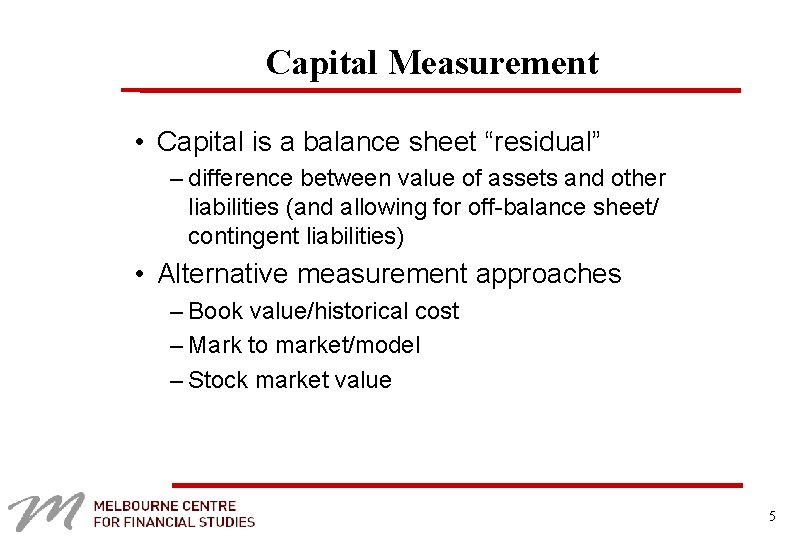
Capital Measurement • Capital is a balance sheet “residual” – difference between value of assets and other liabilities (and allowing for off-balance sheet/ contingent liabilities) • Alternative measurement approaches – Book value/historical cost – Mark to market/model – Stock market value 5
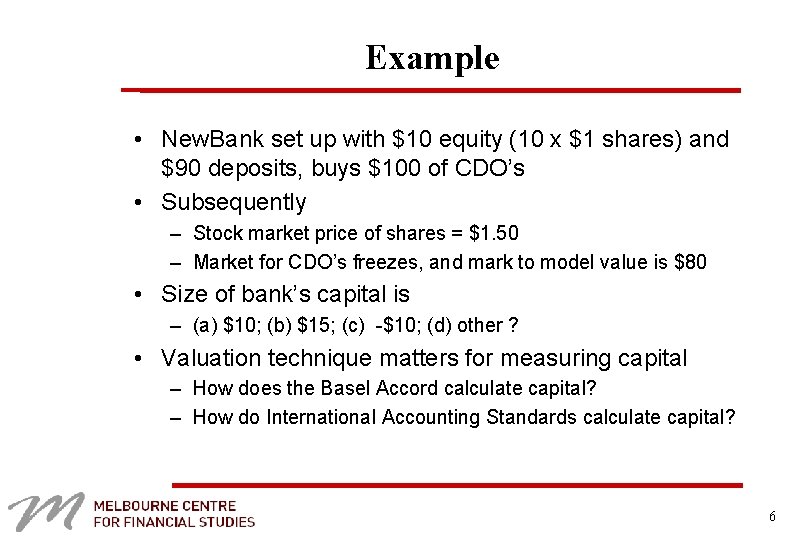
Example • New. Bank set up with $10 equity (10 x $1 shares) and $90 deposits, buys $100 of CDO’s • Subsequently – Stock market price of shares = $1. 50 – Market for CDO’s freezes, and mark to model value is $80 • Size of bank’s capital is – (a) $10; (b) $15; (c) -$10; (d) other ? • Valuation technique matters for measuring capital – How does the Basel Accord calculate capital? – How do International Accounting Standards calculate capital? 6
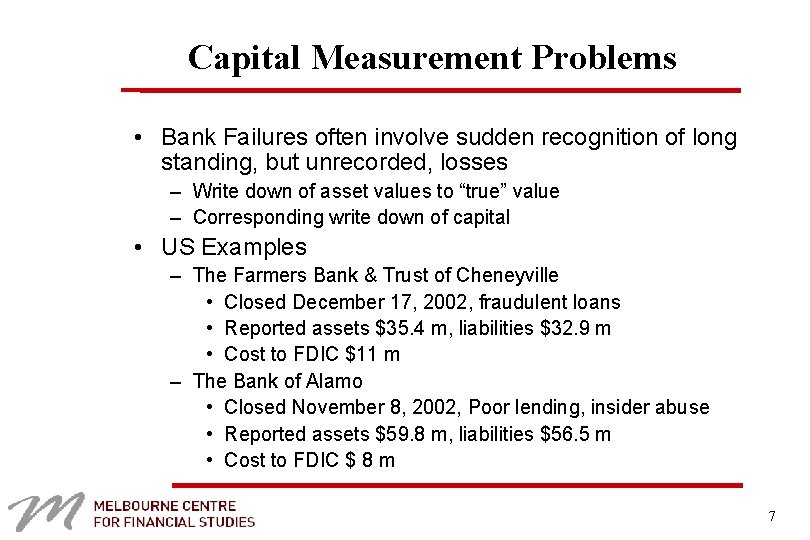
Capital Measurement Problems • Bank Failures often involve sudden recognition of long standing, but unrecorded, losses – Write down of asset values to “true” value – Corresponding write down of capital • US Examples – The Farmers Bank & Trust of Cheneyville • Closed December 17, 2002, fraudulent loans • Reported assets $35. 4 m, liabilities $32. 9 m • Cost to FDIC $11 m – The Bank of Alamo • Closed November 8, 2002, Poor lending, insider abuse • Reported assets $59. 8 m, liabilities $56. 5 m • Cost to FDIC $ 8 m 7

How Much Capital? • Regulatory Capital requirements: one or both of – Minimum Capital/Assets (leverage / gearing) – Minimum Capital/(Risk Weighted Assets) – Basel • Relate capital required to riskiness of activities • May allow some non-equity liabilities as capital – Rank behind, and provide protection to, depositors • Measurement by a mix of book and mtm value 8

How Much Capital? • Economic Capital – Banks determine economic capital based on preferred risk tolerance/appetite – Choose “acceptable” probability that losses over one year could exceed equity capital and lead to bankruptcy • Major banks appear to operate to risk tolerance of less than 1 in 500 (99. 5% confidence interval) • Based solely on equity capital – Actual capital level may be higher to meet ratings agency requirements for target rating. 9

What Drives the Capital Structure? Shareholders Lowest Cost of Capital Rating Agencies Target Rating Level Regulator Tier 1 and Total Capital 10
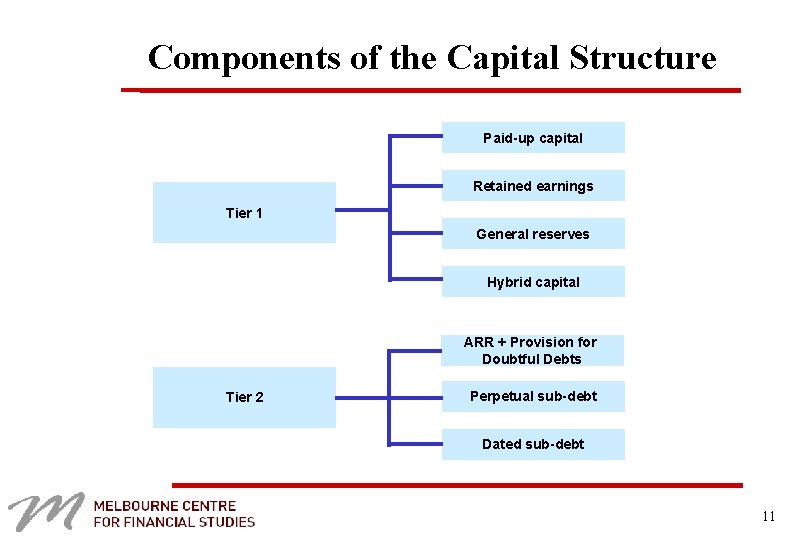
Components of the Capital Structure Paid-up capital Retained earnings Tier 1 General reserves Hybrid capital ARR + Provision for Doubtful Debts Tier 2 Perpetual sub-debt Dated sub-debt 11

Balancing the Competing Requirements Tier 2 Regulatory Capital Regulatory Tier 1 Capital Subordinated Debt Hybrid Capital Rating Agency Capital Tier 1 Economic Capital Common Equity 12

Tier 1 Capital Mix Hybrid Capital • Generally provides funding gap between ratings and regulatory capital • Provides increased capacity for LT 2 capital • Minimal cost differential between hybrid T 1 and UT 2. Adjusted Common Equity (“ACE”) Paid-up Capital Retained Earnings General Reserves less Deductions 13
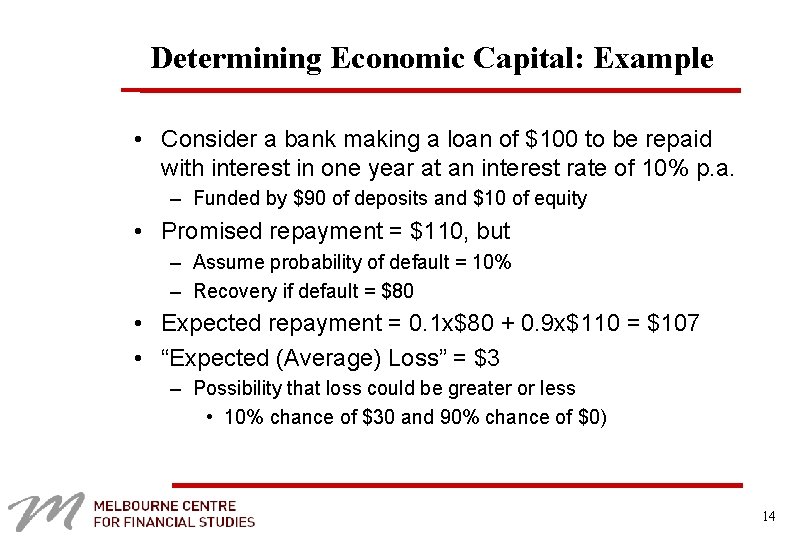
Determining Economic Capital: Example • Consider a bank making a loan of $100 to be repaid with interest in one year at an interest rate of 10% p. a. – Funded by $90 of deposits and $10 of equity • Promised repayment = $110, but – Assume probability of default = 10% – Recovery if default = $80 • Expected repayment = 0. 1 x$80 + 0. 9 x$110 = $107 • “Expected (Average) Loss” = $3 – Possibility that loss could be greater or less • 10% chance of $30 and 90% chance of $0) 14

Bank Balance Sheet Effects • Depend on accounting practices, for example: • Assets – Loan (less provision) = 100 – 3 = 97 • Liabilities – Deposits = 90 – Equity (less provision) = 10 – 3 = 7 • Note: – Expected losses should be “absorbed” by provisions and by loan pricing – Accounting values differ from economic values – Equity capital (after provisions) is the buffer to absorb unexpected losses – referred to as economic capital or capital at risk 15
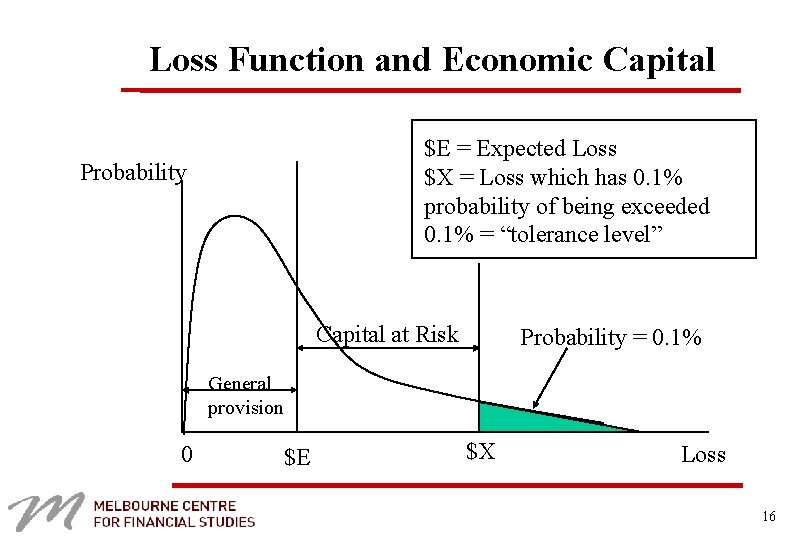
Loss Function and Economic Capital $E = Expected Loss $X = Loss which has 0. 1% probability of being exceeded 0. 1% = “tolerance level” Probability Capital at Risk Probability = 0. 1% General provision 0 $E $X Loss 16
Capital and Bank Behaviour • Capital constrains size of balance sheet – Current crisis situation: Losses reduce capital, low equity prices make equity raisings difficult, lead to restriction of loans • Capital is costly, loan pricing reflects cost of capital (and of deposits) – Current crisis situation: high cost of equity capital (low bank share prices) 17
Conclusions • Bank Capital Management involves managing both economic and regulatory capital • Capital planning is critical • Measurement and management of capital position requires correct accounting and valuation processes 18
- Slides: 18