
Capillary tube viscometer Theory The internal property of
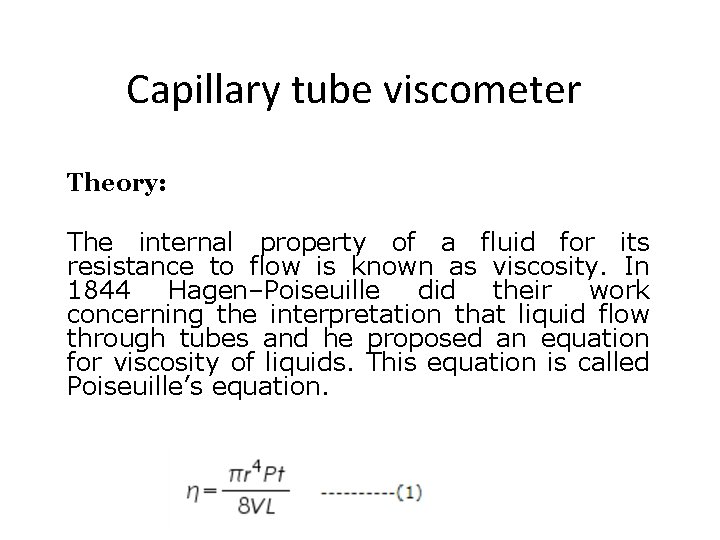
Capillary tube viscometer Theory: The internal property of a fluid for its resistance to flow is known as viscosity. In 1844 Hagen–Poiseuille did their work concerning the interpretation that liquid flow through tubes and he proposed an equation for viscosity of liquids. This equation is called Poiseuille’s equation.
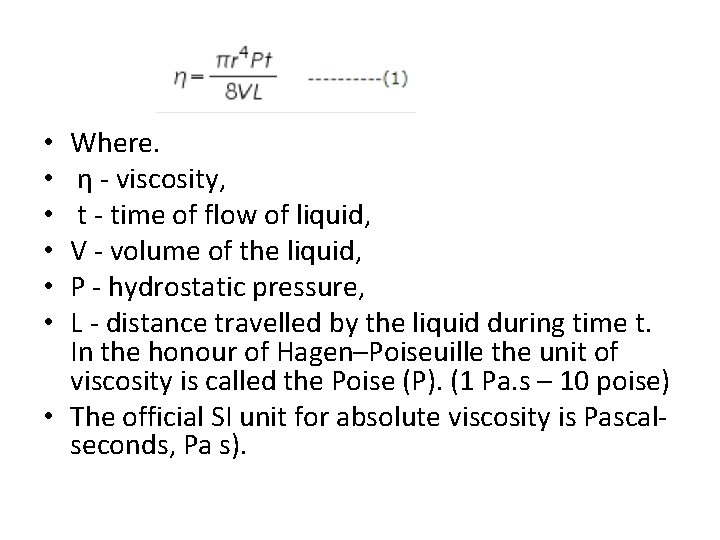
Where. η - viscosity, t - time of flow of liquid, V - volume of the liquid, P - hydrostatic pressure, L - distance travelled by the liquid during time t. In the honour of Hagen–Poiseuille the unit of viscosity is called the Poise (P). (1 Pa. s – 10 poise) • The official SI unit for absolute viscosity is Pascalseconds, Pa s). • • •
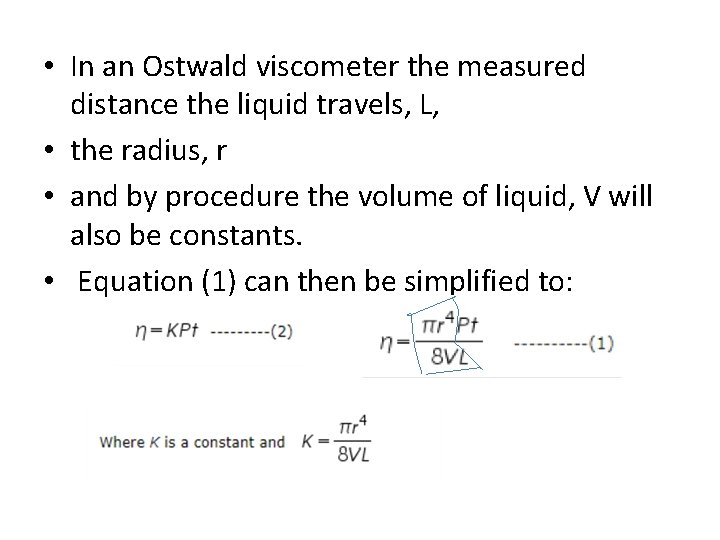
• In an Ostwald viscometer the measured distance the liquid travels, L, • the radius, r • and by procedure the volume of liquid, V will also be constants. • Equation (1) can then be simplified to:
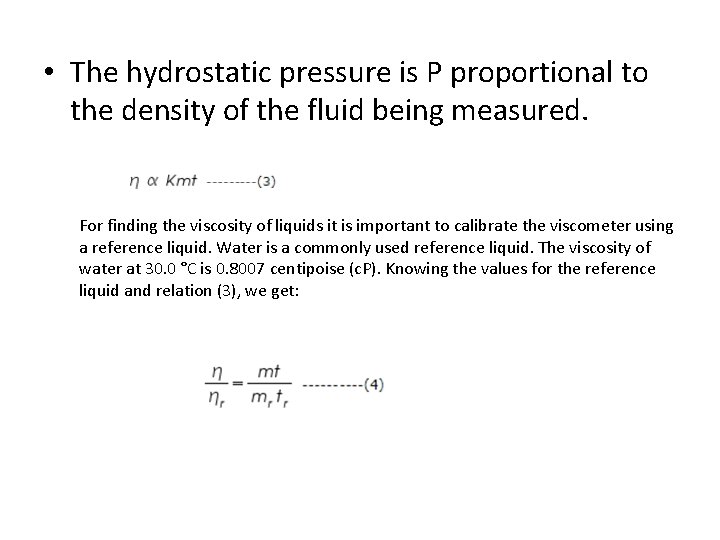
• The hydrostatic pressure is P proportional to the density of the fluid being measured. For finding the viscosity of liquids it is important to calibrate the viscometer using a reference liquid. Water is a commonly used reference liquid. The viscosity of water at 30. 0 °C is 0. 8007 centipoise (c. P). Knowing the values for the reference liquid and relation (3), we get:
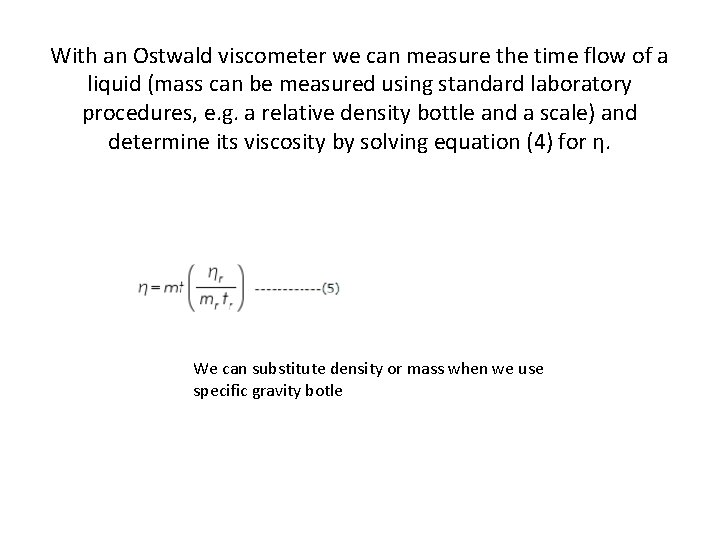
With an Ostwald viscometer we can measure the time flow of a liquid (mass can be measured using standard laboratory procedures, e. g. a relative density bottle and a scale) and determine its viscosity by solving equation (4) for η. We can substitute density or mass when we use specific gravity botle
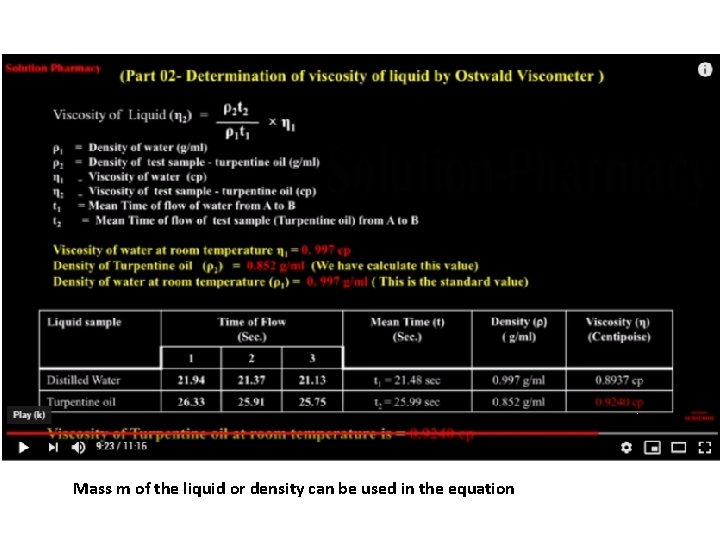
Mass m of the liquid or density can be used in the equation
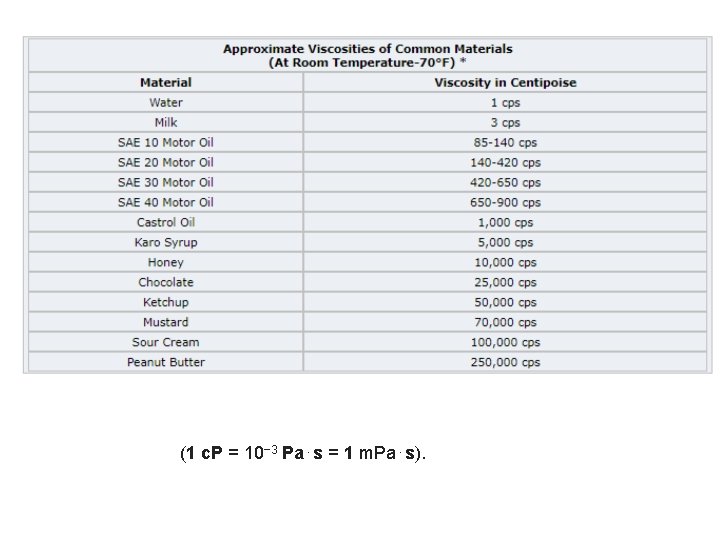
(1 c. P = 10− 3 Pa⋅s = 1 m. Pa⋅s).
Kinematic viscosity • Abs. viscosity/density of liquid • This can be obtained using a capillary viscometer • ν = K. t (cm 2/s or mm 2/s) • Where, K is the viscometer constant • T – is the time taken to flow (s)
- Slides: 8