
Capillary Circulation Red very important Green Doctors notes
- Slides: 37
Capillary Circulation Red: very important. Green: Doctor’s notes. Pink: formulas. Yellow: numbers. Gray: notes and explanation. Physiology Team 436 – Cardiovascular Block Lecture 14 1 Lecture: If work is intended for initial studying. Review: If work is intended for revision.
Objectives o Study Smart: focus on mutual topics. Outline the parts of the microcirculation, and list types of blood capillaries and differentiate between them. o Explain regulation of flow in the capillary beds. o Compare and contrast diffusion and filtration. o State Starling forces acting on the capillary wall. o Define edema, state its causes and discuss its mechanisms. o Describe the role of the microcirculation in temperature regulation. 2
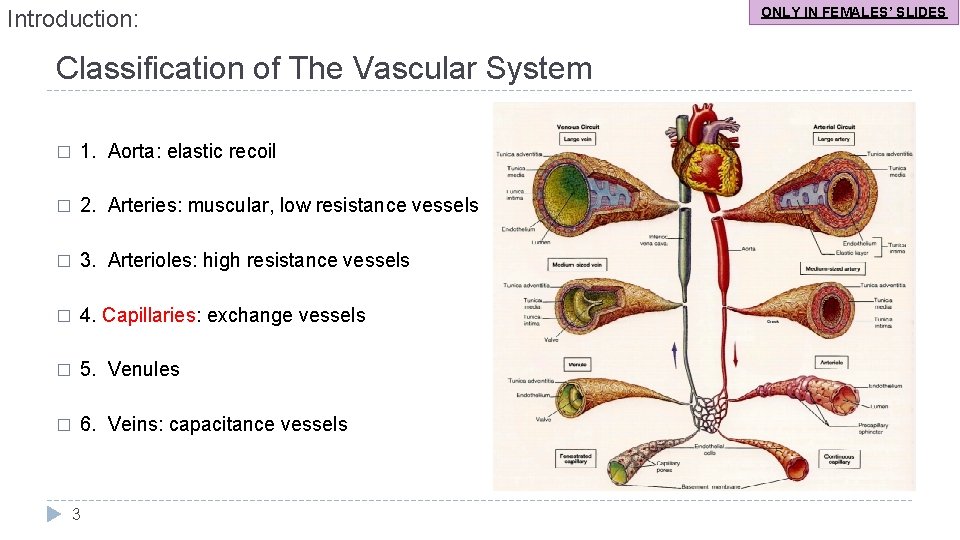
Introduction: Classification of The Vascular System � 1. Aorta: elastic recoil � 2. Arteries: muscular, low resistance vessels � 3. Arterioles: high resistance vessels � 4. Capillaries: exchange vessels � 5. Venules � 6. Veins: capacitance vessels 3 ONLY IN FEMALES’ SLIDES
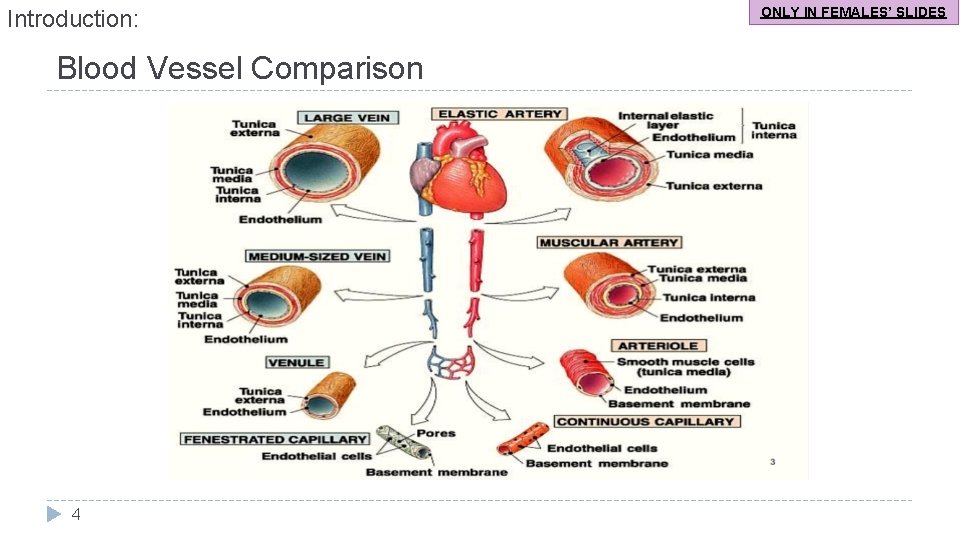
Introduction: Blood Vessel Comparison 4 ONLY IN FEMALES’ SLIDES
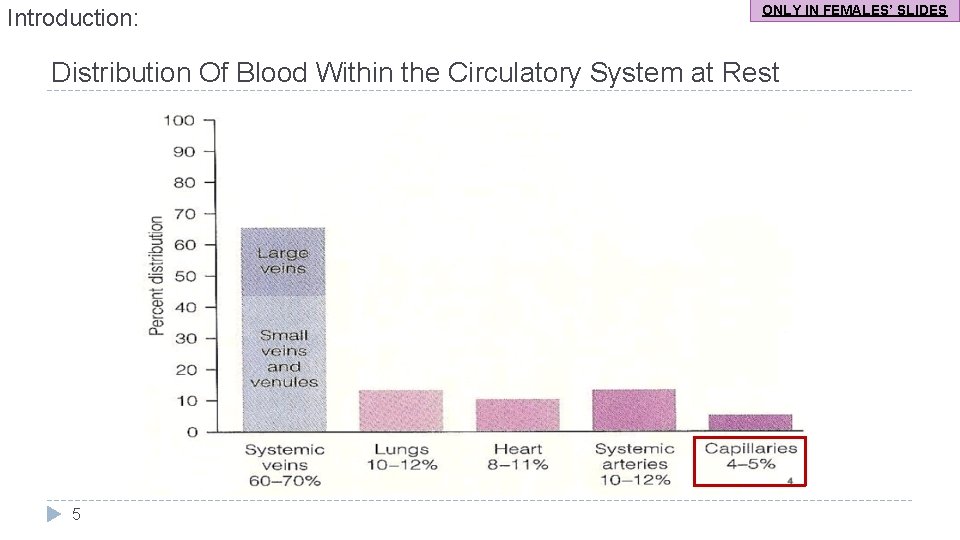
Introduction: ONLY IN FEMALES’ SLIDES Distribution Of Blood Within the Circulatory System at Rest 5
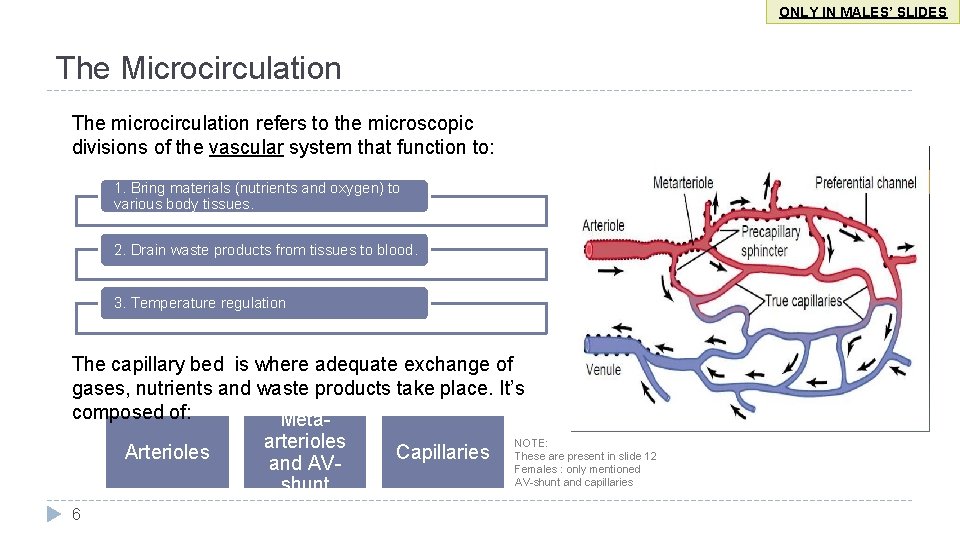
ONLY IN MALES’ SLIDES The Microcirculation The microcirculation refers to the microscopic divisions of the vascular system that function to: 1. Bring materials (nutrients and oxygen) to various body tissues. 2. Drain waste products from tissues to blood. 3. Temperature regulation The capillary bed is where adequate exchange of gases, nutrients and waste products take place. It’s composed of: Meta. NOTE: arterioles Arterioles Capillaries These are present in slide 12 and AVFemales : only mentioned AV-shunt and capillaries shunt 6
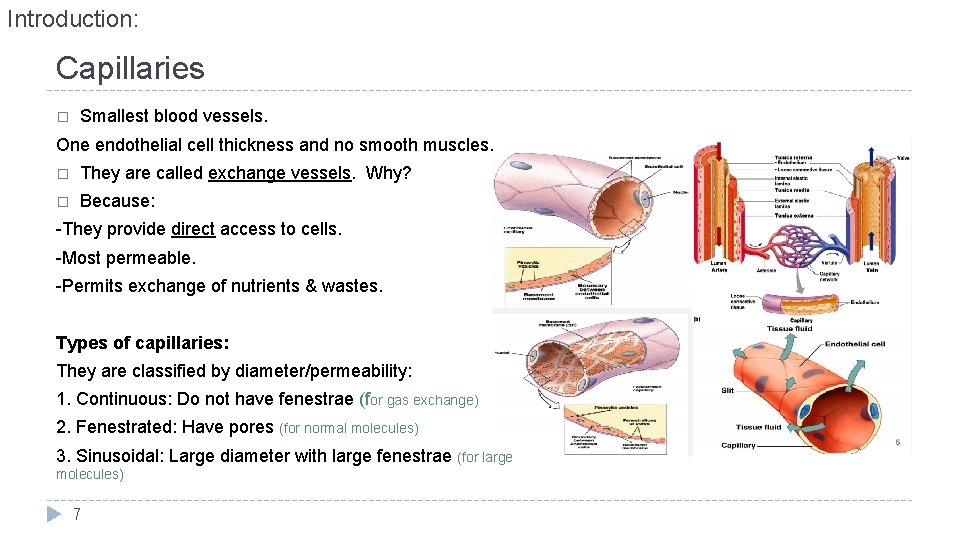
Introduction: Capillaries � Smallest blood vessels. One endothelial cell thickness and no smooth muscles. � They are called exchange vessels. Why? � Because: -They provide direct access to cells. -Most permeable. -Permits exchange of nutrients & wastes. Types of capillaries: They are classified by diameter/permeability: 1. Continuous: Do not have fenestrae (for gas exchange) 2. Fenestrated: Have pores (for normal molecules) 3. Sinusoidal: Large diameter with large fenestrae (for large molecules) 7
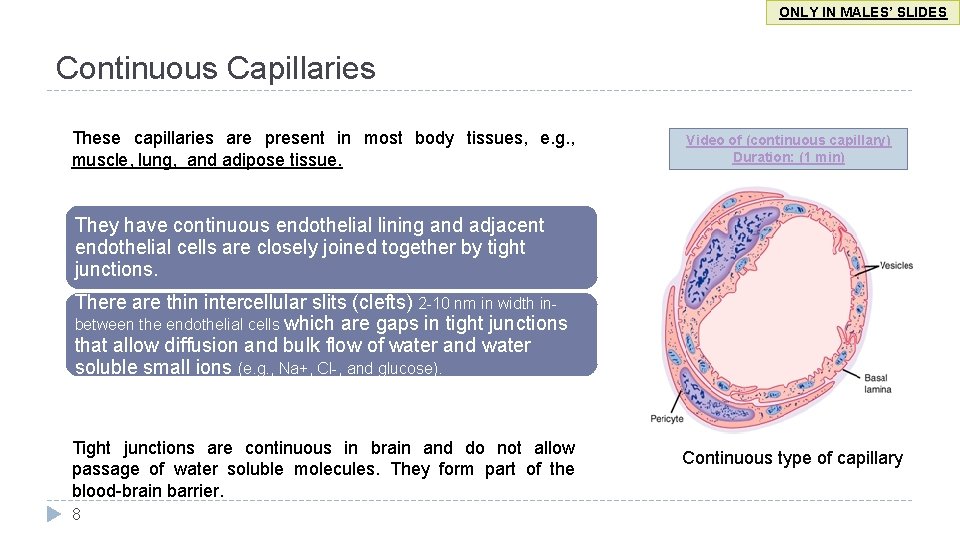
ONLY IN MALES’ SLIDES Continuous Capillaries These capillaries are present in most body tissues, e. g. , muscle, lung, and adipose tissue. Video of (continuous capillary) Duration: (1 min) They have continuous endothelial lining and adjacent endothelial cells are closely joined together by tight junctions. There are thin intercellular slits (clefts) 2 -10 nm in width inbetween the endothelial cells which are gaps in tight junctions that allow diffusion and bulk flow of water and water soluble small ions (e. g. , Na+, Cl-, and glucose). Tight junctions are continuous in brain and do not allow passage of water soluble molecules. They form part of the blood-brain barrier. 8 Continuous type of capillary
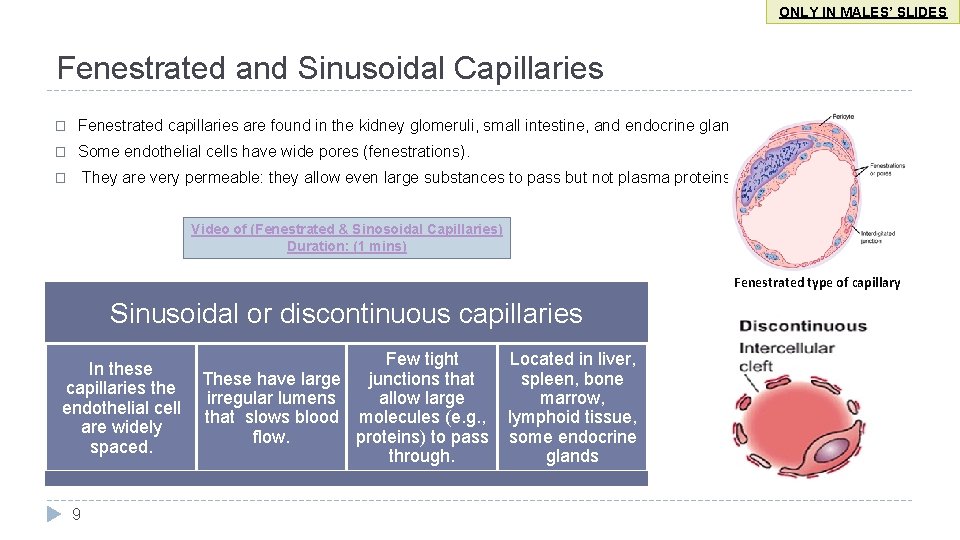
ONLY IN MALES’ SLIDES Fenestrated and Sinusoidal Capillaries � Fenestrated capillaries are found in the kidney glomeruli, small intestine, and endocrine glands � Some endothelial cells have wide pores (fenestrations). They are very permeable: they allow even large substances to pass but not plasma proteins. � Video of (Fenestrated & Sinosoidal Capillaries) Duration: (1 mins) Fenestrated type of capillary Sinusoidal or discontinuous capillaries In these capillaries the endothelial cell are widely spaced. 9 Few tight These have large junctions that allow large irregular lumens that slows blood molecules (e. g. , flow. proteins) to pass through. Located in liver, spleen, bone marrow, lymphoid tissue, some endocrine glands
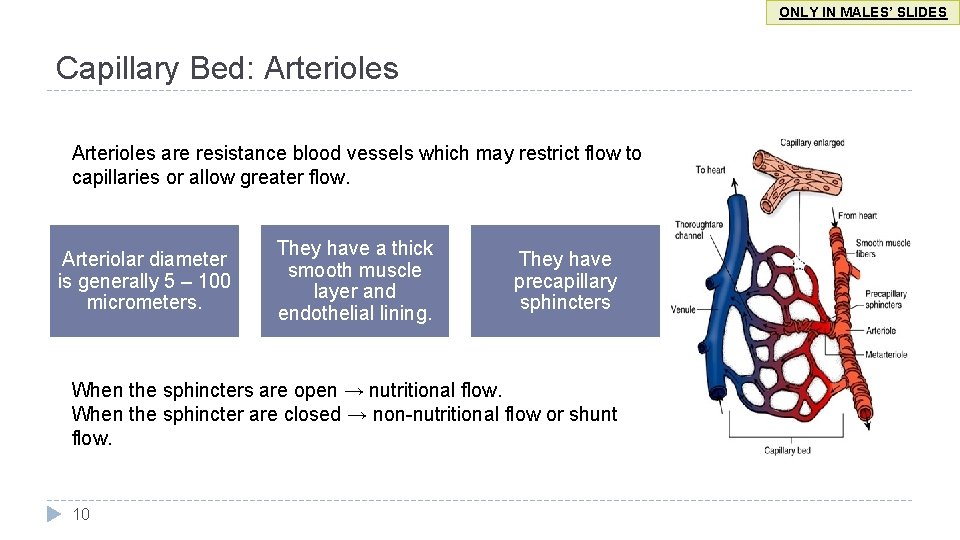
ONLY IN MALES’ SLIDES Capillary Bed: Arterioles are resistance blood vessels which may restrict flow to capillaries or allow greater flow. Arteriolar diameter is generally 5 – 100 micrometers. They have a thick smooth muscle layer and endothelial lining. They have precapillary sphincters When the sphincters are open → nutritional flow. When the sphincter are closed → non-nutritional flow or shunt flow. 10
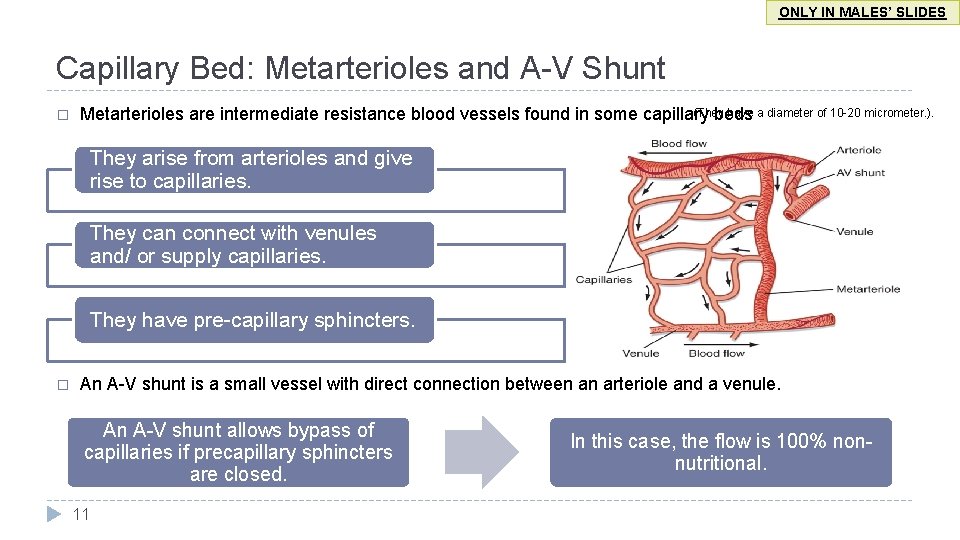
ONLY IN MALES’ SLIDES Capillary Bed: Metarterioles and A-V Shunt � (They have a diameter of 10 -20 micrometer. ). Metarterioles are intermediate resistance blood vessels found in some capillary beds They arise from arterioles and give rise to capillaries. They can connect with venules and/ or supply capillaries. They have pre-capillary sphincters. � An A-V shunt is a small vessel with direct connection between an arteriole and a venule. An A-V shunt allows bypass of capillaries if precapillary sphincters are closed. 11 In this case, the flow is 100% nonnutritional.
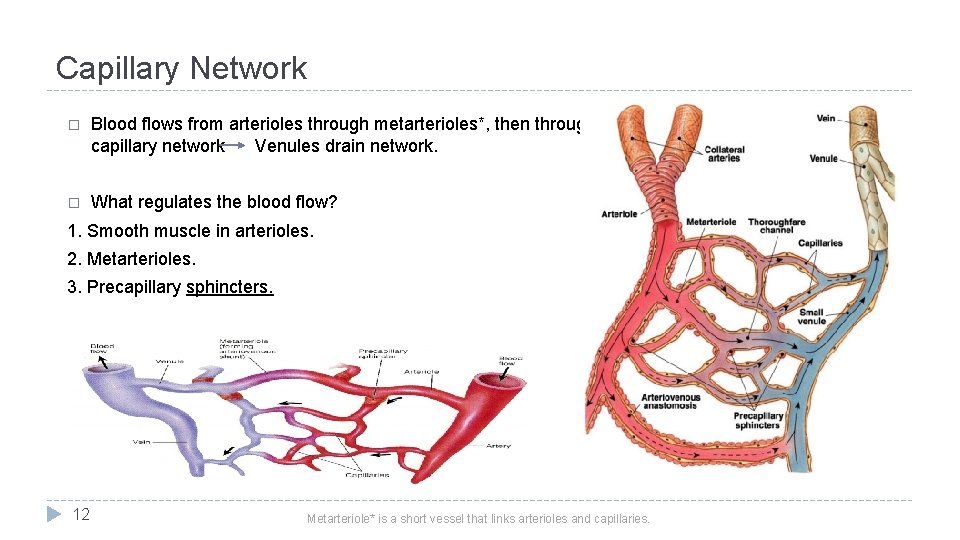
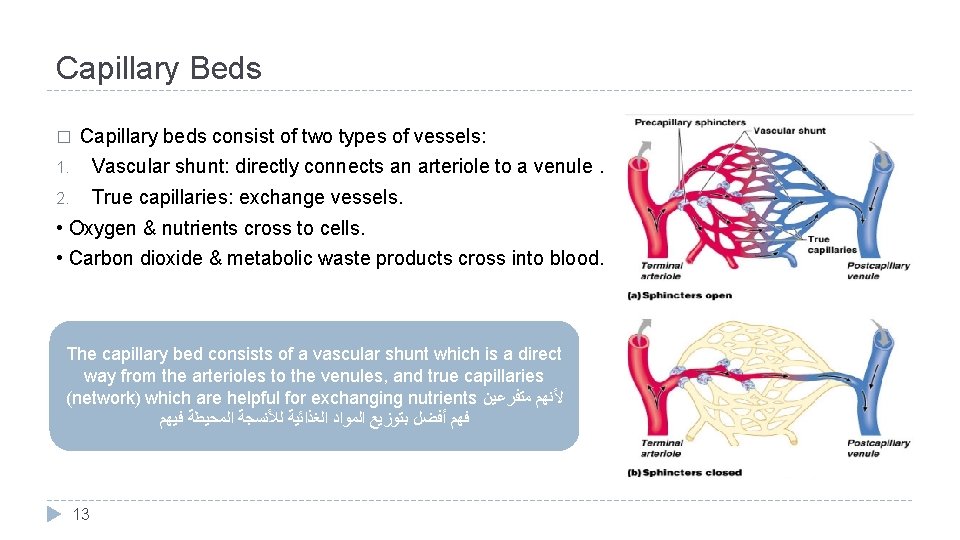
Capillary Network � Blood flows from arterioles through metarterioles*, then through capillary network Venules drain network. � What regulates the blood flow? 1. Smooth muscle in arterioles. 2. Metarterioles. 3. Precapillary sphincters. 12 Metarteriole* is a short vessel that links arterioles and capillaries.
Capillary Beds � Capillary beds consist of two types of vessels: 1. Vascular shunt: directly connects an arteriole to a venule. 2. True capillaries: exchange vessels. • Oxygen & nutrients cross to cells. • Carbon dioxide & metabolic waste products cross into blood. The capillary bed consists of a vascular shunt which is a direct way from the arterioles to the venules, and true capillaries (network) which are helpful for exchanging nutrients ﻷﻨﻬﻢ ﻣﺘﻔﺮﻋﻴﻦ ﻓﻬﻢ ﺃﻔﻀﻞ ﺑﺘﻮﺯﻳﻊ ﺍﻟﻤﻮﺍﺩ ﺍﻟﻐﺬﺍﺋﻴﺔ ﻟﻸﻨﺴﺠﺔ ﺍﻟﻤﺤﻴﻄﺔ ﻓﻴﻬﻢ 13
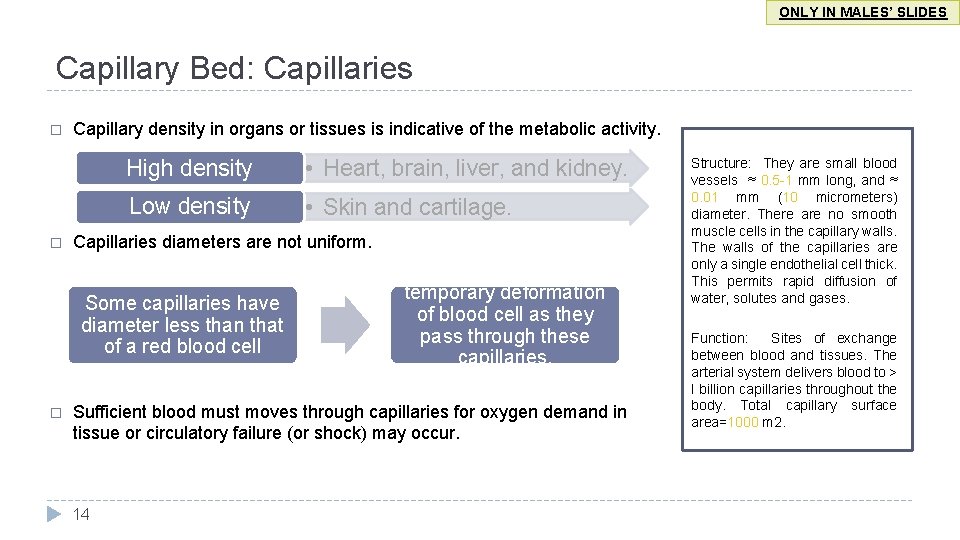
ONLY IN MALES’ SLIDES Capillary Bed: Capillaries � � Capillary density in organs or tissues is indicative of the metabolic activity. High density • Heart, brain, liver, and kidney. Low density • Skin and cartilage. Capillaries diameters are not uniform. Some capillaries have diameter less than that of a red blood cell � temporary deformation of blood cell as they pass through these capillaries. Sufficient blood must moves through capillaries for oxygen demand in tissue or circulatory failure (or shock) may occur. 14 Structure: They are small blood vessels ≈ 0. 5 -1 mm long, and ≈ 0. 01 mm (10 micrometers) diameter. There are no smooth muscle cells in the capillary walls. The walls of the capillaries are only a single endothelial cell thick. This permits rapid diffusion of water, solutes and gases. Function: Sites of exchange between blood and tissues. The arterial system delivers blood to > l billion capillaries throughout the body. Total capillary surface area=1000 m 2.
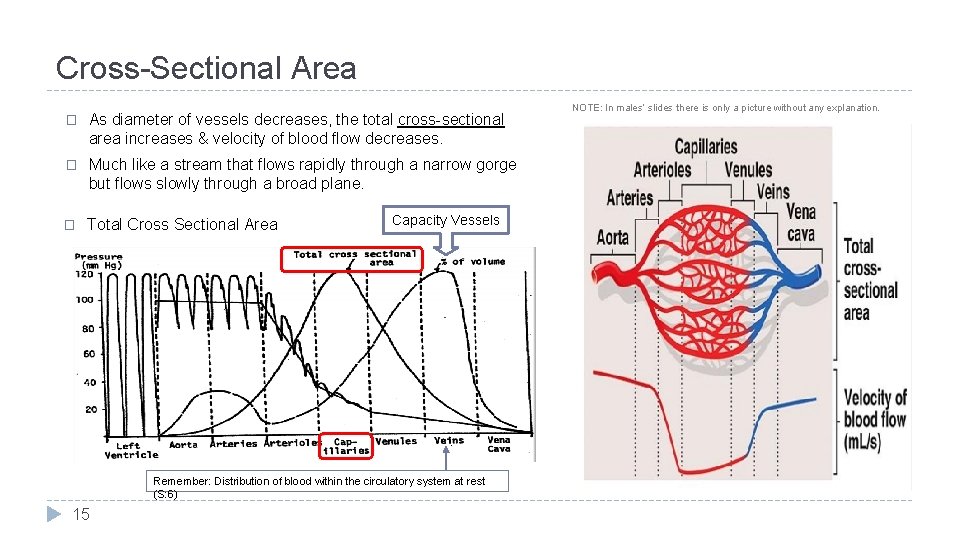
Cross-Sectional Area � As diameter of vessels decreases, the total cross-sectional area increases & velocity of blood flow decreases. � Much like a stream that flows rapidly through a narrow gorge but flows slowly through a broad plane. � Total Cross Sectional Area Capacity Vessels Remember: Distribution of blood within the circulatory system at rest (S: 6) 15 NOTE: In males’ slides there is only a picture without any explanation.
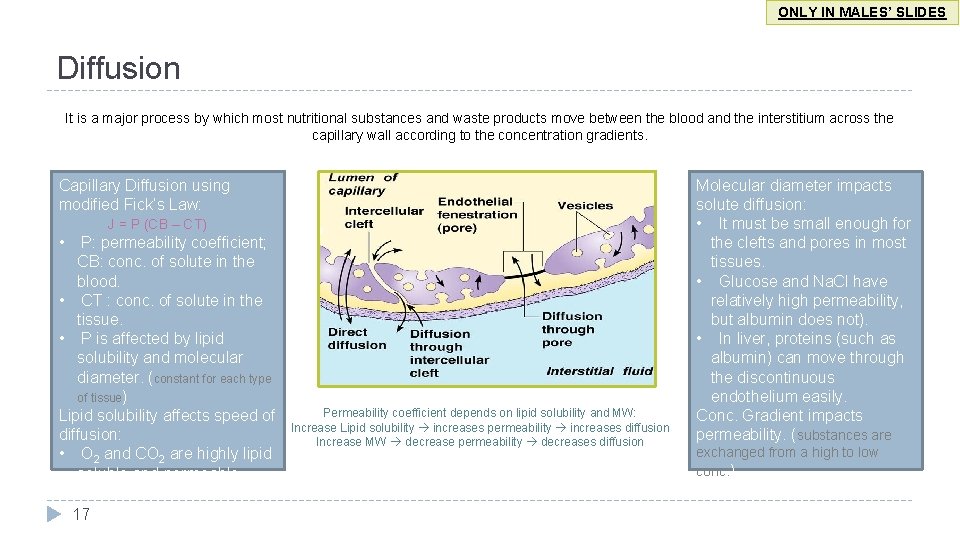
ONLY IN MALES’ SLIDES Regulation of Flow in Capillary Beds and Mechanisms of Capillary Exchange Regulation of flow in capillary beds The arterioles and the precapillary sphincters function as control valves in the tissue they feed: • During the “fight or flight” response, flow to non-essential organs (kidney, skin, etc. ) is clamped off → increased flow to skeletal muscle. • Metabolic waste products act as vasodilators to relax precapillary sphincters. • Vasomotion: intermittent flow through capillary, in response to altering metabolic needs. Mechanisms of capillary exchange. Transport of substances across the capillary wall occurs by 3 major mechanisms: 1 - Diffusion (according to concertation gradient) 2 - Filtration (according to concertation gradient) 3 - Transcytosis (vesicular transport) Keep in mind that capillary permeability is not the same in all tissue. It is specialized for different tissues: • Liver sinusoids have discontinuous endothelium → ↑ permeability → allows exchange of solutes and proteins. • Blood brain barrier capillaries have tight junctions = low permeability. • Kidney and intestinal capillaries contain fenestrations (pores) → ↑ permeability. 16 Clefts or pores only cover 0. 02% of capillary surface area.
ONLY IN MALES’ SLIDES Diffusion It is a major process by which most nutritional substances and waste products move between the blood and the interstitium across the capillary wall according to the concentration gradients. Capillary Diffusion using modified Fick’s Law: J = P (CB – CT) • P: permeability coefficient; CB: conc. of solute in the blood. • CT : conc. of solute in the tissue. • P is affected by lipid solubility and molecular diameter. (constant for each type of tissue) Lipid solubility affects speed of diffusion: • O 2 and CO 2 are highly lipid soluble and permeable. 17 Permeability coefficient depends on lipid solubility and MW: Increase Lipid solubility increases permeability increases diffusion Increase MW decrease permeability decreases diffusion Molecular diameter impacts solute diffusion: • It must be small enough for the clefts and pores in most tissues. • Glucose and Na. Cl have relatively high permeability, but albumin does not). • In liver, proteins (such as albumin) can move through the discontinuous endothelium easily. Conc. Gradient impacts permeability. (substances are exchanged from a high to low conc. )
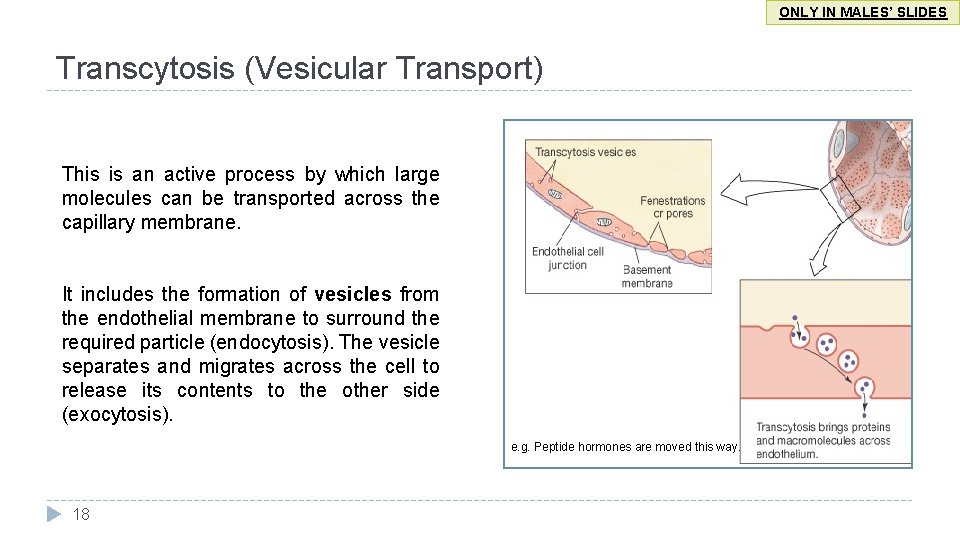
ONLY IN MALES’ SLIDES Transcytosis (Vesicular Transport) This is an active process by which large molecules can be transported across the capillary membrane. It includes the formation of vesicles from the endothelial membrane to surround the required particle (endocytosis). The vesicle separates and migrates across the cell to release its contents to the other side (exocytosis). e. g. Peptide hormones are moved this way. 18
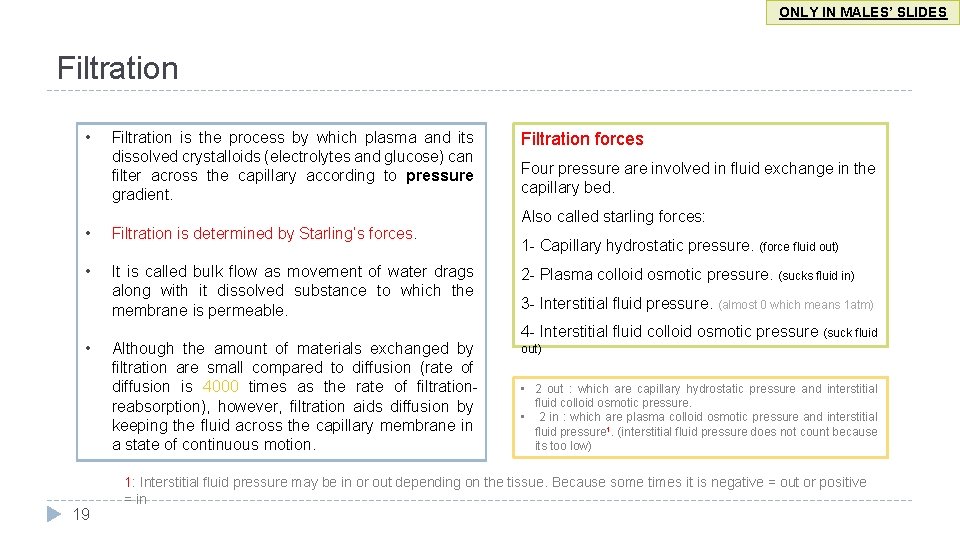
ONLY IN MALES’ SLIDES Filtration • Filtration is the process by which plasma and its dissolved crystalloids (electrolytes and glucose) can filter across the capillary according to pressure gradient. • Filtration is determined by Starling’s forces. • It is called bulk flow as movement of water drags along with it dissolved substance to which the membrane is permeable. • 19 Although the amount of materials exchanged by filtration are small compared to diffusion (rate of diffusion is 4000 times as the rate of filtrationreabsorption), however, filtration aids diffusion by keeping the fluid across the capillary membrane in a state of continuous motion. Filtration forces Four pressure are involved in fluid exchange in the capillary bed. Also called starling forces: 1 - Capillary hydrostatic pressure. (force fluid out) 2 - Plasma colloid osmotic pressure. (sucks fluid in) 3 - Interstitial fluid pressure. (almost 0 which means 1 atm) 4 - Interstitial fluid colloid osmotic pressure (suck fluid out) • 2 out : which are capillary hydrostatic pressure and interstitial fluid colloid osmotic pressure. • 2 in : which are plasma colloid osmotic pressure and interstitial fluid pressure 1. (interstitial fluid pressure does not count because its too low) 1: Interstitial fluid pressure may be in or out depending on the tissue. Because some times it is negative = out or positive = in
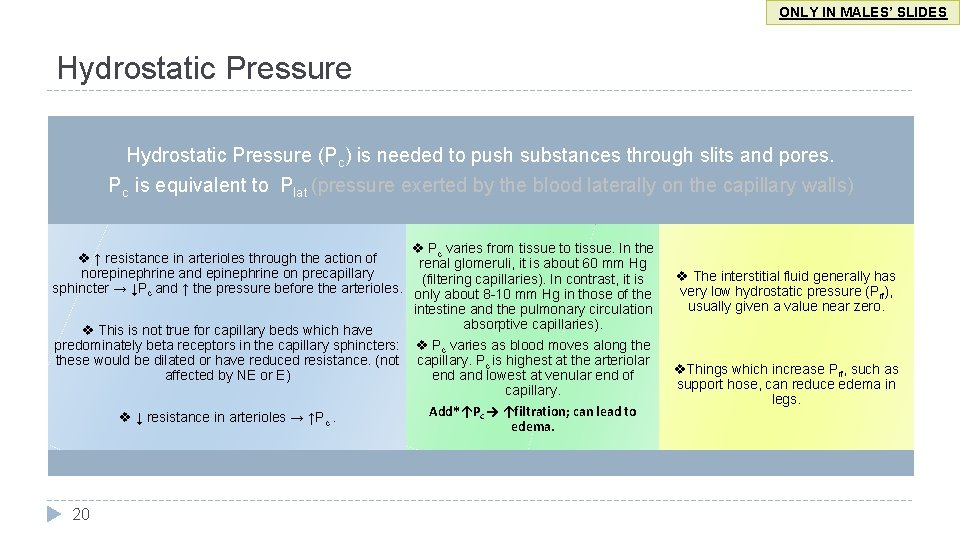
ONLY IN MALES’ SLIDES Hydrostatic Pressure (Pc) is needed to push substances through slits and pores. Pc is equivalent to Plat (pressure exerted by the blood laterally on the capillary walls) Pc varies from tissue to tissue. In the ↑ resistance in arterioles through the action of renal glomeruli, it is about 60 mm Hg norepinephrine and epinephrine on precapillary (filtering capillaries). In contrast, it is sphincter → ↓Pc and ↑ the pressure before the arterioles. only about 8 -10 mm Hg in those of the intestine and the pulmonary circulation absorptive capillaries). This is not true for capillary beds which have predominately beta receptors in the capillary sphincters: Pc varies as blood moves along these would be dilated or have reduced resistance. (not capillary. Pc is highest at the arteriolar affected by NE or E) end and lowest at venular end of capillary. Add*↑Pc → ↑filtration; can lead to ↓ resistance in arterioles → ↑Pc. edema. 20 The interstitial fluid generally has very low hydrostatic pressure (Pif), usually given a value near zero. Things which increase Pif, such as support hose, can reduce edema in legs.
ONLY IN MALES’ SLIDES Oncotic or Osmotic Pressure (π) Oncotic or osmotic pressure in the capillaries is a pressure which is mainly related to the presence of plasma proteins which can’t cross the capillary wall. • Albumin contributes to 65% of the osmotic pressure, whereas globulin contributes to only 15%. • However, an increased solute concentration → an increased osmotic pressure. Proteins in the surrounding interstitial fluid contribute to the tissue osmotic pressure (πif). The πc Leads to reabsorption of water near the venular end of the capillaries, and thus recovers blood volume. During the process of filtration and reabsorption, there is generally a loss of about 15% of the blood volume. This is recovered by the lymphatic system. 21
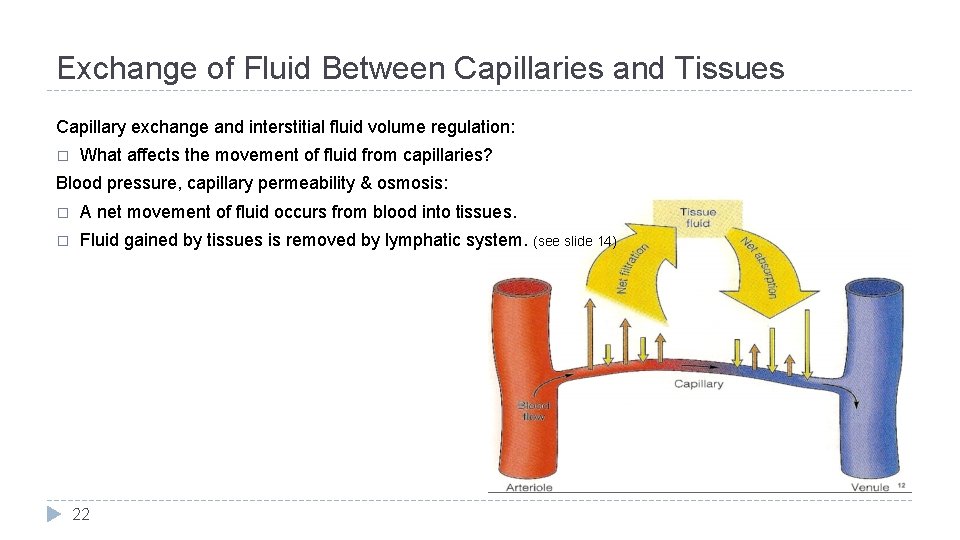
Exchange of Fluid Between Capillaries and Tissues Capillary exchange and interstitial fluid volume regulation: � What affects the movement of fluid from capillaries? Blood pressure, capillary permeability & osmosis: � A net movement of fluid occurs from blood into tissues. � Fluid gained by tissues is removed by lymphatic system. (see slide 14) 22
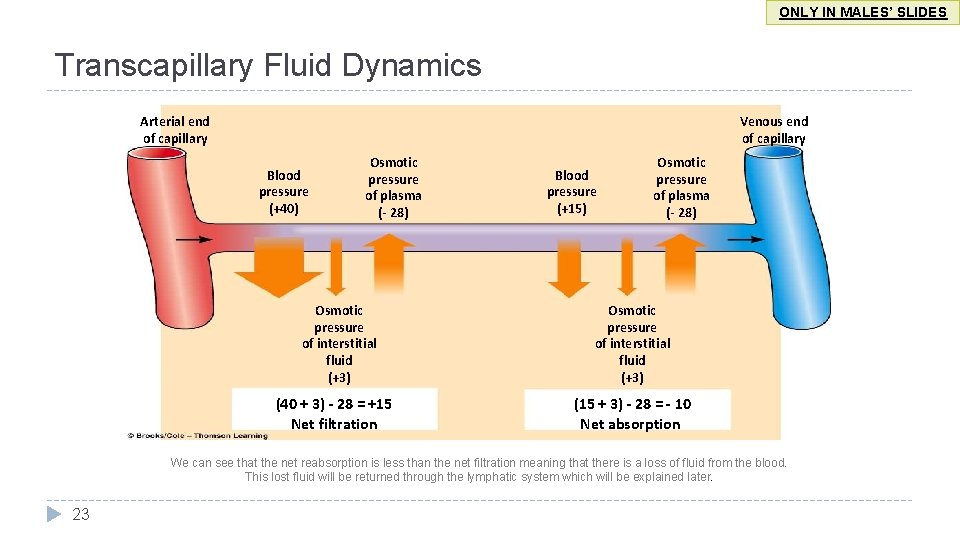
ONLY IN MALES’ SLIDES Transcapillary Fluid Dynamics Arterial end of capillary Venous end of capillary Blood pressure (+40) Osmotic pressure of plasma (- 28) Osmotic pressure of interstitial fluid (+3) (40 + 3) - 28 = +15 Net filtration Blood pressure (+15) Osmotic pressure of plasma (- 28) Osmotic pressure of interstitial fluid (+3) (15 + 3) - 28 = - 10 Net absorption We can see that the net reabsorption is less than the net filtration meaning that there is a loss of fluid from the blood. This lost fluid will be returned through the lymphatic system which will be explained later. 23
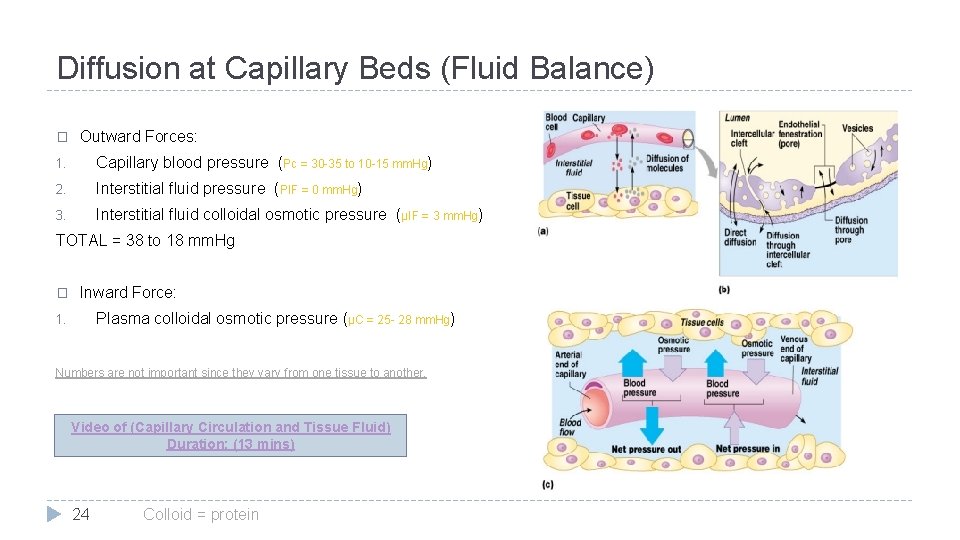
Diffusion at Capillary Beds (Fluid Balance) � Outward Forces: 1. Capillary blood pressure (Pc = 30 -35 to 10 -15 mm. Hg) 2. Interstitial fluid pressure (PIF = 0 mm. Hg) 3. Interstitial fluid colloidal osmotic pressure (µIF = 3 mm. Hg) TOTAL = 38 to 18 mm. Hg � Inward Force: Plasma colloidal osmotic pressure (µC = 25 - 28 mm. Hg) 1. Numbers are not important since they vary from one tissue to another. Video of (Capillary Circulation and Tissue Fluid) Duration: (13 mins) 24 Colloid = protein
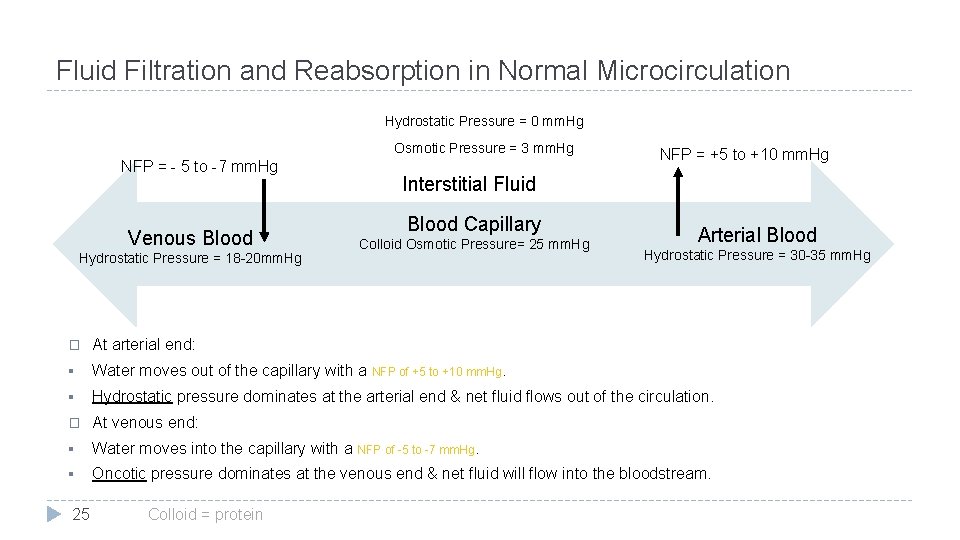
Fluid Filtration and Reabsorption in Normal Microcirculation Hydrostatic Pressure = 0 mm. Hg Osmotic Pressure = 3 mm. Hg NFP = - 5 to -7 mm. Hg Venous Blood Hydrostatic Pressure = 18 -20 mm. Hg NFP = +5 to +10 mm. Hg Interstitial Fluid Blood Capillary Colloid Osmotic Pressure= 25 mm. Hg Arterial Blood Hydrostatic Pressure = 30 -35 mm. Hg � At arterial end: § Water moves out of the capillary with a NFP of +5 to +10 mm. Hg. § Hydrostatic pressure dominates at the arterial end & net fluid flows out of the circulation. � At venous end: § Water moves into the capillary with a NFP of -5 to -7 mm. Hg. § Oncotic pressure dominates at the venous end & net fluid will flow into the bloodstream. 25 Colloid = protein
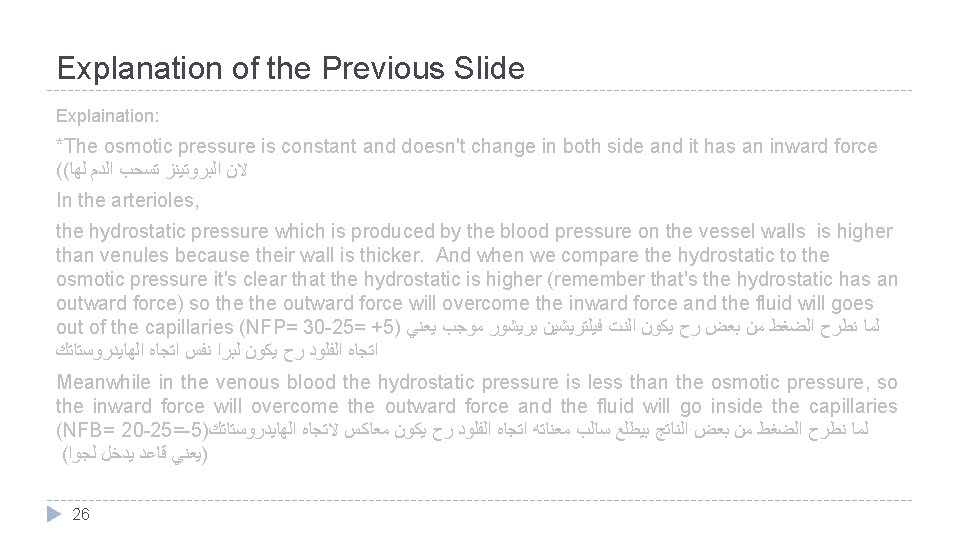
Explanation of the Previous Slide Explaination: *The osmotic pressure is constant and doesn't change in both side and it has an inward force (( ﻻﻥ ﺍﻟﺒﺮﻭﺗﻴﻨﺰ ﺗﺴﺤﺐ ﺍﻟﺪﻡ ﻟﻬﺎ In the arterioles, the hydrostatic pressure which is produced by the blood pressure on the vessel walls is higher than venules because their wall is thicker. And when we compare the hydrostatic to the osmotic pressure it's clear that the hydrostatic is higher (remember that's the hydrostatic has an outward force) so the outward force will overcome the inward force and the fluid will goes out of the capillaries (NFP= 30 -25= +5) ﻟﻤﺎ ﻧﻄﺮﺡ ﺍﻟﻀﻐﻂ ﻣﻦ ﺑﻌﺾ ﺭﺡ ﻳﻜﻮﻥ ﺍﻟﻨﺖ ﻓﻴﻠﺘﺮﻳﺸﻴﻦ ﺑﺮﻳﺸﻮﺭ ﻣﻮﺟﺐ ﻳﻌﻨﻲ ﺍﺗﺠﺎﻩ ﺍﻟﻔﻠﻮﺩ ﺭﺡ ﻳﻜﻮﻥ ﻟﺒﺮﺍ ﻧﻔﺲ ﺍﺗﺠﺎﻩ ﺍﻟﻬﺎﻳﺪﺭﻭﺳﺘﺎﺗﻚ Meanwhile in the venous blood the hydrostatic pressure is less than the osmotic pressure, so the inward force will overcome the outward force and the fluid will go inside the capillaries (NFB= 20 -25=-5) ﻟﻤﺎ ﻧﻄﺮﺡ ﺍﻟﻀﻐﻂ ﻣﻦ ﺑﻌﺾ ﺍﻟﻨﺎﺗﺞ ﺑﻴﻄﻠﻊ ﺳﺎﻟﺐ ﻣﻌﻨﺎﺗﻪ ﺍﺗﺠﺎﻩ ﺍﻟﻔﻠﻮﺩ ﺭﺡ ﻳﻜﻮﻥ ﻣﻌﺎﻛﺲ ﻻﺗﺠﺎﻩ ﺍﻟﻬﺎﻳﺪﺭﻭﺳﺘﺎﺗﻚ ( )ﻳﻌﻨﻲ ﻗﺎﻋﺪ ﻳﺪﺧﻞ ﻟﺠﻮﺍ 26
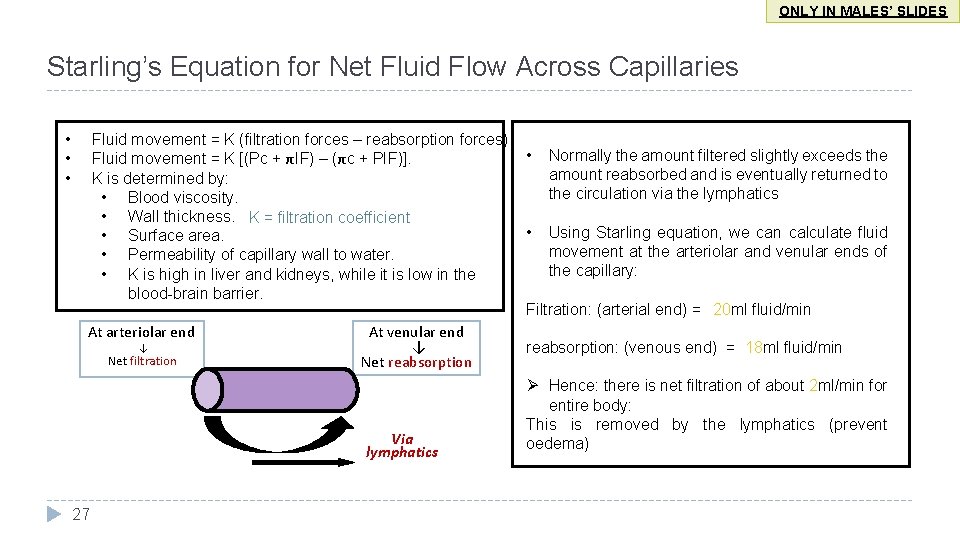
ONLY IN MALES’ SLIDES Starling’s Equation for Net Fluid Flow Across Capillaries • • • Fluid movement = K (filtration forces – reabsorption forces). • Normally the amount filtered slightly exceeds the Fluid movement = K [(Pc + πIF) – (πc + PIF)]. amount reabsorbed and is eventually returned to K is determined by: the circulation via the lymphatics • Blood viscosity. • Wall thickness. K = filtration coefficient • Using Starling equation, we can calculate fluid • Surface area. movement at the arteriolar and venular ends of • Permeability of capillary wall to water. the capillary: • K is high in liver and kidneys, while it is low in the blood-brain barrier. Filtration: (arterial end) = 20 ml fluid/min At arteriolar end At venular end ↓ ↓ reabsorption: (venous end) = 18 ml fluid/min Net filtration Net reabsorption Via lymphatics 27 Ø Hence: there is net filtration of about 2 ml/min for entire body: This is removed by the lymphatics (prevent oedema)
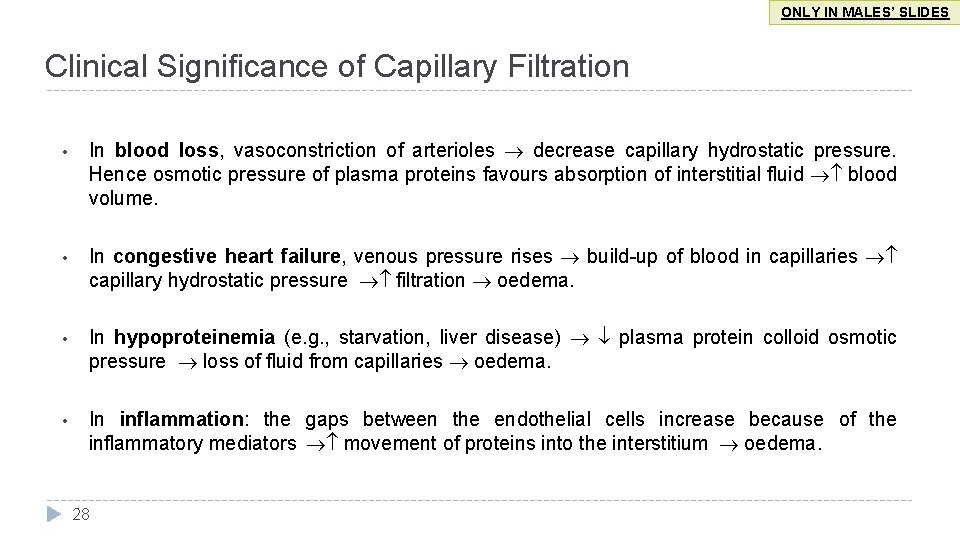
ONLY IN MALES’ SLIDES Clinical Significance of Capillary Filtration • In blood loss, vasoconstriction of arterioles decrease capillary hydrostatic pressure. Hence osmotic pressure of plasma proteins favours absorption of interstitial fluid blood volume. • In congestive heart failure, venous pressure rises build-up of blood in capillaries capillary hydrostatic pressure filtration oedema. • In hypoproteinemia (e. g. , starvation, liver disease) plasma protein colloid osmotic pressure loss of fluid from capillaries oedema. • In inflammation: the gaps between the endothelial cells increase because of the inflammatory mediators movement of proteins into the interstitium oedema. 28
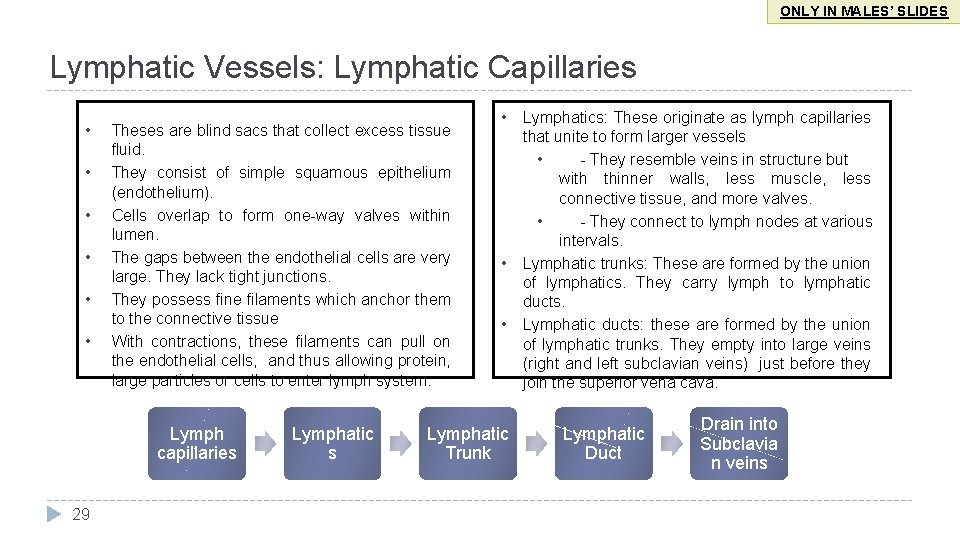
ONLY IN MALES’ SLIDES Lymphatic Vessels: Lymphatic Capillaries • • • Theses are blind sacs that collect excess tissue fluid. They consist of simple squamous epithelium (endothelium). Cells overlap to form one-way valves within lumen. The gaps between the endothelial cells are very large. They lack tight junctions. They possess fine filaments which anchor them to the connective tissue With contractions, these filaments can pull on the endothelial cells, and thus allowing protein, large particles or cells to enter lymph system. Lymph capillaries 29 Lymphatic s • • • Lymphatic Trunk Lymphatics: These originate as lymph capillaries that unite to form larger vessels • - They resemble veins in structure but with thinner walls, less muscle, less connective tissue, and more valves. • - They connect to lymph nodes at various intervals. Lymphatic trunks: These are formed by the union of lymphatics. They carry lymph to lymphatic ducts. Lymphatic ducts: these are formed by the union of lymphatic trunks. They empty into large veins (right and left subclavian veins) just before they join the superior vena cava. Lymphatic Duct Drain into Subclavia n veins
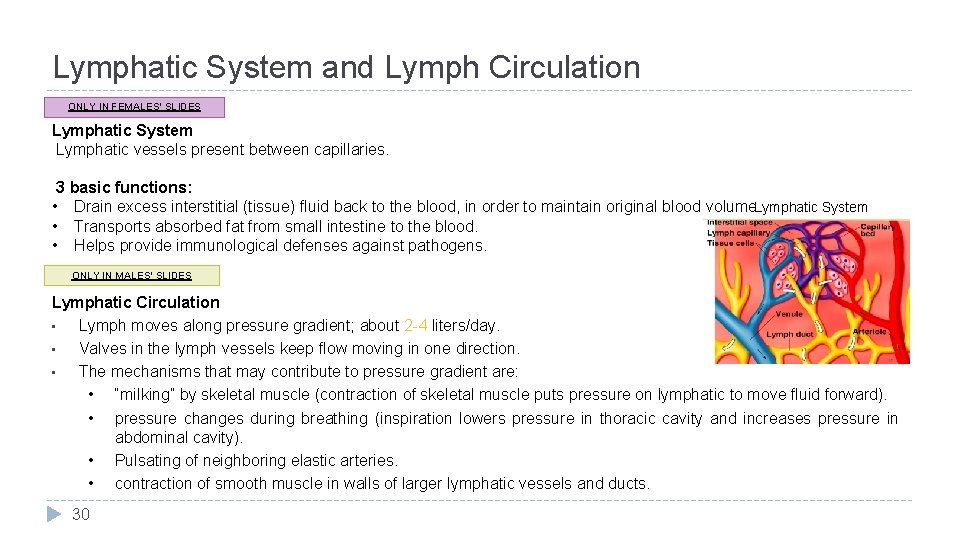
Lymphatic System and Lymph Circulation ONLY IN FEMALES’ SLIDES Lymphatic System Lymphatic vessels present between capillaries. 3 basic functions: • Drain excess interstitial (tissue) fluid back to the blood, in order to maintain original blood volume. Lymphatic System • Transports absorbed fat from small intestine to the blood. • Helps provide immunological defenses against pathogens. ONLY IN MALES’ SLIDES Lymphatic Circulation • Lymph moves along pressure gradient; about 2 -4 liters/day. • Valves in the lymph vessels keep flow moving in one direction. • The mechanisms that may contribute to pressure gradient are: • “milking” by skeletal muscle (contraction of skeletal muscle puts pressure on lymphatic to move fluid forward). • pressure changes during breathing (inspiration lowers pressure in thoracic cavity and increases pressure in abdominal cavity). • Pulsating of neighboring elastic arteries. • contraction of smooth muscle in walls of larger lymphatic vessels and ducts. 30
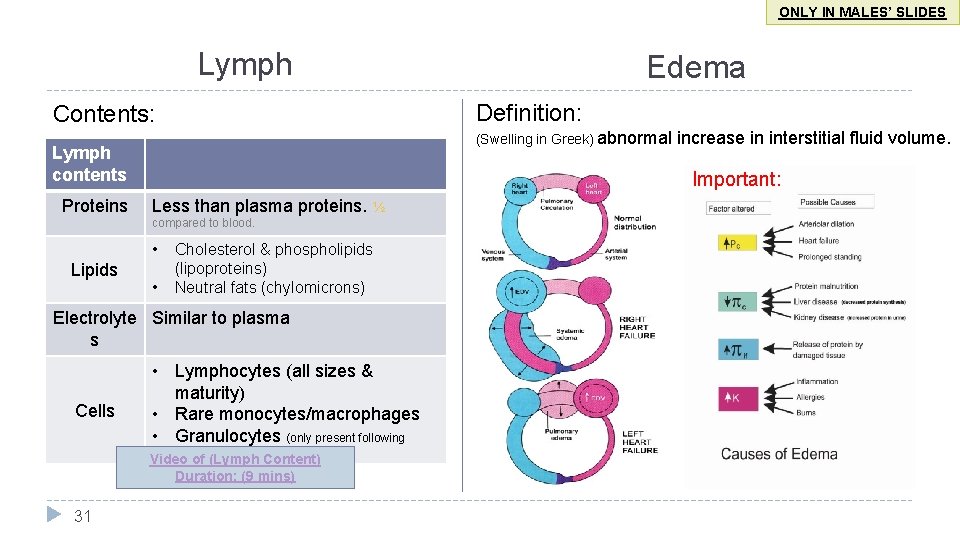
ONLY IN MALES’ SLIDES Lymph Definition: Contents: (Swelling in Greek) abnormal Lymph contents Proteins Less than plasma proteins. ½ • • Cholesterol & phospholipids (lipoproteins) Neutral fats (chylomicrons) Electrolyte Similar to plasma s Cells • Lymphocytes (all sizes & maturity) • Rare monocytes/macrophages • Granulocytes (only present following infection) Video of (Lymph Content) Duration: (9 mins) 31 increase in interstitial fluid volume. Important: compared to blood. Lipids Edema
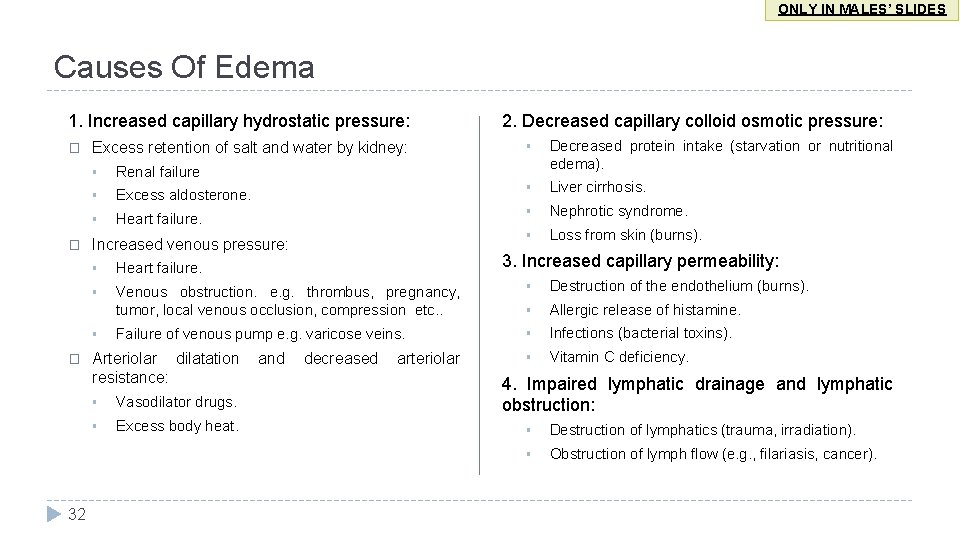
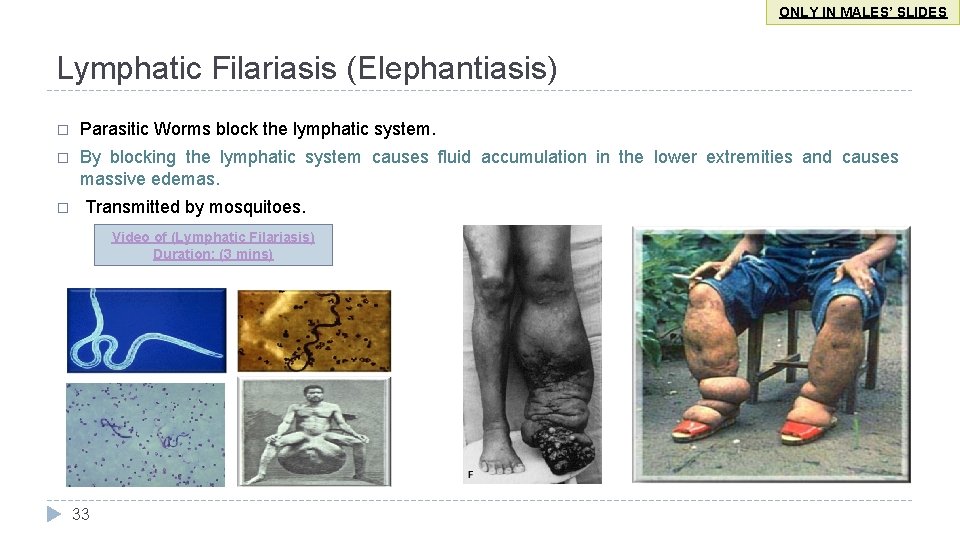
ONLY IN MALES’ SLIDES Causes Of Edema 1. Increased capillary hydrostatic pressure: � � Excess retention of salt and water by kidney: 32 § Decreased protein intake (starvation or nutritional edema). § Renal failure § Excess aldosterone. § Liver cirrhosis. § Heart failure. § Nephrotic syndrome. § Loss from skin (burns). Increased venous pressure: 3. Increased capillary permeability: § Heart failure. § Venous obstruction. e. g. thrombus, pregnancy, tumor, local venous occlusion, compression etc. . § Destruction of the endothelium (burns). § Allergic release of histamine. Failure of venous pump e. g. varicose veins. § Infections (bacterial toxins). § Vitamin C deficiency. § � 2. Decreased capillary colloid osmotic pressure: Arteriolar dilatation resistance: § Vasodilator drugs. § Excess body heat. and decreased arteriolar 4. Impaired lymphatic drainage and lymphatic obstruction: § Destruction of lymphatics (trauma, irradiation). § Obstruction of lymph flow (e. g. , filariasis, cancer).
ONLY IN MALES’ SLIDES Lymphatic Filariasis (Elephantiasis) � Parasitic Worms block the lymphatic system. � By blocking the lymphatic system causes fluid accumulation in the lower extremities and causes massive edemas. � Transmitted by mosquitoes. Video of (Lymphatic Filariasis) Duration: (3 mins) 33
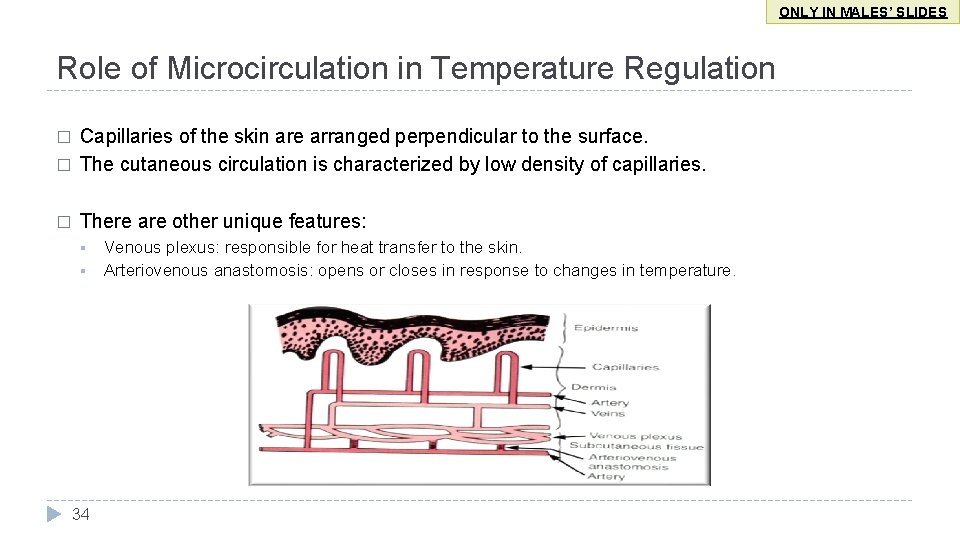
ONLY IN MALES’ SLIDES Role of Microcirculation in Temperature Regulation � Capillaries of the skin are arranged perpendicular to the surface. The cutaneous circulation is characterized by low density of capillaries. � There are other unique features: � § § 34 Venous plexus: responsible for heat transfer to the skin. Arteriovenous anastomosis: opens or closes in response to changes in temperature.
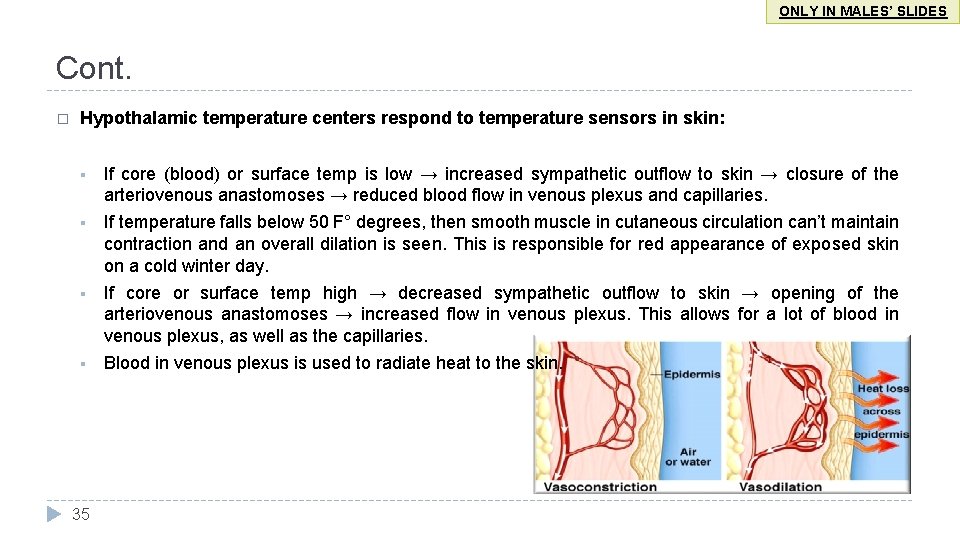
ONLY IN MALES’ SLIDES Cont. � Hypothalamic temperature centers respond to temperature sensors in skin: § If core (blood) or surface temp is low → increased sympathetic outflow to skin → closure of the arteriovenous anastomoses → reduced blood flow in venous plexus and capillaries. § If temperature falls below 50 F° degrees, then smooth muscle in cutaneous circulation can’t maintain contraction and an overall dilation is seen. This is responsible for red appearance of exposed skin on a cold winter day. § If core or surface temp high → decreased sympathetic outflow to skin → opening of the arteriovenous anastomoses → increased flow in venous plexus. This allows for a lot of blood in venous plexus, as well as the capillaries. § Blood in venous plexus is used to radiate heat to the skin. 35
Quiz � https: //www. onlineexambuilder. com/microcirculation/exam-142417 Link to Editing File (Please be sure to check this file frequently for any edits or updates on all of our lectures. ) References: • Girls’ and boys’ slides. • Guyton and Hall Textbook of Medical Physiology (Thirteenth Edition. ) 36
Thank you!. ﺍﻋﻤﻞ ﻭ ﺃﻨﺖ ﺗﻌﻠﻢ ﺃﻦ ﺍﻟﻠﻪ ﻻ ﻳﻀﻴﻊ ﺃﺠﺮ ﻣﻦ ﺃﺤﺴﻦ ﻋﻤﻼ ، ﺍﻋﻤﻞ ﻟﺘﻤﺴﺢ ﺩﻣﻌﺔ ، ﺍﻋﻤﻞ ﻟﺘﺮﺳﻢ ﺑﺴﻤﺔ The Physiology 436 Team: Female Members: Ghadah Almazrou Sumaya Al. Ghamdi Nouf Aloqaili Lama Alfawzan Munirah aldofyan 37 Male Members: Ali Alsubaei Abdulmajeed alamar Team Leaders: Qaiss Almuhaideb Lulwah Alshiha Contact us: Physiology 436@gmail. com @Physiology 436