
CAPE UNIT 1 MICROECONOMICS Lecture 1 Wendell Long
- Slides: 18
CAPE UNIT 1 MICROECONOMICS (Lecture 1) Wendell Long
DEFINITIONS According to Paul A Samuelson, 1985: There exists consensus that economics may be defined as the study of how people and society choose to employ scarce resources that could have alternative uses in order to produce various commodities and to distribute them for consumption, now or in the future, among various persons and groups in society. According to Lipsey (1987, p 4) Economics can be defined, as the study of the use of scarce resources to satisfy unlimited human wants.
Thinking Like An Economist This course approaches the discipline and its associated pedagogy from a naturalist perspective. The Biologist and the Physicist can better understand their subject matter by critically observing examples in nature, so to can the economist. . Thinking like an economists requires you play to attention to certain details in making life altering decisions involving cost-benefit analysis, opportunity costs, maximising behaviour and rationality. These principles can have serious implications to your business and your personal financial success and planning. Above all see the course as more than one needed to pass! But look at it as an enjoyable and exciting adventure in discovering tools and concepts contributing towards a fulfilling life.
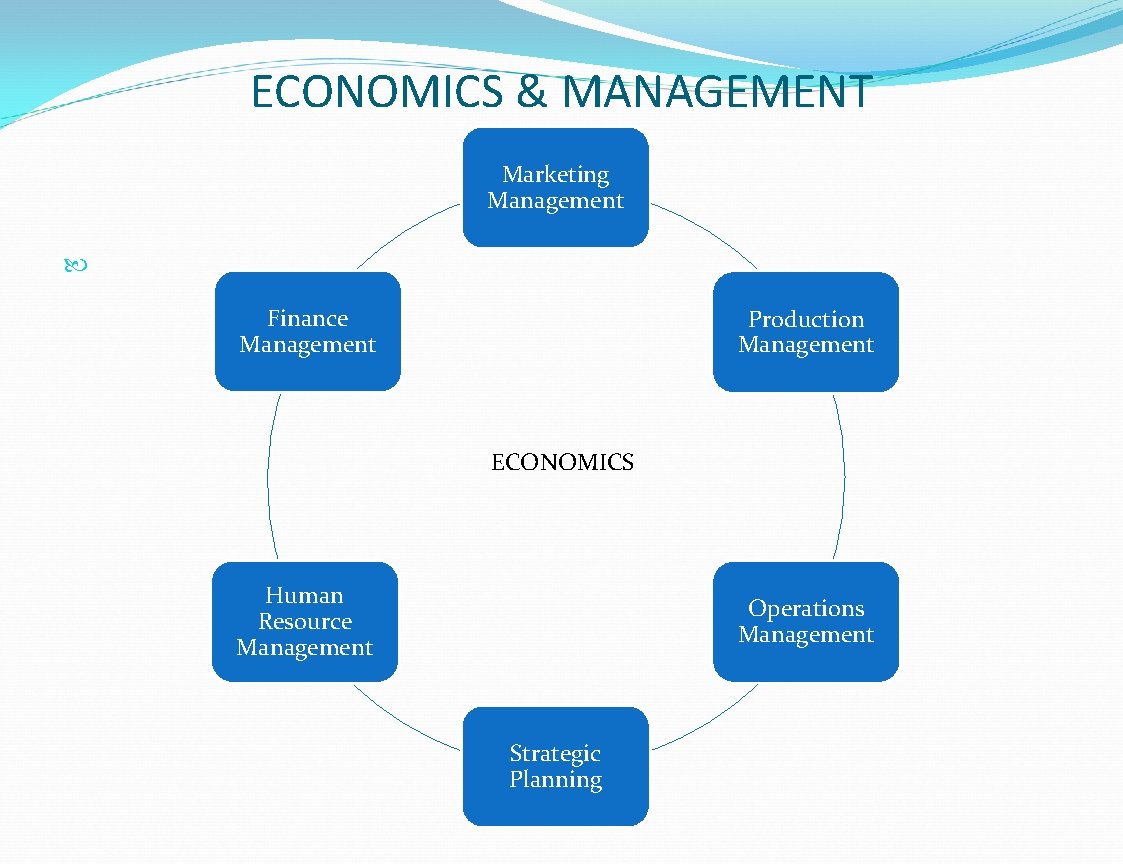
ECONOMICS & MANAGEMENT Marketing Management Finance Management Production Management ECONOMICS Human Resource Management Operations Management Strategic Planning
DIFFERENCES BETWEEN MICROECONOMICS & MACROECONOMICS Microeconomics looks at the economy through a microscope studying the behaviour of an economy's individual molecules, like firms or households / prices or quantities. For example, with how bread prices fall when flour prices fall. Microeconomics deals with the intricate systems of relationships known as the market mechanism. Macroeconomics by contrast, deals with the behaviour of the economy as a whole - or with broad aggregates of economic life. It is the study of economic growth (the expansion of output over the longrun) and the business cycle. Macroeconomics focuses on inflation and unemployment, seeking to explain their causes, consequences and cures. Therefore, macroeconomic studies in broad outline the flow of income in the economy. In contrast, microeconomics deals with the behaviour of individual markets, such as the market for Flour, tomatoes, oil….
DIFFERENCES BETWEEN MICROECONOMICS & MACROECONOMICS (con’t) Microeconomics considers the behaviour of steel prices verses energy prices, while Macroeconomics studies the behaviour of all producer and consumer prices Microeconomic studies whether going college is a good use of your time when young, while Macroeconomics examines what determines the overall unemployment rate. Microeconomics examines the items of foreign trade - why we import Canadian Apple Juice and export Orange Juice. However, Macroeconomics examines the overall trends in our imports and exports - why the value of the $TT has appreciated and why the value of the £UK has depreciated However, be careful: there are interactions between Microeconomics and Macroeconomics. The understanding of macro movements in the economy will require some understanding of the micro tools of demand & supply.
THE CENTRAL PROBLEM OF ECONOMICS Some resources are considered scarce. Resources are the land natural resources, labour, capital (plants, equipment and inventories) that are combined to produce goods and services. These productive resources are also called factors of production. Scarcity forces economic agents to make choices. All societies face the problem of deciding what to produce and how to divide the products among their members. The factors of production are limited; we cannot produce infinite quantities of goods and services. Households must choose how to spend their limited income on the things they want. Businesses must choose among alternative combinations of scarce resources and among different goods to produce. Manufacturers must decide whether to use assembly-line workers or industrial robots. Just as scarcity implies the need for choice, so choice implies the existence of cost.
THE CENTRAL PROBLEM OF ECONOMICS (con’t) Choice means that when one action is taken another must be sacrificed. Costs are measured by these sacrificed alternatives. The opportunity cost of an action is the loss of the next best alternative. It is this fact that makes the first item costly. Free goods are what is needed by the society and is available without limits The free good is a term used in economics to describe a good that is not scarce A free good is available in as great a quantity as desired with zero opportunity cost to society. Examples in textbooks included fresh water and the air that we breathe. However, these are now regarded as common good because competition for them is rivalrous.
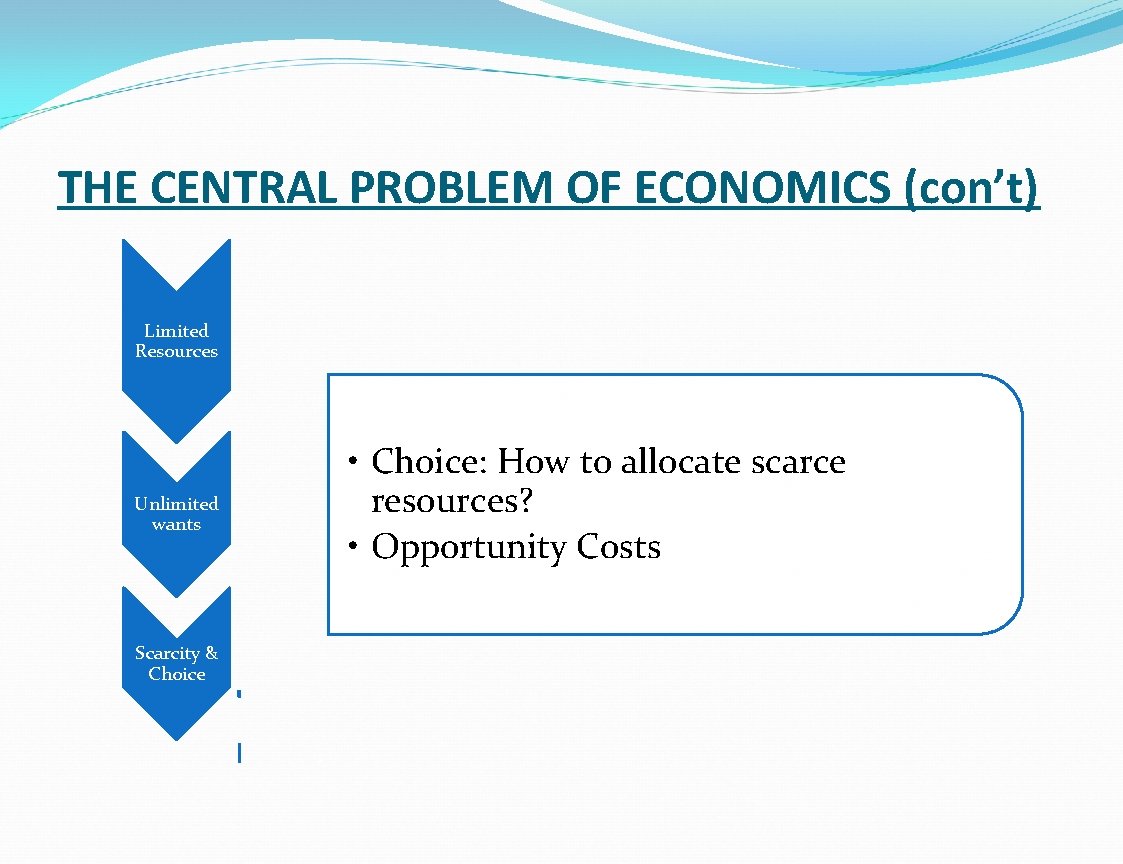
THE CENTRAL PROBLEM OF ECONOMICS (con’t) Limited Resources Unlimited wants Scarcity & Choice • Choice: How to allocate scarce resources? • Opportunity Costs
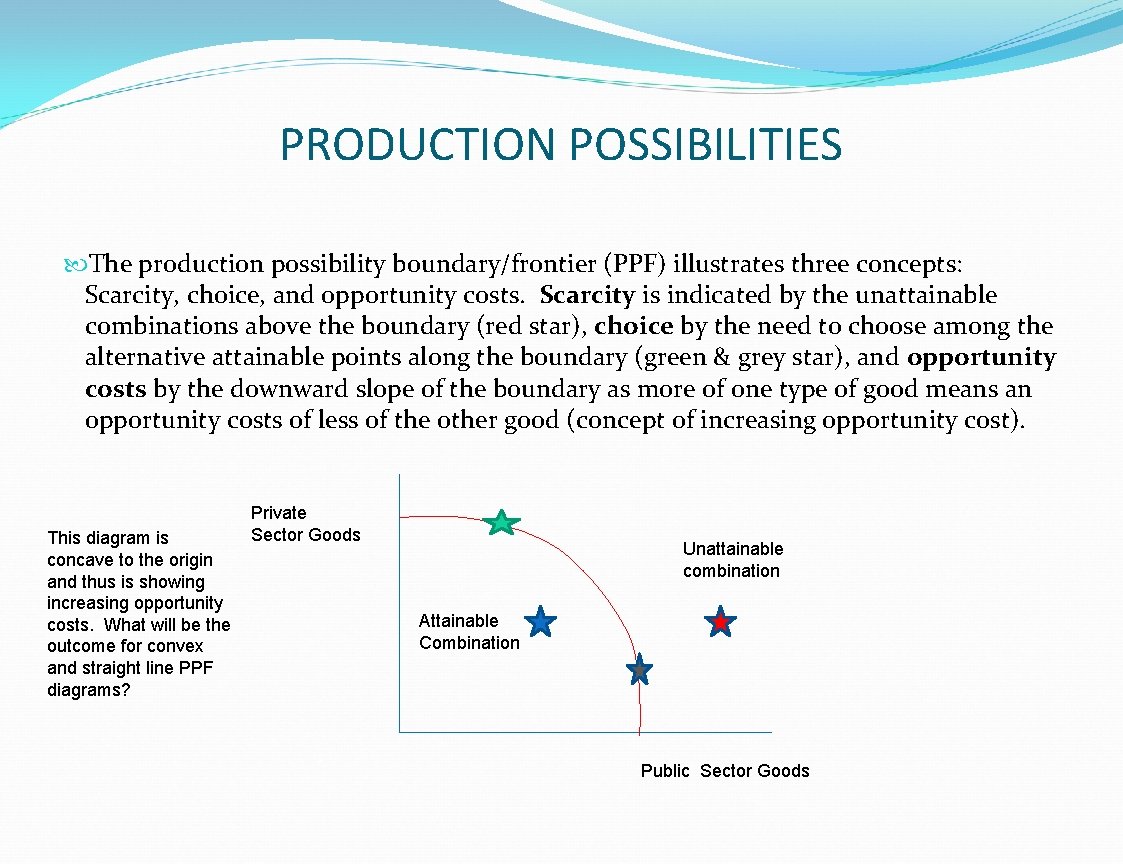
PRODUCTION POSSIBILITIES The production possibility boundary/frontier (PPF) illustrates three concepts: Scarcity, choice, and opportunity costs. Scarcity is indicated by the unattainable combinations above the boundary (red star), choice by the need to choose among the alternative attainable points along the boundary (green & grey star), and opportunity costs by the downward slope of the boundary as more of one type of good means an opportunity costs of less of the other good (concept of increasing opportunity cost). This diagram is concave to the origin and thus is showing increasing opportunity costs. What will be the outcome for convex and straight line PPF diagrams? Private Sector Goods Unattainable combination Attainable Combination Public Sector Goods
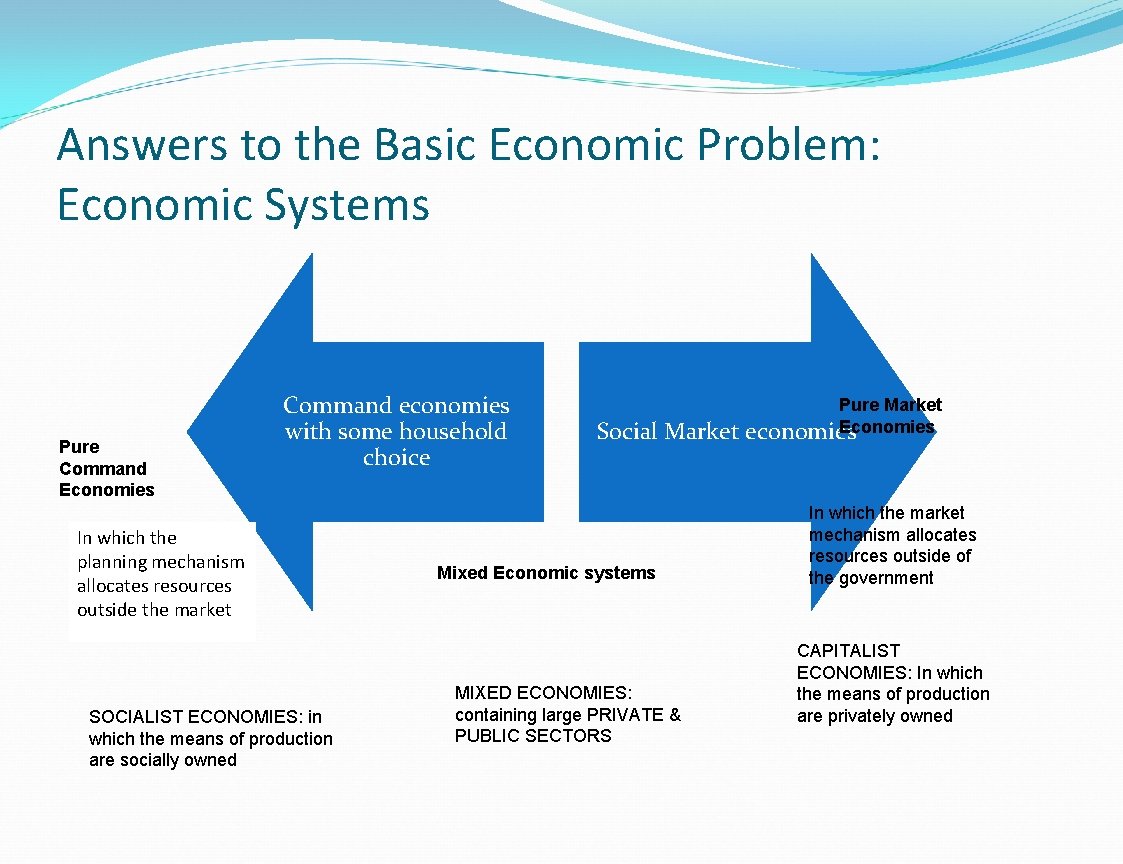
Answers to the Basic Economic Problem: Economic Systems Pure Command Economies Command economies with some household choice In which the planning mechanism allocates resources outside the market SOCIALIST ECONOMIES: in which the means of production are socially owned Social Market Mixed Economic systems MIXED ECONOMIES: containing large PRIVATE & PUBLIC SECTORS Pure Market Economies economies In which the market mechanism allocates resources outside of the government CAPITALIST ECONOMIES: In which the means of production are privately owned
THINKING LIKE AN ECONOMIST The scarcity principle (or the no-free-lunch principle): Thus as we have seen so far we have endless needs and wants, the resources available to us are limited. Hence having more of one thing implies having less of another. It follows that trade-offs results and a choice must be made amongst competing wants. Economists resolves such trade-offs by applying cost-benefit analysis
THINKING LIKE AN ECONOMIST (cont’d) The cost-benefit principle: Implies that an individual (or a firm or a society) should take an action if, and only if, the extra benefits (marginal benefit) from taking the action are at least as great as the extra costs (marginal costs). Now with this cost-benefit principle in mind, let’s consider your decision to attend Presentation College and you are now in your final year. A relevant question will be should I pursue my ‘A’ Levels or do extra job/s instead to earn money to save towards a down payment on a house.
The cost-benefit principle (Cont’d) Answer: pursue if and only if the value of the increase in potential earning outweighs its additional costs
THINKING LIKE AN ECONOMIST (cont’d) Scarcity and the trade-offs that results also apply to resources other than money. In a case cited by Frank and Bernanke (2001) Bill Gates is one of the richest men on earth. His wealth has been estimated at over US$100 billion. Gates has enough money to buy more houses, cars, vacations, and other consumer goods than he could probably use. Yet gates like the rest of us has only 24 hours each day and a limited amount of energy. All his activities uses up time and energy that he could otherwise spend on other things. Indeed, someone once calculated that the value of Gates time is so great that pausing to pick up a US$100 bill from the sidewalk simply wouldn’t be worth his while.
Cost-Benefit & Reservation Prices Reservation price refers to the highest price someone is willing to pay to obtain any good or service, or the lowest payment someone would accept for giving up a good or performing a service. Question: Should you wash your car before going out?
Question: Should you wash your car before going out? You have a date for dinner in one hour, when you suddenly realised that your car is dirty. It does not look to bad and you could certainly use it. But you will feel better if it washed, and you have the time to do it. On the other hand, you do not like to wash the car, and you will need 20 minutes to do the job – time that you could spend doing other things. The cost-benefit principle says that you wash your car if the benefit of doing so exceeds the cost. The problem is that we don’t have convenient ways to measure those benefits and costs. The solution involves applying the principle of opportunity costs and reservation prices. If the highest price you are willing to pay someone to wash your car is $20 then the benefit or reservation price for having your car wash is $20. However, if you are willing to accept $30 or more to wash someone else’s car and no less, then your cost of washing a car is $30.
Question: Should you wash your car before going out? Therefore, in this example, the benefit of washing your car is $20, and the cost of doing it is $30. Hence, your cost exceeds your benefit; your best course of action is not to wash your car.