
Capacity Planning Methodology 1 Learning Objectives Discuss the
Capacity Planning Methodology 1
Learning Objectives �Discuss the concept of adequate capacity of a system. �Introduce service level agreements. �Present a methodology for capacity planning. 2
Learning Objectives (cont’d) �Discuss the main steps of the methodology: – understanding the environment – workload characterization – workload forecasting – performance modeling – performance prediction – cost/performance analysis. Adapted from Menascé & Almeida. 3
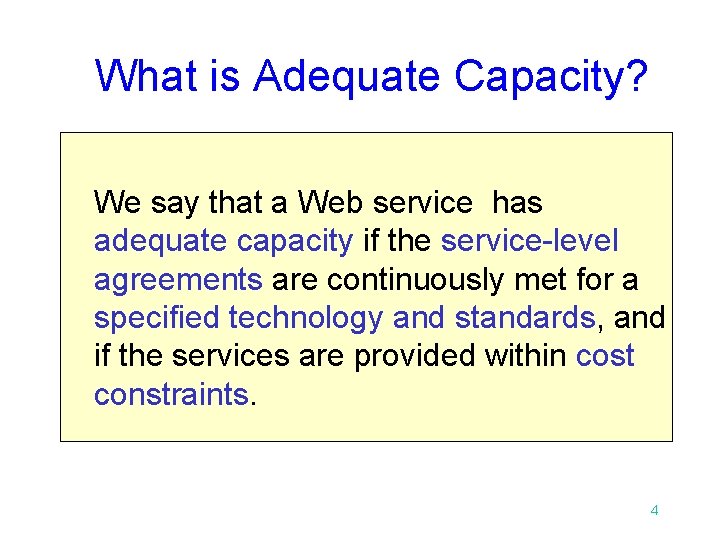
What is Adequate Capacity? We say that a Web service has adequate capacity if the service-level agreements are continuously met for a specified technology and standards, and if the services are provided within cost constraints. 4
Technology and Standards • T&S means, for instance: – HW for servers (and for clients) – O. S. software – LAN, WAN line infrastructure (type, speed) • Sometimes the choice is based on factors not related to performance: – ease of system administration – familiarity of personnel with the system – number/quality of vendors for HW/SW Adapted from Menascé & Almeida. 5
Service-Level Agreements (SLA) • SLAs determine what a user of an application can expect in terms of response time, throughput, system availability, and reliability – focus on metrics that users can understand – set easy-to-measure goals – tie IT costs to your SLAs 6
Service Level Agreements: examples • Response time for trivial database queries should not exceed 2 sec. • We want the same level of availability and response time that we had in the mainframe environment. • The goal for Web services is 99% of availability and less than 1 -sec response time for 90% of the HTTP requests for small documents. Adapted from Menascé & Almeida. 7
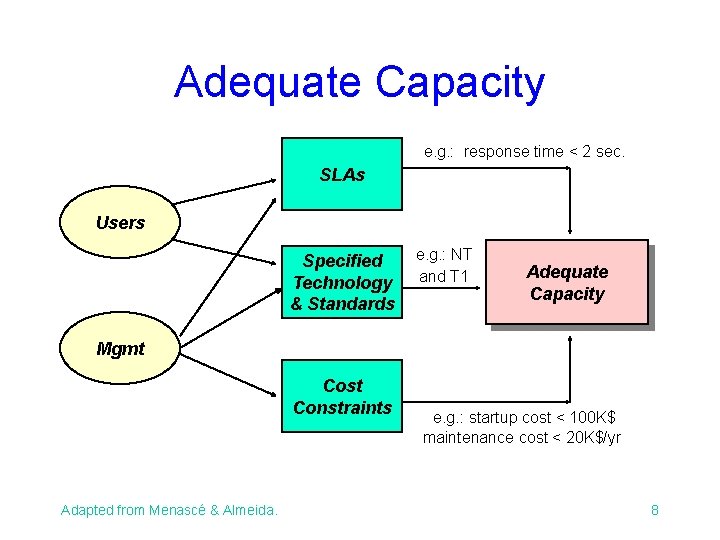
Adequate Capacity e. g. : response time < 2 sec. SLAs Users Specified Technology & Standards e. g. : NT and T 1 Adequate Capacity Mgmt Cost Constraints Adapted from Menascé & Almeida. e. g. : startup cost < 100 K$ maintenance cost < 20 K$/yr 8
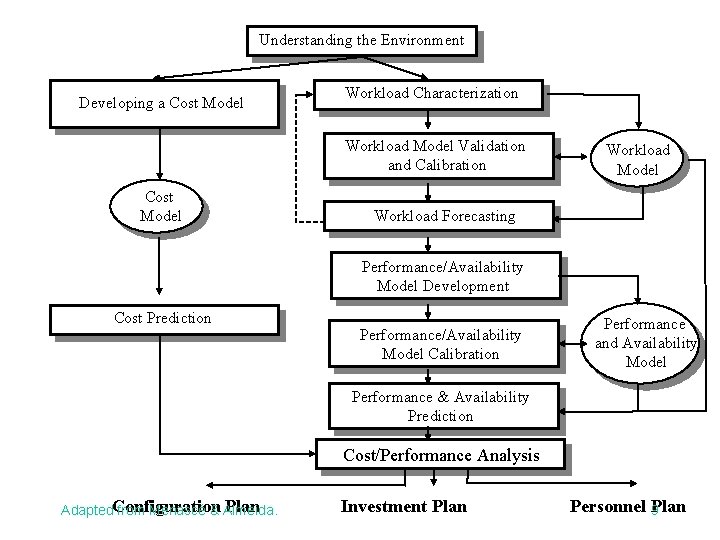
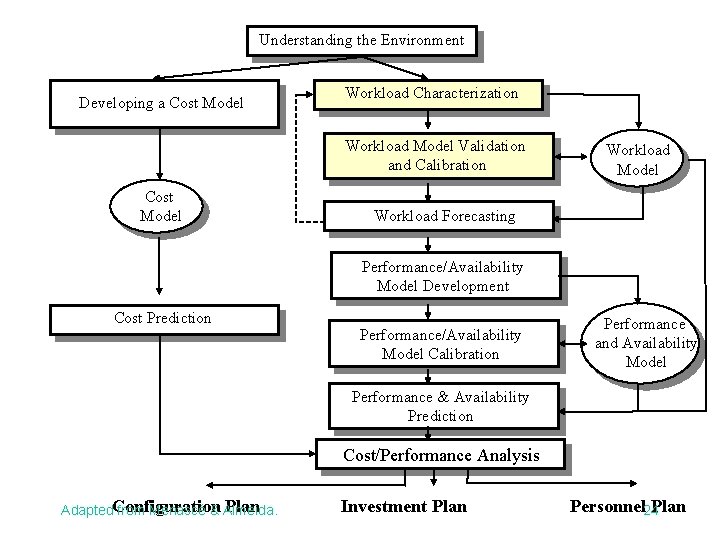
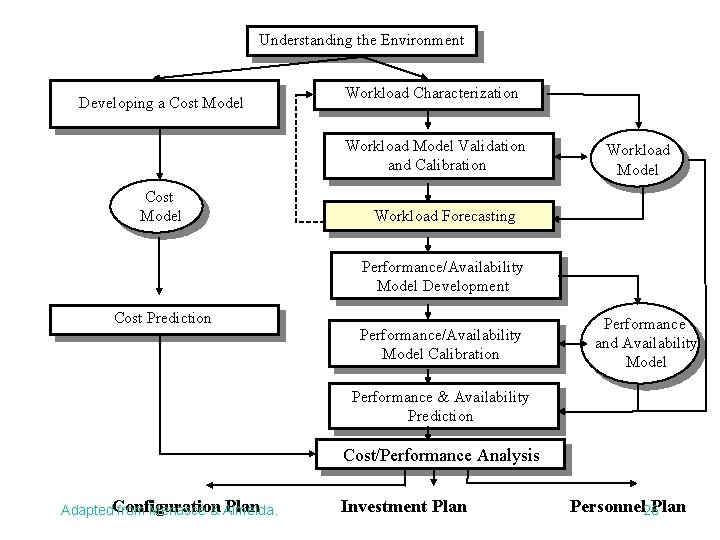
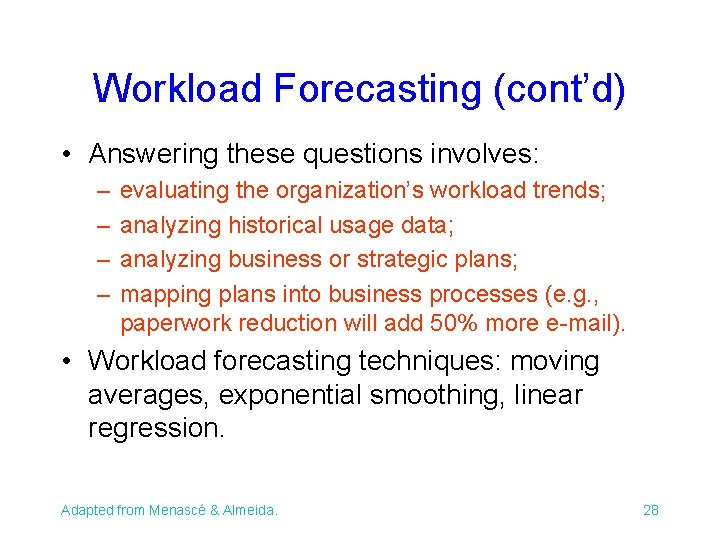
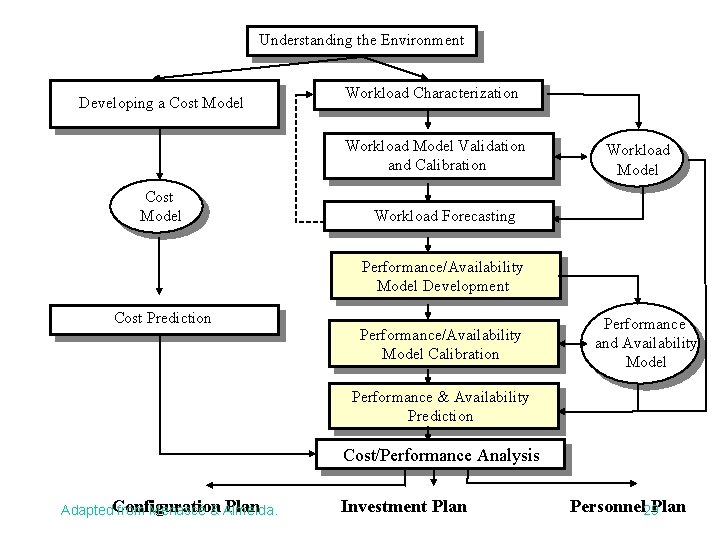
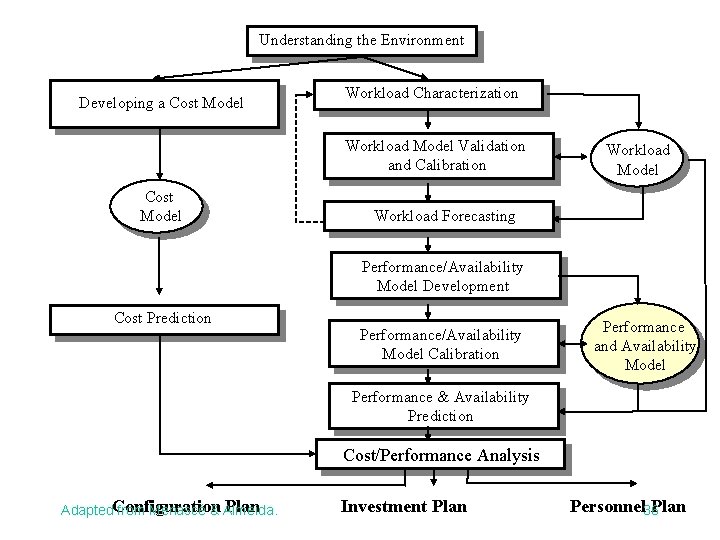
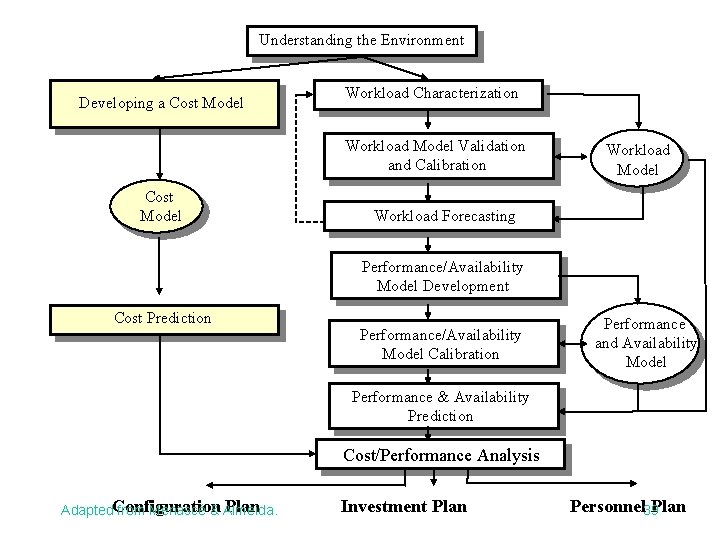
Understanding the Environment Developing a Cost Model Workload Characterization Workload Model Validation and Calibration Cost Model Workload Forecasting Performance/Availability Model Development Cost Prediction Performance/Availability Model Calibration Performance and Availability Model Performance & Availability Prediction Cost/Performance Analysis Plan Adapted. Configuration from Menascé & Almeida. Investment Plan Personnel Plan 9
The Three Models • Workload model: – resource demand, load intensity - for each component of a global workload • Performance model: – used to predict performance as function of system description and workload param. s – outputs: response times, throughputs, system resources utilizations, queue lengths, etc. Adapted from Menascé & Almeida. 10
The Three Models (cont. ) • Performance model (cont. ): – the performance metrics are matched against SLAs to check if capacity is adequate • Cost model: – accounts for SW, HW, TLC, personnel, training, support expenditures, etc. Adapted from Menascé & Almeida. 11
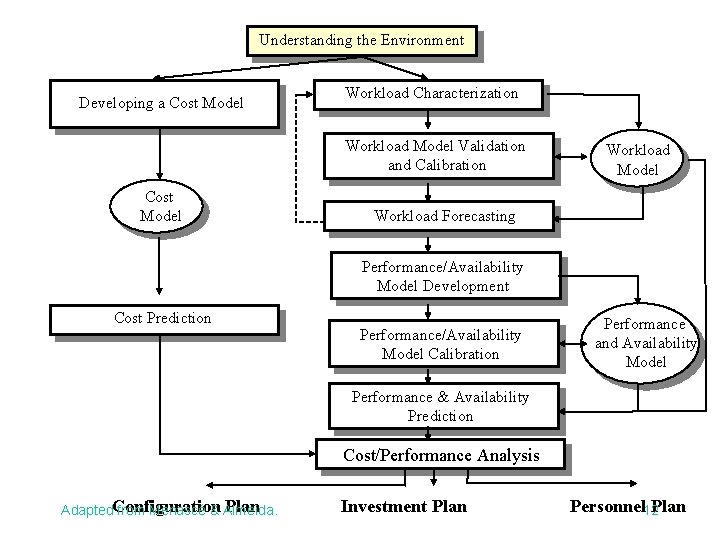
Understanding the Environment Developing a Cost Model Workload Characterization Workload Model Validation and Calibration Cost Model Workload Forecasting Performance/Availability Model Development Cost Prediction Performance/Availability Model Calibration Performance and Availability Model Performance & Availability Prediction Cost/Performance Analysis Plan Adapted. Configuration from Menascé & Almeida. Investment Plan Personnel 12 Plan
Understanding the Environment The goal is • to learn what kind of – hardware (clients and servers) – software (OS, middleware, applications) – network connectivity and protocols are present in the environment. • Identify peak periods, management structures, SLAs Adapted from Menascé & Almeida. 13
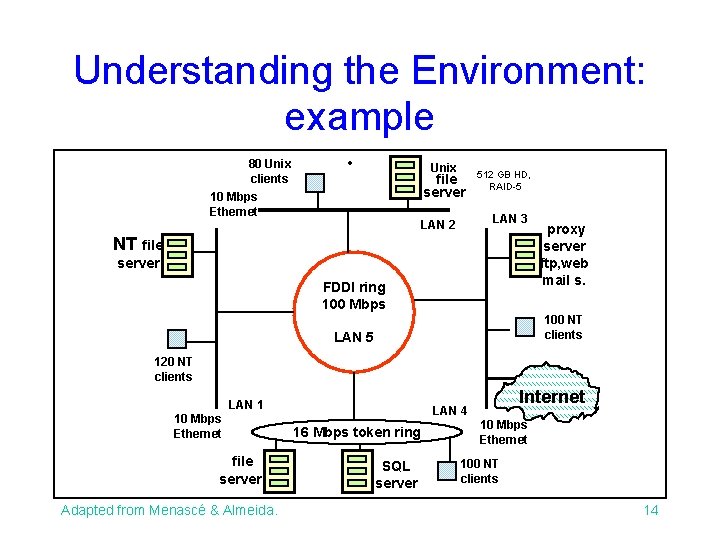
Understanding the Environment: example 80 Unix clients • Unix file server 10 Mbps Ethernet 512 GB HD, RAID-5 LAN 3 LAN 2 NT file server FDDI ring 100 Mbps proxy server ftp, web mail s. 100 NT clients LAN 5 120 NT clients LAN 1 10 Mbps Ethernet file server Adapted from Menascé & Almeida. Internet LAN 4 16 Mbps token ring SQL server 10 Mbps Ethernet 100 NT clients 14

Elements in Understanding the Environment Adapted from Menascé & Almeida. 15
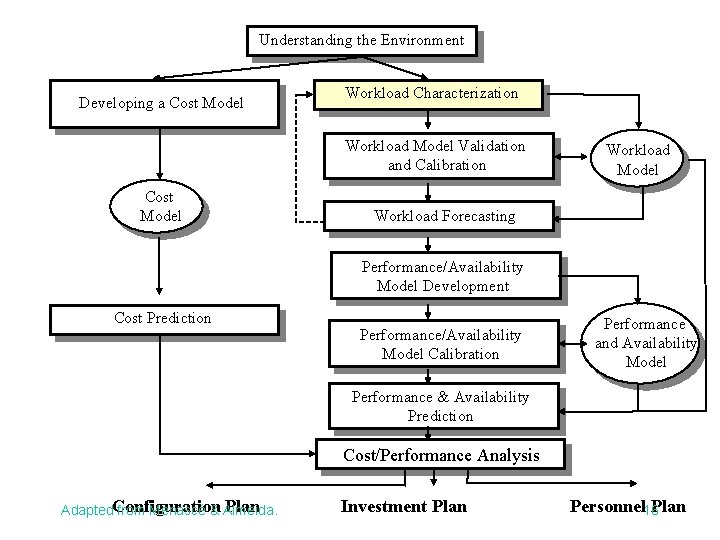
Understanding the Environment Developing a Cost Model Workload Characterization Workload Model Validation and Calibration Cost Model Workload Forecasting Performance/Availability Model Development Cost Prediction Performance/Availability Model Calibration Performance and Availability Model Performance & Availability Prediction Cost/Performance Analysis Plan Adapted. Configuration from Menascé & Almeida. Investment Plan Personnel 16 Plan
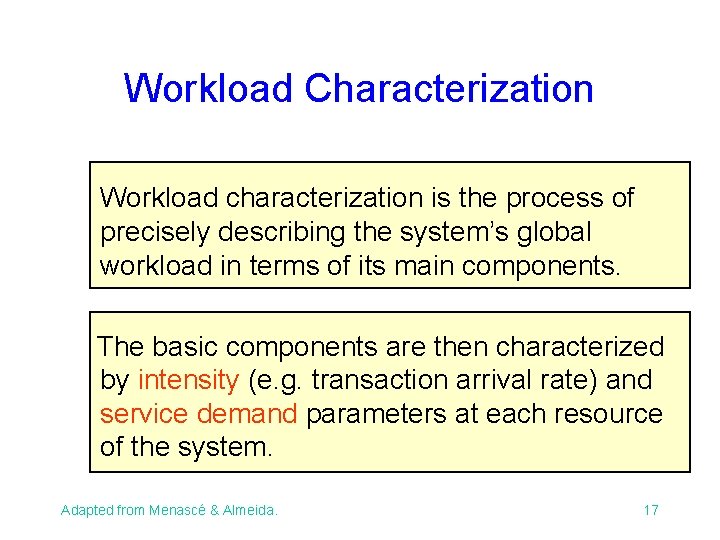
Workload Characterization Workload characterization is the process of precisely describing the system’s global workload in terms of its main components. The basic components are then characterized by intensity (e. g. transaction arrival rate) and service demand parameters at each resource of the system. Adapted from Menascé & Almeida. 17
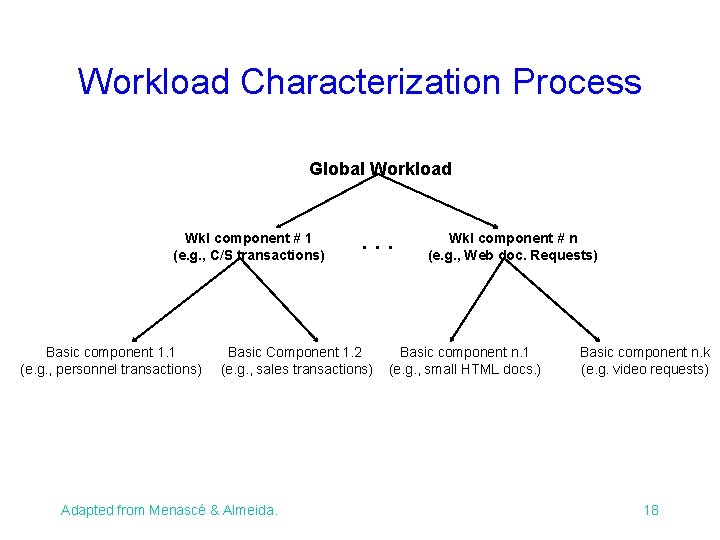
Workload Characterization Process Global Workload Wkl component # 1 (e. g. , C/S transactions) Basic component 1. 1 (e. g. , personnel transactions) . . . Basic Component 1. 2 (e. g. , sales transactions) Adapted from Menascé & Almeida. Wkl component # n (e. g. , Web doc. Requests) Basic component n. 1 (e. g. , small HTML docs. ) Basic component n. k (e. g. video requests) 18
Workload Description • Parameters for a basic component: must usually be derived indirectly (measurement or estimation of other parameters; usage of performance monitors, accounting systems, system log files, etc. ) • Measurements during normal and peak workload periods • Use of clustering algorithms Adapted from Menascé & Almeida. 19
Workload Description: example Adapted from Menascé & Almeida. 20
Workload Parameters • Workload intensity parameters: provide a measure of the load placed on system, indicated by number of units of work that contend for system resources • Workload service demand parameters: specify the total amount of service time required by each basic component at each resource Adapted from Menascé & Almeida. 21
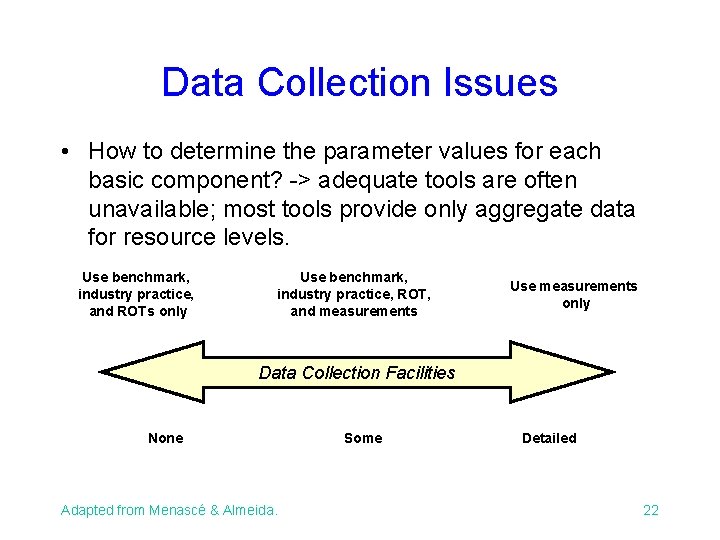
Data Collection Issues • How to determine the parameter values for each basic component? -> adequate tools are often unavailable; most tools provide only aggregate data for resource levels. Use benchmark, industry practice, and ROTs only Use benchmark, industry practice, ROT, and measurements Use measurements only Data Collection Facilities None Adapted from Menascé & Almeida. Some Detailed 22
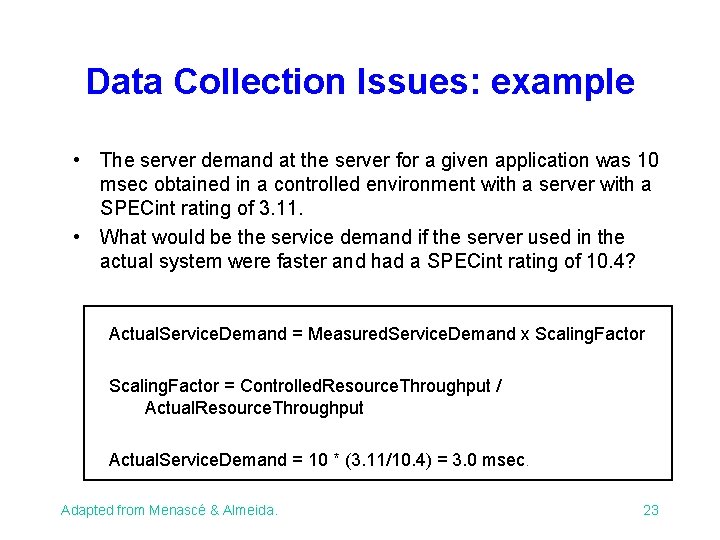
Data Collection Issues: example • The server demand at the server for a given application was 10 msec obtained in a controlled environment with a server with a SPECint rating of 3. 11. • What would be the service demand if the server used in the actual system were faster and had a SPECint rating of 10. 4? Actual. Service. Demand = Measured. Service. Demand x Scaling. Factor = Controlled. Resource. Throughput / Actual. Resource. Throughput Actual. Service. Demand = 10 * (3. 11/10. 4) = 3. 0 msec. Adapted from Menascé & Almeida. 23
Understanding the Environment Developing a Cost Model Workload Characterization Workload Model Validation and Calibration Cost Model Workload Forecasting Performance/Availability Model Development Cost Prediction Performance/Availability Model Calibration Performance and Availability Model Performance & Availability Prediction Cost/Performance Analysis Plan Adapted. Configuration from Menascé & Almeida. Investment Plan Personnel 24 Plan
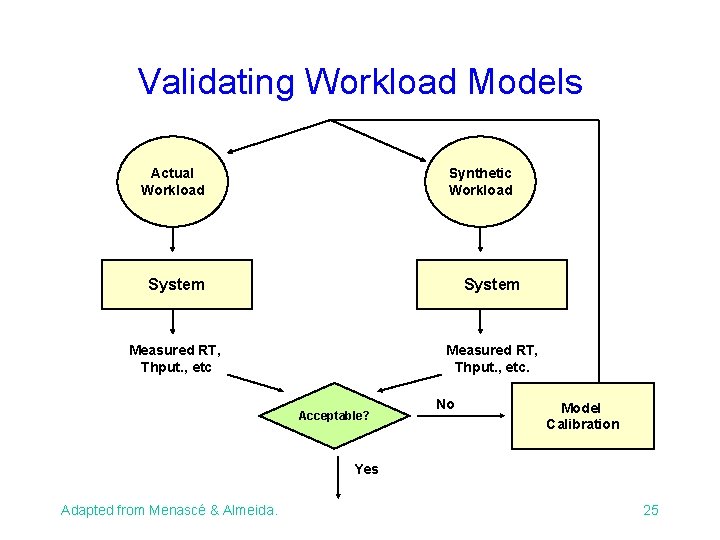
Validating Workload Models Actual Workload Synthetic Workload System Measured RT, Thput. , etc. Acceptable? No Model Calibration Yes Adapted from Menascé & Almeida. 25
Understanding the Environment Developing a Cost Model Workload Characterization Workload Model Validation and Calibration Cost Model Workload Forecasting Performance/Availability Model Development Cost Prediction Performance/Availability Model Calibration Performance and Availability Model Performance & Availability Prediction Cost/Performance Analysis Plan Adapted. Configuration from Menascé & Almeida. Investment Plan Personnel 26 Plan
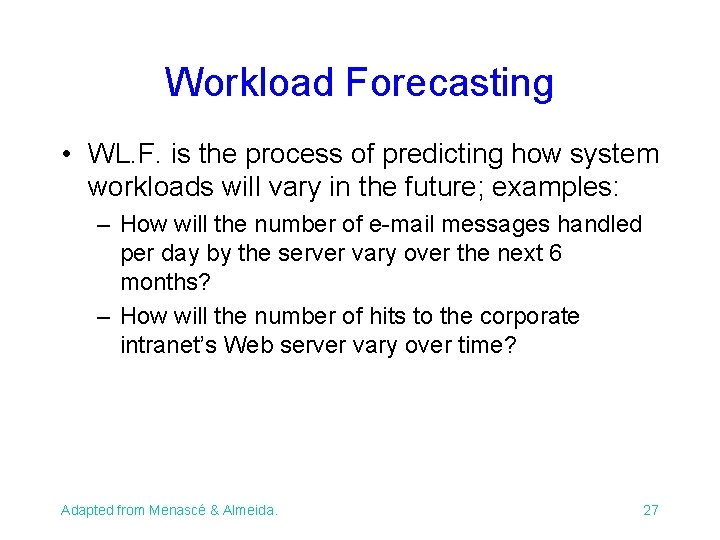
Workload Forecasting • WL. F. is the process of predicting how system workloads will vary in the future; examples: – How will the number of e-mail messages handled per day by the server vary over the next 6 months? – How will the number of hits to the corporate intranet’s Web server vary over time? Adapted from Menascé & Almeida. 27
Workload Forecasting (cont’d) • Answering these questions involves: – – evaluating the organization’s workload trends; analyzing historical usage data; analyzing business or strategic plans; mapping plans into business processes (e. g. , paperwork reduction will add 50% more e-mail). • Workload forecasting techniques: moving averages, exponential smoothing, linear regression. Adapted from Menascé & Almeida. 28
Understanding the Environment Developing a Cost Model Workload Characterization Workload Model Validation and Calibration Cost Model Workload Forecasting Performance/Availability Model Development Cost Prediction Performance/Availability Model Calibration Performance and Availability Model Performance & Availability Prediction Cost/Performance Analysis Plan Adapted. Configuration from Menascé & Almeida. Investment Plan Personnel 29 Plan
Performance Modeling and Prediction • Is the process of estimating performance measures of a computer system for a given set of parameters. • How are performance measures estimated? System and Workload Description Adapted from Menascé & Almeida. Performance metrics: response time, throughput, utilization, etc 30
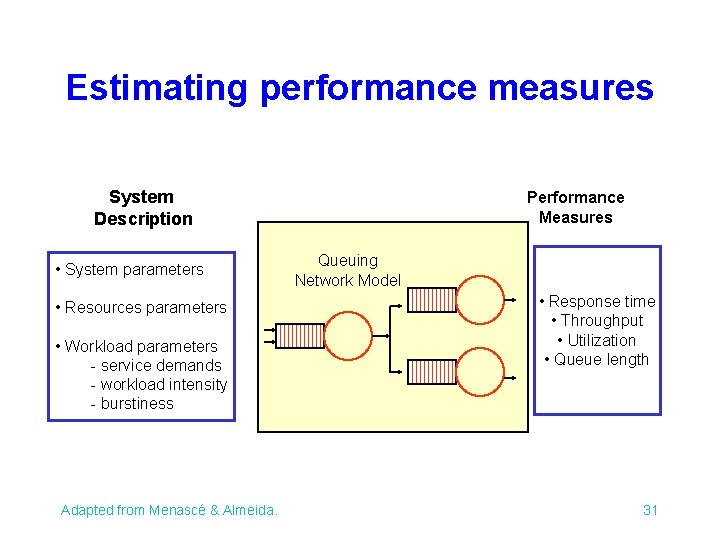
Estimating performance measures System Description • System parameters • Resources parameters • Workload parameters - service demands - workload intensity - burstiness Adapted from Menascé & Almeida. Performance Measures Queuing Network Model • Response time • Throughput • Utilization • Queue length 31
Parameters (Affecting Performance) (I) • System parameters examples: – load-balancing disciplines for WEB serv. s – network protocols – max. numb. of connections supported – max. numb. of threads supported by DBMS • Resource parameters examples: – disk seek times, latency, transfer rate – network bandwidth; router latency – CPU speed Adapted from Menascé & Almeida. 32
Parameters (Affecting Performance) (II) • Workload parameters examples: – WL intensity parameters: • • numb. of hits/day of Web proxy numb. of requests/second to file server numb. of sales transactions to DB server numb. of clients running scientific applications – WL service demand parameters: • CPU time of transactions at DB server • total transmission of replies from DB server • total I/O time at Web proxy for images and video clips Adapted from Menascé & Almeida. 33
Queuing Network Models • Performance prediction requires use of models • Two types: – analytical models: set of formulas and/or computational algorithms ->studied in this course – simulation models: computer programs, all resources and the dataflow are simulated • Both types must consider contention queues • The various queues are interconnected: network of queues Adapted from Menascé & Almeida. 34
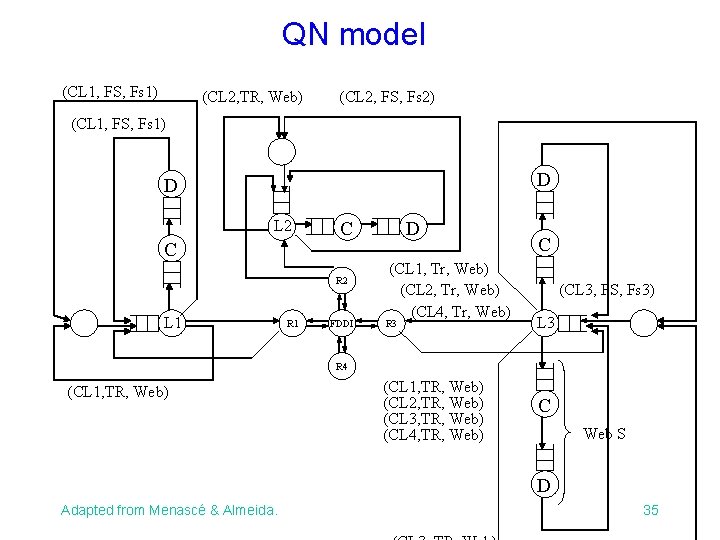
QN model (CL 1, FS, Fs 1) (CL 2, TR, Web) (CL 2, FS, Fs 2) (CL 1, FS, Fs 1) D D L 2 C C R 2 L 1 R 1 FDDI D (CL 1, Tr, Web) (CL 2, Tr, Web) (CL 4, Tr, Web) R 3 C (CL 3, FS, Fs 3) L 3 R 4 (CL 1, TR, Web) (CL 2, TR, Web) (CL 3, TR, Web) (CL 4, TR, Web) C Web S D Adapted from Menascé & Almeida. 35
Understanding the Environment Developing a Cost Model Workload Characterization Workload Model Validation and Calibration Cost Model Workload Forecasting Performance/Availability Model Development Cost Prediction Performance/Availability Model Calibration Performance and Availability Model Performance & Availability Prediction Cost/Performance Analysis Plan Adapted. Configuration from Menascé & Almeida. Investment Plan Personnel 36 Plan
Performance Model Validation • A performance model is said to be valid if the performance metrics calculated by the model match the actual system, within an acceptable error margin. Usually 10 to 30% are acceptable in Capacity Planning. Adapted from Menascé & Almeida. 37
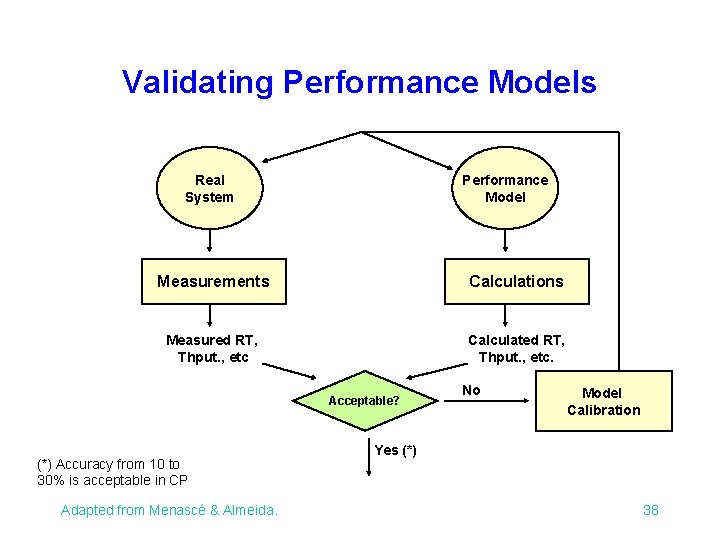
Validating Performance Models Real System Performance Model Measurements Calculations Measured RT, Thput. , etc Calculated RT, Thput. , etc. Acceptable? (*) Accuracy from 10 to 30% is acceptable in CP Adapted from Menascé & Almeida. No Model Calibration Yes (*) 38
Understanding the Environment Developing a Cost Model Workload Characterization Workload Model Validation and Calibration Cost Model Workload Forecasting Performance/Availability Model Development Cost Prediction Performance/Availability Model Calibration Performance and Availability Model Performance & Availability Prediction Cost/Performance Analysis Plan Adapted. Configuration from Menascé & Almeida. Investment Plan Personnel 39 Plan
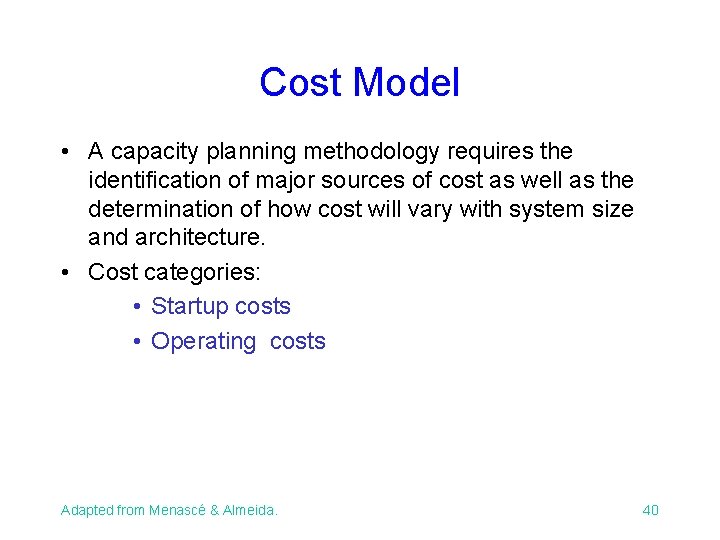
Cost Model • A capacity planning methodology requires the identification of major sources of cost as well as the determination of how cost will vary with system size and architecture. • Cost categories: • Startup costs • Operating costs Adapted from Menascé & Almeida. 40
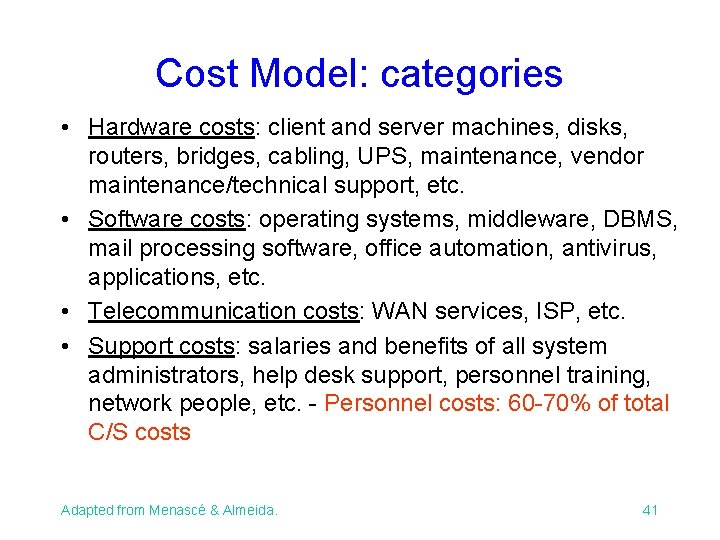
Cost Model: categories • Hardware costs: client and server machines, disks, routers, bridges, cabling, UPS, maintenance, vendor maintenance/technical support, etc. • Software costs: operating systems, middleware, DBMS, mail processing software, office automation, antivirus, applications, etc. • Telecommunication costs: WAN services, ISP, etc. • Support costs: salaries and benefits of all system administrators, help desk support, personnel training, network people, etc. - Personnel costs: 60 -70% of total C/S costs Adapted from Menascé & Almeida. 41
Cost/Performance Analysis • Cost and performance models: used to assess possible scenarios, e. g. – mirror Web server to balance load? – replace Web server with faster one? – Move to a 3 -tier architecture? • For each scenario, predict performances and costs • From comparison of scenarios, get – configuration plan – investment plan – personnel plan • Assess payback: ROI (Return on Investment), company’s image strategy, shorter time-to-market, etc. Adapted from Menascé & Almeida. 42
Summary �Concept of adequate capacity �Service Level Agreement (SLA) �Framework of a methodology for capacity planning: �workload characterization �workload forecasting �performance modeling and prediction �model validation �cost model 43
- Slides: 43