
CAPACITY Objectives Select and use the appropriate instruments
CAPACITY Objectives: Select and use the appropriate instruments of measurement. Estimate and measure capacity using appropriate metric units.
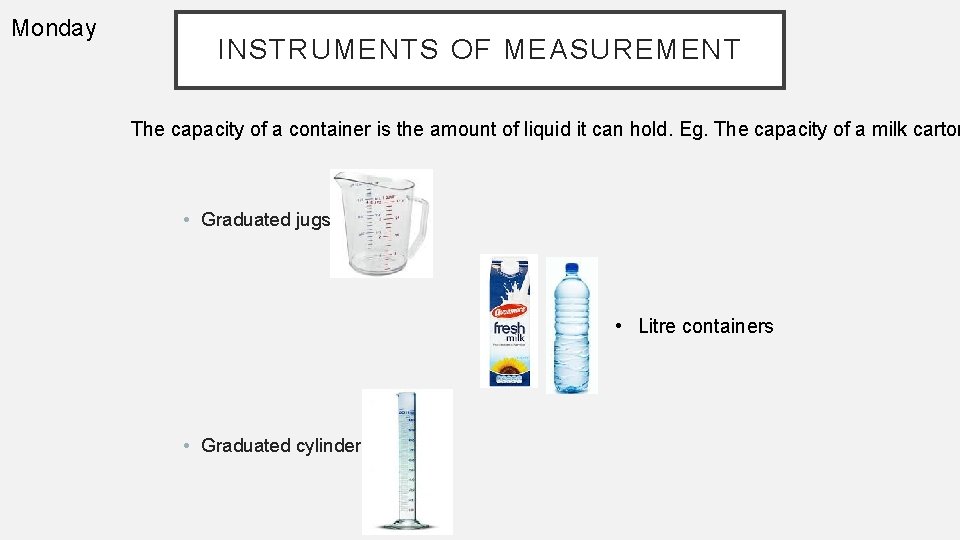
Monday INSTRUMENTS OF MEASUREMENT The capacity of a container is the amount of liquid it can hold. Eg. The capacity of a milk carton • Graduated jugs • Litre containers • Graduated cylinder
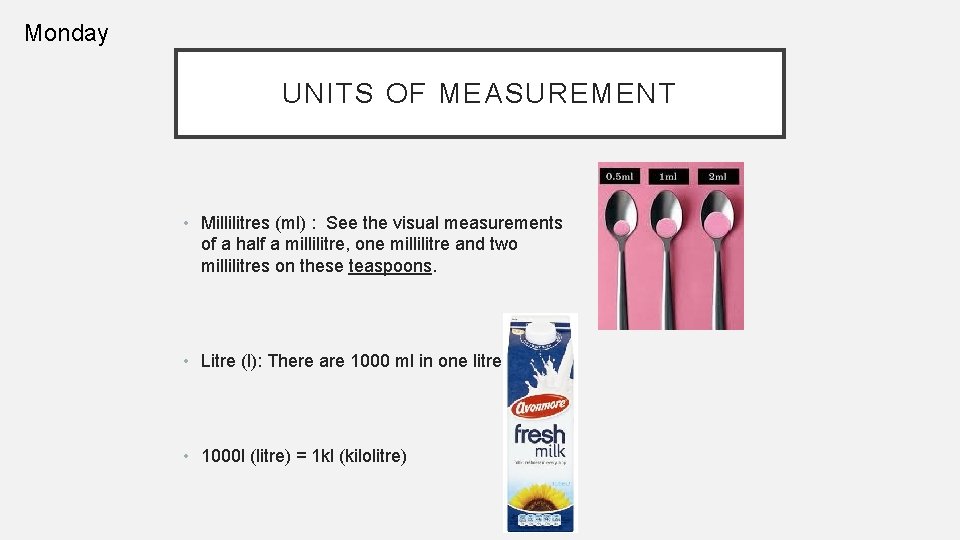
Monday UNITS OF MEASUREMENT • Millilitres (ml) : See the visual measurements of a half a millilitre, one millilitre and two millilitres on these teaspoons. • Litre (l): There are 1000 ml in one litre. • 1000 l (litre) = 1 kl (kilolitre)
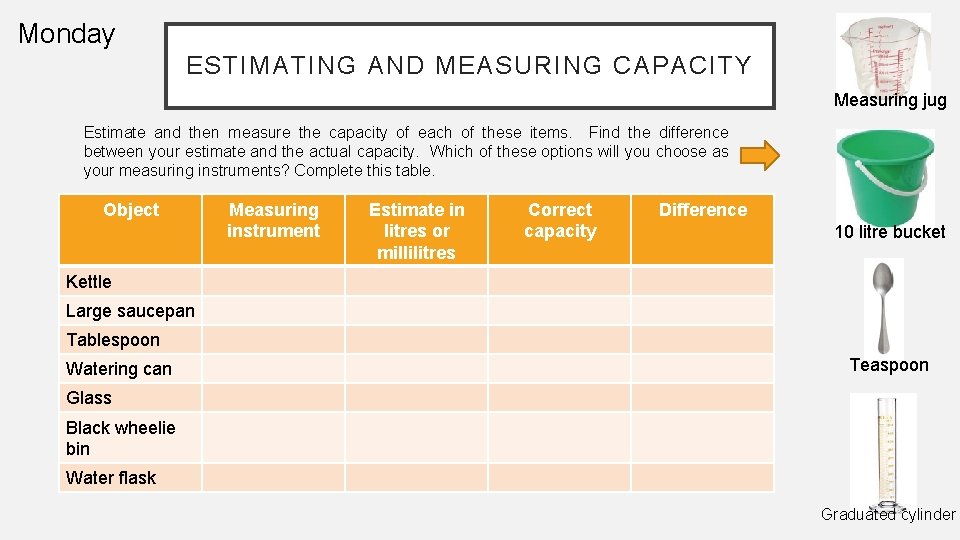
Monday ESTIMATING AND MEASURING CAPACITY Measuring jug Estimate and then measure the capacity of each of these items. Find the difference between your estimate and the actual capacity. Which of these options will you choose as your measuring instruments? Complete this table. Object Measuring instrument Estimate in litres or millilitres Correct capacity Difference 10 litre bucket Kettle Large saucepan Tablespoon Watering can Teaspoon Glass Black wheelie bin Water flask Graduated cylinder
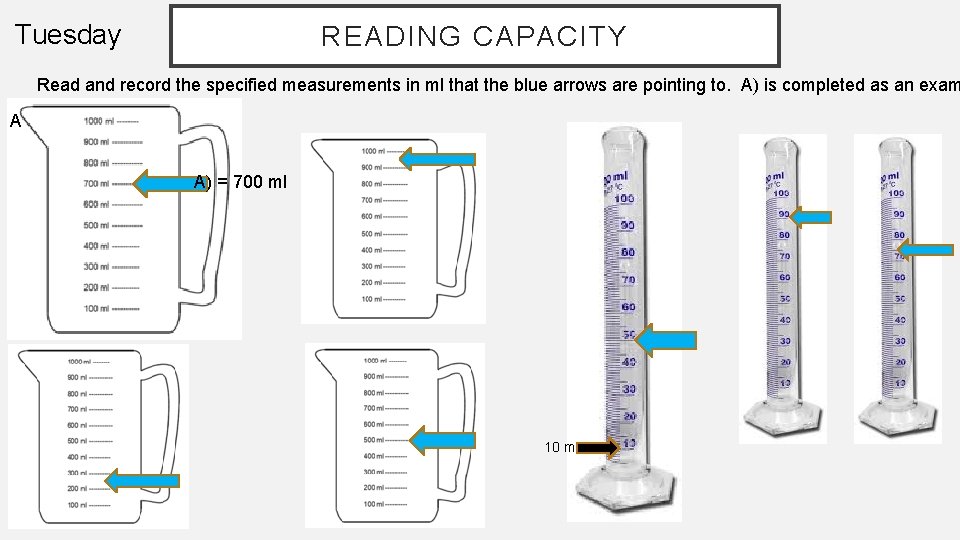
Tuesday READING CAPACITY Read and record the specified measurements in ml that the blue arrows are pointing to. A) is completed as an exam A A) = 700 ml 10 ml
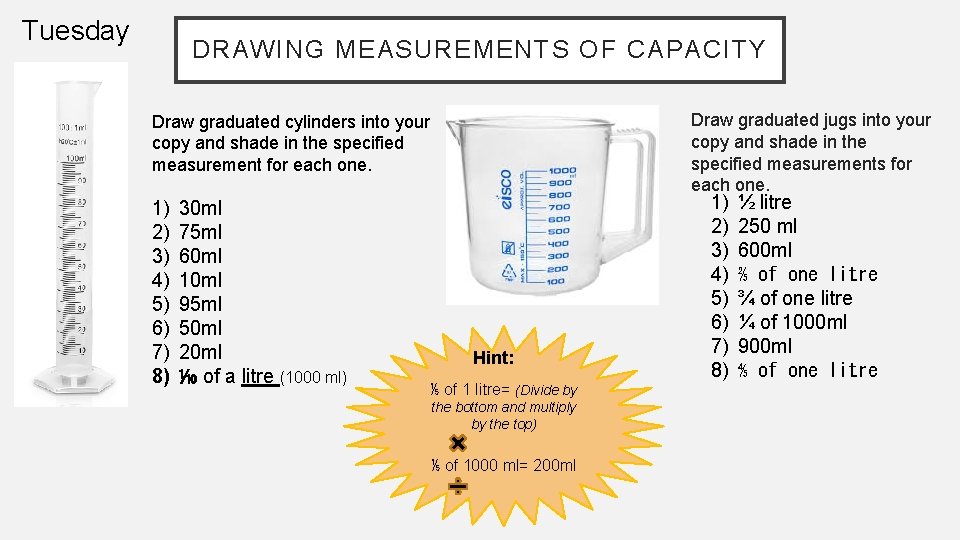
Tuesday DRAWING MEASUREMENTS OF CAPACITY Draw graduated jugs into your copy and shade in the specified measurements for each one. Draw graduated cylinders into your copy and shade in the specified measurement for each one. 1) 2) 3) 4) 5) 6) 7) 8) 30 ml 75 ml 60 ml 10 ml 95 ml 50 ml 20 ml ⅒ of a litre (1000 ml) Hint: ⅕ of 1 litre= (Divide by the bottom and multiply by the top) ⅕ of 1000 ml= 200 ml 1) 2) 3) 4) 5) 6) 7) 8) ½ litre 250 ml 600 ml ⅖ of one litre ¾ of one litre ¼ of 1000 ml 900 ml ⅘ of one litre
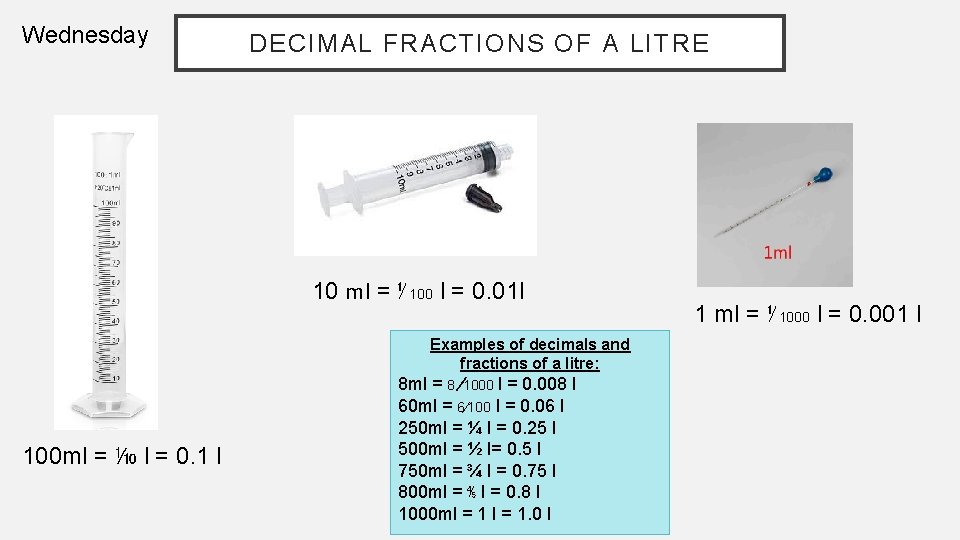
Wednesday DECIMAL FRACTIONS OF A LITRE 10 ml = ⅟ 100 l = 0. 01 l Examples of decimals and fractions of a litre: 100 ml = ⅒ l = 0. 1 l 8 ml = 8 ⁄1000 l = 0. 008 l 60 ml = 6⁄100 l = 0. 06 l 250 ml = ¼ l = 0. 25 l 500 ml = ½ l= 0. 5 l 750 ml = ¾ l = 0. 75 l 800 ml = ⅘ l = 0. 8 l 1000 ml = 1. 0 l 1 ml = ⅟ 1000 l = 0. 001 l
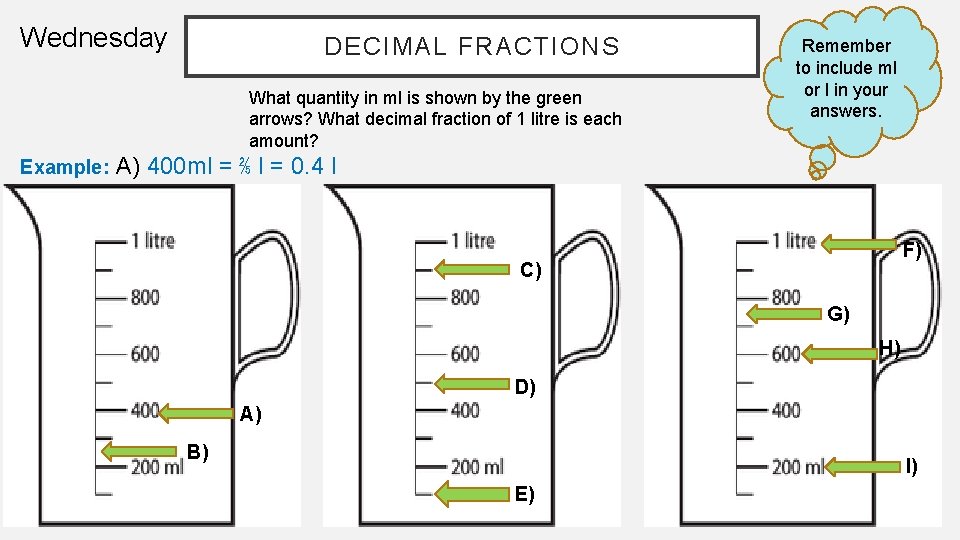
Wednesday DECIMAL FRACTIONS What quantity in ml is shown by the green arrows? What decimal fraction of 1 litre is each amount? Example: Remember to include ml or l in your answers. A) 400 ml = ⅖ l = 0. 4 l F) C) G) H) D) A) B) I) E)
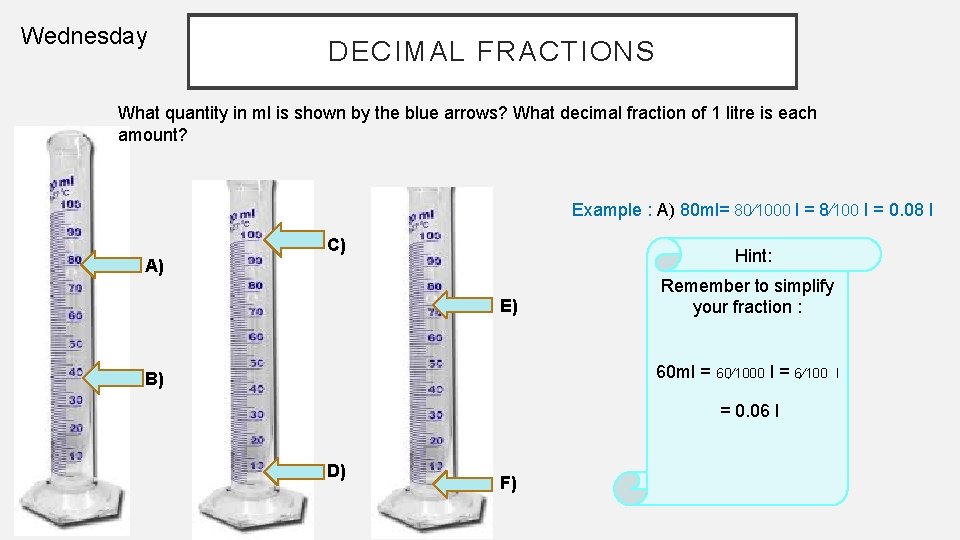
Wednesday DECIMAL FRACTIONS What quantity in ml is shown by the blue arrows? What decimal fraction of 1 litre is each amount? Example : A) 80 ml= 80⁄1000 l = 8⁄100 l = 0. 08 l C) Hint: A) E) Remember to simplify your fraction : 60 ml = 60⁄1000 l = 6⁄100 B) = 0. 06 l D) F) l
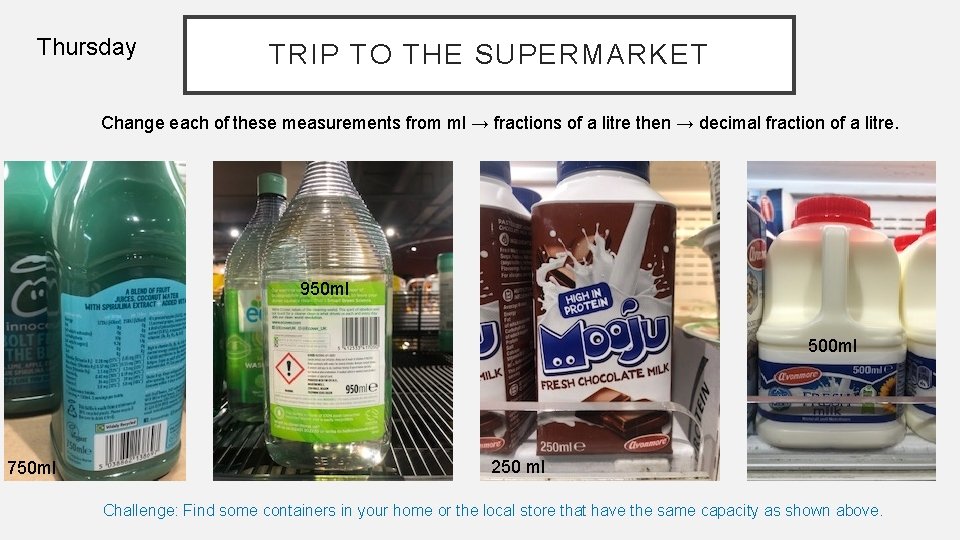
Thursday TRIP TO THE SUPERMARKET Change each of these measurements from ml → fractions of a litre then → decimal fraction of a litre. 950 ml 500 ml 750 ml 250 ml Challenge: Find some containers in your home or the local store that have the same capacity as shown above.
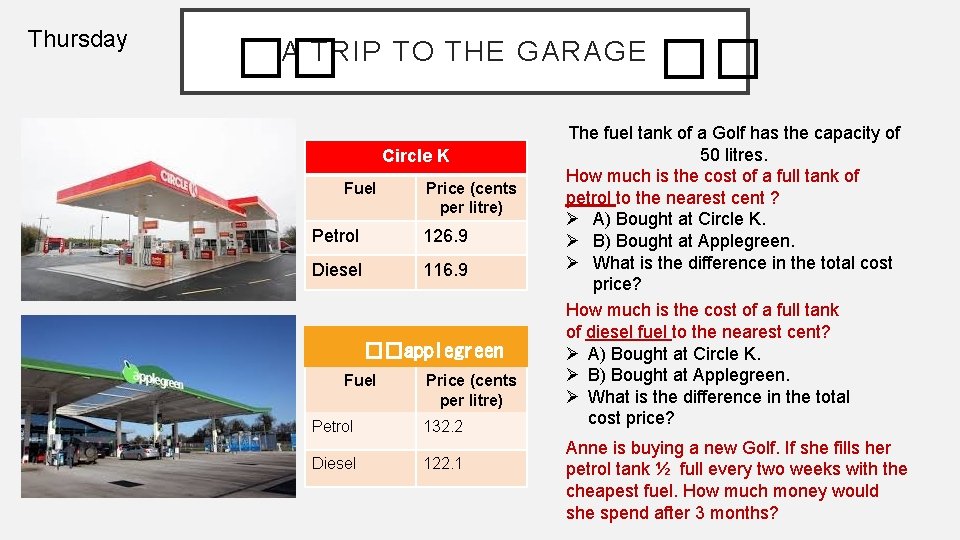
Thursday �� A TRIP TO THE GARAGE Circle K Fuel Price (cents per litre) Petrol 126. 9 Diesel 116. 9 ��applegreen Fuel Petrol Diesel Price (cents per litre) 132. 2 122. 1 �� The fuel tank of a Golf has the capacity of 50 litres. How much is the cost of a full tank of petrol to the nearest cent ? Ø A) Bought at Circle K. Ø B) Bought at Applegreen. Ø What is the difference in the total cost price? How much is the cost of a full tank of diesel fuel to the nearest cent? Ø A) Bought at Circle K. Ø B) Bought at Applegreen. Ø What is the difference in the total cost price? Anne is buying a new Golf. If she fills her petrol tank ½ full every two weeks with the cheapest fuel. How much money would she spend after 3 months?
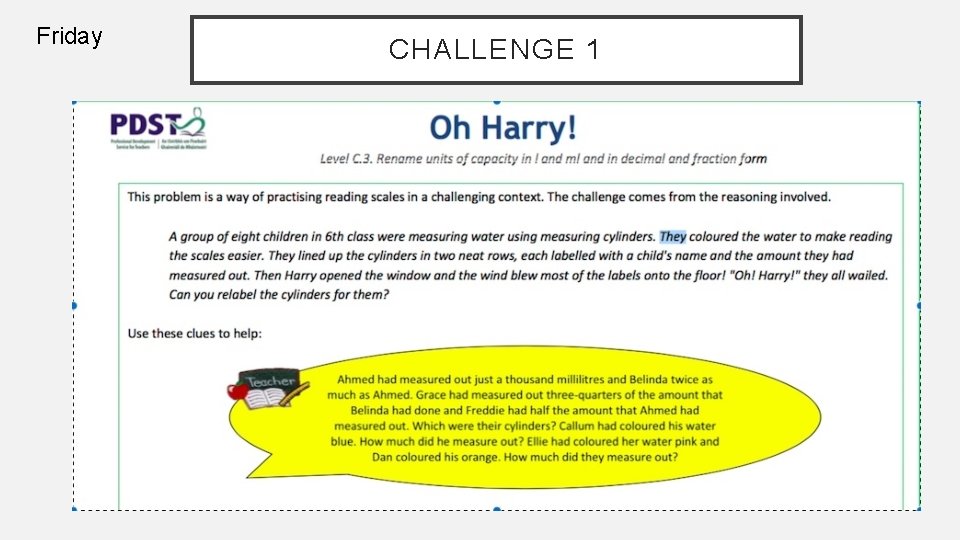
Friday CHALLENGE 1
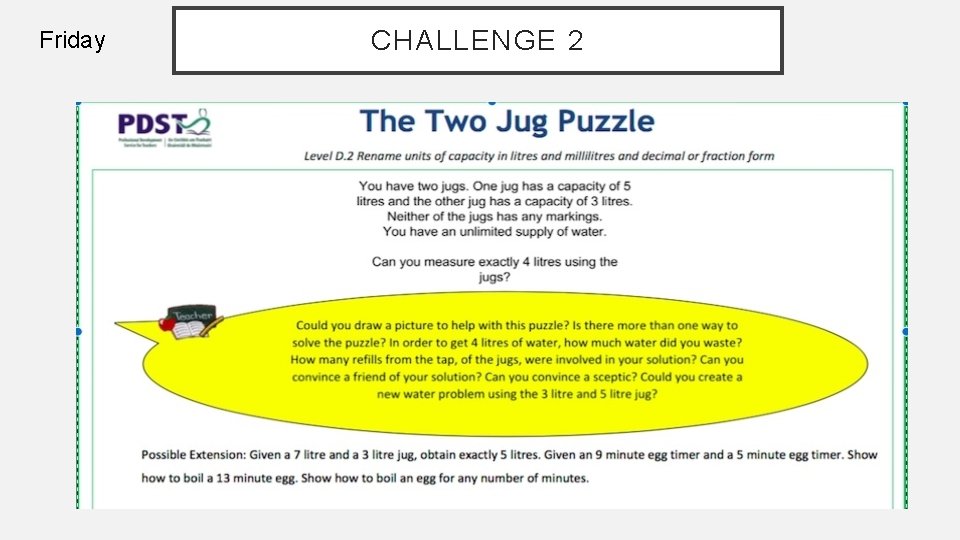
Friday CHALLENGE 2
- Slides: 13