
Capacity Building Programme on the Economics of Adaptation
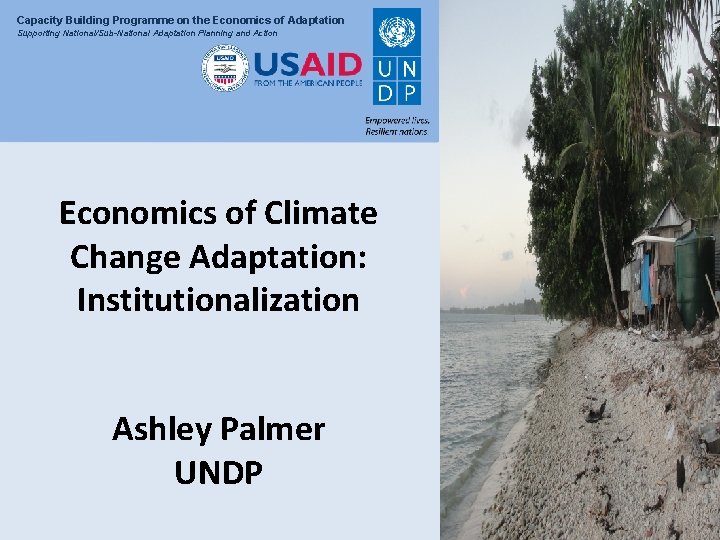
Capacity Building Programme on the Economics of Adaptation Supporting National/Sub-National Adaptation Planning and Action Economics of Climate Presentation Title Change Adaptation: Institutionalization Ashley Palmer UNDP
Introduction • “Initially targeting countries in the Asia region, the programme aims to develop technical skills within relevant national institutions and advance regional knowledge exchange on the economics of adaptation to support medium and long-term climate resilient development planning and budgeting. ” Capacity Building Programme on the Economics of Adaptation Supporting National/Sub-National Adaptation Planning and Action
Economics of Climate Change Adaptation: Institutionalization • Institutionalization: what does it mean? – Embedding a capacity development (CD) program within a broader institutional system: not “one-time/one-off” – Considering the intersection/nexus of technical capacities with functional capacities and also with broader systems • Making the link to Sustainability and to Development Results (not Capacity Development for the sake of Capacity Devt) Capacity Building Programme on the Economics of Adaptation Supporting National/Sub-National Adaptation Planning and Action
Issues for Consideration • Technical and Functional Capacities – Technical capacities: includes skills such as economic analysis; cost-benefit analysis – Functional capacities: cross cutting; enable the “use” of technical skills Capacity Building Programme on the Economics of Adaptation Supporting National/Sub-National Adaptation Planning and Action
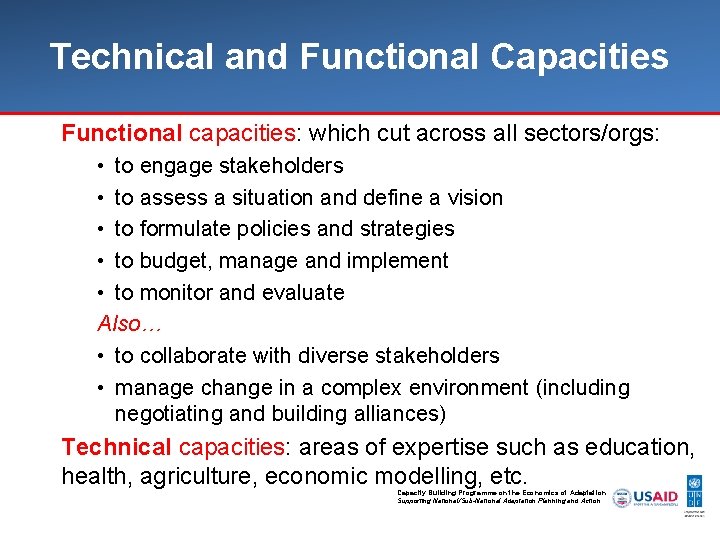
Technical and Functional Capacities Functional capacities: which cut across all sectors/orgs: • to engage stakeholders • to assess a situation and define a vision • to formulate policies and strategies • to budget, manage and implement • to monitor and evaluate Also… • to collaborate with diverse stakeholders • manage change in a complex environment (including negotiating and building alliances) Technical capacities: areas of expertise such as education, health, agriculture, economic modelling, etc. Capacity Building Programme on the Economics of Adaptation Supporting National/Sub-National Adaptation Planning and Action
Why is this distinction important? • Examples of investment in a technical competency area without also thinking through the systems that support the effective use of that technical skill • We often focus too much on technical, without thinking about functional and about broader systems • Therefore, a need to embed technical in systems context, and balance with functional Capacity Building Programme on the Economics of Adaptation Supporting National/Sub-National Adaptation Planning and Action
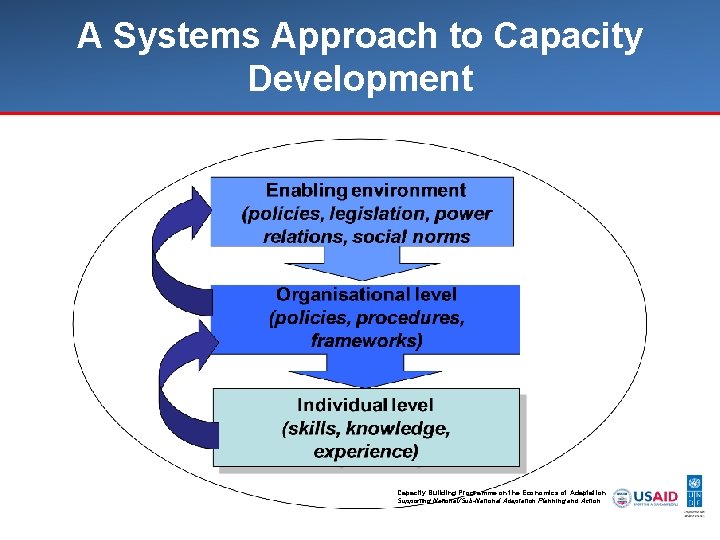
A Systems Approach to Capacity Development Capacity Building Programme on the Economics of Adaptation Supporting National/Sub-National Adaptation Planning and Action
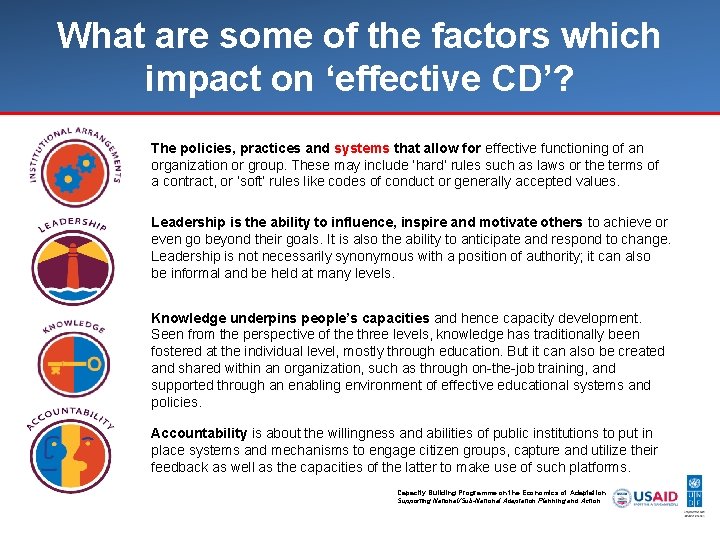
What are some of the factors which impact on ‘effective CD’? The policies, practices and systems that allow for effective functioning of an organization or group. These may include ‘hard’ rules such as laws or the terms of a contract, or ‘soft’ rules like codes of conduct or generally accepted values. Leadership is the ability to influence, inspire and motivate others to achieve or even go beyond their goals. It is also the ability to anticipate and respond to change. Leadership is not necessarily synonymous with a position of authority; it can also be informal and be held at many levels. Knowledge underpins people’s capacities and hence capacity development. Seen from the perspective of the three levels, knowledge has traditionally been fostered at the individual level, mostly through education. But it can also be created and shared within an organization, such as through on-the-job training, and supported through an enabling environment of effective educational systems and policies. Accountability is about the willingness and abilities of public institutions to put in place systems and mechanisms to engage citizen groups, capture and utilize their feedback as well as the capacities of the latter to make use of such platforms. Capacity Building Programme on the Economics of Adaptation Supporting National/Sub-National Adaptation Planning and Action
Example: Local Governance and Decentralization • The problem: getting stuck in “low capacity” assumptions about local governments being unable to fulfill roles related to service delivery • The example: local government block grants • The details: local governments need more than training; need capital budget; opportunity to learn by doing (targeted CD) and demonstrate results; accountability (MC/PM; media) • The result: institutionalization/nationalization of local block grant allocations by nat’l govts Capacity Building Programme on the Economics of Adaptation Supporting National/Sub-National Adaptation Planning and Action
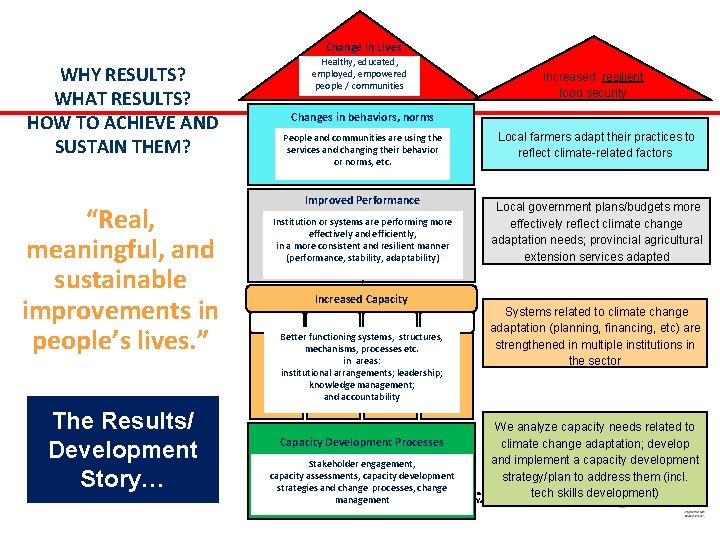
Change in Lives WHY RESULTS? WHAT RESULTS? HOW TO ACHIEVE AND SUSTAIN THEM? “Real, meaningful, and sustainable improvements in people’s lives. ” The Results/ Development Story… Healthy, educated, employed, empowered people / communities Increased resilient food security Changes in behaviors, norms People and communities are using the services and changing their behavior or norms, etc. Improved Performance Institution or systems are performing more effectively and efficiently, in a more consistent and resilient manner (performance, stability, adaptability) Local farmers adapt their practices to reflect climate-related factors Local government plans/budgets more effectively reflect climate change adaptation needs; provincial agricultural extension services adapted r Increased Capacity Better functioning systems, structures, mechanisms, processes etc. in areas: institutional arrangements; leadership; knowledge management; and accountability Systems related to climate change adaptation (planning, financing, etc) are strengthened in multiple institutions in the sector We analyze capacity needs related to Capacity Development Processes climate change adaptation; develop and implement a capacity development Stakeholder engagement, capacity assessments, capacity development strategy/plan to address them (incl. strategies and change processes, change Capacity Building Programme on the Economics of Adaptation tech skills development) management Supporting National/Sub-National Adaptation Planning and Action
Take-away Points • Link between technical/functional, and within complex system • Link between 3 levels: indiv/org/enabling env • CD is about change (it is a process, not a one-off); change involves both ‘hard’ and ‘soft’ factors • Because of this complexity, need to be careful about cause/affect assumptions Capacity Building Programme on the Economics of Adaptation Supporting National/Sub-National Adaptation Planning and Action
Looking Ahead: Questions for Consideration • Who needs to be involved in this process and at what point? : individuals, but also organizations/ stakeholder groups? What are the mandate issues? • What needs to be put in place/thought through in order to improve chances for impact of the program (attention to leadership, accountability, institutional arrangements, coordination mechanisms)? • How are these ideas relevant in the context of your country? What are the incentives/dis-incentives, bottlenecks/challenges, in the area of climate change adaptation? Capacity Building Programme on the Economics of Adaptation Supporting National/Sub-National Adaptation Planning and Action
Questions and Discussion Thank you! Capacity Building Programme on the Economics of Adaptation Supporting National/Sub-National Adaptation Planning and Action
- Slides: 13