
Capacity Building of Banks and Financial Institutions for
Capacity Building of Banks and Financial Institutions for Energy Efficiency Project Financing Module 2 Energy Efficiency Project Characteristics Partnership to Advance Clean Energy-Deployment (PACE-D) Technical Assistance Program September 2014 Capacity Building of Banks/FIs For EE Project Financing Page 1 July 2014
Presentation Outline • Energy Efficiency Projects • Energy User Motivations • EE Projects in Different Sectors • EE Project Characteristics • Typical Energy Efficiency Project • Illustrative Project Examples Capacity Building of Banks/FIs For EE Project Financing Page 2 July 2014
Energy Efficiency Projects • In all major consuming sectors § Large Industries § SMEs § Commercial Buildings (offices, hotels, hospitals, shopping malls, etc. ) § Government Buildings § Municipalities (street lighting, water pumping) § Agriculture Capacity Building of Banks/FIs For EE Project Financing Page 3 July 2014
Energy User Motivations • • • Achieve efficiency Capture energy cost savings; Improve productivity and enterprise competitiveness Improve product quality Address necessary system upgrades, equipment replacement, & deferred maintenance requirements Improve level of energy services in facilities Improve living conditions Improve energy system reliability Comply with environmental regulations Capacity Building of Banks/FIs 4 For EE Project Financing Page 4 July 2014
Perform, Achieve and Trade Scheme • Specific Energy Consumption (SEC) reduction targets for the energyintensive units which are designated consumers under the Energy Conservation Act § § Targets would be % reduction of current SEC Percentage reduction requirement based on: § Sectoral targets to achieve the national goal § Current SEC as a ratio of the best in the sector / groups within a sector § Unit specific diversities § Target setting for the power generation and fertilizer sectors through the existing tariff-setting processes § SEC measurement and verification by BEE through designated verifiers Capacity Building of Banks/FIs For EE Project Financing Page 5 July 2014
List of sectors for PAT • Cement • Textile • Chlor alkali • Power Plants • Aluminum • Iron & steel • Pulp & paper • Fertilizer Capacity Building of Banks/FIs For EE Project Financing Page 6 July 2014
Energy Efficiency Projects in Industry • Replacement of inefficient industrial technologies with energy saving technologies and equipment, such as more efficient industrial boilers, kilns, and heat exchange systems • • Recovery and utilization of by-product gas, waste heat • Industrial system optimization to reduce energy use Installation of highly efficient mechanical and electrical equipment, including lighting, motors, Chillers, refrigeration units, pumps, heating and ventilation equipment, etc. Capacity Building of Banks/FIs For EE Project Financing Page 7 July 2014
Examples of EE in Cement Industry • • Improve kiln combustion efficiency by reducing the false air ingress at the Preheater section and reducing marginally the sintering level of Clinker Optimize the air flow to the grate cooler and reduce the vent air losses Utilize cooler vent air as primary air to the Kiln burner Improve insulation at preheaters ducts & Kiln internally Replace the air cooled Turbulators with Refractory lined Turbulators Generate electricity from the Waste heat of PH exhaust & Cooler Vent streams Install variable frequency drive for fans in the production processes Capacity Building of Banks/FIs For EE Project Financing Page 8 July 2014
EE in SMEs • Key Characteristics of SMEs § § § § Very small in size (majority are MSE units) Majority of units are proprietorship / family owned concern Very limited professional management Obsolete technology/ production process Low capital investment & labor intensive High energy consumption in many sectors Lack of Knowledge about energy efficient production options and available technologies Capacity Building of Banks/FIs For EE Project Financing Page 9 July 2014
Energy Intensive SME Clusters • Forging • Foundry • Limekilns • Brick • Rolling • Rice • Pottery • Paper • Edible oils • Brass • Glass Page 10 July 2014
SIDBI Activities for EE in SMEs • • • Established Energy Efficiency Cell • Developing tools for Developed guidelines for EE project financing JICA credit line for EE equipment – disbursed in 2010 Af. D credit line – initiated in 2010 Kf. W credit line – requires carbon savings estimates and monitoring – initiated in 2010 § Project Assessment § Impact Monitoring Capacity Building of Banks/FIs For EE Project Financing Page 11 July 2014
Energy Efficiency in Buildings • Energy efficiency in residential, commercial, and government buildings: § Lighting § HVAC (heating, ventilation, and air conditioning) § Building envelope (insulation for roof, walls, windows, doors) § Renewable energy in buildings (roof-top solar PV, solar water heaters, and ground source heat pumps) Capacity Building of Banks/FIs For EE Project Financing Page 12 July 2014
Buildings Rating Systems • Energy Conservation Building Code (ECBC) launched in May 2007. The ECBC sets minimum energy standards for new commercial buildings having a connected load of 100 k. W or contract demand of 120 k. VA. • BEE Star Labeling Scheme for § Day Use Buildings § BPO buildings § Shopping malls Capacity Building of Banks/FIs For EE Project Financing Page 13 July 2014
EE in Municipalities • Water Pumping § Leak detection § Efficient pumping systems § Operational optimization • Street Lighting § Efficient lighting § Controls § Solar systems Capacity Building of Banks/FIs For EE Project Financing Page 14 July 2014
EE in Railways • Stations, platforms § Lighting § Space cooling § Water pumping • Rolling stock performance § Two tier rolling stock § Four berth coaches § Managing fuel cost § Kinetic energy storage systems § Power and energy optimization systems Capacity Building of Banks/FIs For EE Project Financing Page 15 July 2014
Characteristics of EE Projects
Characteristics of EE projects • Wide range of technologies, most with substantial experience in successful implementation, internationally as well as in India • • Relatively small project size - many projects less than INR 1 crore • Manageable risks Relatively short simple payback periods – generally one to five years High proportion of project development costs Range of implementation business models with increasing interest in performance based approaches Capacity Building of Banks/FIs For EE Project Financing Page 17 July 2014
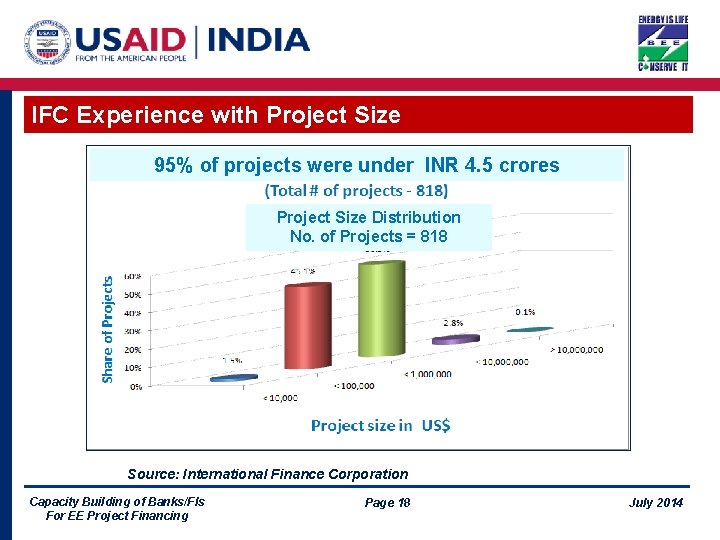
IFC Experience with Project Size 95% of projects were under INR 4. 5 crores Project Size Distribution No. of Projects = 818 Source: International Finance Corporation Capacity Building of Banks/FIs For EE Project Financing Page 18 July 2014
Typical Energy Efficiency Project
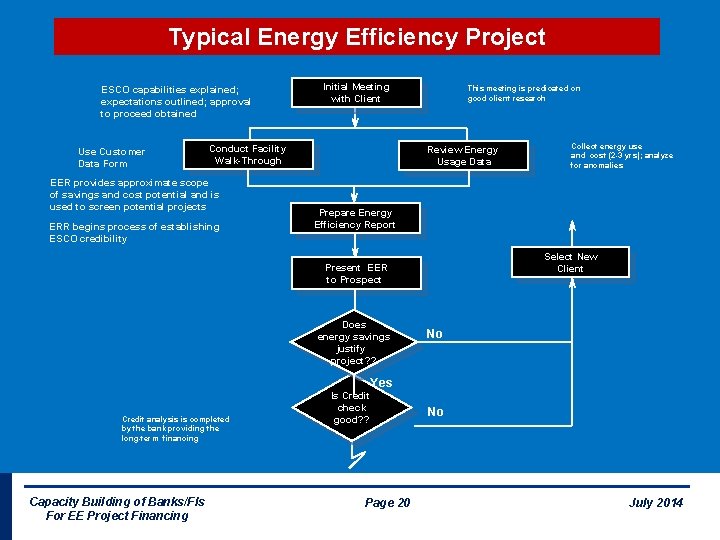
Typical Energy Efficiency Project ESCO capabilities explained; expectations outlined; approval to proceed obtained Use Customer Data Form Initial Meeting with Client Conduct Facility Walk-Through EER provides approximate scope of savings and cost potential and is used to screen potential projects ERR begins process of establishing ESCO credibility This meeting is predicated on good client research Review Energy Usage Data Collect energy use and cost (2 -3 yrs); analyze for anomalies Prepare Energy Efficiency Report Select New Client Present EER to Prospect Does energy savings justify project? ? No Yes Credit analysis is completed by the bank providing the long-term financing Capacity Building of Banks/FIs For EE Project Financing Is Credit check good? ? Page 20 No July 2014
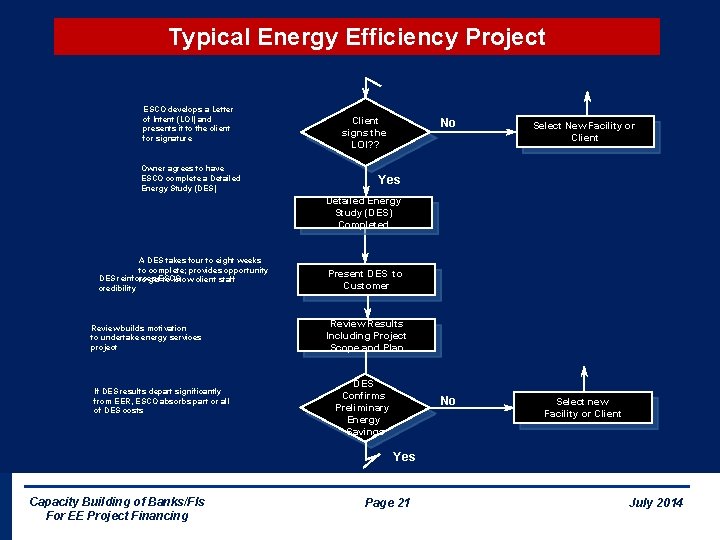
Typical Energy Efficiency Project ESCO develops a Letter of Intent (LOI) and presents it to the client for signature Owner agrees to have ESCO complete a Detailed Energy Study (DES) Client signs the LOI? ? No Select New Facility or Client No Select new Facility or Client Yes Detailed Energy Study (DES) Completed A DES takes four to eight weeks to complete; provides opportunity DES reinforces to get. ESCO to know client staff credibility Review builds motivation to undertake energy services project If DES results depart significantly from EER, ESCO absorbs part or all of DES costs Present DES to Customer Review Results Including Project Scope and Plan DES Confirms Preliminary Energy Savings Yes Capacity Building of Banks/FIs For EE Project Financing Page 21 July 2014
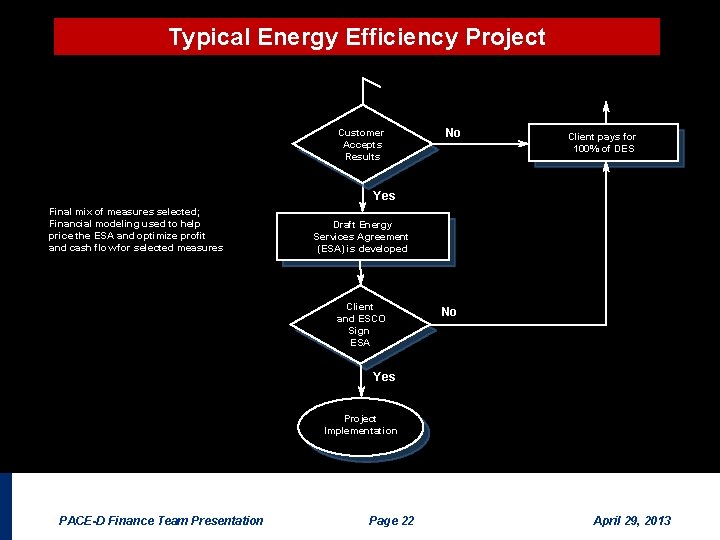
Typical Energy Efficiency Project Customer Accepts Results No Client pays for 100% of DES Yes Final mix of measures selected; Financial modeling used to help price the ESA and optimize profit and cash flow for selected measures Draft Energy Services Agreement (ESA) is developed Client and ESCO Sign ESA No Yes Project Implementation PACE-D Finance Team Presentation Page 22 April 29, 2013
Illustrative Project Examples
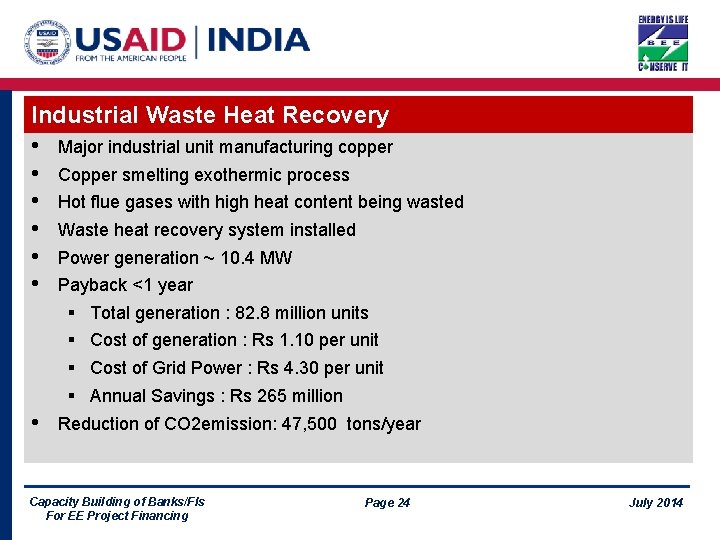
Industrial Waste Heat Recovery • Major industrial unit manufacturing copper • Copper smelting exothermic process • Hot flue gases with high heat content being wasted • Waste heat recovery system installed • Power generation ~ 10. 4 MW • Payback <1 year § § • Total generation : 82. 8 million units Cost of generation : Rs 1. 10 per unit Cost of Grid Power : Rs 4. 30 per unit Annual Savings : Rs 265 million Reduction of CO 2 emission: 47, 500 tons/year Capacity Building of Banks/FIs For EE Project Financing Page 24 July 2014
Biomass Cogeneration • • Edible oil refinery in Maharashtra Steam required for processes Co-generation (top end) using biomass (bagasse) Generation of power 550 KW Loan amount: Rs 20 million Annual savings: Rs 16 million Reduction of CO 2 emission: 4, 350 tpa Capacity Building of Banks/FIs For EE Project Financing Page 25 July 2014
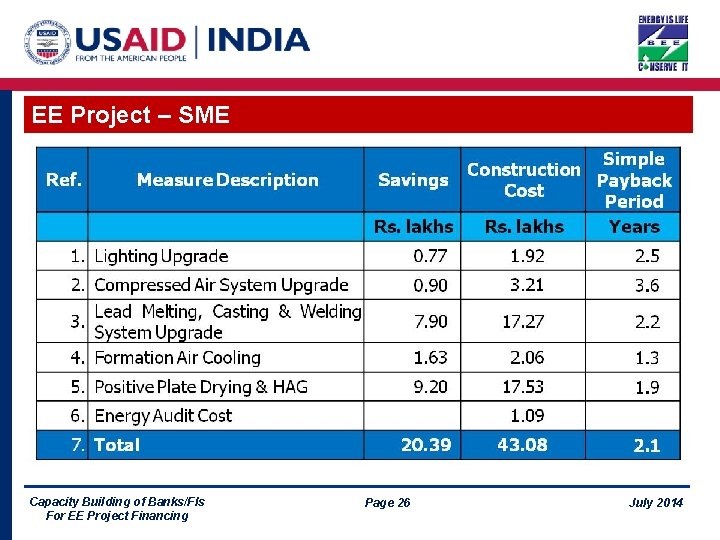
EE Project – SME Capacity Building of Banks/FIs For EE Project Financing Page 26 July 2014
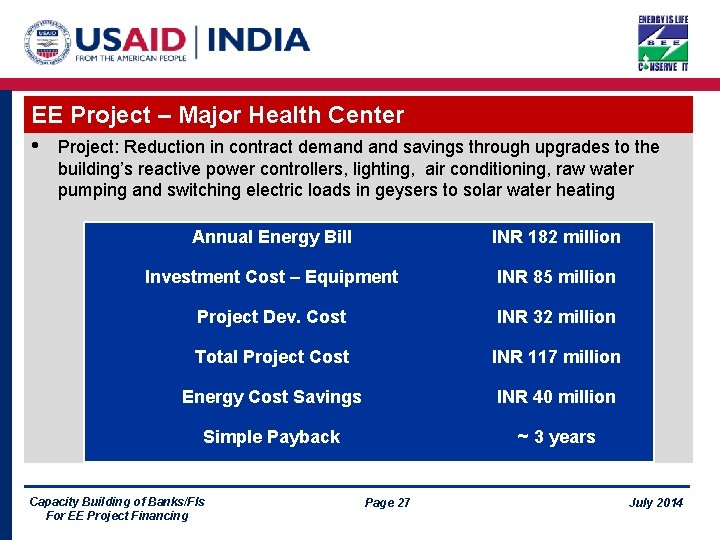
EE Project – Major Health Center • Project: Reduction in contract demand savings through upgrades to the building’s reactive power controllers, lighting, air conditioning, raw water pumping and switching electric loads in geysers to solar water heating Annual Energy Bill INR 182 million Investment Cost – Equipment INR 85 million Project Dev. Cost INR 32 million Total Project Cost INR 117 million Energy Cost Savings INR 40 million Simple Payback ~ 3 years Capacity Building of Banks/FIs For EE Project Financing Page 27 July 2014
Streetlighting Project • Installation by ESCO of 486 street light controllers covering 19, 000 street lights of Nasik Municipal corporation • Improvement in the existing electrical distribution network for : • • • § Reduction in cable losses § Power factor optimization Savings were shared for five years Annual Energy bill prior to implementation - Rs 50. 0 M Achieved annual savings - Rs 17. 0 million on a capital investment of Rs 16. 6 million Payback period ~1. 5 years • Capacity Building of Banks/FIs For EE Project Financing Page 28 July 2014
Energy Services Market in India Energy Service Companies (ESCOs) • Initiated in mid-1990 s • • • Growth has been slow Many issues and challenges faced BEE has empanelment scheme Over 137 ESCOs have been empanelled ESCO capacity building program planned Capacity Building of Banks/FIs For EE Project Financing Page 29 July 2014
Key Characteristics of ESCOs Energy Service Companies: • Provide or arrange a complete package of services, including energy analysis, design, installation, financing, and maintenance of the energy management (and other) technologies • Offer business and financing models under which customers effectively pay for the energy services from a portion of actual energy savings achieved • Payments to the ESCO are based on demonstrable results (that satisfy the performance guarantees provided by the ESCO) • Most of the project risks are assumed by the ESCO. Capacity Building of Banks/FIs For EE Project Financing Page 30 July 2014
Energy Services Market in India Other energy service providers • Energy auditors – certified by BEE • Equipment manufacturers and vendors (Schneider, Siemens, Alstohm, etc. ) • Engineering firms – extending capabilities to provide performance contracting services • Contract energy management companies (Dalkia, A to Z Power, etc. ) Capacity Building of Banks/FIs For EE Project Financing Page 31 July 2014
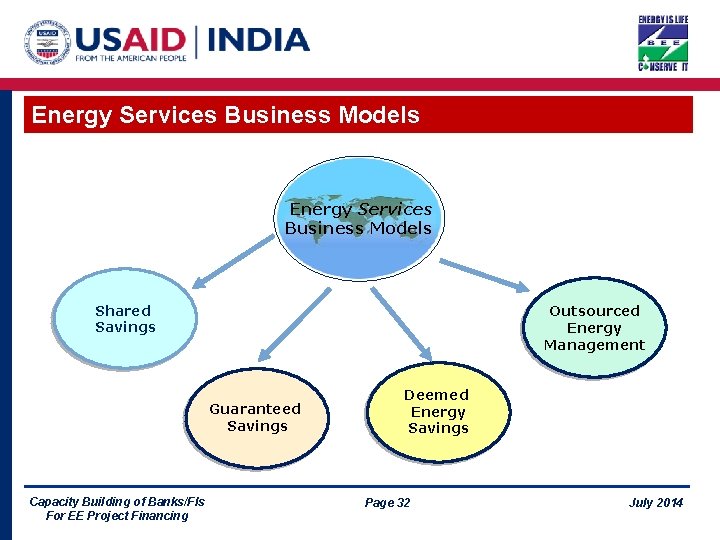
Energy Services Business Models Shared Savings Outsourced Energy Management Guaranteed Savings Capacity Building of Banks/FIs For EE Project Financing Deemed Energy Savings Page 32 July 2014
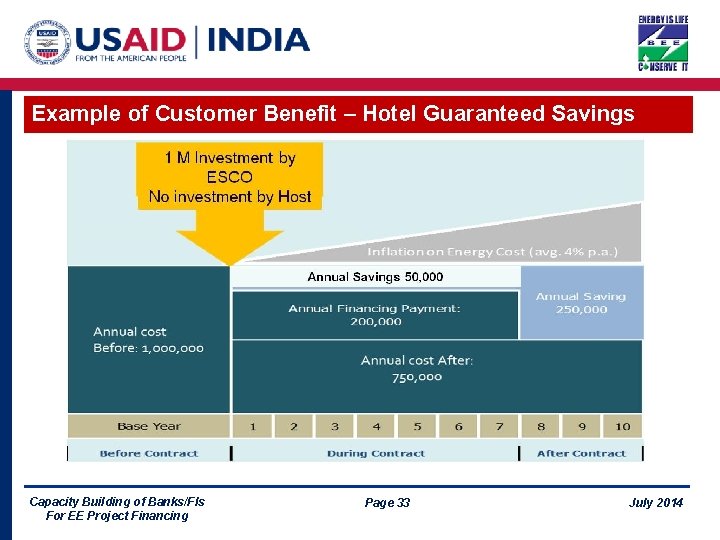
Example of Customer Benefit – Hotel Guaranteed Savings Capacity Building of Banks/FIs For EE Project Financing Page 33 July 2014
Developing Financial Products for EE Projects • Based on target market and project characteristics and implementation business models § credit characteristics § typical deal size & project economics (cash flow, ROI, NPV, etc. ) § Ability to assemble acceptable collateral/security package • Define loan offer(s) § § • term, pricing required security structure, with guarantee(s) economic parameters: e. g. , size, % own funds documentation requirements Prepare business plan, identify/implement initial deals, train branch staff network Capacity Building of Banks/FIs For EE Project Financing Page 34 July 2014
Thank you Dilip R. Limaye Finance Team Leader USAID PACE-D Technical Assistance Program dlimaye@srcglobal. com www. pace-d. com
- Slides: 35