
Capacity Allocation and Congestion Management Rules for Storage
- Slides: 14
Capacity Allocation and Congestion Management Rules for Storage Mr. Walter Boltz ERGEG’s Gas Focus Group (GFG) XV Madrid Forum, 6 and 7 November 2008
Background Ü Improvement of storage access conditions Ü Most European storages fully booked Ü Poor transparency Ü Entry barrier for new entrants Ü Capacity hoarding Ü What happened? Ü ERGEG GGPSSO since March 2005 Ü After Monitoring the GGPSSO twice incomplete implementation identified Ü Development of specific Guidelines for storage on CAM and CMP Ü ERGEG Work Programme 2008: enhancement of these guidelines Ü ERGEG GST TF 2008 Ü Survey on CAM/CMP and Secondary Markets Ü Questioning of NRAs, SSOs and storage users Ü Current way of development, design, acutal use and effects of the system regarding CAM/CMP and Secondary Markets XV Madrid Forum, 6 and 7 November 2008 2
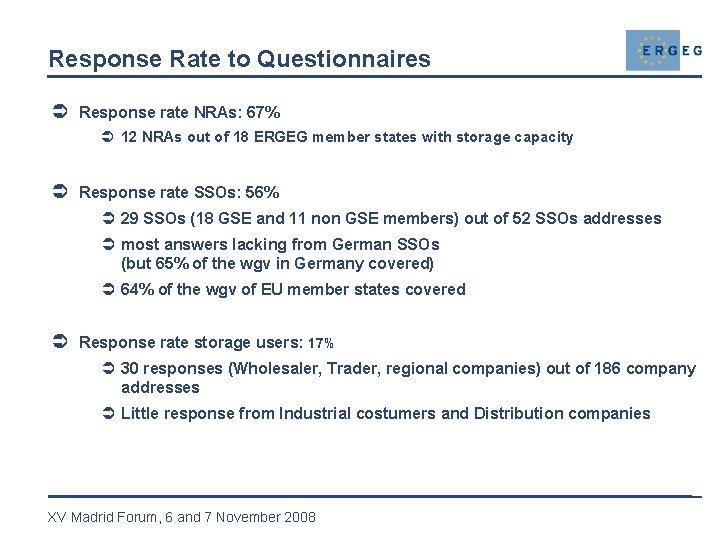
Response Rate to Questionnaires Ü Response rate NRAs: 67% Ü 12 NRAs out of 18 ERGEG member states with storage capacity Ü Response rate SSOs: 56% Ü 29 SSOs (18 GSE and 11 non GSE members) out of 52 SSOs addresses Ü most answers lacking from German SSOs (but 65% of the wgv in Germany covered) Ü 64% of the wgv of EU member states covered Ü Response rate storage users: 17% Ü 30 responses (Wholesaler, Trader, regional companies) out of 186 company addresses Ü Little response from Industrial costumers and Distribution companies XV Madrid Forum, 6 and 7 November 2008 3
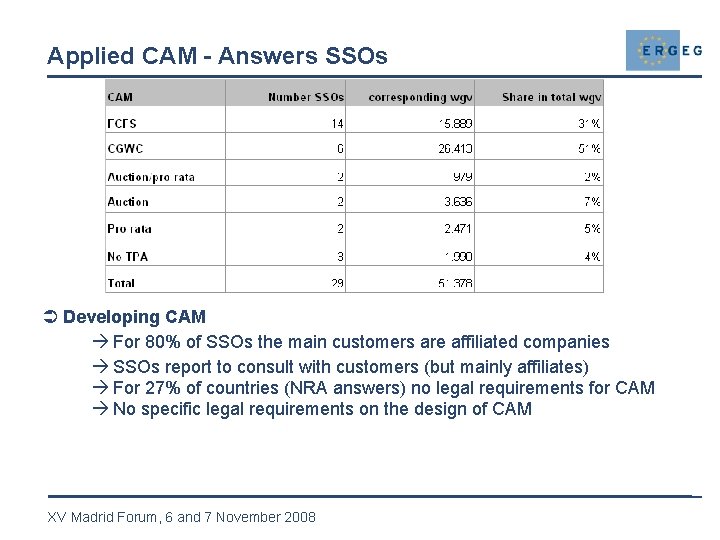
Applied CAM - Answers SSOs Ü Developing CAM à For 80% of SSOs the main customers are affiliated companies à SSOs report to consult with customers (but mainly affiliates) à For 27% of countries (NRA answers) no legal requirements for CAM à No specific legal requirements on the design of CAM XV Madrid Forum, 6 and 7 November 2008 4
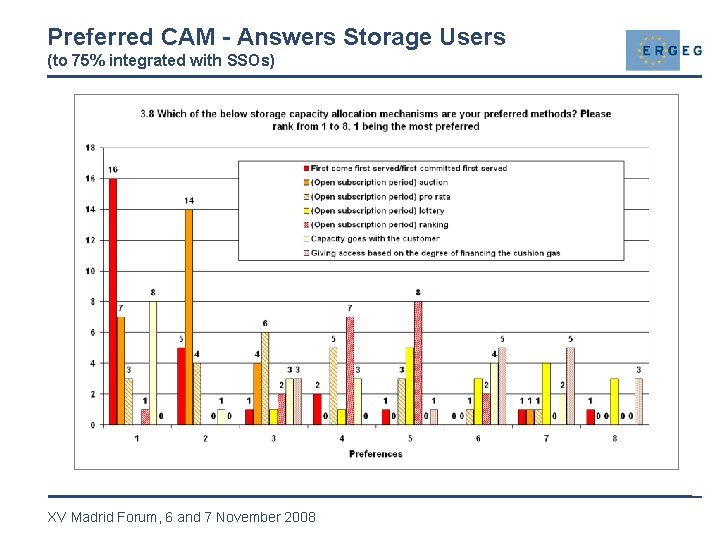
Preferred CAM - Answers Storage Users (to 75% integrated with SSOs) XV Madrid Forum, 6 and 7 November 2008 5
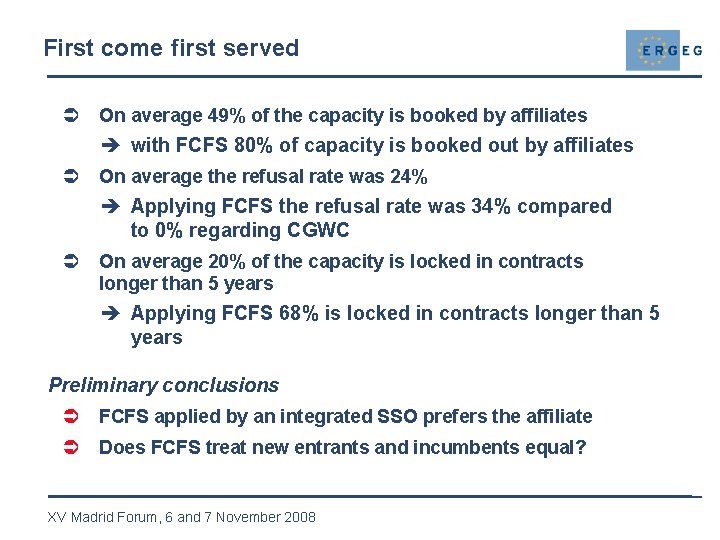
First come first served Ü On average 49% of the capacity is booked by affiliates è with FCFS 80% of capacity is booked out by affiliates Ü On average the refusal rate was 24% è Applying FCFS the refusal rate was 34% compared to 0% regarding CGWC Ü On average 20% of the capacity is locked in contracts longer than 5 years è Applying FCFS 68% is locked in contracts longer than 5 years Preliminary conclusions Ü FCFS applied by an integrated SSO prefers the affiliate Ü Does FCFS treat new entrants and incumbents equal? XV Madrid Forum, 6 and 7 November 2008 6
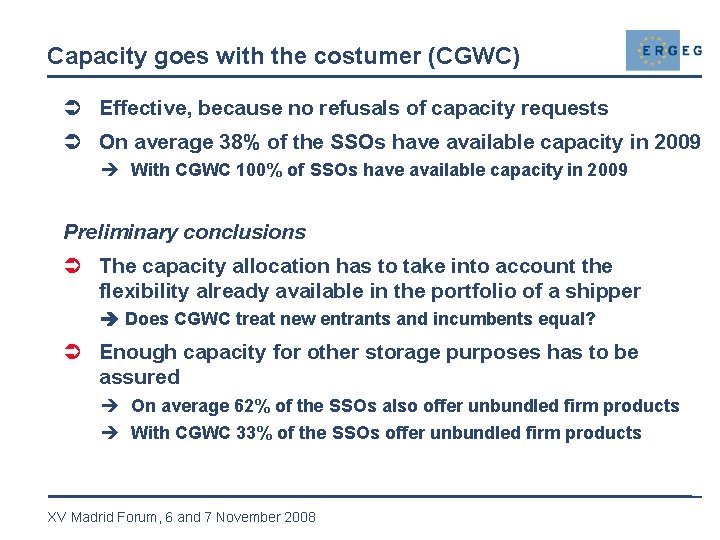
Capacity goes with the costumer (CGWC) Ü Effective, because no refusals of capacity requests Ü On average 38% of the SSOs have available capacity in 2009 è With CGWC 100% of SSOs have available capacity in 2009 Preliminary conclusions Ü The capacity allocation has to take into account the flexibility already available in the portfolio of a shipper Does CGWC treat new entrants and incumbents equal? Ü Enough capacity for other storage purposes has to be assured è On average 62% of the SSOs also offer unbundled firm products è With CGWC 33% of the SSOs offer unbundled firm products XV Madrid Forum, 6 and 7 November 2008 7
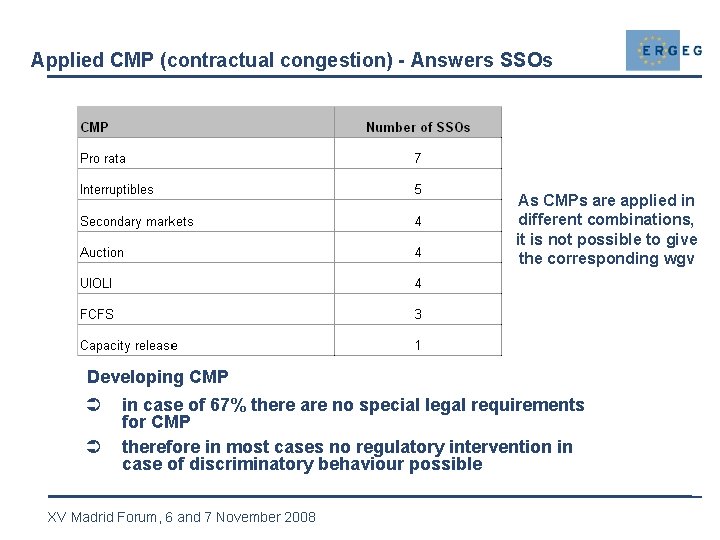
Applied CMP (contractual congestion) - Answers SSOs As CMPs are applied in different combinations, it is not possible to give the corresponding wgv Developing CMP Ü Ü in case of 67% there are no special legal requirements for CMP therefore in most cases no regulatory intervention in case of discriminatory behaviour possible XV Madrid Forum, 6 and 7 November 2008 8
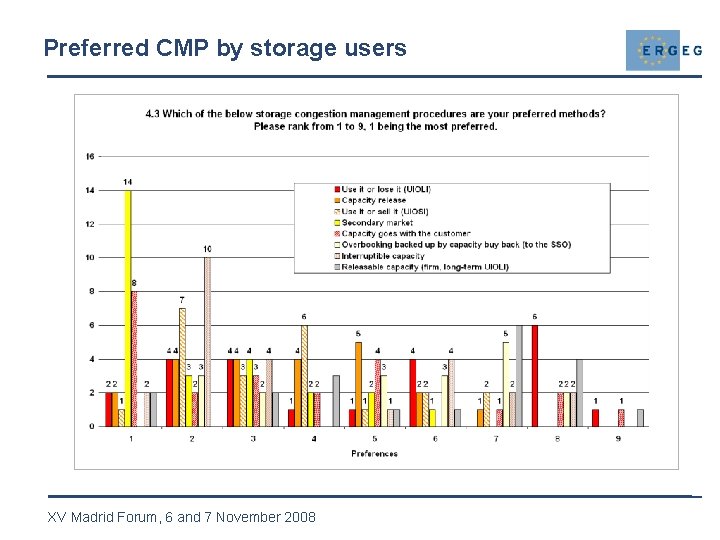
Preferred CMP by storage users XV Madrid Forum, 6 and 7 November 2008 9
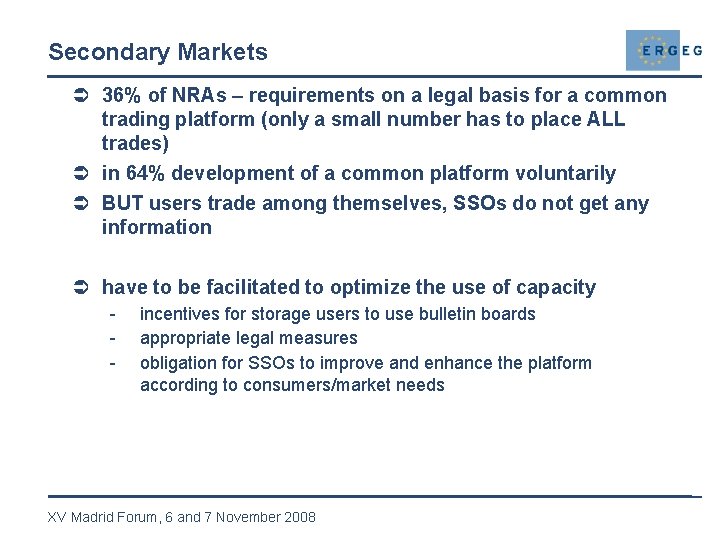
Secondary Markets Ü 36% of NRAs – requirements on a legal basis for a common trading platform (only a small number has to place ALL trades) Ü in 64% development of a common platform voluntarily Ü BUT users trade among themselves, SSOs do not get any information Ü have to be facilitated to optimize the use of capacity - incentives for storage users to use bulletin boards appropriate legal measures obligation for SSOs to improve and enhance the platform according to consumers/market needs XV Madrid Forum, 6 and 7 November 2008 10
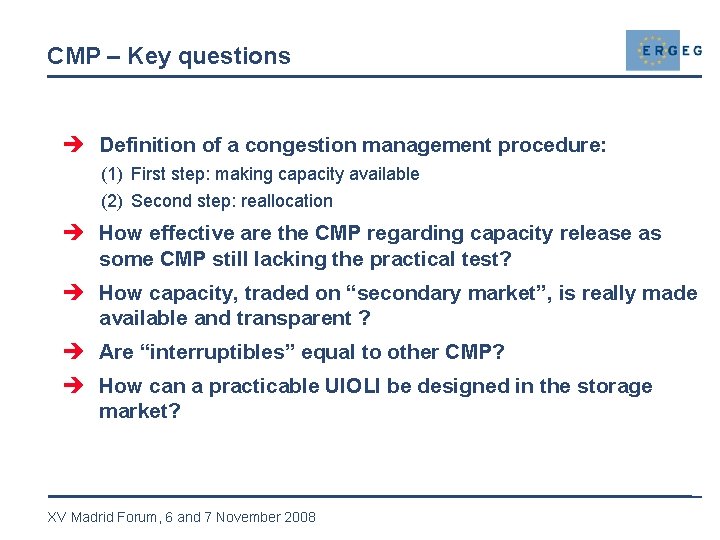
CMP – Key questions è Definition of a congestion management procedure: (1) First step: making capacity available (2) Second step: reallocation è How effective are the CMP regarding capacity release as some CMP still lacking the practical test? è How capacity, traded on “secondary market”, is really made available and transparent ? è Are “interruptibles” equal to other CMP? è How can a practicable UIOLI be designed in the storage market? XV Madrid Forum, 6 and 7 November 2008 11
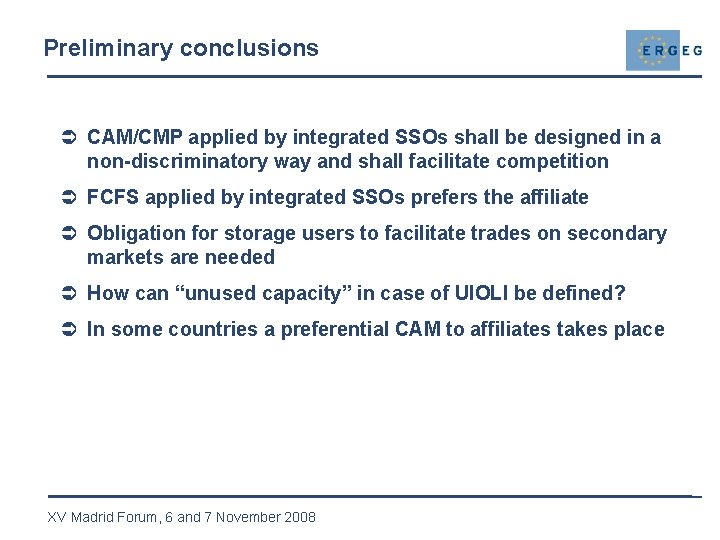
Preliminary conclusions Ü CAM/CMP applied by integrated SSOs shall be designed in a non-discriminatory way and shall facilitate competition Ü FCFS applied by integrated SSOs prefers the affiliate Ü Obligation for storage users to facilitate trades on secondary markets are needed Ü How can “unused capacity” in case of UIOLI be defined? Ü In some countries a preferential CAM to affiliates takes place XV Madrid Forum, 6 and 7 November 2008 12
Next steps Ü Assessment of different CAM and CMP è in a discussion paper for public consultation planned è by defining preconditions under which market situations the various mechanisms are appropriate è regarding the requirements for CAM and CMP stated in the GGPSSO Ü Based on assessment and the outcomes of the public consultation GGP on CAM & CMP to storage will be drafted XV Madrid Forum, 6 and 7 November 2008 13
Thank You ! Further information is available at www. energy-regulators. eu XV Madrid Forum, 6 and 7 November 2008 14