
Capacitive Stimulation of Bones to Enhance Fracture Recovery
Capacitive Stimulation of Bones to Enhance Fracture Recovery John Chi, Mike Desalvio, Kevin Ip Mike Nguyen, Khine Win
Bone Fracture �Osteoporosis worldwide (1) affects 75 million ◦ 1 in 3 women over 50 ◦ 1 in 5 men over 50 �In Europe, it costs more to treat than cancer (2) �In US: 2 million fractures costs $17 billion (3) ◦ Inpatient Care (57%), Long-Term (30%), Outpatient (13%) � Reduce Costs by reducing time for recovery
Studies � Evidence suggests that an electrical current can stimulate cell growth and thus bone repair ◦ Lorich: Capacitive stimulation of rat MC 3 T 3 -E 1 bone cells (4) ◦ Nakajima: Electrical Accupuncture in Rats (5)
Lorich Study � MC 3 T 3 -E 1 ◦ Mouse Osteoblastic Cells � Capacitive Coupled cells to 20 m. V/cm � Increase in cell proliferation
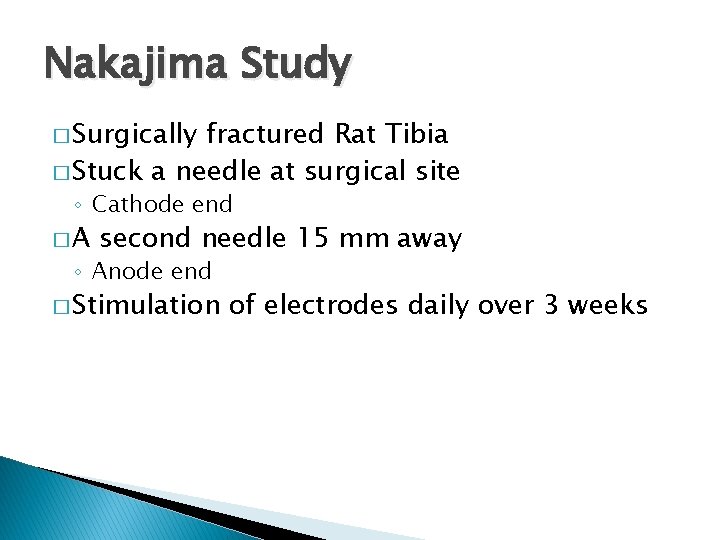
Nakajima Study � Surgically fractured Rat Tibia � Stuck a needle at surgical site ◦ Cathode end �A second needle 15 mm away ◦ Anode end � Stimulation of electrodes daily over 3 weeks
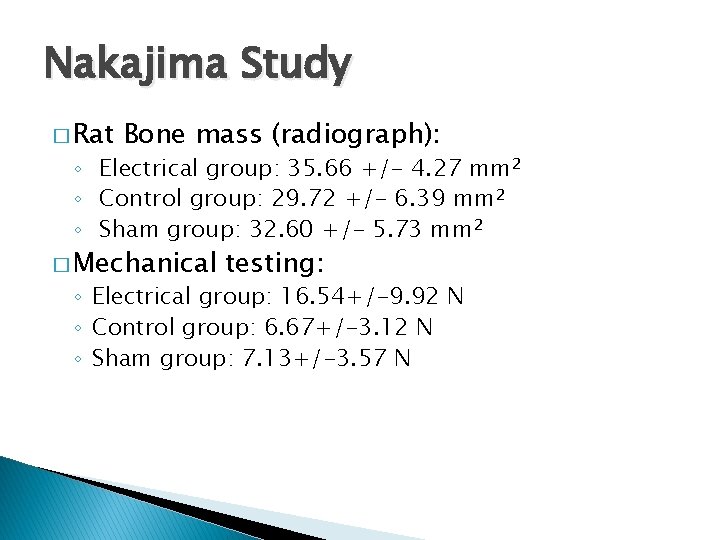
Nakajima Study � Rat Bone mass (radiograph): ◦ Electrical group: 35. 66 +/- 4. 27 mm 2 ◦ Control group: 29. 72 +/- 6. 39 mm 2 ◦ Sham group: 32. 60 +/- 5. 73 mm 2 � Mechanical testing: ◦ Electrical group: 16. 54+/-9. 92 N ◦ Control group: 6. 67+/-3. 12 N ◦ Sham group: 7. 13+/-3. 57 N
Results � Improvement was seen at the cellular and structural level through capacitive coupling � Design a device to stimulate bone growth via capacitive electrical stimulation
Device for Capacitive Coupling of Bone Stimulation
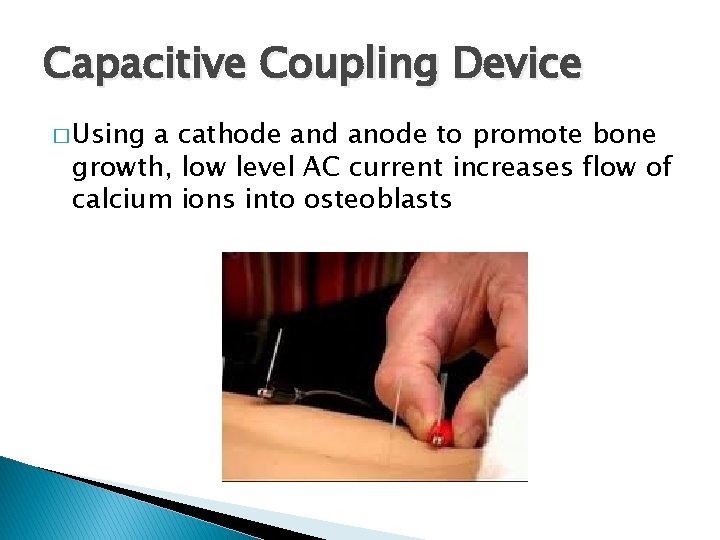
Capacitive Coupling Device � Using a cathode and anode to promote bone growth, low level AC current increases flow of calcium ions into osteoblasts
Design Considerations � Infection � Ease of use � Patient psychology (fear of needles) � Level of discomfort � Storage
Device Features � Disposable needle cartridges � Friendly appearance (soft edges, friendly colors) � Computer-controlled needle insertion (feedback on skin for galvanic responses to fear and pain to adjust needle insertion rate) � Gradual increase in current to therapeutic levels
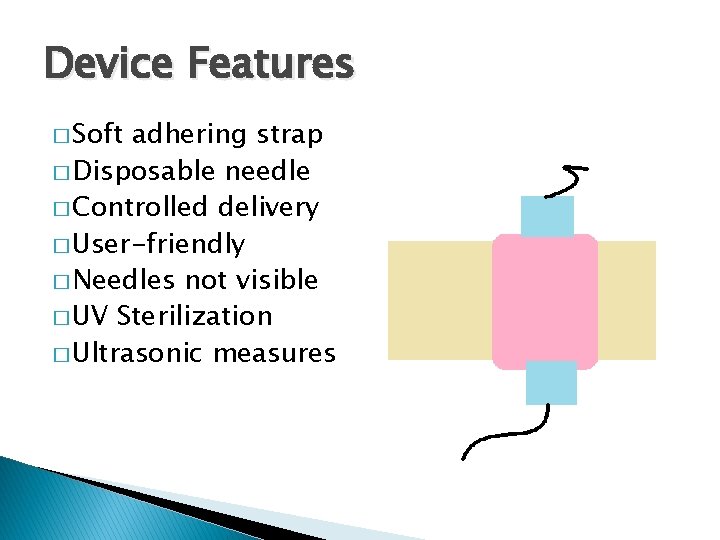
Device Features � Soft adhering strap � Disposable needle � Controlled delivery � User-friendly � Needles not visible � UV Sterilization � Ultrasonic measures
Research vs Device � Research shows electrical stimulation can produce bone growth (osteoblasts) � Device uses technology verified by research to provide bone growth in patients with fractures � Research involves methodology only � Device considers many factors, hygeine, patient psychology, practitioner usage
Research vs Device � Research done in clinical and sterile environment (lab) � Device is robust and functions in varied environments (hospitals, doctor’s office, home) � Research feedback is crude (requires x-ray) � Device provides “friendly” feedback through ultrasound
Reference 1. 2. 3. 4. 5. EFFO and NOF (1997) Who are candidates for prevention and treatment for osteoporosis? Osteoporos Int 7: 1. Luo L and Xu L (2005) Analysis of direct economic burden of osteoporotic hip fracture and its influence factors. Chinese Journal of Epidemiology (Vol. 9). Burge R, Dawson-Hughes B, Solomon DH, et al. (2007) Incidence and economic burden of osteoporosis-related fractures in the United States, 2005 -2025. J Bone Miner Res 22: 465. Biochemical pathway mediating the response of bone cells to capacitive coupling. Lorich DG, Brighton CT, Gupta R, Corsetti JR, Levine SE, Gelb ID, Seldes R, Pollack SR. Clin Orthop Relat Res. 1998 May; (350): 246 -56. Effect of electroacupuncture on the healing process of tibia fracture in a rat model: a randomised controlled trial. Nakajima M, Inoue M, Hojo T, Inoue N, Tanaka K, Takatori R, Itoi M. Acupunct Med. 2010 Sep; 28(3): 140 -3. Epub 2010 Jun 15.
- Slides: 15