
CAPACITANCE CAPASITOR Wenny Maulina Capasitors A capacitor is
- Slides: 15
CAPACITANCE CAPASITOR Wenny Maulina
Capasitors _ A capacitor is constructed of two parallel conducting plates separated by an insulator. _ Conductors are commonly used as places to store charge. _ Capacitance is a measure of a capacitor’s ability to store charge on its plates. _ A capacitor has a capacitance of 1 farad (F) if 1 coulomb (C) of charge is deposited on the plates by a potential difference of 1 volt across its plates. _ The farad is named after Michael Faraday, a nineteenth century English chemist and physicist.
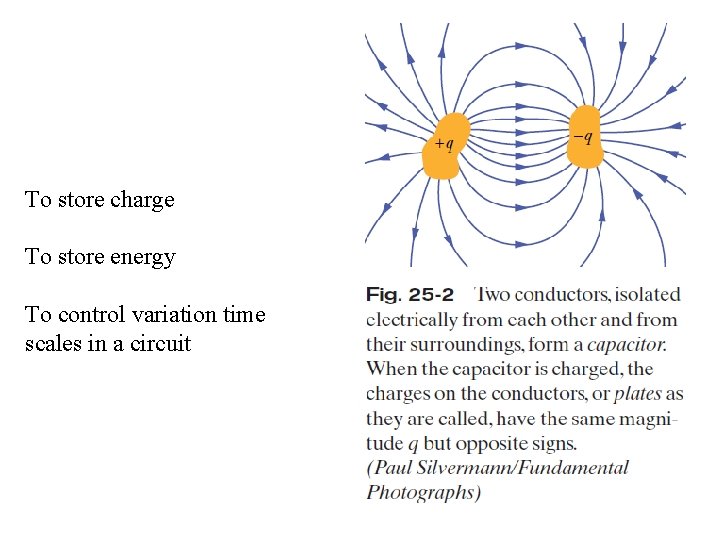
To store charge To store energy To control variation time scales in a circuit
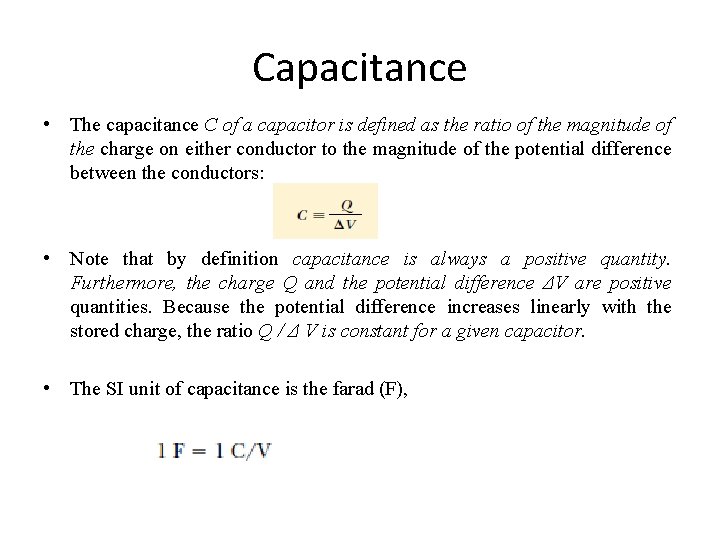
Capacitance • The capacitance C of a capacitor is defined as the ratio of the magnitude of the charge on either conductor to the magnitude of the potential difference between the conductors: • Note that by definition capacitance is always a positive quantity. Furthermore, the charge Q and the potential difference ΔV are positive quantities. Because the potential difference increases linearly with the stored charge, the ratio Q / Δ V is constant for a given capacitor. • The SI unit of capacitance is the farad (F),
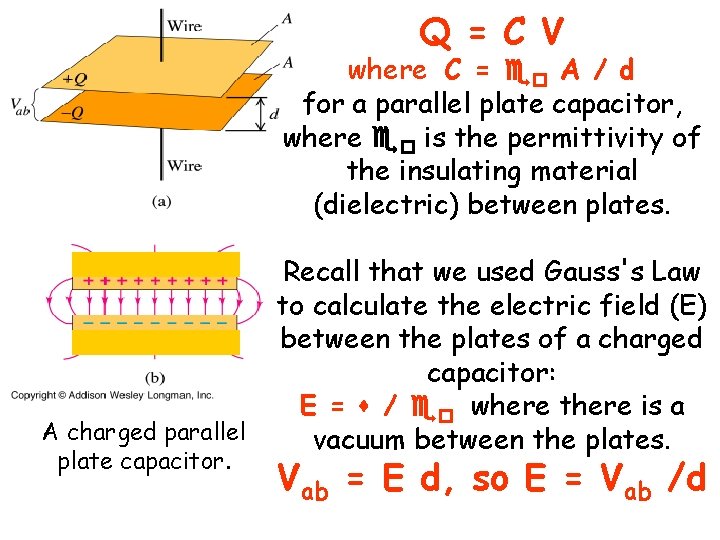
Q = C V where C = eo A / d for a parallel plate capacitor, where eo is the permittivity of the insulating material (dielectric) between plates. A charged parallel plate capacitor. Recall that we used Gauss's Law to calculate the electric field (E) between the plates of a charged capacitor: E = s / eo where there is a vacuum between the plates. Vab = E d, so E = Vab /d
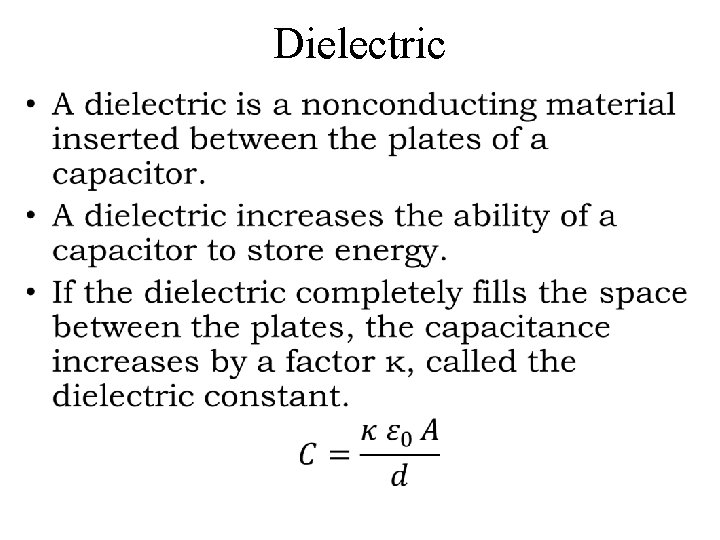
Dielectric •
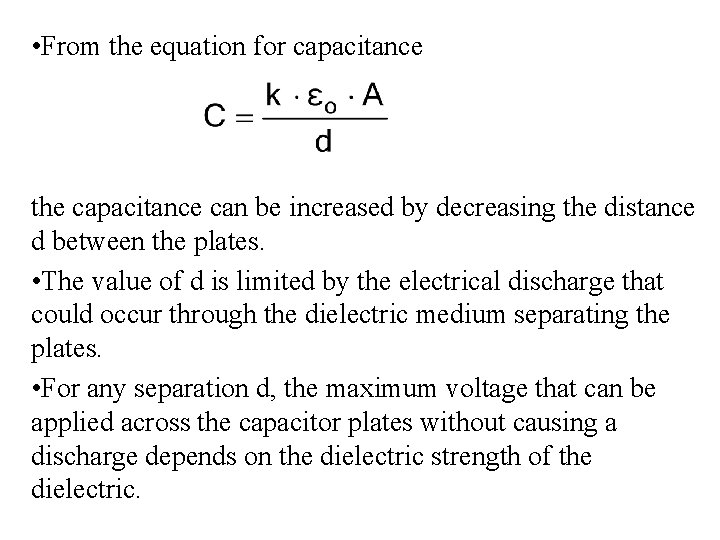
• From the equation for capacitance the capacitance can be increased by decreasing the distance d between the plates. • The value of d is limited by the electrical discharge that could occur through the dielectric medium separating the plates. • For any separation d, the maximum voltage that can be applied across the capacitor plates without causing a discharge depends on the dielectric strength of the dielectric.
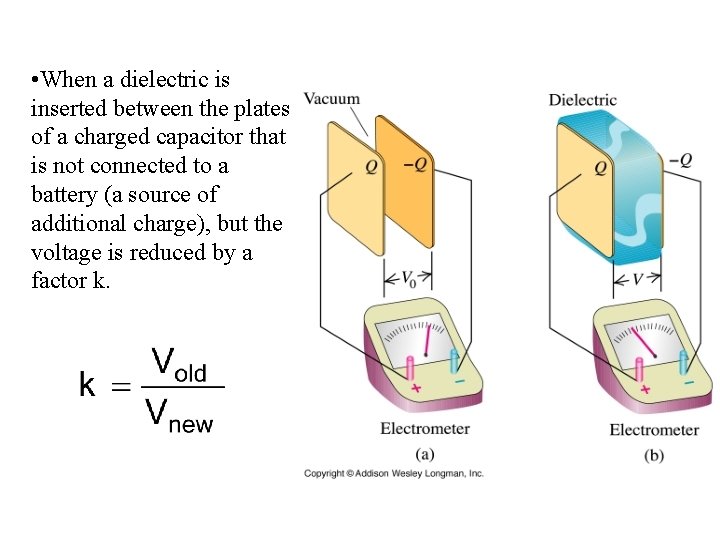
• When a dielectric is inserted between the plates of a charged capacitor that is not connected to a battery (a source of additional charge), but the voltage is reduced by a factor k.
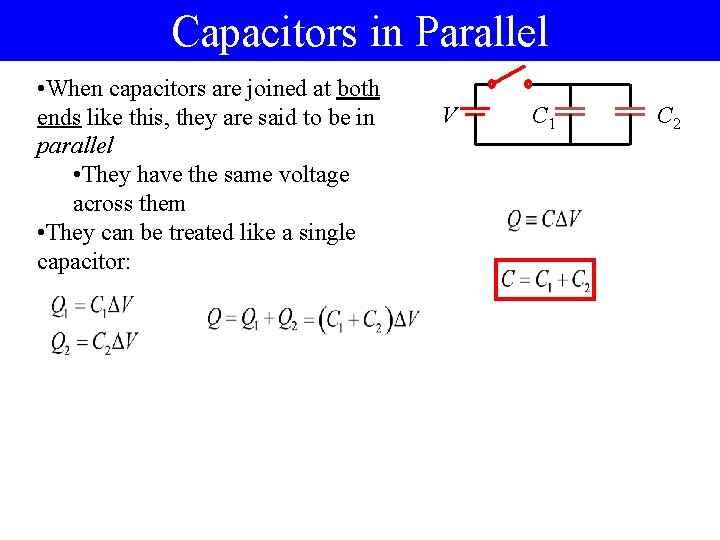
Capacitors in Parallel • When capacitors are joined at both ends like this, they are said to be in parallel • They have the same voltage across them • They can be treated like a single capacitor: V C 1 C 2
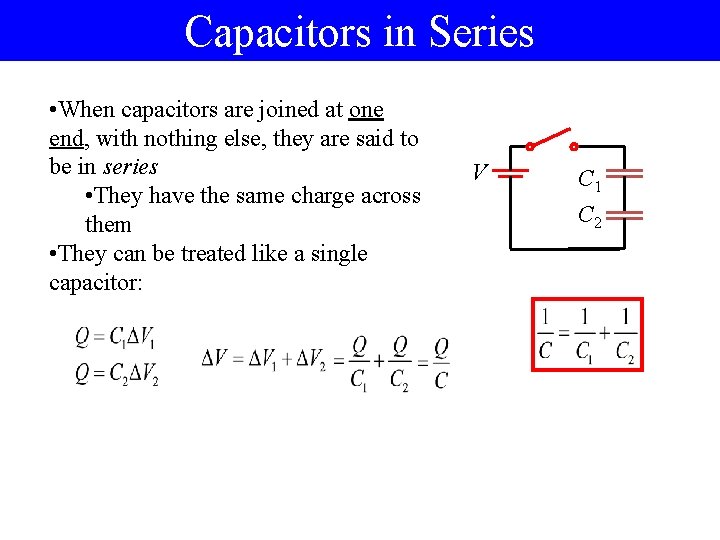
Capacitors in Series • When capacitors are joined at one end, with nothing else, they are said to be in series • They have the same charge across them • They can be treated like a single capacitor: V C 1 C 2
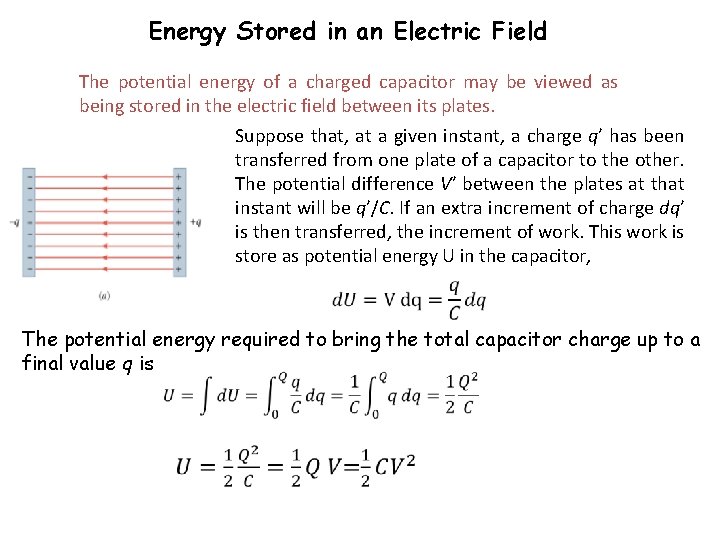
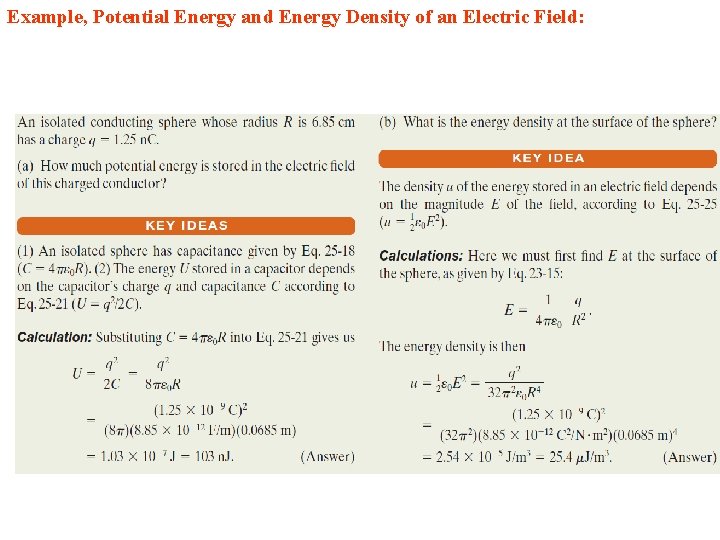
Energy Stored in an Electric Field The potential energy of a charged capacitor may be viewed as being stored in the electric field between its plates. Suppose that, at a given instant, a charge q′ has been transferred from one plate of a capacitor to the other. The potential difference V′ between the plates at that instant will be q′/C. If an extra increment of charge dq′ is then transferred, the increment of work. This work is store as potential energy U in the capacitor, The potential energy required to bring the total capacitor charge up to a final value q is
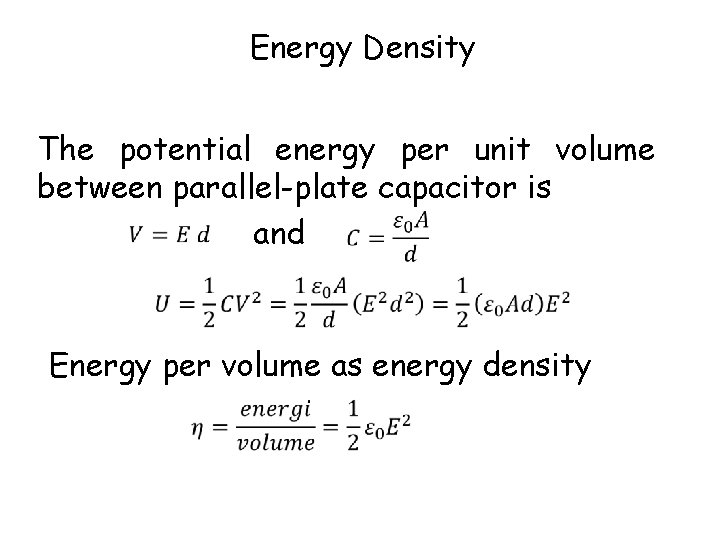
Energy Density The potential energy per unit volume between parallel-plate capacitor is and Energy per volume as energy density
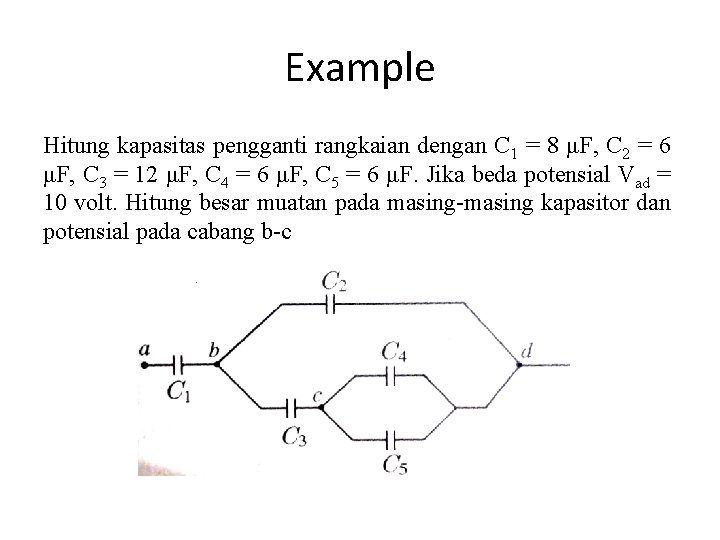
Example Hitung kapasitas pengganti rangkaian dengan C 1 = 8 μF, C 2 = 6 μF, C 3 = 12 μF, C 4 = 6 μF, C 5 = 6 μF. Jika beda potensial Vad = 10 volt. Hitung besar muatan pada masing-masing kapasitor dan potensial pada cabang b-c
Example, Potential Energy and Energy Density of an Electric Field:
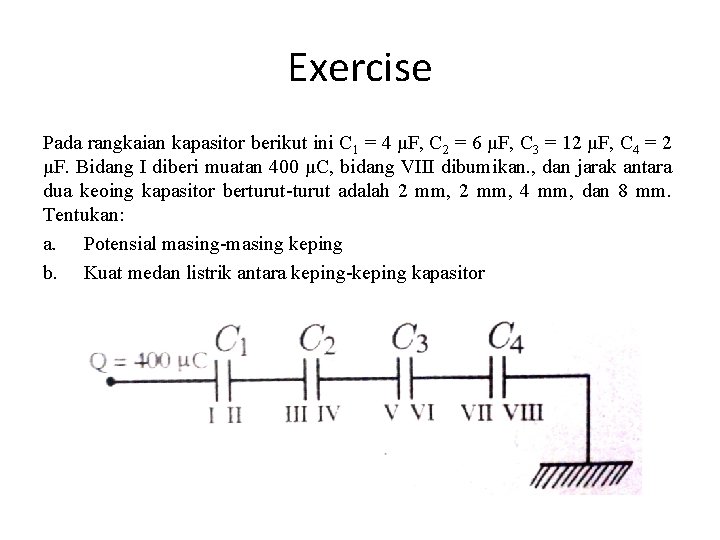
Exercise Pada rangkaian kapasitor berikut ini C 1 = 4 μF, C 2 = 6 μF, C 3 = 12 μF, C 4 = 2 μF. Bidang I diberi muatan 400 μC, bidang VIII dibumikan. , dan jarak antara dua keoing kapasitor berturut-turut adalah 2 mm, 4 mm, dan 8 mm. Tentukan: a. Potensial masing-masing keping b. Kuat medan listrik antara keping-keping kapasitor