
CapabilitiesBased Assessments CBAs Initiation to Materiel Development Decision
Capabilities-Based Assessments (CBAs) Initiation to Materiel Development Decision (MDD)
Lesson Objectives • Explain the importance of Capabilities-Based Assessments (CBAs) to the Joint Capabilities Integration Development System (JCIDS) and the Defense Acquisition System – Summarize the essential characteristics and qualities of CBAs – Examine the major tasks of an effective CBA effort – Examine CBAs and their relation to the DOTm. LPF-P Change Recommendation (DCR) and Initial Capabilities Document (ICD) 2
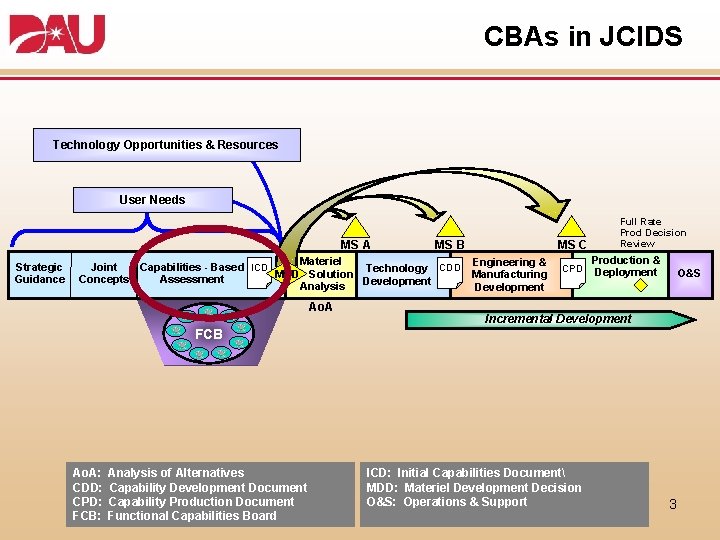
CBAs in JCIDS Technology Opportunities & Resources User Needs MS A Strategic Guidance MS B Materiel Joint Capabilities - Based ICD Technology CDD MDD Solution Concepts Assessment Development Analysis Ao. A MS C Engineering & Manufacturing Development CPD Full Rate Prod Decision Review Production & Deployment O&S Incremental Development FCB Ao. A: CDD: CPD: FCB: Analysis of Alternatives Capability Development Document Capability Production Document Functional Capabilities Board ICD: Initial Capabilities Document MDD: Materiel Development Decision O&S: Operations & Support 3
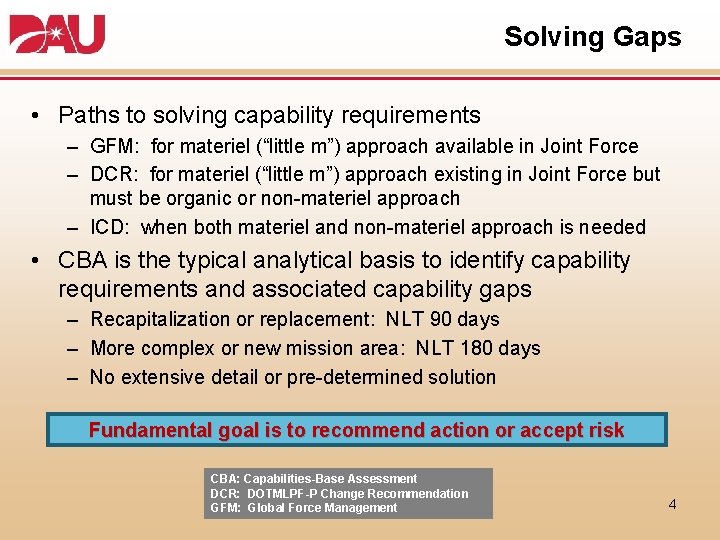
Solving Gaps • Paths to solving capability requirements – GFM: for materiel (“little m”) approach available in Joint Force – DCR: for materiel (“little m”) approach existing in Joint Force but must be organic or non-materiel approach – ICD: when both materiel and non-materiel approach is needed • CBA is the typical analytical basis to identify capability requirements and associated capability gaps – Recapitalization or replacement: NLT 90 days – More complex or new mission area: NLT 180 days – No extensive detail or pre-determined solution Fundamental goal is to recommend action or accept risk CBA: Capabilities-Base Assessment DCR: DOTMLPF-P Change Recommendation GFM: Global Force Management 4
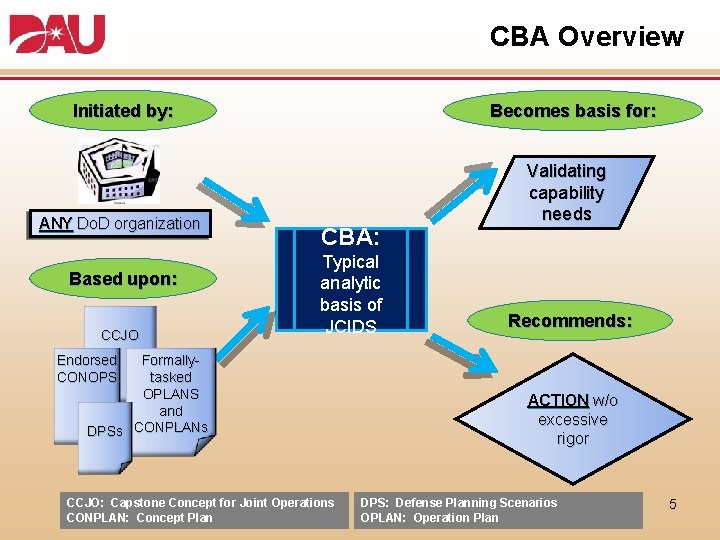
CBA Overview Initiated by: ANY Do. D organization Based upon: CCJO Becomes basis for: CBA: Typical analytic basis of JCIDS Formally- tasked OPLANS and DPSs CONPLANs Validating capability needs Recommends: Endorsed CONOPS CCJO: Capstone Concept for Joint Operations CONPLAN: Concept Plan ACTION w/o excessive rigor DPS: Defense Planning Scenarios OPLAN: Operation Plan 5
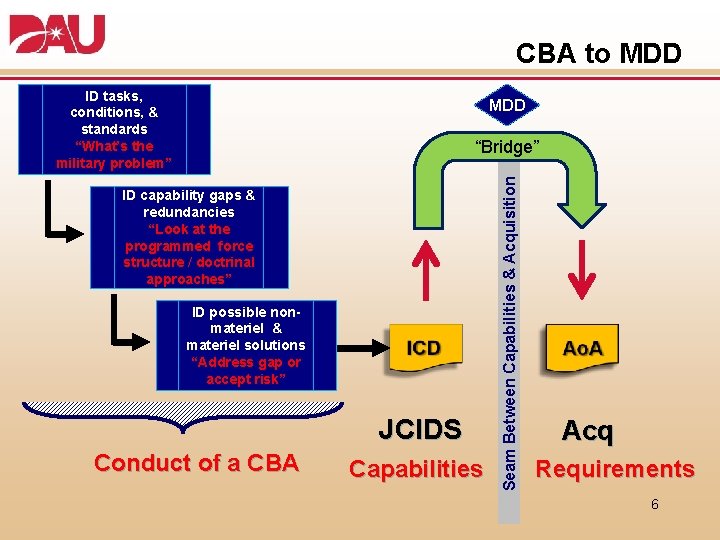
CBA to MDD ID tasks, conditions, & standards “What’s the military problem” MDD ID capability gaps & redundancies “Look at the programmed force structure / doctrinal approaches” ID possible nonmateriel & materiel solutions “Address gap or accept risk” JCIDS Conduct of a CBA Capabilities Seam Between Capabilities & Acquisition “Bridge” Acq Requirements 6
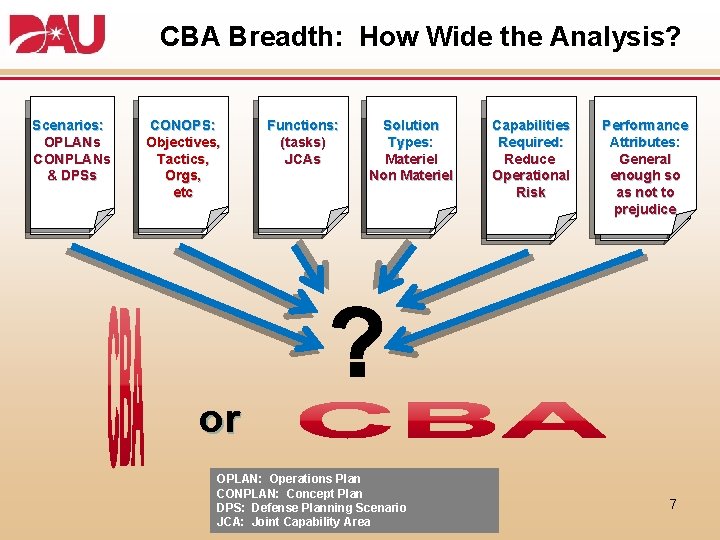
CBA Breadth: How Wide the Analysis? Scenarios: OPLANs Scenarios: CONPLANs Oplans & DPSs CONOPS: Objectives, CONOPS: Tactics, Objectives, Orgs, Tactics, etc Orgs, etc Functions: (tasks) Functions: JCAs Solution Types: Solution Materiel Types: Non Materiel Policies & Treaties Capabilities Required: Capabilities Reduce Desired: Operational Meet Risk Operational Objectives Performance Attributes: Performance General Attributes: enough Metricsso > asprecision not to = more analyses prejudice = more time or or OPLAN: Operations Plan CONPLAN: Concept Plan DPS: Defense Planning Scenario JCA: Joint Capability Area 7
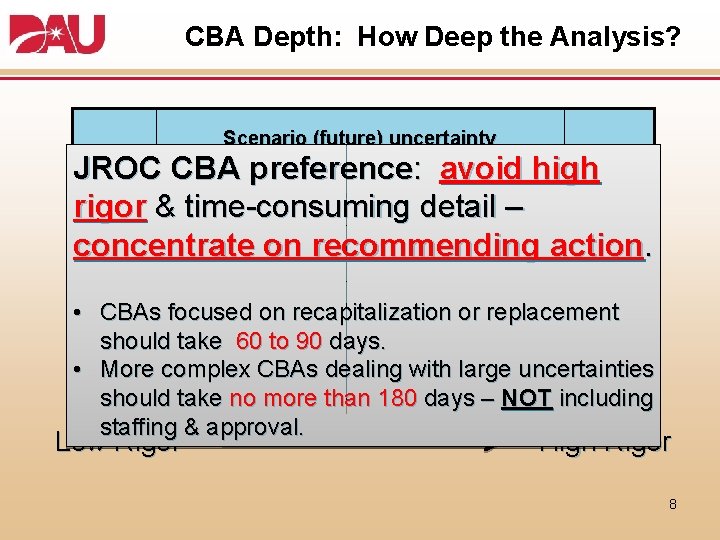
CBA Depth: How Deep the Analysis? Scenario (future) uncertainty JROC CBA preference: avoid high Consequences of operational failure rigor & time-consuming detail – concentrate on recommending action Complexity of assessment Low High. Solution resources required • CBAs focused on recapitalization or replacement should take 60 to 90 days. Solution cost, schedule, performance risk • More complex CBAs dealing with large uncertainties should take no more than 180 days – NOT including staffing & approval. Low Rigor High Rigor 8
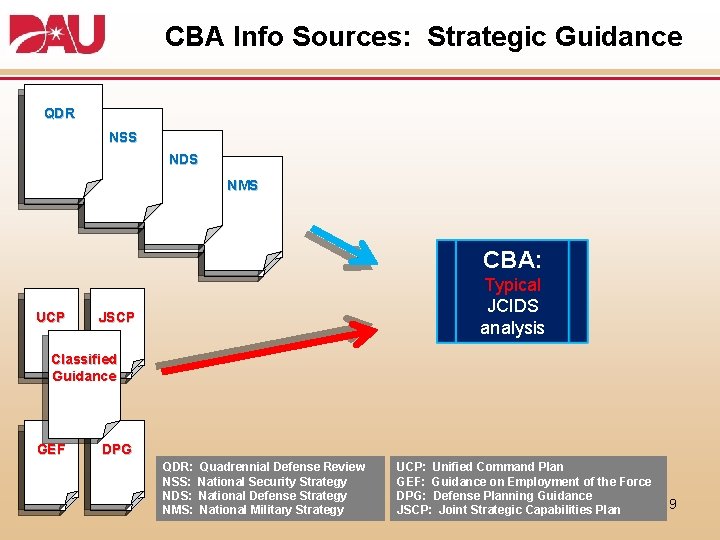
CBA Info Sources: Strategic Guidance QDR NSS NDS NMS CBA: UCP Typical JCIDS analysis JSCP Classified Guidance GEF DPG DPPG QDR: NSS: NDS: NMS: Quadrennial Defense Review National Security Strategy National Defense Strategy National Military Strategy UCP: Unified Command Plan GEF: Guidance on Employment of the Force DPG: Defense Planning Guidance JSCP: Joint Strategic Capabilities Plan 9
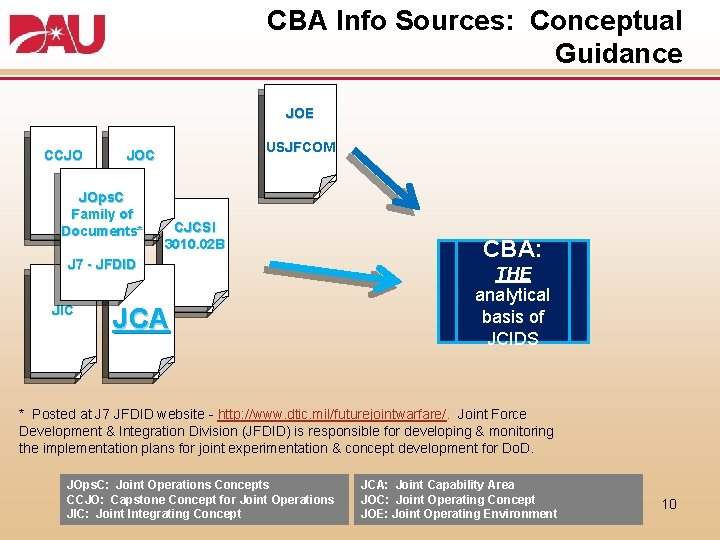
CBA Info Sources: Conceptual Guidance JOE** CCJO JOps. C Family of Documents* J 7 - JFDID JIC USJFCOM JOC CJCSI 3010. 02 B JCA CBA: THE analytical basis of JCIDS * Posted at J 7 JFDID website - http: //www. dtic. mil/futurejointwarfare/. Joint Force Development & Integration Division (JFDID) is responsible for developing & monitoring the implementation plans for joint experimentation & concept development for Do. D. JOps. C: Joint Operations Concepts CCJO: Capstone Concept for Joint Operations JIC: Joint Integrating Concept JCA: Joint Capability Area JOC: Joint Operating Concept JOE: Joint Operating Environment 10
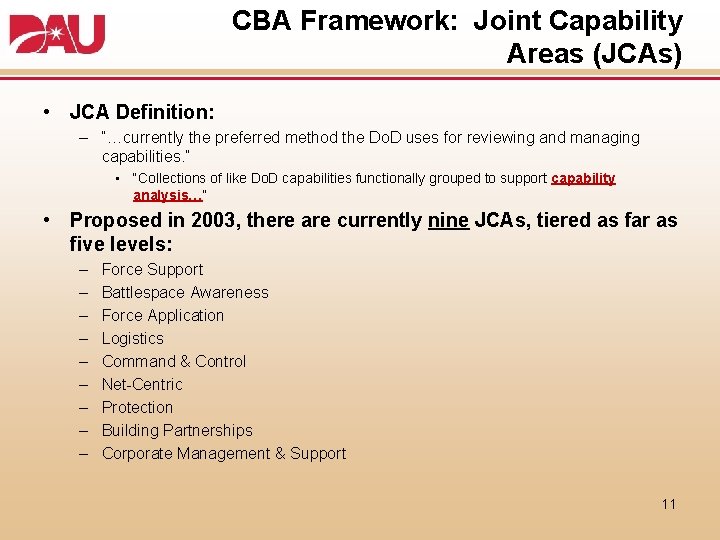
CBA Framework: Joint Capability Areas (JCAs) • JCA Definition: – “…currently the preferred method the Do. D uses for reviewing and managing capabilities. ” • “Collections of like Do. D capabilities functionally grouped to support capability analysis…” • Proposed in 2003, there are currently nine JCAs, tiered as far as five levels: – – – – – Force Support Battlespace Awareness Force Application Logistics Command & Control Net-Centric Protection Building Partnerships Corporate Management & Support 11
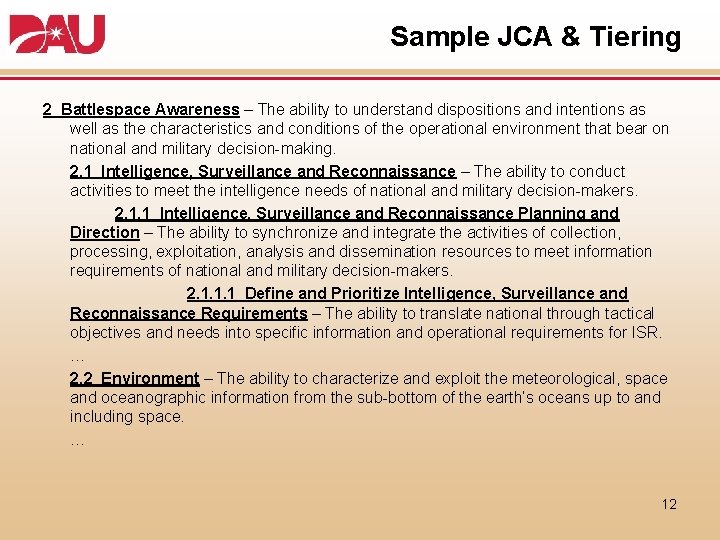
Sample JCA & Tiering 2 Battlespace Awareness – The ability to understand dispositions and intentions as well as the characteristics and conditions of the operational environment that bear on national and military decision-making. 2. 1 Intelligence, Surveillance and Reconnaissance – The ability to conduct activities to meet the intelligence needs of national and military decision-makers. 2. 1. 1 Intelligence, Surveillance and Reconnaissance Planning and Direction – The ability to synchronize and integrate the activities of collection, processing, exploitation, analysis and dissemination resources to meet information requirements of national and military decision-makers. 2. 1. 1. 1 Define and Prioritize Intelligence, Surveillance and Reconnaissance Requirements – The ability to translate national through tactical objectives and needs into specific information and operational requirements for ISR. … 2. 2 Environment – The ability to characterize and exploit the meteorological, space and oceanographic information from the sub-bottom of the earth’s oceans up to and including space. … 12
Value of the CBA & ICD • Proper CBA documented in ICD is critical because it: – – – Provides foundation for future requirements Identifies priorities Within Sponsor / Joint portfolio Identifies military problem being addressed Identifies timeframe when capability must be delivered Provides both materiel and non-materiel approaches • In-Class ICD Review Exercise: – Review an existing ICD – Use Checklist derived from JCIDS Template – Prep for actual ICD review and Capstone later this week… Sets conditions for successful acquisition 13
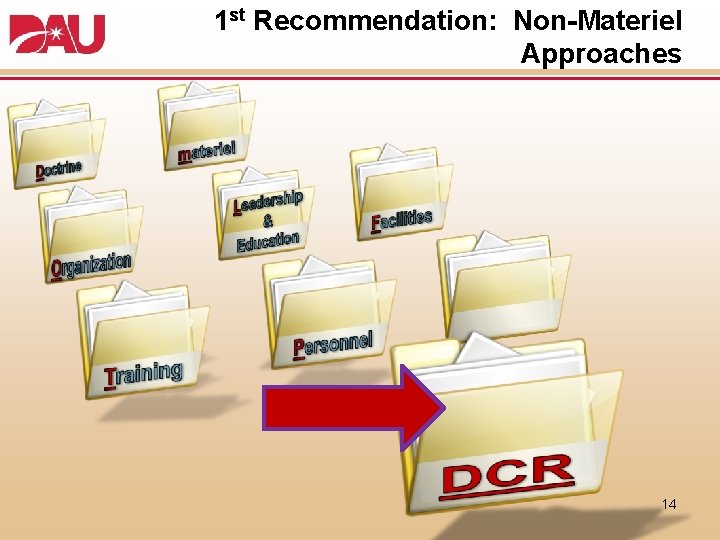
1 st Recommendation: Non-Materiel Approaches 14
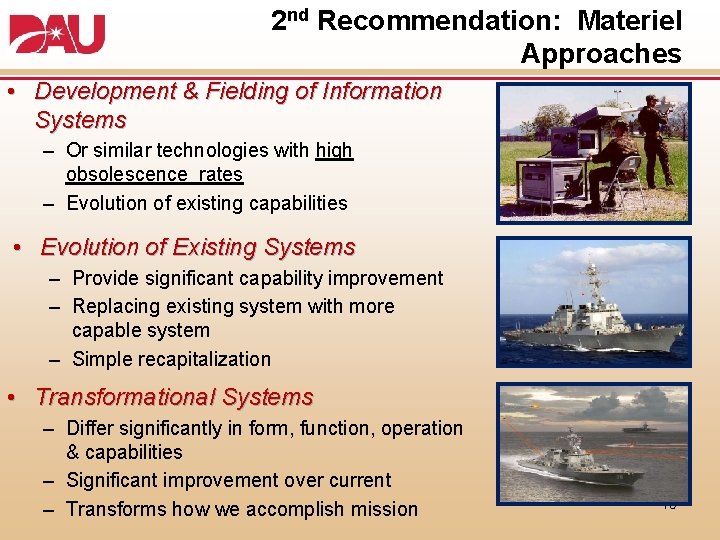
2 nd Recommendation: Materiel Approaches • Development & Fielding of Information Systems – Or similar technologies with high obsolescence rates – Evolution of existing capabilities • Evolution of Existing Systems – Provide significant capability improvement – Replacing existing system with more capable system – Simple recapitalization • Transformational Systems – Differ significantly in form, function, operation & capabilities – Significant improvement over current – Transforms how we accomplish mission 15
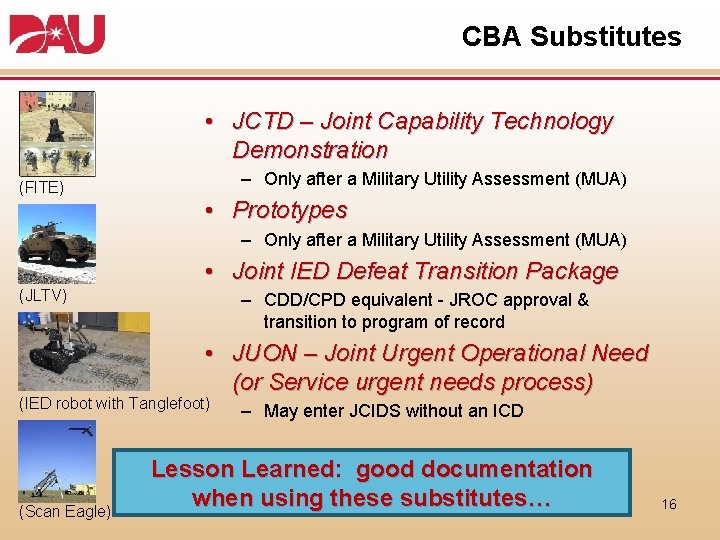
CBA Substitutes • JCTD – Joint Capability Technology Demonstration (FITE) – Only after a Military Utility Assessment (MUA) • Prototypes – Only after a Military Utility Assessment (MUA) • Joint IED Defeat Transition Package (JLTV) – CDD/CPD equivalent - JROC approval & transition to program of record • JUON – Joint Urgent Operational Need (or Service urgent needs process) (IED robot with Tanglefoot) (Scan Eagle) – May enter JCIDS without an ICD Lesson Learned: good documentation when using these substitutes… 16
What an RM Needs to Take Away From This CBA Lesson • Effectively scope the CBA – 60 -180 days – must avoid paralysis-by-analysis • Conduct proper analysis - select representative scenarios with a realistic timeframe for delivery of the capability • Align required capabilities to prioritized JCAs • Use CDTM to develop ICD for correct format and length • Recommend appropriate actions to mitigate gaps – Accept risk – Non-materiel – Materiel 17
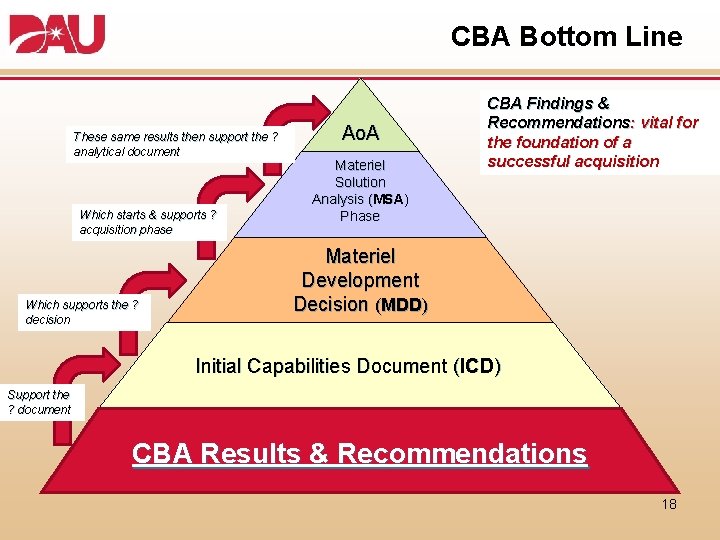
CBA Bottom Line These same results then support the ? analytical document Which starts & supports ? acquisition phase Which supports the ? decision Ao. A Materiel Solution Analysis (MSA) Phase CBA Findings & Recommendations: vital for the foundation of a successful acquisition Materiel Development Decision (MDD) Initial Capabilities Document (ICD) Support the ? document CBA Results & Recommendations 18
Sources for More Detailed CBA Information • • • CJSCI 3170. 01 H, JCIDS: CJCSI 3170. 01 G - TBD 2011 JCIDS Manual: TBD 2011 J 8 CBA User’s Guide, V 3, Mar 2009 – TBD 2011 – Geared toward CBA Team Leaders, Core Team, & Working Groups – Background, context, & detailed CBA procedures • DAU online course CLR 250, Capability-Based Assessments – General CBA overview – more detailed that RQM 310 – access via browse mode • DAU Community of Practice (Co. P) – https: //acc. dau. mil/Community. Browser. aspx? id=204080&lang=en-US 19
- Slides: 19