
CAP Theorem CAP Theorem Assumed by Prof Eric
CAP Theorem
CAP Theorem • Assumed by Prof. Eric Brewer at PODC (Principle of Distributed Computing) 2000 keynote talk • Described the trade-offs involved in distributed system • It is impossible for a web service to provide following three guarantees at the same time: • Consistency • Availability • Partition-tolerance
CAP Theorem • Consistency: – All nodes should see the same data at the same time • Availability: – Node failures do not prevent survivors from continuing to operate • Partition-tolerance: – The system continues to operate despite network partitions • A distributed system can satisfy any two of these guarantees at the same time but not all three
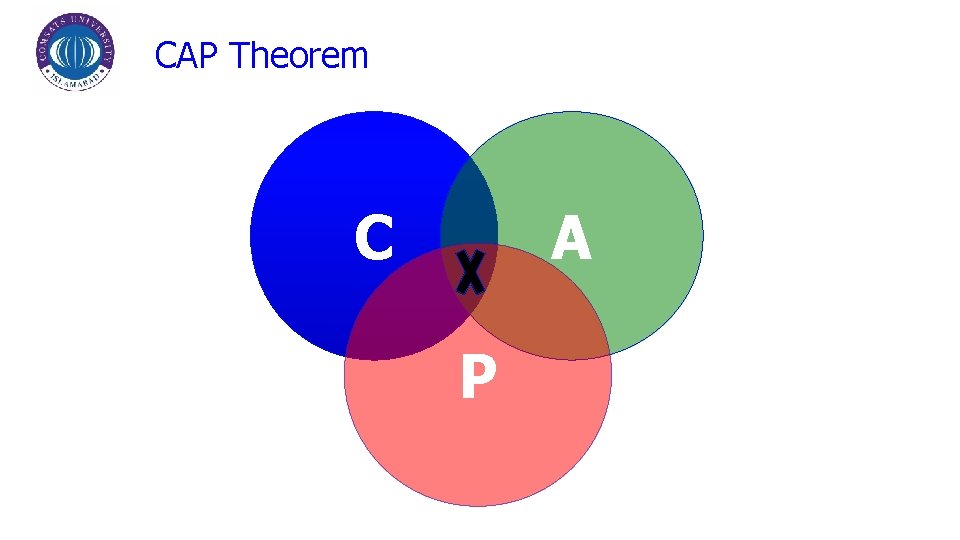
CAP Theorem C A P
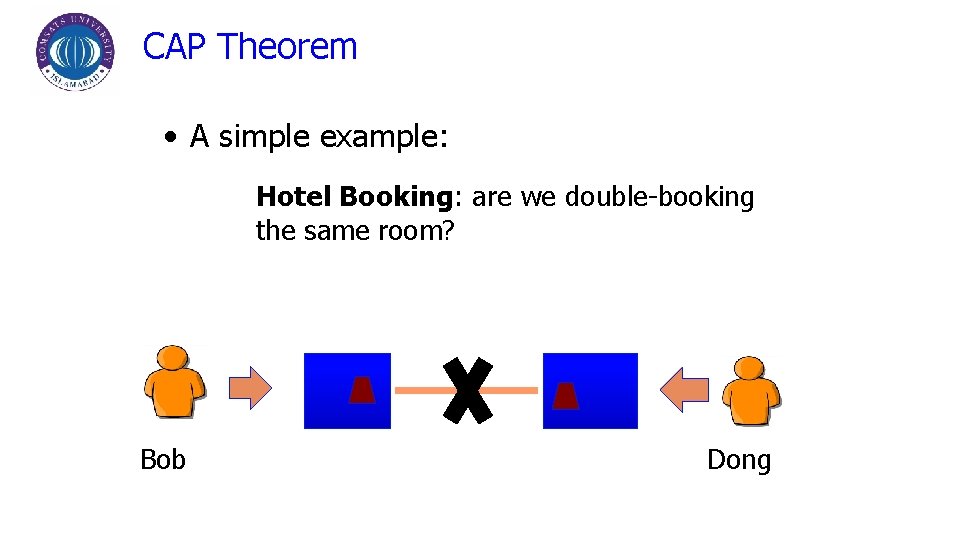
CAP Theorem • A simple example: Hotel Booking: are we double-booking the same room? Bob Dong
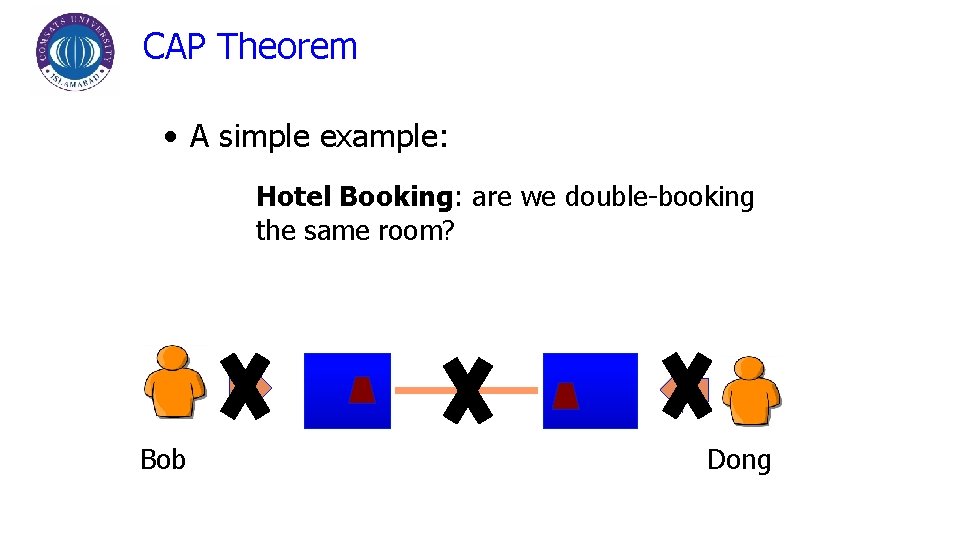
CAP Theorem • A simple example: Hotel Booking: are we double-booking the same room? Bob Dong
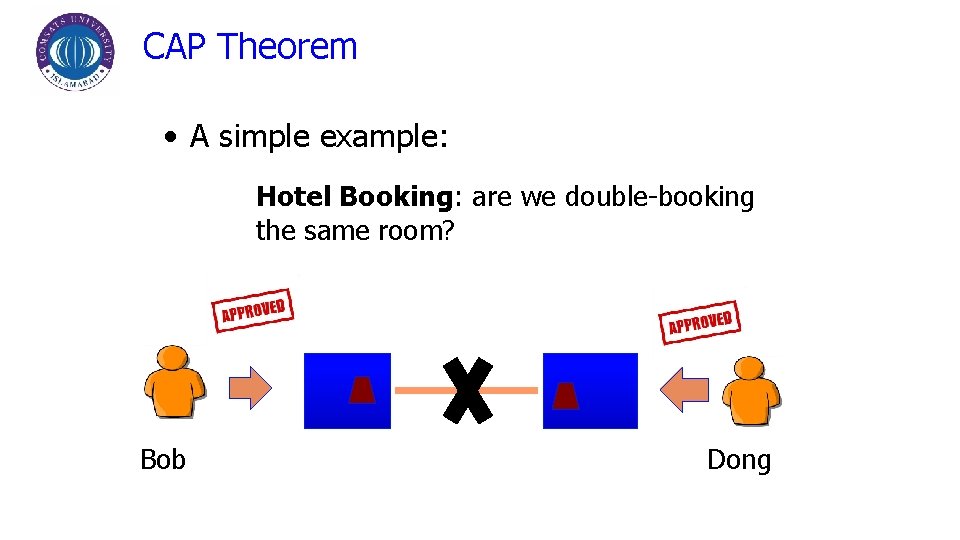
CAP Theorem • A simple example: Hotel Booking: are we double-booking the same room? Bob Dong
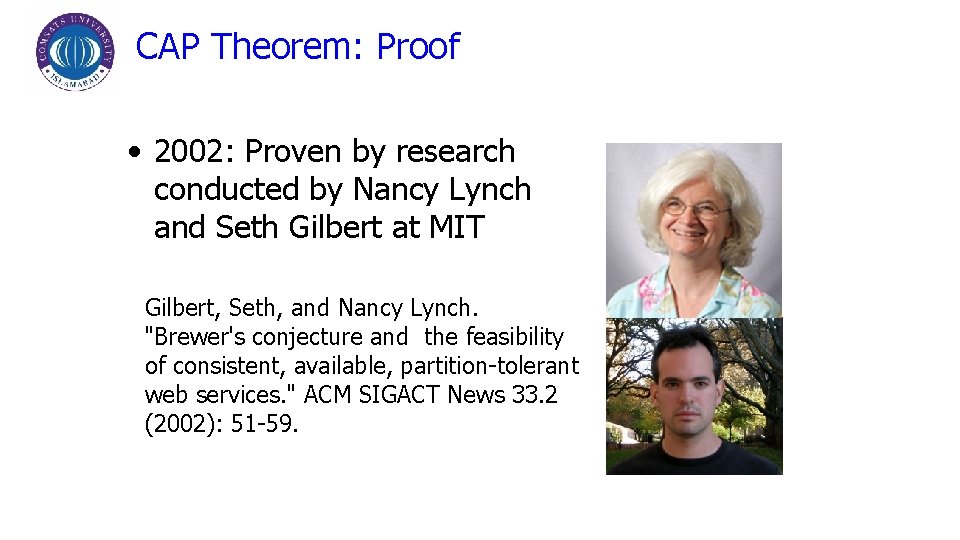
CAP Theorem: Proof • 2002: Proven by research conducted by Nancy Lynch and Seth Gilbert at MIT Gilbert, Seth, and Nancy Lynch. "Brewer's conjecture and the feasibility of consistent, available, partition-tolerant web services. " ACM SIGACT News 33. 2 (2002): 51 -59.
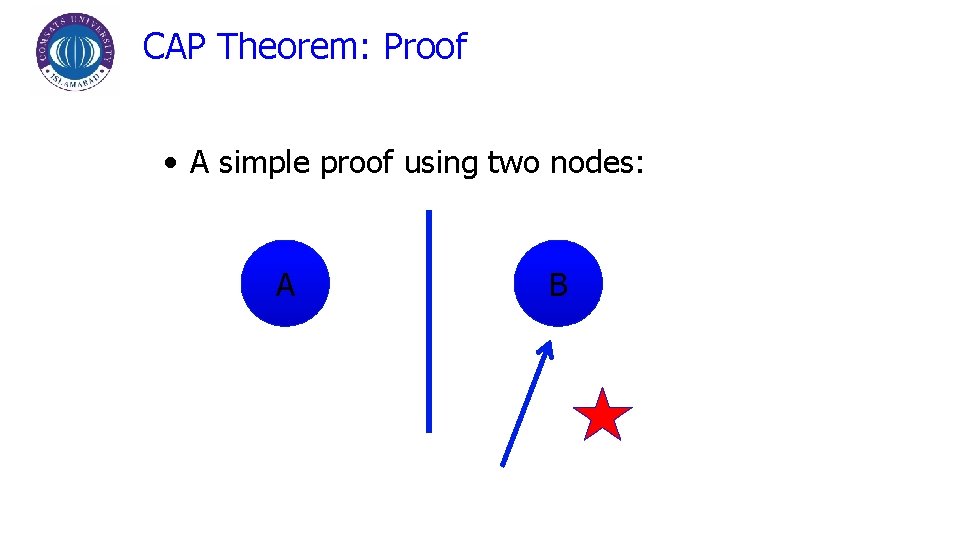
CAP Theorem: Proof • A simple proof using two nodes: A B
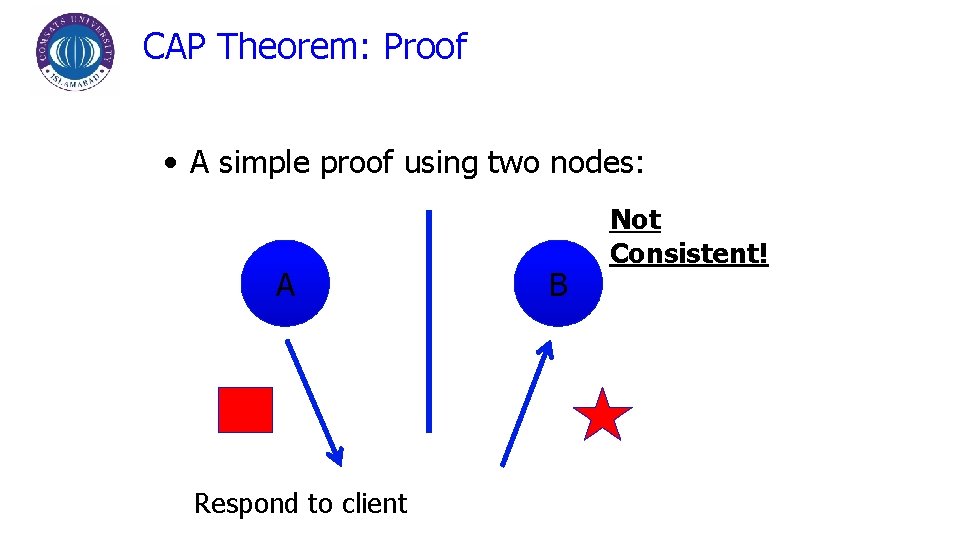
CAP Theorem: Proof • A simple proof using two nodes: A Respond to client B Not Consistent!
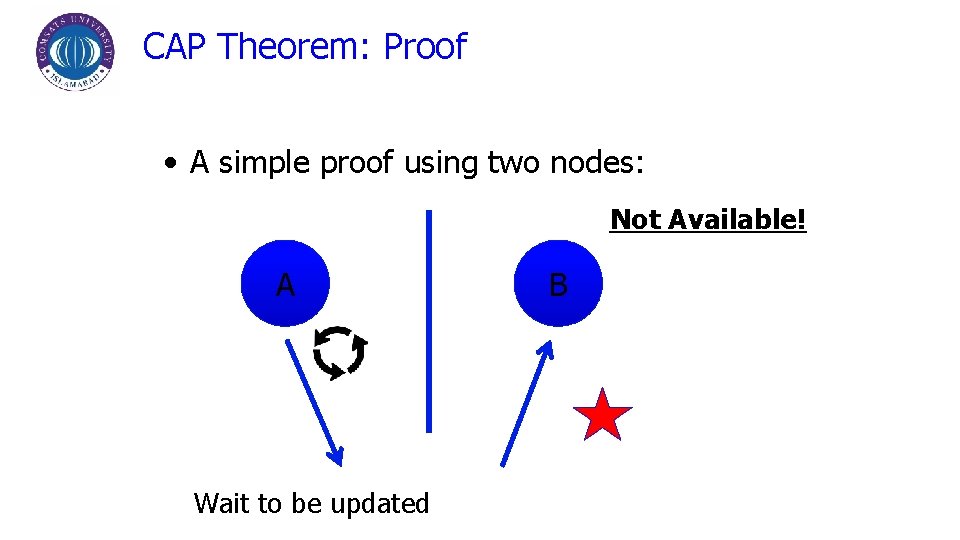
CAP Theorem: Proof • A simple proof using two nodes: Not Available! A Wait to be updated B
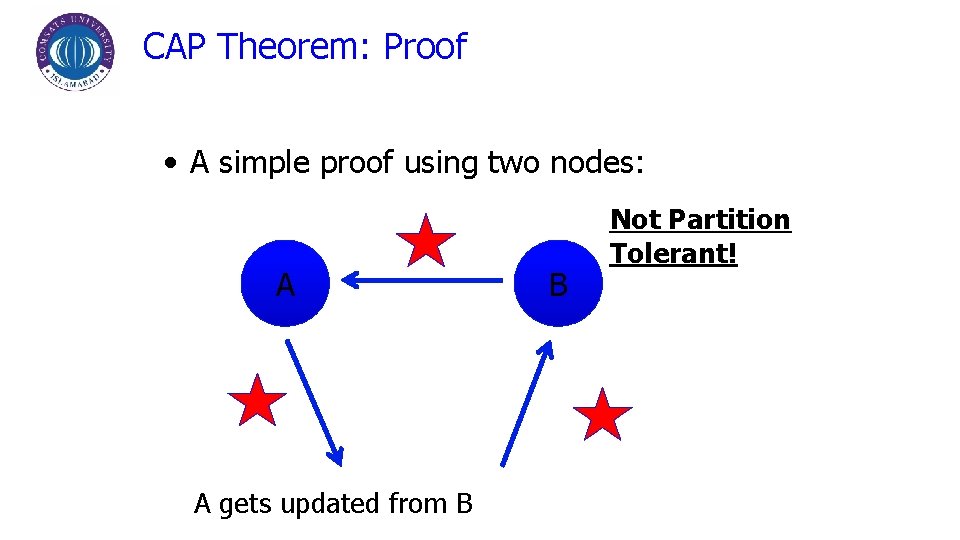
CAP Theorem: Proof • A simple proof using two nodes: A A gets updated from B B Not Partition Tolerant!

Why this is important? • The future of databases is distributed (Big Data Trend, etc. ) • CAP theorem describes the trade-offs involved in distributed systems • A proper understanding of CAP theorem is essential to making decisions about the future of distributed database design • Misunderstanding can lead to erroneous or inappropriate design choices
Problem for Relational Database to Scale • The Relational Database is built on the principle of ACID (Atomicity, Consistency, Isolation, Durability) • It implies that a truly distributed relational database should have availability, consistency and partition tolerance. • Which unfortunately is impossible …
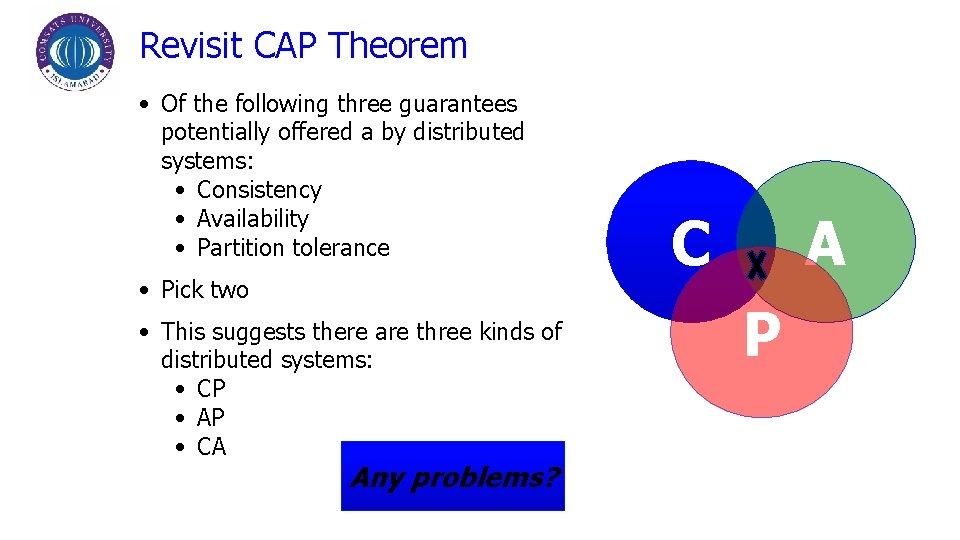
Revisit CAP Theorem • Of the following three guarantees potentially offered a by distributed systems: • Consistency • Availability • Partition tolerance • Pick two • This suggests there are three kinds of distributed systems: • CP • AP • CA Any problems? C A P
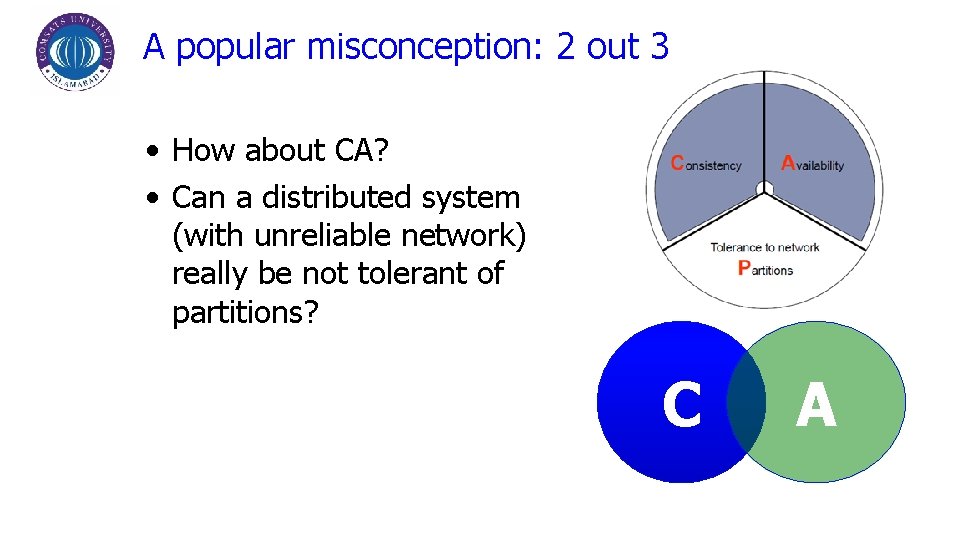
A popular misconception: 2 out 3 • How about CA? • Can a distributed system (with unreliable network) really be not tolerant of partitions? C A
A few witnesses • Coda Hale, Yammer software engineer: – “Of the CAP theorem’s Consistency, Availability, and Partition Tolerance, Partition Tolerance is mandatory in distributed systems. You cannot choose it. ” http: //codahale. com/you-cant-sacrifice-partition-tolerance/
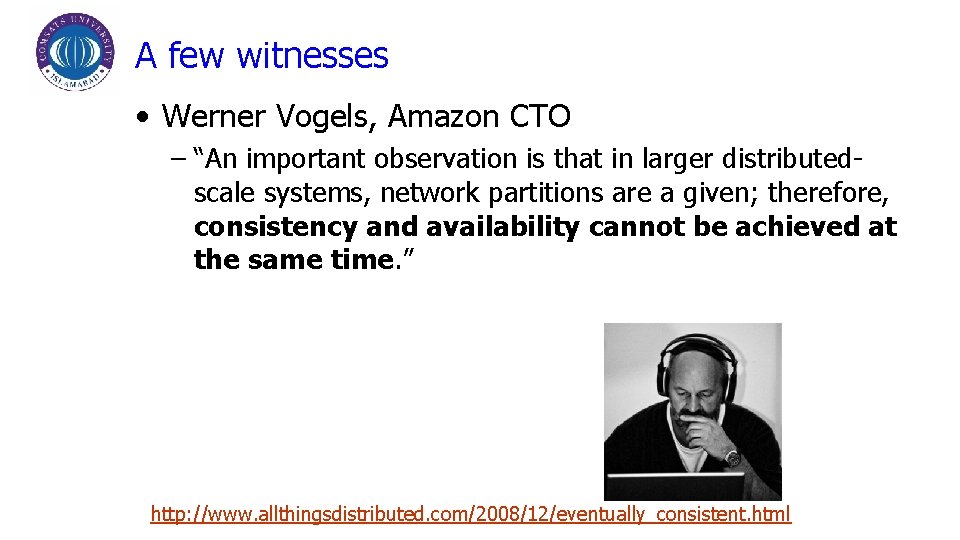
A few witnesses • Werner Vogels, Amazon CTO – “An important observation is that in larger distributedscale systems, network partitions are a given; therefore, consistency and availability cannot be achieved at the same time. ” http: //www. allthingsdistributed. com/2008/12/eventually_consistent. html
A few witnesses • Daneil Abadi, Co-founder of Hadapt – So in reality, there are only two types of systems. . . I. e. , if there is a partition, does the system give up availability or consistency? http: //dbmsmusings. blogspot. com/2010/04/problems-with-cap-and-yahoos-little. html
CAP Theorem 12 year later • Prof. Eric Brewer: father of CAP theorem • “The “ 2 of 3” formulation was always misleading because it tended to oversimplify the tensions among properties. . • CAP prohibits only a tiny part of the design space: perfect availability and consistency in the presence of partitions, which are rare. ” http: //www. infoq. com/articles/cap-twelve-years-later-how-the-rules-have-changed
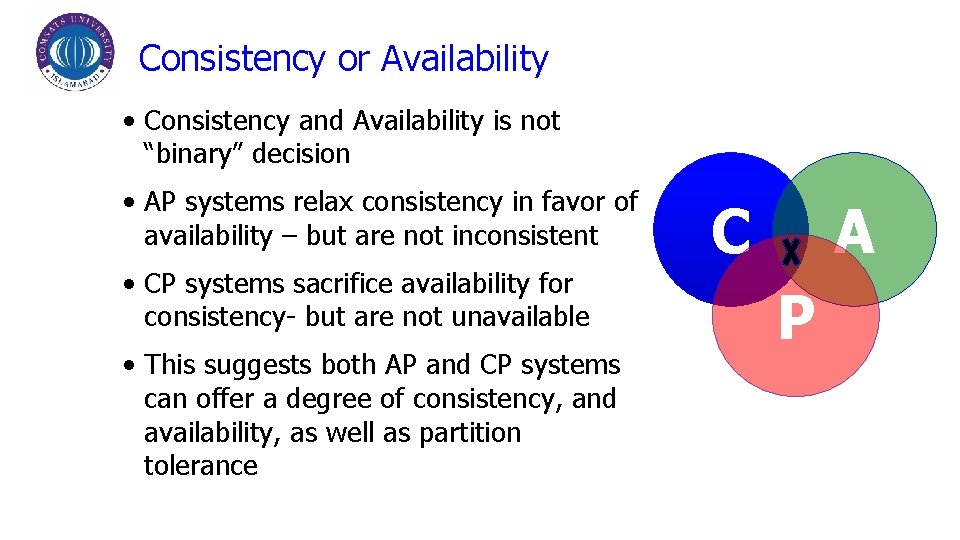
Consistency or Availability • Consistency and Availability is not “binary” decision • AP systems relax consistency in favor of availability – but are not inconsistent • CP systems sacrifice availability for consistency- but are not unavailable • This suggests both AP and CP systems can offer a degree of consistency, and availability, as well as partition tolerance C A P
AP: Best Effort Consistency • Example: – Web Caching – DNS • Trait: – Optimistic – Expiration/Time-to-live – Conflict resolution
CP: Best Effort Availability • Example: – Majority protocols – Distributed Locking (Google Chubby Lock service) • Trait: – Pessimistic locking – Make minority partition unavailable
Types of Consistency • Strong Consistency – After the update completes, any subsequent access will return the same updated value. • Weak Consistency – It is not guaranteed that subsequent accesses will return the updated value. • Eventual Consistency – Specific form of weak consistency – It is guaranteed that if no new updates are made to object, eventually all accesses will return the last updated value (e. g. , propagate updates to replicas in a lazy fashion)
Eventual Consistency Variations • Causal consistency – Processes that have causal relationship will see consistent data • Read-your-write consistency – A process always accesses the data item after it’s update operation and never sees an older value • Session consistency – As long as session exists, system guarantees read-yourwrite consistency
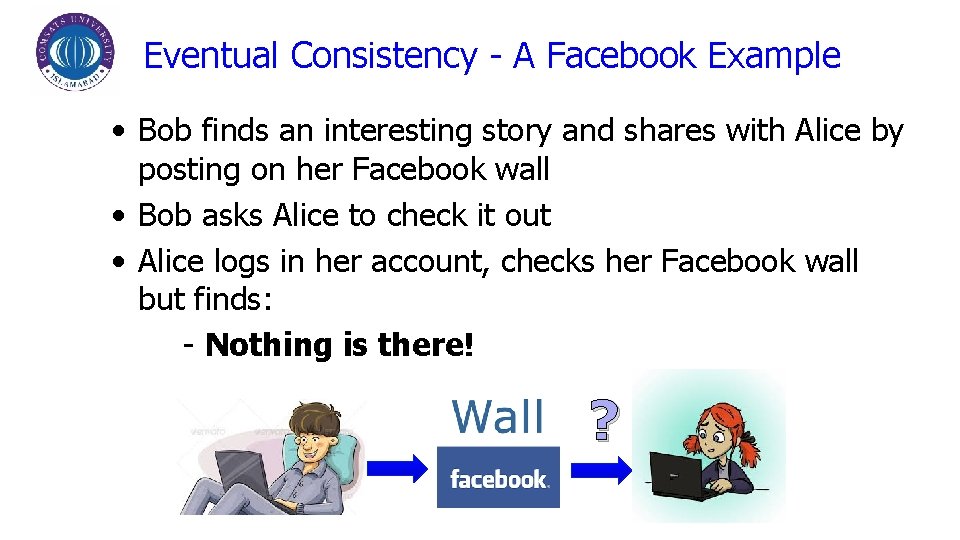
Eventual Consistency - A Facebook Example • Bob finds an interesting story and shares with Alice by posting on her Facebook wall • Bob asks Alice to check it out • Alice logs in her account, checks her Facebook wall but finds: - Nothing is there! ?
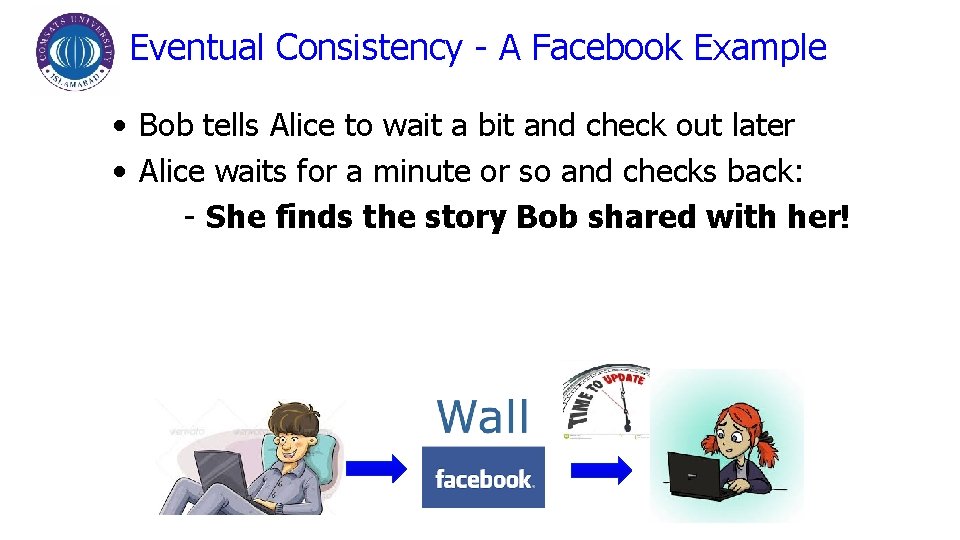
Eventual Consistency - A Facebook Example • Bob tells Alice to wait a bit and check out later • Alice waits for a minute or so and checks back: - She finds the story Bob shared with her!
Eventual Consistency - A Facebook Example • Reason: it is possible because Facebook uses an eventual consistent model • Why Facebook chooses eventual consistent model over the strong consistent one? – Facebook has more than 1 billion active users – It is non-trivial to efficiently and reliably store the huge amount of data generated at any given time – Eventual consistent model offers the option to reduce the load and improve availability
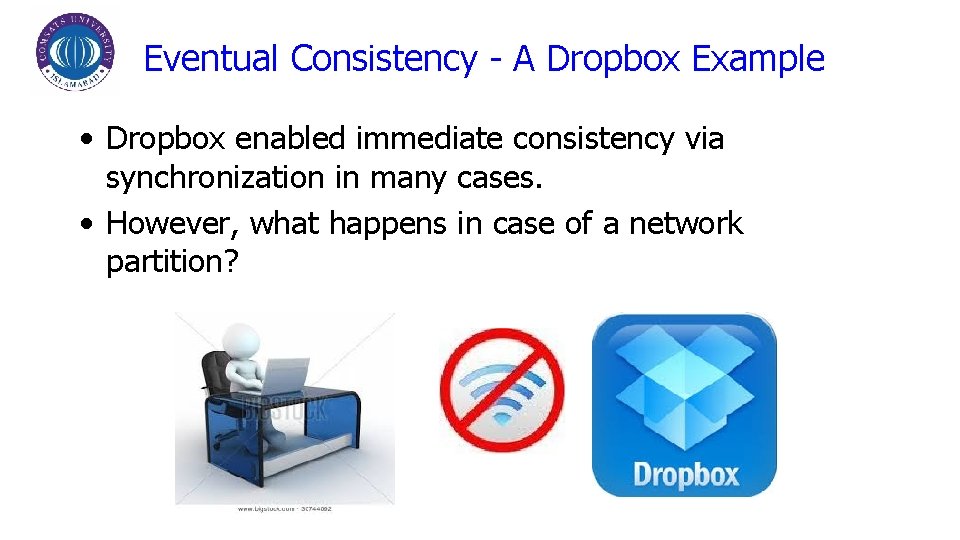
Eventual Consistency - A Dropbox Example • Dropbox enabled immediate consistency via synchronization in many cases. • However, what happens in case of a network partition?
Eventual Consistency- A Dropbox Example • Let’s do a simple experiment here: – Open a file in your drop box – Disable your network connection (e. g. , Wi. Fi, 4 G) – Try to edit the file in the drop box: can you do that? – Re-enable your network connection: what happens to your dropbox folder?
Eventual Consistency - A Dropbox Example • Dropbox embraces eventual consistency: – Immediate consistency is impossible in case of a network partition – Users will feel bad if their word documents freeze each time they hit Ctrl+S , simply due to the large latency to update all devices across WAN – Dropbox is oriented to personal syncing, not on collaboration, so it is not a real limitation.
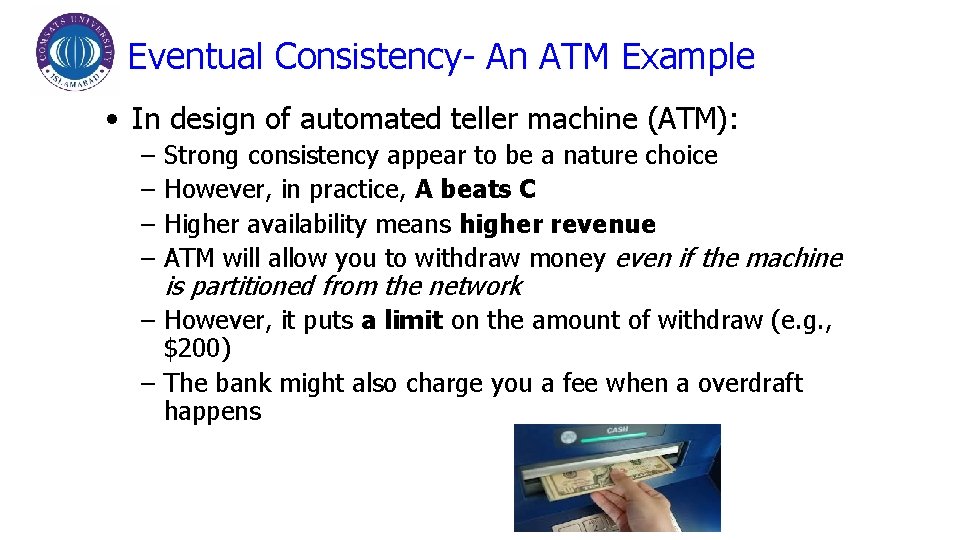
Eventual Consistency- An ATM Example • In design of automated teller machine (ATM): – – Strong consistency appear to be a nature choice However, in practice, A beats C Higher availability means higher revenue ATM will allow you to withdraw money even if the machine is partitioned from the network – However, it puts a limit on the amount of withdraw (e. g. , $200) – The bank might also charge you a fee when a overdraft happens
Dynamic Tradeoff between C and A • An airline reservation system: – When most of seats are available: it is ok to rely on somewhat out-of-date data, availability is more critical – When the plane is close to be filled: it needs more accurate data to ensure the plane is not overbooked, consistency is more critical • Neither strong consistency nor guaranteed availability, but it may significantly increase the tolerance of network disruption
Heterogeneity: Segmenting C and A • No single uniform requirement – Some aspects require strong consistency – Others require high availability • Segment the system into different components – Each provides different types of guarantees • Overall guarantees neither consistency nor availability – Each part of the service gets exactly what it needs • Can be partitioned along different dimensions
Discussion • In an e-commercial system (e. g. , Amazon, e-Bay, etc), what are the trade-offs between consistency and availability you can think of? What is your strategy? • Hint -> Things you might want to consider: – – Different types of data (e. g. , shopping cart, billing, product, etc. ) Different types of operations (e. g. , query, purchase, etc. ) Different types of services (e. g. , distributed lock, DNS, etc. ) Different groups of users (e. g. , users in different geographic areas, etc. )
Partitioning Examples • • • Data Partitioning Operational Partitioning Functional Partitioning User Partitioning Hierarchical Partitioning
Partitioning Examples Data Partitioning • Different data may require different consistency and availability • Example: • Shopping cart: high availability, responsive, can sometimes suffer anomalies • Product information need to be available, slight variation in inventory is sufferable • Checkout, billing, shipping records must be consistent
Partitioning Examples Operational Partitioning • Each operation may require different balance between consistency and availability • Example: • Reads: high availability; e. g. . , “query” • Writes: high consistency, lock when writing; e. g. , “purchase”
Partitioning Examples Functional Partitioning • System consists of sub-services • Different sub-services provide different balances • Example: A comprehensive distributed system – Distributed lock service (e. g. , Chubby) : • Strong consistency – DNS service: • High availability
Partitioning Examples User Partitioning • Try to keep related data close together to assure better performance • Example: – Might want to divide its service into several data centers, e. g. , east coast and west coast • Users get high performance (e. g. , high availability and good consistency) if they query servers closet to them • Poorer performance if a New York user query Craglist in San Francisco
Partitioning Examples Hierarchical Partitioning • Large global service with local “extensions” • Different location in hierarchy may use different consistency • Example: – Local servers (better connected) guarantee more consistency and availability – Global servers has more partition and relax one of the requirement
What if there are no partitions? • Tradeoff between Consistency and Latency: • Caused by the possibility of failure in distributed systems – High availability -> replicate data -> consistency problem • Basic idea: – Availability and latency are arguably the same thing: unavailable -> extreme high latency – Achieving different levels of consistency/availability takes different amount of time
CAP -> PACELC • A more complete description of the space of potential tradeoffs for distributed system: – If there is a partition (P), how does the system trade off availability and consistency (A and C); else (E), when the system is running normally in the absence of partitions, how does the system trade off latency (L) and consistency (C)? Abadi, Daniel J. "Consistency tradeoffs in modern distributed database system design. " Computer-IEEE Computer Magazine 45. 2 (2012): 37.
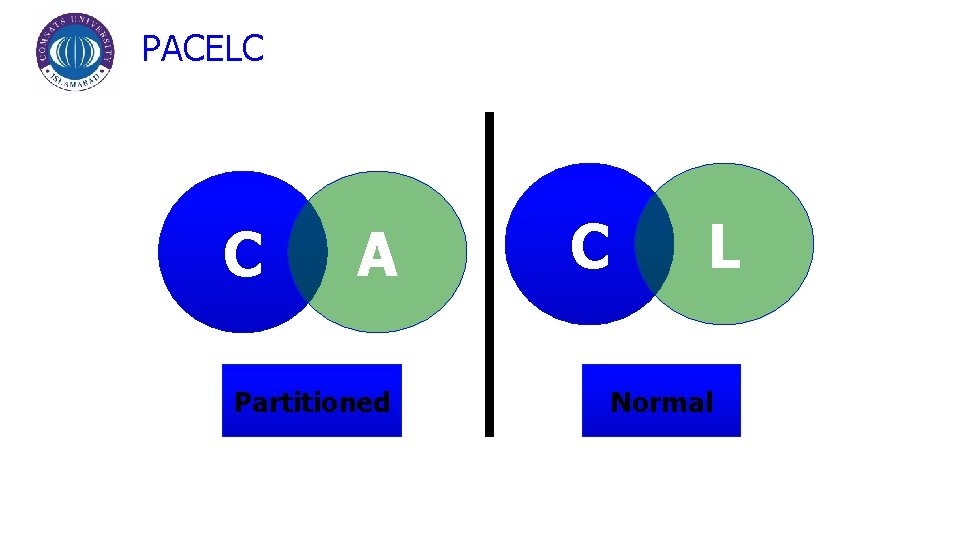
PACELC C A Partitioned C L Normal
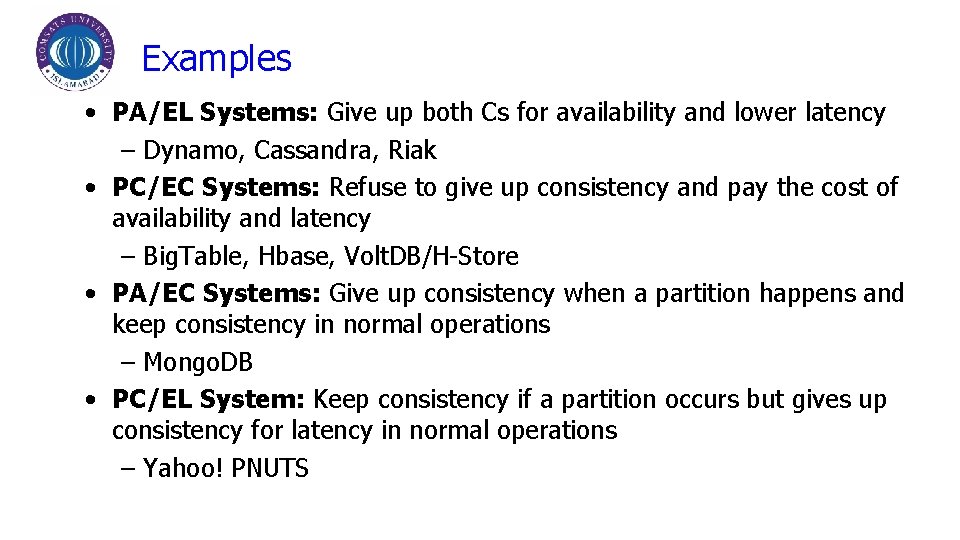
Examples • PA/EL Systems: Give up both Cs for availability and lower latency – Dynamo, Cassandra, Riak • PC/EC Systems: Refuse to give up consistency and pay the cost of availability and latency – Big. Table, Hbase, Volt. DB/H-Store • PA/EC Systems: Give up consistency when a partition happens and keep consistency in normal operations – Mongo. DB • PC/EL System: Keep consistency if a partition occurs but gives up consistency for latency in normal operations – Yahoo! PNUTS
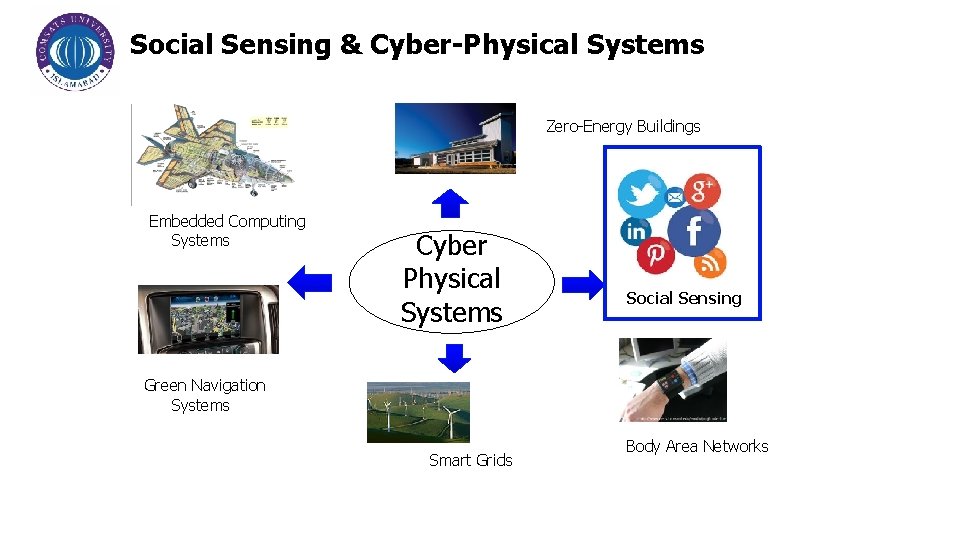
Social Sensing & Cyber-Physical Systems Zero-Energy Buildings Embedded Computing Systems Cyber Physical Systems Social Sensing Green Navigation Systems Smart Grids Body Area Networks

Proto Buffers
Proto Buffers • • Transmit Data Lots of Data Robustly Fast 49
Options • • XML- May be 10 years ago CSV- Sounds good JSON- Looks promising Proto Buffers – Thrift 50
Formal Definition • Protocol Buffers are Google's language neutral, platform-neutral, extensible mechanism for serializing structured data for use in communication protocols, data storage and many more. 51
XML • XML is smaller, faster and simpler • Data is transmitted in compact binary format 52
How to Use Proto Buffers • Define how you want your data to be structured in. proto file. • Generate data access classes using protocol buffer compiler • Write and read data from verity of data streams in your application • Specify transport mechanism 53
Why Not XML or JSON • • • PBs are simple to transfer 3 to 10 times smaller 20 to 100 times faster Less ambiguous Generate Data access classes that are easier to use programmatically 54
File Format Representation XML 69 Bytes JSON 47 Bytes PB 28 Bytes <person> <name> John Dee </name> <email>jdoe@example. com</email> </person> person{ Name=“John Dee” Email: ”jdoe@example. com” } Binary data 0 s and 1 s uses base 128 variants 55
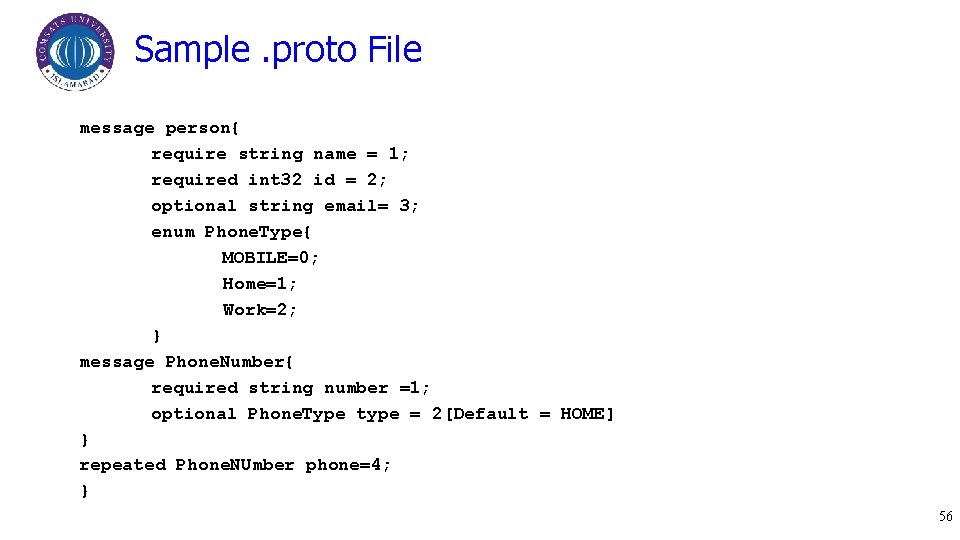
Sample. proto File message person{ require string name = 1; required int 32 id = 2; optional string email= 3; enum Phone. Type{ MOBILE=0; Home=1; Work=2; } message Phone. Number{ required string number =1; optional Phone. Type type = 2[Default = HOME] } repeated Phone. NUmber phone=4; } 56
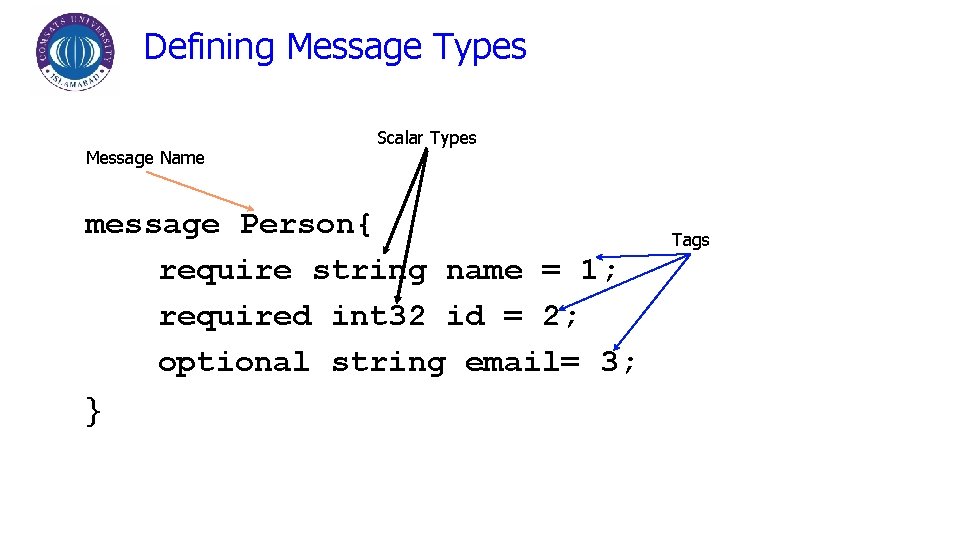
Defining Message Types Message Name Scalar Types message Person{ require string name = 1; required int 32 id = 2; optional string email= 3; } Tags
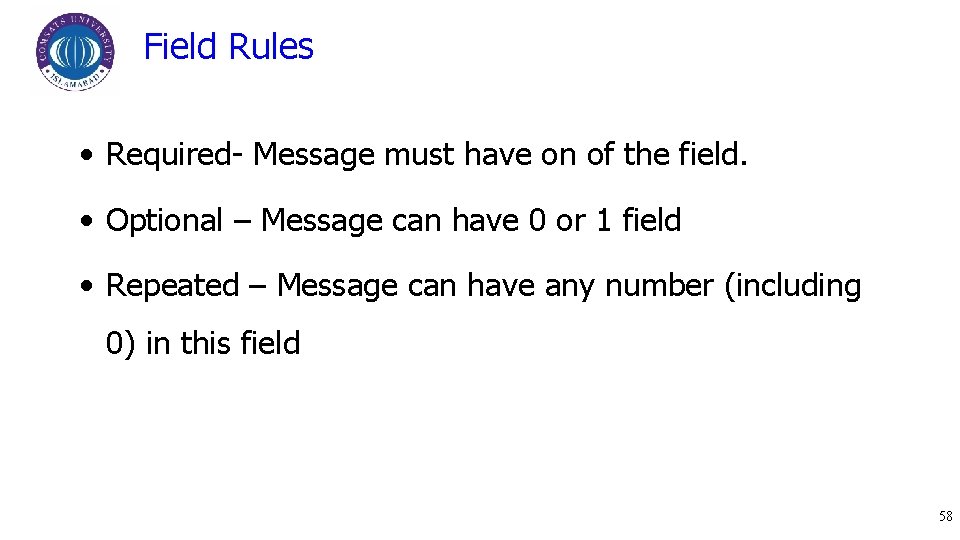
Field Rules • Required- Message must have on of the field. • Optional – Message can have 0 or 1 field • Repeated – Message can have any number (including 0) in this field 58
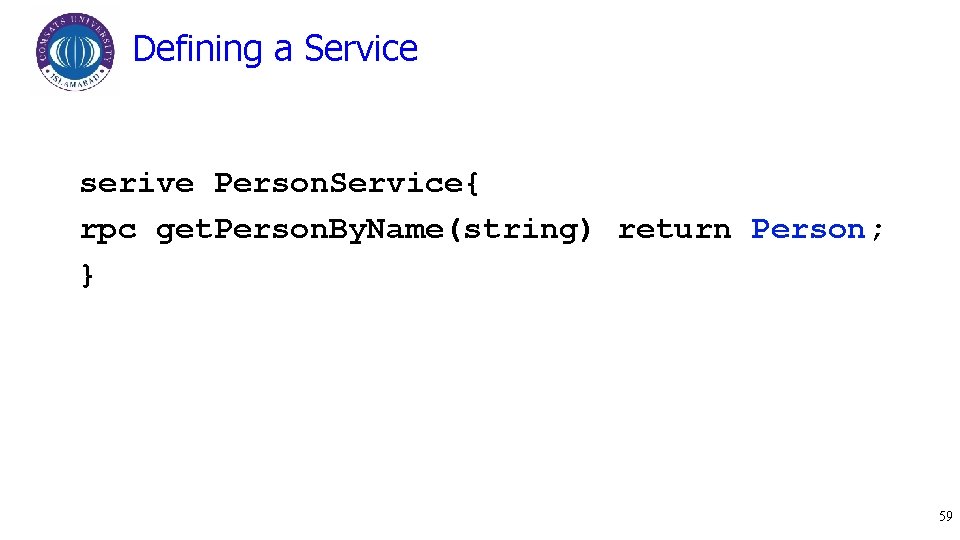
Defining a Service serive Person. Service{ rpc get. Person. By. Name(string) return Person; } 59
What is Generated from your. proto File • Supports 3 languages • Java • C++ • Python • For Java, the compiler generates a. java file with a class for each of message type. Special builder classes for creating message instance class • For C++ it generates. h and. cc files • For Python, a module with static descriptor for each message type. Which is used as metaclass to create a data access class at runtime 60
Other Options • • • Enumerations Using other message Types(Instead of Scalar Types) Nested Message Comments Extensions of Message 61
Base 128 variants • Methods of Serializing Integers • Smaller number take smaller number of Bytes • Each byte in a variant, except the last byte has the MSB set, to indicate further bytes to come • Lower 7 bits of each byte store 2’s complement of the number in groups of bits, LSB first 62
Encoding • PB is series of key value pairs • Binary versions uses the field number as the key • The name and type is determined on the encoding end by looking at the. proto file • Key for each pair is two values – the field number from the. proto file and write type to find the length of the following values • (field_number << 3)write_type • Value is encoded using the Base invariant scheme 63
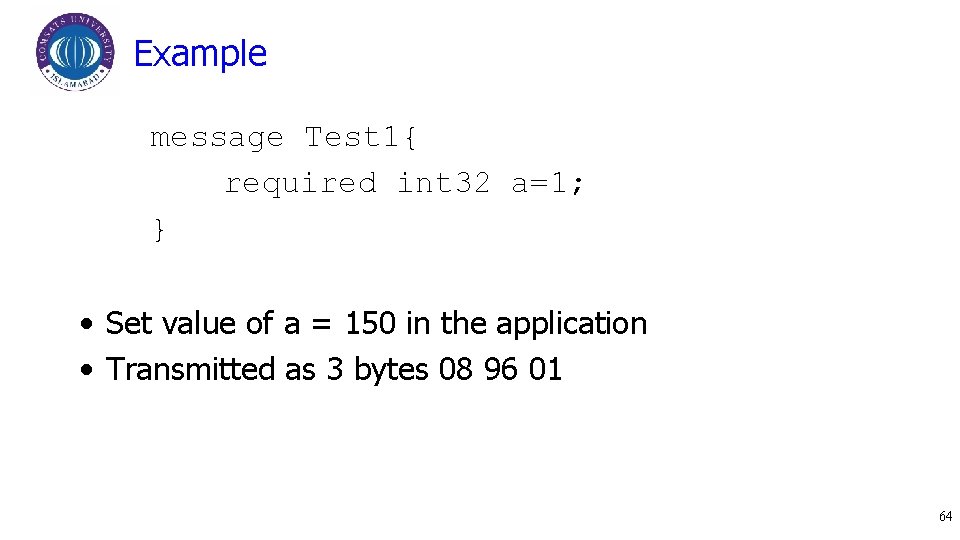
Example message Test 1{ required int 32 a=1; } • Set value of a = 150 in the application • Transmitted as 3 bytes 08 96 01 64
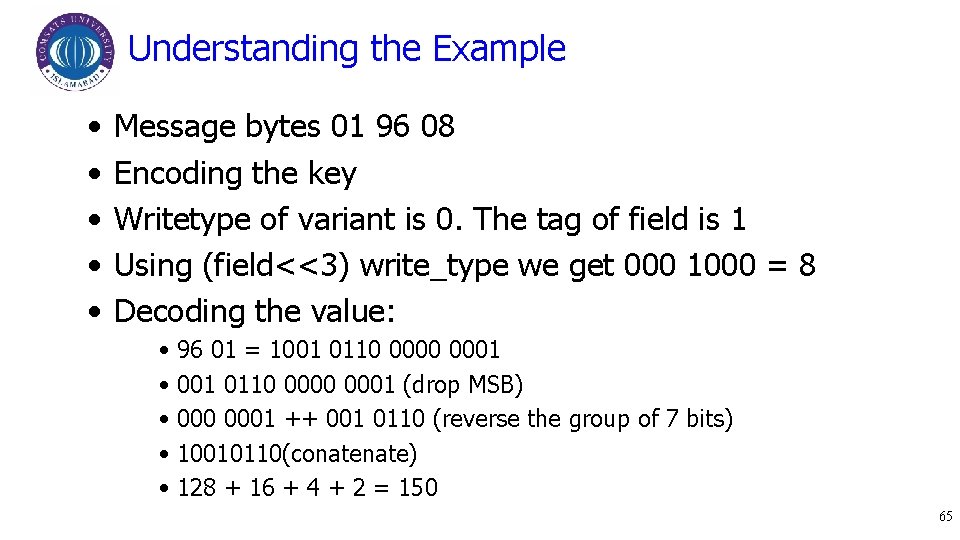
Understanding the Example • • • Message bytes 01 96 08 Encoding the key Writetype of variant is 0. The tag of field is 1 Using (field<<3) write_type we get 000 1000 = 8 Decoding the value: • 96 01 = 1001 0110 0001 • 001 0110 0001 (drop MSB) • 0001 ++ 001 0110 (reverse the group of 7 bits) • 10010110(conate) • 128 + 16 + 4 + 2 = 150 65
- Slides: 64