
CAP AND TRADE WHAT DOES IT MEAN FOR
- Slides: 45
CAP AND TRADE; WHAT DOES IT MEAN FOR YOUR ORGANIZATION? Presented to Members of the Northumberland Manufacturers Association CAMBIUM | Environmental | Geotechnical | Planning | Construction Testing & Inspection | Building Science
PRESENTATION OVERVIEW • What are Greenhouse Gases? • Carbon Dioxide Equivalency • Carbon Tax vs. Cap and Trade System? • Relevant regulations under EPA • Ontario’s Approach • What does the new cap and trade system mean for small and medium size manufacturers? • Green House Gas (GHG) management • Examples of carbon offset projects Cap and Trade; What Does it Mean for Your Organization? CAMBIUM | Environmental | Geotechnical | Planning | Construction Testing & Inspection | Building Science 2
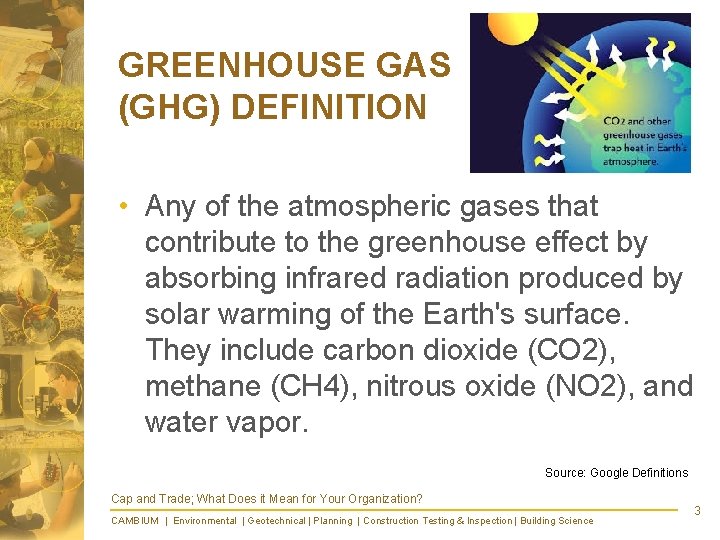
GREENHOUSE GAS (GHG) DEFINITION • Any of the atmospheric gases that contribute to the greenhouse effect by absorbing infrared radiation produced by solar warming of the Earth's surface. They include carbon dioxide (CO 2), methane (CH 4), nitrous oxide (NO 2), and water vapor. Source: Google Definitions Cap and Trade; What Does it Mean for Your Organization? CAMBIUM | Environmental | Geotechnical | Planning | Construction Testing & Inspection | Building Science 3
WHY DO WE CARE ABOUT GHGS? • Aside from the climate science, Canada has committed to GHG reduction (Paris 2015) with the United Nations • Obviously federal commitments will trickle down to the province Cap and Trade; What Does it Mean for Your Organization? CAMBIUM | Environmental | Geotechnical | Planning | Construction Testing & Inspection | Building Science 4
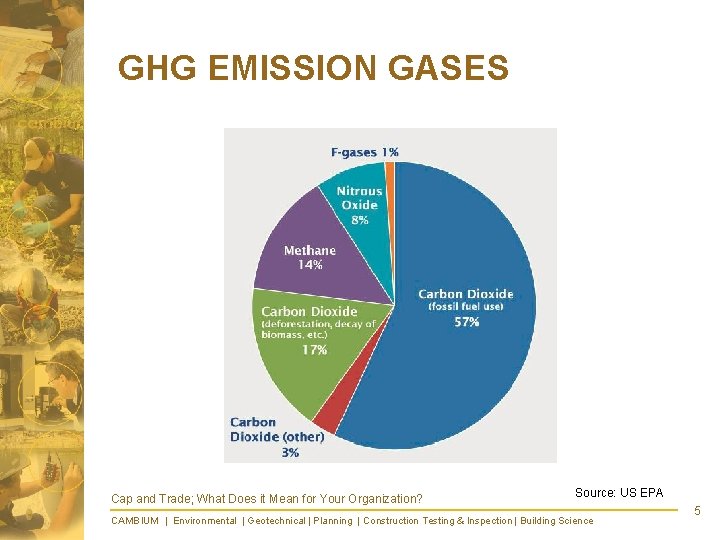
GHG EMISSION GASES Cap and Trade; What Does it Mean for Your Organization? Source: US EPA CAMBIUM | Environmental | Geotechnical | Planning | Construction Testing & Inspection | Building Science 5
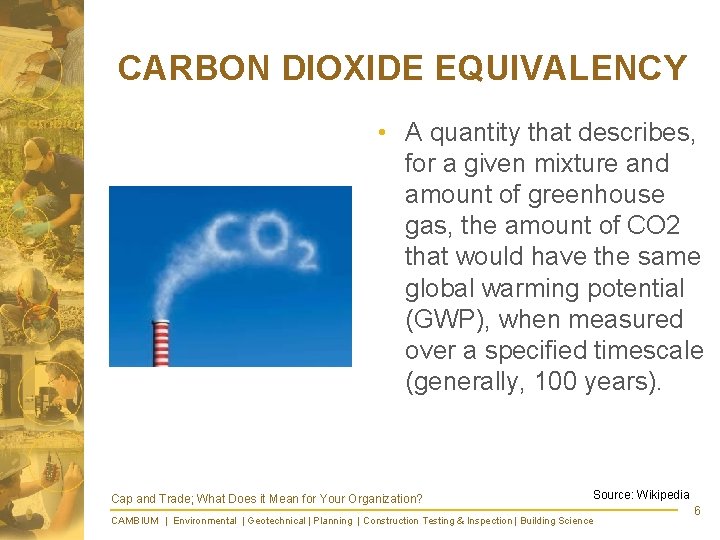
CARBON DIOXIDE EQUIVALENCY • A quantity that describes, for a given mixture and amount of greenhouse gas, the amount of CO 2 that would have the same global warming potential (GWP), when measured over a specified timescale (generally, 100 years). Cap and Trade; What Does it Mean for Your Organization? Source: Wikipedia CAMBIUM | Environmental | Geotechnical | Planning | Construction Testing & Inspection | Building Science 6
CARBON DIOXIDE EQUIVALENCY • What this means is that some chemicals have more of an effect on the atmosphere than carbon dioxide. • Examples: – Methane is considered to have 21 times the warming potential that carbon dioxide has; therefore, 1 tonne of methane would be considered 21 tonnes of carbon dioxide. – 1 single tonne of sulfur hexafluoride would be equivalent to 23, 900 tonnes of carbon dioxide Cap and Trade; What Does it Mean for Your Organization? Source: Wikipedia CAMBIUM | Environmental | Geotechnical | Planning | Construction Testing & Inspection | Building Science 7
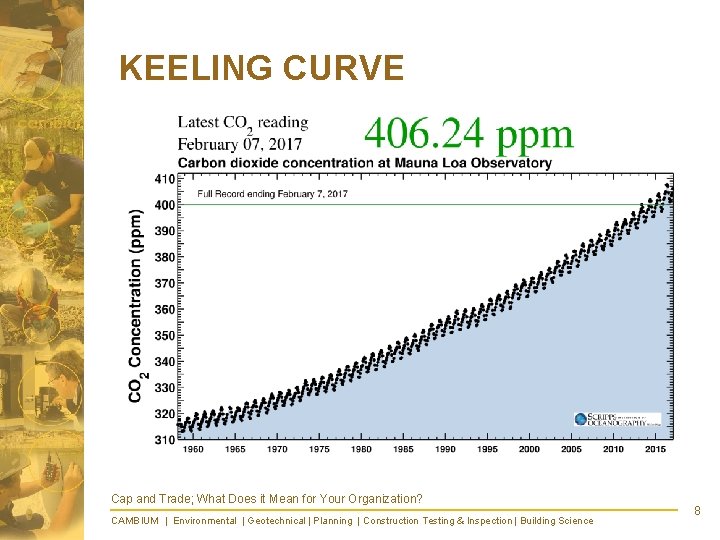
KEELING CURVE Cap and Trade; What Does it Mean for Your Organization? CAMBIUM | Environmental | Geotechnical | Planning | Construction Testing & Inspection | Building Science 8
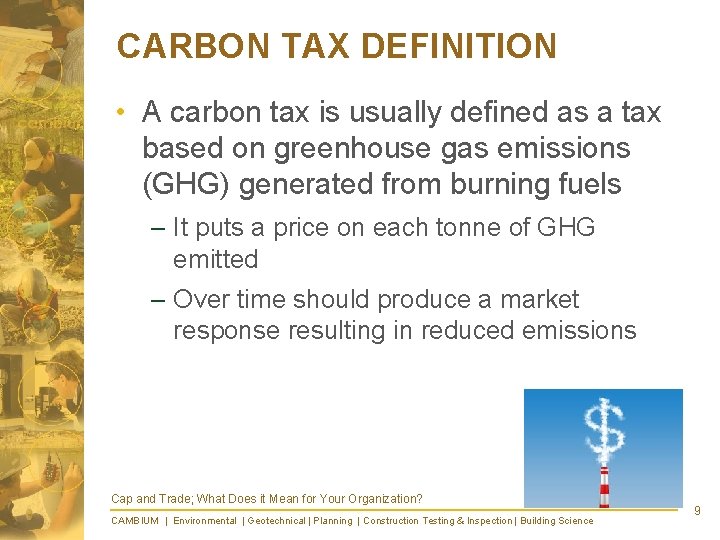
CARBON TAX DEFINITION • A carbon tax is usually defined as a tax based on greenhouse gas emissions (GHG) generated from burning fuels – It puts a price on each tonne of GHG emitted – Over time should produce a market response resulting in reduced emissions Cap and Trade; What Does it Mean for Your Organization? CAMBIUM | Environmental | Geotechnical | Planning | Construction Testing & Inspection | Building Science 9
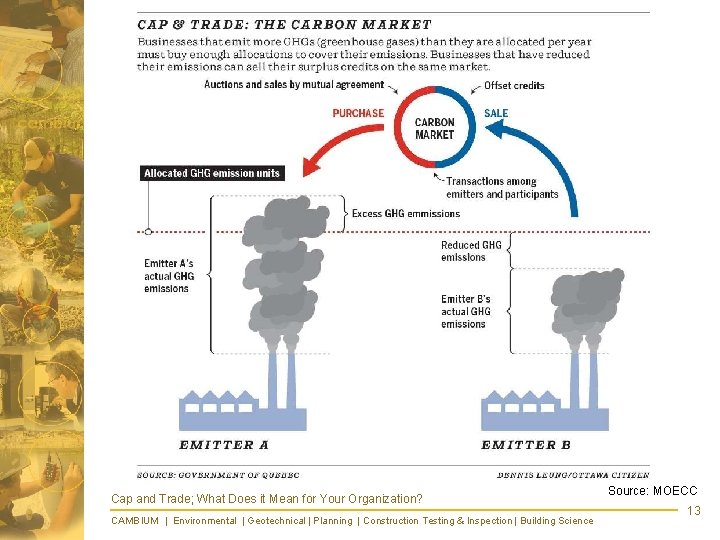
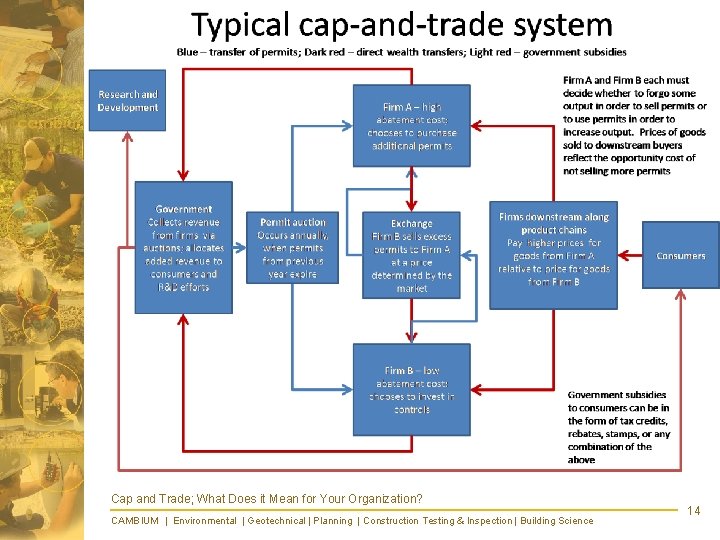
CAP AND TRADE DEFINITION • Sources (i. e. companies) covered by the program receive authorizations to emit in the form of emissions allowances, with the total amount of allowances limited by the cap. • Each facility can design its own compliance strategy to meet the overall reduction requirement which may include: – the sale or purchase of allowances, – installation of pollution controls, – implementation of efficiency measures, etc. Cap and Trade; What Does it Mean for Your Organization? CAMBIUM | Environmental | Geotechnical | Planning | Construction Testing & Inspection | Building Science 10
CAP AND TRADE BASICS • Inventory of emissions established through reporting. • Government sets cap on emissions. • Over time, cap is lowered. • Cap is divided into units called “allowances”, equal to 1 tonne of CO 2 -e each. • Government distributes allowances either free of charge or by auction. Cap and Trade; What Does it Mean for Your Organization? CAMBIUM | Environmental | Geotechnical | Planning | Construction Testing & Inspection | Building Science 11
CAP AND TRADE BASICS CONT’D • Offset credits introduced for emissions reductions/removals that occur outside of the regulated scope. • Allowances and offsets bought and sold. • Facilities need to acquire enough allowances and/or offset credits to cover their emissions. • The overall idea is that Cap-and-trade will harness the power of the marketplace to reduce emissions efficiently. Cap and Trade; What Does it Mean for Your Organization? CAMBIUM | Environmental | Geotechnical | Planning | Construction Testing & Inspection | Building Science 12
Cap and Trade; What Does it Mean for Your Organization? CAMBIUM | Environmental | Geotechnical | Planning | Construction Testing & Inspection | Building Science Source: MOECC 13
Cap and Trade; What Does it Mean for Your Organization? CAMBIUM | Environmental | Geotechnical | Planning | Construction Testing & Inspection | Building Science 14
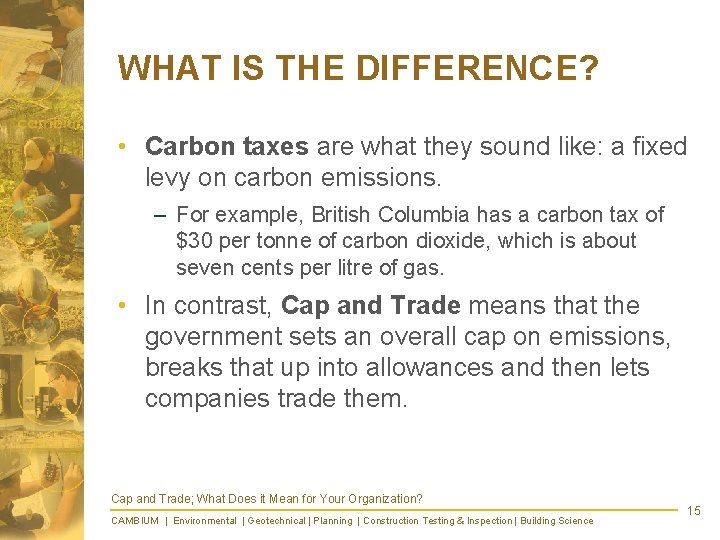
WHAT IS THE DIFFERENCE? • Carbon taxes are what they sound like: a fixed levy on carbon emissions. – For example, British Columbia has a carbon tax of $30 per tonne of carbon dioxide, which is about seven cents per litre of gas. • In contrast, Cap and Trade means that the government sets an overall cap on emissions, breaks that up into allowances and then lets companies trade them. Cap and Trade; What Does it Mean for Your Organization? CAMBIUM | Environmental | Geotechnical | Planning | Construction Testing & Inspection | Building Science 15
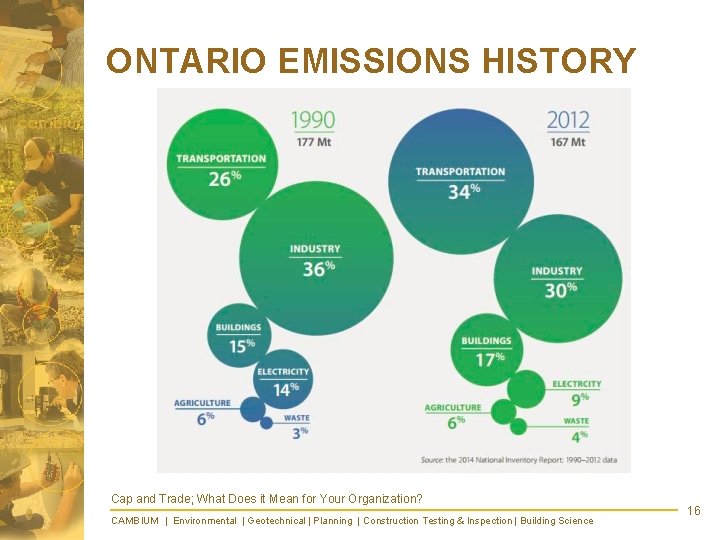
ONTARIO EMISSIONS HISTORY Cap and Trade; What Does it Mean for Your Organization? CAMBIUM | Environmental | Geotechnical | Planning | Construction Testing & Inspection | Building Science 16
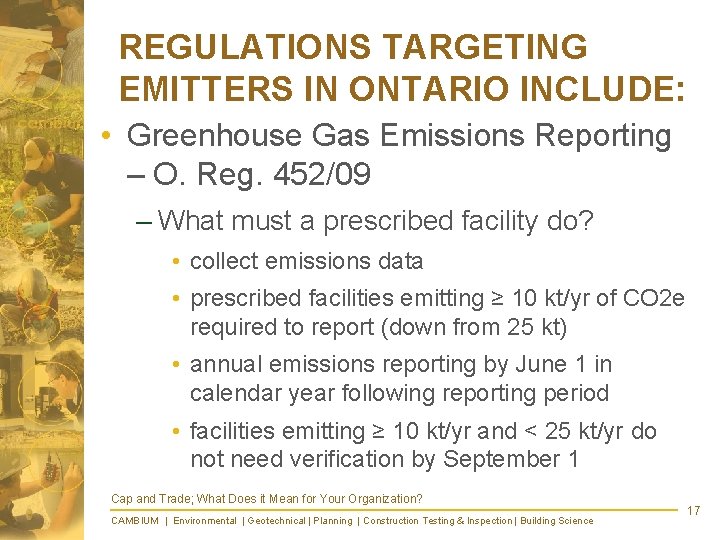
REGULATIONS TARGETING EMITTERS IN ONTARIO INCLUDE: • Greenhouse Gas Emissions Reporting – O. Reg. 452/09 – What must a prescribed facility do? • collect emissions data • prescribed facilities emitting ≥ 10 kt/yr of CO 2 e required to report (down from 25 kt) • annual emissions reporting by June 1 in calendar year following reporting period • facilities emitting ≥ 10 kt/yr and < 25 kt/yr do not need verification by September 1 Cap and Trade; What Does it Mean for Your Organization? CAMBIUM | Environmental | Geotechnical | Planning | Construction Testing & Inspection | Building Science 17
ADDITIONAL EMISSIONS REPORTING REGULATIONS • Environmental Compliance Approvals (ECA) – O. Reg. 419/05 • Environmental Activity and Sector Registry (EASR) – O. Reg. 1/17 • National Pollutant Release Inventory (NPRI) – Environment and Climate Change Canada (Federal) • Toxics Reduction Act (TRA) – O. Reg. 455/09 Cap and Trade; What Does it Mean for Your Organization? CAMBIUM | Environmental | Geotechnical | Planning | Construction Testing & Inspection | Building Science 18
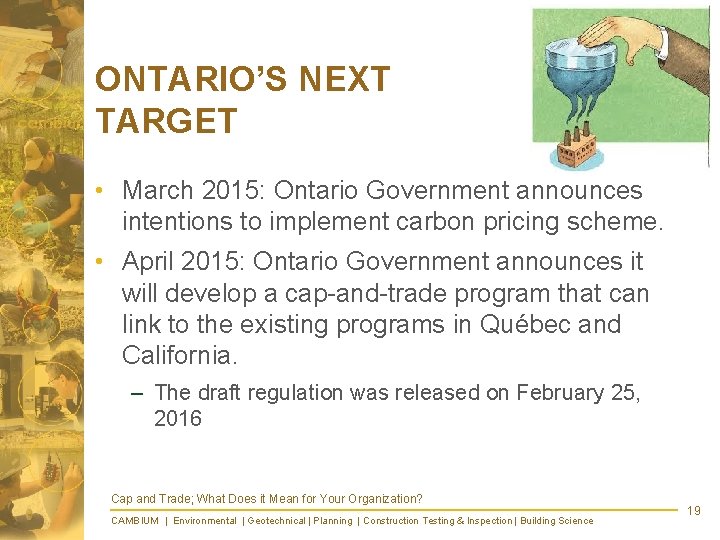
ONTARIO’S NEXT TARGET • March 2015: Ontario Government announces intentions to implement carbon pricing scheme. • April 2015: Ontario Government announces it will develop a cap-and-trade program that can link to the existing programs in Québec and California. – The draft regulation was released on February 25, 2016 Cap and Trade; What Does it Mean for Your Organization? CAMBIUM | Environmental | Geotechnical | Planning | Construction Testing & Inspection | Building Science 19
ONTARIO'S NEXT TARGET CONT. • The Cap and Trade Program – O. Reg. 144/16 – Jan 2017 • Compliance Offset Credits Regulatory Proposal – In Draft Cap and Trade; What Does it Mean for Your Organization? CAMBIUM | Environmental | Geotechnical | Planning | Construction Testing & Inspection | Building Science 20
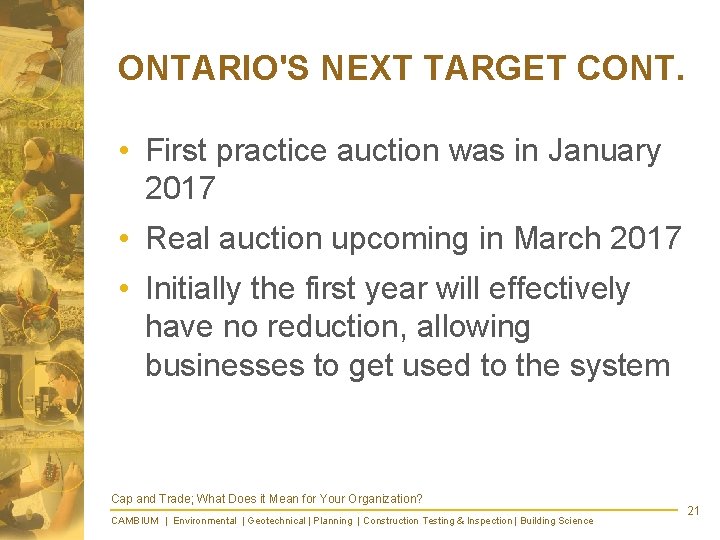
ONTARIO'S NEXT TARGET CONT. • First practice auction was in January 2017 • Real auction upcoming in March 2017 • Initially the first year will effectively have no reduction, allowing businesses to get used to the system Cap and Trade; What Does it Mean for Your Organization? CAMBIUM | Environmental | Geotechnical | Planning | Construction Testing & Inspection | Building Science 21
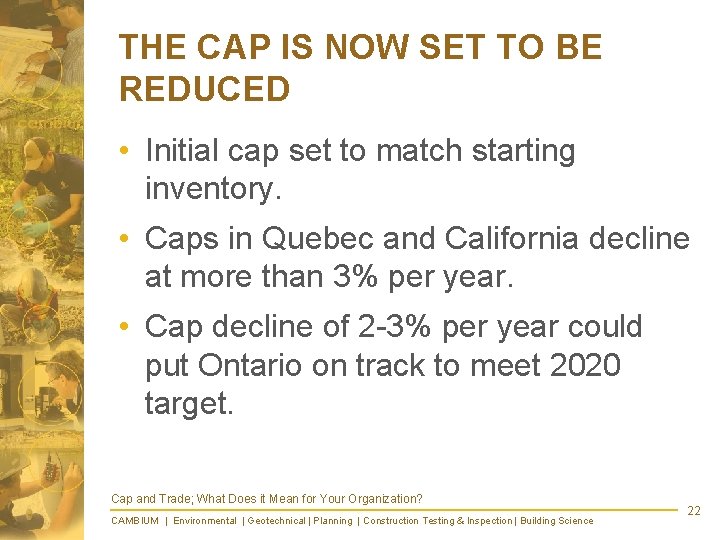
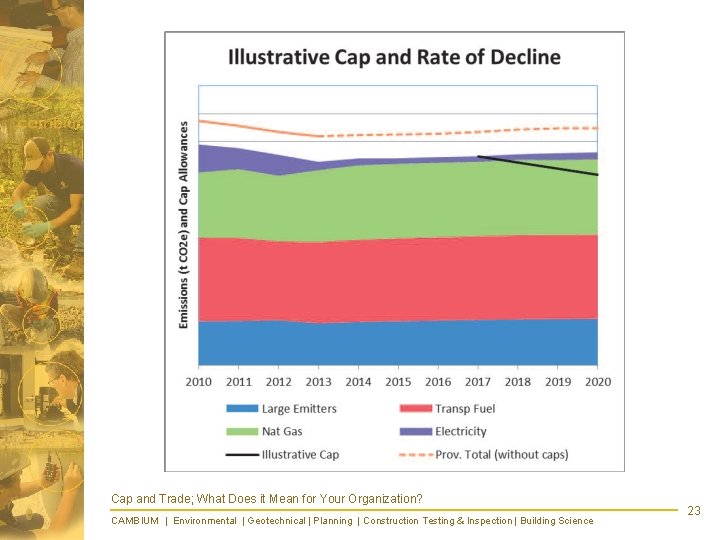
THE CAP IS NOW SET TO BE REDUCED • Initial cap set to match starting inventory. • Caps in Quebec and California decline at more than 3% per year. • Cap decline of 2 -3% per year could put Ontario on track to meet 2020 target. Cap and Trade; What Does it Mean for Your Organization? CAMBIUM | Environmental | Geotechnical | Planning | Construction Testing & Inspection | Building Science 22
Cap and Trade; What Does it Mean for Your Organization? CAMBIUM | Environmental | Geotechnical | Planning | Construction Testing & Inspection | Building Science 23
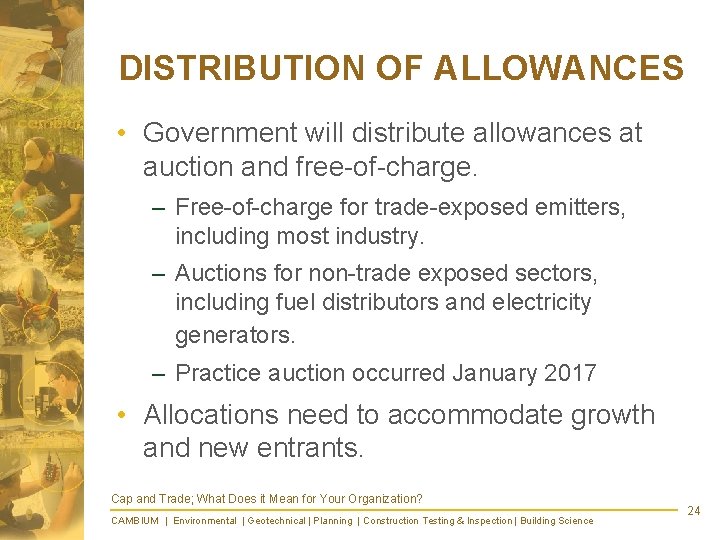
DISTRIBUTION OF ALLOWANCES • Government will distribute allowances at auction and free-of-charge. – Free-of-charge for trade-exposed emitters, including most industry. – Auctions for non-trade exposed sectors, including fuel distributors and electricity generators. – Practice auction occurred January 2017 • Allocations need to accommodate growth and new entrants. Cap and Trade; What Does it Mean for Your Organization? CAMBIUM | Environmental | Geotechnical | Planning | Construction Testing & Inspection | Building Science 24
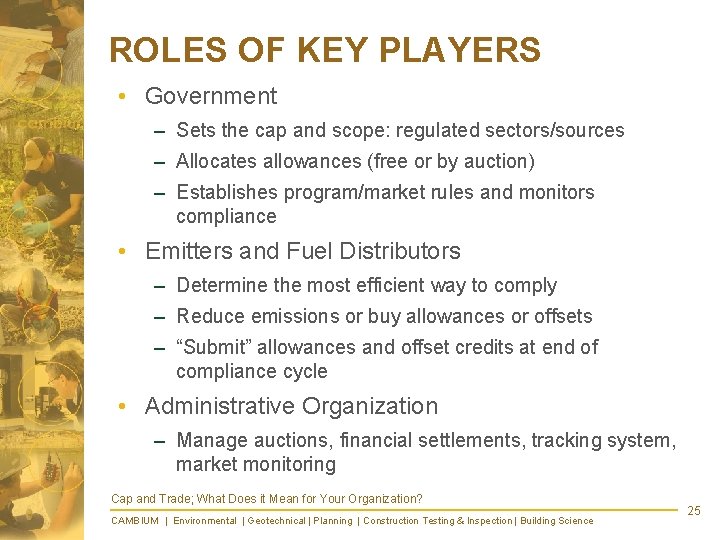
ROLES OF KEY PLAYERS • Government – Sets the cap and scope: regulated sectors/sources – Allocates allowances (free or by auction) – Establishes program/market rules and monitors compliance • Emitters and Fuel Distributors – Determine the most efficient way to comply – Reduce emissions or buy allowances or offsets – “Submit” allowances and offset credits at end of compliance cycle • Administrative Organization – Manage auctions, financial settlements, tracking system, market monitoring Cap and Trade; What Does it Mean for Your Organization? CAMBIUM | Environmental | Geotechnical | Planning | Construction Testing & Inspection | Building Science 25
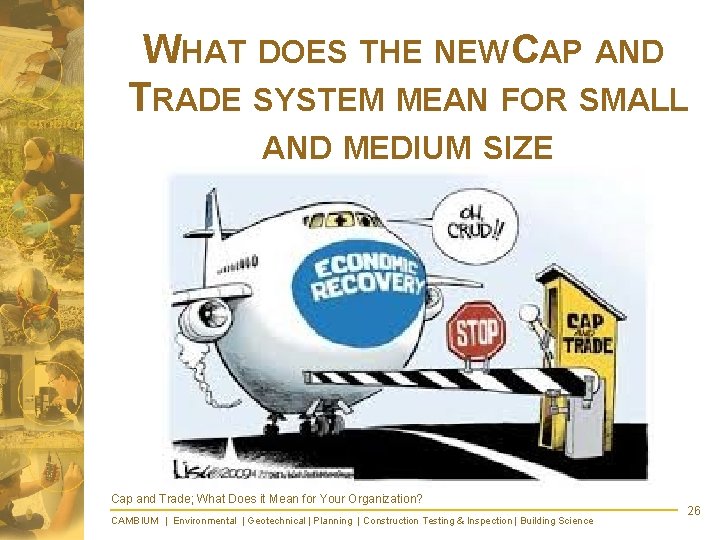
WHAT DOES THE NEW CAP AND TRADE SYSTEM MEAN FOR SMALL AND MEDIUM SIZE MANUFACTURERS? Cap and Trade; What Does it Mean for Your Organization? CAMBIUM | Environmental | Geotechnical | Planning | Construction Testing & Inspection | Building Science 26
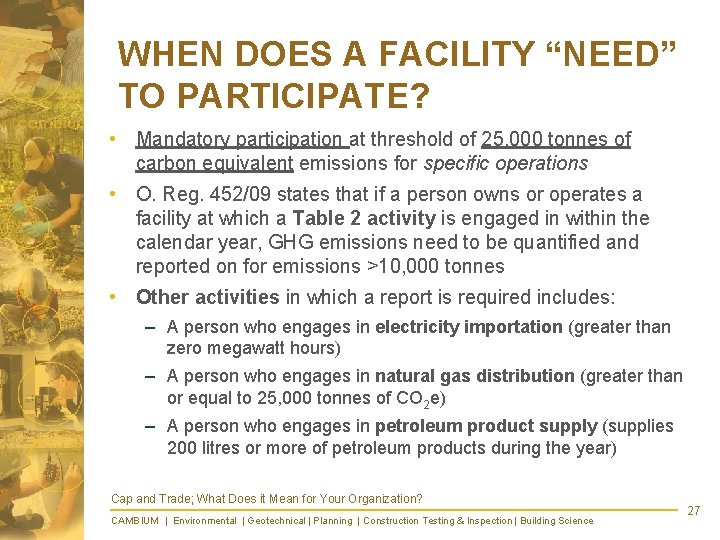
WHEN DOES A FACILITY “NEED” TO PARTICIPATE? • Mandatory participation at threshold of 25, 000 tonnes of carbon equivalent emissions for specific operations • O. Reg. 452/09 states that if a person owns or operates a facility at which a Table 2 activity is engaged in within the calendar year, GHG emissions need to be quantified and reported on for emissions >10, 000 tonnes • Other activities in which a report is required includes: – A person who engages in electricity importation (greater than zero megawatt hours) – A person who engages in natural gas distribution (greater than or equal to 25, 000 tonnes of CO 2 e) – A person who engages in petroleum product supply (supplies 200 litres or more of petroleum products during the year) Cap and Trade; What Does it Mean for Your Organization? CAMBIUM | Environmental | Geotechnical | Planning | Construction Testing & Inspection | Building Science 27
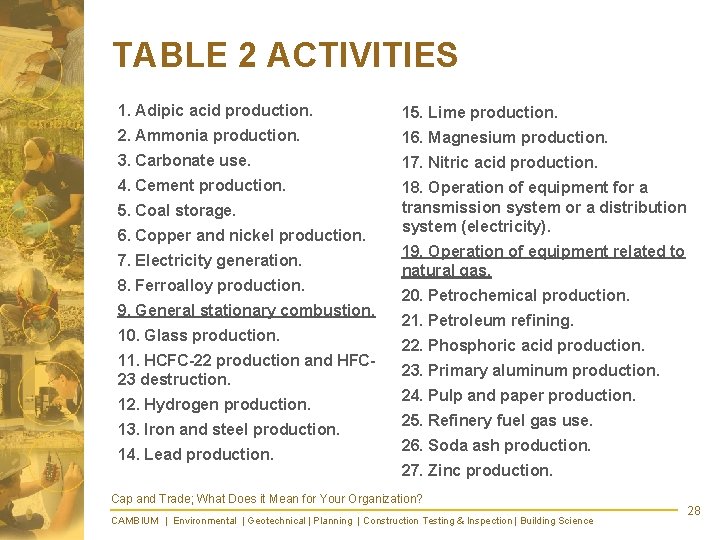
TABLE 2 ACTIVITIES 1. Adipic acid production. 15. Lime production. 2. Ammonia production. 16. Magnesium production. 3. Carbonate use. 17. Nitric acid production. 4. Cement production. 18. Operation of equipment for a transmission system or a distribution system (electricity). 5. Coal storage. 6. Copper and nickel production. 7. Electricity generation. 8. Ferroalloy production. 9. General stationary combustion. 10. Glass production. 11. HCFC-22 production and HFC 23 destruction. 12. Hydrogen production. 13. Iron and steel production. 14. Lead production. 19. Operation of equipment related to natural gas. 20. Petrochemical production. 21. Petroleum refining. 22. Phosphoric acid production. 23. Primary aluminum production. 24. Pulp and paper production. 25. Refinery fuel gas use. 26. Soda ash production. 27. Zinc production. Cap and Trade; What Does it Mean for Your Organization? CAMBIUM | Environmental | Geotechnical | Planning | Construction Testing & Inspection | Building Science 28
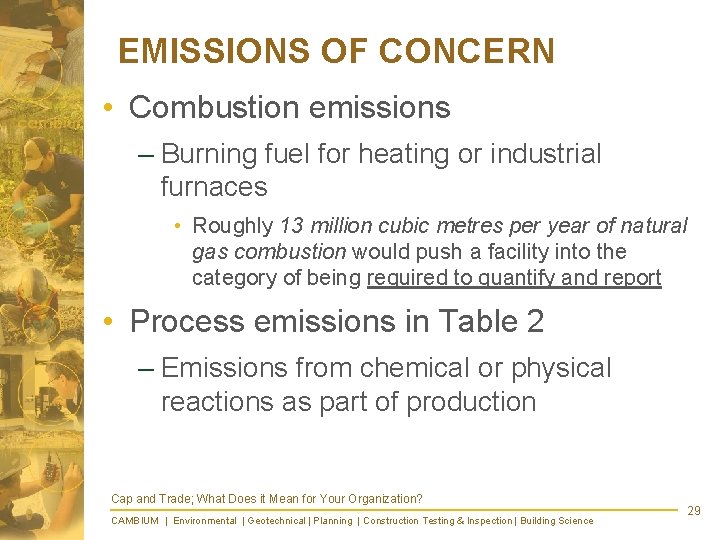
EMISSIONS OF CONCERN • Combustion emissions – Burning fuel for heating or industrial furnaces • Roughly 13 million cubic metres per year of natural gas combustion would push a facility into the category of being required to quantify and report • Process emissions in Table 2 – Emissions from chemical or physical reactions as part of production Cap and Trade; What Does it Mean for Your Organization? CAMBIUM | Environmental | Geotechnical | Planning | Construction Testing & Inspection | Building Science 29
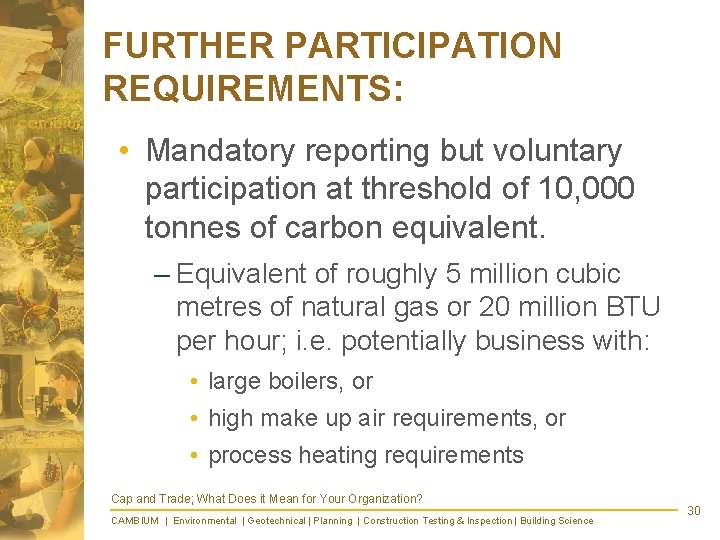
FURTHER PARTICIPATION REQUIREMENTS: • Mandatory reporting but voluntary participation at threshold of 10, 000 tonnes of carbon equivalent. – Equivalent of roughly 5 million cubic metres of natural gas or 20 million BTU per hour; i. e. potentially business with: • large boilers, or • high make up air requirements, or • process heating requirements Cap and Trade; What Does it Mean for Your Organization? CAMBIUM | Environmental | Geotechnical | Planning | Construction Testing & Inspection | Building Science 30
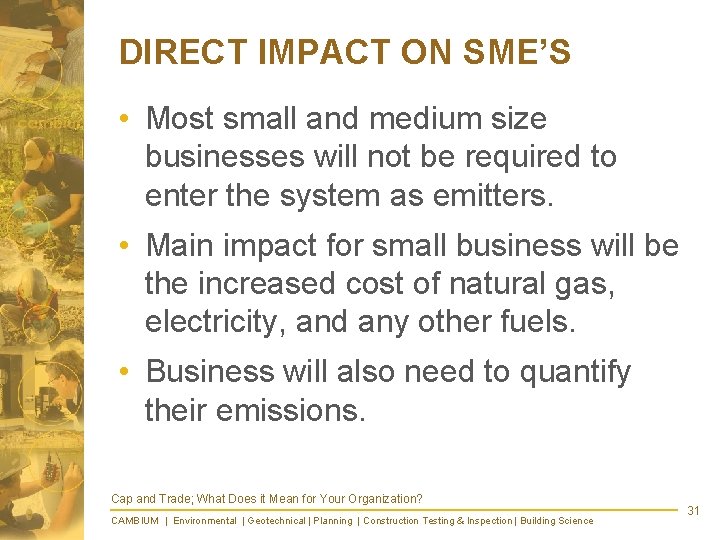
DIRECT IMPACT ON SME’S • Most small and medium size businesses will not be required to enter the system as emitters. • Main impact for small business will be the increased cost of natural gas, electricity, and any other fuels. • Business will also need to quantify their emissions. Cap and Trade; What Does it Mean for Your Organization? CAMBIUM | Environmental | Geotechnical | Planning | Construction Testing & Inspection | Building Science 31
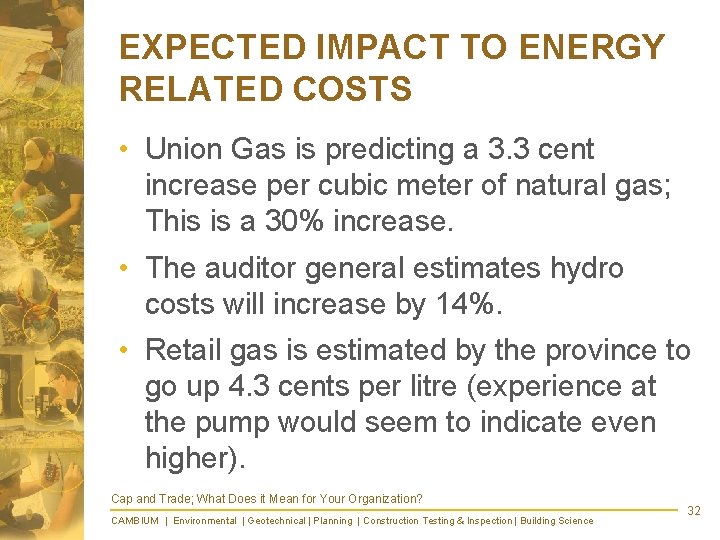
EXPECTED IMPACT TO ENERGY RELATED COSTS • Union Gas is predicting a 3. 3 cent increase per cubic meter of natural gas; This is a 30% increase. • The auditor general estimates hydro costs will increase by 14%. • Retail gas is estimated by the province to go up 4. 3 cents per litre (experience at the pump would seem to indicate even higher). Cap and Trade; What Does it Mean for Your Organization? CAMBIUM | Environmental | Geotechnical | Planning | Construction Testing & Inspection | Building Science 32
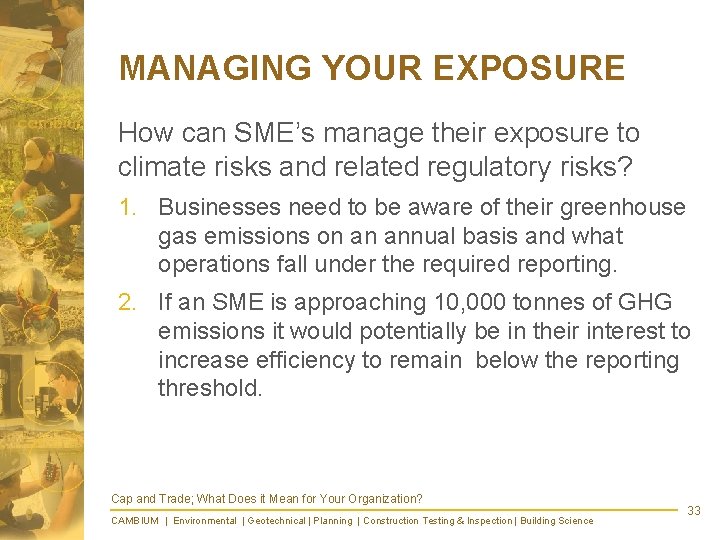
MANAGING YOUR EXPOSURE How can SME’s manage their exposure to climate risks and related regulatory risks? 1. Businesses need to be aware of their greenhouse gas emissions on an annual basis and what operations fall under the required reporting. 2. If an SME is approaching 10, 000 tonnes of GHG emissions it would potentially be in their interest to increase efficiency to remain below the reporting threshold. Cap and Trade; What Does it Mean for Your Organization? CAMBIUM | Environmental | Geotechnical | Planning | Construction Testing & Inspection | Building Science 33
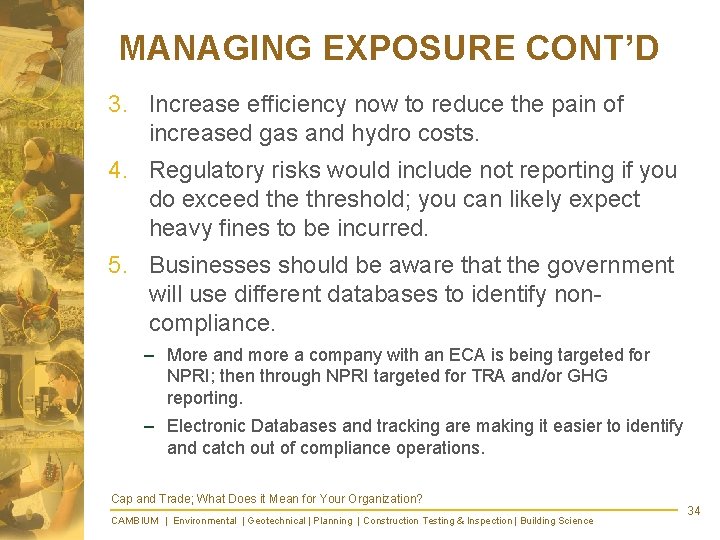
MANAGING EXPOSURE CONT’D 3. Increase efficiency now to reduce the pain of increased gas and hydro costs. 4. Regulatory risks would include not reporting if you do exceed the threshold; you can likely expect heavy fines to be incurred. 5. Businesses should be aware that the government will use different databases to identify noncompliance. – More and more a company with an ECA is being targeted for NPRI; then through NPRI targeted for TRA and/or GHG reporting. – Electronic Databases and tracking are making it easier to identify and catch out of compliance operations. Cap and Trade; What Does it Mean for Your Organization? CAMBIUM | Environmental | Geotechnical | Planning | Construction Testing & Inspection | Building Science 34
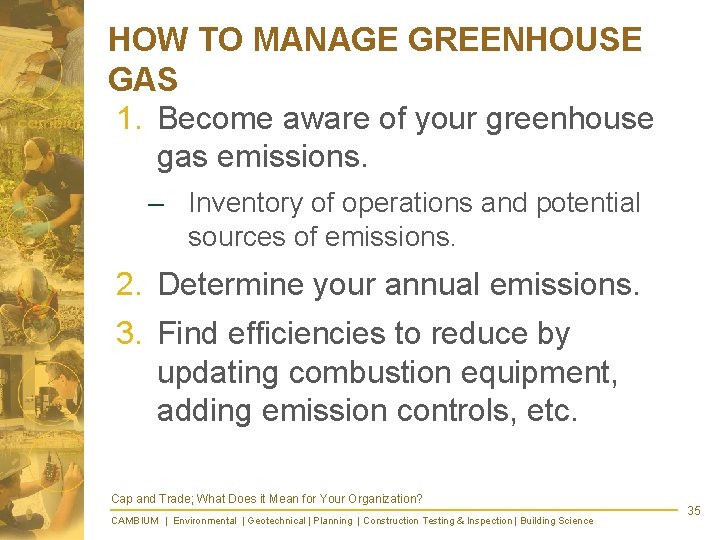
HOW TO MANAGE GREENHOUSE GAS 1. Become aware of your greenhouse gas emissions. – Inventory of operations and potential sources of emissions. 2. Determine your annual emissions. 3. Find efficiencies to reduce by updating combustion equipment, adding emission controls, etc. Cap and Trade; What Does it Mean for Your Organization? CAMBIUM | Environmental | Geotechnical | Planning | Construction Testing & Inspection | Building Science 35
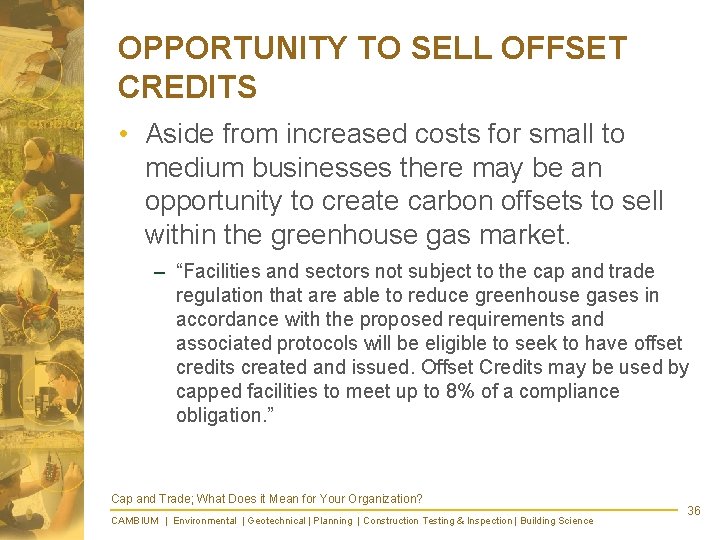
OPPORTUNITY TO SELL OFFSET CREDITS • Aside from increased costs for small to medium businesses there may be an opportunity to create carbon offsets to sell within the greenhouse gas market. – “Facilities and sectors not subject to the cap and trade regulation that are able to reduce greenhouse gases in accordance with the proposed requirements and associated protocols will be eligible to seek to have offset credits created and issued. Offset Credits may be used by capped facilities to meet up to 8% of a compliance obligation. ” Cap and Trade; What Does it Mean for Your Organization? CAMBIUM | Environmental | Geotechnical | Planning | Construction Testing & Inspection | Building Science 36
OFFSET CREDIT PROJECTS • Offset projects are emissions reduction or removal initiatives undertaken by entities outside the sectors covered by cap-andtrade. – Agriculture – Forestry – Waste – Other • Government certified offset credits can be used by facilities in covered sectors as an alternative to allowances. Cap and Trade; What Does it Mean for Your Organization? CAMBIUM | Environmental | Geotechnical | Planning | Construction Testing & Inspection | Building Science 37
OFFSET CREDIT PROJECTS • Currently the Government is looking at 13 offset protocols, expects to have 3 in place by early 2017. • There may be an opportunity in the future to propose offset projects outside the 13 protocols. Cap and Trade; What Does it Mean for Your Organization? CAMBIUM | Environmental | Geotechnical | Planning | Construction Testing & Inspection | Building Science 38
SPECIFIC GHG MANAGEMENT AND CARBON OFFSET PROJECTS • In California: – Reforestation, Forest management or avoided conversion projects – Urban forest, tree planting in municipalities – Manure Management Projects – Ozone depleting substances – capture and destruction of foam blowing substances, and refrigeration agents – Mine Methane Capture Cap and Trade; What Does it Mean for Your Organization? CAMBIUM | Environmental | Geotechnical | Planning | Construction Testing & Inspection | Building Science 39
SPECIFIC GHG MANAGEMENT AND CARBON OFFSET PROJECTS • In Quebec: – Manure Methane management – Landfill Methane destruction – Ozone depleting substances (insulating foam and refrigerants from appliances) – Active coal mines; destruction of methane from drainage system – Destruction of methane from ventilation air Cap and Trade; What Does it Mean for Your Organization? CAMBIUM | Environmental | Geotechnical | Planning | Construction Testing & Inspection | Building Science 40
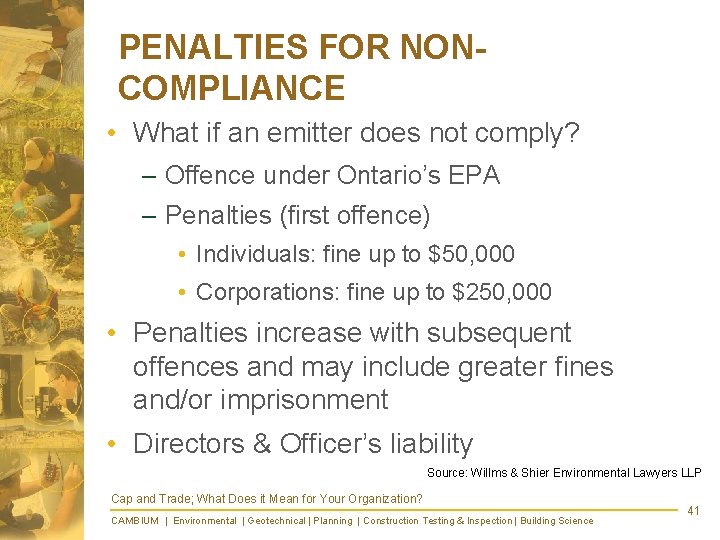
PENALTIES FOR NONCOMPLIANCE • What if an emitter does not comply? – Offence under Ontario’s EPA – Penalties (first offence) • Individuals: fine up to $50, 000 • Corporations: fine up to $250, 000 • Penalties increase with subsequent offences and may include greater fines and/or imprisonment • Directors & Officer’s liability Source: Willms & Shier Environmental Lawyers LLP Cap and Trade; What Does it Mean for Your Organization? CAMBIUM | Environmental | Geotechnical | Planning | Construction Testing & Inspection | Building Science 41
A POSITIVE SPIN… • “The government will reinvest the money raised through cap and trade in a transparent way back into projects that reduce greenhouse gas pollution and help businesses remain competitive” Cap and Trade; What Does it Mean for Your Organization? CAMBIUM | Environmental | Geotechnical | Planning | Construction Testing & Inspection | Building Science 42
WHY IS THIS POSITIVE? • If those “projects” include things that the government would have spent money on anyway, one could argue that cap and trade is going to create the beginnings of tax-shifting in Ontario. • If the government brings in more revenue from a carbon price, it doesn’t need to raise income or other taxes. Cap and Trade; What Does it Mean for Your Organization? CAMBIUM | Environmental | Geotechnical | Planning | Construction Testing & Inspection | Building Science 43
Cap and Trade; What Does it Mean for Your Organization? CAMBIUM | Environmental | Geotechnical | Planning | Construction Testing & Inspection | Building Science 44
THANK YOU! ANY QUESTIONS? Sadie Bachynski, P. Eng. Sadie. Bachynski@cambium-inc. com 705 -742 -7900 ext. 213 Jim Bailey, P. Eng. Jim. bailey@cambium-inc. com 705 -742 -7900 ext. 201 Cap and Trade; What Does it Mean for Your Organization? CAMBIUM | Environmental | Geotechnical | Planning | Construction Testing & Inspection | Building Science 45