
CAP 2025 Clermont Auvergne project 2025 Projet isite
- Slides: 28
CAP 2025 « Clermont Auvergne project 2025 » Projet i-site Le 9 juillet 2013, lancement du nouveau Programme d'Investissements d'Avenir doté de 12 milliards d'euros Objectif de l’appel à projet i-site « initiatives science – innovation – territoire – économie » : soutenir des pôles présentant des atouts thématiques d’excellence reconnus et distinctifs, qui se distingueront par leur capacité à dialoguer avec le monde socio-économique et à renforcer les démarches de spécialisation des territoires.
Ambition et objectifs de CAP 2025 • CAP 2025 vise à accélérer la structuration d’un site universitaire à forte identité à Clermont-Ferrand, à partir d’un programme d'investissements sur 10 ans destinés à amorcer et amplifier par effet d'entraînement la croissance et le développement du site. • CAP 2025 constitue le levier d’une politique d'excellence, de spécialisation et de visibilité du site universitaire clermontois. • L'objectif de CAP 2025 est de positionner le site universitaire clermontois au sein de l’écosystème national et international de l’enseignement supérieur et de la recherche, tout en accompagnant l’évolution de l’Auvergne au sein de la future région Auvergne-Rhône-Alpes.
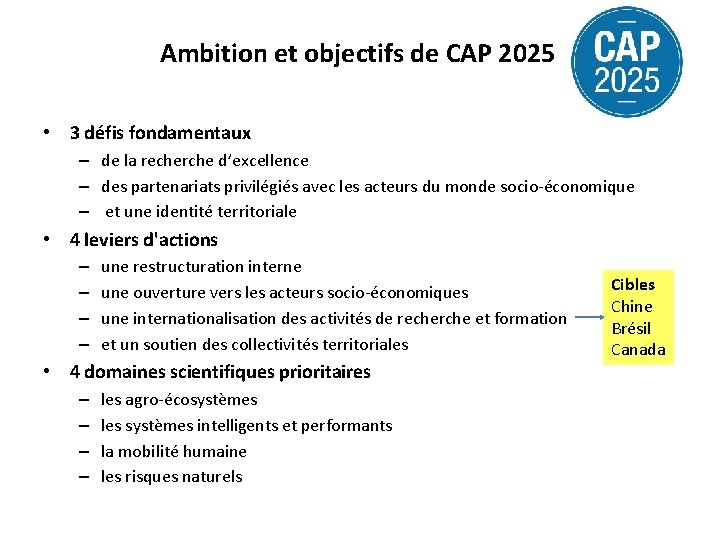
Ambition et objectifs de CAP 2025 • 3 défis fondamentaux – de la recherche d’excellence – des partenariats privilégiés avec les acteurs du monde socio-économique – et une identité territoriale • 4 leviers d'actions – – une restructuration interne une ouverture vers les acteurs socio-économiques une internationalisation des activités de recherche et formation et un soutien des collectivités territoriales • 4 domaines scientifiques prioritaires – – les agro-écosystèmes les systèmes intelligents et performants la mobilité humaine les risques naturels Cibles Chine Brésil Canada
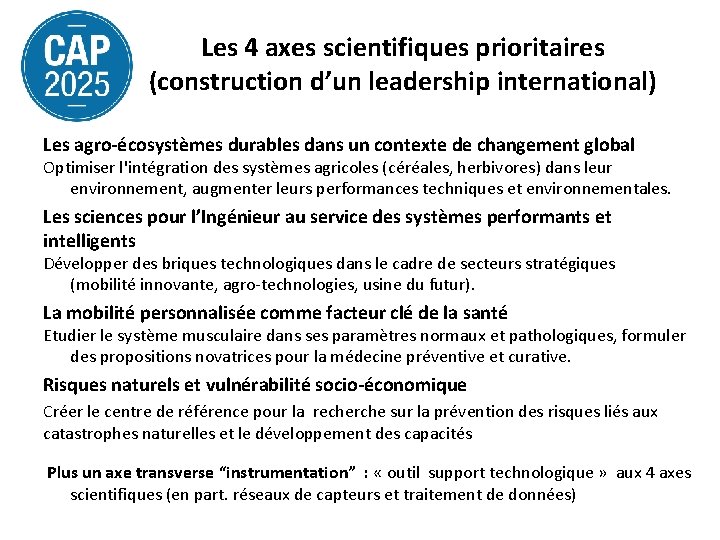
Les 4 axes scientifiques prioritaires (construction d’un leadership international) Les agro-écosystèmes durables dans un contexte de changement global Optimiser l'intégration des systèmes agricoles (céréales, herbivores) dans leur environnement, augmenter leurs performances techniques et environnementales. Les sciences pour l’Ingénieur au service des systèmes performants et intelligents Développer des briques technologiques dans le cadre de secteurs stratégiques (mobilité innovante, agro-technologies, usine du futur). La mobilité personnalisée comme facteur clé de la santé Etudier le système musculaire dans ses paramètres normaux et pathologiques, formuler des propositions novatrices pour la médecine préventive et curative. Risques naturels et vulnérabilité socio-économique Créer le centre de référence pour la recherche sur la prévention des risques liés aux catastrophes naturelles et le développement des capacités Plus un axe transverse “instrumentation” : « outil support technologique » aux 4 axes scientifiques (en part. réseaux de capteurs et traitement de données)
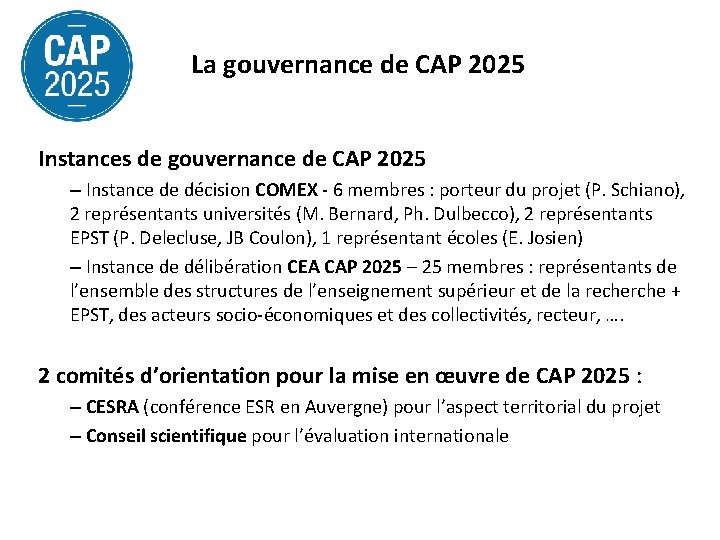
La gouvernance de CAP 2025 Instances de gouvernance de CAP 2025 – Instance de décision COMEX - 6 membres : porteur du projet (P. Schiano), 2 représentants universités (M. Bernard, Ph. Dulbecco), 2 représentants EPST (P. Delecluse, JB Coulon), 1 représentant écoles (E. Josien) – Instance de délibération CEA CAP 2025 – 25 membres : représentants de l’ensemble des structures de l’enseignement supérieur et de la recherche + EPST, des acteurs socio-économiques et des collectivités, recteur, …. 2 comités d’orientation pour la mise en œuvre de CAP 2025 : – CESRA (conférence ESR en Auvergne) pour l’aspect territorial du projet – Conseil scientifique pour l’évaluation internationale
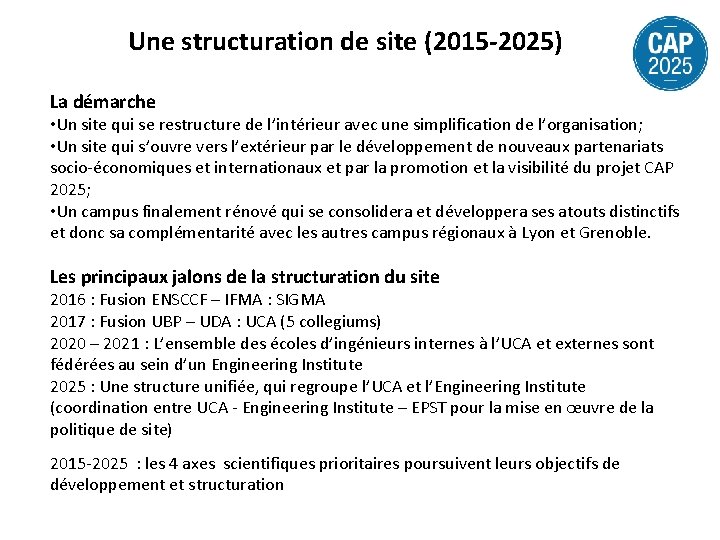
Une structuration de site (2015 -2025) La démarche • Un site qui se restructure de l’intérieur avec une simplification de l’organisation; • Un site qui s’ouvre vers l’extérieur par le développement de nouveaux partenariats socio-économiques et internationaux et par la promotion et la visibilité du projet CAP 2025; • Un campus finalement rénové qui se consolidera et développera ses atouts distinctifs et donc sa complémentarité avec les autres campus régionaux à Lyon et Grenoble. Les principaux jalons de la structuration du site 2016 : Fusion ENSCCF – IFMA : SIGMA 2017 : Fusion UBP – UDA : UCA (5 collegiums) 2020 – 2021 : L’ensemble des écoles d’ingénieurs internes à l’UCA et externes sont fédérées au sein d’un Engineering Institute 2025 : Une structure unifiée, qui regroupe l’UCA et l’Engineering Institute (coordination entre UCA - Engineering Institute – EPST pour la mise en œuvre de la politique de site) 2015 -2025 : les 4 axes scientifiques prioritaires poursuivent leurs objectifs de développement et structuration
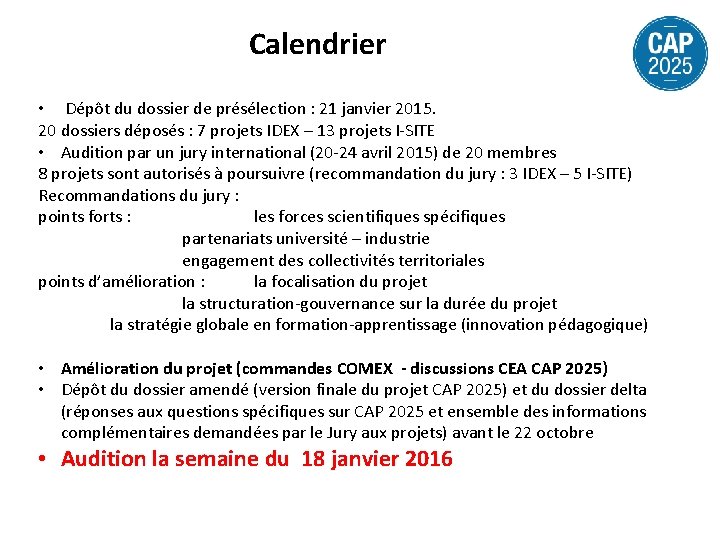
Calendrier • Dépôt du dossier de présélection : 21 janvier 2015. 20 dossiers déposés : 7 projets IDEX – 13 projets I-SITE • Audition par un jury international (20 -24 avril 2015) de 20 membres 8 projets sont autorisés à poursuivre (recommandation du jury : 3 IDEX – 5 I-SITE) Recommandations du jury : points forts : les forces scientifiques spécifiques partenariats université – industrie engagement des collectivités territoriales points d’amélioration : la focalisation du projet la structuration-gouvernance sur la durée du projet la stratégie globale en formation-apprentissage (innovation pédagogique) • Amélioration du projet (commandes COMEX - discussions CEA CAP 2025) • Dépôt du dossier amendé (version finale du projet CAP 2025) et du dossier delta (réponses aux questions spécifiques sur CAP 2025 et ensemble des informations complémentaires demandées par le Jury aux projets) avant le 22 octobre • Audition la semaine du 18 janvier 2016
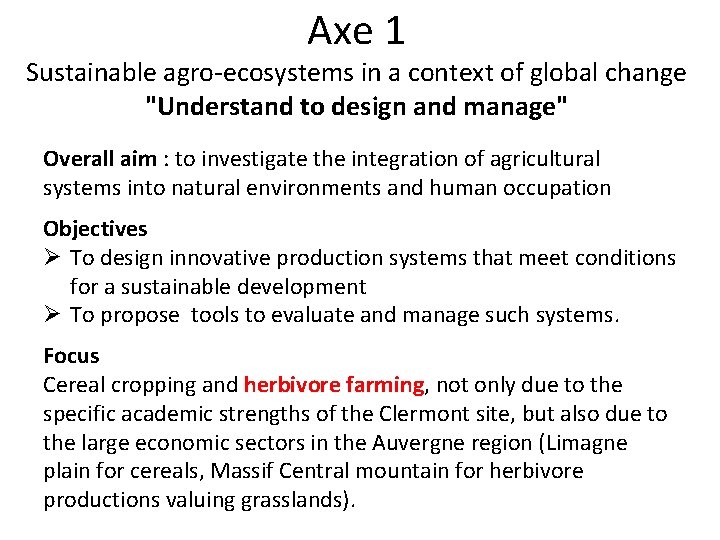
Axe 1 Sustainable agro-ecosystems in a context of global change "Understand to design and manage" Overall aim : to investigate the integration of agricultural systems into natural environments and human occupation Objectives Ø To design innovative production systems that meet conditions for a sustainable development Ø To propose tools to evaluate and manage such systems. Focus Cereal cropping and herbivore farming, not only due to the specific academic strengths of the Clermont site, but also due to the large economic sectors in the Auvergne region (Limagne plain for cereals, Massif Central mountain for herbivore productions valuing grasslands).
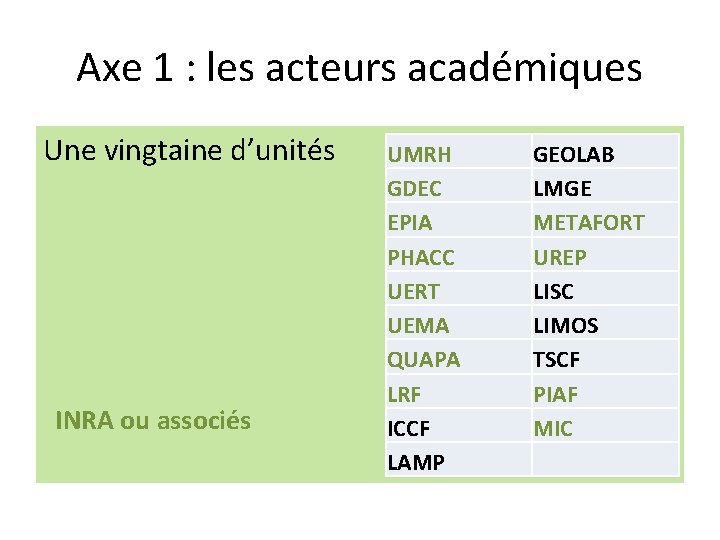
Axe 1 : les acteurs académiques Une vingtaine d’unités INRA ou associés UMRH GDEC EPIA PHACC UERT UEMA QUAPA LRF ICCF LAMP GEOLAB LMGE METAFORT UREP LISC LIMOS TSCF PIAF MIC
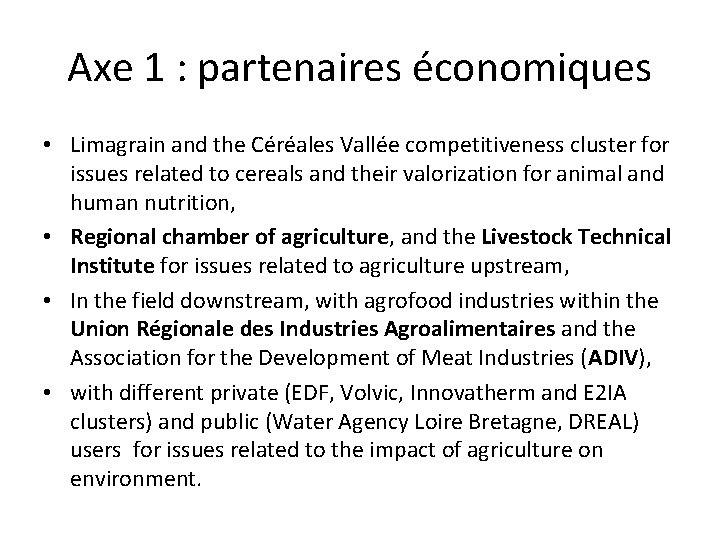
Axe 1 : partenaires économiques • Limagrain and the Céréales Vallée competitiveness cluster for issues related to cereals and their valorization for animal and human nutrition, • Regional chamber of agriculture, and the Livestock Technical Institute for issues related to agriculture upstream, • In the field downstream, with agrofood industries within the Union Régionale des Industries Agroalimentaires and the Association for the Development of Meat Industries (ADIV), • with different private (EDF, Volvic, Innovatherm and E 2 IA clusters) and public (Water Agency Loire Bretagne, DREAL) users for issues related to the impact of agriculture on environment.
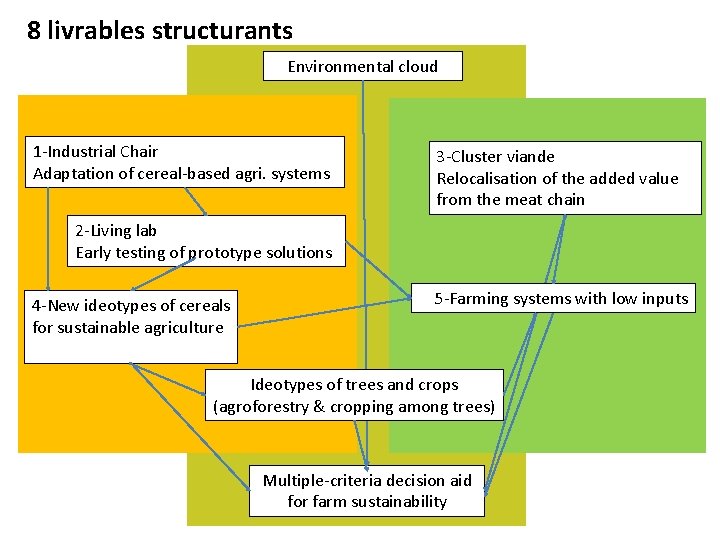
8 livrables structurants Environmental cloud 1 -Industrial Chair Adaptation of cereal-based agri. systems 3 -Cluster viande Relocalisation of the added value from the meat chain 2 -Living lab Early testing of prototype solutions 4 -New ideotypes of cereals for sustainable agriculture 5 -Farming systems with low inputs Ideotypes of trees and crops (agroforestry & cropping among trees) Multiple-criteria decision aid for farm sustainability
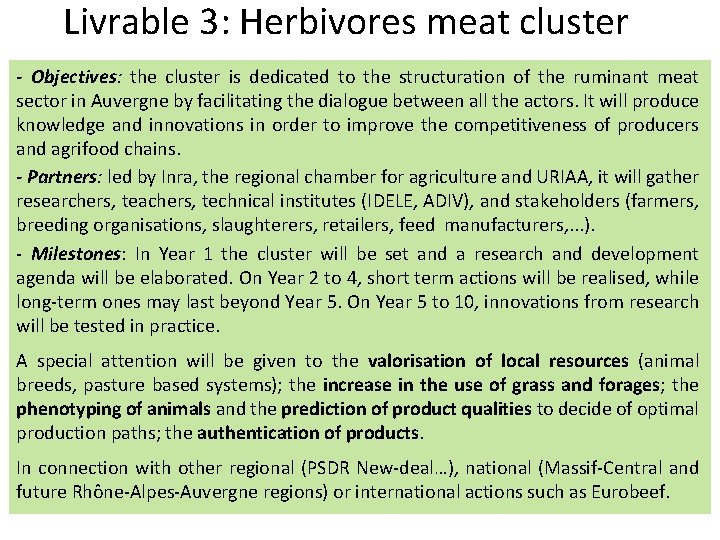
Livrable 3: Herbivores meat cluster - Objectives: the cluster is dedicated to the structuration of the ruminant meat sector in Auvergne by facilitating the dialogue between all the actors. It will produce knowledge and innovations in order to improve the competitiveness of producers and agrifood chains. - Partners: led by Inra, the regional chamber for agriculture and URIAA, it will gather researchers, teachers, technical institutes (IDELE, ADIV), and stakeholders (farmers, breeding organisations, slaughterers, retailers, feed manufacturers, . . . ). - Milestones: In Year 1 the cluster will be set and a research and development agenda will be elaborated. On Year 2 to 4, short term actions will be realised, while long-term ones may last beyond Year 5. On Year 5 to 10, innovations from research will be tested in practice. A special attention will be given to the valorisation of local resources (animal breeds, pasture based systems); the increase in the use of grass and forages; the phenotyping of animals and the prediction of product qualities to decide of optimal production paths; the authentication of products. In connection with other regional (PSDR New-deal…), national (Massif-Central and future Rhône-Alpes-Auvergne regions) or international actions such as Eurobeef.
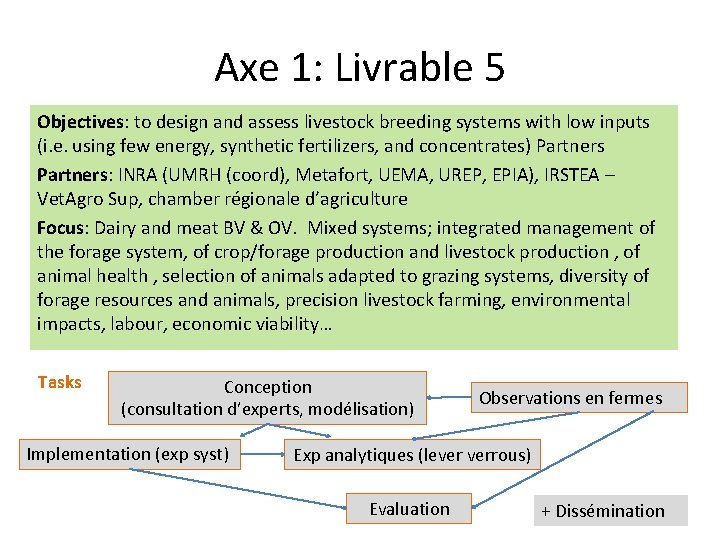
Axe 1: Livrable 5 Objectives: to design and assess livestock breeding systems with low inputs (i. e. using few energy, synthetic fertilizers, and concentrates) Partners: INRA (UMRH (coord), Metafort, UEMA, UREP, EPIA), IRSTEA – Vet. Agro Sup, chamber régionale d’agriculture Focus: Dairy and meat BV & OV. Mixed systems; integrated management of the forage system, of crop/forage production and livestock production , of animal health , selection of animals adapted to grazing systems, diversity of forage resources and animals, precision livestock farming, environmental impacts, labour, economic viability… Tasks Conception (consultation d’experts, modélisation) Implementation (exp syst) Observations en fermes Exp analytiques (lever verrous) Evaluation + Dissémination
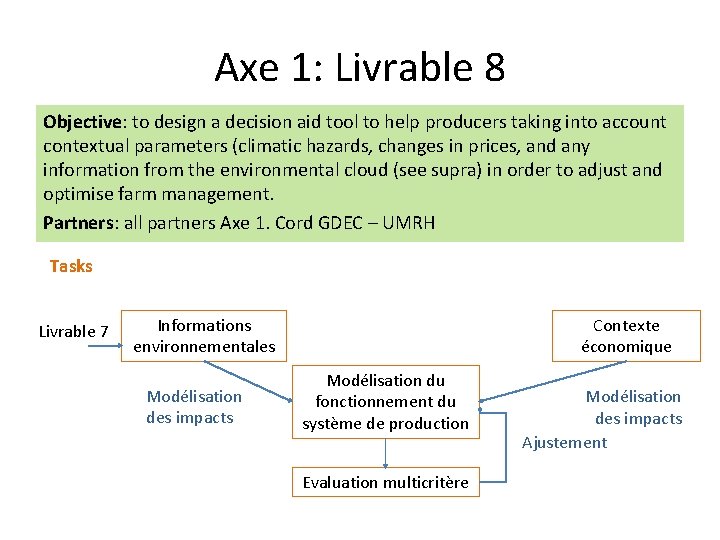
Axe 1: Livrable 8 Objective: to design a decision aid tool to help producers taking into account contextual parameters (climatic hazards, changes in prices, and any information from the environmental cloud (see supra) in order to adjust and optimise farm management. Partners: all partners Axe 1. Cord GDEC – UMRH Tasks Livrable 7 Informations environnementales Modélisation des impacts Contexte économique Modélisation du fonctionnement du système de production Evaluation multicritère Modélisation des impacts Ajustement
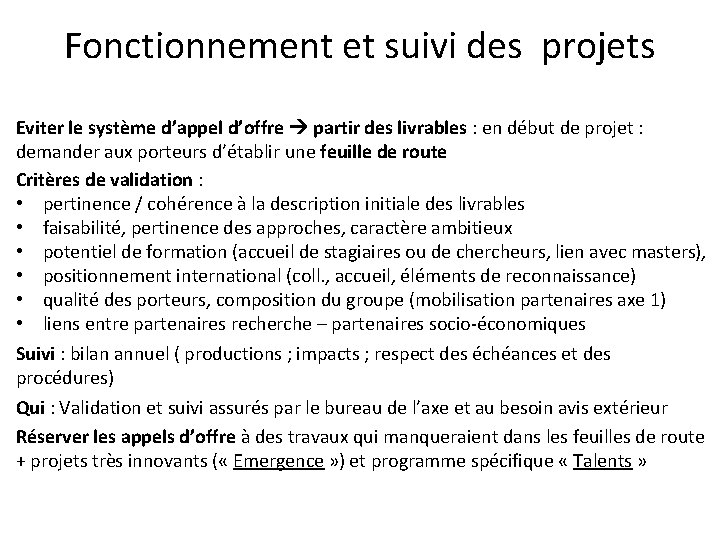
Fonctionnement et suivi des projets Eviter le système d’appel d’offre partir des livrables : en début de projet : demander aux porteurs d’établir une feuille de route Critères de validation : • pertinence / cohérence à la description initiale des livrables • faisabilité, pertinence des approches, caractère ambitieux • potentiel de formation (accueil de stagiaires ou de chercheurs, lien avec masters), • positionnement international (coll. , accueil, éléments de reconnaissance) • qualité des porteurs, composition du groupe (mobilisation partenaires axe 1) • liens entre partenaires recherche – partenaires socio-économiques Suivi : bilan annuel ( productions ; impacts ; respect des échéances et des procédures) Qui : Validation et suivi assurés par le bureau de l’axe et au besoin avis extérieur Réserver les appels d’offre à des travaux qui manqueraient dans les feuilles de route + projets très innovants ( « Emergence » ) et programme spécifique « Talents »
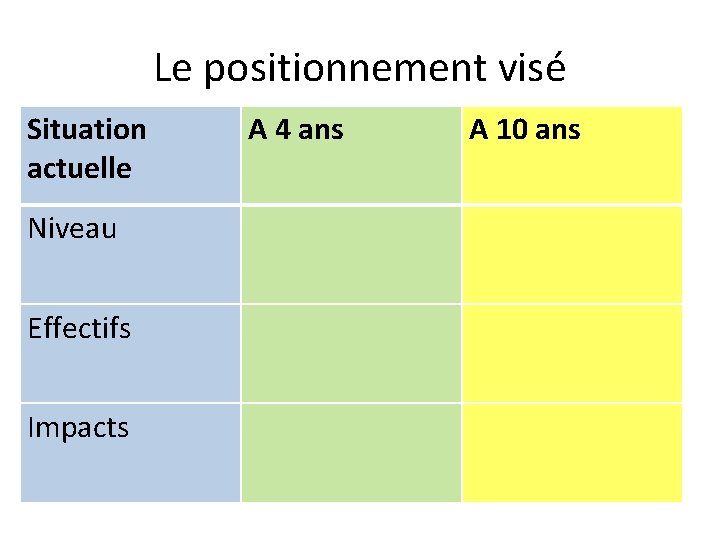
Le positionnement visé Situation actuelle Niveau Effectifs Impacts A 4 ans A 10 ans
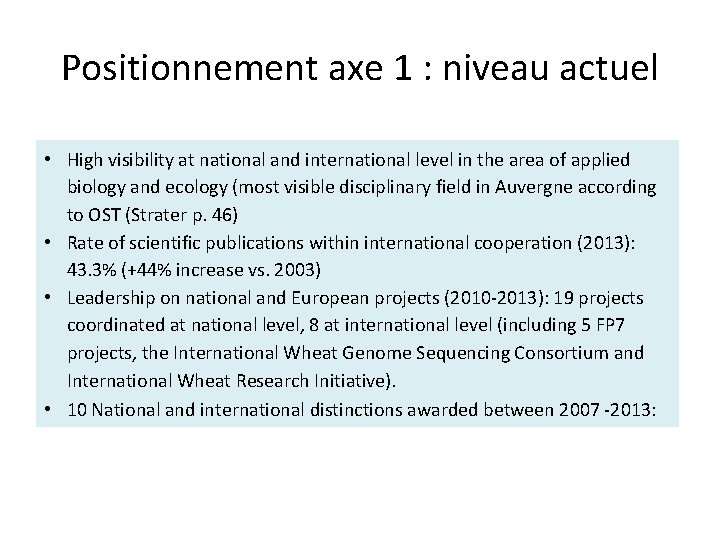
Positionnement axe 1 : niveau actuel • High visibility at national and international level in the area of applied biology and ecology (most visible disciplinary field in Auvergne according to OST (Strater p. 46) • Rate of scientific publications within international cooperation (2013): 43. 3% (+44% increase vs. 2003) • Leadership on national and European projects (2010 -2013): 19 projects coordinated at national level, 8 at international level (including 5 FP 7 projects, the International Wheat Genome Sequencing Consortium and International Wheat Research Initiative). • 10 National and international distinctions awarded between 2007 -2013:
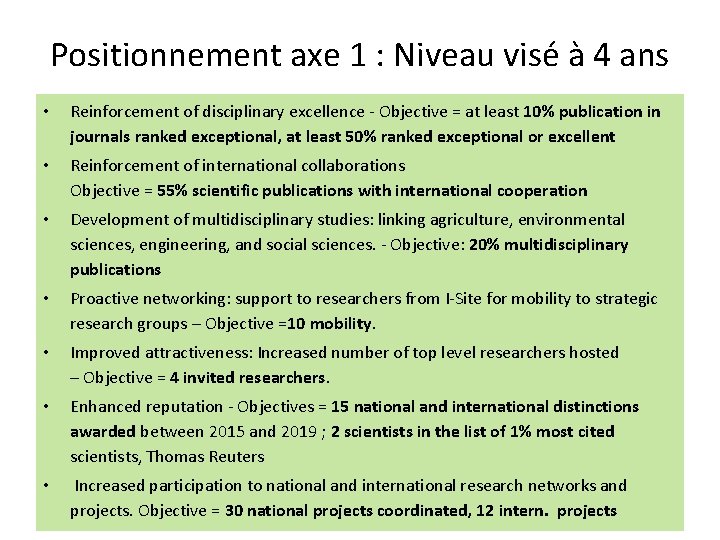
Positionnement axe 1 : Niveau visé à 4 ans • Reinforcement of disciplinary excellence - Objective = at least 10% publication in journals ranked exceptional, at least 50% ranked exceptional or excellent • Reinforcement of international collaborations Objective = 55% scientific publications with international cooperation • Development of multidisciplinary studies: linking agriculture, environmental sciences, engineering, and social sciences. - Objective: 20% multidisciplinary publications • Proactive networking: support to researchers from I-Site for mobility to strategic research groups – Objective =10 mobility. • Improved attractiveness: Increased number of top level researchers hosted – Objective = 4 invited researchers. • Enhanced reputation - Objectives = 15 national and international distinctions awarded between 2015 and 2019 ; 2 scientists in the list of 1% most cited scientists, Thomas Reuters • Increased participation to national and international research networks and projects. Objective = 30 national projects coordinated, 12 intern. projects
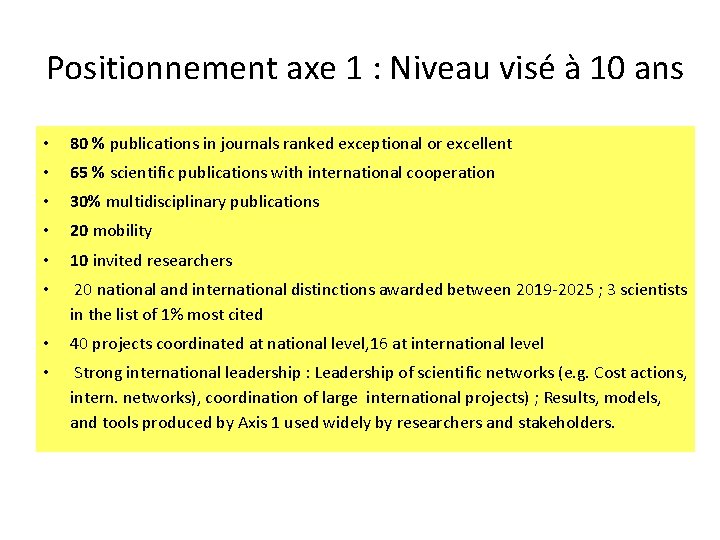
Positionnement axe 1 : Niveau visé à 10 ans • 80 % publications in journals ranked exceptional or excellent • 65 % scientific publications with international cooperation • 30% multidisciplinary publications • 20 mobility • 10 invited researchers • 20 national and international distinctions awarded between 2019 -2025 ; 3 scientists in the list of 1% most cited • 40 projects coordinated at national level, 16 at international level • Strong international leadership : Leadership of scientific networks (e. g. Cost actions, intern. networks), coordination of large international projects) ; Results, models, and tools produced by Axis 1 used widely by researchers and stakeholders.
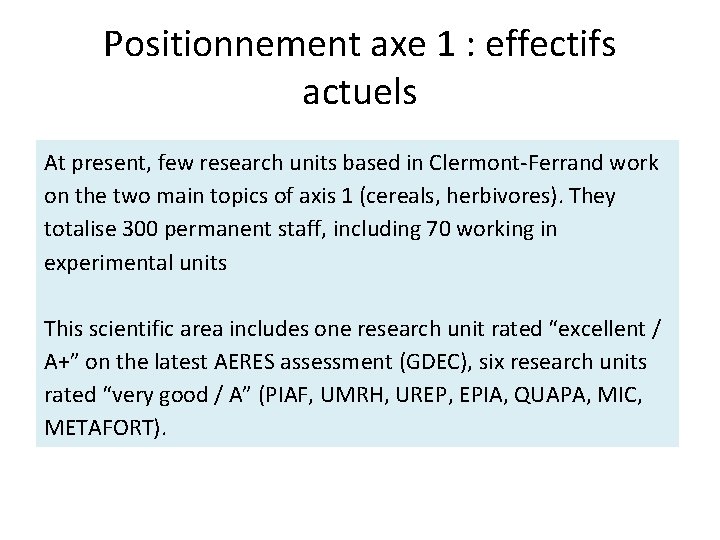
Positionnement axe 1 : effectifs actuels At present, few research units based in Clermont-Ferrand work on the two main topics of axis 1 (cereals, herbivores). They totalise 300 permanent staff, including 70 working in experimental units This scientific area includes one research unit rated “excellent / A+” on the latest AERES assessment (GDEC), six research units rated “very good / A” (PIAF, UMRH, UREP, EPIA, QUAPA, MIC, METAFORT).
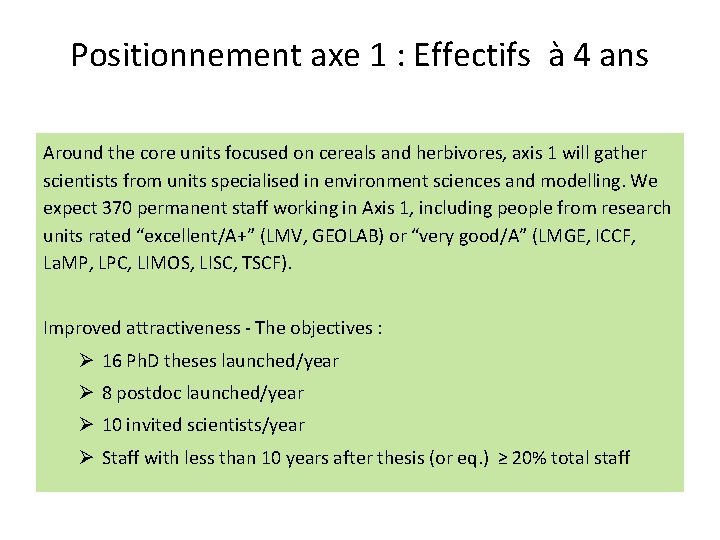
Positionnement axe 1 : Effectifs à 4 ans Around the core units focused on cereals and herbivores, axis 1 will gather scientists from units specialised in environment sciences and modelling. We expect 370 permanent staff working in Axis 1, including people from research units rated “excellent/A+” (LMV, GEOLAB) or “very good/A” (LMGE, ICCF, La. MP, LPC, LIMOS, LISC, TSCF). Improved attractiveness - The objectives : Ø 16 Ph. D theses launched/year Ø 8 postdoc launched/year Ø 10 invited scientists/year Ø Staff with less than 10 years after thesis (or eq. ) ≥ 20% total staff
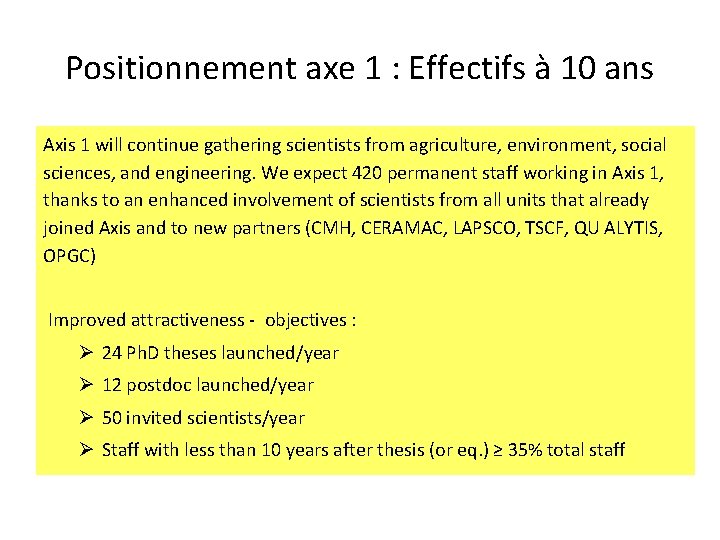
Positionnement axe 1 : Effectifs à 10 ans Axis 1 will continue gathering scientists from agriculture, environment, social sciences, and engineering. We expect 420 permanent staff working in Axis 1, thanks to an enhanced involvement of scientists from all units that already joined Axis and to new partners (CMH, CERAMAC, LAPSCO, TSCF, QU ALYTIS, OPGC) Improved attractiveness - objectives : Ø 24 Ph. D theses launched/year Ø 12 postdoc launched/year Ø 50 invited scientists/year Ø Staff with less than 10 years after thesis (or eq. ) ≥ 35% total staff
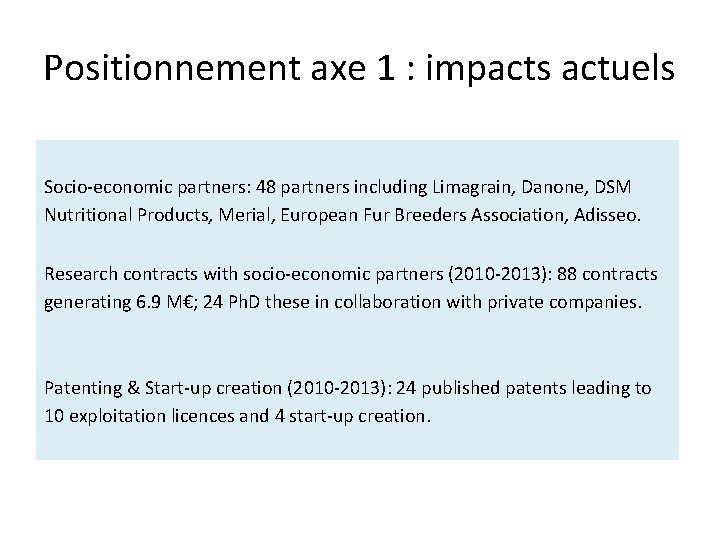
Positionnement axe 1 : impacts actuels Socio-economic partners: 48 partners including Limagrain, Danone, DSM Nutritional Products, Merial, European Fur Breeders Association, Adisseo. Research contracts with socio-economic partners (2010 -2013): 88 contracts generating 6. 9 M€; 24 Ph. D these in collaboration with private companies. Patenting & Start-up creation (2010 -2013): 24 published patents leading to 10 exploitation licences and 4 start-up creation.
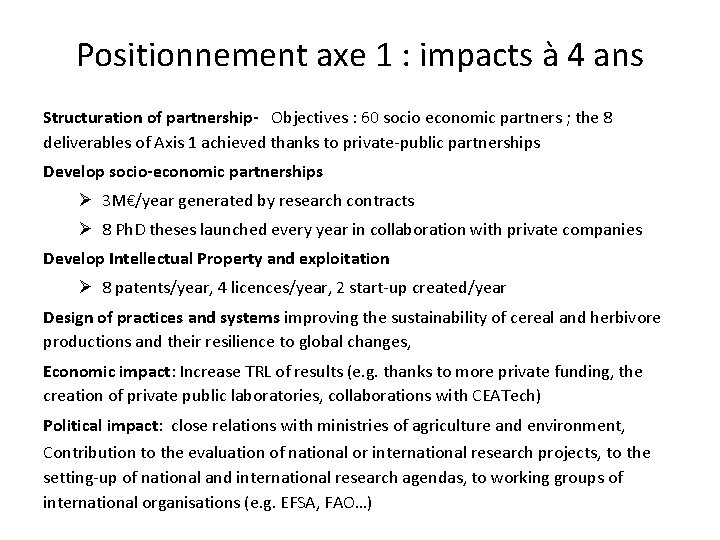
Positionnement axe 1 : impacts à 4 ans Structuration of partnership- Objectives : 60 socio economic partners ; the 8 deliverables of Axis 1 achieved thanks to private-public partnerships Develop socio-economic partnerships Ø 3 M€/year generated by research contracts Ø 8 Ph. D theses launched every year in collaboration with private companies Develop Intellectual Property and exploitation Ø 8 patents/year, 4 licences/year, 2 start-up created/year Design of practices and systems improving the sustainability of cereal and herbivore productions and their resilience to global changes, Economic impact: Increase TRL of results (e. g. thanks to more private funding, the creation of private public laboratories, collaborations with CEATech) Political impact: close relations with ministries of agriculture and environment, Contribution to the evaluation of national or international research projects, to the setting-up of national and international research agendas, to working groups of international organisations (e. g. EFSA, FAO…)
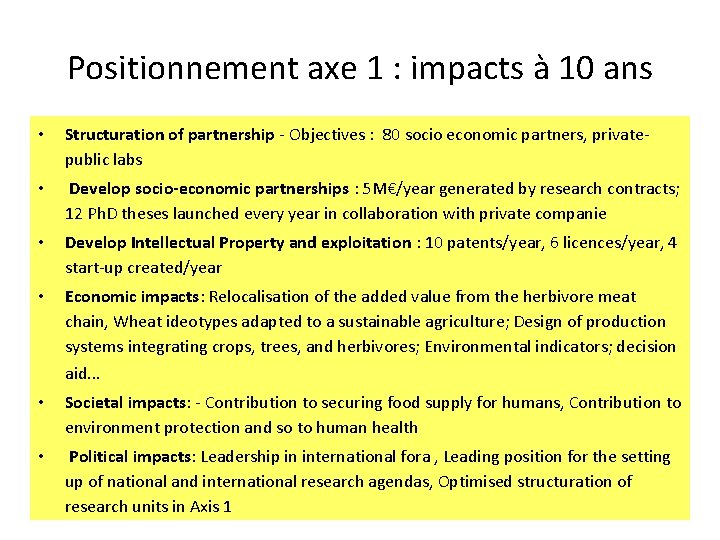
Positionnement axe 1 : impacts à 10 ans • Structuration of partnership - Objectives : 80 socio economic partners, privatepublic labs • Develop socio-economic partnerships : 5 M€/year generated by research contracts; 12 Ph. D theses launched every year in collaboration with private companie • Develop Intellectual Property and exploitation : 10 patents/year, 6 licences/year, 4 start-up created/year • Economic impacts: Relocalisation of the added value from the herbivore meat chain, Wheat ideotypes adapted to a sustainable agriculture; Design of production systems integrating crops, trees, and herbivores; Environmental indicators; decision aid. . . • Societal impacts: - Contribution to securing food supply for humans, Contribution to environment protection and so to human health • Political impacts: Leadership in international fora , Leading position for the setting up of national and international research agendas, Optimised structuration of research units in Axis 1
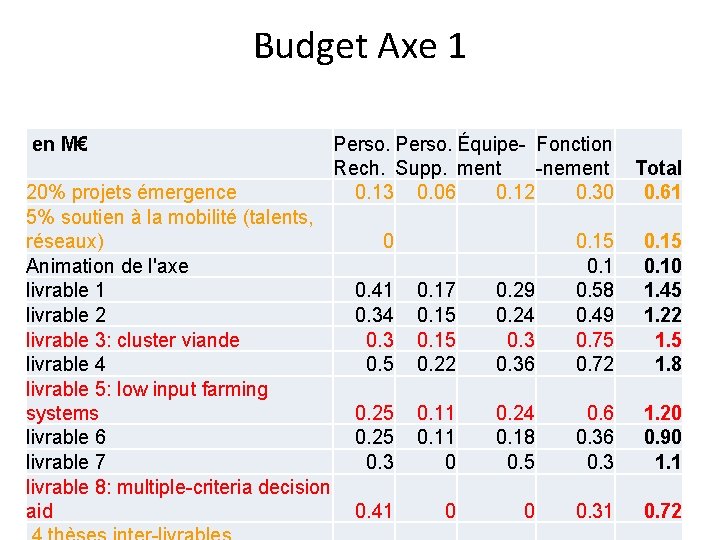
Budget Axe 1 en M€ Perso. Équipe- Fonction Rech. Supp. ment -nement 0. 13 0. 06 0. 12 0. 30 20% projets émergence 5% soutien à la mobilité (talents, réseaux) Animation de l'axe livrable 1 livrable 2 livrable 3: cluster viande livrable 4 livrable 5: low input farming systems livrable 6 livrable 7 livrable 8: multiple-criteria decision aid 0 0. 41 0. 34 0. 3 0. 5 0. 17 0. 15 0. 22 0. 25 0. 3 0. 41 Total 0. 61 0. 29 0. 24 0. 36 0. 15 0. 1 0. 58 0. 49 0. 75 0. 72 0. 15 0. 10 1. 45 1. 22 1. 5 1. 8 0. 11 0 0. 24 0. 18 0. 5 0. 6 0. 3 1. 20 0. 90 1. 1 0 0 0. 31 0. 72
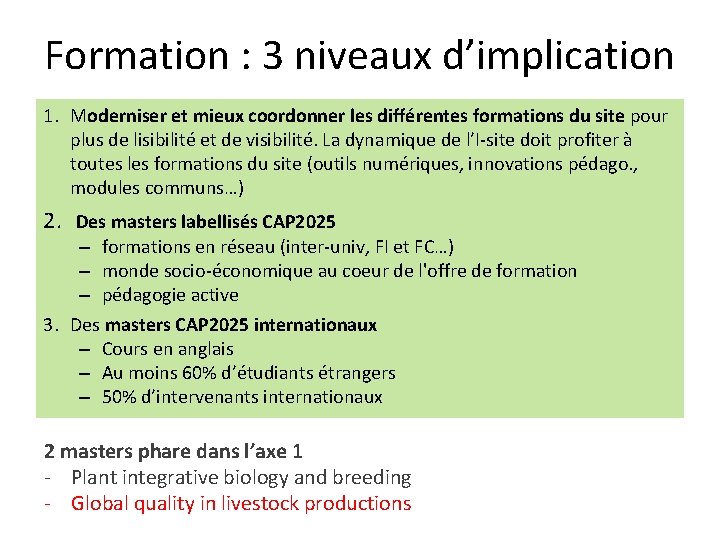
Formation : 3 niveaux d’implication 1. Moderniser et mieux coordonner les différentes formations du site pour plus de lisibilité et de visibilité. La dynamique de l’I-site doit profiter à toutes les formations du site (outils numériques, innovations pédago. , modules communs…) 2. Des masters labellisés CAP 2025 – formations en réseau (inter-univ, FI et FC…) – monde socio-économique au coeur de l'offre de formation – pédagogie active 3. Des masters CAP 2025 internationaux – Cours en anglais – Au moins 60% d’étudiants étrangers – 50% d’intervenants internationaux 2 masters phare dans l’axe 1 - Plant integrative biology and breeding - Global quality in livestock productions
• Merci de votre attention !