
Canyons Middle School Debate League Orientation CSD MS

Canyons Middle School Debate League Orientation
CSD MS Debate League Day 1 Structured Learning 8: 00 am – Welcome and Introductions • Why should CSD have a MS Debate League? • How is a league different from a class? • What are the characteristics of CSD MS League? o Events o Compensation o Competition • Logistics o Recruiting o Tracking o Continued participation • Practices and Teaching • Questions and Answer Session
Why Have a Middle School Debate League?
Alignment with Standards Competitive Speech and Debate Activities Meet 15 of the National Common Core Standards for ELA (including the newly adopted Utah Common Core Standards). Meet all ten of the National Common Core Standards for Social Studies. Meet 58 of 62 current Utah ELA State Standards.
College Board Standards for College Success (CBSCS) Meet all four components of the College Board’s Literacy Standards for College Success: Reading Writing Speaking Listening
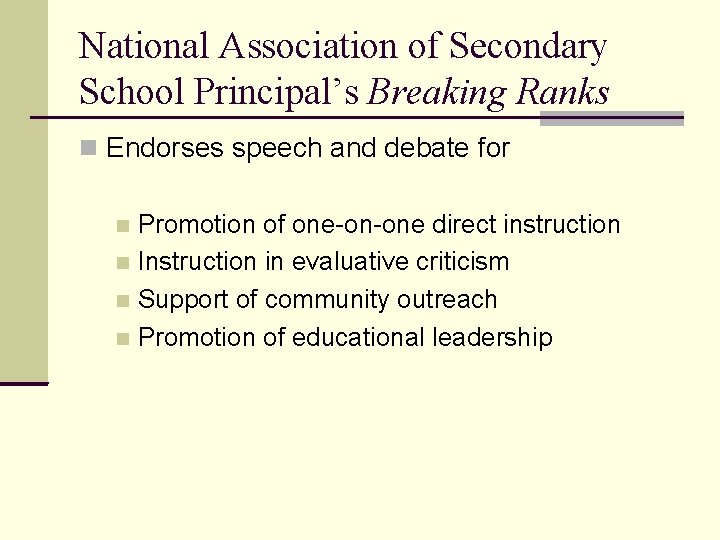
National Association of Secondary School Principal’s Breaking Ranks Endorses speech and debate for Promotion of one-on-one direct instruction Instruction in evaluative criticism Support of community outreach Promotion of educational leadership
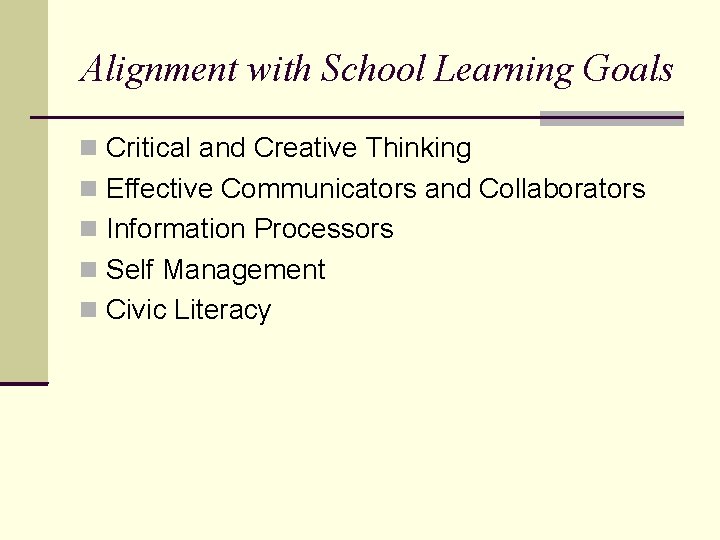
Alignment with School Learning Goals Critical and Creative Thinking Effective Communicators and Collaborators Information Processors Self Management Civic Literacy

Advantages and Benefits Unique benefits for gifted, special needs and at-risk students. – A Georgia State study on speech and debate showed that disciplinary referrals (including expulsions, in-school suspensions and mandatory parent-teacher conferences) dropped by 50% after one year of participating in a speech and debate program; in the following year, it continued to drop an additional 46%. – Improves attendance
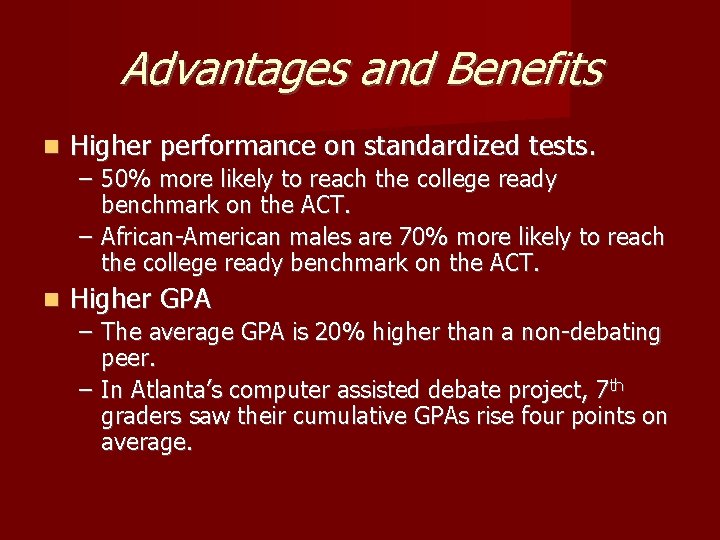
Advantages and Benefits Higher performance on standardized tests. – 50% more likely to reach the college ready benchmark on the ACT. – African-American males are 70% more likely to reach the college ready benchmark on the ACT. Higher GPA – The average GPA is 20% higher than a non-debating peer. – In Atlanta’s computer assisted debate project, 7 th graders saw their cumulative GPAs rise four points on average.
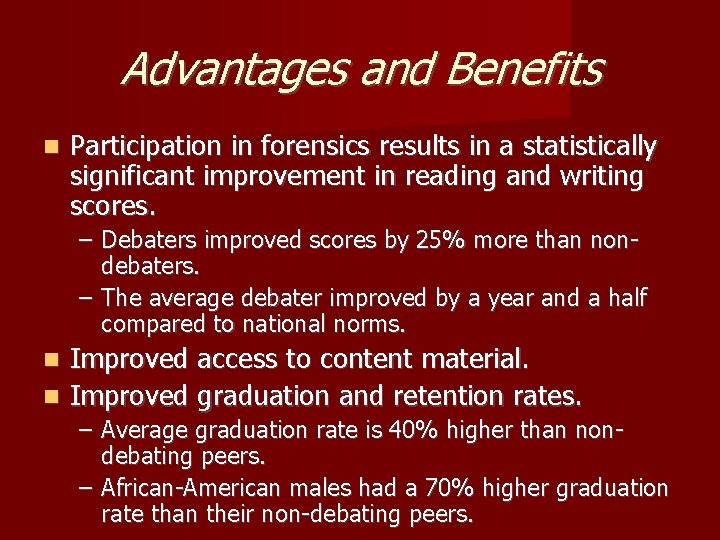
Advantages and Benefits Participation in forensics results in a statistically significant improvement in reading and writing scores. – Debaters improved scores by 25% more than nondebaters. – The average debater improved by a year and a half compared to national norms. Improved access to content material. Improved graduation and retention rates. – Average graduation rate is 40% higher than nondebating peers. – African-American males had a 70% higher graduation rate than their non-debating peers.
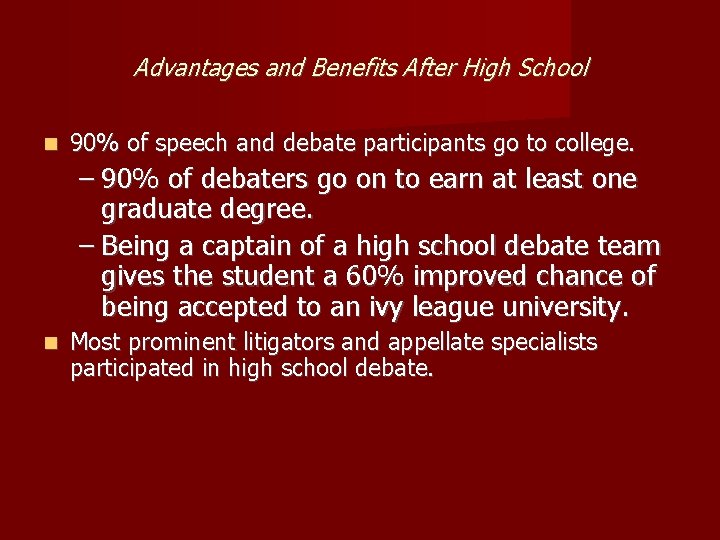
Advantages and Benefits After High School 90% of speech and debate participants go to college. – 90% of debaters go on to earn at least one graduate degree. – Being a captain of a high school debate team gives the student a 60% improved chance of being accepted to an ivy league university. Most prominent litigators and appellate specialists participated in high school debate.
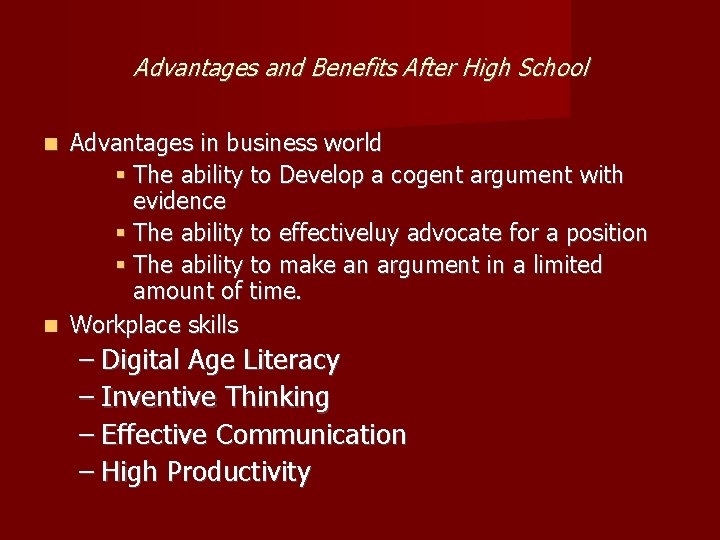
Advantages and Benefits After High School Advantages in business world The ability to Develop a cogent argument with evidence The ability to effectiveluy advocate for a position The ability to make an argument in a limited amount of time. Workplace skills – Digital Age Literacy – Inventive Thinking – Effective Communication – High Productivity
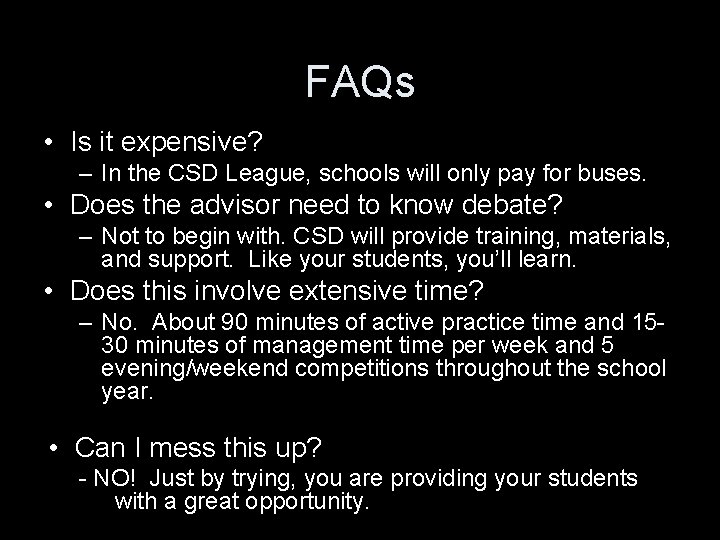
FAQs • Is it expensive? – In the CSD League, schools will only pay for buses. • Does the advisor need to know debate? – Not to begin with. CSD will provide training, materials, and support. Like your students, you’ll learn. • Does this involve extensive time? – No. About 90 minutes of active practice time and 1530 minutes of management time per week and 5 evening/weekend competitions throughout the school year. • Can I mess this up? - NO! Just by trying, you are providing your students with a great opportunity.
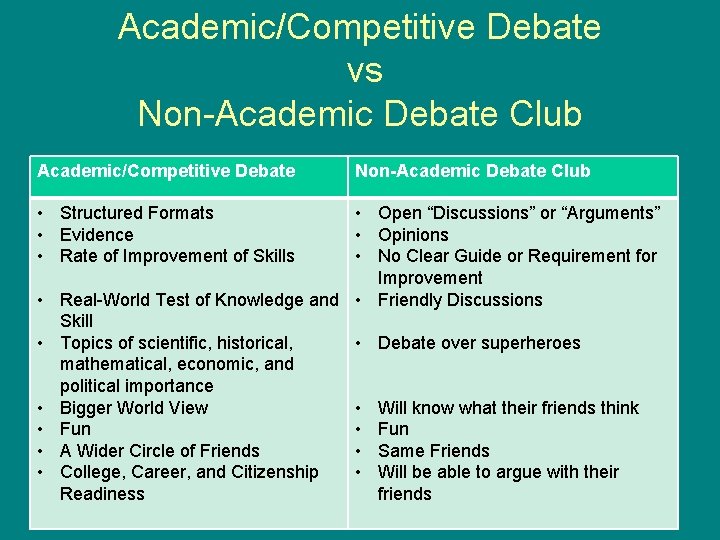
Academic/Competitive Debate vs Non-Academic Debate Club Academic/Competitive Debate • Structured Formats • Evidence • Rate of Improvement of Skills • • • Non-Academic Debate Club • Open “Discussions” or “Arguments” • Opinions • No Clear Guide or Requirement for Improvement Real-World Test of Knowledge and • Friendly Discussions Skill Topics of scientific, historical, • Debate over superheroes mathematical, economic, and political importance Bigger World View • Will know what their friends think Fun • Fun A Wider Circle of Friends • Same Friends College, Career, and Citizenship • Will be able to argue with their Readiness friends
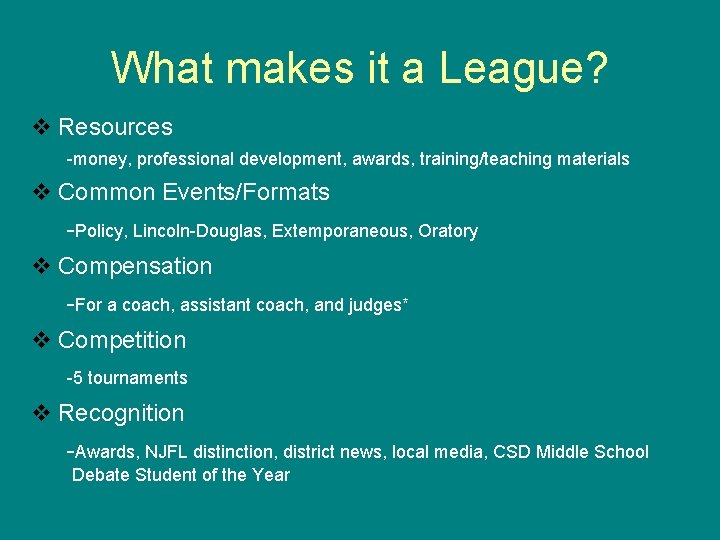
What makes it a League? v Resources -money, professional development, awards, training/teaching materials v Common Events/Formats -Policy, Lincoln-Douglas, Extemporaneous, Oratory v Compensation -For a coach, assistant coach, and judges* v Competition -5 tournaments v Recognition -Awards, NJFL distinction, district news, local media, CSD Middle School Debate Student of the Year
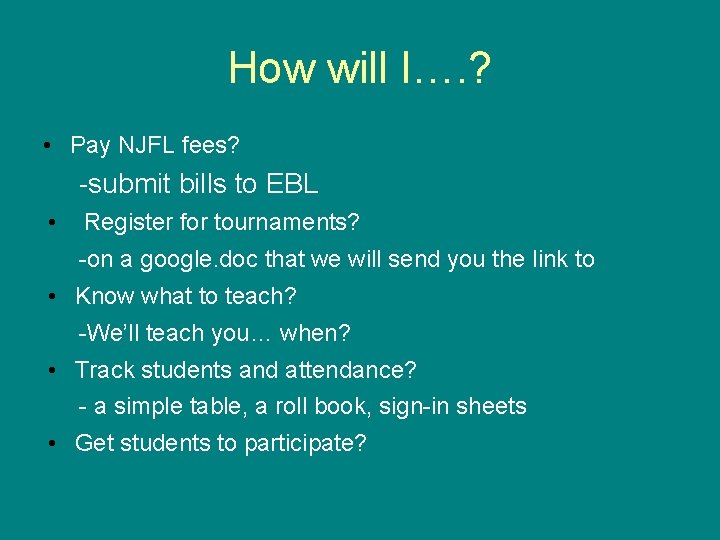
How will I…. ? • Pay NJFL fees? -submit bills to EBL • Register for tournaments? -on a google. doc that we will send you the link to • Know what to teach? -We’ll teach you… when? • Track students and attendance? - a simple table, a roll book, sign-in sheets • Get students to participate?
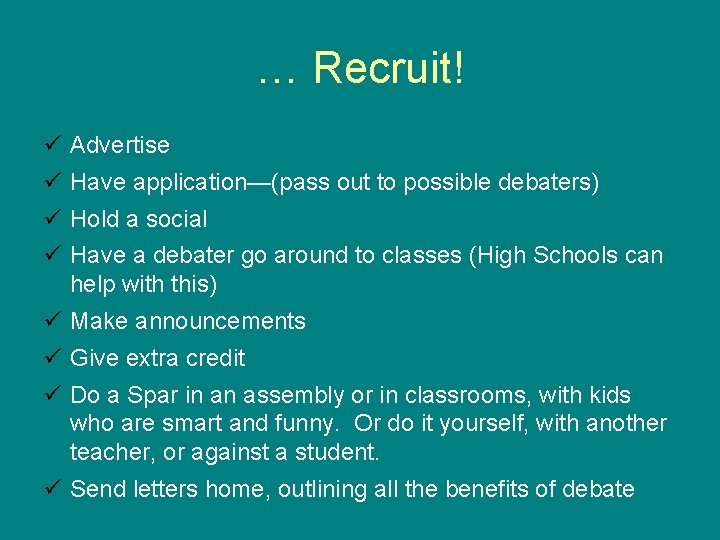
… Recruit! ü Advertise ü Have application—(pass out to possible debaters) ü Hold a social ü Have a debater go around to classes (High Schools can help with this) ü Make announcements ü Give extra credit ü Do a Spar in an assembly or in classrooms, with kids who are smart and funny. Or do it yourself, with another teacher, or against a student. ü Send letters home, outlining all the benefits of debate
Most importantly… See contract how will I get paid?

To Teach… Teach format, vocabulary, show example Add topic Do research Try it Learn from the try, refine, try again Do “Drills” Do stop/starts Practice applicable skills—speaking, thinking researching, cross examination, note-taking (flowing) Learn about the topics
The Events Policy Debate * Lincoln-Douglas Debate* Extemporaneous Speaking Oratory *= required for compensation/district and state event
Policy Debaters work in pairs (teams) to address the school year's topic, either from the affirmative side (to propose a plan to solve a problem with the topic), or the negative side (to prove how the affirmative's plan is flawed). Argumentation includes a constructive case, cross examination, and refutation. Skills learned include research, policy analysis, case building, refutation, questioning, organization and communication. This year’s topic: The State of Utah should establish a policy significantly decreasing plastic waste.
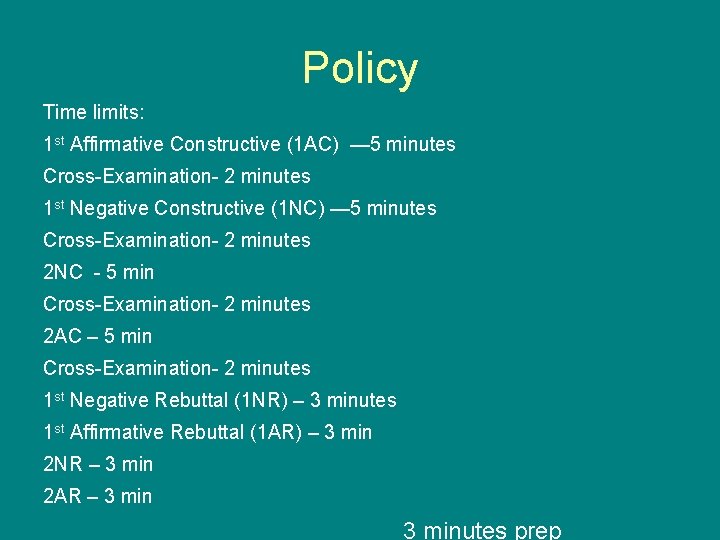
Policy Time limits: 1 st Affirmative Constructive (1 AC) — 5 minutes Cross-Examination- 2 minutes 1 st Negative Constructive (1 NC) — 5 minutes Cross-Examination- 2 minutes 2 NC - 5 min Cross-Examination- 2 minutes 2 AC – 5 min Cross-Examination- 2 minutes 1 st Negative Rebuttal (1 NR) – 3 minutes 1 st Affirmative Rebuttal (1 AR) – 3 min 2 NR – 3 min 2 AR – 3 minutes prep
Lincoln-Douglas Debate Lincoln Douglas debate is an event in which a student competes against another student to discuss affirmative and negative arguments of value. Topics center around the question of what ought to be instead of what is. For example, many topics invoke concepts like justice, morality, and duty. The Lincoln-Douglas debater learns value analysis, research skills, logical argumentation, political theory and philosophy, techniques for asking and answering questions, effective note taking, and oral presentation skills. Topic: Individuals have a moral obligation to reduce plastic waste in their communities.
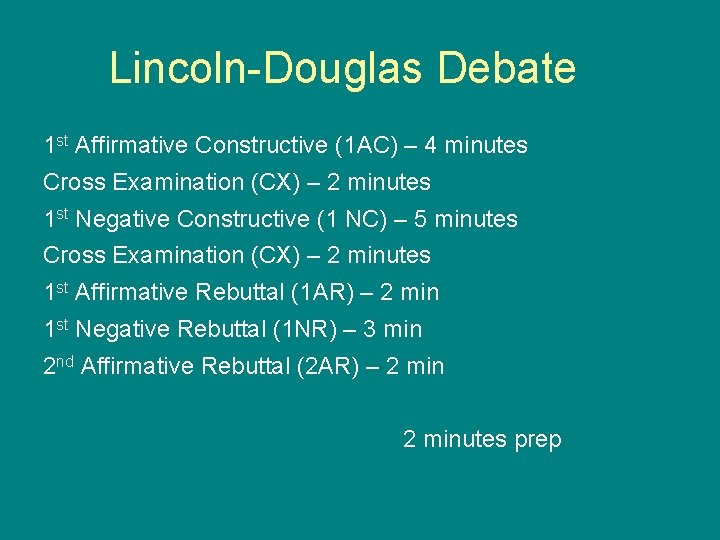
Lincoln-Douglas Debate 1 st Affirmative Constructive (1 AC) – 4 minutes Cross Examination (CX) – 2 minutes 1 st Negative Constructive (1 NC) – 5 minutes Cross Examination (CX) – 2 minutes 1 st Affirmative Rebuttal (1 AR) – 2 min 1 st Negative Rebuttal (1 NR) – 3 min 2 nd Affirmative Rebuttal (2 AR) – 2 minutes prep
Extemporaneous Speaking A speech concerning analysis of current events. A contestant draws three questions, selects one, then has 30 minutes to prepare a speech in response. The contestant utilizes files of published materials (books, magazines, newspapers, online sources) s/he has compiled as a resource for answering the question. At the completion of the 30 minute preparation period, the student speaks on the topic for up to 5 minutes.
Oratory Orators are expected to research and speak intelligently, with a degree of originality, in an interesting manner, and with some profit to the audience, about a topic of significance. Although many orations deal with a current problem and propose a solution this is not the only acceptable form of oratory. Your oration may simply alert the audience to a threatening danger, strengthen its devotion to an accepted cause, or eulogize a person. An orator is given free choice of subject and judged solely on the effectiveness of development and presentation. Speeches should be 6 -8 minutes.
Competition Why compete? • Acquisition, Automaticity, Application The debater who doesn’t compete is like: • The basketball player who never plays in a game. • The musician who never performs. • The lawyer who never goes to court. Skills are only as solid as their application.
Tournaments Each CSD Middles School League tournament will be: • 3 -4 rounds • On a weeknight • Positive learning experiences • Held in conjunction with CSD high schools
Tournaments In Policy and LD, students will debate 2 affirmative and 2 negative. * Awards will be determined off of win/loss records and speaker points. In Extemp and Oratory, students will speak in three rounds. They will be ranked in order of performance and rated on speaker’s criteria. Awards will be determined based on low ranks and high ratings. Final rounds may be held.
Tournaments Students should: • Attend once registered* • Dress up- this does influence credibility • Act professionally • Learn
Tournament Dates CSD NJFL Fall Tournament: October 24, 2013 CSD NJFL Winter Tournament: January 23, 2014 CSD NJFL Spring Tournament: March 4, 2014 CSD District Debate Tournament: TBD State Debate Tournament: April 24, 2014 @ Corner Canyon High
Timeline Early September –Begin recruiting, hold opening social, introduce argumentation, plan for practices October 1 - Meet assistant, begin holding practices October 24 th-First Tournament/ Experiential Learning Continue weekly practices January 23 rd-Second Tournament Continue Weekly Practices
Resources • NJFL handbook: www. nationalforensicleauge. org • Utah Debate Handbook: http: //utahdebate. org • www. cahssa. org • Speaking Across the Curriculum • District’s debate weebly page: http: //csddebate. weebly. com/ • Utah Debate Coaches Association: http: //www. utahdebatecoaches. org
- Slides: 33