
Canterbury Tales Introductory Notes The Tales and The
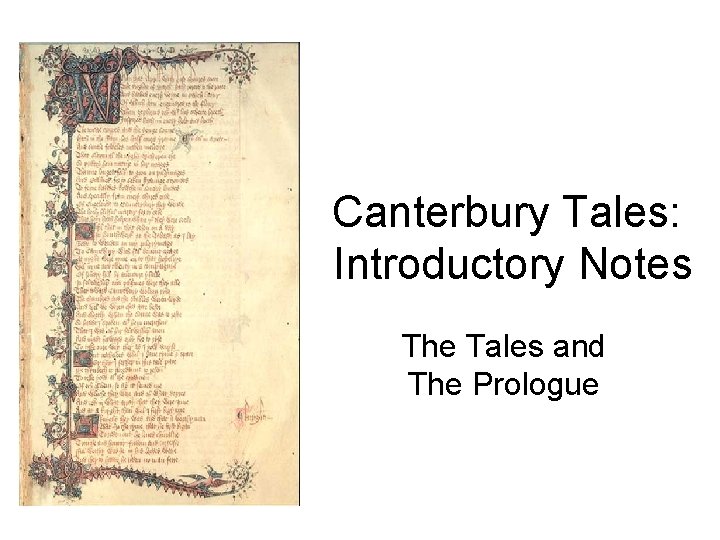
Canterbury Tales: Introductory Notes The Tales and The Prologue
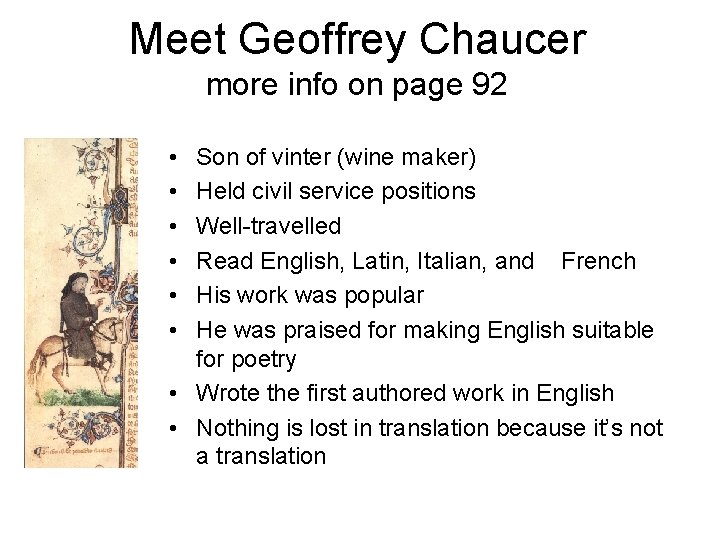
Meet Geoffrey Chaucer more info on page 92 • • • Son of vinter (wine maker) Held civil service positions Well-travelled Read English, Latin, Italian, and French His work was popular He was praised for making English suitable for poetry • Wrote the first authored work in English • Nothing is lost in translation because it’s not a translation
The Canterbury Tales (in general) • Chaucer presents the world as he sees it • Began to write it in 1387 (he had written a large number of works prior to this) • Incomplete (Chaucer died in 1400). “The General Prologue” and only 22 tales completed; there were supposed to be 120 total • Shows a cross section of Medieval society • Stories are not original to Chaucer, but are retellings of popular parables of the time (stories that teach a moral lesson) • The Prologue is ALL Chaucer’s original work, however.
The Tales (cont) • It is a frame story of the pilgrimage to Canterbury (80 miles from London) to visit the tomb of the martyr Thomas à Beckett (killed in Canterbury Cathedral in 1170) • Pilgrimages to shrines were mass activities in the Middle Ages, partly because they were as likely to be vacations as religious observances • Historical background
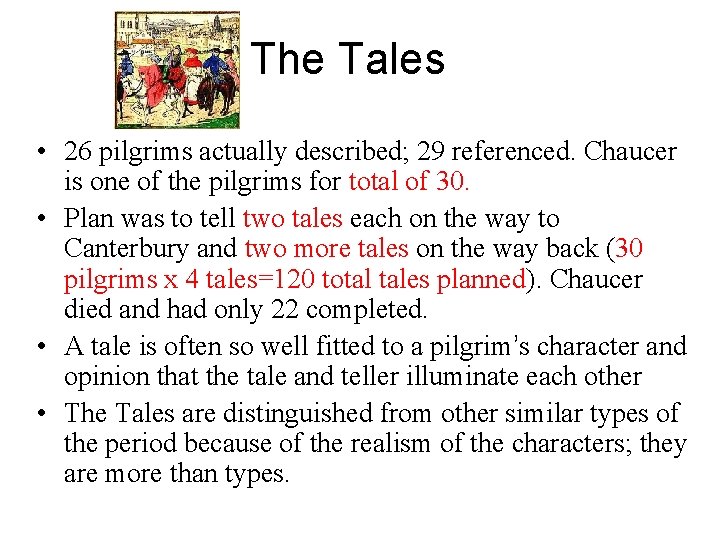
The Tales • 26 pilgrims actually described; 29 referenced. Chaucer is one of the pilgrims for total of 30. • Plan was to tell two tales each on the way to Canterbury and two more tales on the way back (30 pilgrims x 4 tales=120 total tales planned). Chaucer died and had only 22 completed. • A tale is often so well fitted to a pilgrim’s character and opinion that the tale and teller illuminate each other • The Tales are distinguished from other similar types of the period because of the realism of the characters; they are more than types.
General Information • Tabard Inn (leave from here) • The owner is Harry Bailey (he is the host who established the contest---winner gets a free dinner paid for by other pilgrims) • Bailey will be the judge of the best tale • The telling of the tales will help to pass the time more quickly • Written in iambic pentameter • Lines written in rhymed couplets
The Writing of the Tales • Narrative POV • Narrator is actually a character • Creates multiple levels of irony…story told as he sees things, as he is hearing them and understand them, and includes his interpretation of the characters (reflective of Chaucer’s knowledge of types of people in the Middle Ages) • Suspicions that author does not agree with narrator • Written in iambic pentameter (10 syllables per line, with 5 stressed beats and 5 unstressed beats) • Lines rhyme in couplets
The Prologue • Opening lines provide a setting and motivation for the Canterbury pilgrimage • Prologue contains all levels of English life • The order of the introduction of each pilgrim is important because it provides the social standing of the different occupations; it begins with the highest social rank and descends in order.
The Prologue: Characters • • Highest rank is aristocracy or nobility Knight and his household, including Squire (his son) Prioress Monk Friar (should be in lower class but begged so well he is now in the company of nobles)
The Prologue: Characters • • Commercial Wealthy class Merchant (illegally makes his money from selling French coins) Sergeant of Law (used knowledge of law to buy up foreclosed property) Clerk (good manners, knowledge of books) Franklin (made enough money to be a country gentleman and push for a place of nobility)
The Prologue: Characters • • Guildsmen Similar to specialized unions of craftsmen or guilds Haberdasher (makes men’s accessories) Dyer (dyes fabric) Carpenter (works with wood) Weaver (makes fabric) Tapestry-maker (makes rugs/carpets/wall hangings none of them tells a tale
The Prologue: Characters • • Middle-class group Cook (ranked too high, but he is master of his trade and respected) Shipman (knowledge of and travels in the world) Physician (doctor of medicine[much less revered in Middle Ages than today]) Wife of Bath (included here because of her knowledge and deportment [demeanor; behavior; mannerisms])
The Prologue: Characters Virtuous poor or lower class • Parson • Plowman (very poor but represents all of the Christian virtues)
The Prologue: Characters • • • Immoral lower class Manciple (profits from buying food for the lawyers in the Inns of Court) Miller (vulgar, steals from his customers) Reeve (tells dirty stories and cheats his trusting young master Summoner (corrupt, takes bribes) Pardoner (corrupt: sells fake pardons and fake relics)
- Slides: 14