
Canterbury Christ Church University College Second Year Science
Canterbury Christ Church University College Second Year Science Medical Physics & Health Science MEDICAL ULTRASOUND David Andrews 1
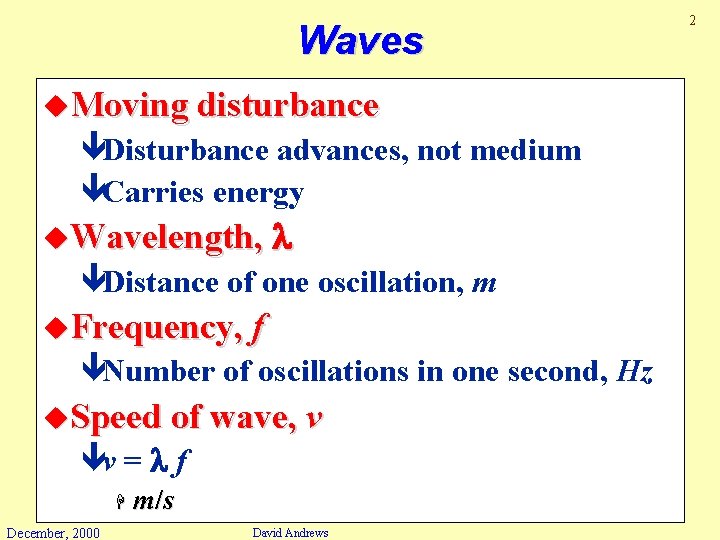
Waves u. Moving disturbance êDisturbance advances, not medium êCarries energy u. Wavelength, êDistance of one oscillation, m u. Frequency, f êNumber of oscillations in one second, Hz u. Speed of wave, v êv = f H December, 2000 m/s David Andrews 2
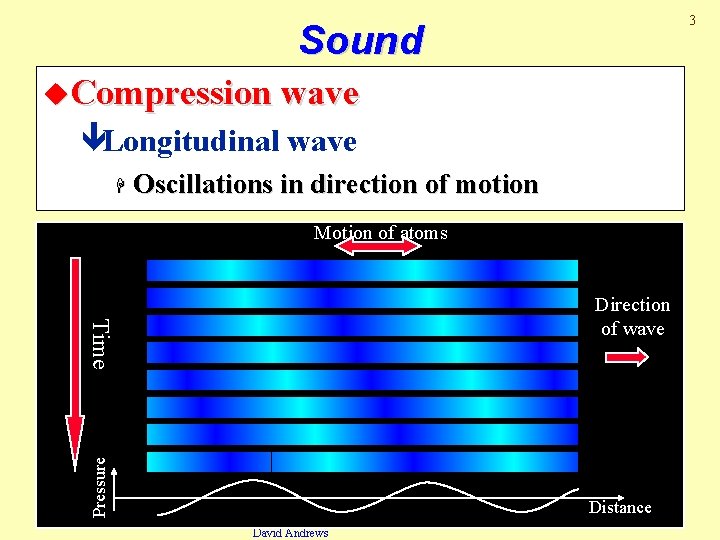
3 Sound u. Compression wave êLongitudinal wave H Oscillations in direction of motion Motion of atoms Pressure Time Direction of wave Distance David Andrews
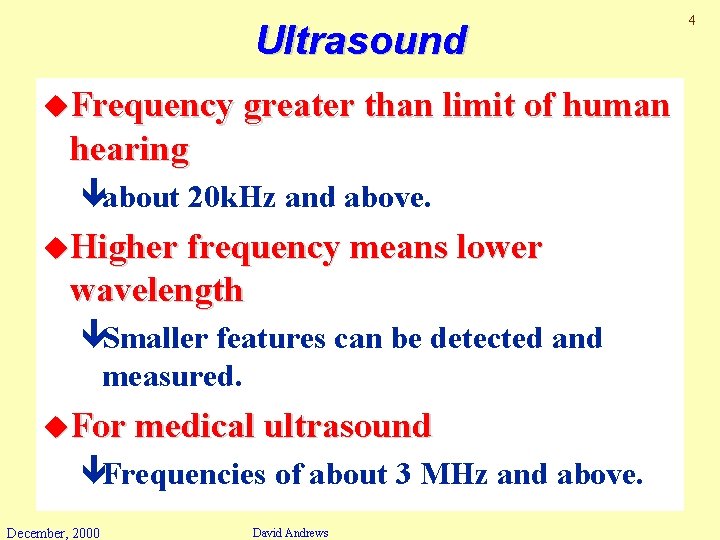
Ultrasound u. Frequency greater than limit of human hearing êabout 20 k. Hz and above. u. Higher frequency means lower wavelength êSmaller features can be detected and measured. u. For medical ultrasound êFrequencies of about 3 MHz and above. December, 2000 David Andrews 4

Velocity of Sound u. Velocity dependent on êbulk modulus, B and density, u Bulk modulus defined as êratio of increase in pressure to factional change in volume êunits are N/m 2 H Air, B = 1. 5× 10⁵ N m-2, = 1. 27 kg m-3 Fv = 345 m s-1 ( at room temperature & pressure) H Water, B = 2. 05× 109 N m-2, = 1× 10³ kg m-3 Fv = 1432 m s-1 ( at room temperature & pressure) December, 2000 David Andrews 5
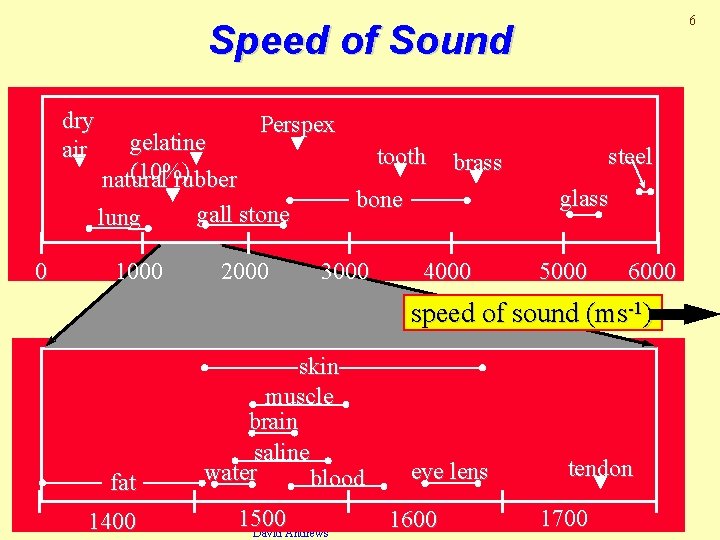
6 Speed of Sound dry air gelatine (10%) natural rubber lung 0 1000 Perspex tooth 2000 glass bone gall stone 3000 steel brass 4000 5000 6000 speed of sound (ms-1) fat 1400 skin muscle brain saline water blood 1500 David Andrews eye lens 1600 tendon 1700
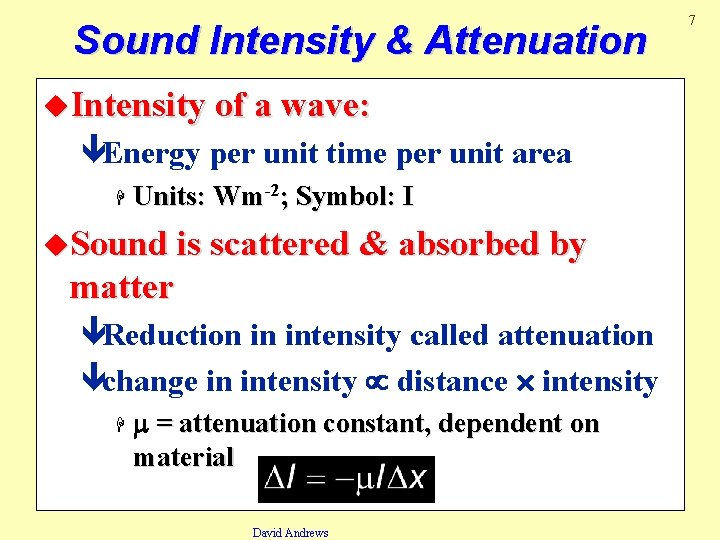
Sound Intensity & Attenuation u. Intensity of a wave: êEnergy per unit time per unit area H Units: Wm-2; Symbol: I u. Sound is scattered & absorbed by matter êReduction in intensity called attenuation êchange in intensity µ distance ´ intensity H = attenuation constant, dependent on material David Andrews 7
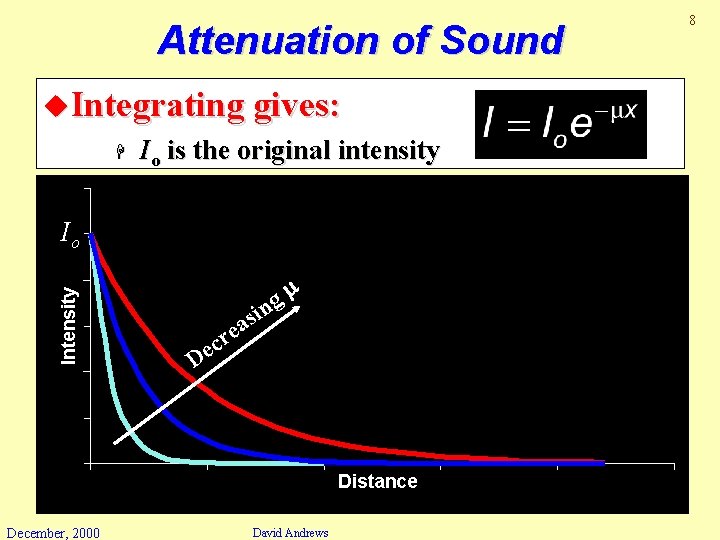
Attenuation of Sound u. Integrating gives: H Io is the original intensity Io c e D i s ea r g n Distance December, 2000 David Andrews 8
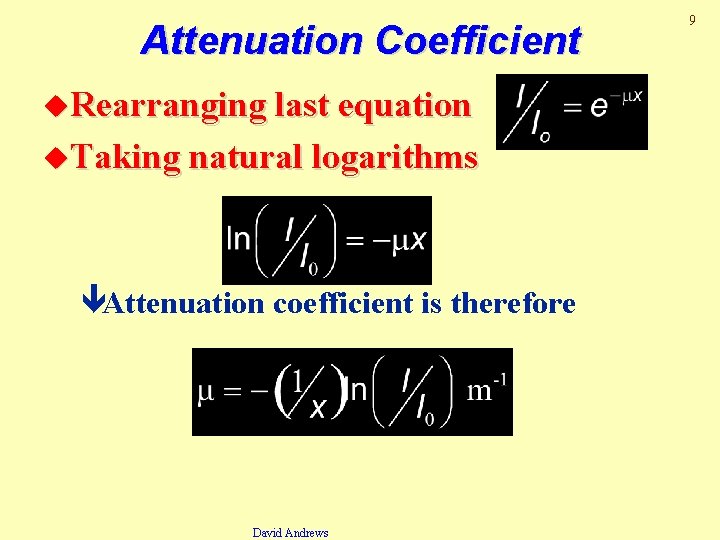
Attenuation Coefficient u. Rearranging last equation u. Taking natural logarithms êAttenuation coefficient is therefore David Andrews 9
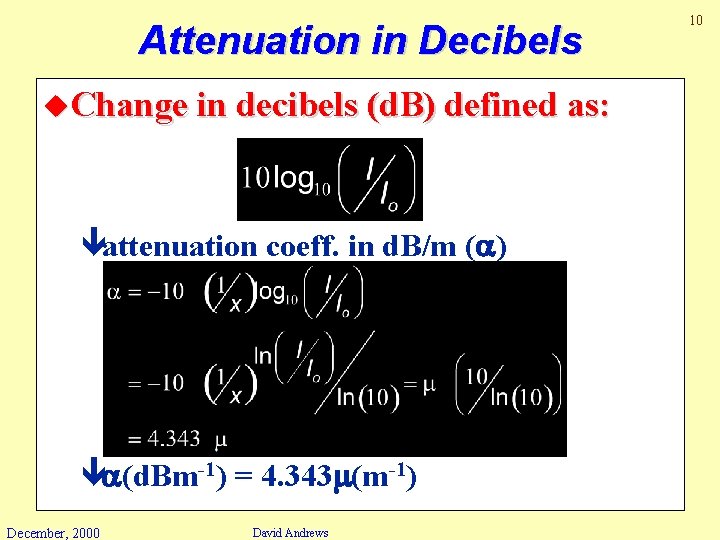
Attenuation in Decibels u. Change in decibels (d. B) defined as: êattenuation coeff. in d. B/m ( ) ê (d. Bm-1) = 4. 343 (m-1) December, 2000 David Andrews 10
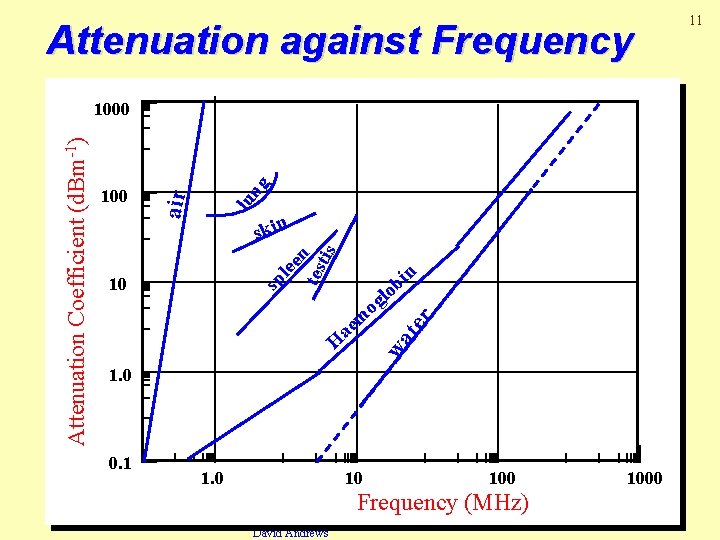
Attenuation against Frequency ng lu sp 10 l og em wa a H n i b o te r en tes tis skin le 100 air Attenuation Coefficient (d. Bm-1) 1000 1. 0 0. 1 1. 0 10 100 Frequency (MHz) David Andrews 1000 11
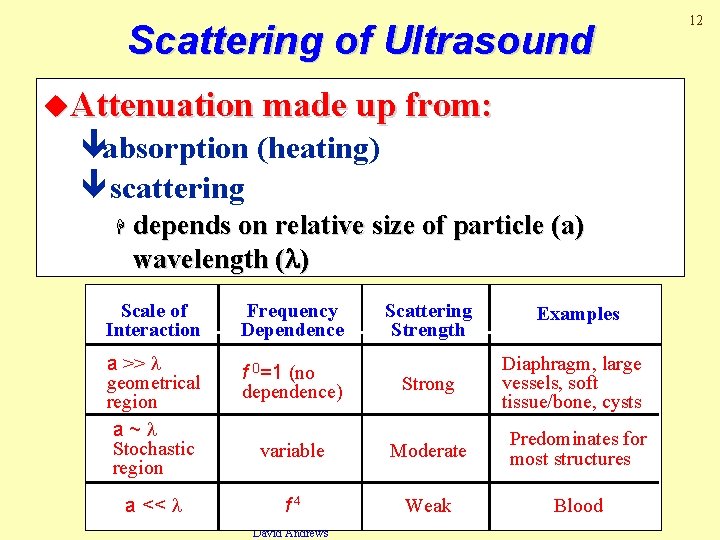
Scattering of Ultrasound u. Attenuation made up from: êabsorption (heating) ê scattering H depends on relative size of particle (a) wavelength ( ) Scale of Interaction a >> geometrical region a~ Stochastic region a << Frequency Dependence Scattering Strength Examples Diaphragm, large vessels, soft tissue/bone, cysts f 0=1 (no dependence) Strong variable Moderate Predominates for most structures f 4 Weak Blood David Andrews 12
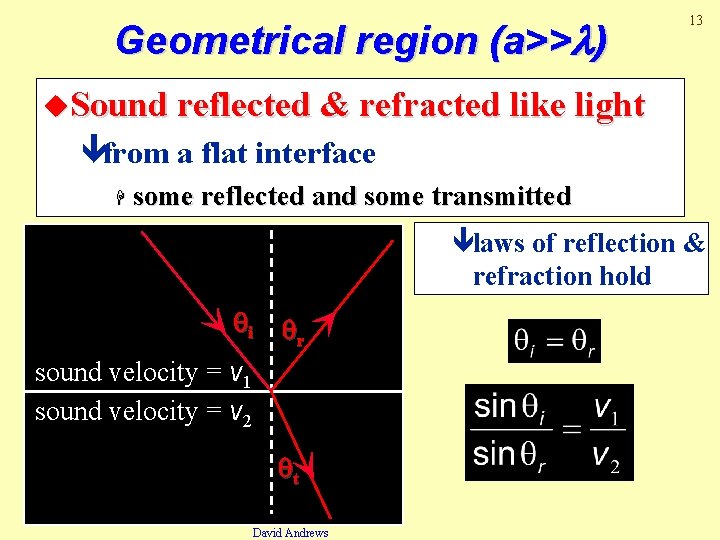
Geometrical region (a>> ) 13 u. Sound reflected & refracted like light êfrom a flat interface H some reflected and some transmitted êlaws of reflection & refraction hold qi q r sound velocity = v 1 sound velocity = v 2 qt David Andrews
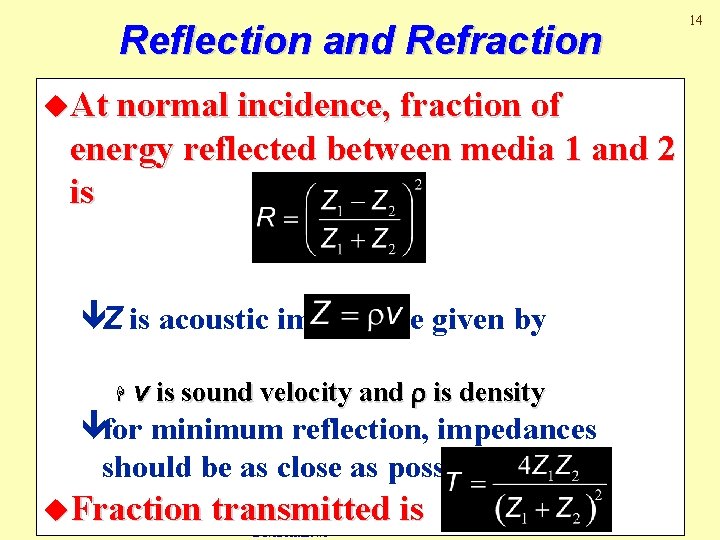
Reflection and Refraction u. At normal incidence, fraction of energy reflected between media 1 and 2 is êZ is acoustic impedance given by H v is sound velocity and is density êfor minimum reflection, impedances should be as close as possible u. Fraction transmitted is David Andrews 14
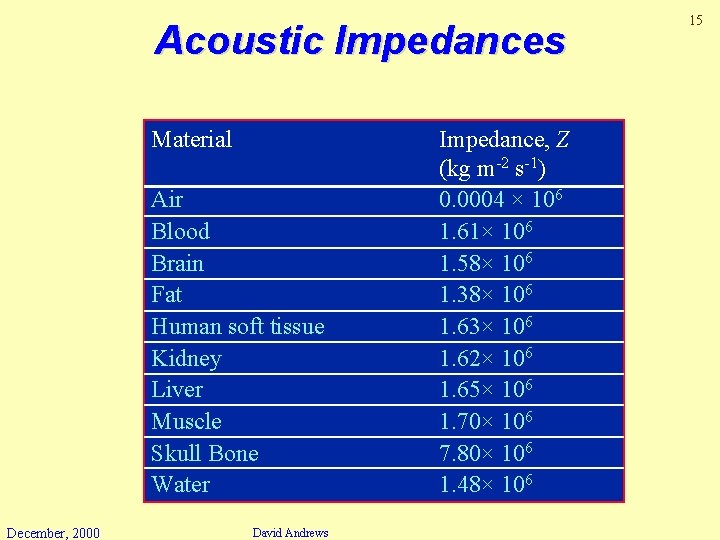
Acoustic Impedances Material Air Blood Brain Fat Human soft tissue Kidney Liver Muscle Skull Bone Water December, 2000 David Andrews Impedance, Z (kg m-2 s-1) 0. 0004 × 106 1. 61× 106 1. 58× 106 1. 38× 106 1. 63× 106 1. 62× 106 1. 65× 106 1. 70× 106 7. 80× 106 1. 48× 106 15
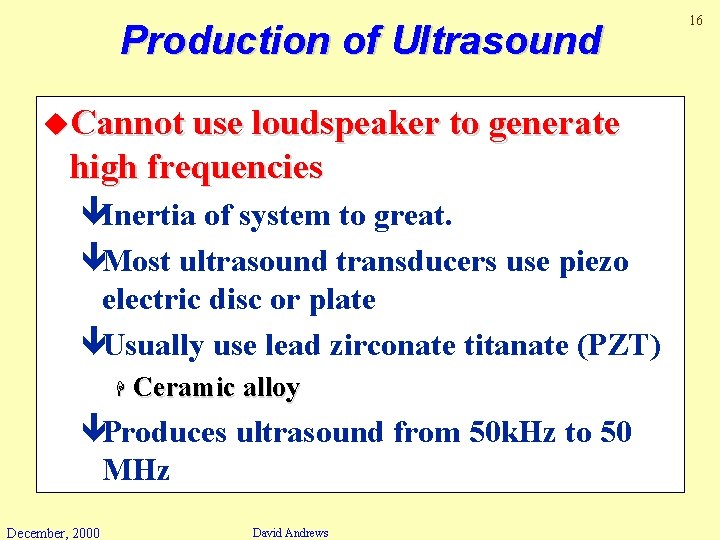
Production of Ultrasound u. Cannot use loudspeaker to generate high frequencies êInertia of system to great. êMost ultrasound transducers use piezo electric disc or plate êUsually use lead zirconate titanate (PZT) H Ceramic alloy êProduces ultrasound from 50 k. Hz to 50 MHz December, 2000 David Andrews 16
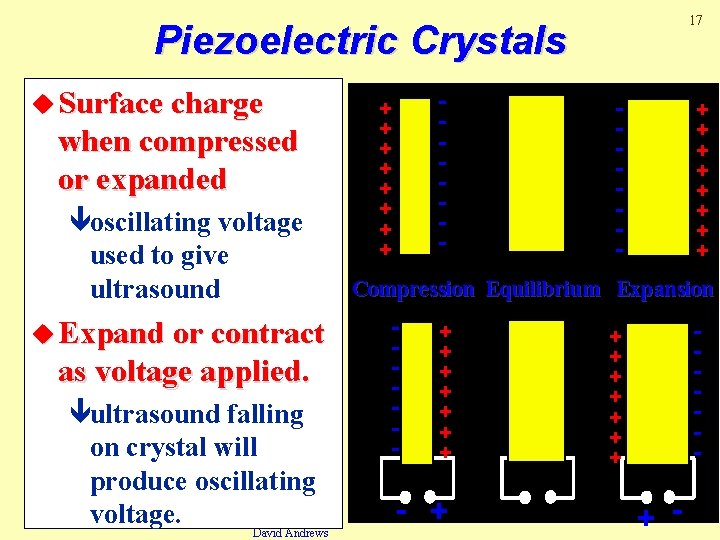
17 Piezoelectric Crystals u Surface charge when compressed or expanded êoscillating voltage used to give ultrasound u Expand or contract as voltage applied. êultrasound falling on crystal will produce oscillating voltage. David Andrews - + + + + Compression Equilibrium Expansion - + + + + -
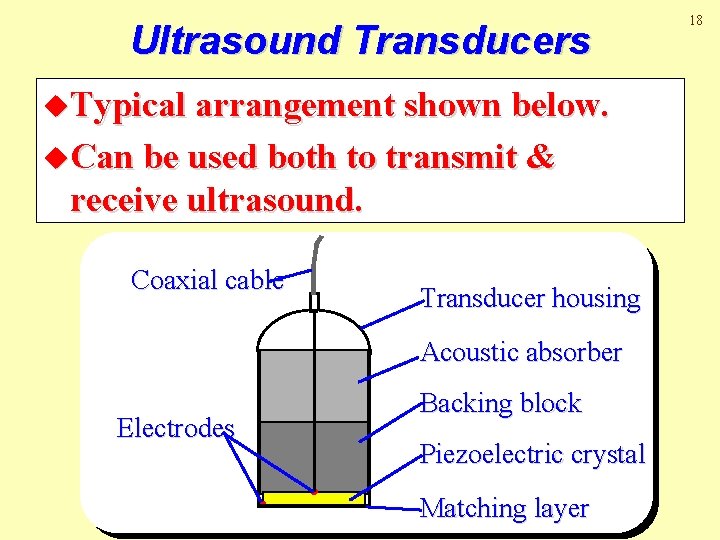
Ultrasound Transducers u. Typical arrangement shown below. u. Can be used both to transmit & receive ultrasound. Coaxial cable Transducer housing Acoustic absorber Backing block Electrodes Piezoelectric crystal Matching layer David Andrews 18
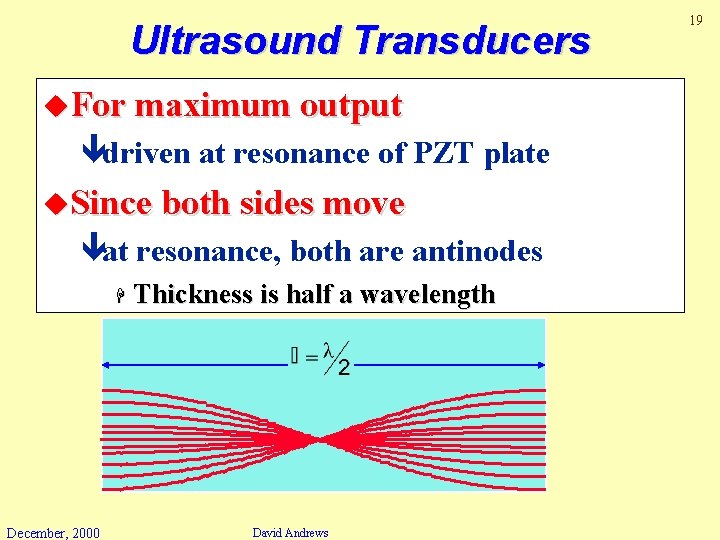
Ultrasound Transducers u. For maximum output êdriven at resonance of PZT plate u. Since both sides move êat resonance, both are antinodes H December, 2000 Thickness is half a wavelength David Andrews 19
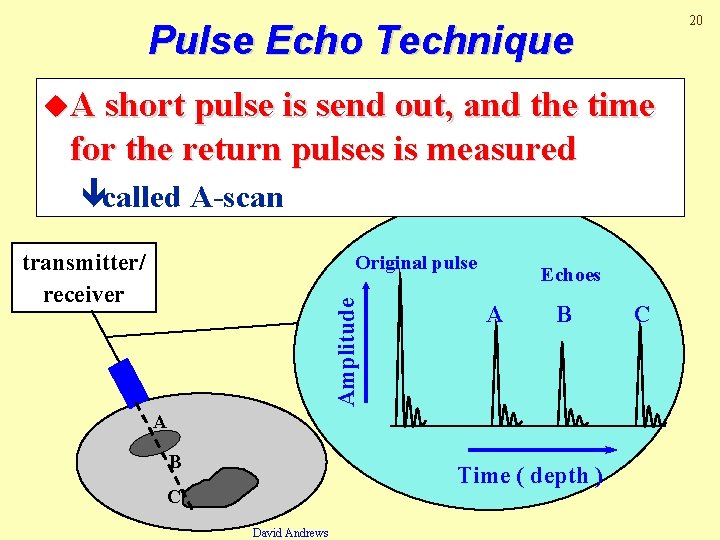
20 Pulse Echo Technique u. A short pulse is send out, and the time for the return pulses is measured êcalled A-scan transmitter/ receiver Amplitude Original pulse Echoes A B Time ( depth ) C David Andrews C
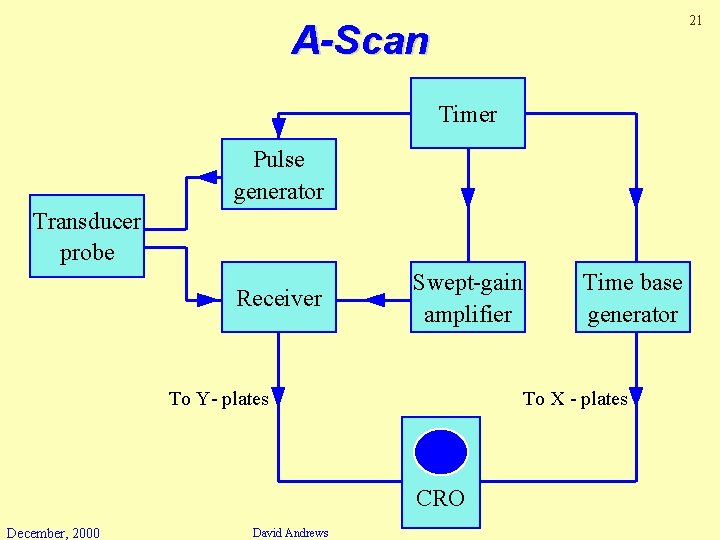
21 A-Scan Timer Pulse generator Transducer probe Receiver Swept-gain amplifier To Y- plates To X - plates CRO December, 2000 David Andrews Time base generator
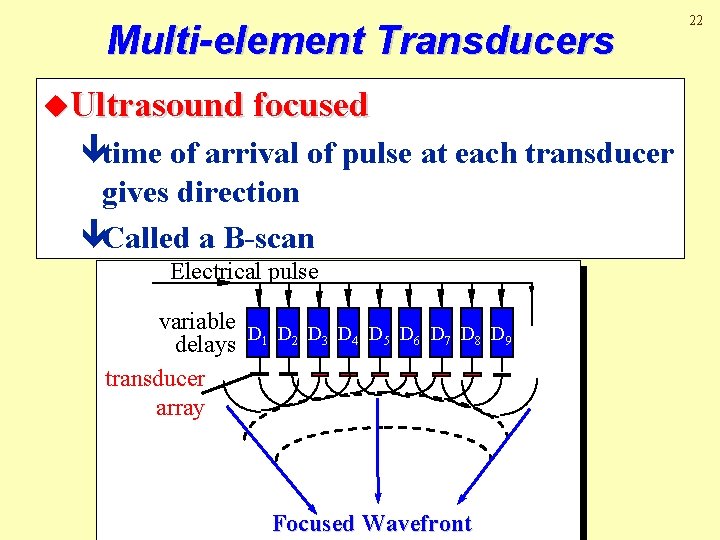
Multi-element Transducers u. Ultrasound focused êtime of arrival of pulse at each transducer gives direction êCalled a B-scan Electrical pulse variable D D D D D delays 1 2 3 4 5 6 7 8 9 transducer array Focused Wavefront David Andrews 22
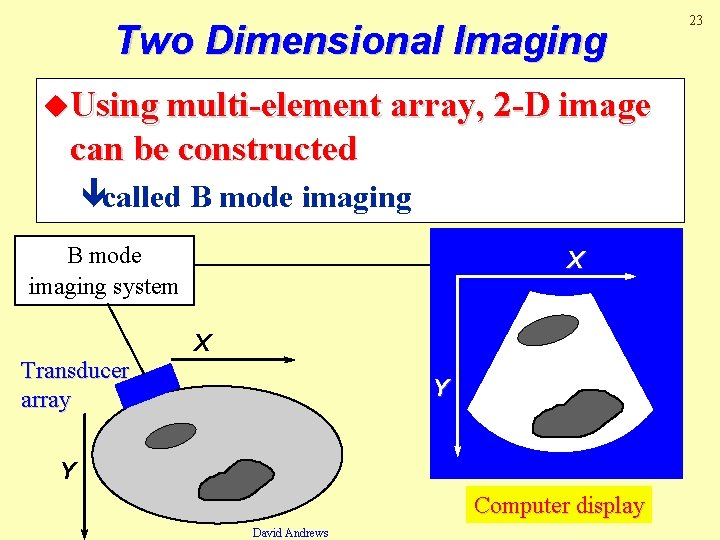
Two Dimensional Imaging u. Using multi-element array, 2 -D image can be constructed êcalled B mode imaging system X X Transducer array Y Y Computer display David Andrews 23
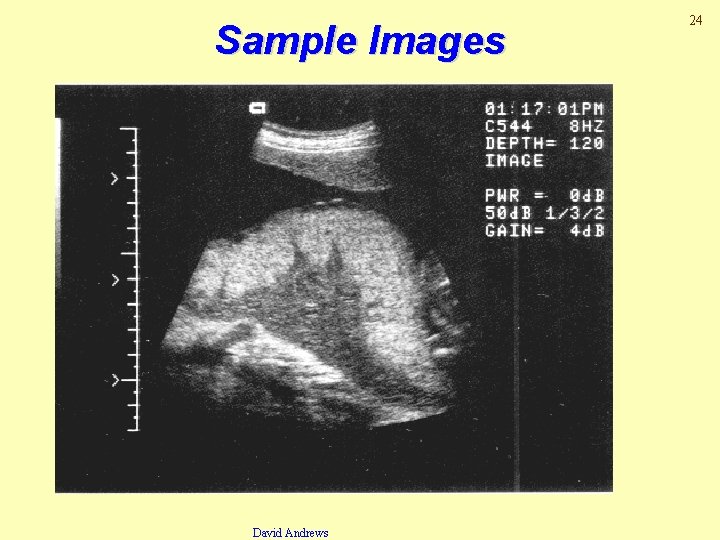
Sample Images David Andrews 24
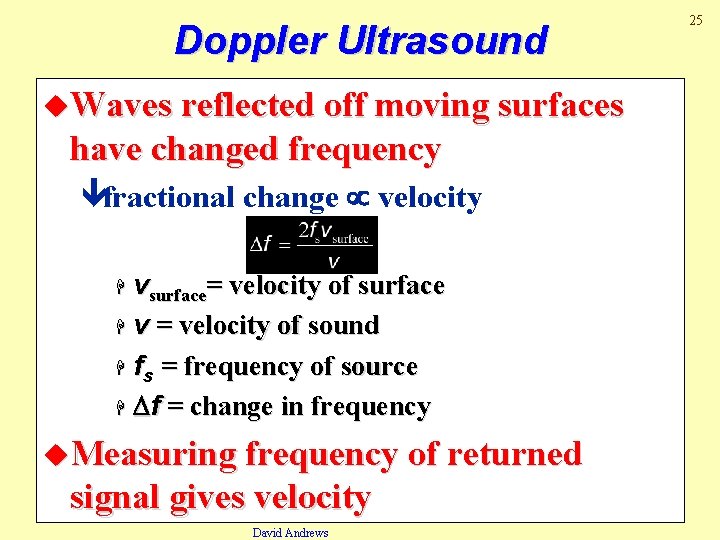
Doppler Ultrasound u. Waves reflected off moving surfaces have changed frequency êfractional change µ velocity vsurface= velocity of surface H v = velocity of sound H fs = frequency of source H f = change in frequency H u. Measuring frequency of returned signal gives velocity David Andrews 25
Doppler Ultrasound u. Used to monitor heartbeats, blood flow, etc. u. Can produce images showing motion êi. e. Imaging beating heart December, 2000 David Andrews 26
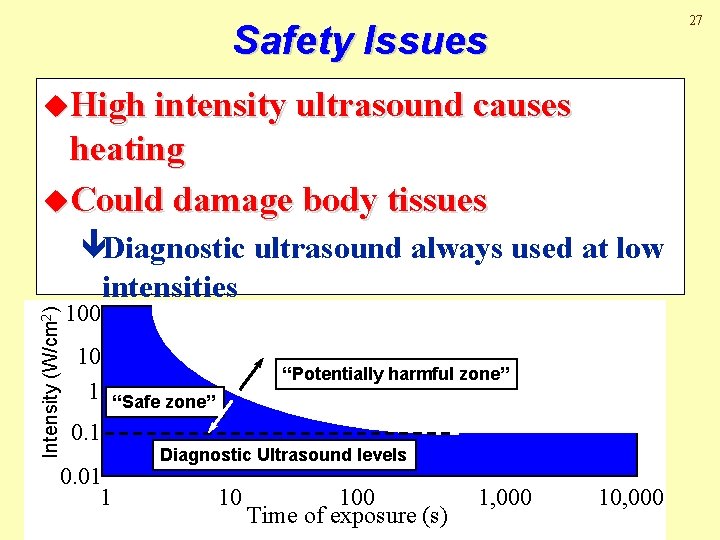
27 Safety Issues u. High intensity ultrasound causes heating u. Could damage body tissues Intensity (W/cm 2) êDiagnostic ultrasound always used at low intensities 100 10 1 0. 01 1 “Potentially harmful zone” “Safe zone” Diagnostic Ultrasound levels 10 Exposure time (seconds) 100 Time of exposure (s) David Andrews 1, 000 10, 000
- Slides: 27