
CannonDozier Project ALPHA PHI ALPHA FRATERNITY INC Brother
Cannon-Dozier Project ALPHA PHI ALPHA FRATERNITY, INC.
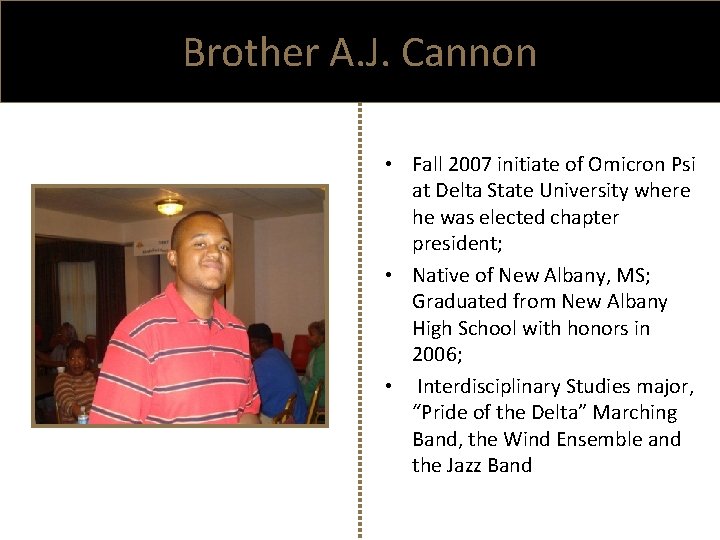
Brother A. J. Cannon • Fall 2007 initiate of Omicron Psi at Delta State University where he was elected chapter president; • Native of New Albany, MS; Graduated from New Albany High School with honors in 2006; • Interdisciplinary Studies major, “Pride of the Delta” Marching Band, the Wind Ensemble and the Jazz Band
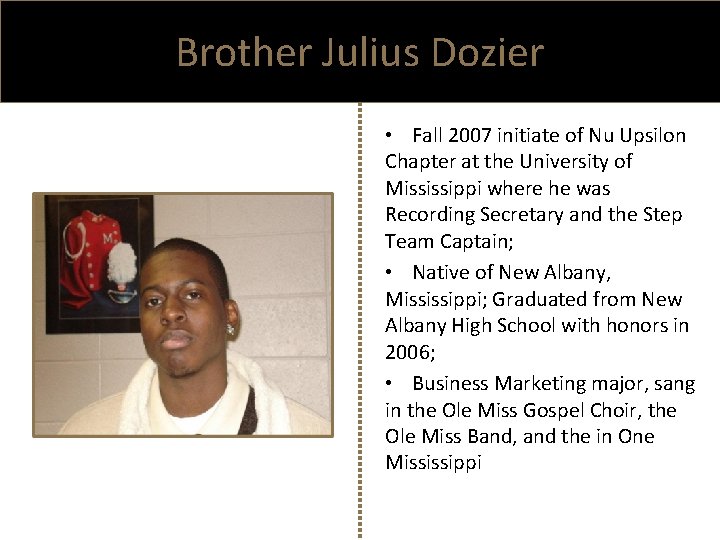
Brother Julius Dozier • Fall 2007 initiate of Nu Upsilon Chapter at the University of Mississippi where he was Recording Secretary and the Step Team Captain; • Native of New Albany, Mississippi; Graduated from New Albany High School with honors in 2006; • Business Marketing major, sang in the Ole Miss Gospel Choir, the Ole Miss Band, and the in One Mississippi
STATISTICS ALCOHOL IS AMERICA’S MOST WIDELY USED DRUG AND IS BY FAR OUR BIGGEST DRUG PROBLEM
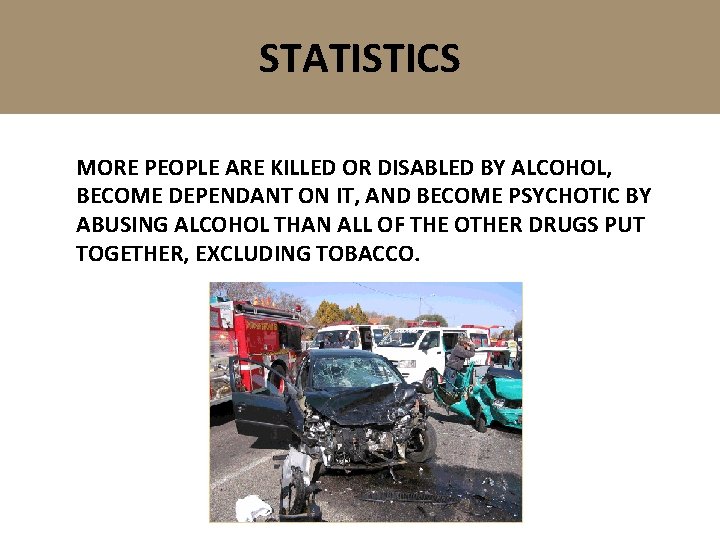
STATISTICS MORE PEOPLE ARE KILLED OR DISABLED BY ALCOHOL, BECOME DEPENDANT ON IT, AND BECOME PSYCHOTIC BY ABUSING ALCOHOL THAN ALL OF THE OTHER DRUGS PUT TOGETHER, EXCLUDING TOBACCO.
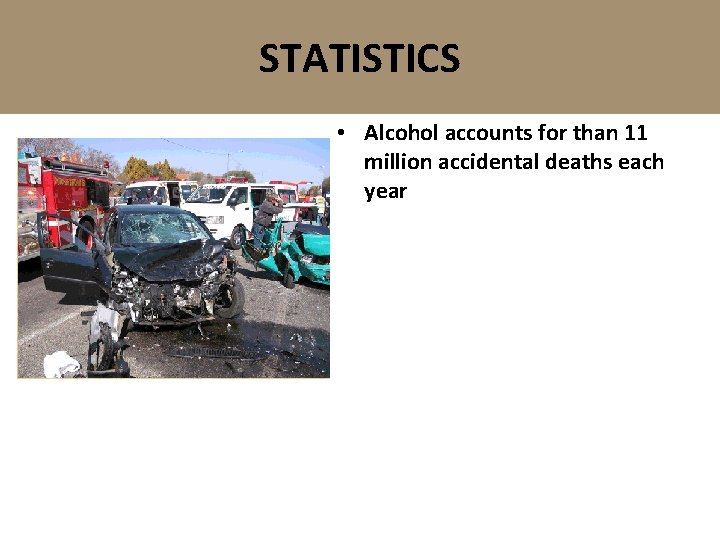
STATISTICS • Alcohol accounts for than 11 million accidental deaths each year
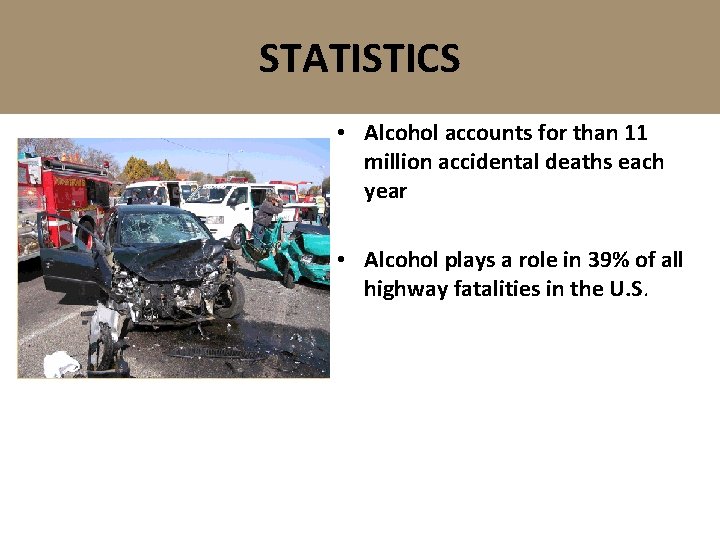
STATISTICS • Alcohol accounts for than 11 million accidental deaths each year • Alcohol plays a role in 39% of all highway fatalities in the U. S.
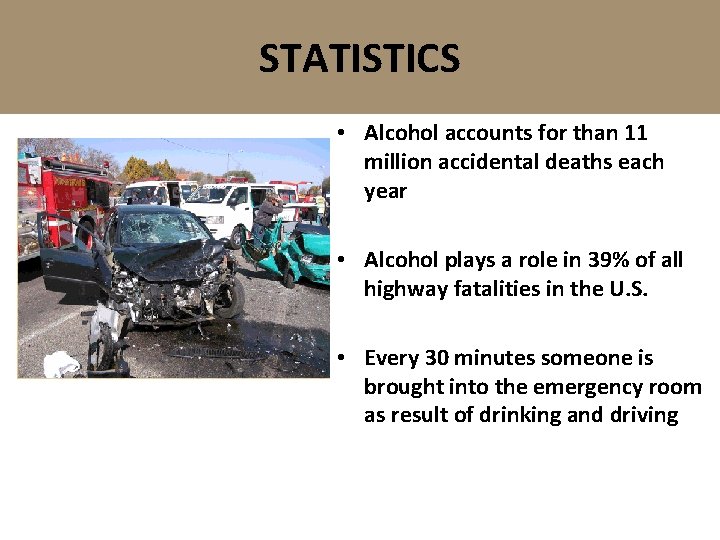
STATISTICS • Alcohol accounts for than 11 million accidental deaths each year • Alcohol plays a role in 39% of all highway fatalities in the U. S. • Every 30 minutes someone is brought into the emergency room as result of drinking and driving
STATISTICS • 50% of arrests made each year are due to alcohol use
STATISTICS • 50% of arrests made each year are due to alcohol use • 40% of Mental Hospital admissions are due to alcohol use
STATISTICS • 50% of arrests made each year are due to alcohol use • 40% of Mental Hospital admissions are due to alcohol use • Alcohol is the 3 rd leading cause of health problems behind only cancer and heart disease
STATISTICS • 50% of arrests made each year are due to alcohol use • 40% of Mental Hospital admissions are due to alcohol use • Alcohol is the 3 rd leading cause of health problems behind only cancer and heart disease ALCOHOLIC DEPRESSION IS THE #1 CAUSE OF SUICIDE IN THE U. S.
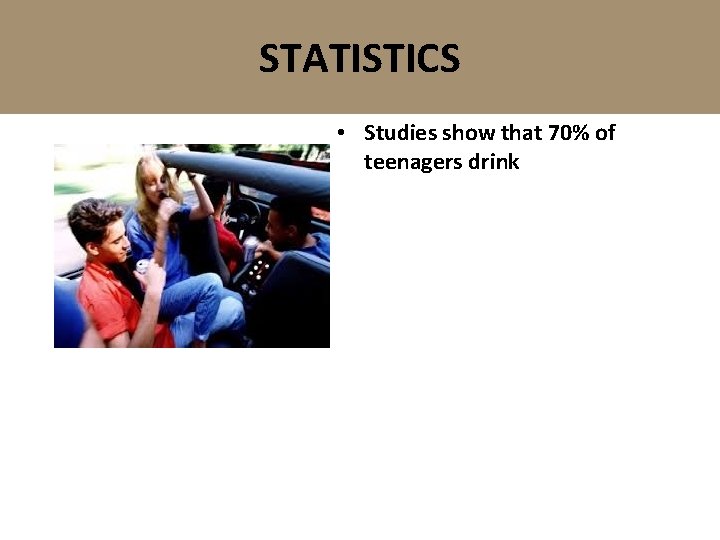
STATISTICS • Studies show that 70% of teenagers drink
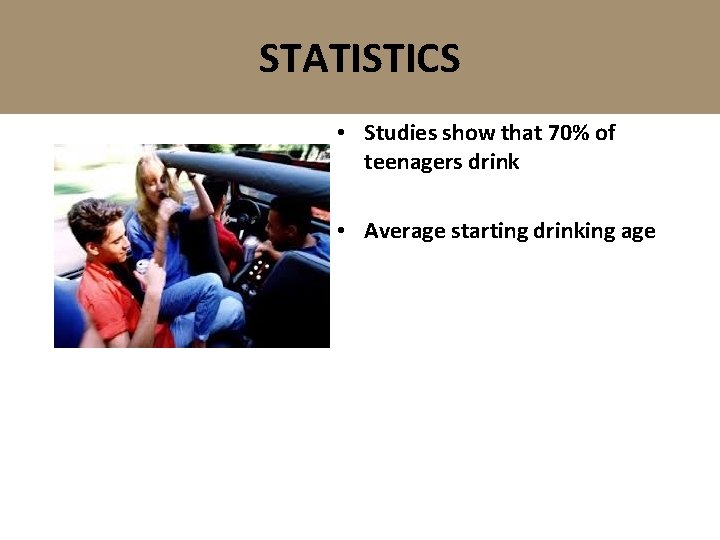
STATISTICS • Studies show that 70% of teenagers drink • Average starting drinking age


Drinking and the College Student
Drinking and the College Student • College students are more likely to engage in high-risk drinking than their peers who do not attend college (Monitoring the Future Study, The National Household Survey on Drug Abuse)
Drinking and the College Student • 25% of college students (approx 2 million) drove a car while under the influence of alcohol in previous 12 months (2002) • One in three reported getting in a car driven by someone who had been drinking (2002)
Drinking and the College Student • Over 1 million students (25%) report academic problems related to alcohol use
Drinking and the College Student • 700, 000 students assaulted as a result of alcohol (2005) • 500, 000 injured as a result of their drinking (2002) • 100, 000 are victims of sexual assault or rape in which alcohol is involved (2005)
Drinking and the College Student • Between 1992 -2002, 14, 000 students died as a result of their drinking; 1, 700 in 2005 • In the past 12 months (2002 data), 31% of college students met the diagnostic criteria for alcohol abuse and 6% met the criteria for alcohol dependence.
Drinking and the College Student • 400, 000 students had unprotected sex and over 100, 000 reported being too intoxicated to know if they consented to having sex (2002)
Drinking and the College Student • 11% of college students report that they have damaged property as a result of being under the influence of alcohol (2002)
Drinking and the College Student • Students who do not drink suffer the consequences as well – disrupted sleep and study, unwanted sexual advances, physical and sexual assault, property damage
Drinking and the Law
Drinking and the Law • Limit for drinking and driving in most states is. 08% blood alcohol content for adults • Limit for minors is. 02% in most states
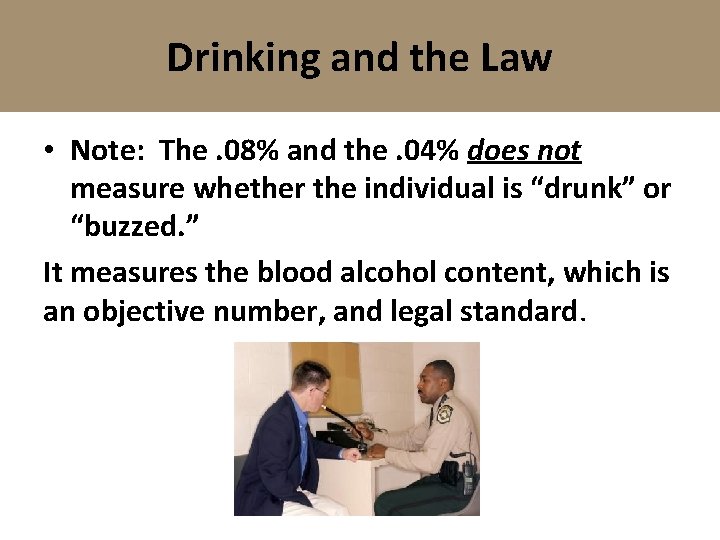
Drinking and the Law • Note: The. 08% and the. 04% does not measure whether the individual is “drunk” or “buzzed. ” It measures the blood alcohol content, which is an objective number, and legal standard.
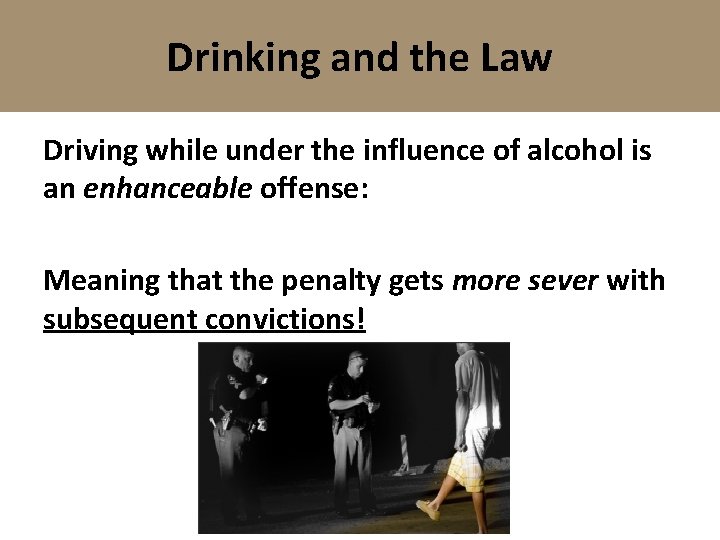
Drinking and the Law Driving while under the influence of alcohol is an enhanceable offense: Meaning that the penalty gets more sever with subsequent convictions!
Drinking and the Law DUI 1 ST OFFENSE In most states the a DUI First is a misdemeanor
Drinking and the Law DUI 1 ST OFFENSE Penalties include Temporary loss of driver’s license
Drinking and the Law DUI 1 ST OFFENSE Penalties include Temporary loss of driver’s license Fines
Drinking and the Law DUI 1 ST OFFENSE Penalties include Temporary loss of driver’s license Fines Mandatory drinking and driving classes
Drinking and the Law DUI 2 nd OFFENSE DUI Second Offense may be a misdemeanor or a felony
Drinking and the Law DUI 2 nd OFFENSE Penalties include Temporary Loss of Driver’s license
Drinking and the Law DUI 2 nd OFFENSE Penalties include Temporary Loss of Driver’s license May include jail time
Drinking and the Law DUI 2 nd OFFENSE Penalties include Temporary Loss of Driver’s license May include jail time Fines
Drinking and the Law DUI 3 RD OFFENSE DUI Third Offense is a Felony!!!
Drinking and the Law DUI 3 RD OFFENSE Penalties include Substantial Jail Time : 1 -5 years
Drinking and the Law DUI 3 RD OFFENSE Penalties include Substantial Jail Time : 1 -5 years Permanent loss of driver’s license
Drinking and the Law DUI 3 RD OFFENSE Penalties include Substantial Jail Time : 1 -5 years Permanent loss of driver’s license Fines and costs
Drinking and the Law Other consequences of DUI convictions • • Permanently appears on criminal record Permanently appears on driver’s record Increased cost, or loss, of insurance Financial costs of fines, fees, and attorney’s fees
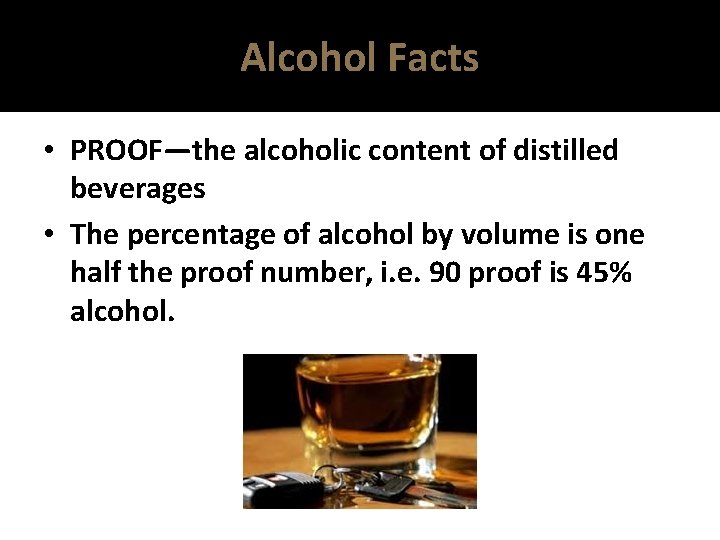
Alcohol Facts • PROOF—the alcoholic content of distilled beverages • The percentage of alcohol by volume is one half the proof number, i. e. 90 proof is 45% alcohol.
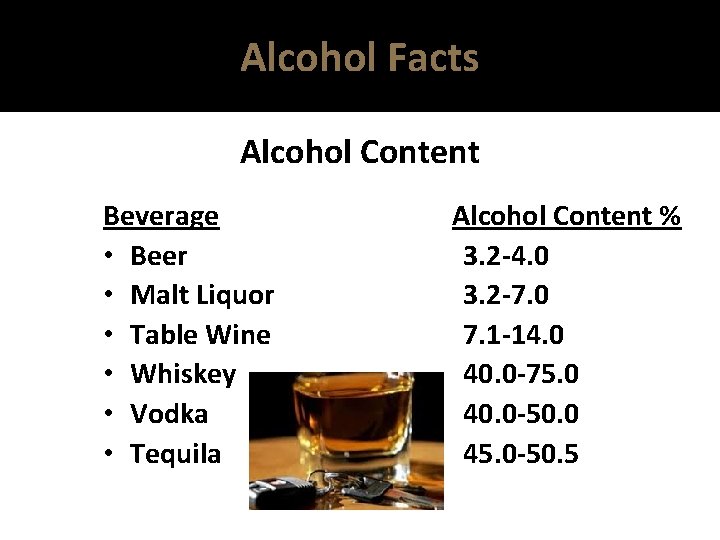
Alcohol Facts Alcohol Content Beverage • Beer • Malt Liquor • Table Wine • Whiskey • Vodka • Tequila Alcohol Content % 3. 2 -4. 0 3. 2 -7. 0 7. 1 -14. 0 40. 0 -75. 0 40. 0 -50. 0 45. 0 -50. 5
Alcohol Facts Alcohol is a central nervous system depressant and it is the central nervous system which is the bodily system that is most severely affected by alcohol
Alcohol Facts Absorption • Alcohol requires no digestion and can be absorbed unchanged from the stomach. • Food and water slow the rate of absorption.
Alcohol Facts Absorption • Women absorb alcohol at a rate of 30% faster than men. • Women also achieve greater alcohol concentration at a faster rate than men
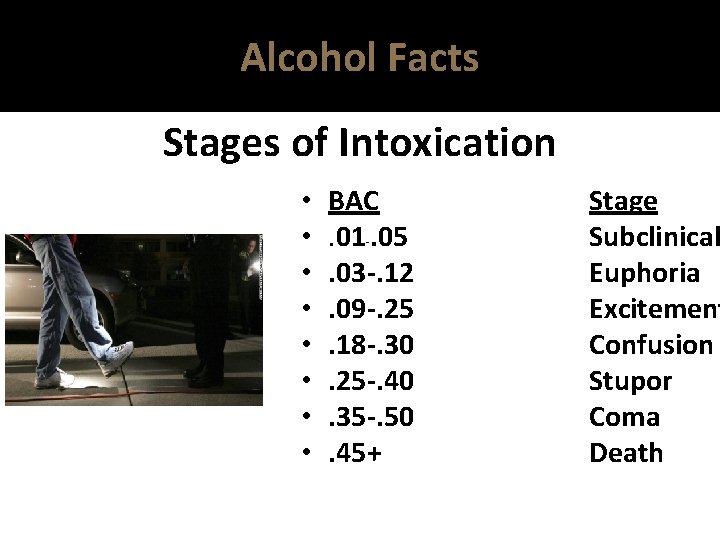
Alcohol Facts Stages of Intoxication • • BAC. 01 -. 05. 03 -. 12. 09 -. 25. 18 -. 30. 25 -. 40. 35 -. 50. 45+ Stage Subclinical Euphoria Excitement Confusion Stupor Coma Death
Alcohol Facts Subclinical Behavior nearly normal by ordinary observation
Alcohol Facts Euphoria ü Mild euphoria, sociability, talkativeness ü Increased self-confidence; decreased inhibitions ü Diminution of attention; judgment and control ü Beginning of sensory-motor impairment ü Loss of efficiency in finer performance tests
Alcohol Facts Excitement ü Emotional instability; loss of critical judgment ü Impairment of perception, memory and comprehension ü Decreased sensory response; increased reaction time ü Reduced visual acuity; peripheral vision and glare recovery ü Sensory-motor incoordination; impaired balance ü Drowsiness
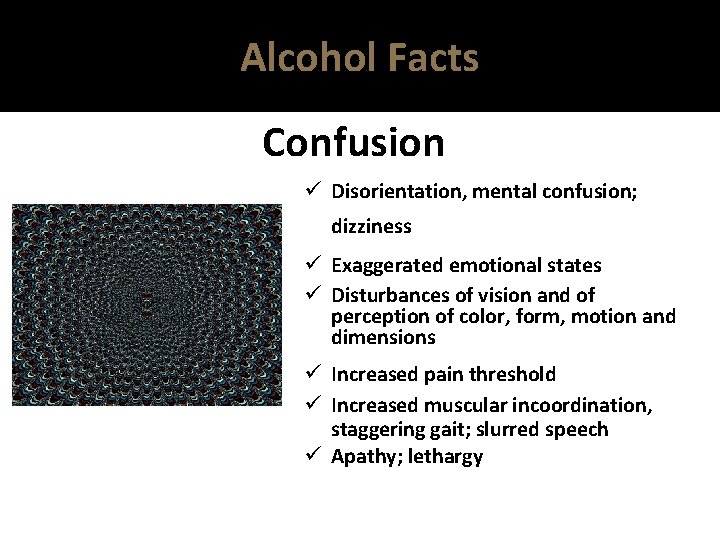
Alcohol Facts Confusion ü Disorientation, mental confusion; dizziness ü Exaggerated emotional states ü Disturbances of vision and of perception of color, form, motion and dimensions ü Increased pain threshold ü Increased muscular incoordination, staggering gait; slurred speech ü Apathy; lethargy
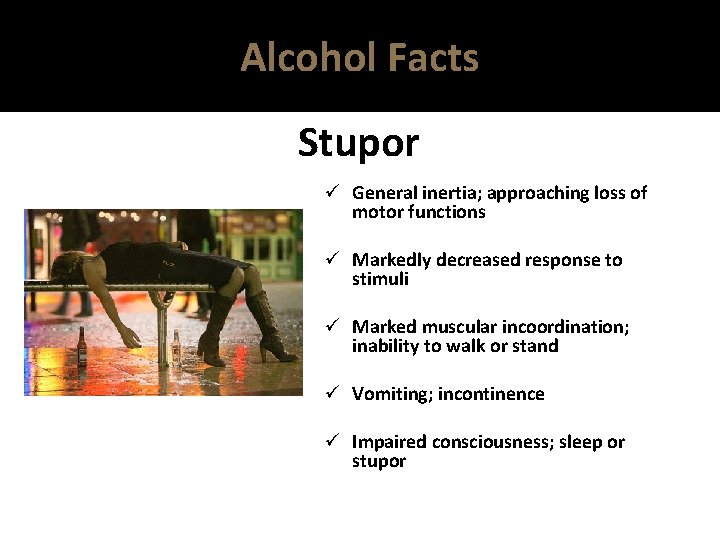
Alcohol Facts Stupor ü General inertia; approaching loss of motor functions ü Markedly decreased response to stimuli ü Marked muscular incoordination; inability to walk or stand ü Vomiting; incontinence ü Impaired consciousness; sleep or stupor
Alcohol Facts Coma ü Complete unconsciousness ü Depressed or abolished reflexes ü Subnormal body temperature ü Incontinence ü Impairment of circulation and respiration ü Possible death
Alcohol Facts Death from respiratory arrest
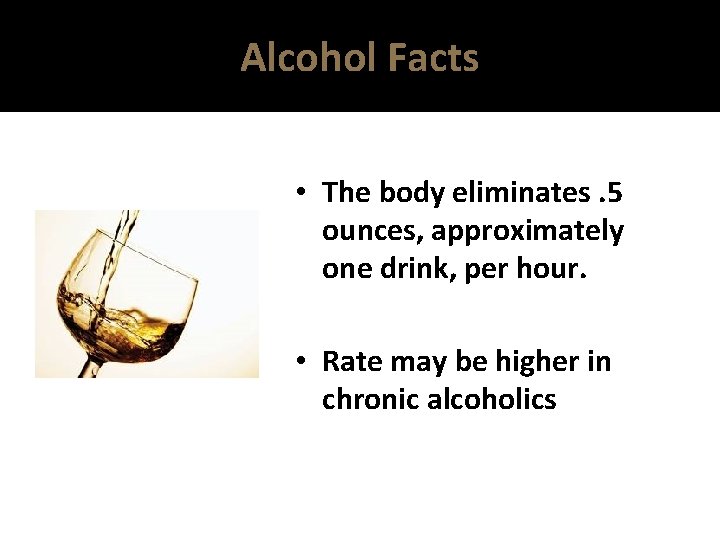
Alcohol Facts • The body eliminates. 5 ounces, approximately one drink, per hour. • Rate may be higher in chronic alcoholics
Alcohol Facts
Alcohol Facts THE HANGOVER
Alcohol Facts Hangovers The experience of various unpleasant physiological and psychological effects following consumption of alcoholic beverages
Alcohol Facts Hangovers Symptoms: Headache Feeling Sick or Depressed Grouchiness Diarrhea
Alcohol Facts Hangovers Ø Headaches are caused by dehydration
Alcohol Facts Hangovers Ø Headaches are caused by dehydration Ø Sick feeling caused by additives, or congeners, which give drinks their color, flavor, and smell
Alcohol Facts Hangovers Ø Headaches are caused by dehydration Ø Sick feeling caused by additives, or congeners, which give drinks their color, flavor, and smell Ø Queasiness and nausea Causes caused by acids accumulating in stomach
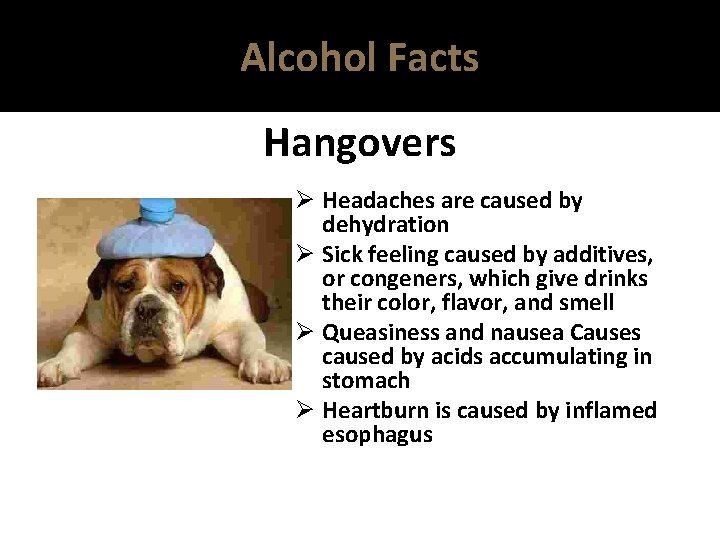
Alcohol Facts Hangovers Ø Headaches are caused by dehydration Ø Sick feeling caused by additives, or congeners, which give drinks their color, flavor, and smell Ø Queasiness and nausea Causes caused by acids accumulating in stomach Ø Heartburn is caused by inflamed esophagus
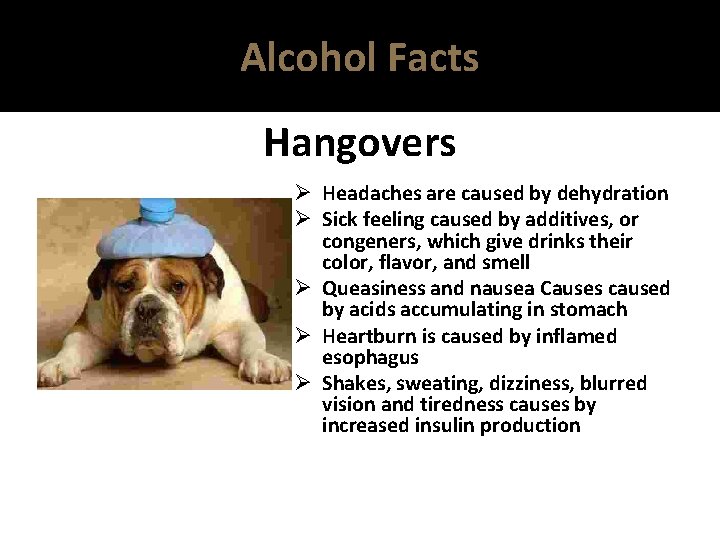
Alcohol Facts Hangovers Ø Headaches are caused by dehydration Ø Sick feeling caused by additives, or congeners, which give drinks their color, flavor, and smell Ø Queasiness and nausea Causes caused by acids accumulating in stomach Ø Heartburn is caused by inflamed esophagus Ø Shakes, sweating, dizziness, blurred vision and tiredness causes by increased insulin production
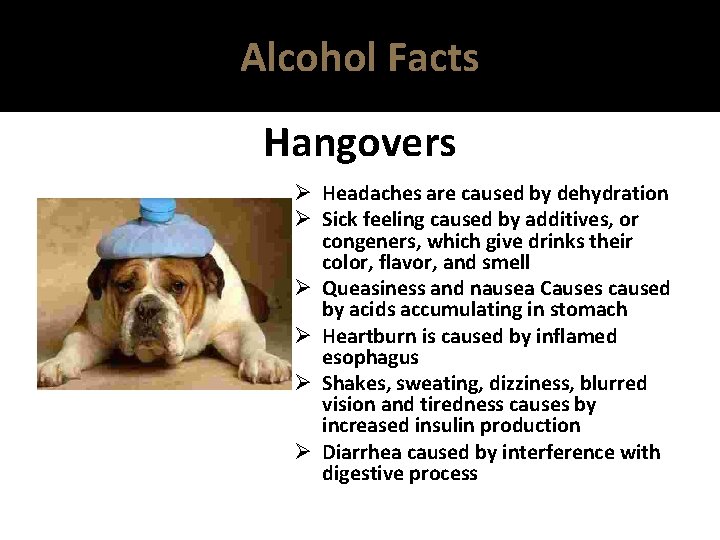
Alcohol Facts Hangovers Ø Headaches are caused by dehydration Ø Sick feeling caused by additives, or congeners, which give drinks their color, flavor, and smell Ø Queasiness and nausea Causes caused by acids accumulating in stomach Ø Heartburn is caused by inflamed esophagus Ø Shakes, sweating, dizziness, blurred vision and tiredness causes by increased insulin production Ø Diarrhea caused by interference with digestive process
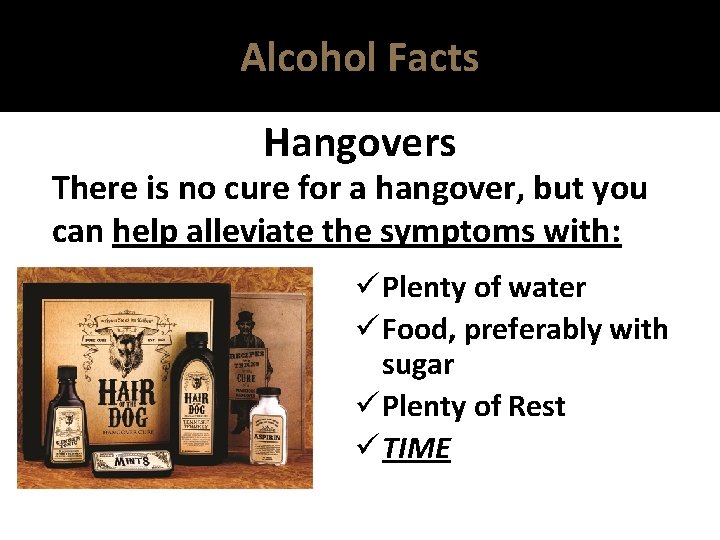
Alcohol Facts Hangovers There is no cure for a hangover, but you can help alleviate the symptoms with: ü Plenty of water ü Food, preferably with sugar ü Plenty of Rest ü TIME
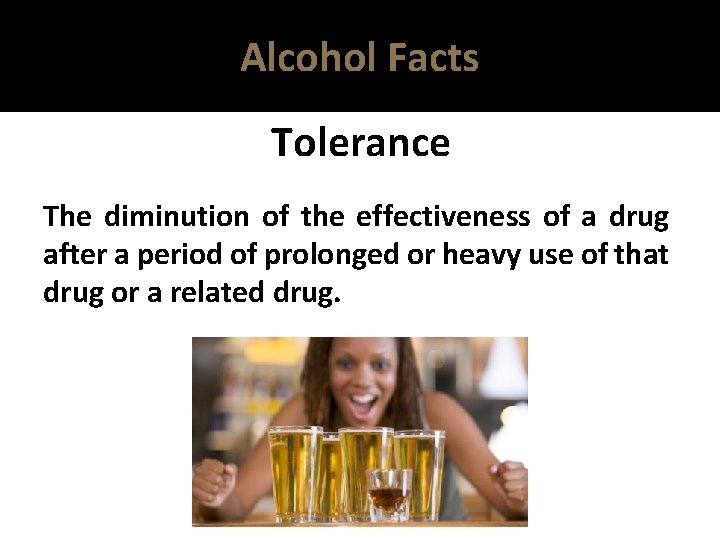
Alcohol Facts Tolerance The diminution of the effectiveness of a drug after a period of prolonged or heavy use of that drug or a related drug.
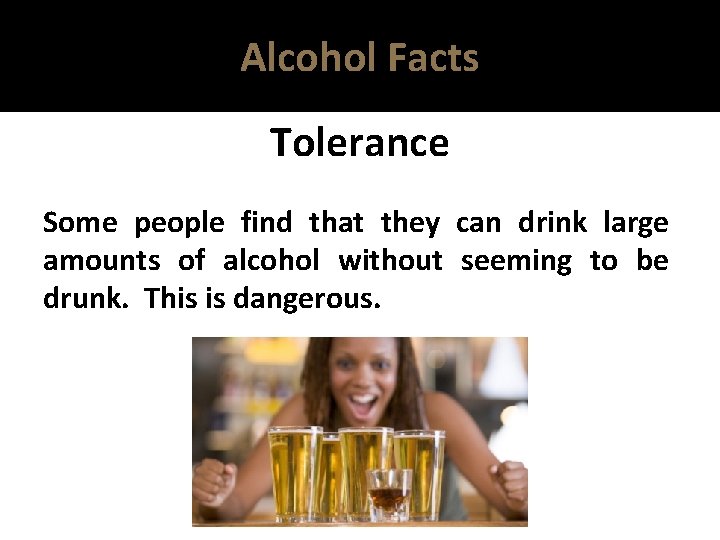
Alcohol Facts Tolerance Some people find that they can drink large amounts of alcohol without seeming to be drunk. This is dangerous.
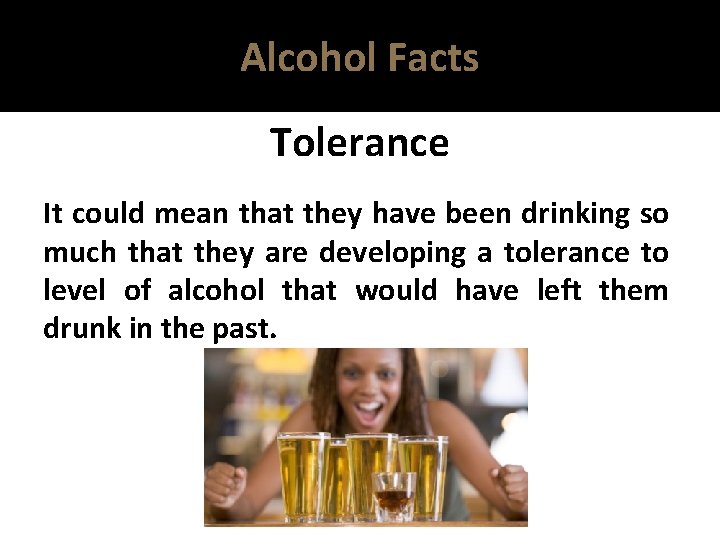
Alcohol Facts Tolerance It could mean that they have been drinking so much that they are developing a tolerance to level of alcohol that would have left them drunk in the past.
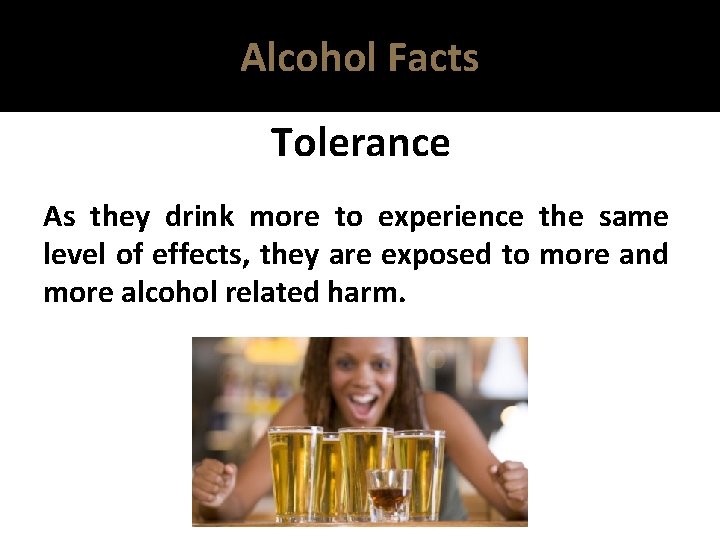
Alcohol Facts Tolerance As they drink more to experience the same level of effects, they are exposed to more and more alcohol related harm.
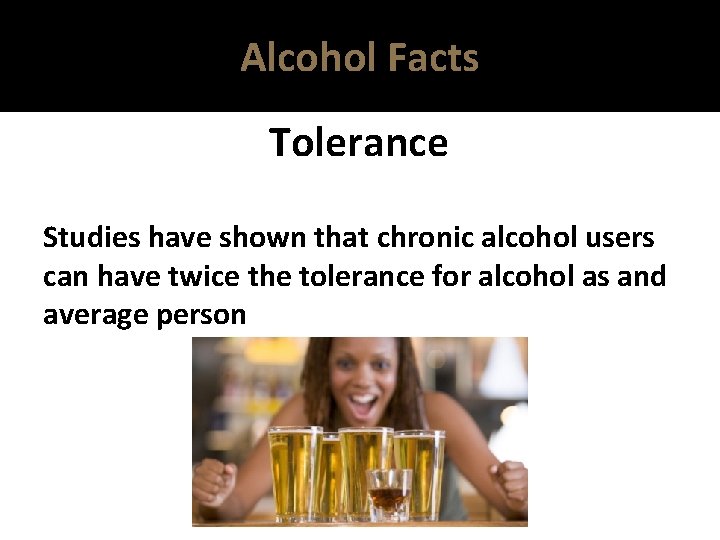
Alcohol Facts Tolerance Studies have shown that chronic alcohol users can have twice the tolerance for alcohol as and average person
Alcohol Facts Tolerance v. Impairment It has been shown conclusively that even in heavy alcohol users functional impairment is clearly measurable at the blood alcohol concentration levels that are currently used for traffic law enforcement and safety sensitive job performance
Alcohol Facts Tolerance v. Impairment Just because you feel ok doesn’t mean that you are!!!
Alcohol Facts Tolerance Metabolic Tolerance
Alcohol Facts Tolerance Metabolic Tolerance Alcohol is metabolized at higher rate in (up to 72% more quickly) in chronic users. Because of higher metabolic rate for alcohol lower peak blood alcohol concentrations are achieved by chronic alcohol users than the average drinker when the same amount of alcohol is ingested
Alcohol Facts Tolerance Functional Tolerance
Alcohol Facts Tolerance Functional Tolerance There is an actual change in the organ or system’s sensitivity to the drug.

College and Alcoholism
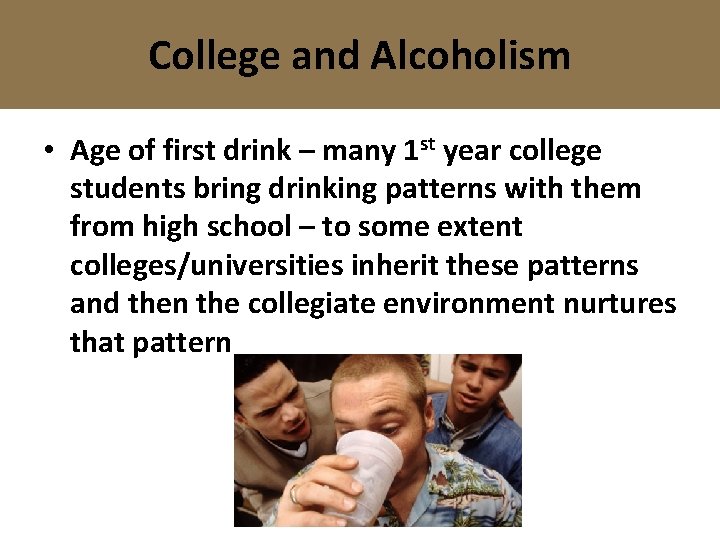
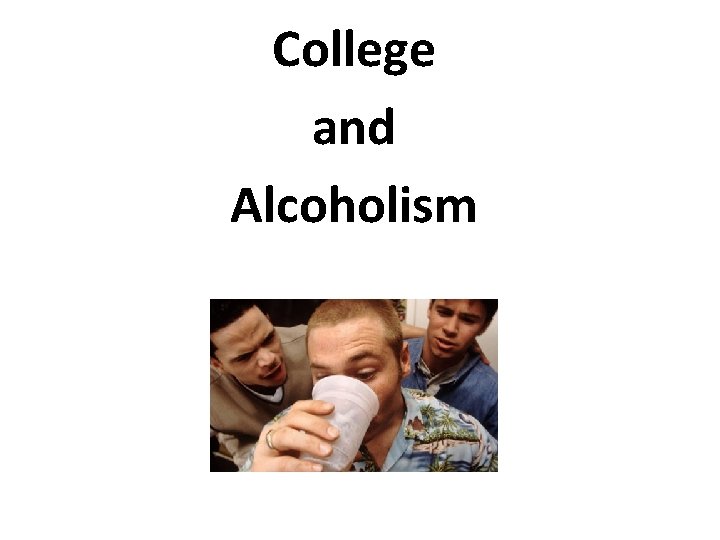
College and Alcoholism • Age of first drink – many 1 st year college students bring drinking patterns with them from high school – to some extent colleges/universities inherit these patterns and then the collegiate environment nurtures that pattern
College and Alcoholism • • • Family history of alcoholism Use of tobacco and/or marijuana in high school Untreated depression or anxiety Severe academic stress History of impulsive or deviant behaviors
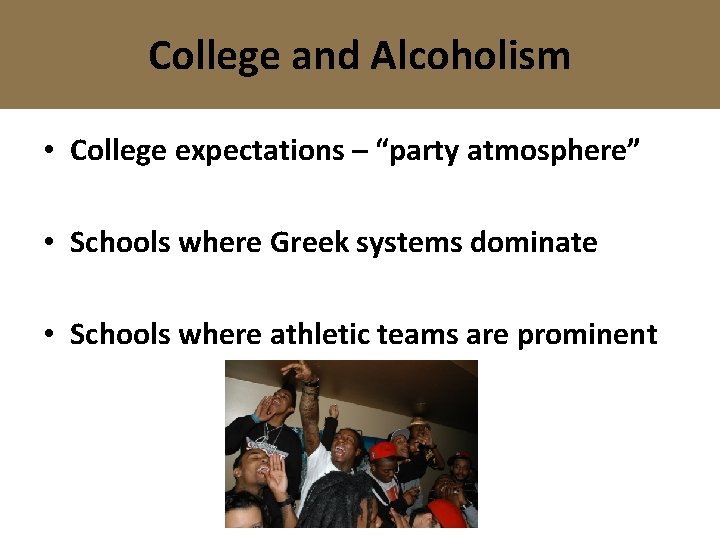
College and Alcoholism • College expectations – “party atmosphere” • Schools where Greek systems dominate • Schools where athletic teams are prominent
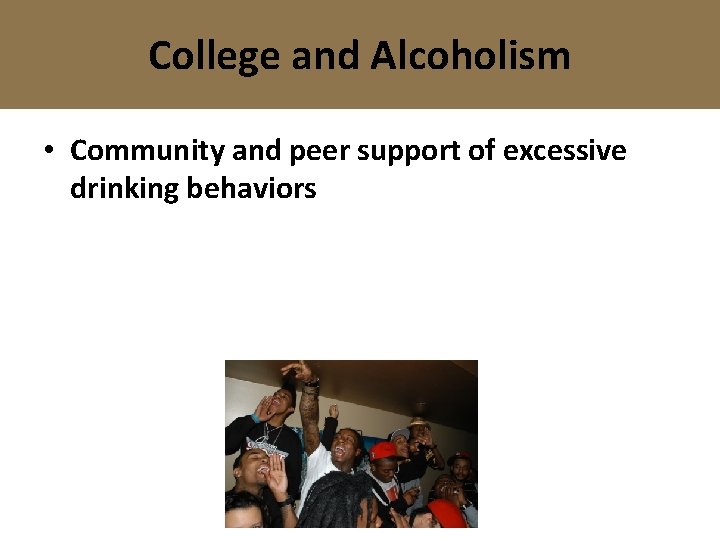
College and Alcoholism • Community and peer support of excessive drinking behaviors
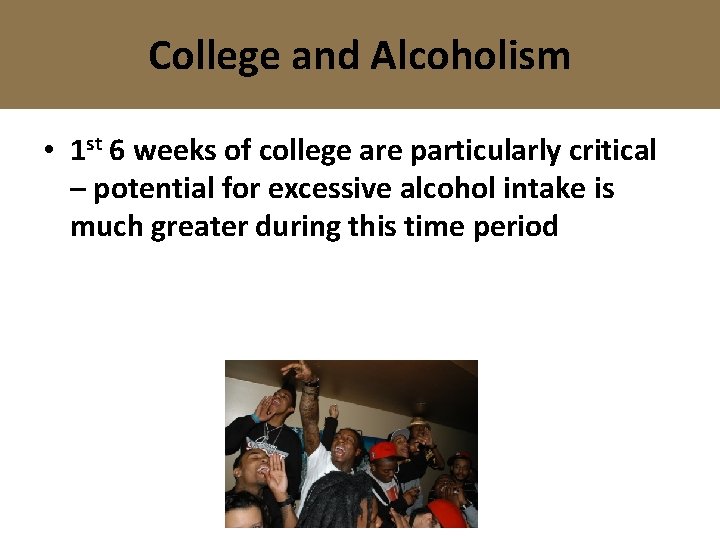
College and Alcoholism • 1 st 6 weeks of college are particularly critical – potential for excessive alcohol intake is much greater during this time period
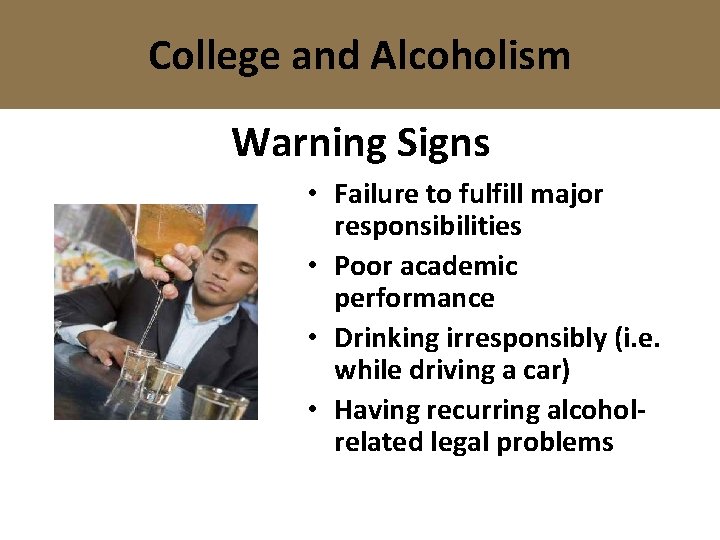
College and Alcoholism Warning Signs • Failure to fulfill major responsibilities • Poor academic performance • Drinking irresponsibly (i. e. while driving a car) • Having recurring alcoholrelated legal problems
College and Alcoholism Warning Signs • Continued drinking behaviors despite relationship problems that are caused or worsened by drinking • Mood changes such as irritability, defensiveness, temper flare-ups • Physical or mental problems (i. e. memory loss, poor concentration, bloodshot eyes, lack of coordination, slurred speech)
College and Alcoholism Do You Have a Problem? • Do you drink alone when you feel angry or sad? • Does your drinking ever make you late for work? • Does your drinking anger your family?
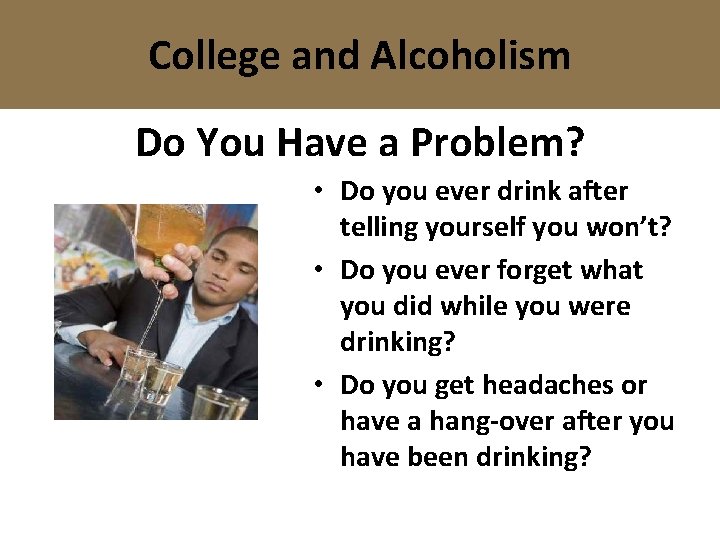
College and Alcoholism Do You Have a Problem? • Do you ever drink after telling yourself you won’t? • Do you ever forget what you did while you were drinking? • Do you get headaches or have a hang-over after you have been drinking?
College and Alcoholism Do You Have a Problem? • If you answered “yes” to any of these questions, you may have a drinking problem. Your doctor will be able to tell you whether you should cut down or abstain.
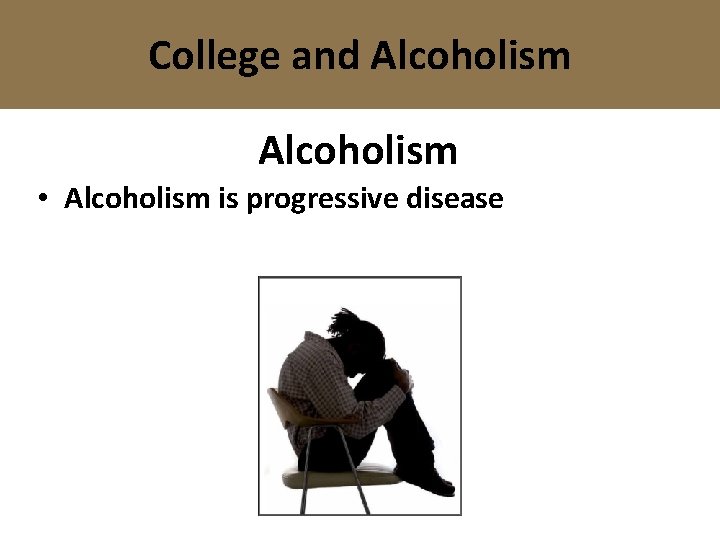
College and Alcoholism • Alcoholism is progressive disease
College and Alcoholism • Alcoholism is progressive disease • IT CANNOT BE CURED • But it can be treated
College and Alcoholism • Every problem drinker adversely affects an average of 4 other persons in his family and more than 16 friends and business associates in the community. Therefore at the very least, 130 million Americans are affected by alcoholism. • This does not include the alcoholic himself
College and Alcoholism • Problem drinkers increase at a rate of 200, 000 per year • There an estimated 9 million Americans who are chronic alcoholics • Alcoholism is among first three of health problems and is the number on killer
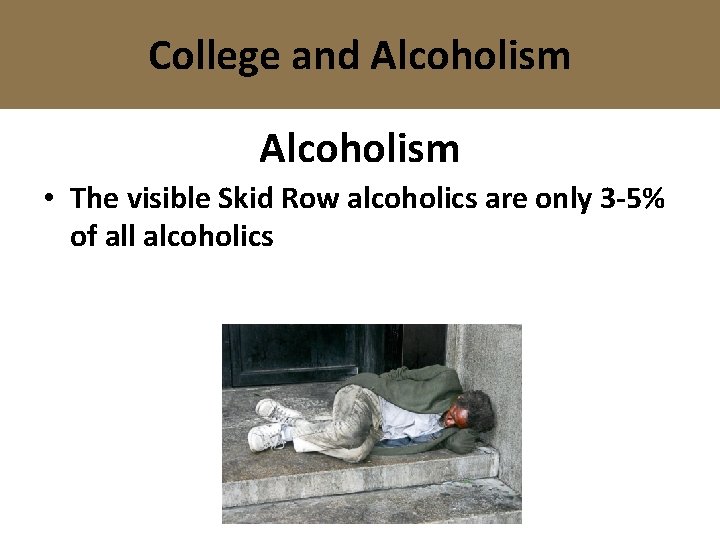
College and Alcoholism • The visible Skid Row alcoholics are only 3 -5% of all alcoholics
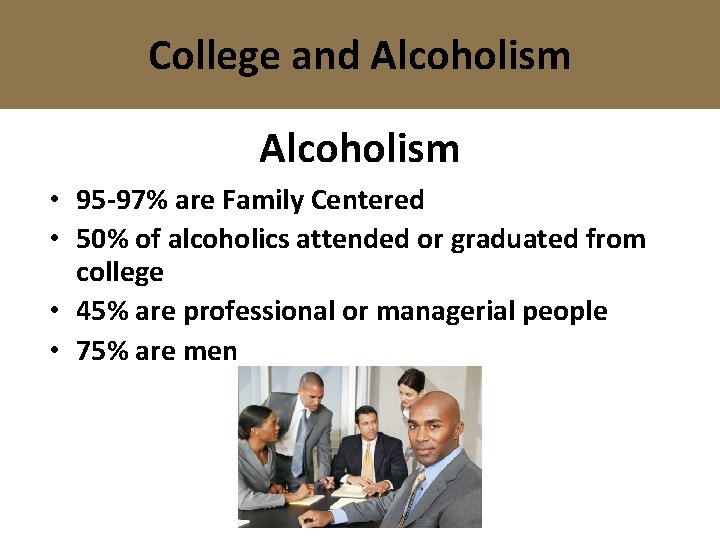
College and Alcoholism • 95 -97% are Family Centered • 50% of alcoholics attended or graduated from college • 45% are professional or managerial people • 75% are men
College and Alcoholism • One in three suicides is an alcoholic • 50% of person on welfare directly or indirectly related to alcoholism • 40% of all admissions to mental hospitals are alcohol related
College and Alcoholism • • An alcoholic employee is Only 50% as efficient Absent four times as the normal worker Submits four times the medical claims
College and Alcoholism • Alcoholism is responsible for an economic loss of approximately $20 million dollars a day
Progression and Recovery of the Alcoholic
Progression and Recovery of the Alcoholic • Adaptive Stage • Dependant Stage • Deteriorative Stage • Re-Education • Recovery
Progression and Recovery of the Alcoholic Adaptive Stage • • Drinks to feel better Drinks to relax Drinks for any reason Frequency and Amount Increases Preoccupation with the next drink Gets drunk more frequently Daily Drinking Mild Shakes which cure themselves
Progression and Recovery of the Alcoholic Dependant Stage • Drinks at inappropriate times and places • Loss of other interests • Shakes increase • Blames Drinking on problems • Efforts to quit fail • Memory Lapses
Progression and Recovery of the Alcoholic Deteriorative Stage • Severe physical penalty if Drinking is stopped • Loss of appetite Digestive Problems • Yellow of Eyes or skin • Blood in urine or stool • Bruises easily • Brain Damage • Liver Damage • Reproductive System disfunctions/damage
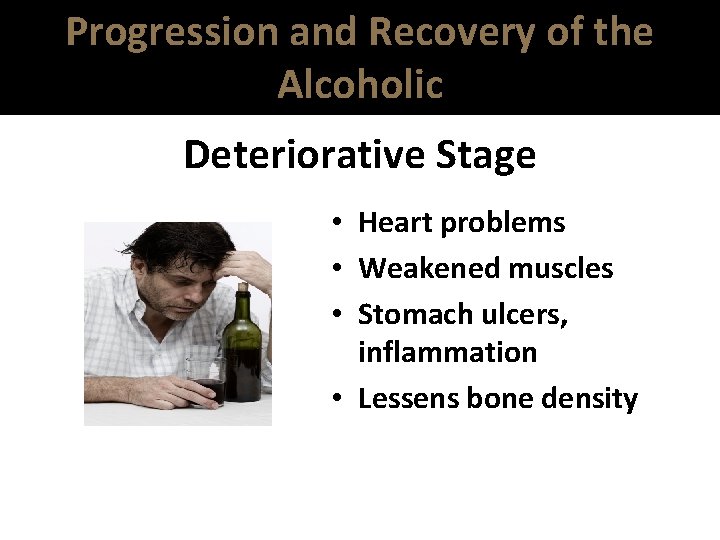
Progression and Recovery of the Alcoholic Deteriorative Stage • Heart problems • Weakened muscles • Stomach ulcers, inflammation • Lessens bone density
Progression and Recovery of the Alcoholic Re-Education Stage • • Detoxification Medical Conditions are treated Feels guilty, angry, depressed Denial Learns that alcoholism is a disease Admits the disease Learns treatment Begins to take personal responsibility
Progression and Recovery of the Alcoholic Recovery • Anger, Depression, Guilt subsides • Becomes working in groups • Willing to go to great lengths for sobriety • Accepts oneself as non-drinking alcoholic • Not Drinking becomes unconditional • Willing to help others • Maintains recovery
Progression and Recovery of the Alcoholic Help is Available • Alcoholics Anonymous • Campus Drug and Alcohol Counselors • Peer Counseling Groups • Community outreach – Mothers Against Drunk Driving – Churches and religious affiliations
Progression and Recovery of the Alcoholic • Know the Risks • Know the Signs • If you must drink, please be responsible
DON’T DRINK AND DRIVE
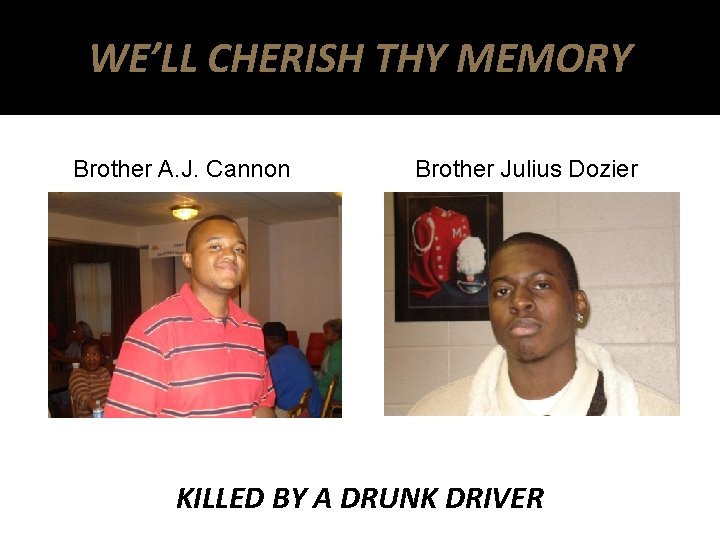
WE’LL CHERISH THY MEMORY Brother A. J. Cannon Brother Julius Dozier KILLED BY A DRUNK DRIVER
Information provided by: Bro. Kevin T. Wilbert, MSL Director of Operations, Department of Pharmacology/Toxicology University of Mississippi Medical Center John Owen, Director/ Counselor Recovery Consultations NIAAA Presentations sponsored by the Alpha Phi Alpha Fraternity, Inc.
- Slides: 111