
Candidate for Standardization Pilot Program Status Report September
Candidate for Standardization Pilot Program - Status Report September 27, 2011 Michael Burshtin, Standardization Coordinator Dale Engelhardt, Vice Chair Technical Subcommittee
Basic Standardization Approach • Development of Standards embraced same process used to develop vehicle specifications • Use of Technical Subgroups to disposition suggested Standardization Candidates, and to develop wording for resulting Standards • These Technical Subgroups are our Subject Matter Experts, and intimately know the vehicle specification details
Standardization Process Flow • Candidate for Standardization Form submitted • Assigned to appropriate Technical Subgroup • Subgroup does initial assessment (Proceed? Y/N); if approved develops appropriate wording for draft Standard, economic check • Draft Standard reviewed by Standardization Working Group, and Executive Board • Standard then issued, using the Document Management System
Pilot Program Used to Test Standardization Process • Pilot Program – Established in May – Seven standardization candidates identified; at least one for each Technical Subgroup to process – Train set specification delayed work – First standards should be processed this month
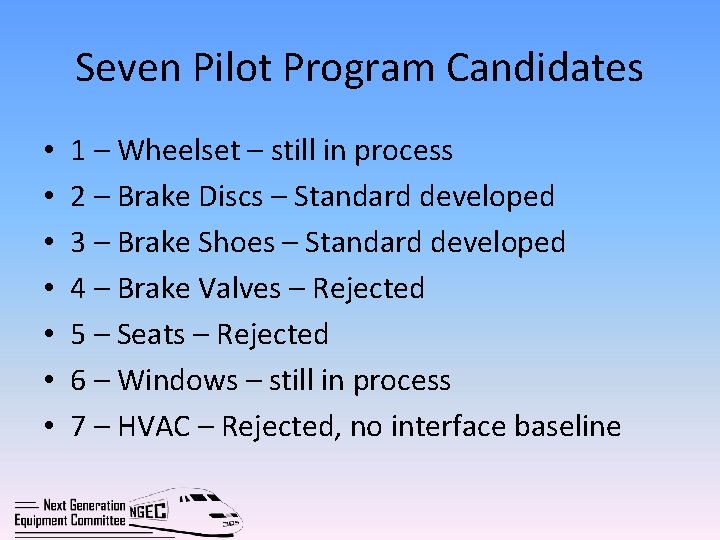
Seven Pilot Program Candidates • • 1 – Wheelset – still in process 2 – Brake Discs – Standard developed 3 – Brake Shoes – Standard developed 4 – Brake Valves – Rejected 5 – Seats – Rejected 6 – Windows – still in process 7 – HVAC – Rejected, no interface baseline

Issues Found During Pilot Process • Process took much longer than expected • Major issues – lack of Subgroup member interest in participation; no current baseline vehicle yet designed to use as basis for subsystem interface Standards • Minor issues – improvements in process steps; some Candidates were too broad and Subgroups couldn’t come to full agreement on all items of a Candidate
Greatest Challenge • Most significant issue encountered by all Subgroups was an extreme lack of interest and participation by their members to work on the concepts of Standardization • Only one quarter to one-third of Subgroup committee membership have been participating in Standardization work
No Urgency • Of those members who did participate, a great lack of urgency to respond to Standardization work tasks was also encountered • This is in general contrast to much higher member responsiveness found when drafting a vehicle specification (except for Trainset, which had limited interest)
Delays Resulted • Lack of participation, combined with slow response to task assignments, have resulted in lengthy delays in developing the Pilot Standards
Must Determine Reason for Low Member Support • We need to determine why this is so • Perhaps the next step might be to determine how to assemble a similar team for standardization, if it is not happening within the Technical Subgroups • Consultant support may be needed, but this may result in backlash from volunteer members and further reduce their active involvement
Lack of Current PRIIA Vehicle Hinders Interface Standards • Where a Subsystem interface mounting standard was proposed, the Subgroups found it difficult to proceed further without having a starting point with a candidate PRIIA car already designed, as a starting point • When considered worthwhile to proceed, they found it necessary to defer further work until the design efforts have started upon the first PRIIA standard railcar order
Process Improvements Are Needed • Research work that takes place at the start of the standardization process was found much more complex than expected • Determining if work on a proposed Standard should be pursued takes some time • If approved, then must establish the process to be used to create a Standard (use an existing one, purchase one, write one, etc. )
Recommend Workflow Improvements • Divide into additional initial steps • Evaluate the merits of the candidate • Identify/recommend sources of a standard or inputs to a standard • Conduct a limited life cycle cost analysis • Then develop or acquire the standard itself
Economic Analysis Not Understood • Technical Subgroups not clear as to what is the process for a Candidate economic analysis • Financial Advisor assigned also not clear as to what should be done as a formal process • Have found that AAR does little/no formal economic analysis of freight car Standards • Formal economic analysis was not practiced in Technical Subgroup preparation of vehicle specifications, process not well understood
Summary - Recommend Changes • Decide if Technical Subgroups should continue to be used for Standards development • If not, need to determine their replacement • Need to determine why is there so little Technical subgroup member interest in Standardization • Make needed improvements in workflow • Defer formal economic analysis until this process is better defined and understood
- Slides: 15