
Candida infection Tricpmonas vaginalis Bacterial vaginosis Type of
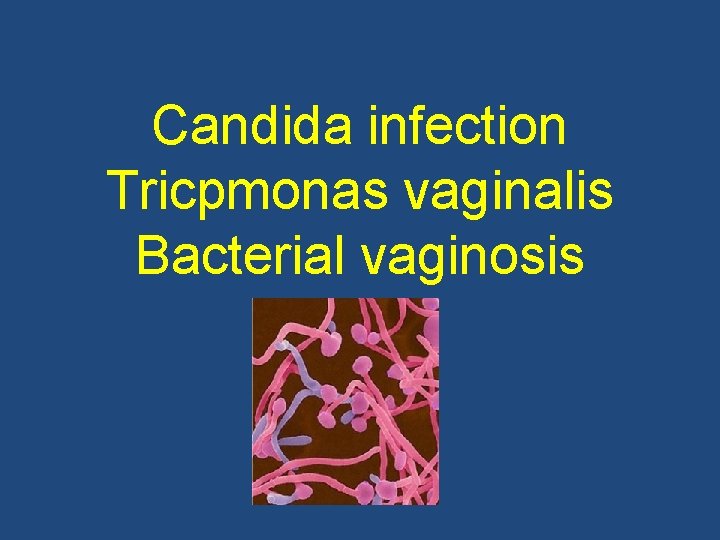
Candida infection Tricpmonas vaginalis Bacterial vaginosis

Type of infection • Females – – – Cervicitis Vulvovaginitis Urethritis Bacterial vaginosis (BV) Salpingitis (pelvic inflammatory disease [PID]) – Endometritis – Genital ulcers • Pregnant females – Disease in the neonate. • Children and postmenopausal women • Males – – Urethritis Epididymitis Prostatitis Genital ulcers
Abnormal vaginal secretion • Normal physiological vaginal secretion • Vaginal infection • Trichimoniasis • Vulvovaginitis candiasis • Bacterial vaginnosis • Desquamative inflammatory vaginitis • Cervicitis • Infectious • Noninfectious • Esterogen deficiency
History & symptoms of valvovaginitis • General gyneclogical history( age Neonatal , pregnancy, prepubescent, atr ophic post menop) • Onset, , Esterogen depletion) – – – Menstrual history Pregnancy Sexual Hx Contraception Sexual relationship Prior infection • General medical Hx – – Allergies DM Malignancies Immunodeficiecy • Medication OCP<steroids, duches • Symptoms – Discharge(quality scanty)physiological OCP – Oder(BV, FB, EV fistula) – Valvular disconfort(HSV) – Dyspareunia – Abdominal pain (tricho) PID
Examination • • • Breast Adequate illumination Magnification if possible Give a patient mirror Inspect external genetalia – Lesions – Erythema • Vaginal mucosa – Erythema – Lesion – Secretion • Examination of cervix – – Ectropion Lesions Erythema Endocervical secretion • Collect cervical and vaginal specimen • Bimanual examination
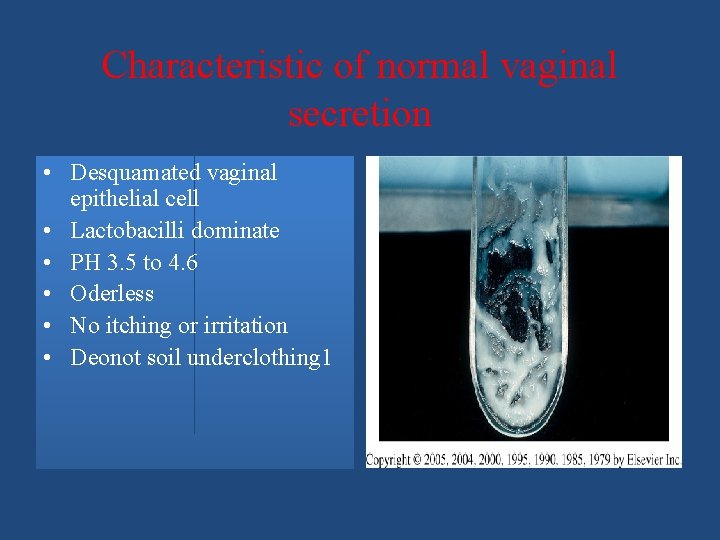
Characteristic of normal vaginal secretion • Desquamated vaginal epithelial cell • Lactobacilli dominate • PH 3. 5 to 4. 6 • Oderless • No itching or irritation • Deonot soil underclothing 1
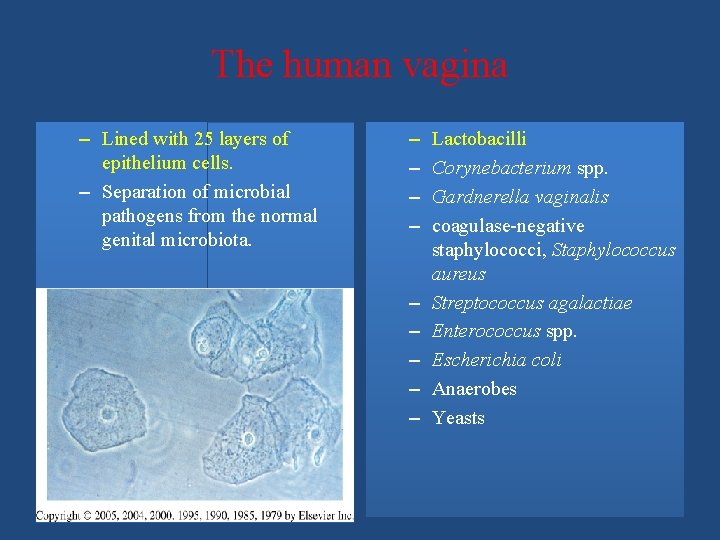
The human vagina – Lined with 25 layers of epithelium cells. – Separation of microbial pathogens from the normal genital microbiota. – – – – – Lactobacilli Corynebacterium spp. Gardnerella vaginalis coagulase-negative staphylococci, Staphylococcus aureus Streptococcus agalactiae Enterococcus spp. Escherichia coli Anaerobes Yeasts

Vaginal PH examination

Cassification of vulvovaginitis • • Uncomplicated – Sporadic – No underlying disease – By Candida albican – Not pregnanat – Mild to moderate severity • Any available topical agent • Fluconazole 150 mg as a single oral dose • • • Complicated – Underlying illness • HIV • DM – Recurrent infection 4 or more per year – Non albican candida – Pregnancy – Sever infection Culture confirmation mandatory Antifungal suscep. Testing Treat for 10 -14 days with vaginal or oral agent Other topical – Boric acid – 5 fluorocytocine Consider treatment of the partners Long term suppressive treatment for frequently recurrent diseases
Candida infections yeast infection moniliasis • Candidiasis or thrush is a fungal infection (mycosis) of any of the Candida species (yeasts) of which Candida albicans is the most common. • Common superficial infections of skin and mucosal membranes by Candida causing local inflammation and discomfort.
Candidal vulvovaginitis vaginal thrush • Infection of the vagina’s mucous membranes by Candida albicans. • 75% of adult women • Found naturally in the vagina • Hormonal changes • Change in vaginal acidity. • Broad-spectrum antibiotics. • Use of corticosteroid medications • Pregnancy. • 20 -30 years • Poorly controlled diabetes mellitus.
Risk factors – Antibiotics – Pregnancy – Diabetes (poorly controlled) – Immunodeficiency – Contraceptives – Sexual behaviour – Tight-fitting clothing – Female hygiene
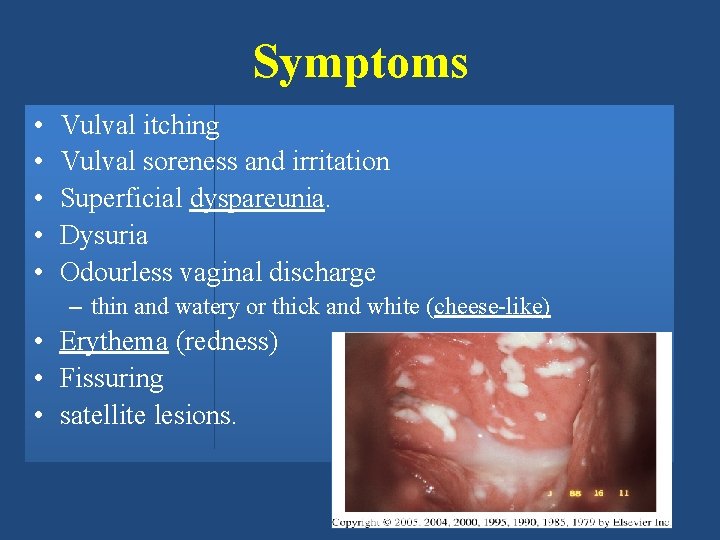
Symptoms • • • Vulval itching Vulval soreness and irritation Superficial dyspareunia. Dysuria Odourless vaginal discharge – thin and watery or thick and white (cheese-like) • Erythema (redness) • Fissuring • satellite lesions.
Types of candidal vulvovaginitis • Uncomplicated thrush – single episode/less than four episodes in a year. – mild or moderate symptoms – caused by the Candida albicans. • Complicated thrush – – – four or more episodes in a year. severe symptoms. Pregnancy poorly controlled diabetes/immune deficiency. not caused by the Candida albicans
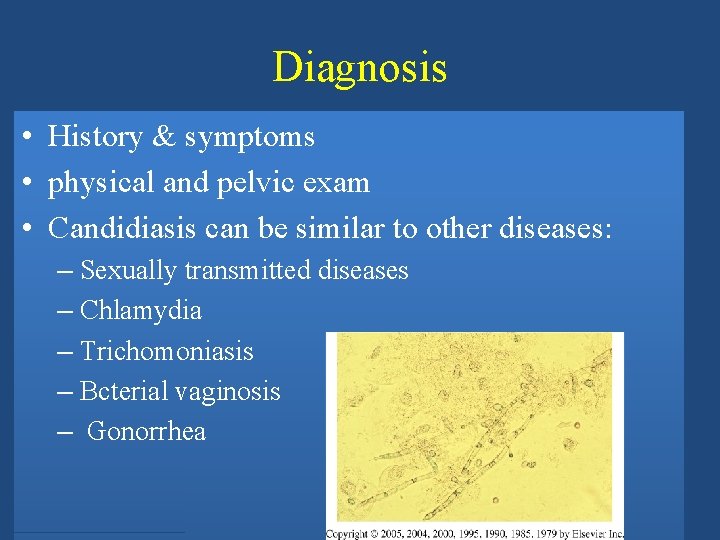
Diagnosis • History & symptoms • physical and pelvic exam • Candidiasis can be similar to other diseases: – Sexually transmitted diseases – Chlamydia – Trichomoniasis – Bcterial vaginosis – Gonorrhea
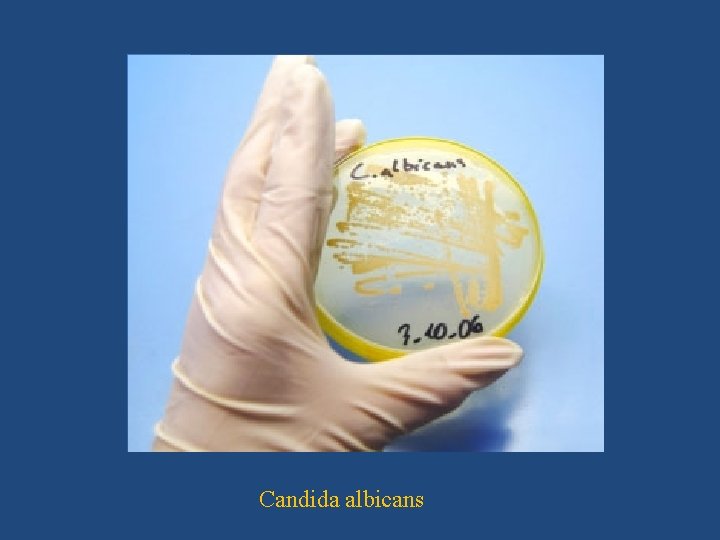
Candida albicans
Treatment • Butoconazole cream • Clotrimazole – 1% cream – vaginal tablet • Miconazole – 2% cream – vagina suppository • Nystatin – vaginal tablet • Oral Agent: – Fluconazole- oral one tablet in single dose
Treatment • Short-course topical formulations – – single dose and regimens of 1– 3 days effectively treat uncomplicated candidal vulvovaginitis Topical azole drugs are more effective than nystatin Azole drugs relief of symptoms in 80%– 90% of cases. • Treatment failure – In up to 20% of cases – If the symptoms do not clear within 7– 14 days

Trichomoniasis (sexually-transmitted infection) • Symptoms – Purulent vaginal discharge – yellow or greenish in color – Vulvar irritation (strawberry) – Dysurea – Dyspareunia – Abnormal vaginal odor The wet mount's fast results
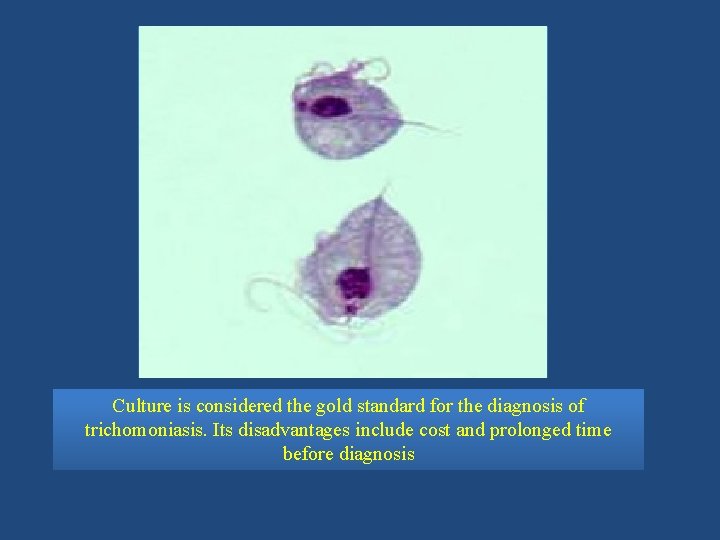
Culture is considered the gold standard for the diagnosis of trichomoniasis. Its disadvantages include cost and prolonged time before diagnosis
Management • Confirm the diagnosis – Wet preparation (miss 30%) – Culture – Gram Stain • Confirm all current sexual partners treated • Oral metronidazole • 500 mg bid for 7 days • 2 g daily for 3 -5 days • If Rx failure -Consultation with experts – Susceptibility testing – Higher dose of metronidazole – Alternative Tinidazole
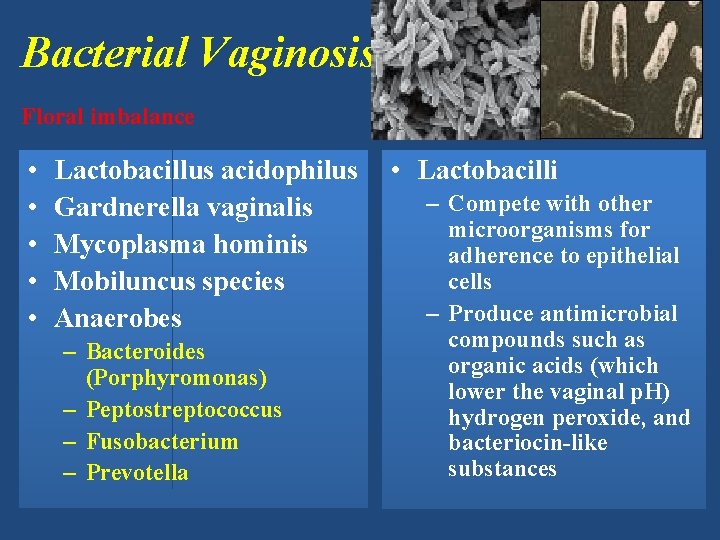
Bacterial Vaginosis Floral imbalance • • • Lactobacillus acidophilus Gardnerella vaginalis Mycoplasma hominis Mobiluncus species Anaerobes – Bacteroides (Porphyromonas) – Peptostreptococcus – Fusobacterium – Prevotella • Lactobacilli – Compete with other microorganisms for adherence to epithelial cells – Produce antimicrobial compounds such as organic acids (which lower the vaginal p. H) hydrogen peroxide, and bacteriocin-like substances
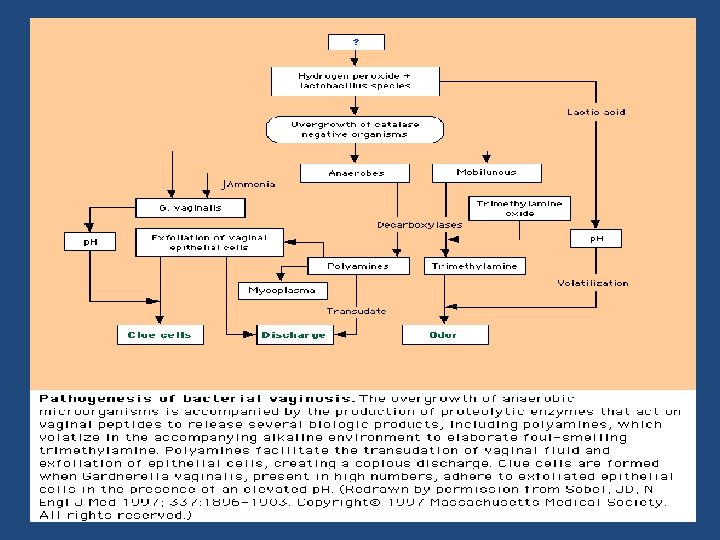
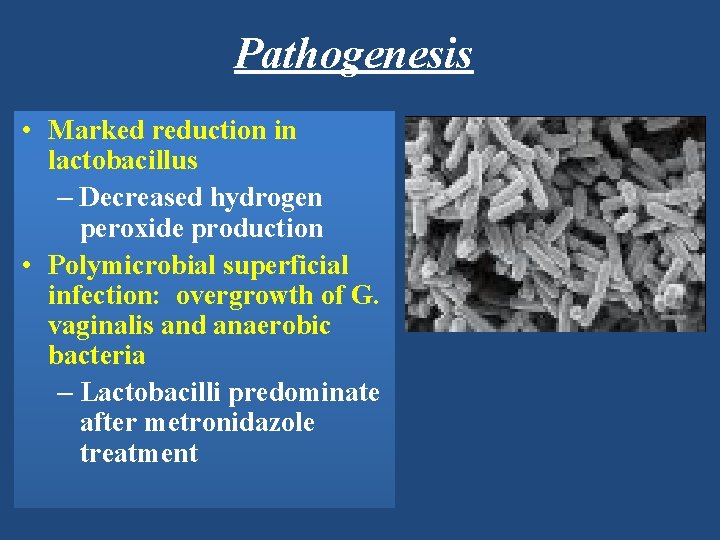
Pathogenesis • Marked reduction in lactobacillus – Decreased hydrogen peroxide production • Polymicrobial superficial infection: overgrowth of G. vaginalis and anaerobic bacteria – Lactobacilli predominate after metronidazole treatment
Epidemiology • The most common vaginal infection in women of childbearing age-29% • Risk factors – Multiple or new sexual partners – (sexual activity alteration of vaginal p. H) – Early age of first sexual intercourse – Douching – Cigarette smoking – Use of IUD *Although sexual activity is a risk factor for the infection, bacterial vaginosis can occur in women who have never had vaginal intercourse
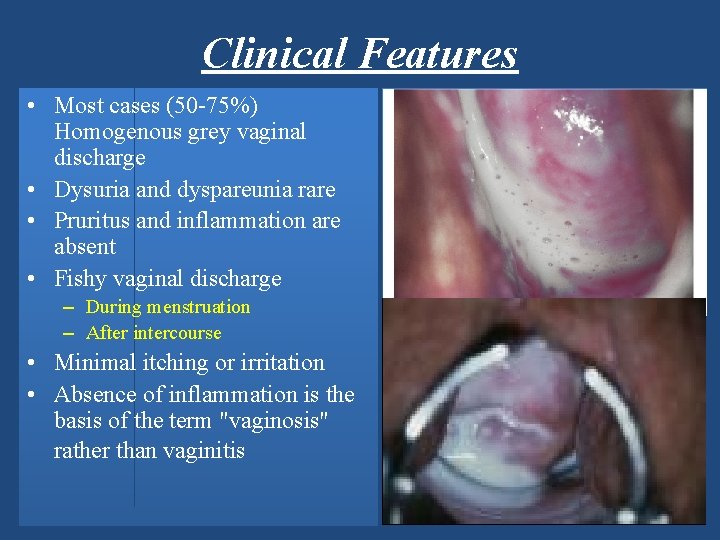
Clinical Features • Most cases (50 -75%) Homogenous grey vaginal discharge • Dysuria and dyspareunia rare • Pruritus and inflammation are absent • Fishy vaginal discharge – During menstruation – After intercourse • Minimal itching or irritation • Absence of inflammation is the basis of the term "vaginosis" rather than vaginitis
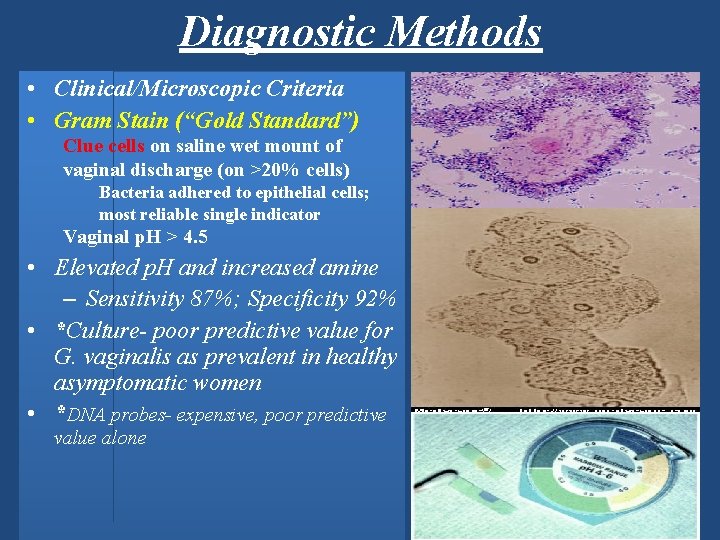
Diagnostic Methods • Clinical/Microscopic Criteria • Gram Stain (“Gold Standard”) Clue cells on saline wet mount of vaginal discharge (on >20% cells) Bacteria adhered to epithelial cells; most reliable single indicator Vaginal p. H > 4. 5 • Elevated p. H and increased amine – Sensitivity 87%; Specificity 92% • *Culture- poor predictive value for G. vaginalis as prevalent in healthy asymptomatic women • *DNA probes- expensive, poor predictive value alone
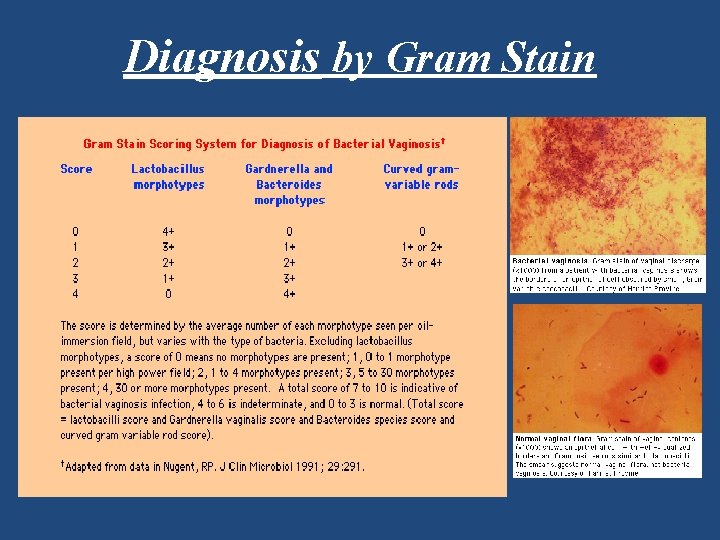
Diagnosis by Gram Stain
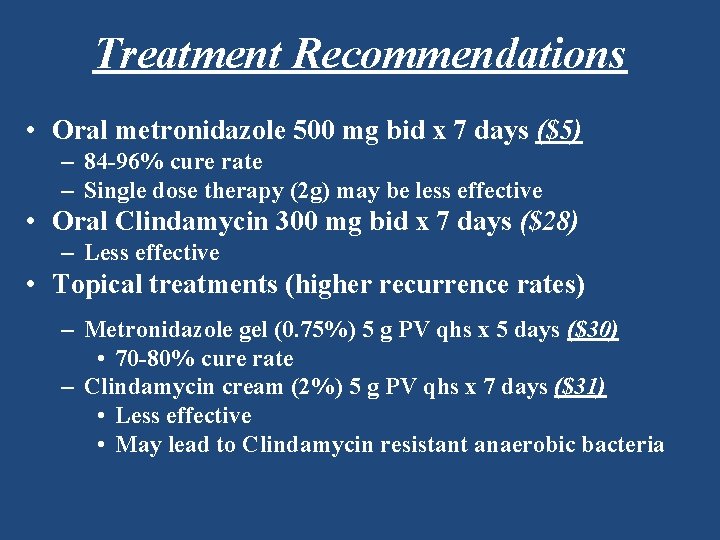
Treatment Recommendations • Oral metronidazole 500 mg bid x 7 days ($5) – 84 -96% cure rate – Single dose therapy (2 g) may be less effective • Oral Clindamycin 300 mg bid x 7 days ($28) – Less effective • Topical treatments (higher recurrence rates) – Metronidazole gel (0. 75%) 5 g PV qhs x 5 days ($30) • 70 -80% cure rate – Clindamycin cream (2%) 5 g PV qhs x 7 days ($31) • Less effective • May lead to Clindamycin resistant anaerobic bacteria
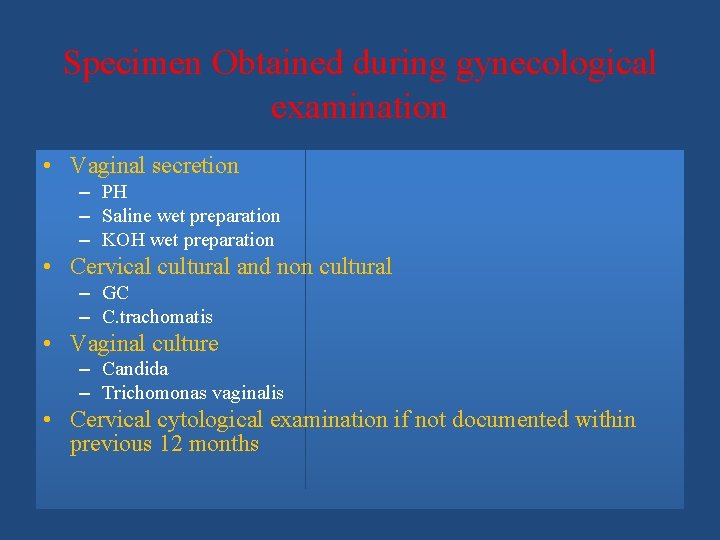
Specimen Obtained during gynecological examination • Vaginal secretion – PH – Saline wet preparation – KOH wet preparation • Cervical cultural and non cultural – GC – C. trachomatis • Vaginal culture – Candida – Trichomonas vaginalis • Cervical cytological examination if not documented within previous 12 months
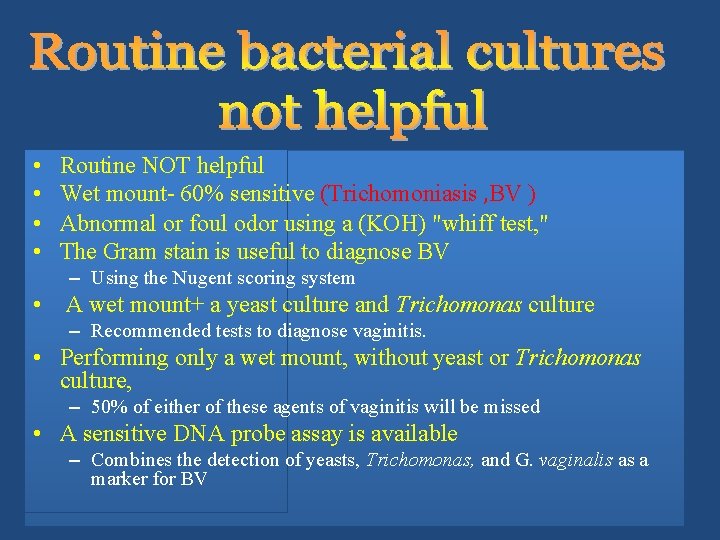
• • Routine NOT helpful Wet mount- 60% sensitive (Trichomoniasis , BV ) Abnormal or foul odor using a (KOH) "whiff test, " The Gram stain is useful to diagnose BV – Using the Nugent scoring system • A wet mount+ a yeast culture and Trichomonas culture – Recommended tests to diagnose vaginitis. • Performing only a wet mount, without yeast or Trichomonas culture, – 50% of either of these agents of vaginitis will be missed • A sensitive DNA probe assay is available – Combines the detection of yeasts, Trichomonas, and G. vaginalis as a marker for BV
- Slides: 32