
CANCER IN THE COMMONWEALTH Lesson 1 Cancer Basics
CANCER IN THE COMMONWEALTH Lesson 1: Cancer Basics and Disparities
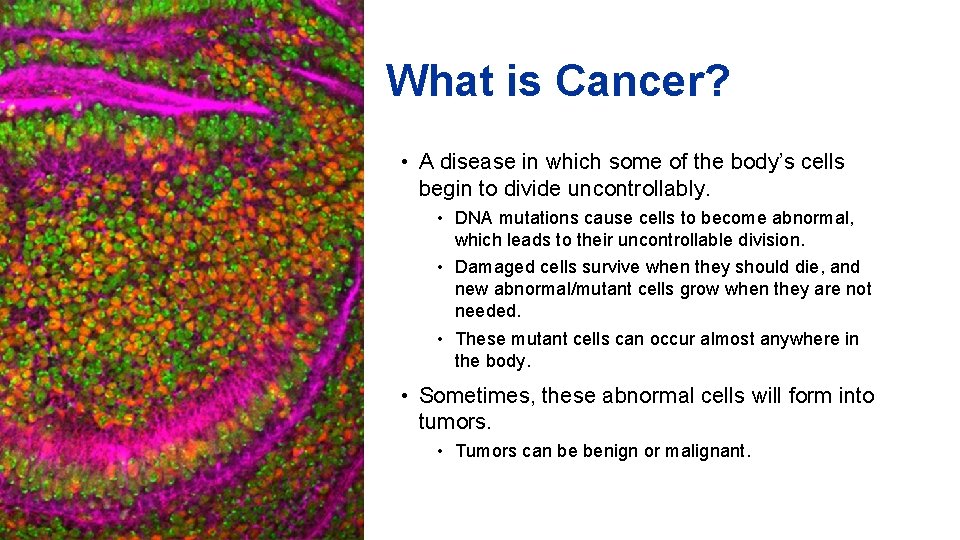
What is Cancer? • A disease in which some of the body’s cells begin to divide uncontrollably. • DNA mutations cause cells to become abnormal, which leads to their uncontrollable division. • Damaged cells survive when they should die, and new abnormal/mutant cells grow when they are not needed. • These mutant cells can occur almost anywhere in the body. • Sometimes, these abnormal cells will form into tumors. • Tumors can be benign or malignant.

ACTIVITIES
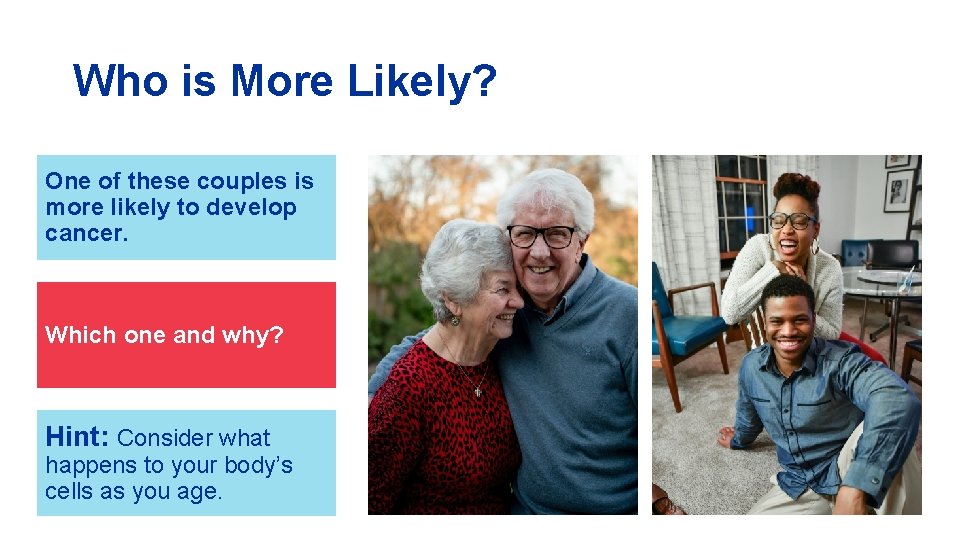
Who is More Likely? One of these couples is more likely to develop cancer. Which one and why? Hint: Consider what happens to your body’s cells as you age.
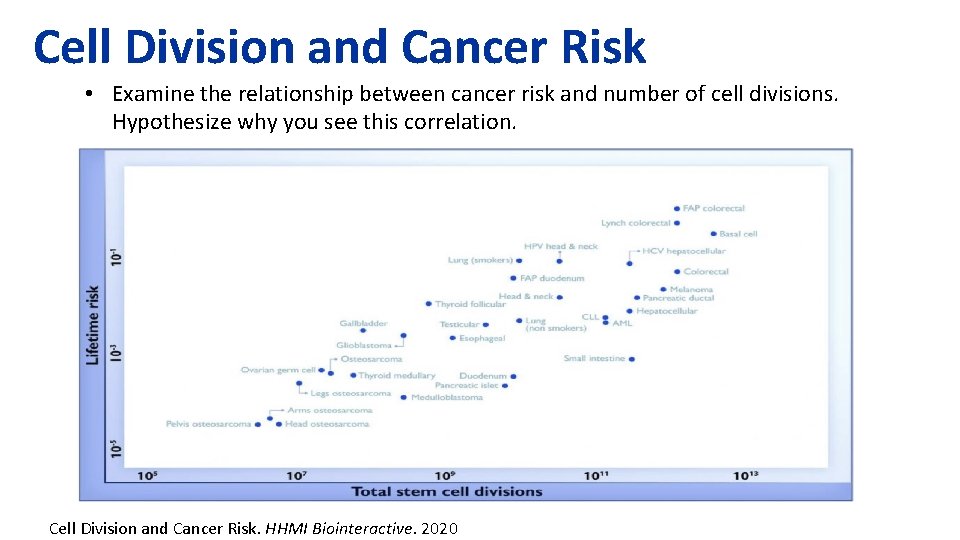
Cell Division and Cancer Risk • Examine the relationship between cancer risk and number of cell divisions. Hypothesize why you see this correlation. Cell Division and Cancer Risk. HHMI Biointeractive. 2020
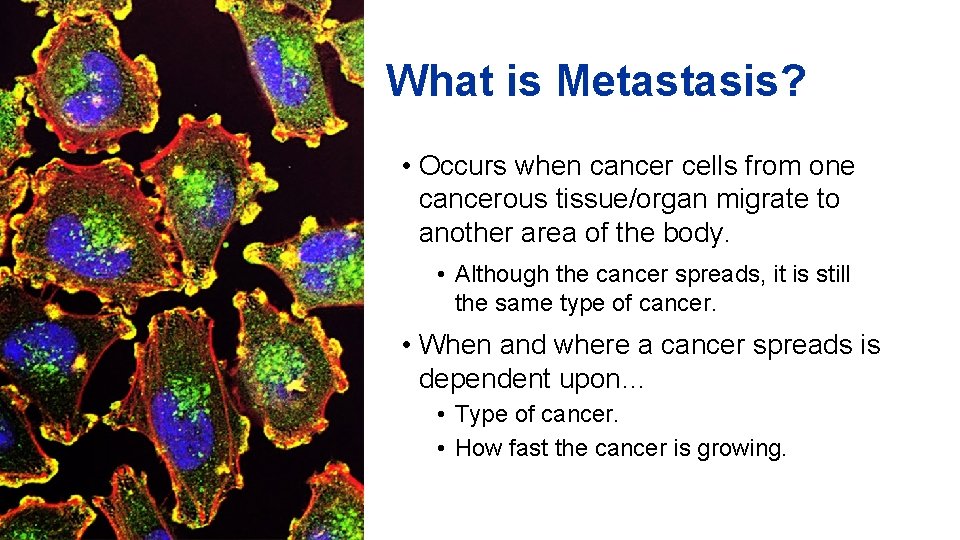
What is Metastasis? • Occurs when cancer cells from one cancerous tissue/organ migrate to another area of the body. • Although the cancer spreads, it is still the same type of cancer. • When and where a cancer spreads is dependent upon… • Type of cancer. • How fast the cancer is growing.
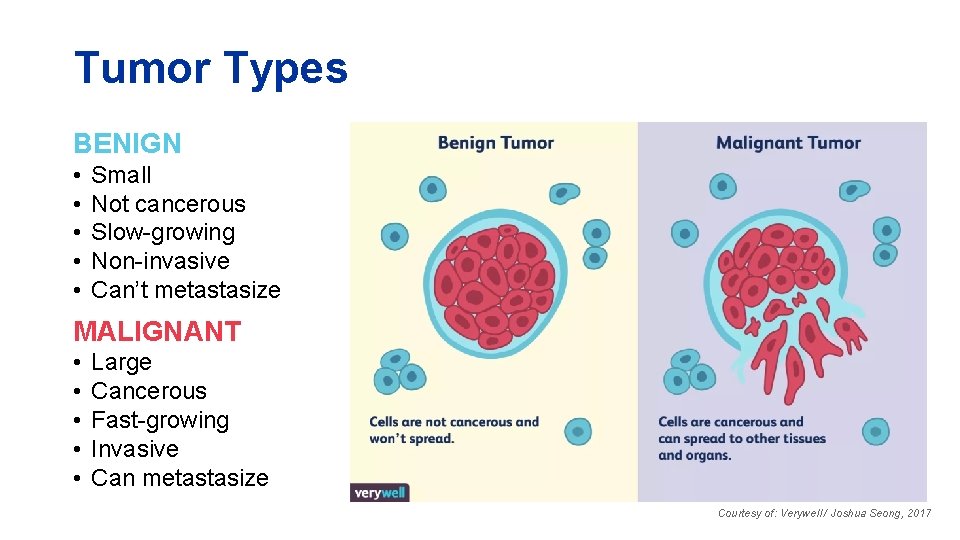
Tumor Types BENIGN • • • Small Not cancerous Slow-growing Non-invasive Can’t metastasize MALIGNANT • • • Large Cancerous Fast-growing Invasive Can metastasize Courtesy of: Verywell / Joshua Seong, 2017
Types of Cancer THERE ARE MORE THAN 100 types OF CANCER • Most are named for the organs or tissues where the cancers form. • Some are named after cell types (Ex: carcinoma, leukemia, melanoma). Some common cancer types: • Breast • Cervical • Prostate • Colorectal • Liver Some less common cancer types: • Ependymoma • Fallopian tube • Heart
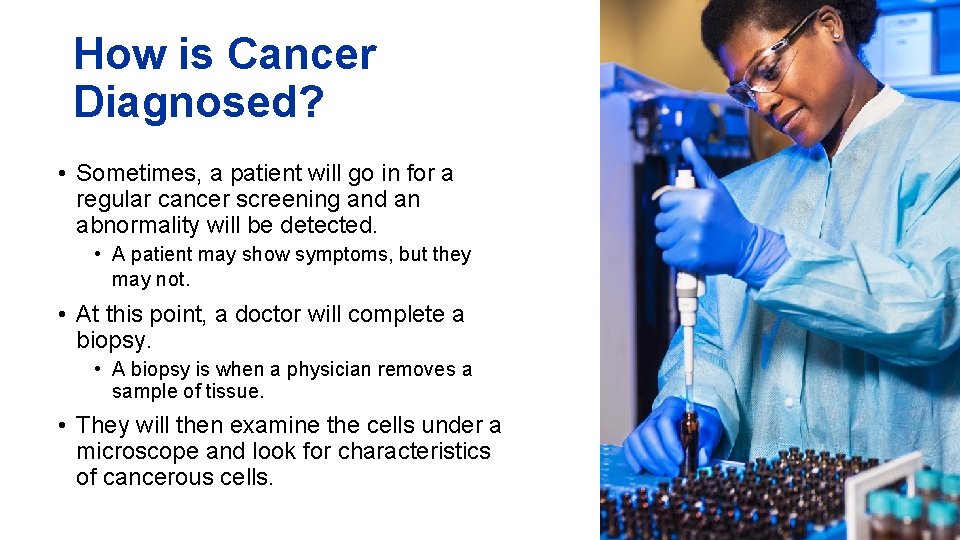
How is Cancer Diagnosed? • Sometimes, a patient will go in for a regular cancer screening and an abnormality will be detected. • A patient may show symptoms, but they may not. • At this point, a doctor will complete a biopsy. • A biopsy is when a physician removes a sample of tissue. • They will then examine the cells under a microscope and look for characteristics of cancerous cells.
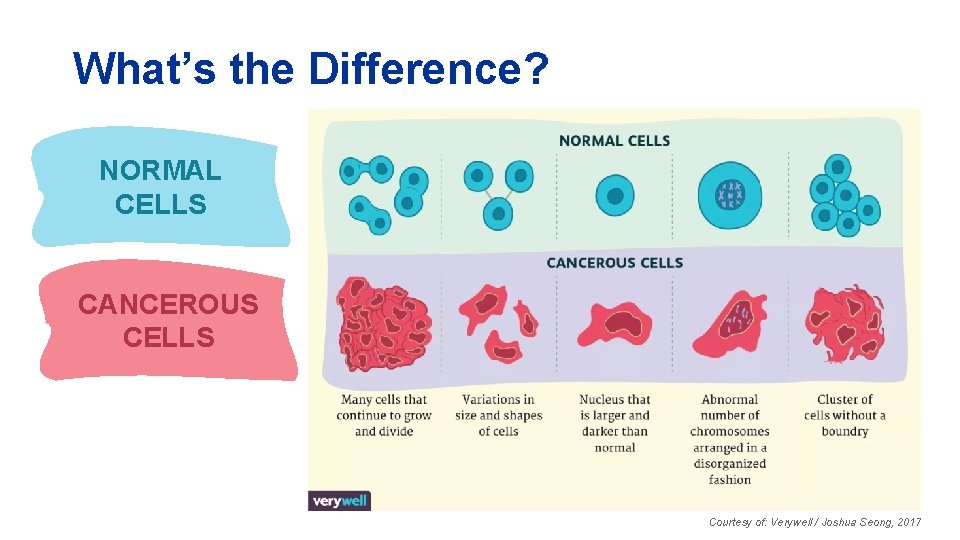
What’s the Difference? NORMAL CELLS CANCEROUS CELLS Courtesy of: Verywell / Joshua Seong, 2017
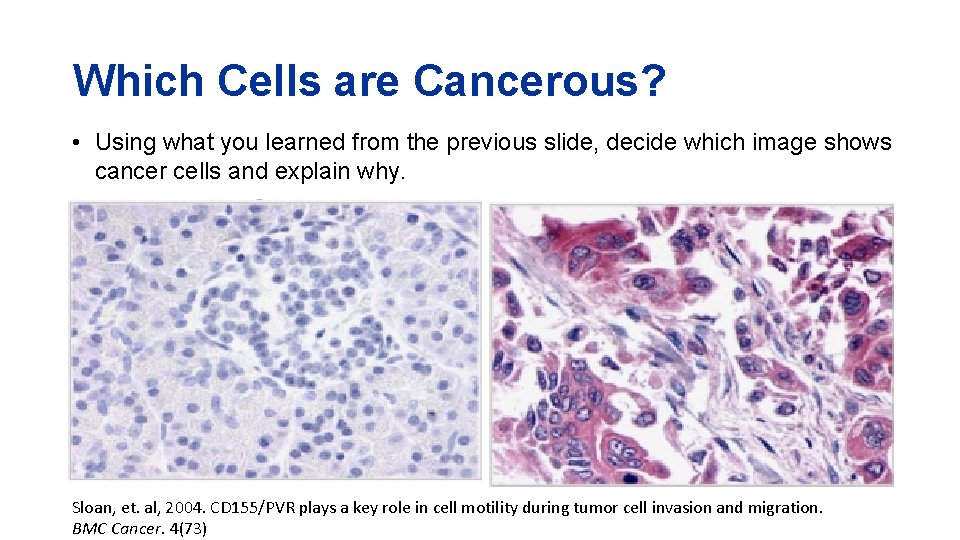
Which Cells are Cancerous? • Using what you learned from the previous slide, decide which image shows cancer cells and explain why. Sloan, et. al, 2004. CD 155/PVR plays a key role in cell motility during tumor cell invasion and migration. BMC Cancer. 4(73)

ACTIVITY
The Geography of Cancer • Find a partner and examine the map of the United States (U. S. ) on the board. Which areas of the U. S. do you think are most affected by cancer? • Send one person up to mark the area that you believe sees the highest number of cancer cases. • Examine the map of Kentucky on the board. Which areas of Kentucky do you think are most affected by cancer? • Send one person up to mark the area that you believe sees the highest number of cancer cases.
Which economic class is most affected by cancer? • People who do not have a high school degree have higher cancer rates than those that are college-educated. • Families with annual incomes less than $12, 500 per year are 1. 7 times more likely to develop lung cancer than those that make $50, 000. • Lower socioeconomic class is also associated with cancers presenting at more severe stages. • Why? • Lack of cancer knowledge • Lack of healthcare access • Belief that other things are more important Clegg LX, Reichman ME, Miller BA, et al. Impact of socioeconomic status on cancer incidence and stage at diagnosis: selected findings from the surveillance, epidemiology, and end results: National Longitudinal Mortality Study. Cancer Causes Control. 2009; 20(4): 417 -435. doi: 10. 1007/s 10552 -008 -9256 -0
Which race is most affected by cancer? • New cancer cases in the US are the highest in Black populations. • Number of cancer deaths are also highest in Black populations. • Why? • Genetics • Healthcare inequities • Delay of care is often caused by previous experiences of racism within the healthcare system. • Black populations are less likely to receive state-of-the-art care. • Black populations are less likely to be chosen for research studies. • Socioeconomic factors (education, access to health insurance) Fortune article by Maria Aspan: https: //fortune. com/2020/06/30/black-women-breast-cancer-mortality-racism-healthcare-pandemic/
Which states see the lowest number of cancer cases? 5 California, 386 cases for every 100, 000 people. 4 Nevada, 385 cases for every 100, 000 people. 3 District of Columbia, 378 cases for every 100, 000 people. 2 Arizona, 376 cases for every 100, 000 people. 1 New Mexico, 359 cases for every 100, 000 people.
Which states see the highest number of cancer cases? 5 New York, 475 cases for every 100, 000 people. 4 New Hampshire, 481 cases for every 100, 000 people. 3 Pennsylvania, 483 cases for every 100, 000 people. 2 Delaware, 487 cases for every 100, 000 people. 1 Kentucky, 510 cases for every 100, 000 people.
Which areas of Kentucky are most affected by cancer? • Typically, rural residents are more likely to develop cancer. • Residents of Appalachian Kentucky are 8% more likely to die from a preventable cancer malignancy than those living outside of Appalachia. • Why? • Lifestyle habits • Lack of access to healthcare • Low education and low socioeconomic levels
Summary • Cancer is caused by an uncontrollable division of cells. • Tumors can be malignant or benign. • These cells can spread to other areas of the body, which is known as metastasis. • Certain areas of the United States see higher numbers of cancer cases than others. • Black populations see higher numbers. • Lower socioeconomic classes see higher numbers. • Kentucky, specifically the Appalachian region, sees higher numbers.

QUESTIONS
- Slides: 20