
Canadian Identity An Inquiry Criteria for Effective Inquiry
- Slides: 21
Canadian Identity An Inquiry
Criteria for Effective Inquiry Questions ❏ An invitation to think (not recall, summarize, or detail). ❏ Arises from genuine curiosity and confusion about the world. ❏ Makes you think about something in a way you never considered before. ❏ Invites both deep thinking and deep feelings. Asks you to think ethically (what is right and wrong). ❏ Asks you to think critically, creatively, ethically, productively, and reflectively about essential ideas. ❏ Leads to more good questions.
Examples of Questions 1. 2. 3. 4. 5. 6. What are examples of teenage rebellion? Should teenagers rebel? What television shows feature rebellious teenagers? How many people in prison are teenagers? How is the teenage brain different? Do we need specific laws for teenagers?
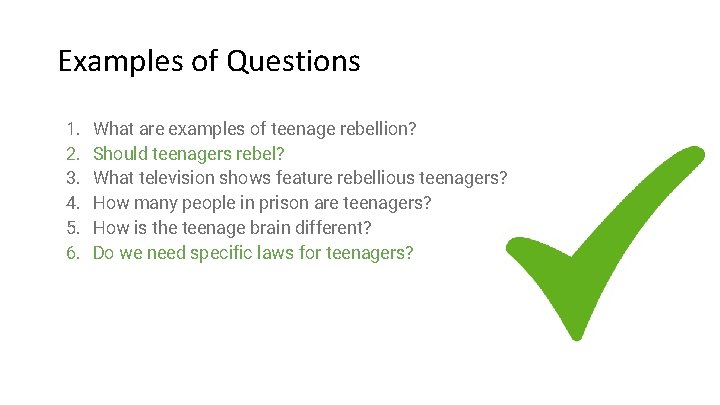
Examples of Questions 1. 2. 3. 4. 5. 6. What are examples of teenage rebellion? Should teenagers rebel? What television shows feature rebellious teenagers? How many people in prison are teenagers? How is the teenage brain different? Do we need specific laws for teenagers?
Improving Questions Do teenagers commit more crimes than adults?
Improving Questions Do teenagers commit more crimes than adults? Can be changed to… Should teenagers be held just as accountable for their crimes as adults?
Improving Questions Do teenagers commit more crimes than adults? Can be changed to… Should teenagers be held just as accountable for their crimes as adults? Should violent teens face harsher punishments than adults?
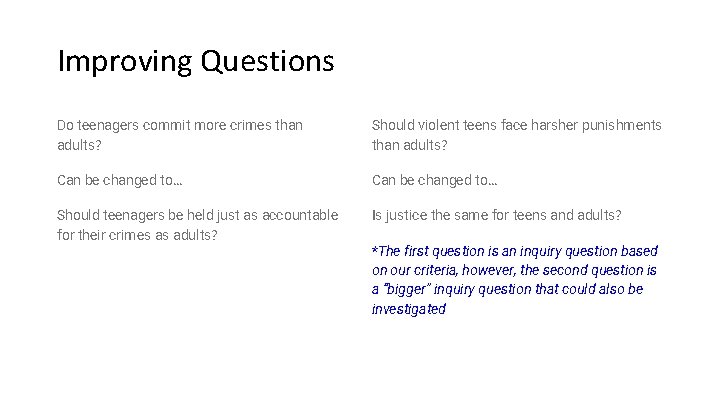
Improving Questions Do teenagers commit more crimes than adults? Should violent teens face harsher punishments than adults? Can be changed to… Should teenagers be held just as accountable for their crimes as adults? Is justice the same for teens and adults? *The first question is an inquiry question based on our criteria, however, the second question is a “bigger” inquiry question that could also be investigated
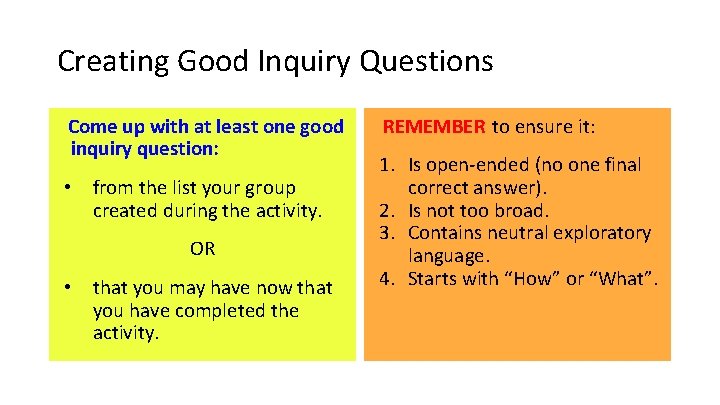
Creating Good Inquiry Questions Come up with at least one good inquiry question: • from the list your group created during the activity. OR • that you may have now that you have completed the activity. REMEMBER to ensure it: 1. Is open-ended (no one final correct answer). 2. Is not too broad. 3. Contains neutral exploratory language. 4. Starts with “How” or “What”.
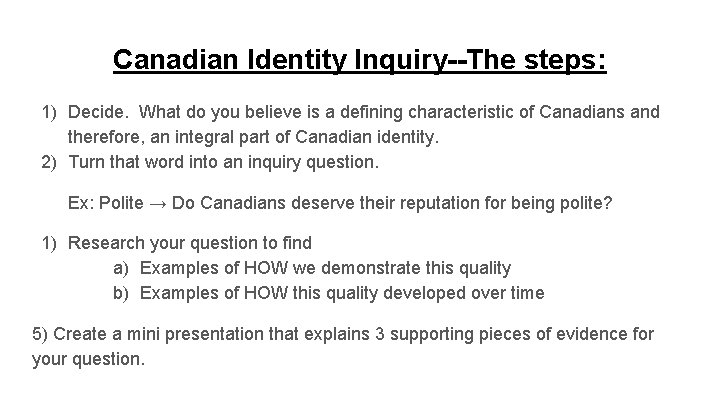
Canadian Identity Inquiry--The steps: 1) Decide. What do you believe is a defining characteristic of Canadians and therefore, an integral part of Canadian identity. 2) Turn that word into an inquiry question. Ex: Polite → Do Canadians deserve their reputation for being polite? 1) Research your question to find a) Examples of HOW we demonstrate this quality b) Examples of HOW this quality developed over time 5) Create a mini presentation that explains 3 supporting pieces of evidence for your question.
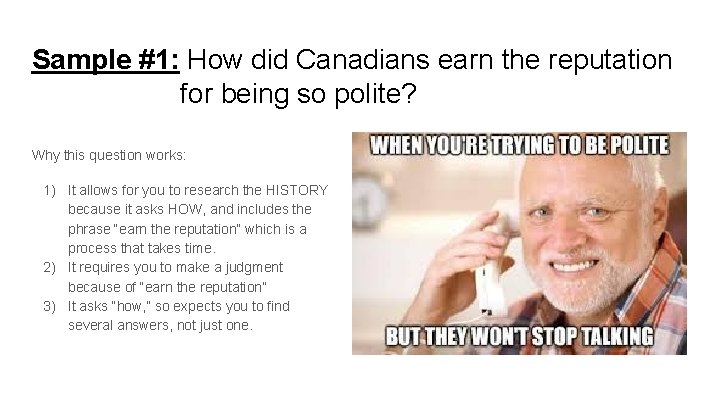
Sample #1: How did Canadians earn the reputation for being so polite? Why this question works: 1) It allows for you to research the HISTORY because it asks HOW, and includes the phrase “earn the reputation” which is a process that takes time. 2) It requires you to make a judgment because of “earn the reputation” 3) It asks “how, ” so expects you to find several answers, not just one.
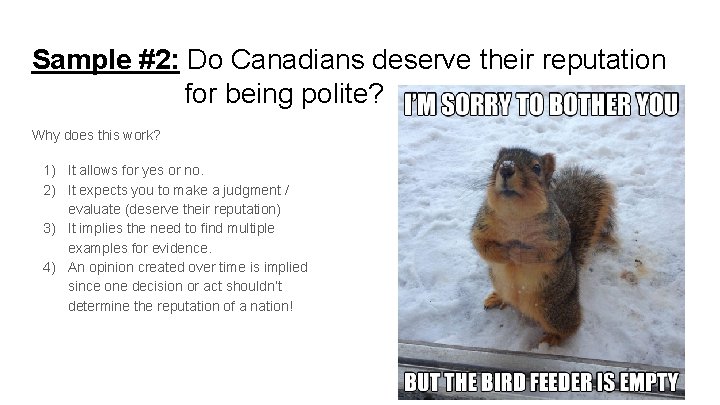
Sample #2: Do Canadians deserve their reputation for being polite? Why does this work? 1) It allows for yes or no. 2) It expects you to make a judgment / evaluate (deserve their reputation) 3) It implies the need to find multiple examples for evidence. 4) An opinion created over time is implied since one decision or act shouldn’t determine the reputation of a nation!
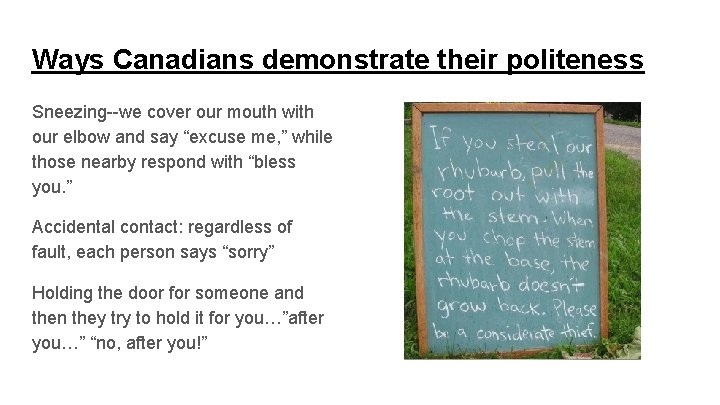
Ways Canadians demonstrate their politeness Sneezing--we cover our mouth with our elbow and say “excuse me, ” while those nearby respond with “bless you. ” Accidental contact: regardless of fault, each person says “sorry” Holding the door for someone and then they try to hold it for you…”after you…” “no, after you!”
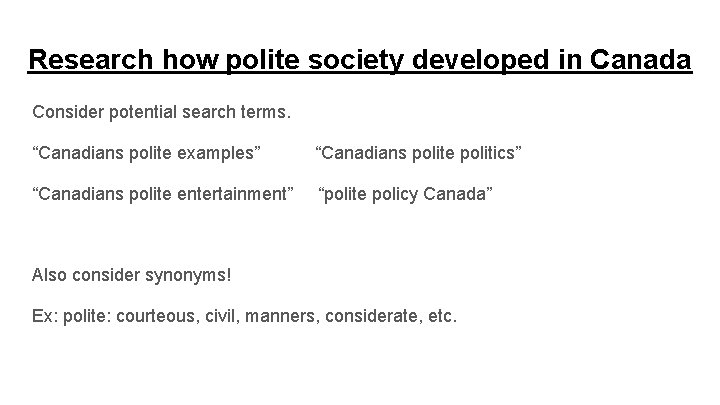
Research how polite society developed in Canada Consider potential search terms. “Canadians polite examples” “Canadians polite politics” “Canadians polite entertainment” “polite policy Canada” Also consider synonyms! Ex: polite: courteous, civil, manners, considerate, etc.
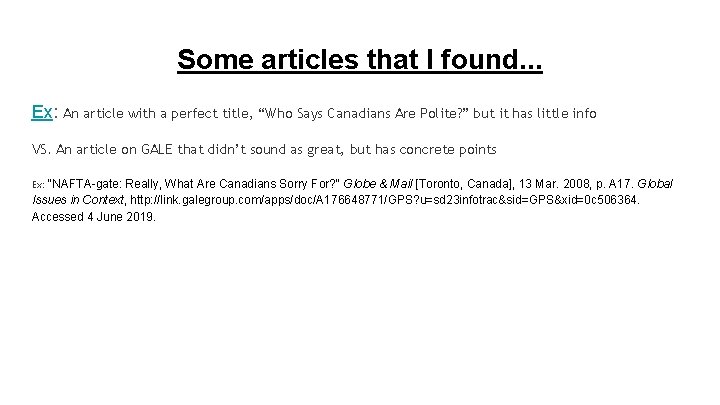
Some articles that I found. . . Ex: An article with a perfect title, “Who Says Canadians Are Polite? ” but it has little info VS. An article on GALE that didn’t sound as great, but has concrete points "NAFTA-gate: Really, What Are Canadians Sorry For? " Globe & Mail [Toronto, Canada], 13 Mar. 2008, p. A 17. Global Issues in Context, http: //link. galegroup. com/apps/doc/A 176648771/GPS? u=sd 23 infotrac&sid=GPS&xid=0 c 506364. Accessed 4 June 2019. Ex:
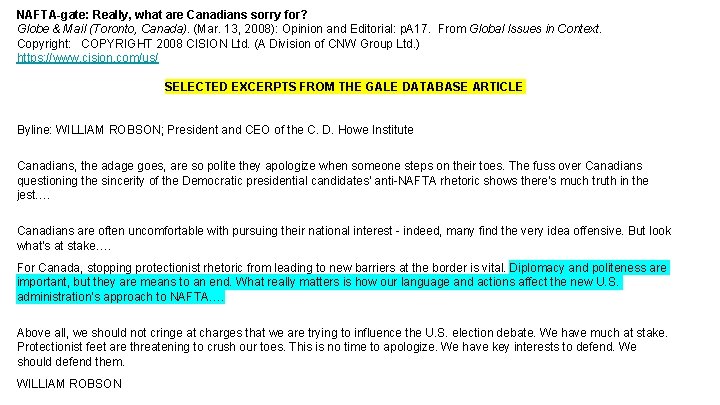
NAFTA-gate: Really, what are Canadians sorry for? Globe & Mail (Toronto, Canada). (Mar. 13, 2008): Opinion and Editorial: p. A 17. From Global Issues in Context. Copyright: COPYRIGHT 2008 CISION Ltd. (A Division of CNW Group Ltd. ) https: //www. cision. com/us/ SELECTED EXCERPTS FROM THE GALE DATABASE ARTICLE Byline: WILLIAM ROBSON; President and CEO of the C. D. Howe Institute Canadians, the adage goes, are so polite they apologize when someone steps on their toes. The fuss over Canadians questioning the sincerity of the Democratic presidential candidates' anti-NAFTA rhetoric shows there's much truth in the jest…. Canadians are often uncomfortable with pursuing their national interest - indeed, many find the very idea offensive. But look what's at stake…. For Canada, stopping protectionist rhetoric from leading to new barriers at the border is vital. Diplomacy and politeness are important, but they are means to an end. What really matters is how our language and actions affect the new U. S. administration's approach to NAFTA…. Above all, we should not cringe at charges that we are trying to influence the U. S. election debate. We have much at stake. Protectionist feet are threatening to crush our toes. This is no time to apologize. We have key interests to defend. We should defend them. WILLIAM ROBSON
Examples of Canadians being polite over time Canada did NOT have to declare war in WWII when Britain did, but still chose to join 4 days later. . . after a few days to discuss the decision democratically Canada supported Vietnam War Resisters who were coming to Canada, and our Prime Minister suggested a “pause on bombs” at a speech at Temple University. Our present-day immigration policy and support for immigrants once in Canada is quite respected. Roughly 22% of Canadians were born elsewhere.
Did you know? ? ? We are SO polite, that Apology Acts exist in Canada. In Ontario, one became a law in 2009. BC has a similar law: evidence of an apology made by or on behalf of a person in connection with any matter is not admissible in any court as evidence of the fault or liability of the person in connection with that matter.
Take your time. . . THINK. . . be flexible Finding historical examples may not be an instantaneous process! Again, remember to consider synonyms and other creative ways to find the answer to your question. Ex: Canadian diplomacy, diplomatic relations, free trade agreements, United Nations, foreign policy, immigration policy, look at specific events, time periods…. Ex: polite entertainers, kindness canada, etc.
Next steps: 1) Research 2) Create a SOURCE in Noodle. Tools for each article you want to use 3) Create a NOTECARD for 3 articles (pick 2 -3 important sentences from each article, paraphrase, comment, and question) 4) Find ONE powerful image that connects to your research 5) Decide how you will COMMUNICATE your findings to Mr. Jusunovic 6) Practice : -) 7) Print your bibliography for Mrs. Oakes to mark.